

Rockley Photonics eyes multiple markets
Andrew Rickman, founder and CEO of silicon photonics start-up, Rockley Photonics, discusses the new joint venture with Hengtong Optic-Electric, the benefits of the company’s micron-wide optical waveguides and why the timing is right for silicon photonics.
 Andrew Rickman
The joint venture between Rockley Photonics and Chinese firm Hengtong Optic-Electric is the first announced example of Rockley’s business branching out.
The start-up’s focus has been to apply its silicon photonics know-how to data-centre applications. In particular, Rockley has developed an Opto-ASIC package that combines optical transceiver technology with its own switch chip design. Now it is using the transceiver technology for its joint venture.
“It was logical for us to carve out the pieces generated for the Opto-ASIC and additionally commercialise them in a standard transceiver format,” says Andrew Rickman, Rockley’s CEO. “That is what the joint venture is all about.”
Rockley is not stopping there. Rickman describes the start-up as a platform business, building silicon photonics and electronics chipsets for particular applications including markets other than telecom and datacom.
Joint venture
Hengtong and Rockley have set up the $42 million joint venture to make and sell optical transceivers.
Known for its optical fibre cables, Hengtong is also a maker of optical transceivers and owns 75.1 percent of the new joint venture. Rockley gains the remaining 24.9 percent share in return for giving Hengtong its 100-gigabit QSFP transceiver designs. The joint venture also becomes a customer of Rockley’s, buying its silicon photonics and electronics chips to make the QSFP modules.
“Hengtong is one of the world’s largest optical fibre cable manufacturers, is listed on the Shanghai stock market, and sells extensively in China and elsewhere into the data centre market,” says Rickman. “It is a great conduit, a great sales channel into these customers.”
The joint venture will make three 100-gigabit QSFP-based products: a PSM4 and a CWDM4 pluggable module and an active optical cable. Rickman expects the joint venture to make other module designs and points out that Rockley participates in the IEEE standards work for 400 gigabits and is one of the co-founders of the 400-gigabit CWDM8 MSA.
Rockley cites several reasons why the deal with Hengtong makes sense. First, a large part of the bill of materials used for active optical cables is the fibre itself, something which the vertically integrated Hengtong can provide.
China also has a ‘Made in China 2025’ initiative that encourages buying home-made optical modules. Teaming with Hengtong means Rockley can sell to the Chinese telecom operators and internet content players.
In addition, Hengtong is already doing substantial business with all of the global data centres as a cable, patch panel and connector supplier, says Rickman:“So it is an immediate sales channel into these companies without having to break into these businesses as a qualified supplier afresh.”
A huge amount of learning happened and then what Rockley represented was the opportunity to start all over again with a clean sheet of paper but with all that experience
Bigger is Best?
At the recent SPIE Photonics West conference held in San Francisco, Rickman gave a presentation entitled Silicon Photonics: Bigger is Better. His talk outlined the advantages of Rockley’s use of three-micron-wide optical waveguides, bucking the industry trend of using relatively advanced CMOS processes to make silicon photonics components.
Rickman describes as seductive the idea of using 45nm CMOS for optical waveguides.“These things exist and work but people are thinking of them in the same physics that have driven microelectronics,” he says. Moving to ever-smaller feature sizes may have driven Moore’s Law but using waveguide dimensions that are smaller than the wavelength of light makes things trickier.
To make his point, he plots the effective index of a waveguide against its size in microns. The effective index is a unitless measure - a ratio of a phase delay in a unit length of a waveguide relative to the phase delay in a vacuum. “Once you get below one micron, you get a waveguide that is highly polarisation-dependent and just a small variation in the size of the waveguide has a huge variation in the effective index,” says Rickman.
Such variations translate to inaccuracies in the operating wavelength. This impacts the accuracy of circuits, for example, arrayed-waveguide gratings built using waveguides to multiplex and demultiplex light for wavelength-division multiplexing (WDM).
“Above one micron is where you want to operate, where you can manufacture with a few percent variation in the width and height of a waveguide,” says Rickman.“But the minute you go below one micron, in order to hit the wavelength registration that you need for WDM, you have got to control the [waveguide’s] film thickness and line thickness to fractions of a percent.” A level of accuracy that the semiconductor industry cannot match, he says.
A 100GHz WDM channel equates to 0.8nm when expressed using a wavelength scale. “In our technology, you can easily get a wavelength registration on a WDM grid of less than 0.1nm,” says Rickman. “Exactly the same manufacturing technology applied to smaller waveguides is 25 times worse - the variation is 2.5nm.”
Moreover, WDM technology is becoming increasingly important in the data centre. The 100-gigabit PSM4 uses a single wavelength, the CWDM4 uses four, while the newer CWDM8 MSA for 400 gigabit uses eight wavelengths. “In telecom, 90-plus wavelengths can be used; the same thing will come to pass in the years to come in data centre devices,” he says.
Rockley also claims it has a compact modulator that is 50 times smaller than competing modulators despite them being implemented using nanometer feature sizes.
We set out to generate a platform that would be pervasive across communications, new forms of advanced computing, optical signal processing and a whole range of sensor applications
Opto-ASIC reference design
Rockley’s first platform technology example is its Opto-ASIC reference design. The design integrates silicon photonics-based transceivers with an in-house 2 billion transistor switch chip all in one package. Rockley demonstrated the technology at OFC 2017.
“If you look around, this is something the industry says is going to happen but there isn't a single practical instantiation of it,” says Rickman who points out that, like the semiconductor industry, very often a reference design needs to be built to demonstrate the technology to customers.“So we built a complete reference design - it is called Topanga - an optical-packaged switch solution,” he says.
Despite developing a terabyte-class packet processor, Rockley does not intend to compete with the established switch-chip players. The investment needed to produce a leading edge device and remain relevant is simply too great, he says.
Rockley has demonstrated its in-package design to relevant companies. “It is going very well but nothing we can say publicly,” says Rickman.
New Markets
Rockley is also pursuing opportunities beyond telecom and datacom.
“We set out to generate a platform that would be pervasive across communications, new forms of advanced computing, optical signal processing and a whole range of sensor applications,” says Rickman.
Using silicon photonics for sensors is generating a lot of interest. “We see these markets starting to emerge and they are larger than the data centre and communications markets,” he says. “A lot of these things are not in the public domain so it is very difficult to report on.”
Moreover, the company’s believes its technology gives it an advantage for such applications. “When we look across the other application areas, we don’t see the small waveguide platforms being able to compete,” says Rickman. Such applications can use relatively high power levels that exceed what the smaller waveguides can handle.
Rockley is sequencing the markets it will address. “We’ve chosen an approach where we have looked at the best match of the platform to the best opportunities and put them in an order that makes sense,” says Rickman.
Rockley Photonics represent Rickman’s third effort to bring silicon photonics to the marketplace.Bookham Technology, the first company he founded, build different prototypes in several different areas but the market wasn't ready. In 2005 he joined start-up Kotura as a board member. “A huge amount of learning happened and then what Rockley represented was the opportunity to start all over again with a clean sheet of paper but with all that experience,” says Rickman.
Back in 2013, Rockley saw certain opportunities for its platform approach and what has happened since is that their maturity and relevance has increased dramatically.
“Like all things it is always down to timing,” says Rickman. “The market is vastly bigger and much more ready than it was in the Bookham days.”

Verizon, Ciena and Juniper trial 400 Gigabit Ethernet
Verizon has sent a 400 Gigabit Ethernet signal over its network, carried using a 400-gigabit optical wavelength.
The trial’s goal was to demonstrate multi-vendor interoperability and in particular the interoperability of standardised 400 Gigabit Ethernet (GbE) client signals.
 Glenn Wellbrock“[400GbE] Interoperability with the client side has been the long pole in the tent - and continues to be,” says Glenn Wellbrock, director, optical transport network - architecture, design and planning at Verizon. “This was trial equipment, not generally-available equipment.”
It is only the emergence of standardised modules - in this case, an IEEE 400GbE client-side interface specification - that allows multi-vendor interoperability, he says.
By trialing a 400-gigabit lightpath, Verizon also demonstrated the working of a dense wavelength-division multiplexing (DWDM) flexible grid, and a baud rate nearly double the 32-35Gbaud in wide use for 100-gigabit and 200-gigabit wavelengths.
“It shows we can take advantage of the entire system; we don’t have to stick to 50GHz channel spacing anymore,” says Wellbrock.
[400GbE] Interoperability with the client side has been the long pole in the tent - and continues to be
Trial set-up
The trial used Juniper Networks’ PTX5000 packet transport router and Ciena’s 6500 packet-optical platform, equipment already deployed in Verizon’s network.
The Verizon demonstration was not testing optical transmission reach. Indeed the equipment was located in two buildings in Richardson, within the Dallas area. Testing the reach of 400-gigabit wavelengths will come in future trials, says Wellbrock.
The PTX5000 core router has a traffic capacity of up to 24 terabits and supports 10-gigabit, 40-gigabit and 100-gigabit client-side interfaces as well as 100-gigabit coherent interfaces for IP-over-DWDM applications. The PTX5000 uses a mother card on which sits one or more daughter cards hosting the interfaces, what Juniper calls a flexible PIC concentrator (FPC) and physical interface cards (PICs), respectively.
Juniper created a PIC with a 400GbE CFP8 pluggable module implementing the IEEE’s 10km 400GBASE-LR8 standard.
“For us, it was simply creating a demo 400-gigabit pluggable line card to go into the line card Verizon has already deployed,” says Donyel Jones-Williams, director of product marketing management at Juniper Networks.
 Donyel Jones-WilliamsThe CFP8 400GbE interface connected the router to Ciena’s 6500 packet-optical platform.
Ciena also used demonstration hardware developed for 400-gigabit trials. “We expect to develop other hardware for general deployment,” says Helen Xenos, senior director, portfolio marketing at Ciena. “We are looking at smaller form-factor pluggables to carry 400 Gigabit Ethernet.”
400-gigabit deployments and trials
Ciena started shipping its WaveLogic Ai coherent modem that implements 400-gigabit wavelengths in the third quarter of 2017. Since then, the company has announced several 400-gigabit deployments and trials.
Vodafone New Zealand deployed 400 gigabits in its national transport network last September, a world first, claims Ciena. German cable operator, Unitymedia, has also deployed Ciena’s WaveLogic Ai coherent modem to deliver a flexible grid and 400-gigabit wavelengths to support growing content delivered via its data centres. And JISC, which runs the UK’s national research and education network, has deployed the 6500 platform and is using 400-gigabit wavelengths.
 Helen Xenos
Last September, AT&T conducted its own 400-gigabit trial with Ciena. With AT&T’s trial, the 400-gigabit signal was generated using a test bed. “An SDN controller was used to provision the circuit and the [400-gigabit] signal traversed an OpenROADM line system,” says Xenos.
Using the WaveLogic Ai coherent modem and its support for a 56Gbaud rate means that tunable capacity can now be doubled across applications, says Xenos. The wavelength capacity used for long-haul distances can now be 200 gigabits instead of 100 gigabits, while metro-regional networks spanning 1,000km can use 300-gigabit wavelengths. Meanwhile, 400-gigabit lightpaths suit distances of several hundred kilometres.
It is the large data centre operators that are driving the majority of 400 gigabit deployments, says Ciena. The reason the 400-gigabit announcements relate to telecom operators is because the data centre players have not gone public with their deployments, says Xenos.
Juniper Networks’ PTX5000 core router with 400GbE interfaces will primarily be used by the telecom operators. “We are in trials with other providers on 400 gigabits,” says Jones-Williams. “Nothing is public as yet.”
Ayar Labs advances I/O and pens GlobalFoundries deal
Silicon photonics start-up, Ayar Labs, has entered into a strategic agreement with semiconductor foundry, GlobalFoundries.
 Alexandra Wright-GladsteinAyar Labs will provide GlobalFoundries with its optical input-output (I/O) technology. In return, the start-up will gain early access to the foundry’s 45nm CMOS process being tailored for silicon photonics.
GlobalFoundries has also made an investment in the start-up for an undisclosed fee.
“We gain, first and foremost, a close relationship with GlobalFoundries as we qualify our product for customers,” says Alexandra Wright-Gladstein, co-founder and CEO of Ayar Labs. “That will help us speed up availability of our product and have their weight of support behind us.”
Strategy
Ayar Labs is bringing to market technology developed by academics originally at MIT. The research group developed a way to manufacture silicon photonics components using a standard silicon-on-insulator (SOI) CMOS process. The research work resulted in a novel dual-core RISC-V microprocessor demonstrator that used optical I/O to send and receive data, work that was published in the Nature science journal in December 2015.
Ayar Labs is using its optical I/O technology to address the high-performance computing and data centre markets. The optical I/O reaches up to 2km, from chip-to-chip communications to linking equipment between the buildings of a large data centre.
The start-up will offer a die - chiplet - that can be integrated within a multi-chip module, as well as a high-capacity 3.2-terabit optical module.
“We are aggregating the capacity of 4, 8 or 16 pluggable transceivers into a single module to share the cost of production at such high data rates,” says Wright-Gladstein. “This makes us competitive [for applications] where a pluggable transceiver is not.” Offering a chiplet and a high-density optical module on a board will bring to the marketplace the benefits companies are looking for if they are to move from copper to optics, she says.
Ayar Labs will also license its technology. “Our goal is to create an ecosystem for optical I/O for chips,” says Wright-Gladstein.

Technology
Ayar Labs has been a customer of GlobalFoundries for several years, using its existing 45nm SOI CMOS process to make devices as part of the foundry’s multi-project wafer service. The start-up will use the same 45nm CMOS process to make its first product. The CEO points out that using an unmodified electronics process introduces tight design constraints; no new materials can be introduced or layer thicknesses modified.
The start-up will also support GlobalFoundries in the development of its 45nm CMOS process optimised for silicon photonics. “The new process is more geared to traditional applications of optics such as optical transceivers for longer-distance communications,” says Wright-Gladstein.
Our goal is to create an ecosystem for optical I/O for chips
The intellectual property of Ayar Labs includes a micro-ring resonator optical modulator that is tiny compared to a Mach-Zehnder modulator. An issue with a micro-ring resonator is its sensitivity to temperature and manufacturing variances. Ayar’s Labs ability to design the ring resonator using standard CMOS means control circuitry can be added to ensure the modulator’s stability.
Ayar Labs has advanced its technology since the publication of the 2015 Nature paper. It has changed the operating wavelength of its optics from 1180nm to the standard 1310nm. It has also increased the speed of optical transmission from 2.5 to 25 gigabits-per-second (Gbps). The start-up expects to be able to extend the data rate to 50Gbps and even 100Gbps using 4-level pulse-amplitude modulation (PAM-4). The company has already demonstrated PAM-4 technology working with its optics.
The company also has wavelength-division multiplexing technology, using 8 wavelengths on a fibre; the original microprocessor demonstrator used only one wavelength. “We have 8 [micro-resonator] rings that lock on the transmit side and 8 rings that lock on the receive side,” says Wright-Gladstein. The company expects to extend the number of working wavelengths to 16 and even 32.
“We believe this is the process of the future because it can scale,” she says.
A factor of 10
Wright-Gladstein says its technology delivers a tenfold improvement using several metrics when compared to copper interconnect.
Typically a 25Gbps electrical interface will occupy 1 mm2 of chip area whereas Ayar Labs can fit more - potentially much more - than 250Gbps. The use of WDM technology also means that the amount of data passing the chip’s edge is at least 10 times greater.
The energy efficiency for the I/O is also between 5 times and 20 times greater than copper
The latency - how long it takes a signal to arrive at the receiver from the transmitter - is also improved tenfold. The fastest electrical interfaces at 56Gbps that use PAM-4 require forward-error correction which adds 100ns to the latency. Sending light 3m between racks takes 10ns, a tenth of the time. And more wavelengths can be added rather than using PAM-4 to avoid adversely impacting latency. “That matters for HPC customers,” she says.
The energy efficiency for the I/O is also between 5 times and 20 times greater than copper.
Ayar Labs has also developed an integrated laser module that provides the light sources for its optical I/O. Multiple lasers are integrated on a single die and the module outputs several wavelengths of light on several fibres.
The start-up claims the overall optical I/O design is simplified as there is no attachment of laser dies to the silicon and there are no attached driver chips. The result is a die that is flip-chip-attached allowing the use of standard high-volume CMOS packaging techniques.
First samples are expected sometime this year, with general product availability starting in 2019.
Meanwhile, GlobalFoundries is expected to offer the optical I/O as part of its 45nm silicon photonics process library in 2019.
Books in 2017: Part 2
Dave Welch, founder and chief strategy and technology officer at Infinera
One favourite book I read this year was Alexander Hamilton by Ron Chernow. Great history about the makings of the US government and financial systems as well as a great biography. Another is The Gene: An Intimate History by Siddhartha Mukherjee, a wonderful discussion about the science and history of genetics.
Yuriy Babenko, senior expert NGN, Deutsche Telekom
As part of my reading in 2017 I selected two technical books, one general life-philosophy title and one strategy book.
Today’s internet infrastructure design is hardly possible without what we refer to as the cloud. Cloud is a very general term but I really like the definition of NIST: Cloud computing is a model for enabling ubiquitous, convenient, on-demand network access to a shared pool of configurable computing resources that can be rapidly provisioned and released with minimal management effort or service provider interaction.
Cloud Native Infrastructure: Patterns for scalable infrastructure and applications in a dynamic environment by Kris Nova and Justin Garrison helps you understand the necessary characteristics of such cloud infrastructure and defines the capabilities of the service architecture that fits this model. The Cloud Native architecture is not just about ‘lift and shift’ into the cloud, it is the redesign of your services focusing on cloud elasticity, scalability, and security as well as operational models including but not limited to infrastructure as code. If you already heard about Kubernetes, Terraform and Cloud Native Foundation but want to understand how various technologies and frameworks fit together, this is a great and easy read.
High Performnce Browser Networking: What Every Web Developer Should Know About Networking and Web Performance by Ilya Grigorik provides a thorough look into the peculiarities of modern browser networking protocols, their foundation, methods and tools that help to optimise and increase the performance of internet sites.
Every serious business today has a web presence. Many services and processes are consumed through the browser, so a look behind the curtains of these infrastructure is informative and useful.
Probably one of the more interesting conclusions is that is not always the bandwidth which is necessary for a site’s successful operation but rather the end-to-end latency. The book discusses HTTP, HTTP2 and SPDY and will be of great interest to anyone who wants to refresh their knowledge of the history of the internet as well as to understand the peculiarities of performance optimisation of (big) internet sites.
Principles: Life and Work by Ray Dalio is probably one of the most discussed books of 2017. Mr Dalio is one of the most successful hedge-fund investors of our generation. In this book, he decided to share the main life and business principles that have guided his decisions during the course of his life. The main message which Dalio shares is not to copy or use his particular principles, although you are likely to adopt several of them, but to have your own.
One of Dalio’s key ideas is that everything works as a machine so if you define the general rules of how the machine (i.e. life in general) works, it will be significantly easier to follow the ups and downs and apply clear thinking in case of difficulties and challenges. He sums it up in an easy-to-comprehend approach which goes like the following: you try things out, reflect on them if something goes well or wrong, log all problems you face along the way, reflect on them and formulate and write down the principles. In due course, you will end up with your own version of Principles. Sounds easy but doing it is the key.
Edge Strategy: A New Mindset for Profitable Growth by Dan McKone and Alan Lewis is about the edges of a business, opportunities sitting comfortably in front of you and your business and which can be 'easily’ tackled and addressed.
Why would you go for a crazy new and risky business idea when there is a bunch of market opportunities just outside of the main door of your core business?
This sounds like “focus and expand” to me and makes a lot of sense. The authors identify three main “edges” which a business can address: product edge, journey edge and enterprise edge.
The book goes into detail about how product edge can be expanded (remember your shiny new iPhone leather case?); a firm can focus more on the complete customer journey (What are the jobs to be done? What problem is the customer really trying to solve? Airbnb service can be a great example); and finally leveraging the enterprise edge (like Amazon renting and selling unused server capacity via its AWS services).
Edge strategies are not new per se, but this book helps to formulate and structure the discussion in an understandable and comprehensive framework.
5G-PON: SK Telecom’s unified distribution network
SK Telecom has detailed a networking architecture based on wavelength division multiplexing-passive optical network (WDM-PON) technology that it says will simplify the rollout of 5G while delivering significant cost savings.
 The telecom operator has already deployed the networking architecture, dubbed 5G-PON, for its LTE network and is offering the design to the 5G network standards of the ITU-T.
“SK Telecom is already witnessing a great amount of cost reductions from the deployment of 5G-PON,” says Seungjoo Hong, manager of the Broadband Technology Lab at SK Telecom (pictured).
5G-PON
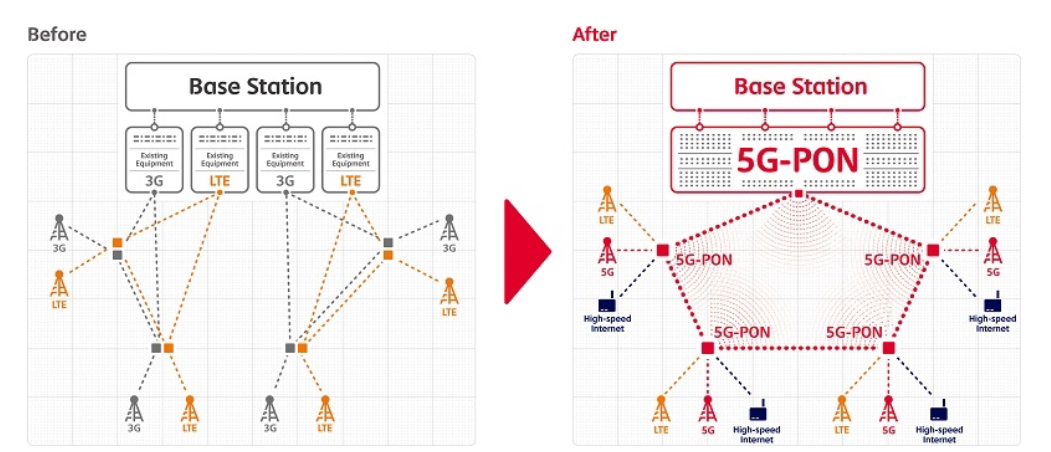
5G-PON provides a single distribution network for both cellular - LTE and 5G - and high-speed wireline broadband (see diagram).
 Source: SK Telecom
The architecture reduces networking costs by reusing existing fibre and optical filters while expanding capacity to support different and growing traffic streams. The architecture also uses passive nodes that do not require electrical power.
The 5G-PON network comprises three main elements: a central office terminal, the remote node and a tunable SFP pluggable module.
The central office terminal is located at the cellular base band unit (BBU) and performs such functions as wavelength conversion for WDM transmission, the monitoring of the optical link, and the management and configuration - location and order - of the remote nodes. The central office terminal also collects and analyses digital diagnostic monitoring information sent over an auxiliary management and control channel.
SK Telecom is already witnessing a great amount of cost reductions from the deployment of 5G-PON
The second element, the remote node, is a passive optical wavelength router, says Hong, and can be placed indoors or outdoors at a remote site. The remote node comprises a filter for coarse WDM (CWDM) and a filter for dense WDM (DWDM) and supports an optical ring topology between the first stage nodes - called the main radio node - as well as multi-stage node configurations such as a main and sub radio nodes (see the diagram below).
 Different 5G-PON configurations. SK Telecom favours a single-fibre ring arrangement. Source: SK Telecom
The central office terminal has knowledge of the order and location of the remote site nodes. This ensures a seamless service by performing delay equalisation due to optical path differences while executing ring protection switching within 50ms when a fibre is cut.
Meanwhile, the tunable SFP is installed at the cellular remote radio head (RRH). The tunable SFP is a low-cost design; it does not use a wavelength locker such that the SFP’s tunable laser is not dependent on a specific wavelength grid. The SFP is operated at the remote radio head using a software wavelength locking function that tracks the centre of the WDM filter using received optical power information from the central office terminal sent via an auxiliary management and control channel.
5G-PON has halved the cost of installation while operations and maintenance costs have been reduced 70 percent
CWDM architecture
5G-PON’s WDM-PON architecture uses CWDM with sub-channels.
The architecture can use existing installed fibre and filters while expanding capacity to a total of 256 wavelengths (16 sub-channels in each of 16 CWDM 20nm-wide bands), such that it can work alongside existing CWDM, DWDM and time-division multiplexing PON (TDM-PON) deployments.
“To expand network capacity in an area, operators can easily deploy a basestation using their existing fibre infrastructure, saving a great amount of installation cost,” says Hong. “5G-PON also allows operators to cover new areas with the least amount of cost.”
Hong says deploying 5G-PON has halved the cost of installation while operations and maintenance costs have been reduced 70 percent due to the intelligent operation and management of the passive nodes and the use of tunable SFPs at the remote sites.
SK Telecom has worked with local vendors including Solid, HFR, SunwaveTec and Coweaver to develop the 5G-PON architecture.
Status
The 5G-PON deployed for SK Telecom’s LTE front-haul network uses single-fibre bidirectional 3-gigabit and 6-gigabit 20km tunable SFPs that support 96 optical links on CPRI/ OBSAI interface channel cards.
Hong says that in 2018, SK Telecom will have bidirectional 10-gigabit tunable SFPs and will start developing of 25-gigabit bidirectional tunable SFPs and eCPRI interface channel cards for its 5G radio access network.
SK Telecom’s own preference is to use 5G-PON in a ring architecture to ensure service continuity in the event of a fibre cut. But depending on the operator, various topologies can be supported.
The operator plans to roll out 5G-PON in 85 areas nationwide, with further deployments expected thereafter.
Books in 2017
Andrew Schmitt, founder and lead analyst of Cignal AI
I didn’t have a good year with books. I bought more than these and either didn’t read them or I lost interest. Hopefully, 2018 will be better.
A Mind at Play: How Claude Shannon Invented the Information Age by Jimmy Soni and Rob Goodman was a big disappointment. It is a well-researched book and has tons of great history on Claude Shannon but there was something about the writing style that made it turgid. I struggled to finish it but learned a lot about Claude Shannon, including that his home in Boston wasn’t far from mine.
The Hard Thing about Hard Things: Building a Business When There are No Easy Answers by Ben Horowitz was the year’s winner. Ben Horowitz started the VC firm A16Z with Marc Andreessen, and both worked at Netscape and later founded Loudcloud. This is easily one of my favourite management books. Each chapter of the book covers an operational topic via a narrative of experiences from the author. Examples include how to build culture and how to scale a sales organisation. The book is highly readable and enjoyable, rare for a title about management advice. Horowitz talks about another book, High Output Management by Andy Grove, which I am reading now.
I reread Cryptonomicon by Neal Stephenson this year for fun. Entertaining book, particularly in light of all the crypto-currency mania. It was written 18 years ago and was way ahead of its time. As William Gibson said, the future is already here, it’s just not evenly distributed. Seveneves was good too (from 2015), but I sure hope that isn’t our future.
The King and Queen of Malibu: The True Story of the Battle for Paradise by David Randall is a history of the large parcel of land now known as Malibu in Southern California. One person owned it after the Spanish American war, and the book is the story of how a rapidly encroaching Los Angeles, spurred on by the automobile, led to its eventual taking by eminent domain. If you know the area and are interested in the history, it is a great book. Otherwise, it is probably of little interest.
I also read a few other sci-fi fiction books while on the road that came highly recommended (Ready Player One, Fortress at the End of Time, Blindsight) but I thought they were not that great.
Vladimir Kozlov, founder and CEO of LightCounting Market Research
I read two books in 2017 that I would highlight.
The first is War and Peace by Leo Tolstoy.
The second is Makers and Takers: The Rise of Finance and the Fall of American Business by Rana Foroohar. The book offers a sobering outlook on modern economic developments and questions the sustainability of growth.
TIP tackles the growing complexity of open design
The TIP chairman and vice president, technology innovation at Deutsche Telekom described how the relentless growth of IP traffic is causing production costs to rise yet the average revenues per subscriber for bundled communications services is flat or dipping. “Not a good situation to be in,” he said. The industry is also investing in new technologies including the rollout of 5G.
 Niall Robinson
The industry needs a radically different approach if it is to achieve capital efficiency, said Clauberg, and that requires talent to drive innovation. Garnering such talent needs an industry-wide effort and this is the motivation for TIP.
TIP
Established in 2016, TIP brings together internet giants Facebook and Microsoft with leading telecom operators, systems vendors, components players and others to co-develop open-source designs for telecoms. In the last year, TIP has added 200 companies to total over 500 members.
TIP used its second summit held in Santa Clara, California to unveil several new project groups. These include End-to-End Networking Slicing, Edge Computing, and Artificial Intelligence and Applied Machine Learning.
There are three main project categories within TIP: access, backhaul, and core and management. Access now includes six project groups including the new Edge Computing, backhaul has two, while core and management has three including the new network slicing and artificial intelligence initiatives. TIP has also established what it calls ecosystem acceleration centres and community labs.
“TIP is definitely bigger and, I think, better,” says Niall Robinson, vice president, global business development at ADVA Optical Networking. “As with any organisation there is always initial growing pains and TIP has gone through those.”
Open Optical Packet Transport
ADVA Optical Networking is a member in one of TIP’s more established projects, the Open Optical Packet Transport group which announced the 1-rack-unit Voyager packet transport and routing box last year.
OOPT itself comprises four work groups: Optical Line System, Disaggregated Transponders and Chips, Physical Simulation Environment and the Common API. A fifth group is being considered to tackle routing and software-defined interconnection.
Robinson highlights two activities of the OOPT’s subgroups to illustrate the scope and progress of TIP.
The Common API group in which Robinson is involved aims to bring commonality to the various open source groups’ application programming interfaces (APIs).
Open is great but there are so many initiatives out there that it is really not helping the market
The Open Networking Forum alone has several initiatives: the Central Office Rearchitected as a Data centre (CORD), the Open Networking Operating System (ONOS) SDN controller, the Open Core Model, and the Transport API. Other open initiatives developing APIs include OpenConfig set up by operators, the Open API initiative, and OpenROADM.
“Open is great but there are so many initiatives out there that it is really not helping the market,” says Robinson. An operator may favour a particular system vendor’s equipment that does not support a particular API. Either the operator or the vendor must then develop something, a situation in the case of an operator that can repeat itself many times. The goal of the Common API group’s work is to develop a mapping function between the software-defined networking (SDN) controller and equipment so that any SDN controller can use these industry-initiative APIs.
Robinson’s second example is the work of the OOPT’s Disaggregated Transponders and Chips group that is developing a transponder abstraction interface. The goal is to make it easier for vendors to benefit from the functionality of a transponder’s coherent DSP independent of the particular chip used.
“For ADVA, when we build our own gear we pick a DSP and we have to get our firmware to work with it,” says Robinson. “We can’t change that DSP easily; it’s a custom interface.”
The goal of the work is to develop a transponder abstraction interface that sits between the higher-level functionality software and the coherent DSP. The transponder vendor will interface its particular DSP to the abstraction interface that will then allow a network element’s software to configure settings and get optical monitoring data.
“It doesn’t care or even know what DSP is used, all it is talking to is this common transponder abstraction interface,” says Robinson.
Cassini and Voyager platforms
Edgecore Networks has contributed its packet transponder white box platform to the TIP OOPT group. Like Voyager, the platform uses the Broadcom StrataXGS Tomahawk 3.2 terabit switch chip. But instead of using built-in coherent interfaces based on Acacia’s AC-400 module, Cassini offers eight card slot options. Each slot can accommodate three module options: a coherent CFP2-ACO, a coherent CFP2-DCO or two QSFP28 pluggables. The Cassini platform also has 16 fixed QSFP28 ports.
Accordingly, the 1.5-rack-unit box can be configured as a 3.2 terabit switch using QSFP28 modules only or as a transport box with up to 1.6 terabits of client-side interfaces and 1.6 terabits of line-side coherent interfaces. This contrasts with the Voyager that uses up to 2 terabits of the switch capacity with its dozen 100-gigabit client-side interfaces and 800 gigabits of coherent line-side capacity.
There have also been developments with TIP’s Voyager box. Cumulus Network has replaced Snaproute to provide the platform’s Linux network operating system. ADVA Optical Networking, a seller of the Voyager, says the box will likely be generally available in the first quarter of 2018.
Robinson says TIP will ultimately be judged based on what it ends up delivering. “Eighteen months is not enough time for the influence of something like this to be felt,” he says.
TIP Summit 2017 talks, click here
ON2020 rallies industry to address networking concerns
 Source: ON2020
The slide shows how router-blade client interfaces are scaling at 40% annually compared to the 20% growth rate of general single-wavelength interfaces (see chart).
Extrapolating the trend to 2024, router blades will support 20 terabits while client interfaces will only be at one terabit. Each blade will thus require 20 one-terabit Ethernet interfaces. “That is science fiction if you go off today’s technology,” says Winzer, director of optical transmission subsystems research at Nokia Bell Labs and a member of the ON2020 steering committee.
This is where ON2020 comes in, he says, to flag up such disparities and focus industry efforts so they are addressed.
ON2020
Established in 2016, the companies driving ON2020 are Fujitsu, Huawei, Nokia, Finisar, and Lumentum.
The reference to 2020 signifies how the group looks ahead four to five years, while the name is also a play on 20/20 vision, says Brandon Collings, CTO of Lumentum and also a member of the steering committee.
 Brandon CollingsON2020 addresses a void in the industry, says Collings. The Optical Internetworking Forum (OIF) organisation may have a similar conceptual mission but it is more hands-on, focussing on components and near-term implementations. ON2020 looks further out.
“Maybe you could argue it is a two-step process,” says Collings. “First, ON2020 is longer term followed by the OIF’s definition in the near term.”
To build a longer-term view, ON2020 surveyed network operators worldwide including the largest internet content providers players and leading communications service providers.
ON2020 reported its findings at the recent ECOC show under three broad headings: traffic growth and the impact on fibre capacity and interfaces, interconnect requirements, and network management and operations.
Things will have to get cheaper; that is the way things are.
Network management
One key survey finding is the importance network operators attach to software-defined networking (SDN) although the operators are frustrated with the lack of SDN solutions available, forcing them to work with vendors to address their needs.
 Peter WinzerThe network operators also see value in white boxes and disaggregation, to lower hardware costs and avoid vendor lock-in. But as with SDN, there are challenges with white boxes and disaggregation.
“Let’s not forget that SDN comes from the big webscales,” says Winzer, companies with abundant software and control experience. Telecom companies don’t have such sophisticated resources.
“This produces a big conundrum for the telecom operators: they want to get the benefits without spending what the webscales are spending,” says Winzer. The telcos also need higher network reliability such that their job is even harder.
Responding to ON2020’s anonymous survey, the telecom players stress how SDN, disaggregation and the adoption of white boxes will require a change in practices and internal organisation and even the employment of system integrators.
“They are really honest. They say, nice, but we are just overwhelmed,” says Winzer. “It highlights the very important organisational challenges operators are facing.”
Operators are frustrated with the lack of SDN solutions available.
Capacity and connectivity
The webscales and telecom operators were also surveyed about capacity and connectivity issues.
Both classes of operator use 10-terabit links or more and this will soon rise to 40 terabits. The consensus is that the C-band alone is insufficient given their capacity needs.
Those operators with limited fibre want to grow capacity by also using the L-band with the C-band, while operators with plenty of fibre want to combine fibre pairs - a form of spatial division multiplexing - and using the C and L bands. The implication here is that there is an opportunity for hardware integration, says ON2020.
Network operators use backbone wavelengths at 100, 200 and 400 gigabits. As for service feeds - what ON2020 refers to as granularity - webscale players favour 25 gigabit-per-second (Gbps) whereas telecom operators continue to deal with much slower feeds - 10Mbps, 100Mbps, and 1Gbps.
What can ON2020 do to address the demanding client-interface requirements of IP router blades, referred to in the chart?
Xiang Liu, distinguished scientist, transmission product line at Huawei and a key instigator in the creation of ON2020, says photonic integration and a tighter coupling between photonics and CMOS will be essential to reduce the cost-per-bit and power-per-bit of future client interfaces.
 Xiang Liu
“As the investment for developing routers with such throughputs could be unprecedentedly high, it makes sense for our industry to collectively define the specifications and interfaces,” says Liu. “ON2020 can facilitate such an industry-wide effort.”
Another survey finding is that network operators favour super-channels once client interfaces reach 400 gigabits and higher rates. Super-channels are more efficient in their use of the fibre’s spectrum while also delivering operations, administration, and management (OAM) benefits.
The network operators were also asked about their node connectivity needs. While they welcome the features of advanced reconfigurable optical add-drop multiplexers (ROADMs), they don’t necessarily need them all. A typical response being they will adopt such features if they are practically for free.
This, says Winzer, is typical of carriers. “Things will have to get cheaper; that is the way things are.”
Photonic integration and a tighter coupling between photonics and CMOS will be essential to reduce the cost-per-bit and power-per-bit of future client interfaces
Future plans
ON2020 is still seeking feedback from additional network operators, the survey questionnaire being availability for download on its website. “The more anonymous input we get, the better the results will be,” says Winzer.
Huawei’s Liu says the published findings are just the start of the group’s activities.
ON2020 will conduct in-depth studies on such topics as next-generation ROADM and optical cross-connects; transport SDN for resource optimisation and multi-vendor interoperability; 5G-oriented optical networking that delivers low latency, accurate synchronisation and network slicing; new wavelength-division multiplexing line rates beyond 200 gigabit; and optical link technologies beyond just the C-band and new fibre types.
ON2020 will publish a series of white papers to stimulate and guide the industry, says Liu.
The group also plans to provide input to standardisation organisations to enhance existing standards and start new ones, create proof-of-concept technology demonstrators, and enable multi-vendor interoperable tests and field trials.
Discussions have started for ON2020 to become an IEEE Industry Connections programme. “We don’t want this to be an exclusive club of five [companies],” says Winzer. “We want broad participation.”
Juniper Networks opens up the optical line system
Juniper Networks has responded to the demands of the large-scale data centre players with an open optical line system architecture.
 Donyel Jones-WilliamsThe system vendor has created software external to its switch, IP router and optical transport platforms that centrally controls the optical layer.
Juniper has also announced a reconfigurable optical add-drop multiplexer (ROADM) - the TCX1000 - that is Lumentum’s own white box ROADM design. Juniper will offer the Lumentum white box as its own, part of its optical product portfolio.
The open line system architecture, including the TCX1000, is also being pitched to communications service providers that want an optical line system and prefer to deal with a single vendor.
“Juniper plans to address the optical layer with a combination of software and open hardware in the common optical layer,” says Andrew Schmitt, founder and lead analyst at Cignal AI. “This is the solution it will bring to customers rather than partnering with an optical vendor, which Juniper has tried several times without great success.”
Open line systems
An optical line system comprises terminal and transmission equipment and network management software. The terminal equipment refers to coherent optics hosted on platforms, while line elements such as filters, optical amplifiers and ROADMs make up the transmission equipment. Traditionally, a single vendor has provided all these elements with the network management software embedded within the vendor’s platforms.
An open optical line system refers to line equipment and the network management system from a vendor such as Nokia, Infinera or Ciena that allows the attachment of independent terminal equipment. An example would be the Telecom Infra Project’s Voyager box linked to a Nokia line system, says Schmitt.
The open line system can also be implemented as a disaggregated design. Here, says Schmitt, the control software would be acquired from a vendor such as Juniper, Fujitsu, or Ciena with the customer buying open ROADMs, amplifiers and filters from various vendors before connecting them. Open software interfaces are used to communicate with these components. And true to an open line system, any terminal equipment can be connected.
The advantage of an open disaggregated optical line system is that elements can be bought from various sources to avoid vendor lock-in. It also allows the best components to be acquired and upgraded as needed.
Meanwhile, disaggregating the management and control software from the optical line system and equipment appeals to the way the internet content providers architect and manage their large-scale data centres. This is what Juniper’s proNX Optical Director platform enables, the second part of its open line system announcement.
Juniper believes its design is an industry first in how it separates the control plane from the optical hardware.
“We have taken the concept of disaggregation and software-defined networking to separate the control plane out of the hardware,” says Donyel Jones-Williams, director of product marketing management at Juniper Networks. “Our control plane is no longer tied to physical hardware.”
Having an open line system supplied by one vendor gets you 90% of the way there
Disaggregated control benefits the optimisation of the open line system, and enables flexible updates without disrupting the service.
Cignal AI’s Schmitt says that the cloud and co-location players are already using open line systems just not disaggregated ones.
“Having an open line system supplied by one vendor gets you 90% of the way there,” says Schmitt. For him, a key question is what problem is being solved by taking this one step further and disaggregating the hardware.
Schmitt’s view is that an operator introduces a lot of complexity into the network for the marginal benefit of picking hardware suppliers independently. “And realistically they are still single-sourcing the software from a vendor like Juniper or Ciena,” says Schmitt.
Juniper now can offer an open line system, and if a customer wants a disaggregated one, it can build it. “I don’t think users will choose to do that,” says Schmitt. “But Juniper is in a great position to sell the right open line system technology to its customer base and this announcement is interesting and important because Juniper is clearly stating this is the path it plans to take.”
TCX1000 and proNX
Juniper’s open optical line system announcement is the latest development in its optical strategy since it acquired optical transport firm, BTI Systems, in 2016.
BTI’s acquisition provided Juniper with a line system for 100-gigabit transport. “The filters and ROADMs didn’t allow the system to scale to 200-gigabit and 400-gigabit line rates and to support super-channels and flexgrid,” says Jones-Williams.
With the TCX1000, Juniper now has a one-rack-unit 20-degree ROADM that is colourless, directionless and which supports flexgrid to enable 400-gigabit, 600-gigabit and even higher capacity optical channels in future. The TCX1000 supports up to 25.6 terabits-per-second per line.
A customer can also buy the white box ROADM from Lumentum directly, says Juniper. “It gives our customers freedom as to how they want to source their product,” says Jones-Williams.
Competition between vendors is now in the software domain. We no longer believe that there is differentiation in the optical line system hardware
Juniper’s management and control software, the ProNX Optical Director, has been architected using microservices. Microservices offers a way to architect applications using virtualisation technology. Each application is run in isolation based on the service they provide. This allows a service to run and scale independently while application programming interfaces (APIs) enable communication with other services.
Container technology is used to implement microservices. Containers use fewer hardware resources than virtual machines, an alternative approach to server virtualisation.
 Source: Juniper Networks.
“It is built for data centre operators,” says Don Frey, principal analyst, routers and transport at the market research firm, Ovum. “Microservices makes the product more modular.”
Juniper believes the competition between vendors is now in the software domain. “We no longer believe that there is differentiation in the optical line system hardware,” says Jones-Williams.
Data centre operators are not concerned about line system interoperability, they are just trying to remove the blade lock-in so they can get the latest technology.
Market demands
Most links between data centres are point-to-point networks yet despite that, the internet content providers are interested in ROADMs, says Juniper. What they want is to simplify network design using the ROADM’s colourless and flexible grid attributes. A directionless ROADM is only needed for complex hub sites that require flexibility in moving wavelengths through a mesh network.
The strategy of the large-scale data centre operators is to split the optical system between an open line system and purpose-built blades. The split allows them to upgrade to the best blades or pluggable optics while leaving the core untouched. “The concept is similar to the open submarine cables as the speed of innovation in core systems is not the same as the line optics,” says Frey. “Data centre operators are not concerned about line system interoperability, they are just trying to remove the blade lock-in so they can get the latest technology.”
Juniper says there is also interest from communications service providers in the ROADM as part of their embrace of open initiatives such as the Open ROADM MSA. Frey says AT&T will make its first deployment of the Open ROADM before the year-end or in early 2018.
“There are a lot of synergies in terms of what we have announced and things like Open ROADM,” says Jones-Williams. “But we know that there are customers out there that just want a line system and they do not care if it is open or not.”
Juniper is already working with customers with its open line system as part of the development of its proNX software.
The branded ROADM and the proNX Optical Director will be generally available in early 2018.
Finisar's 10 Gig bi-directional DWDM architecture
Finisar has developed a bi-directional 10-gigabit SFP+ module for the metro-access market. The dense wavelength-division multiplexing (DWDM) module is designed to expand capacity at locations where fibre is scarce. And being tunable, the SFP+ also simplifies network planning for the operators.
Finisar demonstrated the module working at the recent ECOC 2017 show held in Gothenburg.
Market applications
Interest is growing in using WDM optics for wireless, metro-access and cable networks that are undergoing upgrades. The interest in WDM at the network edge is due to a need to use fibre resources more efficiently. “We are seeing that globally, more and more dark fibre is being used up,” says Leo Lin, director of product line management at Finisar.
 Leo LinGiven the cost of leasing and installing fibre, operators are keen to make the best use of their existing fibre and are willing to pay more for WDM optics.
According to Finisar, leasing a fibre can cost $250-$2,000 per fibre annually while the cost of installing fibre can be $500,000 per 10km. “Using WDM optics, you can get payback in less than a year,” says Lin.
LightCounting Market Research's latest forecast estimates that the global wireless transceiver market for 10 gigabit WDM will be approximately $400 million in 2022.
Finisar’s bi-directional 10-gigabit SFP+ product is also being aimed at two emerging ITU Telecom standards: G.metro and NG-PON2.
G.Metro and NG-PON2
The G.metro standard supports up to 40 DWDM wavelengths on a 100GHz wavelength grid. Tuneable transponders each at 10 gigabits-per-second (Gbps) are used and have a reach of up to 20km without amplification.
NG-PON2 is a time and wavelength division multiplexing, passive optical network (TWDM-PON) standard. “In addition to TWDM-PON, they want to have a few dedicated point-to-point WDM links, an overlay on top of the PON,” says Lin.
G.metro uses both the C-band and the L-band: one band is used for the sent wavelengths and the other band for the received wavelengths. In contrast, Finisar’s bi-directional approach sends and receives wavelengths using the C-band only.
“The G.metro standard calls out bi-directional and tuneable optics, and our bi-directional module product can be directly used here,” says Lin. “Since ECOC, we have had quite some support from operators and OEMs that will add our architecture as one of the channel options in both G.metro and NG-PON2.”
Bidi design
Finisar describes its design as a dual-band bi-directional DWDM approach. To understand the design, it helps to compare it to existing DWDM duplex and single fibre schemes.
 Standard DWDM (A), a hybrid bi-directional scheme that uses 50GHz AWGs (B), and the bi-directional approach (C) using the C- and L-bands being proposed for G.metro and NG-PON2. Finisar's approach is shown in the diagram below. Source Finisar.
With standard DWDM, two fibres are used, each having a multiplexer and demultiplexer pair. The C-band is used with wavelengths sent down one fibre and received on the other (see diagram A).
The hybrid bi-directional DWDM design (diagram B) sends wavelengths in both directions on one fibre. The hybrid approach is growing in popularity, says Finisar, to address fibre scarcity, for example between a central office and a remote node. For the hybrid scheme, only a single multiplexer-demultiplexer pair is needed. But to fit all the wavelengths on one fibre, a 50GHz channel mux-demux is used rather than a cheaper 100GHz one.
Another bi-directional scheme - one that G.metro and NG-PON2 are promoting - uses 100GHz channels but requires both the C-band and the L-band (diagram C). Here, east-to-west traffic is sent across one band while west-to-east traffic is sent on the other.
“This approach requires cyclic arrayed-waveguide gratings,” says Lin. A cyclic or colourless arrayed-waveguide grating (AWG) can separate or combine wavelengths across multiple bands. But unlike the hybrid bi-directional case, one fibre only connects to each bi-directional transceiver hosting a C-band wavelength in one direction and an L-band one travelling in the opposite direction. Using fewer fibres saves cost and space.
Finisar’s bi-directional design is similar but with one important twist: only the C-band is used.
To do this, two carriers are placed into the single 100GHz channel: one an upstream wavelength and one a downstream one. The result is 40, 10Gbps wavelengths - 80 carriers in total - spread across the C-band (see diagram below).
 Finisar's bi-directional architecture uses two carriers per channel spread across the C-band. Source: Finisar
A tuneable filter is used in the module not only to match the channel that the remote module’s tuneable laser will use, but also to select the particular band in a given channel, either the upstream or downstream band. The result is that one bi-directional module can be used for all 40 channels. “One single part number for the far end and the near end,” says Lin.
The technical challenge Finisar faced to make its design work is separating the two closely spaced carriers in a 100GHz channel.
Finisar says that with a 50GHz DWDM system, the wavelength must sit centrally in the channel and that requires a wavelength locker. The two carriers within its 100GHz band are not placed centrally yet Finisar has developed a way to separate the two without needing wavelength-locker technology.
The tuneable bi-directional approach also simplifies network planning. If an operator wants to add a new wavelength and drop it at an existing node, the node’s optical add-drop multiplexer does not need to be upgraded.
“All operators have different channel plans and customised optical add-drop multiplexers in the field,” says Lin. “In our case, we are even simpler than the duplex. In duplex you need a multiplexer-demultiplexer pair; in our case, any AWG or thin-film filter based design can be used.”
Finisar uses an out-of-band communication channel for the central office module to co-ordinate the channel to be used with a newly inserted remote module. “You can plug in a module on any available port and it establishes a link by itself in under 10 seconds,” says Lin.
Roadmap
Finisar is working to extend the reach of its 10-gigabit bi-directional tuneable SFP+ DWDM architecture to beyond the current 40km to 60km with the use of a bi-directional EDFA.
The current 40km reach is determined by the link budget chosen for the expected use cases with the assumption being that multiple add-drop sites will exist between the central office and the remote end. “The tuneable laser used is the same that is used in our tuneable XFP+, so supporting beyond 80km is not a problem,” says Lin.
Finisar says it is working on a 25-gigabit bi-directional module that will be available in 2019.
Meanwhile, select customers are evaluating samples of the 10-gigabit bi-directional SFP+ module. General availability is expected by mid-2018.