

High fives: 5 Terabit OTN switching and 500 Gig super-channels.
Infinera has announced a core network platform that combines Optical Transport Network (OTN) switching with dense wavelength division multiplexing (DWDM) transport. "We are looking at a system that integrates two layers of the network," says Mike Capuano, vice president of corporate marketing at Infinera.
 "This is 100Tbps of non-blocking switching, all functioning as one system. You just can't do that with merchant silicon."
Mike Capuano, Infinera
The DTN-X platform is based on Infinera's third-generation photonic integrated circuit (PIC) that supports five, 100Gbps coherent channels.
Each DTN-X platform can deliver 5 Terabits-per-second (Tbps) of non-blocking OTN switching using an Infinera-designed ASIC. Ten DTN-X platforms can be combined to scale the OTN switching and transport capacity to 50Tbps currently.
Infinera also plans to add Multiprotocol Label Switching (MPLS) to turn the DTN-X into a hybrid OTN/ MPLS switch. With the next upgrades to the PIC and the switching, the ten DTN-X platforms will scale to 100Tbps optical transport and 100Tbps OTN and MPLS switching capacity.
The platform is being promoted by Infinera as a way for operators to tackle network traffic growth and support developments such as cloud computing where applications and content increasingly reside in the network. "What that means [for cloud-based services to work] is a network with huge capacity and very low latency," says Capuano.
Platform details
The 5x100Gbps PIC supports what Infinera calls a 500Gbps 'super-channel'. Each super-channel is a multi-carrier implementation comprising five, 100Gbps wavelengths. Combined with OTN, the 500Gbps super-channel can be filled with 1, 10, 40 and 100 Gigabit streams (SONET/SDH, Ethernet, video etc). Moreover, there is no spectral efficiency penalty: the super-channel uses 250GHz of fibre spectrum, provisioning five 50GHz-wide, 100Gbps wavelengths at a time.
"We have seen 40 and 100Gbps come on the market and they are definitely helping with fibre capacity issues," says Capuano. "But they are more expensive from a cost-per-bit perspective than 10Gbps." By introducing the 500Gbps PIC, Infinera says it is reducing the cost-per-bit performance of high speed optical transport.
 DTN-X: shown are 5 line and tributary cards top and bottom with switching cards in the centre of the chassis. Source: Infinera
Integrating OTN switching within the platform results in the lowest cost solution and is more efficient when compared to multiplexed transponders (muxponder) configured manually, or an external OTN switch which must be optically connected to the transport platform.
The DTN-X also employs Generalised MPLS (GMPS) software. "GMPLS makes it easy to deploy networks and services with point-and-click provisioning," says Capuano.
Each DTX-N line card supports a 500Gbps PIC but the chassis backplane is specified at 1Tbps, ready for Infinera's next-generation 10x100Gbps PIC that will upgrade the DTN-X to a 10Tbps system. "We have already presented our test results for our 1Tbps PIC back in March," says Capuano. The fourth-generation PIC, estimated around 2014 (based on a company slide although Infinera has made no public comment), will support a 1Tbps super-channel.
Adding MPLS will add the transport capability of the protocol to the DTN-X. "You will have MPLS transport, OTN switching and DWDM all in one platform," says Capuano.
OTN switching is the priority of the tier-one operators to carry and process their SONET/SDH traffic; adding MPLS will enable extra traffic processing capabilities to the system, he says.
Infinera says that by eventually integrating MPLS switching into the optical transport network, operators will be able to bypass expensive router ports and simplify their network operation.
Performance
Infinera says that the DTX-N 5Tbps performance does not dip however the system is configured: whether solely as a switch (all line card slots filled with tributary modules), mixed DWDM/ switching (half DWDM/ half tributaries, for example) or solely as a DWDM platform. Depending on the cards in the DTN-X platform, the transport/ switching configuration can be varied but the 5Tbps I/O capacity is retained. Infinera says other switches on the market do lose I/O capacity as the interface mix is varied.
Overall, Infinera claims the platform requires half the power of competing solutions and takes up a third less space.
The DTN-X will be available in the first half of 2012.
Analysis
Gazettabyte asked several market research firms about the significance of the DTN-X announcement and the importance of combining OTN, DWDM and soon MPLS within one platform.
Ovum
Ron Kline, principal analyst, and Dana Cooperson, vice president, of the network infrastructure practice

"MPLS switching is setting up a very interesting competitive dynamic among vendors"
Dana Cooperson, Ovum
The DTN-X is a platform for the largest service providers and their largest sites, says Ovum.
It sees the DTN-X in the same light as other integrated OTN/ WDM platforms such as Huawei's OSN 8800, Nokia Siemens Networks' hiT 7100, Alcatel-Lucent's 1830 PSS and Tellabs' 7100 OTS.
"It fits the mold for Verizon's long-haul optical transport platform (LH OTP), especially once MPLS is added," says Kline. "NSN is also claiming it will add MPLS to the 7100. Once MPLS is added, then you have the big packet optical transport box that Verizon wants."
The DTN-X platform will boost the business case for 100 Gig in a similar way to how Infinera's current PIC has done at 10 Gig. "The others will be forced to lower price," says Kline.
Having GMPLS is important, especially if there is a need to do dynamic bandwidth allocation, however it is customer-dependent. "When you start digging, it's hard to find large-scale implementations of GMPLS," says Kline.
The Ovum analysts stress that the need for OTN in the core depends on the customer. Content service providers like Google couldn't care less about OTN. "It's really an issue for multi-service providers like BT and AT&T," says Cooperson,
There is a consensus about the need for MPLS in the core. "Different service providers are likely to take different approaches — some might prefer an integrated box and others might not, it depends on their business," she says. "I think MPLS switching is setting up a very interesting competitive dynamic among vendors that focus on IP/MPLS, those that focus on optical, and those that are trying to do both [optical and IP/MPLS].
Ovum highlights several aspects regarding the DTN-X's claimed performance.
"Assuming it performs as advertised, this should finally give Infinera what it needs to be of real interest to the tier-ones," says Cooperson. "The message of scalability, simplicity, efficiency, and profitability is just what service providers want to hear."
Cooperson also highlights Infinera's approach to optical-electrical-optical conversion and the benefit this could deliver at line speeds greater than 100Gbps.
At present ROADMs are being upgraded to support flexible spectrum channel configurations, also known as gridless. This is to enable future line speeds that will use more spectrum than current 50GHz DWDM channels. Operators want ROADMs that support flexible spectrum requirements but managing the network to support these variable width channels is still to resolved.
 "It fits the mold for Verizon's long-haul optical transport platform (LH OTP), especially once MPLS is added"
Ron Kline, Ovum
Infinera's approach is based on conversion to the electrical domain when dropping and regenerating wavelengths such that the issue of flexible channels does not arise or is at least forestalled. This, says Cooperson, could be Infinera's biggest point of differentiation.
"What impresses me is the 500Gbps super-channel using five, 100Gbps carriers and the size of the switch fabric," adds Kline. The 5Tbps switching performance also exceeds that of everyone else: "Alcatel-Lucent is closest with 4Tbps but most range from 1-3Tbps and top out at 3Tbps."
The ease of use is also a big deal. Infinera did very well in marketing rapid turn up: 10 Gig in 10 days for example, says Kline: "It looks like they will be able to do the same here with 100 Gig."
Infonetics Research
Andrew Schmitt, directing analyst, optical

"GMPLS isn't that important, yet."
The DTN-X is a WDM platform which optionally includes a switch fabric for carriers that want it integrated with the transport equipment, says Schmitt. Once MPLS is added, it has the potential to be a full-blown packet-optical system.
"[The announcement is] pretty significant though not unexpected," says Schmitt. "I think the key question is what it costs, and whether the 500G PIC translates into compelling savings."
Having MPLS support is important for some carriers such as XO Communications and Google but not for others.
Schmitt also says GMPLS isn't that important, yet. "Infinera's implementation of regen-rich networks should make their GMPLS implementation workable," he says. "It has been building networks like that for a while."
OTN in the core is still an open debate but any carrier that doesn't have the luxury of a homogenous data network needs it, he says
Schmitt has yet to speak with carriers who have used the DTN-X: "I can't comment on claimed performance but like I said, cost is important."
ACG Research
Eve Griliches, managing partner

"Infinera has already introduced the 500G PIC, but the OTN is significant in that it can be used as a standalone OTN switch, and it has the largest capacity out there today"
The DTN-X as an OTN/ WDM platform awaiting label switch router (LSR) functionality, says Griliches: "With the LSR functionality it will be able to do statistical multiplexing for direct router connections."
Infinera has already introduced the 500 Gig PIC but the OTN is significant in that it can be used as a standalone OTN switch, and it has the largest capacity out there today. An OTN survey conducted last year by ACG Research found that the switch capacity sweet spot is between 4 and 8Tbps.
Griliches says that LSR-based products are taking time to incorporate WDM and OTN technologies, while it is unclear when the DTN-X will support MPLS to add LSR capabilities. The race is on as to whom can integrate everything first, but DWDM and OTN before MPLS is the right direction for most tier-one operators, she says.
Infinera has over eight thousand of its existing DTNs deployed at 85 customers in 50 countries. The scale of the DTN-X will likely broaden Infinera's customer base to include tier-one operators, says Griliches.
ACG Research has heard positive feedback from operators it has spoken to. One stressed that the decreased port count due to the larger OTN cross-connect significantly improves efficiencies. Another operator said it would pick Infinera and said the beta version of the 500Gbps PIC is "working beautifully".

Optical networking market in rude health
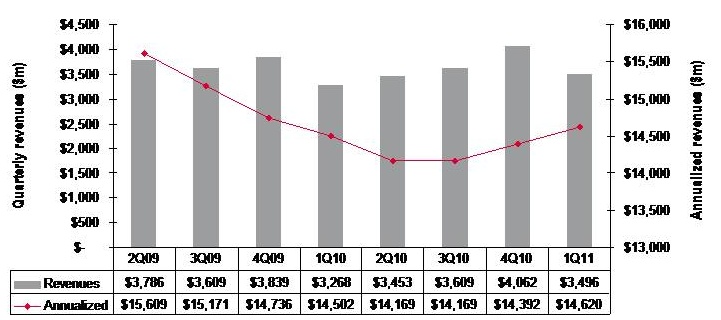 Quarterly market revenues, global optical networking (1Q 2011). Source: Ovum
Despite recent falls in optical equipment makers’ stock, the optical networking market remains in good health with analysts predicting 6-7% growth in 2011.
For Andrew Schmitt, directing analyst for optical at Infonetics Research, unfulfilled expectations are nothing new. Optical networking is a market of single-digit yearly growth yet in the last year certain market segments have grown above average: spending on ROADM-based wavelength division multiplexing (WDM) optical network equipment, for example, has grown 20% since the first quarter of 2010.
“Every few years people get this expectation that there is going to be this hockey stick [growth] and it is not,” says Schmitt. “There has been a lot of Wall Street money moving into this sector in the latter part of 2010 and first part of this year and they have just had their expectations reset, but operationally the industry is very healthy.”
“Nothing in this business changes quickly but the pace of change is starting to accelerate”
Andrew Schmitt, Infonetics Research
But Schmitt acknowledges that there is industry concern about the market outlook. “There have been lots of client calls in the first half of the year wanting to talk numbers,” says Schmitt. “When the market is growing rapidly there is no need for such calls but when it is uncertain, customers put more time into understanding what is going on.”
Both Infonetics and market research firm Ovum say the optical networking market grew 7% globally in the last year (2Q10 to 1Q11).
Ovum says the market reached US $3.5bn in the first quarter of 2011 and it expects 6% growth this year. “Most of the growth will come from North America—general recovery, stimulus-related spending, and LTE (Long Term Evolution)-inspired spending; and from South and Central America mostly mobile and fixed broadband-related,” says Dana Cooperson, network infrastructure practice leader at Ovum.
Ovum also notes that optical networking annualised spending for the last four quarters (2Q10-1Q11) finally went into the black with 1% growth, to reach $14.6bn. Annualised share figures are a strong indicator of longer-term market trends, says Ovum.
Market growth
Factors accounting for the growth include optical equipment demand for mobile and broadband backhaul. Carriers are also embarking on a multi-year optical upgrade to 40 and 100 Gigabit transmission over Optical Transport Network (OTN) and ROADM-based networks. Infonetics notes that ROADM spending in particular set a new high in the first quarter, rising 4% sequentially.
Ovum expects overall growth to come from metro and backbone WDM markets and from LTE. “For metro it is a combination of new builds, as DWDM continues to take over the metro core from SONET/SDH, and expansions of ROADM and 40 Gigabit,” says Cooperson. “For backbone it is a combination of retrofits for 40 and 100 Gigabit and overbuilds with 40 and 100 Gigabit coherent-optimised systems.”
Many operators are also looking at OTN switching and how it can help with network efficiency and manageability, she says, while mobile backhaul continues to be a hot spot as well at the access end of the network.
The Americas are the regions accounting for market growth whereas in Asia-Pacific and Europe, Middle East and Africa the spending remains flat.
“We’re not as bullish on Europe as I’ve heard some others are,” says Cooperson. “We expected China to slow down as capital intensities in the 34-35% seen in 2008 and 2009 were unsustainable. We saw the cooling down a bit earlier in 2010 than we had expected, but it did cool down and will continue to.”
Ovum expects Asia-Pacific as a whole to be moribund. But at least the pullbacks in China will be countered by slow growth in Japan and a big upsurge in India after a huge decline last year due to delayed 3G-related builds among other issues.
Outlook
Ovum is optimistic about the optical networking market due to continued competitive pressures and traffic growth. “We don’t think traffic growth can just continue without attention to the underlying issues related to revenue pressure, regardless of competitive pressures,” says Cooperson. “But newer optical and packet systems offer significant improvements over the old in terms of power efficiency, manageability, and of course 40 and 100 Gigabit coherent and ROADM features.”
“Most of the growth will come from North America"
Dana Cooperson, Ovum.
Many networks worldwide are also due for a core infrastructure update to benefit capacity and efficiency while many other operators are upgrading their access networks for mobile backhaul and enterprise Ethernet services.
Schmitt stresses that while it is right to talk about a 'core reboot', there are all sorts of operators that make up the market: the established carriers, those focussed on Layer 2 and Layer 3 transport, dark fibre companies and cable companies.
“Everyone has a different business so there is not a whole lot of group-think in this industry,” says Schmitt. “So when you talk about a transition to 40 and 100 Gigabit, some carriers will make that transition earlier than others because the nature of their business demands it.”
However, there are developments in equipment costs that are leading to change. “Once you get out to 2013-14, 100 Gigabit [transport] looks really good relative to 40 Gigabit and tunable XFPs at 10 Gigabit look really, really good,” says Schmitt, who believes these are going to be two dominating technologies. “People are going to use 100 Gigabit and when they can afford to throw more 10 Gigabit at the [capacity] problem, in shorter metro and regional spans, they will use tunable XFPs,” he says. “That is a whole new level in terms of driving down cost at 10 Gigabit that people haven’t factored in yet.”
Pacier change
The move to 100 Gigabit will not lead to increased spending, stresses Schmitt. Rather its significance is as a ‘mix shift’: The adoption of 100 Gigabit will shift spending from older systems to newer ones so that the technology is interesting in terms of market share shift rather than by growing overall revenues.
That said, there are areas of optical spending where capital expenditure (capex) is growing faster than the single-digit trend. These include certain competitive telco providers and dark fibre providers like AboveNet, TimeWarner Telecom and Colt. “You look at their capex year-over-year and it is increasing in some cases more over 20% a year,” says Schmitt.
He also notes that while the likes of Google, Yahoo, Microsoft and Apple do not spend on optical equipment as much as established operators such as Verizon or AT&T, their growth rate is higher. “There are sectors of the market that are growing quickly, and competition that are positioned to service those sectors successfully are going to see above-trend growth,” says Schmitt.
He highlights three areas of innovations - ‘big vectors’- that are going to change the business.
One is optical transport's move away from simple on-off keying signalling that opens up all kinds of innovation. Another is the shift in the players buying optical equipment. “A lot more of the R&D is driven by the AboveNets, Time Warners, Comcasts and the Googles and less by the old time PTTs,” says Schmitt. “That is going to change the way R&D is done.”
The third is photonic integration which Schmitt equates to the very early state of the electronics business. While Infinera has done some interesting things with integration, its latest 500 Gigabit PIC (photonic integrated circuit) is a big leap in density, he says: “It will be interesting if that sort of technology crosses over into other applications such as short- and intermediate-reach applications.”
“Nothing in this business changes quickly but the pace of change is starting to accelerate,” says Schmitt. “These three things, when you throw them together in a pot, are going to result in some unpredictable outcomes.”
Infinera details Terabit PICs, 5x100G devices set for 2012
Infinera has given first detail of its terabit coherent detection photonic integrated circuits (PICs). The pair - a transmitter and a receiver PIC – implement a ten-channel 100 Gigabit-per-second (Gbps) link using polarisation multiplexing quadrature phase-shift keying (PM-QPSK). The Infinera development work was detailed at OFC/NFOEC held in Los Angeles between March 6-10.
Infinera has recently demonstrated its 5x100Gbps PIC carrying traffic between Amsterdam and London within Interoute Communications’ pan-European network. The 5x100Gbps PIC-based system will be available commercially in 2012.

“We think we can drive the system from where it is today – 8 Terabits-per-fibre - to around 25 Terabits-per-fibre”
Dave Welch, Infinera
Why is this significant?
The widespread adoption of 100Gbps optical transport technology will be driven by how quickly its cost can be reduced to compete with existing 40Gbps and 10Gbps technologies.
Whereas the industry is developing 100Gbps line cards and optical modules, Infinera has demonstrated a 5x100Gbps coherent PIC based on 50GHz channel spacing while its terabit PICs are in the lab.
If Infinera meets its manufacturing plans, it will have a compelling 100Gbps offering as it takes on established 100Gbps players such as Ciena. Infinera has been late in the 40Gbps market, competing with its 10x10Gbps PIC technology instead.
40 and 100 Gigabit
Infinera views 40Gbps and 100Gbps optical transport in terms of the dynamics of the high-capacity fibre market. In particular what is the right technology to get most capacity out of a fibre and what is the best dollar-per-Gigabit technology at a given moment.
For the long-haul market, Dave Welch, chief strategy officer at Infinera, says 100Gbps provides 8 Terabits (Tb) of capacity using 80 channels versus 3.2Tb using 40Gbps (80x40Gbps). The 40Gbps total capacity can be doubled to 6.4Tb (160x40Gbps) if 25GHz-spaced channels are used, which is Infinera’s approach.
“The economics of 100 Gigabit appear to be able to drive the dollar-per-gigabit down faster than 40 Gigabit technology,” says Welch. If operators need additional capacity now, they will adopt 40Gbps, he says, but if they have spare capacity and can wait till 2012 they can use 100Gbps. “The belief is that they [operators] will get more capacity out of their fibre and at least the same if not better economics per gigabit [using 100Gbps],” says Welch. Indeed Welch argues that by 2012, 100Gbps economics will be superior to 40Gbps coherent leading to its “rapid adoption”.
For metro applications, achieving terabits of capacity in fibre is less of a concern. What matters is matching speeds with services while achieving the lowest dollar-per-gigabit. And it is here – for sub-1000km networks – where 40Gbps technology is being mostly deployed. “Not for the benefit of maximum fibre capacity but to protect against service interfaces,” says Welch, who adds that 40 Gigabit Ethernet (GbE) rather than 100GbE is the preferred interface within data centres.
Shorter-reach 100Gbps
Companies such as ADVA Optical Networking and chip company MultiPhy highlight the merits of an additional 100Gbps technology to coherent based on direct detection modulation for metro applications (for a MultiPhy webinar on 100Gbps direct detection, click here). Direct detection is suited to distances from 80km up to 1000km, to connect data centres for example.
Is this market of interest to Infinera? “This is a great opportunity for us,” says Welch.
The company’s existing 10x10Gbps PIC can address this segment in that it is least 4x cheaper than emerging 100Gbps coherent solutions over the next 18 months, says Welch, who claims that the company’s 10x10Gbps PIC is making ‘great headway’ in the metro.
“If the market is not trying to get the maximum capacity but best dollar-per-gigabit, it is not clear that full coherent, at least in discrete form, is the right answer,” says Welch. But the cost reduction delivered by coherent PIC technology does makes it more competitive for cost-sensitive markets like metro.
A 100Gbps coherent discrete design is relatively costly since it requires two lasers (one as a local oscillator (LO - see fig 1 - at the receiver), sophisticated optics and a high power-consuming digital signal processor (DSP). “Once you go to photonic integration the extra lasers and extra optics, while a significant engineering task, are not inhibitors in terms of the optics’ cost.”
Coherent PICs can be used ‘deeper in the network’ (closer to the edge) while shifting the trade-offs between coherent and on-off keying. However even if the advent of a PIC makes coherent more economical, the DSP’s power dissipation remains a factor regarding the tradeoff at 100Gbps line rates between on-off keying and coherent.
Welch does not dismiss the idea of Infinera developing a metro-centric PIC to reduce costs further. He points out that while such a solution may be of particular interest to internet content companies, their networks are relatively simple point-to-point ones. As such their needs differ greatly from cable operators and telcos, in terms of the services carried and traffic routing.
PIC challenges
 Figure 1: Infinera's terabit PM-QPSK coherent receiver PIC architecture
There are several challenges when developing multi-channel 100Gbps PICs. “The most difficult thing going to a coherent technology is you are now dealing with optical phase,” says Welch. This requires highly accurate control of the PIC’s optical path lengths.
The laser wavelength is 1.5 micron and with the PIC's indium phosphide waveguides this is reduced by a third to 0.5 micron. Fine control of the optical path lengths is thus required to tenths of a wavelength or tens of nanometers (nm).
Achieving a high manufacturing yield of such complex PICs is another challenge. The terabit receiver PIC detailed in the OFC paper integrates 150 optical components, while the 5x100Gbps transmit and receive PIC pair integrate the equivalent of 600 optical components.
Moving from a five-channel (500Gbps) to a ten-channel (terabit) PIC is also a challenge. There are unwanted interactions in terms of the optics and the electronics. “If I turn one laser on adjacent to another laser it has a distortion, while the light going through the waveguides has potential for polarisation scattering,” says Welch. “It is very hard.”
But what the PICs shows, he says, is that Infinera’s manufacturing process is like a silicon fab’s. “We know what is predictable and the [engineering] guys can design to that,” says Welch. “Once you have got that design capability, you can envision we are going to do 500Gbps, a terabit, two terabits, four terabits – you can keep on marching as far as the gigabits-per-unit [device] can be accomplished by this technology.”
The OFC post-deadline paper details Infinera's 10-channel transmitter PIC which operates at 10x112Gbps or 1.12Tbps.
Power dissipation
The optical PIC is not what dictates overall bandwidth achievable but rather the total power dissipation of the DSPs on a line card. This is determined by the CMOS process used to make the DSP ASICs, whether 65nm, 40nm or potentially 28nm.
Infinera has not said what CMOS process it is using. What Infinera has chosen is a compromise between “being aggressive in the industry and what is achievable”, says Welch. Yet Infinera also claims that its coherent solution consumes less power than existing 100Gbps coherent designs, partly because the company has implemented the DSP in a more advanced CMOS node than what is currently being deployed. This suggests that Infinera is using a 40nm process for its coherent receiver ASICs. And power consumption is a key reason why Infinera is entering the market with a 5x100Gbps PIC line card. For the terabit PIC, Infinera will need to move its ASICs to the next-generation process node, he says.
Having an integrated design saves power in terms of the speeds that Infinera runs its serdes (serialiser/ deserialiser) circuitry and the interfaces between blocks. “For someone else to accumulate 500Gbps of bandwdith and get it to a switch, this needs to go over feet of copper cable, and over a backplane when one 100Gbps line card talks to a second one,” says Welch. “That takes power - we don’t; it is all right there within inches of each other.”
Infinera can also trade analogue-to-digital (A/D) sampling speed of its ASIC with wavelength count depending on the capacity required. “Now you have a PIC with a bank of lasers, and FlexCoherent allows me to turn a knob in software so I can go up in spectral efficiency,” he says, trading optical reach with capacity. FlexCoherent is Infinera’s technology that will allow operators to choose what coherent optical modulation format to use on particular routes. The modulation formats supported are polarisation multiplexed binary phase-shift keying (PM-BPSK) and PM-QPSK.
 Dual polarisation 25Gbaud constellation diagrams
What next?
Infinera says it is an adherent of higher quadrature amplitude modulation (QAM) rates to increase the data rate per channel beyond 100Gbps. As a result FlexCoherent in future will enable the selection of higher-speed modulation schemes such as 8-QAM and 16-QAM. “We think we can drive the system from where it is today –8 Terabits-per-fibre - to around 25 Terabits-per-fiber.”
But Welch stresses that at 16-QAM and even higher level speeds must be traded with optical reach. Fibre is different to radio, he says. Whereas radio uses higher QAM rates, it compensates by increasing the launch power. In contrast there is a limit with fibre. “The nonlinearity of the fibre inhibits higher and higher optical power,” says Welch. “The network will have to figure out how to accommodate that, although there is still significant value in getting to that [25Tbps per fibre]” he says.
The company has said that its 500 Gigabit PIC will move to volume manufacturing in 2012. Infinera is also validating the system platform that will use the PIC and has said that it has a five terabit switching capacity.
Infinera is also offering a 40Gbps coherent (non-PIC-based) design this year. “We are working with third-party support to make a module that will have unique performance for Infinera,” says Welch.
The next challenge is getting the terabit PIC onto the line card. Based on the gap between previous OFC papers to volume manufacturing, the 10x100Gbps PIC can be expected in volume by 2014 if all goes to plan.
Infinera PICs 100Gbps coherent
Infinera is expediting its product plans, basing its optical transmission roadmap on coherent detection.
The company plans to launch a 100Gbps coherent transmission system in 2012. The design will be based on a pair of 5x100Gbps ultra-long-haul photonic integrated circuit (PIC) chips that will enable its systems to deliver 8 Terabits-per-second (Tbps) over a fibre.

“This change in roadmap is because of the successful development of our 100G coherent ASIC programme, and we have integrated five 100Gbps coherent channels onto one card.”
Drew Perkins, Infinera
Infinera also announced that it will be adding 40Gbps coherent detection to its DTN system in 2011. The 40Gbps will be based on optical modules and not its PIC technology. Using its planar technology and working with optical module suppliers to integrate its in-house coherent technology, Infinera’s DTN system will support 25GHz channel spacings to cram 160 lightpaths across the C-band, to deliver 6.4Tbps capacity.
Why is the announcement important?
Infinera had still to launch its 10x40Gbps PIC. This announcement marks a shift in Infinera’s strategy to focus on 100Gbps and gain a technology edge by offering the highest line speed at an unmatched density.
“It’s a good roadmap for Infinera,” says Jimmy Yu, a director at the Dell'Oro Group. “From an optical market perspective, I think 2012 is the right time for having a 100Gbps DWDM long-haul system. And it'll definitely be coherent.”
Dell’Oro expects to see early adopters of 100Gbps in 2010 and 2011, but it will be 2012/2013 when the market for 100Gbps will ramp.
What has motivated Infinera’s shift has been its success in developing coherent technology, says Drew Perkins, Infinera’s CTO. Coherent technology in combination with PICs is the best of all worlds, he says, marrying the two most significant optical developments of the last decade.
Perkins admits Infinera has been slow in offering 40Gbps technology.
“We are late to a very small market,” he says. “We think there is a 40G squeeze going on – it took the industry so long to get 40Gbps right with coherent technology such that 100Gbps is now just around the corner, as we are proving here.”
Yet Infinera will offer 40Gbps next year and will seek to differentiate itself with 25GHz channel spacing. “But it [the 40Gbps design] will be rapidly superseded by our 100Gbps, 8Tbps technology and then we believe we will be early to market with 100Gbps,” says Perkins.
Dell’Oro says 40Gbps is growing rapidly and it expects continued growing. “In 2009, 40Gbps wavelength shipments grew a little over 160 percent, and we’re forecasting it to grow nearly 90 percent in 2010,” says Yu. “If Infinera delivers 40Gbps on 25GHz channel spacing, it'll be a good interim step to 100Gbps.”
What’s being done?
Infinera has now scrapped its 10x40Gbps differential quadrature phase-shift keying (DQPSK) PIC, going to a 5x100Gbps polarisation multiplexing quadrature phase-shift keying (PM-QPSK) design instead. Interestingly, Perkins says that the 10x40Gbps transmitter PIC was designed from the start to also support 5x100Gbps PM-QPSK modulation.
The challenge is designing the coherent receiver PIC which is significantly different, and has required Infinera to gain coherent expertise in-house.
The receiver PIC also requires a local oscillator laser. “We have integrated the laser onto the receiver PIC per channel,” says Perkins. Infinera’s PICs already use lasers that are tuned over a significant number of channels though not the whole C-band so this is using technology it already has.
Another key aspect of the coherent receiver is the associated electronics that comprises very high-speed A/D converters, a digital signal processor and most likely advanced forward error correction. Developing such an ASIC is a significant challenge.
Is Infinera developing such a design? Infinera points to its Ottawa, Ontario-based research facility that was announced in September last year. “That team is working on ASIC level coherent technology,” says Perkins. “This change in roadmap is because of the successful development of our 100G coherent ASIC programme, and we have integrated five 100Gbps coherent channels onto one card.”
Did Infinera consider designing a 10x100Gbps PIC? “It comes down to the size of the line card,” says Perkins. Infinera believes the resulting terabit line card would have been too large a jump for the industry given the status of associated electronics such as switching technology.
What next?
Infinera says that in 2012 it will ship systems based on its 100Gbps coherent PICs to customers but it is unwilling to detail the key development milestones involved between now and then.
As for future product developments, Infinera claims it can extend overall capacity of its coherent technology in several directions.
It says it can integrate 10, 100Gbps channels onto a PIC. “Somewhere in the future we undoubtedly will”, says Perkins. The company also states that in the “fullness of time” it could deliver 100Gbps over 25GHz channel spacings.
Perkins also reconfirmed that Infinera will continue to advance the modulation scheme used, going from QPSK to include higher order quadrature amplitude modulation (QAM) schemes.
Jagdeep Singh's Infinera effect
Talking to gazettabyte, he reflects on the ups and downs of being a CEO, his love of running, 40 Gigabit transmission and why he is looking forward to his next role at Infinera.

"We are looking to lead the 40 Gig market, not be first to market.”
Jagdeep Singh, Infinera CEO
Ask Jagdeep Singh about how Infinera came about and there is no mistaking the enthusiasm and excitement in his voice.
During the bubble era of 2000 he started to question whether the push to all-optical networking pursued by numerous start-ups made sense. “The reason for these all-optical device companies was that they were developing the analogue functions needed,” says Singh. “Yet what operators really wanted was access to the [digital] bits.”
This led him to think about optical-to-electrical (O-E) conversion and the digital processing of signals to correct for transmission impairments. “The question then was: could this be done in a low-cost way?” says Singh. Achieving O-E conversion would also allow access to the bits for add/ drop, switching and grooming functions at the sub-wavelength level before using inverse electrical-to-optical (E-O) conversion to continue the optical transmission.
“We came at this from an orthogonal direction: building lower-cost O-E-O. Was it possible?” says Singh. “The answer was that most of the cost was in the packaging and that led us to think about photonic integration.”
Singh started out with his colleague Drew Perkins (now Infinera’s CTO) with whom he co-founded Lightera, a company acquired by Ciena in 1999. Then the two met with Dave Welch at a Christmas party in 2000. Welch had been CTO of SDL, a company just acquired by JDS Uniphase. “It was clear that he was not that happy and there were a lot of VCs (venture capitalists) chasing him,” says Singh. “He (Welch) recognised the power of what we were planning.” In January 2001 the three founded Infinera.
So why is he stepping down as CEO? The answer is to focus on long-term strategy. And perhaps to reclaim time outside work, given he has a young family.
He may even have more time for running.
Singh typically runs at least two marathons a year. “As a CEO your schedule is fully booked. There is so much stuff there is no time to think.” Running for him is quiet time. “I can get out and recharge the batteries. I find it invaluable. I can process things and it keeps the stress levels down.”
Being CEO
“There are two roles to being a CEO: running the business – the P&Ls (profit and loss statements), financials, sales – all real-time and urgent; and then there is the second part – setting the product vision: what products will be needed in two, three, four years’ time?” he says.
This second part is particularly important for Infinera given it develops products around its photonic integrated circuit (PIC) designs, requiring a longer development cycle than other optical equipment makers. “We have to get the requirements right up front,” says Singh.
And it is this part of the CEO’s role, he says, that gets trumped due to real-time tasks that must be addressed. Thus, from January, Singh will become Infinera’s executive chairman focussing exclusively on product planning. “If I had to choose [between the two roles], the longer term stuff is more appealing,” he says.
Looking back over his period as CEO, he believes his biggest achievement has been the team assembled at Infinera. “What I’ve learnt over the years is that the quality of success depends on the quality of the team.
“We started after the telecom bust,” says Singh. “There were world-class people that were never that locked in and [once on board] they knew people that they respected.” Now Infinera has a staff of 1,000, and had gone from a start-up to a publicly-listed company.
One downside of becoming a large company is that Singh regrets no longer personally knowing all his staff. “What I miss is that I knew everyone, I was part of a small team with a lot of energy,” he says. Another change is all the regulatory, legal and accounting that a public company must do. “I was also free to do and say what I wanted. Now I have to be a lot more careful.”
The Infinera effect
Asked about why Infinera is still not shipping a PIC with 40Gbps line rate channels, it is Singh-as-scrutinised-CEO that kicks in. “If we built 40 Gig purely using off-the-shelf components we’d have a product.” But he argues that the economics of 40 Gigabit-per-second (Gbps) are still not compelling. According to market research firm Ovum, he says, it will only be 2012 when 40Gbps dips below four times the cost of 10Gbps.
Indeed in Q3 2009 shipments of 40Gbps slipped. According to Ovum, this was in part due to what it calls the “Infinera effect” that is lowering the cost of existing 10Gbps technology. Only when 40Gbps is around 2.5x the cost of 10Gbps that it is likely to take off; the economic rule-of-thumb with all previous optical speed hikes.
“Our goal is to come in with a 40 Gig solution that is economically viable,” says Singh. This is what Infinera is working on with its 10x40Gbps PIC pair of chips that integrate hundreds of optical functions. “With the PIC we are looking to lead the 40 Gig market, not be first to market.”
This year also saw Infinera introduce its second class of platform, the ATN, aimed at metro networks. The platform was developed across three Infinera sites: in Silicon Valley, India and China.
Coupled with Infinera’s DTN, the ATN allows end-to-end bandwidth management of its systems. “Until now we have only played in long-haul; this now doubles the market we play in,” says Infinera's CEO. Italian operator Tiscali announced in December 2009 its plan to deploy Infinera’s systems with the ATN being deployed in 80 metro locations.
How are cheap wavelength-selective switches and tunability impacting Infinera’s business? Singh bats away the question: “We just don’t see it in our space.”
Singh agrees with Infinera’s Dave Welch’s thesis that PICs are optics’ current disruption. What developments can he cite that will indicate this is indeed happening?
There are several examples that would confirm this, he says: “PICs in adjacent devices such as routers or switches; you would need something like a PIC to reduce the power and space of such platforms.” Other areas of adoption include connecting multiple bays such as required for the largest IP core routers, and even chip-to-chip interconnect.
Surely chip-to-chip is silicon photonics not Infinera’s PICs’ based on indium phosphide technology? Is silicon photonics of interest to Infinera?
"We are an optical transport company. To generate light over vast distances requires indium phosphide,” says Singh. “But if and when there is a breakthrough in silicon to generate light efficiently, we’d want to take advantage of that.”
One wonders what ideas Singh will come up with on his two-hour runs once he can think beyond the next financial quarter.
