
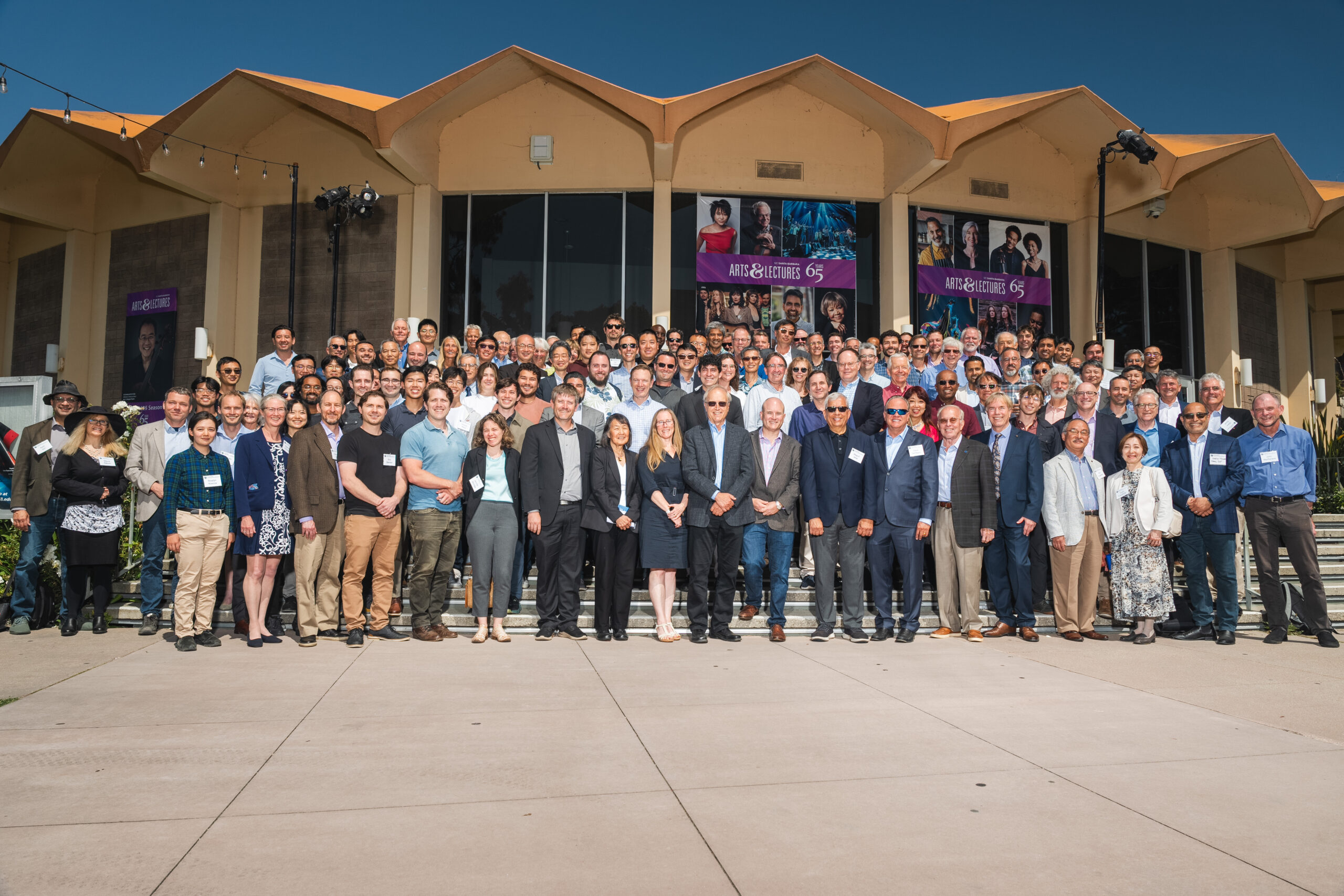
John Bowers: We are still at the dawn of photonics

After 38 years at the University of California, Santa Barbara (UCSB), Professor John Bowers (pictured) is stepping away from teaching and administrative roles to focus on research.
He welcomes the time it will free for biking and golf. He will also be able to linger, not rush, when travelling. On a recent trip to Saudi Arabia, what would have centered around a day-event became a week-long visit.
Bowers’ career includes significant contributions to laser integration and silicon photonics, mentoring some 85 PhD students, and helping found six start-ups, two of which he was the CEO.
Early Influences
Bowers’ interest in science took root while at high school. He built oscilloscopes and power supplies using Heathkits, then popular educational assemblies for electronics enthusiasts. He was also inspired by his physics and chemistry teachers, subjects he majored in at the University of Minnesota.
A challenging experience led him to focus solely on physics: “I took organic chemistry and hated it,” says Bowers. “I went, ‘Okay, let’s stick to inorganic materials.’”
Bowers became drawn to high-energy physics and worked in a group conducting experiments at Fermilab and Argonne National Laboratories. Late-night shifts – 10 PM to 6 AM – offered hands-on learning, but a turning point came when his mentor was denied tenure. “My white knight fell off his horse,” he says.
He switched to applied physics at Stanford, where he explored gallium arsenide and silicon acoustic devices, working under the supervision of the late Gordon Kino, a leading figure in applied physics and electrical engineering.
Bowers then switched to fibre optics, working in a group that was an early leader in single-mode optical fibre. “It was a period when fibre optics was just taking off,” says Bowers. “In 1978, they did the first 50-megabit transmission system, and OFC [the premier optical fibre conference] was just starting.”
Bell Labs and fibre optics
After gaining his doctorate, Bowers joined Bell Labs, where his work focused on the devices—high-speed lasers and photodetectors—used for fibre transmission. He was part of a team that scaled fibre-optic systems from 2 to 16 gigabits per second. However, the 1984 AT&T breakup signalled funding challenges, with Bell Labs losing two-thirds of its financial support.
Seeking a more stable environment, Bowers joined UCSB in 1987. He was attracted by its expertise in semiconductors and lasers, including the presence of the late Herbert Kroemer, who went on to win the 2000 Nobel Prize in Physics. Kroemer developed the double heterostructure laser and played a big part in enticing Bowers to join. Bowers was tasked with continuing the laser work, something he has done for the last 40 years.
“Coming to Santa Barbara was brilliant, in retrospect,” says Bowers, citing its strong collaborative culture and a then newly formed materials department.
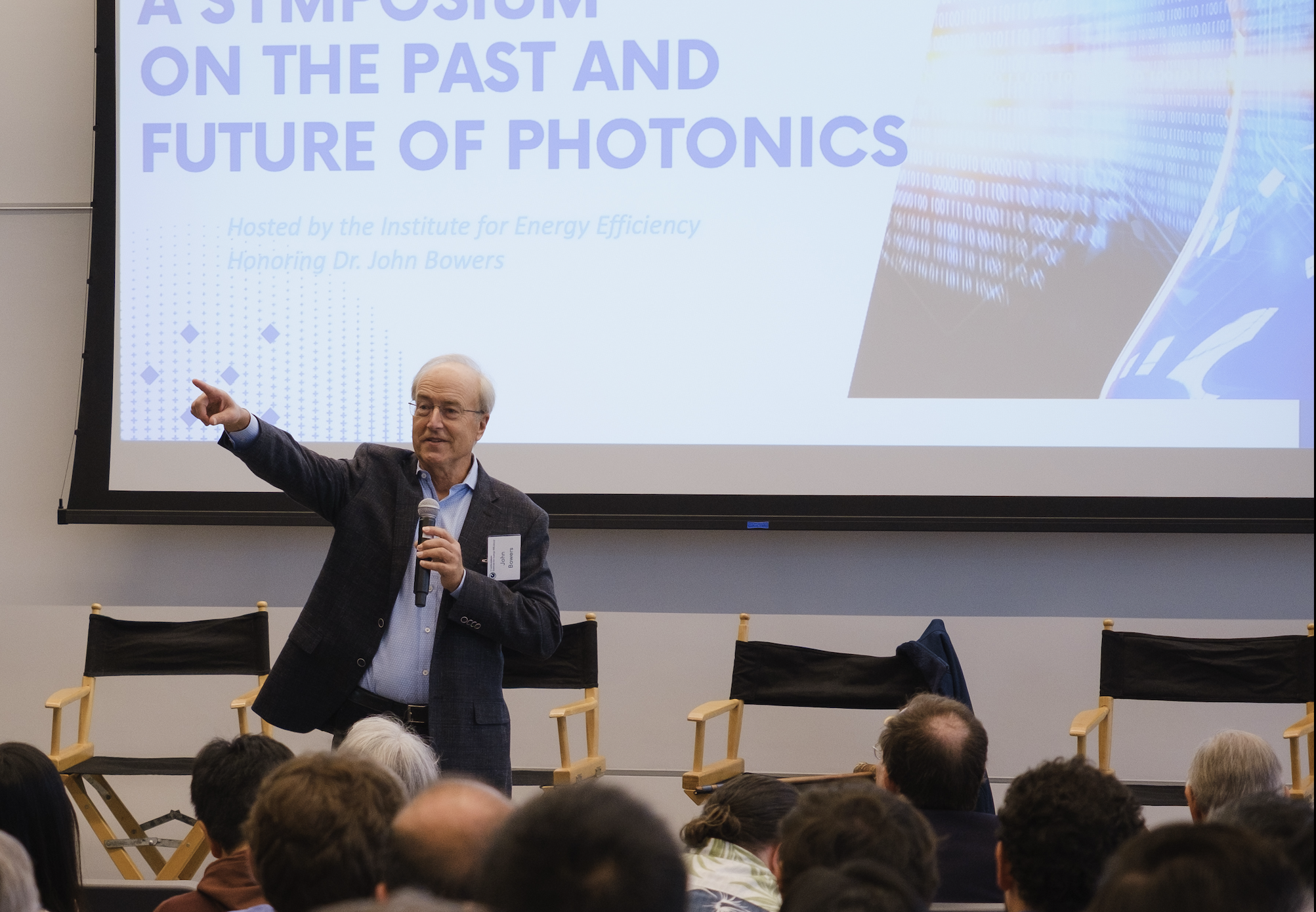
Integrated lasers
At UCSB, Bowers worked on integrated circuits using indium phosphide, including tunable lasers and 3D stacking of photonic devices.
At the same time, the field of silicon photonics was starting after Richard Soref wrote a seminal paper proposing silicon as an optical material for photonic integrated circuits (PIC).
“We all knew that silicon was a terrible light emitter because it is an indirect band-gap material,” says Bowers. “So when people started talking about silicon photonics, I kept thinking: ‘Well, that is fine, but you need a light source, and if you don’t have a light source, it’ll never become important.’”
Bowers tackled integrating lasers onto silicon to address the critical need for an on-chip light source. He partnered with Intel’s Mario Paniccia and his team, which had made tremendous progress developing a silicon Raman lasers with higher powers and narrower linewidths.
“It was very exciting, but you still needed a pump laser; a Raman laser is just a wavelength converter from one wavelength to another,” says Bowers. “So I focused on the pump laser end, and the collaboration benefitted us both.”
Intel commercialised the resulting integrated laser design and sold millions of silicon-photonics-based pluggable transceivers.
“Our original vision was verified: the idea that if you have CMOS processing, the yields will be better, the performance will be better, the cost will be lower, and it scales a lot better,” says Bowers. “All that has proven to be true.
Is Bowers surprised that integrated laser designs are not more widespread?
All the big silicon photonics companies, including foundry TSMC, will incorporate lasers into their products, he says, just as Intel has done and Infinera before that.
Infinera, an indium phosphide photonic integrated circuit (PIC) company now acquired by Nokia, claimed that integration would improve the reliability and lower the cost, says Bowers: “Infinera did prove that with indium phosphide and Intel did the same thing for silicon.”
The indium phosphide transceiver has a typical failure rate of 10 FIT (failures per ten billion hours), and if there are 10 laser devices, the FIT rises to 100, he says. By contrast, Intel’s design has a FIT of 0.1, and so with 10, the FIT becomes on the order of 1.
Silicon lasers are more reliable because there’s no III-V material exposed anywhere. Silicon or silicon dioxide facets eliminate the standard degradation mechanisms in III-V materials. This enables non-hermetic packaging, reducing costs and enabling rapid scaling.
According to Bowers, Intel scaled to a million transceivers in one year. Such rapid scaling to high volumes is important for many applications, and that is where silicon photonics has an advantage.
“Different things motivate different people. For me, it’s not about money, it’s more about your impact, particularly on students and research fields. To the extent that I’ve contributed to silicon photonics becoming important and dynamic, that is something I’m proud of.”
-Professor John Bowers
Optical device trends
Bowers notes how the rise of AI has surprised everyone, not just in terms of the number of accelerator chips needed but their input-output (I/O) requirements.
Copper has been the main transmission medium since the beginning of semiconductor chips, but that is now being displaced by optics – silicon photonics in particular – for the communications needs of very high bandwidth chips. He also cites companies like Broadcom and Nvidia shipping co-packaged optics (CPO) for their switching chips and platforms.
“Optics is the only economic way to proceed, you have to work on 3D stacking of chips coupled with modern packaging techniques,” he says, adding that the need for high yield and high reliability has been driving the work on III-V lasers on silicon.
One current research focus for Bowers is quantum dot lasers, which reduce the line width and minimise reflection sensitivity by 40dB. This eliminates the need for costly isolators in datacom transceivers.
Quantum dot devices also show exceptional durability, with lifetimes for epitaxial lasers on silicon a million times longer than quantum well devices on silicon and 10 times less sensitivity to radiation damage, as shown in a recent Sandia National Labs study for space applications.
Another area of interest is modulators for silicon photonics. Bowers says his group is working on sending data at 400 gigabits-per-wavelength using ‘slow light’ modulators. These optical devices modulate the intensity or phase, of light. Slowing down the light improves its interaction in the material, improving efficiency and reducing device size and capacitance. He sees such modulators is an important innovation.
“Those innovations will keep happening; we’re not limited in terms of speed by the modulator,” says Bowers, who also notes the progress in thin-film lithium niobate modulators, which he sees as benefiting silicon photonics, “We have written papers suggesting most of the devices may be III-V,” says Bowers, and the same applies to materials such as thin-film lithium niobate.
“I believe that as photonic systems become more complex, with more lasers and amplifiers, then everyone will be forced to integrate,” says Bowers.
Other applications
Beyond datacom, Bowers sees silicon photonics enabling LIDAR, medical sensors, and optical clocks. His work on low-noise lasers, coupled to silicon nitride waveguides, reduces phase noise by 60dB, enhancing sensor sensitivity. “If you can reduce the frequency noise by 60dB, then that makes it either 60dB more efficient, or you need 60dB less power,” he says.
Applications include frequency-based sensors for gas detection, rotation sensing, and navigation, where resonance frequency shifts detect environmental changes.
Other emerging applications include optical clocks for precise timing in navigation, replacing quartz oscillators. “You can now make very quiet clocks, and at some point we can integrate all the elements,” Bowers says, envisioning chip-scale solutions.
Mentorship and entrepreneurial contributions
Bowers’ impact extends to mentorship, guiding so many PhD students who have gone on to achieve great success.
“It’s very gratifying to see that progression from an incoming student who doesn’t know what an oscilloscope is to someone who’s running a group of 500 people,” he says.
Alan Liu, former student and now CEO of the quantum dot photonics start-up Quintessent, talks about how Bowers calls on his students to ‘change the world’.
Liu says it is not just about pushing the frontiers of science but also about having a tangible impact on society through technology and entrepreneurship.”
Bowers co-founded UCSB’s Technology Management Department and taught entrepreneurship for 30 years. Drawing on mentors like Milton Chang, he focused on common start-up pitfalls: “Most companies fail for the same set of reasons.”
His own CEO start-up experience informed his teaching, highlighting interdisciplinary skills and team dynamics.
Mario Paniccia, CEO of Anello Photonics, who collaborated with Bowers as part of the Intel integrated laser work, highlights Bowers’ entrepreneurial skills.
“John is one of the few professors who are not only brilliant and technically a world expert – in John’s case, in III-V materials – but also business savvy and entrepreneurial,” says Paniccia. “He is not afraid to take risks and can pick and hire the best.”
Photonics’ future roadmap
Bowers compares photonics’ trajectory to electronics in the 1970s, when competing CMOS technologies standardised, shifting designers’ focus from device development to complex circuits. “Just like in the 1970s, there were 10 competing transistor technologies; the same consolidation will happen in photonics,” he says.
Standardised photonic components will be integrated into process design kits (PDKs), redirecting research toward systems like sensors and optical clocks.
“We’re not at the end, we’re at the beginning of photonics,” emphasises Bowers.
Reflections
Looking back, would he have done anything differently?
A prolonged pause follows: “I’ve been very happy with the choices I have made,” says Bowers, grateful for his time at UCSB and his role in advancing silicon photonics.
Meanwhile, Bowers’ appetite for photonics remains unwavering: “The need for photonic communication, getting down to the chip level, is just going to keep exploding,” he says.


Books of 2024: Part 1
Gazettabyte asks industry figures to pick their notable reads during the year. Harald Bock, Jonathan Homa, and Maxim Kuschenrov kick off with their chosen books.
Harald Bock, Vice President Network Architecture, Infinera
I love reading but have not read as many books as I would have liked in recent years. I decided to change that in 2024.
My pick of fictional books this year was mainly classic science fiction after seeing the movie Dune Part 2 with my family. I read the book Dune by Frank Herbert, published in 1965, a while ago, and I wasn’t sure that the movies did the book justice.
My son advised me to launch myself into all five sequels of Dune, which kept me busy. While the sequels are for die-hard fans, I recommend the first of the books whether or not you’ve seen the movie. Frank Herbert’s modern and sophisticated thinking adds unconventional perspectives to up-to-date societal, environmental and political questions.
I went on to read Ray Bradbury’s The Martian Chronicles and H.G. Wells’ Time Machine, published in 1950 and 1895, respectively. The two books are fascinating as they are timeless and do not require any adaptation to modern times. They are classics of their genre.
I also found time for non-fictional books. I was looking for unconventional thoughts by unlikely authors to challenge my thinking.
One that adds to the discussions about sustainability is a book by Fred Vargas, a French author who normally writes crime fiction and is an archaeologist and historian. ‘L’humanité en péril: Virons de bord, toute !‘ was published as a follow-up to an older, shorter text by the same author read on the occasion of the conference on climate change COP24 in Paris in 2018. Surprisingly, the book does not yet exist in English.
Another interesting author is a professor of computer science, Katharina Zweig. Her books: Awkward Intelligence: Where AI Goes Wrong, Why It Matters, and What We Can Do about It and Die KI war’s: Von absurd bis tödlich: Die Tücken der künstlichen Intelligenz (‘It was the AI: From absurd to deadly: The pitfalls of artificial intelligence’, in German only to date) do a good job exploring considerations, boundary conditions, and limits of using AI systems in practical decision-making.
Jonathan Homa, Senior Director of Solutions Marketing at Ribbon Communications
I recommend a book I re-read this year: The Name of the Rose by Umberto Eco. As my wife points out, re-reading a book is its own recommendation.
This is an intricate and beautifully written murder mystery novel set in late medieval Europe. Through the eyes of the protagonist, Brother William of Baskerville, we begin to see glimpses of enlightenment. I also recommend the 1986 movie by the same name, starring Sean Connery.
Maxim Kuschnerov, director of R&D at Huawei
I had a light year of reading. One book I did read was Nuclear War: A Scenario by Annie Jacobsen which details the scenario of how a nuclear war would go down if someone started it. The answer: a surprisingly quick annihilation of humankind.
I also read Angela Merkel’s autobiography, Freedom: Memoirs 1954 – 2021 – that was published recently. I was hoping for more insight into her thinking when dealing with the immigration crisis or with Vladimir Putin, but the book added nothing that I didn’t already know about her. The book clarified how Angela Merkel was profoundly shaped in her upbringing by Eastern German communism and Russia.
The request to highlight my reads of 2024 made me think about what I have been reading this past year. Perhaps disappointingly, it turned out to be mostly not-noteworthy fiction.

OFC 2024 industry reflections: Final part
Chris Cole, Consultant
OFC and optics were back with a vengeance. The high level of excitement and participation in the technical and exhibit programmes was fueled by artifical intelligence/ machine learning (AI/ML). To moderate this exuberance, a few reality checks are offered.
During the Optica Executive Forum, held on the Monday, one of the panels was with optics industry CEOs. They were asked if AI/ML is a bubble. All five said no. They are right that there is a real, dramatic increase in optics demand driven by AI/ML, with solid projections showing exponential growth.
At the same time, it is a bubble because of the outrageous valuations for anything with an AI/ML label, even on the most mundane products. Many booths in the Exhibit Hall had AI/ML on their panels, for the same product types companies have been showing for years. Some of the start-ups and public companies presenting and exhibiting at OFC have frothy valuations by claiming to solve compute bottlenecks. An example is optically interconnecting memory, which sends investors into a frenzy, as if this has not been considered for decades.
The problem with a bubble is that it misallocates resources to promises of near-term pay off, at the expense of investment into long-term fundamental technology which is the only way to enable a paradigm shift to optical AI/ML interconnect.
I presented a version of the below table at the OFC Executive Forum, pointing out that there have only been two paradigm shifts in optical datacom, and these were enabled by fundamentally new optical components and devices which took decades to develop.
My advice to investors was to be skeptical of any optically-enabled breakthrough claims which simply rearrange or integrate existing components and devices. As with previous bubbles, this one will self-correct, and many of the stratospheric valuations will collapse.
Source: Chris Cole
A second dose of reality was provided by Ashkan Seyedi of Nvidia, in several OFC forums, illustrated by the Today’s Interconnect Details table below (shared with permission).
Source: Ashkan Seyedi, Nvidia
He pointed out that the dominant AI/ML interconnect continues to be copper because it beats optics by integer or decade better metrics of bandwidth density, power, and cost. Existing data centre optical networking technology cannot simply be repackaged as optical compute input-output (I/O), including optical memory interconnect, because that does not beat copper.
A third dose of reality came from Xiang Zhou of Google and Qing Wang of Meta in separate detailed analysis presented at the Future of LPO (Linear Pluggable Optics) Workshop. They showed that not only does linear pluggable optics have no future beyond 112 gigabits per lane, but even at that rate it is highly constrained, making it unsuitable for general data centre deployment.
Yet linear pluggable optics was one of the big stories at OFC 2024, with many highly favourable presentations and more than two dozen booths exhibiting it in some form. This was the culmination of a view that has been advanced for years that optics development is too slow, especially if it involves standards. LPO was moved blazingly fast into prototype hardware without being preceded by extensive analysis. The result was predictable as testing in typical large deployment scenarios found significant problems.
At OFC 2025, there will be few if any linear pluggable optics demos. And it will not be generally deployed in large data centres.
Coincidently, the OIF announced that it started a project to standardise optics with one digital signal processor (DSP) in the link, located in the transmitter. This was preceded by analysis, including by Google and Meta, showing good margin against the types of impairments found in large data centres. The expectation is that many IC vendors will have DSP on transmit-only chips soon, including likely at OFC 2025.
A saving grace of linear pluggable optics may be the leveraging of related OIF work on linear receiver specification methodology. Another benefit may be the reaffirmation that real progress in optics is hard and requires fundamental understanding. Shortcutting of well-established engineering practices leads to wasted effort.
Real advances require large investment and take many years, which is what is necessary for optical AI/ML compute interconnect. Let’s hope investors realise this.
Hojjat Salemi, Chief Business Development Officer, Ranovus
Hyperscalers are increasingly recognising that scaling AI/ML compute demands extensive optical connectivity, and the conventional approach of using pluggable optical modules is proving inadequate.
The network infrastructure plays a pivotal role in the compute architecture, with various optimisation strategies depending on the workload. Both compute scale-up and scale-out scenarios necessitate substantial connectivity, high-density beach-front, cost-effectiveness, and energy efficiency. These requirements underscore the advantages of co-packaged optics (CPO) in meeting the evolving demands of AI/ML compute scaling.
It is great to see prominent tier-1 vendors like Nvidia, AMD, Broadcom, Marvell, GlobalFoundries, and TSMC embracing co-packaged optics. Their endorsement shows a significant step forward, indicating that the supply chain is gearing up for high-volume manufacturing by 2026. The substantial investments being poured into this technology underscore the collective effort to address the pressing challenge of scaling compute efficiently. This momentum bodes well for the future of AI/ML compute infrastructure and its ability to meet the escalating demands of various applications.
What surprise me was how fast low-power pluggable optics fizzled. While initially shown as a great technology, linear pluggable optics ultimately fell short in meeting some critical requirements crucial to Hyperscalers. Although retimed pluggable optical modules have been effective in certain applications and are likely to continue serving those needs for the foreseeable future, the evolving demands of new applications such as scaling compute necessitate innovative solutions like co-packaged optics.
The shift towards co-packaged optics highlights the importance of adapting to emerging technologies that can better address the unique challenges and requirements of rapidly evolving industries like hyperscale computing.
Harald Bock, Vice President Network Architecture, Infinera
I am impressed by the range of topics, excellent scientific work and product innovation each time I attend OFC.
Normally, the show's takeaways differ among the participants that I talk to. This year, most of the attendees I chatted agreed on the main topics. The memorable items this year ranged from artificial intelligence (AI) data centres, 800 gigabit-per-second (Gbps) pluggables, to the Full Spectrum Concert at Infinera’s OFC party that was held on the USS Midway.
AI is becoming the key driver for network capacity. While we are a very technology-driven industry, the interest in different technologies is driven by the business opportunities we expect. This puts AI at the top of the list. It is not the AI use cases in network operations, planning, and analytics, which are all progressing, but rather the impact that deploying AI data centres will have on network capacity and particularly on optical interfaces within and between data centres.
The interest was clearly amplified by the fact that recovery of the telecom networks business is only expected in the year’s second half.
Short term, AI infrastructure creates massive demand for short-reach interconnect within data centres, with longer-reach inter-data centre connectivity also being driven by new buildouts. So, we can expect AI to be the key driver of network bandwidth in the coming years.
It is in this context that linear pluggable optics has become an important candidate technology to provide efficient, low-energy interconnect, and as a result, it generated a huge amount of interest this year, stealing some of the attention that co-packaged optics or similar approaches have received in the past. Overall, AI use cases drove huge interest in 800Gbps pluggable optics products and demonstrations at the show.
Reducing interface and network power consumption have become key industry objectives. In all of these use cases and products, power consumption is now the main optimisation goal in order to drive down overall data centre power or to fit all pluggable optics into the same existing form factors (QSFP-DD and OSFP), even at higher rates such as 1.6Tbps.
I do believe that reducing power consumption, be it per capacity, or per reach x capacity depending on use case, has become our industry’s main objective. Looking at projected capacity growth that will continue at 35 to 40 per cent per year across much of cloud networks, that is what we all should be working on.
Another observation is that power consumption and capacity per duct have replaced spectral efficiency as the figure of merit. You could say that this is starting to replace the objective of increasing fibre capacity that our industry has been working under for many years.
We have all discussed the fact that we are no longer going to be able to easily increase spectral efficiency as we are approaching Shannon’s limit. In order to further increase fibre capacity, we have been talking about additional wavelength bands, with products now achieving beyond 10-terabit transmission bandwidth with Super C- and Super L-band and the option to add the S-, O-, and U- bands, as well as about spatial division multiplexing, which today refers to the use of multiple fibre cores to transmit data.
Before OFC, I was puzzled about the steps we, as an industry, would take since all of these require more than a single product from one company. Indeed it is an ecosystem of related components, amplifiers, wavelength handling, even splicing procedures. After OFC, I am now confident that uncoupled multi-core fibre is a good candidate for a next step, with progress on additional wavelength bands not at all out of the picture.
There is one additional point I learned from looking at this topic. In real-world deployments today, multi-core fibre will accelerate a massive increase in parallel fibres that are being deployed in fibre ducts across the world. To me, that means that while we are going to all focus on power consumption as a key measure for innovation, we should really use capacity per duct as an additional figure of merit.
In terms of technological progress, I would like to call out the area of quantum photonics.
We all saw the results from an impressive research push in this area, with complex photonic integration and interesting use cases being explored. The amount of work done in this area makes it difficult for me to keep up to speed. I continue to be fascinated and excited about the work done.
An entirely different category of innovation was shown in the post-deadline session where Microsoft and University of Southampton presented hollow-core fiber with a record 0.11 dB/km fiber loss. While we have been talking about the great promise of anti-resonant hollow-core fiber for a while as it offers significantly reduced latency, it reduces signal distortion by removing nonlinearity and offering low dispersion. All that has been shown before, but achieving a fibre loss that is considerably lower than that of all other fibre types is excellent news.
It confirms that hollow-core fiber could change the systems and the networks we build, and I will continue to keep close tabs on the progress in this area.
Overall, OFC 2024 was a great show, with my company launching new products and having a packed booth full of visitors, a large number of customer engagements, and meetings with most of our suppliers.
I left San Diego already looking forward to next year's OFC.

OFC 2024 reflects a mature industry with new offshoots
- The three General Chairs preview the upcoming Optical Fiber Communications (OFC) conference and discuss photonics developments and trends.
- The General Chairs' role is to choose the plenary speakers, programme theme, and conference schedule.
- OFC takes place during March 24th-28th in San Diego, CA.*
Photonics, at least for traditional applications, has become a mature industry. So says Professor Dimitra Simeonidou, one of this year’s OFC General Chairs.
y traditional, Simeonidou is referring to classical optical communications.
But she also stresses new developments: the use of optical fibres for environmental sensing, optics for satellites, and quantum.
“Quantum is like a micro-OFC,” says Simeonidou. “You have issues from technology to subsystem to system applications now appearing in the OFC programmes.”

The OIF's coherent optics work gets a ZR+ rating
The OIF has started work on a 1600ZR+ standard to enable the sending of 1.6 terabits of data across hundreds of kilometres of optical fibre.The initiative follows the OIF's announcement last September that it had kicked off 1600ZR. ZR refers to an extended reach standard, sending 1.6 terabits over an 80-120km point-to-point link.
600ZR follows the OIF’s previous work standardising the 400-gigabit 400ZR and the 800-gigabit 800ZR coherent pluggable optics.
The decision to address a ‘ZR+’ standard is a first for the OIF. Until now, only the OpenZR+ Multi-Source Agreement (MSA) and the OpenROADM MSA developed interoperable ZR+ optics.
The OIF’s members’ decision to back the 1600ZR+ coherent modem work was straightforward, says Karl Gass, optical vice chair of the OIF’s physical link layer (PLL) working group. Several companies wanted it, and there was sufficient backing. “One hyperscaler in particular said: ‘We really need that solution’,” says Gass.
OIF, OpenZR+, and OpenROADM
Developing a 1600ZR+ standard will interest telecom operators who, like with 400ZR and the advent of 800ZR, can take advantage of large volumes of coherent pluggables driven by hyperscaler demand. However, Gass says no telecom operator is participating in the OIF 1600ZR+ work.
“It appears that they are happy with whatever the result [of the ZR+ work] will be,” says Gass. Telecom operators are active in the OpenROADM MSA.
Now that the OIF has joined OpenZR+ and the OpenROADM MSA in developing ZR+ designs, opinions differ on whether the industry needs all three.
“There is significant overlap between the membership of the OpenZR+ MSA and the OIF, and the two groups have always maintained positive collaboration,” says Tom Williams, director of technical marketing at Acacia, a leading member of the OpenZR+. “We view the adoption of 1600ZR+ in the OIF as a reinforcement of the value that the OpenZR+ has brought to the market.”
Robert Maher, Infinera’s CTO, believes the industry does not need three standards. However, having three organisations does provide different perspectives and considerations.
Meanwhile, Maxim Kuschnerov, director R&D at Huawei, says the OIF’s decision to tackle ZR+ changes things.”OpenZR+ kickstarted the additional use cases in the industry, and OpenROADM took it away but going forward, it doesn’t seem that we need additional MSAs if the OIF is covering ZR+ for Ethernet clients in ROADM networks,” says Kuschnerov. “Only the OTN [framing] modes need to be covered, and the ITU-T can do that.”
Kuschnerov also would like more end-user involvement in the OIF group. “It would help shape the evolving use cases and not be guided by a single cloud operator,” he says.
ZR history
The OIF is a 25-year-old industry organisation with over 150 members, including hyperscalers, telecom operators, systems and test equipment vendors, and component companies.
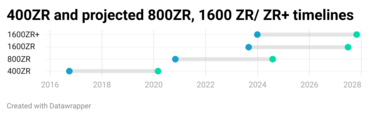
In October 2016, the OIF started the 400ZR project, the first pluggable 400-gigabit Ethernet coherent optics specification. The principal backers of the 400ZR work were Google and Microsoft. The standard was designed to link equipment in data centres up to 120km apart.
The OIF 400ZR specification also included an un-amplified version with a reach of several tens of kilometres. The first 400ZR specification document, which the OIF calls an Implementation Agreement, was completed in March 2020 (see chart above).
The OIF started the follow-up on the 800ZR specification in November 2020, a development promoted by Google. Gass says the OIF is nearing completion of the 800ZR Implementation Agreement document, expected in the second half of 2024.
If the 1600ZR and ZR+ coherent work projects take a similar duration, the first 1600ZR and 1600ZR+ products will appear in 2027.
Symbol rate and other challenges
Moving to a 1.6-terabit coherent pluggable module using the same modulation scheme – 16-ary quadrature amplitude modulation or 16-QAM – used for 400ZR and 800ZR suggests a symbol rate of 240 gigabaud (GBd).
“That is the maths, but there might be concerns with technical feasibility,” says Gass. “That’s not to say it won’t come together.”
The highest symbol rate coherent modem to date is Ciena’s WaveLogic 6e, which was announced a year ago. The design uses a 3nm CMOS coherent digital signal processor (DSP) and a 200GBd symbol rate. It is also an embedded coherent design, not one required to fit inside a pluggable optical module with a constrained power consumption.
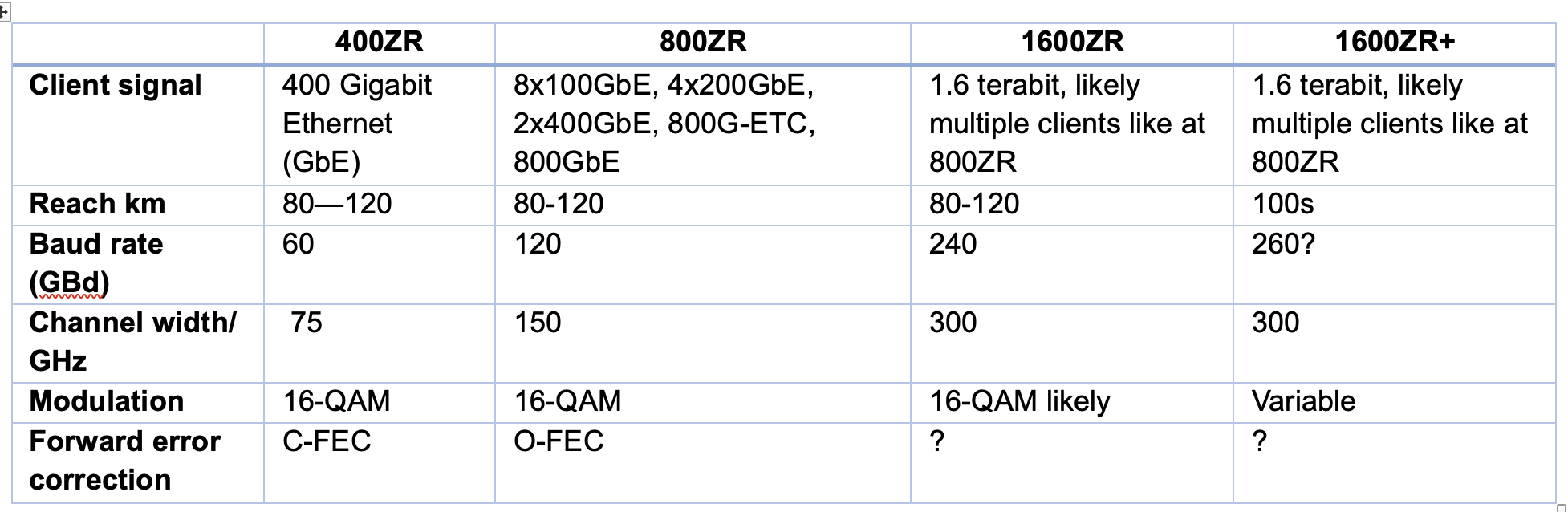
Kuschnerov points out that the baud rates of ZR and ZR+ have differed. And this will likely continue. 800ZR, using Ethernet with no probabilistic constellation shaping, has a baud rate of 118.2GBd, while 800ZR+, which uses OTN and probabilistic constellation shaping, has a baud rate of up to 131.35GBd. Every symbol has a varying probability when probabilistic constellation shaping is used. “This decreases the information per symbol, and thus, the baud rate must be increased,“ says Kuschnerov.
Doubling up for 1600ZR/ ZR+, those numbers become around 236GBd and 262GBd, subject to future standardisation. “So, saying that 1600ZR is likely to be at 240GBd is correct, but one cannot state the same for a potential 1600ZR+,” says Kuschnerov.
Nokia’s view is that for 1600ZR, the industry will look at operating modes that include 16QAM at 240 GBd. Other explored options include 64-QAM with probabilistic constellation shaping at 200GBd and even dual optical carrier solutions with each carrier operating at approximately 130GBd. “However, this last option may be challenging from a power envelope perspective,” says Szilárd Zsigmond, head of Nokia’s optical subsystems group.
In turn, if 1600ZR+ reaches 1,000km distances, the emphasis will be on higher baud rate options than those used for 1600ZR. “This will be needed to enable longer reaches, which will also put pressure on managing power dissipation,” says Zsigmond.
The coherent DSP must also have digital-to-analogue (DACs) and analogue-to-digital converters (ADCs) to sample at least at 240 giga-samples per second. Indeed, the consensus among the players is that achieving the required electronics and optics will be challenging.
“All component bandwidths have to double and that is a significant challenge,” says Josef Berger, associate vice president, cloud optics marketing at Marvell.
The coherent optics – the modulators and receivers – must extend their analogue bandwidth of 120GHz. Infinera is one company that is confident this will be achieved. “Infinera, with our highly integrated Indium Phosphide-based photonic integrated circuits, will be producing a TROSA [transmitter-receiver optical sub-assembly] capable of supporting 1.6-terabit transmission that will fit in a pluggable form factor,” says Maher.
The coherent DSP and optics operating must also meet the pluggable modules’ power and heat limits. “That is an extra challenge here: the development needs to maintain focus on cost and power simultaneously to bring the value network operators need,” says Williams. “Scaling baud rate by itself doesn’t solve the challenge. We need to do this in a cost and power-efficient way.”
Current 800ZR modules consume 30W or more, and since the aim of ZR modules is to be used within Ethernet switches and routers, this is challenging. In comparison, 400ZR modules now consume 20W or less.
“For 800ZR and 800ZR+, the target is to be within the 28W range, and this target is not changing for 1600ZR and 1600ZR+,” says Zsigmond. Coherent design engineers are being asked to double the bit rate yet keep the power envelope constant.
Certain OIF members are also interested in backward compatibility with 800ZR or 400ZR. “That also might affect the design,” says Gass.
Given the rising cost to tape out a coherent DSP using 3nm and even 2nm CMOS process nodes required to reduce power per bit, most companies designing ASICs will look to develop one design for the 1600ZR and ZR+ applications to maximise their return on investment, says Zsigmond, who notes that the risk was lower for the first generations of ZR and ZR+ applications. Most companies had already developed components for long-haul applications that could be optimised for ZR and ZR+ applications.
For 400ZR, which used a symbol rate of 60 GBd, 60-70 GBd optics already existed. For 800 gigabit transmissions, high-performance embedded coherent optics and pluggable, low-power ZR/ZR+ modules have been developed in parallel. “For 1600ZR/ZR+, it appears that the pluggable modules will be developed first,” says Zsigmond. “There will be more technology challenges to address than previous ZR/ZR+ projects.”
The pace of innovation is faster than traditional coherent transmission systems and will continue to reduce cost and power per bit, notes Marvell’s Berger: “This innovation creates technologies that will migrate into traditional coherent applications as well.”
Gass is optimistic despite the challenges ahead: “You’ve got smart people in the room, and they want this to happen.”
OIF's OFC 2024 demo
The OIF has yet to finalise what it will show for the upcoming coherent pluggable module interoperable event at OFC to be held in San Diego in March. But there will likely be 400ZR and 800ZR demonstrations operating over 75km-plus spans and 400-gigabit OpenZR+ optics operating over greater distance spans.

ECOC 2023 industry reflections - Final Part
Gazettabyte has been asking industry figures to reflect on the recent ECOC show in Glasgow. The final instalment emphasises coherent technology with contributions from Adtran, Cignal AI, Infinera, Ciena, and Acacia.
Jörg-Peter Elbers, head of advanced technology at Adtran
The ECOC 2023 conference and show was a great event. The exhibition floor was busy and offered ample networking opportunities. In turn, the conference and the Market Focus sessions provided information on the latest technologies, products, and developments.
One hot topic was coherent 800ZR modems. Several vendors demonstrated coherent 800ZR modules and related components. Importantly, these modules also boast new and improved 400 gigabit-per-second (Gbps) modes. The 120 gigabaud (GBd) symbol rate enables 400-gigabit dual-polarisation quadrature phase shift keying (DP-QPSK) transmission over demanding links and long-haul routes. In turn, the advent of 5nm CMOS digital signal processor (DSP) technology enables lower power DP-16QAM than 400ZR modules.
There is broad agreement that the next step in coherent transmission is a 240GBd symbol rate, paving the way to single-wavelength 1.6 terabit-per-second (Tbps) optical transport.
Meanwhile, the use of coherent optical technology closer to the network edge continues. Several players announced plans to follow Adtran and Coherent and jump on the low-power 100 gigabit-per-second ZR (100ZR) ‘coherent lite’ bandwagon. Whether passive optical networking (PON) systems will adopt coherent technology after 50G-PON sparked lively debate but no definitive conclusions.
The OIF 400ZR+ demonstration showed interoperability between a dozen optical module vendors over metro-regional distances. It also highlighted the crucial role of an intelligent optical line system such as Adtran’s FSP3000 OLS in automating operation and optimising transmission performance.
The post-deadline papers detailed fibre capacity records by combining multiple spectral bands and multiple fibre cores. The line-system discussions on the show floor focused on the practical implications of supporting C-, L-, extended, and combined band solutions for customers and markets.
From workshops to the regular sessions, the application of artificial intelligence (AI) was another prominent theme, with network automation a focus area. Examples show not only how discriminative AI can detect anomalies or analyse failures but also how generative AI can improve the interpretation of textual information and simplify human-machine and intent interfaces. For network engineers, ‘Copilot’-like AI assistance is close.
After ECOC is also before ECOC, so please mark in your calendars September 22-26, 2024. ECOC will celebrate its 50th anniversary next year and will take place in Frankfurt, Germany. As one of the General Chairs of the ECOC 2024 event, and on behalf of the entire organising committee, I look forward to welcoming you!
Andrew Schmitt, founder and directing analyst, Cignal AI
ECOC is a great show, it’s like OFC (the annual optical communications and networking event held in the US) but refined to only the critical elements. Here are my key takeaways.
The most impressive demonstration was 800ZR test boards and modules from Marvell and its partners Coherent and Lumentum. Within eight weeks of the first silicon, Marvell has demos up and running in-house and at its partners. The company has at least a 6-month lead in the 800ZR market, making intelligent tradeoffs to achieve this.
Lumentum showed an 8-QAM mode of operation that allows 800 gigabit transmission within a 100GHz channel spacing, which should be interesting. After the massive success of 400ZR, it’s natural to extrapolate the same success for 800ZR, but the use cases for this technology are substantially different. We also heard updates and broader support for 100ZR.
Linear drive pluggable optics (LPO) was a hot topic, although it was our impression that, while optimism ruled public discussion, scepticism was widely expressed in private. There was more agreement than disagreement with our recent report (see the Active Insight: The Linear Drive Market Opportunity). No one is more confident about LPO than the companies who view this as another opportunity to bid for business at hyperscale operators they don’t currently have.
The 200 gigabit per lane silicon/ physical media device (PMD)/ optics development continues, and it is on track to enable 1.6-terabit optics by 2024. Marvell had a more advanced and mature demo of what they showed behind closed doors at OFC. The advancements here are the real threat to adopting LPO, and people need to realise that LPO is competing with the power specs of 200 gigabits per lane, not 100 gigabits per lane solutions.
Also impressive was the comprehensive engineering effort by Eoptolink to show products that covered 100 gigabit and 200 gigabit per lane solutions, both retimed and linear. The company’s actions show that if you have the engineering resources and capital, rather than pick the winning technology, do everything and let the market decide. Also impressive is the CEO, who understood the demos and the seasoned application engineers. Kudos to keeping engaged with the products!
System vendors had a more significant presence at the show, particularly Ciena and Infinera. It’s unsurprising to see more system vendors since they are increasing investments in pluggables, particularly coherent pluggables.
We had many discussions about our forecasts for IPoDWDM deployment growth. This disruption is something that component vendors are excited about, and hardware OEMs view it as an opportunity to adjust how they deliver value to operators (see the Active Insight: Assessing the Impact of IP-over DWDM).
Lastly, the OIF coordinated 400ZR+ and OpenROADM interoperability testing despite the organisation not being directly involved in those industry agreements. The OIF is a fantastic organisation that gets valuable things done that its members need.
Paul Momtahan, director, solutions marketing, Infinera
ECOC 2023 provided an excellent opportunity to catch the latest trends regarding transponder innovation, coherent pluggables and optical line systems. A bonus was getting to the show without needing a passport.
Transponder innovation topics included coherent digital signal processor (DSP) evolution, novel modulators, and the maximum possible baud rate. DSP sessions included the possibility of offloading DSP functions into the photonic domain to reduce power consumption and latency.
There were also multiple presentations on constellation shaping, including enhanced nonlinear performance, reduced power consumption for probabilistic constellation shaping, and potential uses for geometric shaping.
Novel modulators with very high baud rates, including thin-film lithium niobate, barium titanate, plasmonic, and silicon-organic hybrid, were covered. The need for such modulators is the limited bandwidth potential of silicon photonics modulators, though each face challenges such as integration with silicon photonics and manufacturability.
From the baud rate session, the consensus was that 400GBd symbol rates are probable, up to 500GBd might be possible, but higher rates are unlikely. The critical challenges are the radio frequency (RF) interconnects and the digital-to-analogue and analogue-to-digital converters. However, several presenters wondered whether a multi-wavelength transponder might be more sensible for symbol rates above 200 to 250GBd.
Coherent pluggables were another topic, especially at 800 gigabit. However, one controversial topic was the longevity of coherent pluggables in routers (IPoDWDM). Several presenters argued the current period would pass once router port speeds and coherent port speeds no longer align.
As the coherent optical engines approach the Shannon limit, innovation is shifting towards optical line systems and fibres as alternative way to scale capacity.
Several presentations covered ROADM evolution to 64 degrees and even 128 degrees. A contrasting view is that ROADMs’ days are numbered to be replaced by fibre switches and full spectrum transponders, at least in core networks.
Additional options for scaling capacity included increasing the spectrum of existing bands with super-C and super-L. Lighting different bands, such as the S-band (in addition to C+L bands), is seen as the best candidate, with commercial solutions three to five years away.
Overall, it was a great event, and I look forward to seeing how things evolve by the time of next year’s ECOC show in Frankfurt. (For more, click here)
Helen Xenos, senior director, portfolio marketing, Ciena
This was my third year attending ECOC, and the show never disappoints. I always leave this event excited and energised about what we’ve accomplished as an industry.
Every year seems to bring new applications and considerations for coherent optical technology. This year, ECOC showcased the ever-growing multi-vendor ecosystem for 400-gigabit coherent pluggable transceivers, considerations in the evolution to 800-gigabit pluggables, evolution to coherent PON, quantum-secure coherent networking, and the evolution to 200 gigabaud and beyond. When will coherent technology make it into the data centre? A question still open for debate.
Ciena’s optical engineer wizards were on hand to share specifics about our recently announced 3nm CMOS-based WaveLogic 6 technology, which includes the industry’s first performance-optimised 1.6 teraburs-per-second (Tbps) optics as well as 800-gigabit pluggables.
It was exciting for me to introduce customers, suppliers and research graduates to their first view of 3nm chip performance results and show how these enable the next generation of products. And, of course, Ciena was thrilled that WaveLogic 6 was awarded the Most Innovative Coherent Module Product at the event.
Tom Williams, director of technical marketing at Acacia
From my perspective, while there weren’t as many major product announcements as OFC, several trends and technologies continued to progress, including OIF interoperability, 800ZR/ZR+, linear pluggable optics (LPO) and terabit optics.
The OIF interop demonstration was once again a highlight of the show. The booth was at the entrance to the exhibition and seemed to be packed with people each time I passed by.
OIF has expanded the scope of these demonstrations with each show, and this year was the largest ever. In addition to having the participation of 12 module vendors (with 34 modules), the focus was on the ZR+ operation. What was successfully demonstrated was a single-span 400ZR network and a multi-span network.
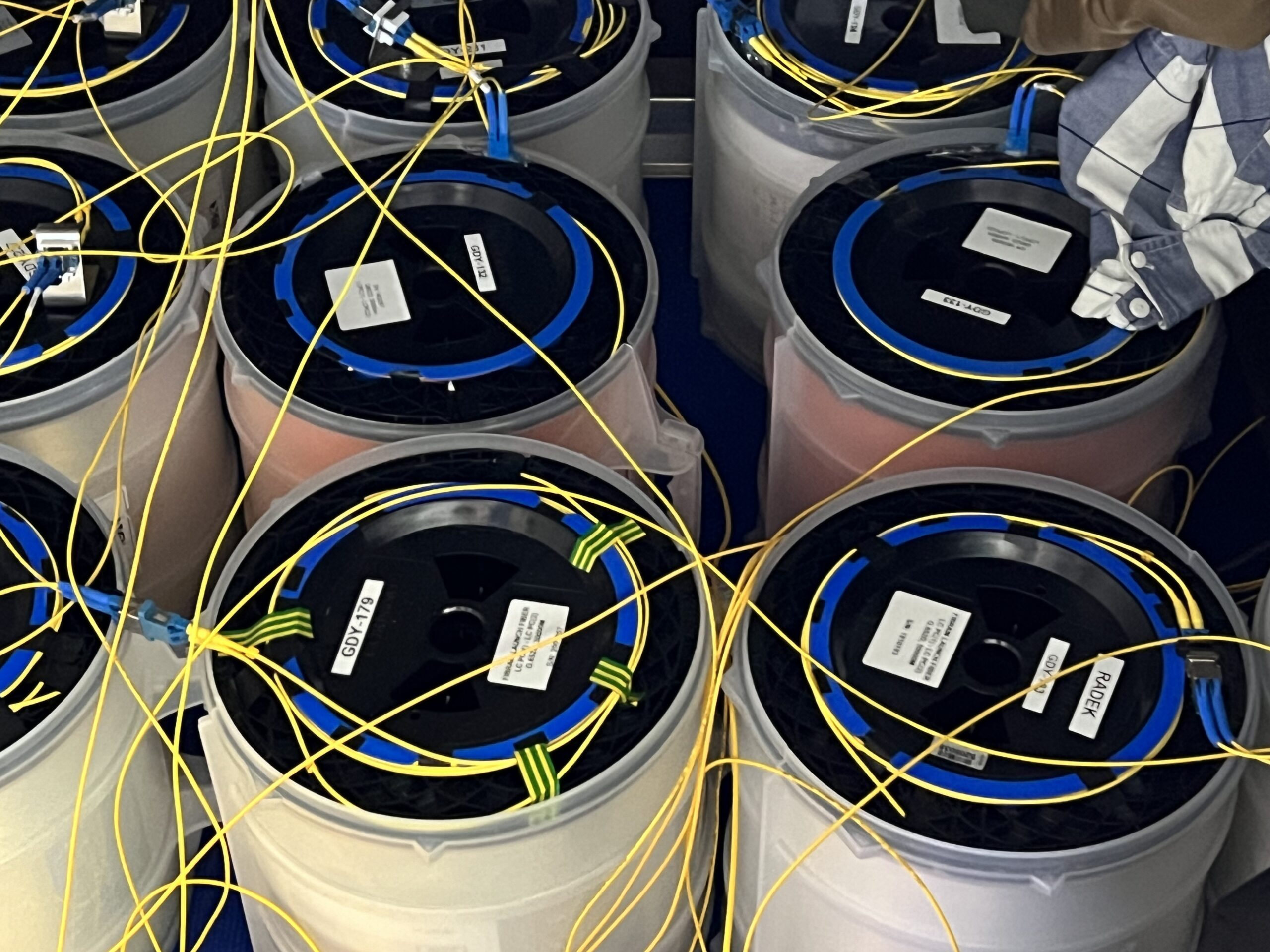
As co-chair of the OpenZR+ MSA, I was excited by the great collaboration with OIF. These efforts help to drive the industry forward. Karl Gass is not only the most creatively dressed person at every trade show; he is exceptional at coordinating these activities.
It is clear that linear drive pluggable optics (LPO) works in some situations, but views differ about how widespread its adoption will be and how standardisation should be addressed. I lived through the analogue coherent optics (ACO) experience. ACO was essentially a linear interface for a coherent module where the digital processing happened outside the module. For ACO, it was a DSP on the host board and for LPO it is the switch ASIC. The parameters that need to be specified are similar. There is a precedent for this kind of effort. Hopefully, lessons learned there will be helpful for those driving LPO. I am interested to see how this discussion progresses in the industry as some of the challenges are discussed, such as its current limited interoperability and support for 200 gigabits per lane.
There have been announcements from several companies about performance-optimised coherent optics in what we call Class 3 (symbol rates around 140 gigabaud), which support up to 1.2 terabits on a wavelength. Our CIM 8 module has been used in multiple field trials, demonstrating the performance benefits of these solutions.
Our CIM 8 (Coherent Interconnect Module 8) achieves this performance in a pluggable form factor. The CIM 8 uses the same 3D siliconisation technology we introduced for our 400-gigabit pluggables and enables operators to scale their network capacity in a cost- and power-efficient way.

Agent of change

Dave Welch on how entrepreneurial problem-solving skills can tackle some of society’s biggest challenges
Dave Welch is best known for being the founder and chief innovation officer at Infinera, the optical equipment specialist. But he has a history of involvement in social causes.
In 2012, Welch went to court to fight for the educational rights of children in schools in California, a story covered by newspapers in the US and abroad and featured on the front cover of Time magazine.
“Ultimately, we lost,” says Welch. “But the facts of these [school] practices and their link to a poor educational outcome were confirmed and never disputed.”
Welch recently co-founded NosTerra Ventures, a non-profit organisation tackling challenging social issues. These Grand Challenges, as NosTerra calls them, cover housing, energy and environment, access to healthcare, public education, democracy, and information security, issues more suited to a presidential debate.
“NosTerra aims to identify key societal issues to contribute to, identify differentiated strategies and appropriate entrepreneurs, and help get those launched,” explains Welch. Nosterra has added partners, equivalent to a board of directors, to guide the organisation and ensure its strategies make sense. “We are not a Bill Gates or a Michael Bloomberg, but the object, frankly, is to make an organisation that can have the same influence on how we address these problems,” says Welch.
Welch says his involvement stems from being gifted with various opportunities, creating a responsibility to the greater society. Moreover, these issues define the quality of a society, so it is crucial to address them. “It’s also personally very rewarding to figure out what you can do to help,” says Welch.
Strategy for change
NosTerra works to identify what it must do to contribute to a solution and do it in a differentiated fashion, to make a structural change that improves things over time.
Welch returns to the example of public education and establishing the right to a quality education. “That’s a doable task, and trust me, we will reach out to the Bloombergs and the Gates to ask them for their help,” says Welch.
Energy and the environment is another example. Welch says there is much debate about the topic, which is only right given its impact. But less is discussed about the future direction of energy.
Welch sits on the Natural Resources Defense Council board, an important non-profit organisation, and is involved in setting strategies. He believes NosTerra can pursue various activities, including investing in technologies or creating the opportunity for its partners to invest directly. “In this case, the vehicles of change are that we absolutely need new technologies,” he says, citing the extreme example of fusion to shorter-term battery technologies.
NosTerra also believes it can use politics and influence what Welch calls factual prioritisation Developing solutions to significant problems by 2035 results in a markedly different approach to a 2060 timeframe. “If I’m a government or organisation, where do I want to spend my next pile of money?” says Welch. “What is shocking is that there isn’t a go-to validated model to run such scenarios on.”
Some organisations, such as the US Department of Energy, do have detailed models, but there is no open-source trusted model to see what impact short-term and longer-term investments will have. NosTerra is looking to address this with an open-source energy model so that if the Government is willing to invest $100 billion, it can identify what will give it the best return.
“I applaud the financial attack on the system to convert our energy sources, but I’m also a little appalled at the prioritisation of some of where we spend our money,” says Welch. “We can do some things to help there.”
NosTerra is busy creating a community around these areas to develop solutions to get ‘some of these things done’. Any NosTerra success will not be evident in one or two years but more likely five or ten years.
Welch stresses such ventures is not new to Silicon Valley. “David Packard and Bill Hewlett, those guys not only ran an incredible company [Hewlett-Packard or HP], but they were plugged into their community and sat on school boards,” he says. “I still find Silicon Valley is made up of people that care and work with the community.”
Welch is still fully involved at Infinera. “My added value [at Infinera] is the 40 years of watching telecom technologies develop and watching markets change,” he says. He provides creative thought, a perspective on technologies and why customers and markets will adopt specific directions. He also helps with prioritising what technologies Infinera should develop that will make a difference.
“I love that area,” he says.
ECOC 2022 Reflections - Part 1

Gazettabyte is asking industry and academic figures for their thoughts after attending ECOC 2022, held in Basel, Switzerland. In particular, what developments and trends they noted, what they learned, and what, if anything, surprised them.
In Part 1, Infinera’s David Welch, Cignal AI’s Scott Wilkinson, University of Cambridge’s Professor Seb Savory, and Huawei’s Maxim Kuschnerov share their thoughts.
David Welch, Chief Innovation Officer and Founder of Infinera
First, we had great meetings. It was exciting to be back to a live, face-to-face industry event. It was also great to see strong attendance from so many European carriers.
Point-to-multipoint developments were a hot topic in our engagements with service providers and component suppliers. It was also evident in the attendance and excitement at the Open XR Forum Symposium, as well as the vendor demos.
We’re seeing that QSFP-DD ZR+ is a book-ended solution for carriers; interoperability requirements are centred on the CFEC (concatenated or cascaded FEC) market; oFEC (Open FEC) is not being deployed.
Management of pluggables in the optical layer is critical to their network deployment, while network efficiency and power reduction are top of mind.
The definition of ZR and ZR+ needs to be subdivided further into ZR – CFEC, ZR+ – oFEC, and ZR+-HP (high performance), which is a book-ended solution.
Scott T. Wilkinson, Lead Analyst, Optical Components, Cignal AI.
The show was invaluable, given this was our first ECOC since Cignal AI launched its optical components coverage.
Coherent optics announcements from the show did not follow the usual bigger-faster-stronger pattern, as the success of 400ZR has convinced operators and vendors to look at coherent at the edge and inside the data centre.
100ZR for access, the upcoming 800ZR specifications from the OIF, and coherent LR (coherent designed for 2km-10km) will revolutionise how coherent optics are used in networks.
Alongside the coherent announcements were developments from the direct-detect vendors demonstrating or previewing key technologies for 800 Gigabit Ethernet (GbE) and 1.6 Terabit Ethernet (TbE) modules.
800GbE is nearly ready for prime time, awaiting completion of systems based on the newest 112 gigabit-per-second (Gbps) serialiser-deserialiser (serdes) switches. The technology for 224Gbps serdes is just starting to emerge and looks promising for products in late 2024 or 2025.
While there were no unexpected developments at the show, it was great to compare developments across the industry and understand the impact of supply chain issues, operator deployment plans, and any hints of oversupply.
We came away optimistic about continued growth in optical components shipments and revenue into 2023.
Seb Savory, Professor of Optical Fibre Communication, University of Cambridge
My overwhelming sense from ECOC was it was great to be meeting in person again. I must confess I was looking at logistics as much as content with a view to ECOC 2023 in Glasgow where I will be a technical programme committee chair.
Maxim Kuschnerov, Director of the Optical and Quantum Communications Laboratory at Huawei
In the last 12 months, the industry has got more technical clarification regarding next-generation 800ZR and 800LR coherent pluggables.
While 800ZR’s use case seems to be definitely in the ZR+ regime, including 400 gigabit covering metro and long-haul, the case for 800LR is less clear.
Some proponents argue that this is a building block toward 1.6TbE and the path of coherence inside the data centre.
Although intensity-modulation direct detection (IMDD) faces technical barriers to scaling wavelength division multiplexing to 8×200 gigabit, the technological options for beyond 800-gigabit coherent aren’t converging either.
In the mix are 4×400 gigabit, 2×800 gigabit and 1×1.6 terabit, making the question of how low-cost and low-power coherent can scale into data centre applications one of the most interesting technical challenges for the coming years.
Arista continues making a case for a pluggable roadmap through the decade based on 200-gigabit serdes.
With module power envelopes of around 40W at the faceplate, it shows the challenge that the industry is facing and the case co-packaged optics is trying to make.
However, putting all the power into, or next to, the switching chip doesn’t make the cooling problem any less problematic. Here, I wonder if Avicena’s microLED technology could benefit next-generation chip-to-chip or die-to-die interconnects by dropping the high-speed serdes altogether and thus avoiding the huge overhead current input-output (I/O) is placing on data centre networking.
It was great to see the demo of the 200-gigabit PAM-4 externally modulated laser (EML) at Coherent’s booth delivering high-quality eye diagrams. The technology is getting more mature, and next year will receive much exposure in the broader ecosystem.
As for every conference, we have seen the usual presentations on Infinera’s XR Optics. Point-to-multipoint coherent is a great technology looking for a use case, but it is several years too early.
At ECOC’s Market Focus, Dave Welch put up a slide on the XR ecosystem, showing several end users, several system OEMs and a single component vendor – Infinera. I think one can leave it at this for now without further comment.

Infinera’s ICE6 crosses the 100-gigabaud threshold

Coherent discourse 3
- The ICE6 Turbo can send two 800-gigabit wavelengths over network spans of 1,100-1,200km using a 100.4 gigabaud (GBd) symbol rate.
- The enhanced reach can reduce the optical transport equipment needed in a network by 25 to 30 per cent.
Infinera has enhanced the optical performance of its ICE6 coherent engine, increasing by up to 30 per cent the reach of its highest-capacity wavelength transmissions.
The ICE6 Turbo coherent optical engine can send 800-gigabit optical wavelengths over 1,100-1,200km compared to the ICE6’s reach of 700-800km.
ICE6 Turbo uses the same coherent digital signal processor (DSP) and optics as the ICE6 but operates at a higher symbol rate of 100.4GBd.
“This is the first time 800 gigabits can hit long-haul distances,” says Ron Johnson, general manager of Infinera’s optical systems & network solutions group.
Baud rates
Infinera’s ICE6 operates at 84-96GBd to transmit two wavelengths ranging from 200-800 gigabits. This gives a total capacity of 1.6 terabits, able to send 4×400 Gigabit Ethernet (GbE) or 16x100GbE channels, for example.
Infinera’s ICE6’s coherent DSP uses sub-carriers and their number and baud rates are tuned to the higher symbol rate.
The bit rate sent is defined using long-codeword probabilistic constellation shaping (LC-PAS) while Infinera also uses soft-decision FEC gain sharing between the DSP’s two channels.
The ICE6 Turbo adds several more operating modes to the DSP that exploit this higher baud rate, says Rob Shore, senior vice president of marketing at Infinera.
Reach
Infinera says that the ICE6 Turbo can also send two 600-gigabit wavelengths over 4,000km.

“This is almost every network in the world except sub-sea,” says Shore, adding that the enhanced reach will reduce the optical transport equipment needed in a network by 25 to 30 per cent.
“One thousand kilometres sending 2×800 gigabits or 4x400GbE is a powerful thing,” adds Johnson. “We’ll see a lot of traction with the content providers with this.”
Increasing symbol rate
Optical transport system designers continue to push the symbol rate. Acacia, part of Cisco, has announced its next 128GBd coherent engine while Infinera’s ICE6 Turbo now exceeds 100GBd.
Increasing the baud rate boosts the capacity of a single coherent transceiver while lowering the cost and power used to transport data. A higher baud rate can also send the same data further, as with the ICE6 Turbo.
“The original ICE6 device was targeted for 84GBd but it had that much overhead in the design to allow for these higher baud rate modes,” says Johnson. “We strived for 84GBd and technically we can go well beyond 100.4GBd.”
This is common, he adds.
The electronics of the coherent design – the silicon germanium modulator drivers, trans-impedance amplifiers, and analogue-to-digital and digital-to-analogue converters – are designed to perform at a certain level and are typically pushed harder and harder over time.
Baud rate versus parallel-channel designs
Shore believes that the industry is fast approaching the point where upping the symbol rate will no longer make sense. Instead, coherent engines will embrace parallel-channel designs.
Already upping the baud rate no longer improves spectral efficiency. “The industry has lost a vector in which we typically expect improvements generation by generation,” says Shore. “We now only have the vector of lowering cost-per-bit.”
At some point, coherent designs will use multiple DSP cores and wavelengths. What matters will be the capacity of the optical engine rather than the capacity of an individual wavelength, says Shore.
“We have had a lot of discussion about parallelism versus baud rate,” adds Johnson.
Already there is fragmentation with embedded and pluggable coherent optics designs. Embedded designs are optimised for high-performance spectral efficiency while for pluggables cost-per-bit is key.
This highlights that there is more than one optimisation approach, says Johnson: “We have got to develop multiple technologies to hit all those different optimisations.”
Infinera will use 5nm and 3nm CMOS for its future coherent DSPs, optimised for different parts of the network.
Infinera will keep pushing the baud rate but Johnson admits that at some point the cost-per-bit will start to rise.
“At present, it is not clear that doubling the baud rate again is the right answer,” says Johnson. “Maybe it is a combination of a little bit more [symbol rate] and parallelism, or it is moving to 200GBd.”
The key is to explore the options and deliver coherent technology consistently.
“If we put too much risk in one area and drive too hard, it has the potential to push our time-to-market out,” says Johnson.
The ICE6 Turbo will be showcased at the OFC show being held in San Diego in March.


Is traffic aggregation the next role for coherent?
Ciena and Infinera have each demonstrated the transmission of 800-gigabit wavelengths over near-1,000km distances, continuing coherent's marked progress. But what next for coherent now that high-end optical transmission is approaching the theoretical limit? Can coherent compete over shorter spans and will it find new uses?
Part 1: XR Optics
“I’m going to be a bit of a historian here,” says Dave Welch, when asked about the future of coherent.
Interest in coherent started with the idea of using electronics rather than optics to tackle dispersion in fibre. Using electronics for dispersion compensation made optical link engineering simpler.

Dave Welch
Coherent then evolved as a way to improve spectral efficiency and reduce the cost of sending traffic, measured in gigabit-per-dollar.
“By moving up the QAM (quadrature amplitude modulation) scale, you got both these benefits,” says Welch, the chief innovation officer at Infinera.
Improving the economics of traffic transmission still drives coherent. Coherent transmission offers predictable performance over a range of distances while non-coherent optics links have limited spans.
But coherent comes at a cost. The receiver needs a local oscillator - a laser source - and a coherent digital signal processor (DSP).
Infinera believes coherent is now entering a phase that will add value to networking. “This is less about coherent and more about the processor that sits within that DSP,” says Welch.
Aggregation
Infinera is developing technology - dubbed XR Optics - that uses coherent for traffic aggregate in the optical domain.
The 'XR’ label is a play on 400ZR, the 400-gigabit pluggable optics coherent standard. XR will enable point-to-point spans like ZR optics but also point-to-multipoint links.
Infinera, working with network operators, has been assessing XR optics’ role in the network. The studies highlight how traffic aggregation dictates networking costs.
“If you aggregate traffic in the optical realm and avoid going through a digital conversion to aggregate information, your network costs plummet,” says Welch.
Are there network developments that are ripe for such optical aggregation?
“The expansion of bandwidth demand at the network edge,” says Rob Shore, Infinera’s senior vice president of marketing. “It is growing, and it is growing unpredictably.”
XR Optics
XR optics uses coherent technology and Nyquist sub-carriers. Instead of a laser generating a single carrier, pulse-shaping at the optical transmitter is used to create multiple carriers, dubbed Nyquist sub-carriers.
The sub-carriers carry the same information as a single carrier but each one has a lower symbol rate. The lower symbol rate improves tolerance to non-linear fibre effects and enables the use of lower-speed electronics. This benefits long-distance transmissions.
But sub-carriers also enable traffic aggregation. Traffic is fanned out over the Nyquist sub-carriers. This enables modules with different capacities to communicate, using the sub-carrier as a basic data rate. For example, a 25-gigabit single sub-carrier XR module and a 100-gigabit XR module based on four sub-carriers can talk to a 400-gigabit module that supports 16.
It means that optics is no longer limited to a fixed point-to-point link but can support point-to-multipoint links where capacities can be changed adaptively.
“You are not using coherent to improve performance but to increase flexibility and allow dynamic reconfigurability,” says Shore.

Rob Shore
XR optics makes an intermediate-stage aggregation switch redundant since the higher-capacity XR coherent module aggregates the traffic from the lower-capacity edge modules.
The result is a 70 per cent reduction in networking costs: the transceiver count is halved and platforms can be removed from the network.
XR Optics starts to make economic sense at 10-gigabit data rates, says Shore. “It depends on the rest of the architecture and how much of it you can drive out,” he says. “For 25-gigabit data rates, it becomes a virtual no-brainer.”
There may be the coherent ‘tax’ associated with XR Optics but it removes so much networking cost that it proves itself much earlier than a 400ZR module, says Shore.
Applications
First uses of XR Optics will include 5G and distributed access architecture (DAA) whereby cable operators bring fibre closer to the network edge.
XR Optics will likely be adopted in two phases. The first is traditional point-to-point links, just as with 400ZR pluggables.
“For mobile backhaul, what is fascinating is that XR Optics dramatically reduces the expense of your router upgrade cost,” says Welch. “With the ZR model I have to upgrade every router on that ring; in XR I only have to upgrade the routers needing more bandwidth.”
Phase two will be for point-to-multipoint aggregation networks: 5G, followed by cable operators as they expand their fibre footprint.
Aggregation also takes place in the data centre, has coherent a role there?
“The intra-data centre application [of XR Optics] is intriguing in how much you can change in that environment but it is far from proven,” says Welch.
Coherent for point-to-point links will not be used inside the data centre as it doesn’t add value but configurable point-to-multiple links do have merit.
“It is less about coherent and more about the management of how content is sent to various locations in a point-to-multiple or multipoint-to-multipoint way,” says Welch. “That is where the game can be had.”
Uptake
Infinera is working with leading mobile operators regarding using XR Optics for optical aggregation. Infinera is talking to their network architects and technologists at this stage, says Shore.
Given how bandwidth at the network edge is set to expand, operators are keen to explore approaches that promise cost savings. “The people that build mobile networks or cable have told us they need help,” says Shore.
Infinera is developing the coherent DSPs for XR Optics and has teamed with optical module makers Lumentum and II-VI. Other unnamed partners have also joined Infinera to bring the technology to market.
The company will detail its pluggable module strategy including XR Optics and ZR+ later this year.