

From 8-bit micros to modelling the brain
Part 1: An interview with computer scientist, Professor Steve Furber
Steve Furber is renowned for architecting the 32-bit reduced instruction set computer (RISC) processor from Acorn Computer, which became the founding architecture for Arm.
Arm processors have played a recurring role in Furber’s career. He and his team developed a clockless – asynchronous – version of the Arm, while a specialist Arm design has been the centrepiece building block for a project to develop a massively-parallel neural network computer.
Origins
I arrive at St Pancras International station early enough to have a coffee in the redeveloped St Pancras Renaissance London Hotel, the architecturally striking building dating back to the 19th century that is part of the station.
The train arrives on time at East Midlands Parkway, close to Nottingham, where Professor Steve Furber greets me and takes me to his home.
He apologises for the boxes, having recently moved to be closer to family.
We settle in the living room, and I’m served a welcome cup of tea. I tell Professor Furber that it has been 13 years since I last interviewed him.
Arm architecture
Furber was a key designer at Acorn Computer, which developed the BBC Microcomputer, an early personal computer that spawned a generation of programmers.
The BBC Micro used a commercially available 8-bit microprocessor, but in 1983-84 Acorn’s team, led by Furber, developed a 32-bit RISC architecture.
The decision was bold and had far-reaching consequences: the Acorn RISC Machine, or ARM1, would become the founding processor architecture of Arm.
Nearly 40 years on, firms have shipped over 250 billion Arm-based chips.
Cambridge
Furber’s interest in electronics began with his love of radio-controlled aircraft.
He wasn’t very good at it, and his Physics Master at Manchester Grammar School helped him.
Furber always took a bag with him when flying his model plane, as he often returned with his plane in pieces; he refers to his aircraft as ‘radio-affected’ rather than radio-controlled.
Furber was gifted at maths and went to Cambridge, where he undertook the undergraduate Mathematical Tripos, followed by the Maths Part III. Decades later, the University of Cambridge recognised Maths Part III as equivalent to a Master’s.
“It [choosing to read maths] was very much an exploration,” says Furber. “My career decisions have all been opportunistic rather than long-term planned.”
At Cambridge, he was influenced by the lectures of British mathematician James Lighthill on biofluid dynamics. This led to Furber’s PhD topic, looking at the flight of different animals and insects to see if novel flight motions could benefit jet-engine design.
He continued his love of flight as a student by joining a glider club, but his experience was mixed. When he heard of a fledgling student society building computers, he wondered if he might enjoy using computers for simulated flight rather than actual flying.
“I was one of the first [students] that started building computers,” says Furber. “And those computers then started getting used in my research.”
The first microprocessor he used was the 8-bit Signetics 2650.
Acorn Computers
Furber’s involvement in the Cambridge computer society brought him to the attention of Chris Curry and Hermann Hauser, co-founders of Acorn Computers, a pioneering UK desktop company.
Hauser interviewed and recruited Furber in 1977. Furber joined Acorn full-time four years later after completing his research fellowship.
Hauser, who co-founded venture capital firm Amadeus Capital Partners, said Furber was among the smartest people he had met. And having worked in Cambridge, Hauser said he had met a few.
During design meetings, Furber would come out with outstandingly brilliant solutions to complex problems, said Hauser, who led the R&D department at Acorn Computers.
BBC Micro and the ARM1
The BBC’s charter was to educate the public and broadcast programmes highlighting microprocessors.
The UK broadcaster wanted to educate in detail about what microprocessors might do and was looking for a computer to provide users with a hands-on perspective via TV programmes.
When the BBC spoke to Acorn, it estimated it would need 12,000 machines. Public demand was such that 1.5 million Acorn units were sold.
The computer’s success led Acorn to consider its next step. Acorn had already added a second processor to the BBC Micro, and Acorn had expanded its computer portfolio, including the Acorn Cambridge workstation. But by then, microprocessors were moving from 8-bit to 16-bits.
Acorn’s R&D group lab-tested leading 16-bit processors but favoured none.
One issue was that the processors would not be interruptible for relatively long periods – when writing to disk storage, for example, yet the BBC Micro used processor interrupts heavily.
A second factor was that memory chips accounted for much of the computer’s cost.
“The computer’s performance was defined by how much memory bandwidth the processor could access, and those 16-bit processors couldn’t use the available bandwidth; they were slower than the memory,” says Furber. “And that struck us as just wrong.”
While Furber and colleagues were undecided about how to proceed, they began reading academic papers on RISC processors, CPUs designed on principles different to mainstream 16-bit processors.
“To us, designing the processor was a bit of a black art,” says Furber. “So the idea that there was this different approach, which made the job much simpler, resonated with us.”
Hauser was very keen to do ambitious things, says Furber, so when Acorn colleague, Sophie Wilson, started discussing designing a RISC instruction set, they started work but solely as an exploration.
Furber would turn Wilson’s processor instructions and architecture designs into microarchitecture.
“It was sketching an architecture on a piece of paper, going through the instructions that Sophie had specified, and colouring it in for what would happen in each phase,” says Furber.
The design was scrapped and started again each time something didn’t work or needed a change.
“In this sort of way, that is how the ARM architecture emerged,” says Furber.
It took 18 months for the first RISC silicon to arrive and another two years to get the remaining three chips that made up Acorn’s Archimedes computer.
The RISC chip worked well, but by then, the IBM PC had emerged as the business computer of choice, confining Acorn to the educational market. This limited Acorn’s growth, making it difficult for the company to keep up technologically.
Furber was looking at business plans to move the Arm activity into a separate company.
“None of the numbers worked,” he says. “If it were going to be a royalty business, you’d have to sell millions of them, and nobody could imagine selling such numbers.”
During this time, a colleague told him how the University of Manchester was looking for an engineering professor. Furber applied and got the position.
Arm was spun out in November 1990, but Furber had become an academic by then.

Asynchronous logic
Unlike most UK computing departments, Manchester originated in building machines. Freddy Williams and Tom Kilburn built the first programmed computer in 1948. Kilburn went on to set up the department.
“The department grew out of engineering; most computing departments grew out of Maths,” says Furber.
Furber picked asynchronous chip design as his first topic for research, motivated by a desire to improve energy efficiency. “It was mainly exploring a different way to design chips and seeing where it went,” says Furber.
Asynchronous or self-timed circuits use energy only when there’s something useful to do. In contrast, clocked circuits burn energy all the time unless they turn their clocks off, a technique that is now increasingly used.
Asynchronous chips also have significant advantages in terms of electromagnetic interference.
“What a clock does on the chip is almost as bad as you can get when it comes to generating electrical interference, locking everything to a particular frequency, and synchronising all the current pulses is exactly that,” says Furber.
The result was the Amulet processor series, asynchronous versions of the Arm, which kept Furber and his team occupied during the 1990s and the early 2000s.
In the late 1990s, Arm moved from making hard-core processors to synthesised ones. The issue was that the electronic design automation (EDA) tools did not synthesise asynchronous designs well.
While Furber and his team learnt how to build chips – the Amulet3 processor was a complete asynchronous system-on-chip – the problem shifted to automating the design process. Even now, asynchronous design EDA tools are lagging, he says.
In the early 2000s, Furber’s interest turned to neuromorphic computing.
The resulting SpiNNaker chip, the programable building block of Furber’s massively parallel neural network, uses asynchronous techniques, as does Intel’s Loihi neuromorphic processor.
“There’s always been a synergy between neuromorphic and asynchronous,” says Furber.
Implementing a massive neural network using specialised hardware has been Furber’s main interest for the last 20 years, the subject of the second part of the interview.
For Part 2: Modelling the Human Brain with specialised CPUs, click here
Further Information:
The Everything Blueprint: The Microchip Design That Changed The World, by James Ashton.


Modelling the Human Brain with specialised CPUs

Part 2: University of Manchester’s Professor Steve Furber discusses the design considerations for developing hardware to mimic the workings of the human brain.
The designed hardware, the Arm-based Spiking Neural Network Architecture (SpiNNAker) chip, is being used to understand the working of the brain and for industrial applications to implement artificial intelligence (AI)
Steve Furber has spent his career researching computing systems but his interests have taken him on a path different to the mainstream.
As principal designer at Acorn Computers, he developed a reduced instruction set computing (RISC) processor architecture when microprocessors used a complex instruction set.
The RISC design became the foundational architecture for the processor design company Arm.
As an academic, Furber explored asynchronous logic when the digital logic of commercial chips was all clock-driven.
He then took a turn towards AI during a period when AI research was in the doldrums.
Furber had experienced the rapid progress in microprocessor architectures, yet they could not do things that humans found easy. He became fascinated with the fundamental differences between computer systems and biological brains.
The result was a shift to neuromorphic computing – developing hardware inspired by neurons and synapses found in biological brains.
The neural network work led to the Arm-based SpiNNaker and the University of Manchester’s massively parallel computer that uses one million.
Now, a second-generation SpiNNaker exists, a collaboration between the University of Manchester and University of Technology Dresden. But it is Germany, rather than the UK, exploiting the technology for its industry.
Associative memory
Furber’s interest in neural networks started with his research work on inexact associative memory.
Traditional memory returns a stored value when the address of a specific location in memory is presented to the chip. In contrast, associative memory – also known as content addressable memory – searches all of its store, returning data only when there is an exact match. Associative memory is used for on-chip memory stores for high-speed processors, for example.
Each entry in the associative memory effectively maps to a point in a higher dimensional space, explains Furber: “If you’re on that point, you get an output, and if you’re not on that point, you don’t.”
The idea of inexact associative memory is to soften it by increasing the radius at the output from a point to a space.
“If you have many of these points in space that you are sensitive to, then what you want to do is effectively increase the space that gives you an output without overlapping too much,” says Furber. “This is exactly what a neural network looks for.”
Biological neural networks
Neurons and synapses are the building blocks making up a biological neural network. A neuron sends electrical signals to a network of such cells, while the synapse acts as a gateway enabling one neuron to talk to another.
When Furber looked at biological neural networks to model them in hardware, he realized the neural networks models kept changing as the understanding into their workings deepened.
So after investigating hardware designs to model biological neural networks, he decided to make the engines software programmable. Twenty years on, the decision proved correct, says Furber, allowing the adaptation of the models run on the hardware.
Furber and his team chose the Arm architecture to base their programmable design, resulting in the SpiNNaker chip.
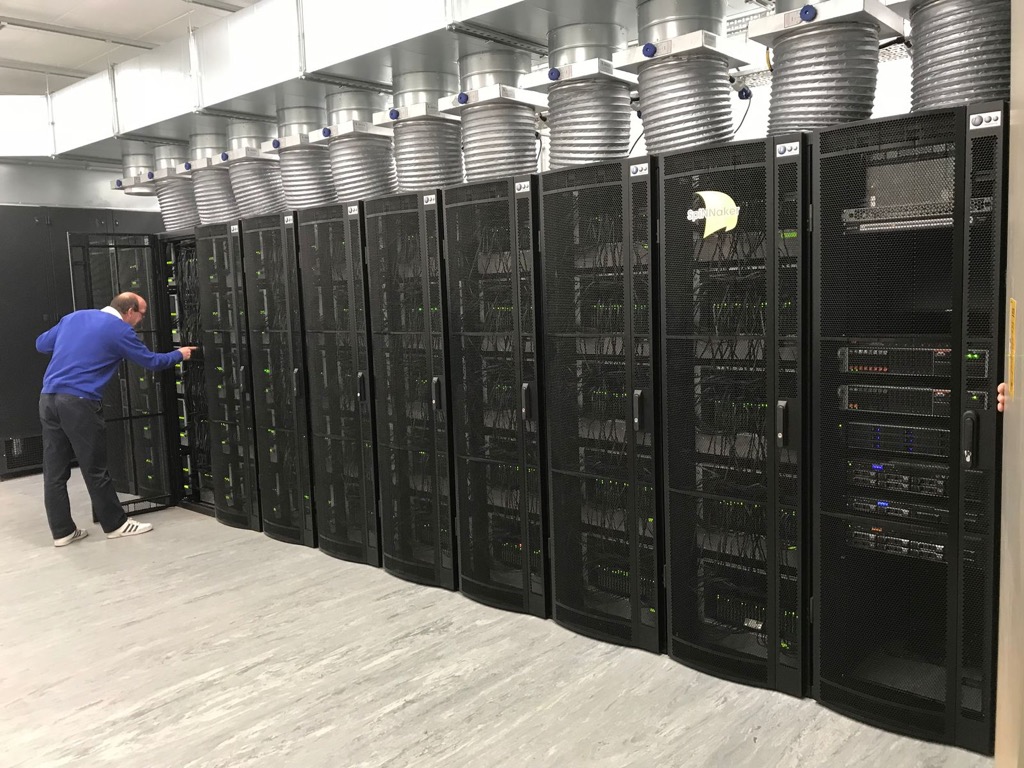
SpiNNaker was designed with massive scale in mind, and one million SpiNNakers make up the massively parallel computer that models human brain functions and runs machine learning algorithms.
Neurons, synapses and networking
Neural networks had a low profile 20 years ago. It was around 2005 when academic Geoffrey Hinton had a breakthrough that enabled deep learning to take off. Hinton joined Google in 2013 and recently resigned from the company to allow him to express his concerns about AI.
Furber’s neural network work took time; funding for the SpiNNaker design began in 2005, seven years after the inexact associative memory began.
Furber started by looking at how to model neural networks in hardware more efficiently: neurons and synapses.
“The synapse is a complex function which, my biological colleagues tell me, has 1,500 proteins; the presence or absence of each affects how it behaves,” says Furber. “So you have very high dimensional space around one synapse in reality.”
Furber and his team tackled such issues as how to encode the relevant equations in hardware and how the chips were to be connected, given the connectivity topology of the human brain is enormous.
A brain neuron typically connects to 10,000 others. Specific cells in the cerebellum, a part of the human brain that controls movement and balance, have up to 250,000 inputs.
“How do they make a sensible judgment, and what’s happening on these quarter of a million impulses is a mystery,” says Furber.
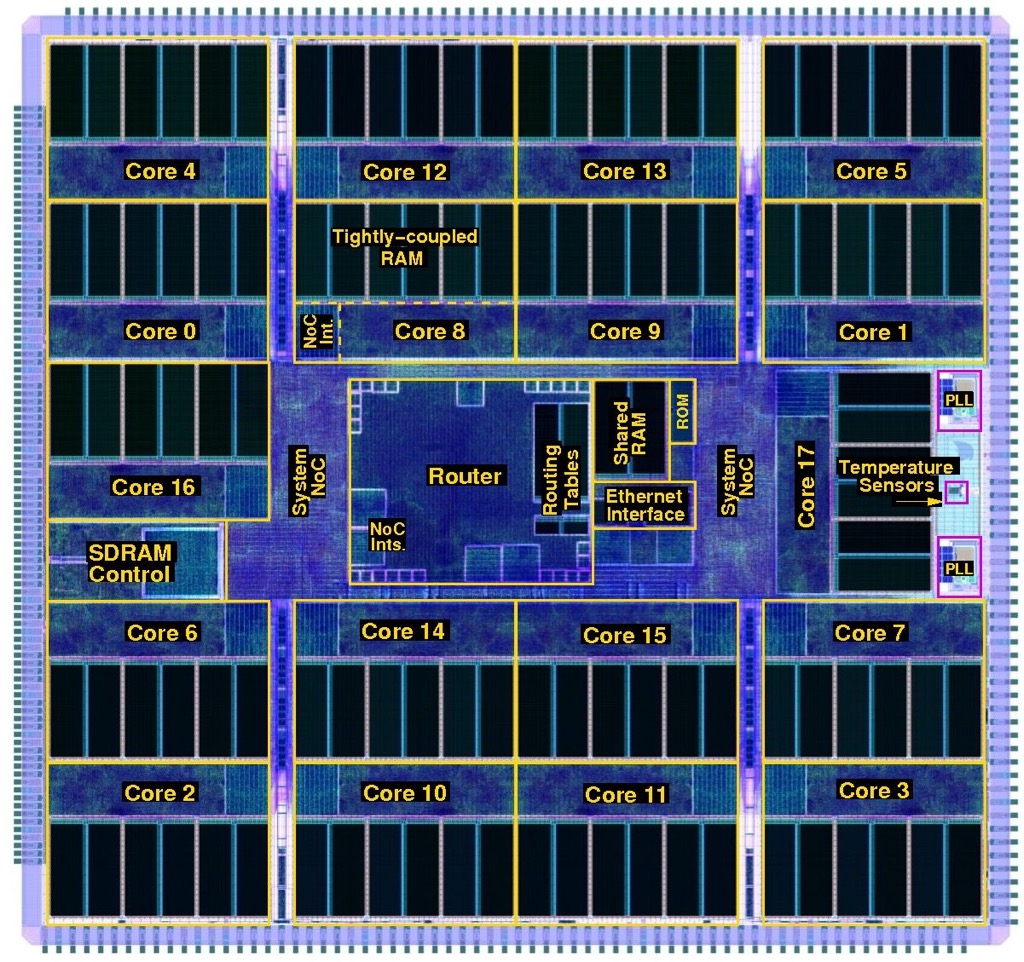
SpiNNaker design
Neurons communicate by sending electrical spikes, asynchronous events that encapsulate information in the firing patterns, so the SpiNNaker would have to model such spiking neurons.
In the human brain, enormous resources are dedicated to communication; 100 billion (1011) neurons are linked by one quadrillion (1015) connections.
For the chip design, the design considerations included how the inputs and outputs would get into and out of the chip and how the signals would be routed in a multi-chip architecture.
Moreover, each chip would have to be general purpose and scalable so that the computer architecture could implement large brain functions.
Replicating the vast number of brain connections electronically is impractical, so Furber and his team exploited the fact that electronic communication is far faster than the biological equivalent.
This is the basis of SpiNNaker: electrical spikes are encapsulated as packets and whizzed across links. The spikes reach where they need to be in less than a millisecond to match biological timescales.
The neurons and synapses are described using mathematical functions solved on the Arm-based processor using fixed-point arithmetic.
SpiNNaker took five years to design. This sounds a long time, especially when the Arm1 took 18 months, until Furber explains the fundamental differences between the two projects.
“Moore’s Law has delivered transistors in exponentially growing abundance,” he says. “The Arm1 had 25,000 transistors, whereas the SpiNNaker has 100 million.”
Also, firms have tens or even 100s of engineers designing chips; the University of Manchester’s SpiNNaker team numbered five staff.
One critical design decision that had to be made was whether a multi-project wafer run was needed to check SpiNNaker’s workings before committing to production.
“We decided to go for the full chip, and we got away with it,” says Furber. Cutting out the multi-project wafer stage saved 12% of the total system build cost.
The first SpiNNaker chips arrived in 2010. First test boards had four SpiNNaker chips and were used for software development. Then the full 48-chip boards were made, each connecting to six neighbouring ones.

The first milestone was in 2016 when a half-million processor machine was launched and made available for the European Union’s Human Brain Project. The Human Brain Project came about as an amalgam of two separate projects; modelling of the human brain and neuromorphic computing.
This was followed in 2018 by the entire one million SpiNNaker architecture.
“The size of the machine was not the major constraint at the time,” says Furber. “No users were troubled by the fact that we only had half a million cores.” The higher priority was improving the quality and reach of the software.
Programming the computer
The Python programming language is used to program the SpiNNaker parallel processor machine, coupled with the Python Neural Network application programming interface (PyNN API).
PyNN allows neuroscientists to describe their networks as neurons with inputs and outputs (populations) and how their outputs act as inputs to the next layer of neurons (projections).
Using this approach, neural networks can be described concisely, even if it is a low-level way to describe them. “You’re not describing the function; you’re describing the physical instantiation of something,” says Furber.
Simulators are available that run on laptops to allow model development. Once complete, the model can be run on the BrainScaleS machine for speed or the SpiNNaker architecture if scale is required.
BrainScaleS, also part of the Human Brain Project, is a machine based in Heidelberg, Germany, that implements models of neurons and synapses at 1000x biological speeds.
Modeling the brain
The SpiNNaker computer became the first to run a model of the segment of a mammalian cortex in real biological time. The model of the cortex was developed by Jülich Research Centre in Germany.
“The cortex is a very important part of the brain and is where most of the higher-level functions are thought to reside,” says Furber.
When the model runs, it reproduces realistic biological spiking in the neural network layers. The problem, says Furber, is that the cortex is poorly understood.
Neuroscientists have a good grasp of the Cortex’s physiology – the locations of the neurons and their connections, although not their strengths – and this know-how is encapsulated in the PyNN model.
But neuroscientists don’t know how the inputs are coded or what the outputs mean. Furber describes the Cortex as a black box with inputs and outputs that are not understood.
“What we are doing is building a model of the black box and asking if the model is realistic in the sense that it reproduces something we can sensibly measure,” says Furber
For neuroscientists to progress, the building blocks must be combined to form whole brain models to understand how to test them.
At present, the level of testing is to turn them on and see if they produce realistic spike patterns, says Furber.
SpiNNaker 2
A second-generation SpiNNaker 2 device has been developed, with the first silicon available in late 2022 while the first large SpiNNaker 2 boards are becoming available.
The original SpiNNaker was implemented using a 130nm CMOS process, while SpiNNaker 2 is implemented using a 22nm fully depleted silicon on insulator (FDSOI) process.
SpiNNaker 2 improves processing performance by 50x such that a SpiNNaker 2 chip exceeds the processing power of the 48- SpiNNaker printed circuit board.
SpiNNaker 2’s design is also more general purpose. A multiply-accumulator engine has been added for deep learning AI. The newer processor also has 152 processor engines compared to Spinnaker’s 18, and the device includes dynamic power management.
“Each of the 152 processor engines effectively has its dynamic voltage and frequency scaling control,” says Furber. “You can adjust the voltage and frequency and, therefore, the efficiency for each time step, even at the 0.1-millisecond level; you look at the incoming workload and just adjust.”
The University of Technology Dresden has been awarded an $8.8 billion grant to build a massively parallel processor using 10 million SpiNNaker 2 devices.
The university is also working with German automotive firms to develop edge-cloud applications using SpiNNaker 2 to process sensor data with milliseconds latency.
The device is also ideal for streaming AI applications where radar, video or audio data can be condensed close to where it is generated before being sent for further processing in the cloud.
Furber first met with the University of Technology Dresden’s neuromorphic team via the Human Brain Project.
The teams decided to collaborate, given Dresden’s expertise in industrial chip design complementing Furber and his team’s system expertise.
Takeaways
“We are not there yet, says Furber, summarizing the brain work in general.
Many practical lessons have been learnt from the team’s research work in developing programmable hardware at a massive scale. The machine runs brain models in real time, demonstrating realistic brain behaviour.
“We’ve built a capability,” he says. “People are using this in different ways: exploring ideas and exploring new learning rules.
In parallel, there has also been an explosion in industrial AI, and a consensus is emerging that neuromorphic computing and mainstream AI will eventually converge, says Furber.
“Mainstream AI has made these huge advances but at huge cost,” says Furber. Training one of these leading neural networks takes several weeks consuming vast amounts of power. “Can Neuromorphics change that?”
Mainstream AI is well established and supported with compelling tools, unlike the tools for neuromorphic models.
Furber says the SpiNNaker technology is proven and reliable. The Manchester machine is offered as a cloud service and remained running during the pandemic when no one could enter the university.
But Furber admits it has not delivered any radical new brain science insights.
“We’ve generated the capability that has that potential, but no results have been delivered in this area yet, which is a bit disappointing for me,” he says.
Will devices like SpiNNaker impact mainstream AI?
“It’s still an open question,” says Furber. “It has the potential to run some of these big AI applications with much lower power.”
Given such hardware is spike-driven, it only processes when spiking takes place, saving energy. As does the nature of the processing, which is sparse, areas of the chip tend to be inactive during spiking.
Professor Emeritus
Furber is approaching retirement. I ask if he wants to continue working as a Professor Emeritus. “I hope so,” he says. “I will probably carry on at that moment.”
He also has some unfinished business with model aircraft. “I’ve never lost my itch to play with model aeroplanes, maybe I’ll have time for that,” he says.
The last time he flew planes was when he was working at Acorn. “Quite often, the aeroplanes came back in one piece,” he quips.
For Part 1: From 8-bit micros to the modeling the human brain, click here
Further information
Podcast: SpiNNaker 2: Building a Brain with 10 Million CPUs

The computing problem of our time: Moving data
- Celestial AI’s Photonic Fabric technology can deliver up to 700 terabits per second of bidirectional bandwidth per chip package.
- The start-up has recently raised $100 million in funding.
The size of AI models that implement machine learning continue to grow staggeringly fast.
Such AI models are used for computer vision, large language models such as ChatGPT, and recommendation systems that rank items such as search results and music playlists.
The workhorse silicon used to build such AI models are graphics processing units (GPUs). GPU processing performance and their memory size may be advancing impressively but AI model growth is far outpacing their processing and input-output [I/O] capabilities.
To tackle large AI model workloads, hundreds and even thousands of GPUs are deployed in parallel for boost overall processing performance and high-performance memory storage capacity.
But it is proving hugely challenging to scale such parallel systems and feed sufficient data to the expensive processing nodes so they can do their work.
Or as David Lazovsky, CEO of start-up Celestial AI puts it, data movement has become the computing problem of our time.
Input-output bottleneck
The data movement challenge and scaling hardware for machine learning has caused certain AI start-ups to refocus, looking beyond AI processor development to how silicon photonics can tackle the input-output [I/O] bottleneck.
Lightelligence is one such start-up; Celestial AI is another.
Founded in 2020, Celestial AI has raised $100 million in its latest round of funding, and $165 million overall.
Celestial AI’s products include the Orion AI processor and its Photonic Fabric, an optoelectronic system-in-package comprising a silicon photonics chip and the associated electronics IC.
The Photonic Fabric uses two technological differentiators: a thermally stable optical modulator, and an electrical IC implemented in advanced CMOS.

Thermally stable modulation
Many companies use a ring resonator modulator for their co-packaged optics designs, says Lazovsky. Ring resonator modulators are tiny but sensitive to heat, so they must be temperature-controlled to work optimally.
“The challenge of rings is that they are thermally stable to about one degree Celsius,” says Lazovsky.
Celestial AI uses silicon photonics as an interposer such that it sits under the ASIC, a large chip operating at high temperatures.
“Using silicon photonics to deliver optical bandwidth to a GPU that’s running at 500-600 Watts, that’s just not going to work for a ring,” says Lazovsky, adding that even integrating silicon photonics into memory chips that consume 30W will not work.
Celestial AI uses a 60x more thermally stable modulator than a ring modulator.
The start-up uses continuous wave distributed feedback laser (DFB) lasers as the light source, the same lasers used for 400-gigabit DR4 and FR4 pluggable transceivers, and sets their wavelength to the high end of the operating window.
The result is a 60-degree operating window where the silicon photonics circuits can operate. “We can also add closed-loop control if necessary,” says Lazovsky.
Celestial AI is not revealing the details of its technology, but the laser source is believed to be external to the silicon photonics chip.
Thus a key challenge is getting the modulator to work stably so close to the ASIC, and this Celestial AI says it has done.
Advanced CMOS electronics
The start-up says TSMC’s 4nm and 5nm CMOS are the process nodes to be used for the Photonic Fabric’s electronics IC accompanying the optics.
“We are qualifying our technology for both 4nm and 5nm,” says Lazovsky. “Celestial AI’s current products are built using TSMC 5nm, but we have also validated the Photonic Fabric using 4nm for the ASIC in support of our IP licensing business.”
The electronics IC includes the modulator’s drive circuitry and the receiver’s trans-impedance amplifier (TIA).
Celestial AI has deliberately chosen to implement the electronics in a separate chip rather than use a monolithic design as done by other companies. With a monolithic chip, the optics and electronics are implemented using the same 45nm silicon photonics process.
But a 45nm process for the electronics is already an old process, says the start-up.
Using state-of-the-art 4nm or 5nm CMOS cuts down the area and the power requirements of the modulation driver and TIA. The optics and electronics are tightly aligned, less than 150 microns apart.
“We are mirroring the layout of our drivers and TIAs in electronics with the modulator and the photodiode in silicon photonics such that they are directly on top of each other,” says Lazovsky.
The proximity ensures a high signal-to-noise ratio; no advanced forward error correction (FEC) scheme or a digital signal processor (DSP) is needed. The short distances also reduce latency.
This contrasts with co-packaged optics, where chiplets surround the ASIC to provide optical I/O but take up valuable space alongside the ASIC edge, referred to as beachfront.
If the ASIC is a GPU, such chiplets must compete with stacked memory packages – the latest version being High Bandwidth Memory 3 (HBM3) – that also must be placed close to the ASIC.
There is also only so much space for the HBM3’s 1024-bit wide interface to move data, a problem also shared by co-packaged optics, says Lazovsky.
Using the Universal Chiplet Interconnect Express (UCIe) interface, for example, there is a limit to the bandwidth that can be distributed, not just to the chip but across the chip too.
“The beauty of the Photonic Fabric is not just that we have much higher bandwidth density, but that we can deliver that bandwidth anywhere within the system,” says Lazovsky.
The interface comes from below the ASIC and can deliver data to where it is needed: to the ASIC’s compute engines and on-chip Level 2 cache memory.
Bandwidth density
Celestial AI’s first-generation implementation uses four channels of 56 gigabits of non-return-to-zero signalling to deliver up to 700 terabit-per-second (Tbps) total bidirectional bandwidth per package.
How this number is arrived have not been given, but it is based on feeding the I/O via the ASIC’s surface area rather than the chip’s edges.
To put that in perspective, Nvidia’s latest Hopper H100 Tensor Core GPU uses five HBM3 sites. These sites deliver 80 gigabytes of memory and over three terabytes-per-second – 30Tbps – total memory bandwidth.”
The industry trend is to add more HBM memory in-package, but AI models are growing hundreds of times faster. “You need orders of magnitude more memory for a single workload than can fit on a chip,” he says.
Accordingly, vast amounts of efficient I/O are needed to link AI processors to remote pools of high-bandwidth memory by disaggregating memory from compute.
Celestial AI is now working on its second-generation interface that is expected in 18 months. The newer interface quadruples the package bandwidth to >2,000Tbps. The interface uses 4-level pulse amplitude modulation (PAM-4) signaling to deliver 112Gbps per channel and doubles the channel count from four to eight.
“The fight is about bandwidth density, getting large-scale parameters from external memory to the point of computing as efficiently as possible,” says Lazovsky,
By efficiently, Lazovsky means bandwidth, energy, and latency. And low latency for AI applications translates to revenues.
Celestial AI believes its Photonics Fabric technology is game-changing due to the bandwidth density achieved while overcoming the beachfront issue.
Composible memory
Celestial AI changed its priorities to focus on memory disaggregation after working with hyperscalers for the last two years.
The start-up will use its latest funding to expand its commercial activities.
“We’re building optically interconnected, high-capacity and high-bandwidth memory systems to allow our customers to develop composable resources,” says Lazovsky.
Celestial AI is using its Photonic fabric to enable 16 servers (via PCI Express cards) to access a single high-capacity optical-enabled DDR, HBM and hybrid pooled memory.
Another implementation will use its technology in chiplet form via the UCIe interface. Here, the bandwidth is 14.4Tbps, more than twice the speed of the leading co-packaged optics solutions.
Celestial AI also has an optical multi-chip interconnect bridge (OMIB), enabling an ASIC to access pooled high-capacity external memory in a 40ns round trip. OMIB can also be used to link chips optically on a multi-chip module.
Celestial AI stressed that its technology is not limited to memory disaggregation. The Photonic Fabric came out of the company looking to scale multiples of its Orion AI processors.
Celestial AI supports the JEDEC HBM standard and CXL 2.0 and 3.0, as well as other physical interface technologies such as Nvidia’s NVlink and AMD’s Infinity fabric.
“It is not limited to our proprietary protocol,” says Lazovsky.
The start-up is in discussions with ‘multiple’ companies interested in its technology, while Broadcom is a design services partner. Near Margalit, vice president and general manager of Broadcom’s optical systems division, is a technical advisor to the start-up.
Overall, the industry trend is to move from general computing to accelerated computing in data centres. That will drive more AI processors and more memory and compute disaggregation.
“It is optical,” says Lazovsky: “There is no other way to do it.”

Using light to connect an AI processor’s cores
Lightelligence is using silicon photonics to connect 64 cores of its AI processor. But the company has bigger ambitions for its optical network-on-chip technology
Lightelligence has unveiled its optical network-on-chip designed to scale multiprocessor designs.
The start-up’s first product showcasing the technology is the Hummingbird, a system-in-package that combines Lightelligence’s 64-core artificial intelligence (AI) processor and a silicon photonics chip linking the processor’s cores.
A key issue impeding the scaling of computing resources is the ‘memory wall’ which refers to the growing gap between processor and memory speeds, causing processors to be idle as they wait for data to crunch.
“The memory wall is a genuine problem,” says Maurice Steinman, vice president of engineering at Lightelligence. “Even with the generational scaling of computing, the input-output (I/O) and access to off-chip communications are struggling to keep up.”
Lightelligence has developed Hummingbird to show how its optical networking approach could be used to scale multi-chip designs.
Origins
Lightelligence, an MIT spin-out, is a fabless chip company founded in 2017. The start-up has 200 engineers and has raised over $200 million in funding. Now, after five years, the company is beginning to generate revenues.
The company started by using nanophotonics to tackle such computations as matrix multiplications and linear algebra.
After two years, the focus broadened to include communications. There is no point in developing a low-latency analogue compute engine only to then encounter I/O and scaling issues, says Steinman.
Optical network-on-chip
The start-up is pursuing two communication tracks. The first is developing board-to-board or rack-to-rack communications based on optical transceivers and fibre. The second is communications at a smaller, system-in-package or chip-to-wafer scale, with Hummingbird and the optical network-on-chip being the first example.
“How do we address the challenges of purely electronic solutions today?” says Steinman. “How can we use photonics and an optical waveguide-based solution to get back some of the limitations there?”
The issue is that while chips can now have transistor counts in the tens of billions, a dimensions of the die are limited to some 800mm2, dictated by the reticule size. A multi-chip module or a chiplet approach is needed if additional computation is required.
“Ideally, you would want the performance to scale with the sum of silicon area; if I’ve got N chips, I want pure linear scaling,” says Steinman.
The issue with multiple chips is that they need interfaces which introduce communication and power consumption issues. And with an array of chips, a scheduler must oversee workload assignment to the processors as they become available.
“You’ve got all these interfaces, you’ve got queuing delay, you’ve got contention, you have multiple messages trying to contend for the same path,” says Steinman. “It is hard to see all that in multiple dimensions.”
Lightelligence wants to use optical networking to enable routing topologies linking compute resources that are impractical if attempted electronically.
“That’s the breakthrough we’re trying to bring to the world,” says Steinman. “What we are calling optical network-on-chip.”
The first implementation uses a network to link cores of a single-chip parallel processor, while the goal is to extend the networking beyond the chip scale, he says.
Lightelligence believes the technology will be attractive to silicon vendors facing similar scale-out issues. And by having a functioning device, the start-up has credibility when approaching potential customers.
“We want to work with them to design a purpose-built semi-custom solution because I’m sure every scale-out solution has different topology needs,” says Steinman.
Architecture
The Hummingbird device uses programmable cores that implement scalar, vector, and matrix operations, including 2D convolution. Such computations are accelerated using the optical network-on-chip with convolution used to implement a convolutional neural network for AI.
The chip includes a central instruction unit to implement a single-instruction, multiple-data (SIMD) architecture; each core performing the same operation on part of the data set.
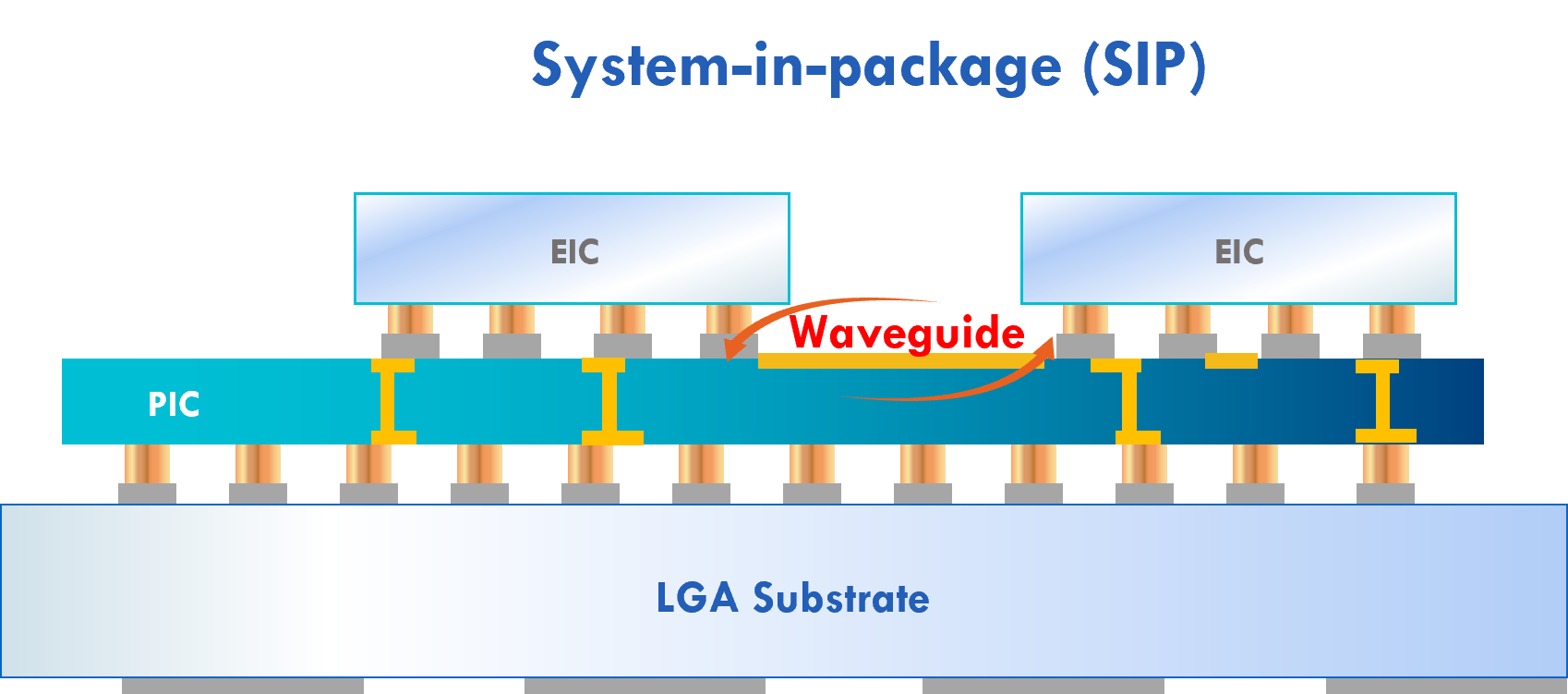
To aid the computation, each core has an optical broadcast transmitter. Every core can send and also receive data from every other core using the silicon photonics chip’s splitters and optical waveguides.
The ratio used by the optical-network-on-chip is 64 optical transmitters and 512 optical receivers rather than 64×64 optical receivers. This simplifies the optical design’s complexity, with electronics being used for the final stage to get data to particular cores in eight-core clusters.
“It is an all-to-all broadcast, an unusual topology,” says Steinman. “But in doing that, we have put a lot of transmitters and receivers on our companion photonic die that goes with the electronic [AI processor] die in Hummingbird.”
Lightelligence says the silicon photonics chip could implement other topologies, such as a 2D torus, for example.
Benefits
The motivation for the Lightelligence design is to achieve linear scaling, beyond what Hummingbird is showing for the single chip design. That said, the design already shows that many optical transmitters and receivers can be integrated into a dense space.
Lightelligence’s approach is also pragmatic. It has taken several years to develop Hummingbird and the start-up didn’t want to wait before developing a wafer-scale solution.
“There’s a little bit of constraining the problem to a single die, which is not the optimal proof point for it,” says Steinman. “But now we have a tangible working thing that gives us credibility for those higher-scale conversations.”
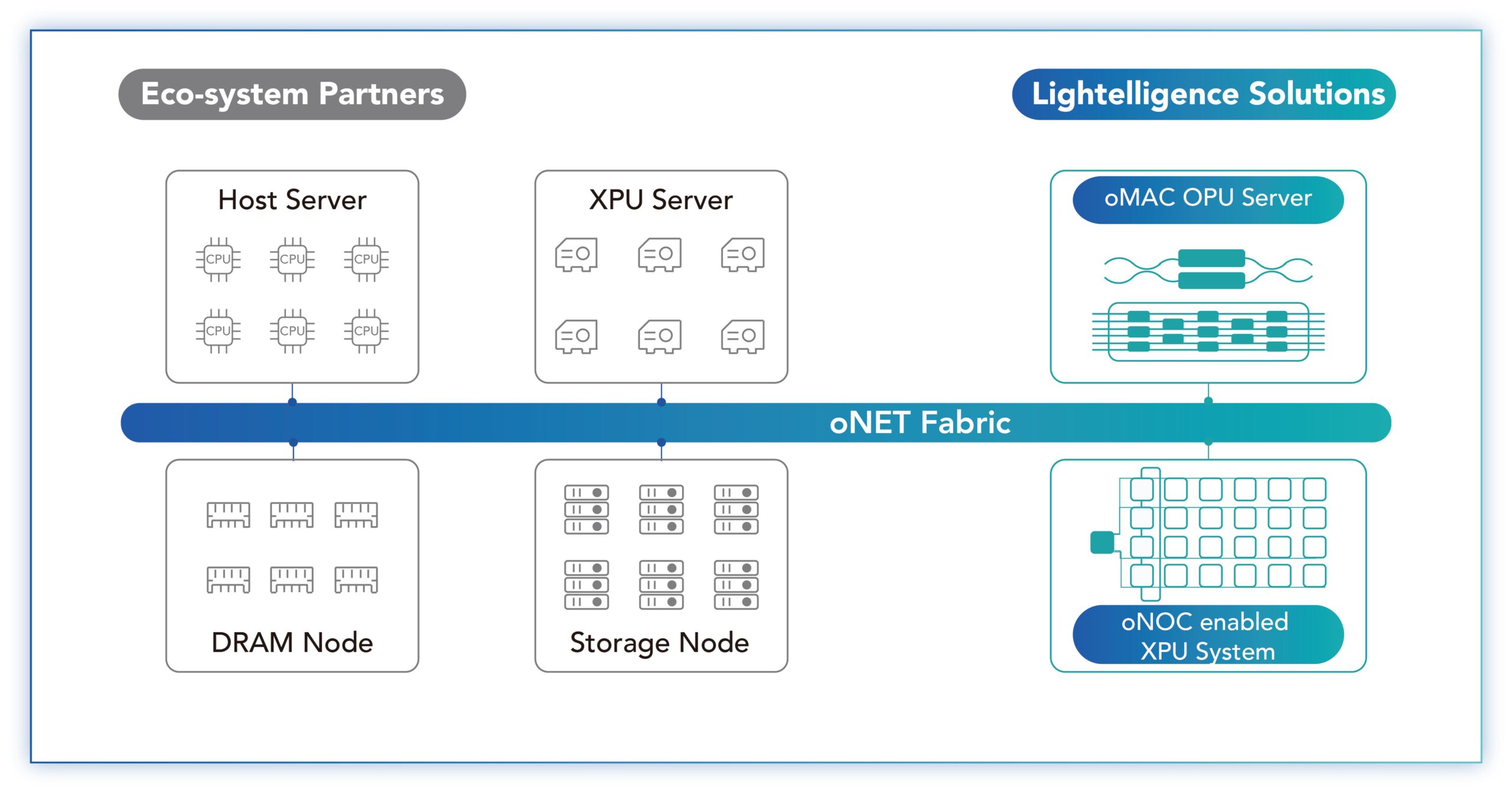
Steinman says the limit using the optical-network-on-chip technology is a wafer-sized design. Scaling beyond a wafer will require conventional optical interface technology (oNET, see diagram below) which Lightelligence is also developing.
Customers
The start-up has developed a PCI Express (PCIe) plug-in card that hosts the Hummingbird system-in-package. “It is a programmable machine; it does have an instruction set, compiler, and toolchain,” says Steinman.
Samples are with early adopter customers with AI inference tasks and Lightelligence is awaiting their feedback. “That next level of feedback is really important for our commercial objectives,” says Steinman.
Lightelligence also wants to partner with chip companies to start working on what Steinman calls ‘semi-custom’ engagements. “What are their problems that need to be solved, and how can we help?” he says.
Lightelligence will demonstrate the Hummingbird at the Hot Chips 2023 event in late August at Stanford University. Details of the device’s performance will also be revealed.

Fibre to everywhere
For years, passive optical networks (PON) were all about fibre-to-the-premise, particularly fibre-to-the-home. Japan, South Korea, and China led the market with massive PON deployments.
“Now the focus is on fibre-to-everywhere, whether it’s a home, a business, a school, a university, an enterprise, a traffic light,” says Julie Kunstler, chief analyst, broadband access intelligence at Omdia.
Meanwhile, in the US, government funding is spurring fibre deployments, especially in underserved areas.
PON usage
Omdia conducted a 25-gigabit and 50-gigabit PON survey (see chart above) earlier this year that included basic questions such as how operators use PON infrastructure.
Many service providers use PON for other applications besides residential services to grow revenues.
“There are a good number of operators that are using that same PON infrastructure for business services, especially with XGS-PON 10-Gigabit PON,” says Kunstler. “A symmetrical 2-gigabit, 5-gigabit, 8-gigabit link is certainly enough for many small and medium-sized businesses.”
This requires the operator to undertake software integration involving the operations support system (OSS) and business support system (BSS) to manage subscriptions and billing for the two classes of customers.
The survey also highlighted PON being used for transport, not just wireless backhaul but traffic aggregation. “Once you have XGS-PON in place, you have a lot of capability to haul data around,” says Kunstler.
Vendors have responded with more varied equipment, not just PON optical line terminals (OLTs) for the central office.
For the central office, a key driver has been to reduce the space a PON chassis occupies, requiring denser line cards and port densities per line card. But OLTs are also being deployed in the field that support residential users and other applications with requirements such as low latency.
Government funding
Funding for broadband in the US, Europe, and the UK have increased since Covid, highlighting its crucial role.
“It [Covid] created two classes of people, those that could participate in the remote hybrid work environment, and those that could not,” says Robert Conger, senior vice president of technology and strategy at Adtran.

Conger stresses there has always been government funding for broadband, but it was a fraction of what is now being earmarked.
In the US, two significant funds have been added to the Rural Digital Opportunity Fund (RDOF), the Federal Communications Commission initiative that existed before Covid. RDOF is a $20.8 billion programme funded in two phases.
The two significant new funds are the American Rescue Plan, a $25 billion to invest in affordable high-speed internet and connectivity and the $42.5 billion for deployments in underserved areas, known as the Broadband Equity, Access, and Deployment (BEAD) programme.
“The funding will find its way into the service providers’ hands late next year, while 2025 and 2026 will be the big years,” says Conger.
The European Union (EU), comprising 27 member countries, has defined broadband as an essential service for its citizens, like electricity and water. The EU’s goal is to offer complete coverage (100 megabit-per-sec) in rural areas by 2025, while by 2030, the goal is to deliver a gigabit network to all EU households.
In Italy, for example, the plan was to spend 3% ($8.3 billion) of an EU emergency package on broadband, 5G and satellite infrastructure. The EU package was awarded in 2021 to aid Italy’s recovery following Covid.
Meanwhile, the UK government has the £5 billion ($6.4 billion) Project Gigabit to provide broadband to rural areas currently ignored by the CSPs.
These fundings enable operators to deploy ‘fibre all the way’ and use the infrastructure for applications alongside residential services. Indeed, the funds can be seen as a one-off subsidy enabling fibre deployments in regions previously ignored by operators due to the lack of a viable business case.
Broadband solutions
The US broadband funding has also grown the PON vendor landscape and diversity of solutions, says Kunstler.
PON equipment can be added to switches and routers and to digital nodes being deployed by cable operators. Such equipment enables the operators to make pointed PON deployments, which Kunstler calls ‘surgical PON’. This allows an operator to deploy quickly to benefit from regions where a quicker uptake is expected or to respond to competition.
“We’re seeing that type of surgical approach being done by the larger US cable operators and by several telcos,” she says.
Such cable operators have already invested heavily in their networks, and with the deployment of DOCSIS 3.1 technology, their coax networks continue to support increased broadband speeds. But such cable operators can now add PON selectively where there is more demand or competition.
Equally, the US has many small cable operators with pockets of subscribers, each with typically several thousand consumers. Instead of upgrading to DOCSIS 3.1 running over their coax cable assets, small operators may decide to go to fibre and use PON to serve such users.
Another broadband technology suited to more remote deployments is fixed wireless access. To date, fixed wireless access remains the most successful 5G business case in generating new revenues for an operator.
Fixed wireless access’s issue, says Kunstler, is that it is not the best use of finite spectrum, and the service has experienced consumer churn as the quality of experience decreases as more subscribers join.
However, Omdia does see the value of fixed wireless access for some rural regions and urban neighbourhoods.
25G and 50G PON
A key advantage of fibre is its ability to support bandwidth increases. “You can easily increase your bandwidth over fibre by changing out the GPON for XGS-PON or, in the future, 25-gigabit or 50-gigabit PON and whatever comes after that,” says Kunstler.

A benefit of PON is that such upgrades can be done without touching the optical distribution plant.
The cost of customer premise equipment has also come down such that several US operators are deploying fibre and XGS-PON or 10G-EPON with 10-gigabit endpoints because it costs less than doing a truck roll when the customer eventually upgrades.
“We are seeing a very strong appetite for 1 gigabit and multi-gigabit services,” says Kunstler. A multi-gigabit service to the home only costs a few dollars more, and no household users complain when there is ample bandwidth to be shared.
Another factor is energy savings for the operator. XGS-PON has a 4x bandwidth increase on GPON but doesn’t consume 4x the power.
Meanwhile, Adtran’s Conger believes that a lot of fibre will be put into the ground in the US over five years, involving many smaller operators.
Conger’s parents live in a rural area of the US and do not have broadband, but at last, a local utility is installing fibre. “They will have it soon, so it [the government programme] is having an impact,” he says.

Broadcom's first Jericho3 takes on AI's networking challenge
Add Content
Broadcom’s Jericho silicon has taken an exciting turn.
The Jericho devices are used for edge and core routers.
But the first chip of Broadcom’s next-generation Jericho is aimed at artificial intelligence (AI); another indicator, if one is needed, of AI’s predominance.
Dubbed the Jericho3-AI, the device networks AI accelerator chips that run massive machine-learning workloads.
AI supercomputers
AI workloads continue to grow at a remarkable rate.
The most common accelerator chip used to tackle such demanding computations is the graphics processor unit (GPU).
GPUs are expensive, so scaling them efficiently is critical, especially when AI workloads can take days to complete.
“For AI, the network is the bottleneck,” says Oozie Parizer, (pictured) senior director of product management, core switching group at Broadcom.
Squeezing more out of the network equates to shorter workload completion times.
“This is everything for the hyperscalers,” says Parizer. “How quickly can they finish the job.”
Broadcom shares a chart from Meta (below) showing how much of the run time for its four AI recommender workloads is spent on networking, moving the data between the GPUs.

In the worse case, networking accounts for three fifths (57 per cent) of the time during which the GPUs are idle, waiting for data.
Scaling
Parizer highlights two trends driving networking for AI supercomputers.
One is the GPU’s growing input-output (I/O), causing a doubling of the interface speed of network interface cards (NICs). The NIC links the GPU to the top-of-rack switch.
The NIC interface speeds have progressed from 100 to 200 to now 400 gigabits and soon 800 gigabits, with 1.6 terabits to follow.
The second trend is the amount of GPUs used for an AI cluster.
The largest cluster sizes have used 64 or 256 GPUs, limiting the networking needs. But now machine-learning tasks require clusters of 1,000 and 2,000 GPUs up to 16,000 and even 32,000.
Meta’s Research SuperCluster (RSC), one of the largest AI supercomputers, uses 16,000 Nvidia A100 GPUs: 2,000 Nvidia DGX A100 systems each with eight A100 GPUs. The RSC also uses 200-gigabit NICs.
“The number of GPUs participating in an all-to-all exchange [of data] is growing super fast,” says Parizer.
The Jericho3-AI is used in the top-of-rack switch that connects a rack’s GPUs to other racks in the cluster.
The Jericho3-AI enables clusters of up to 32,000 GPUs, each served with an 800-gigabit link.
An AI supercomputer can used all its GPUs to tackle one large training job or split the GPUs into pools running AI workloads concurrently.
Either way, the cluster’s network must be ‘flat’, with all the GPU-to-GPU communications having the same latency.
Because the GPUs exchange machine-learning training data in an all-to-all manner, only when the last GPU receives its data can the computation move onto the next stage.
“The primary benefit of Jericho3-AI versus traditional Ethernet is predictable tail latency,” says Bob Wheeler, principal analyst at Wheeler’s Network. “This metric is very important for AI training, as it determines job-completion time.”
Data spraying
“We realised in the last year that the premium traffic capabilities of the Jericho solution are a perfect fit for AI,” says Parizer.
The Jericho3-AI helps maximise GPU processing performance by using the full network capacity while traffic routing mechanisms help nip congestion in the bud.
The Jericho also adapts the network after a faulty link occurs. Such adaptation must avoid heavy packet loss otherwise the workload must be restarted, potentially losing days of work.
AI workloads use large packet streams known as ‘elephant’ flows. Such flows tie up their assigned networking path, causing congestion when another flow also needs that path.
“If traffic follows the concept of assigned paths, there is no way you get close to 100 per cent network efficiency,” says Parizer.
The Jericho3-AI, used in a top-of-rack switch, has a different approach.
Of the device’s 28.8 terabits of capacity, half connects the rack’s GPUs’ NICs and a half to the ‘fabric’ that links the rack’s GPUs to all the other cluster’s GPUs.
Broadcom uses the 14.4-terabit fabric link as one huge logical pipe over which traffic is evenly spread. Each destination Jericho3-AI top-of-rack switch then reassembles the ‘sprayed’ traffic.
“From the GPU’s perspective, it is unaware that we are spraying the data,” says Parizer.
Receiver-based flow control
Spraying may ensure full use of the network’s capacity, but congestion can still occur. The sprayed traffic may be spread across the fabric to all the spine switches, but for short periods, several GPUs may send data to the same GPU, known as incast (see diagram).

The Jericho copes with this many-to-one GPU traffic using receiver-based flow control.
Traffic does not leave the receiving Jericho chip just because it has arrived, says Parizer. Instead, the receiving Jericho tells the GPUs with traffic to send and schedules part of the traffic from each.
“Traffic ends up queueing nearer the sender GPUs, notifying each of them to send a little bit now, and now,” says Parizer, who stresses this many-to-one condition is temporary.
Ethernet flow control is used when Jericho chip senses that too much traffic is being sent.
“There is a temporary stop in data transmission to avoid packet loss in network congestion,” says Parizer. “And it is only that GPU that needs to slow down; it doesn’t impact any adjacent GPUs.”
Fault control
At Optica’s Executive Forum event, held alongside the OFC show in March, Google discussed using a 6,000 tensor processor unit (TPU) accelerator system to run large language models.
One Google concern is scaling such clusters while ensuring overall reliability and availability, given the frailty of large-scale accelerator clusters.
“With a huge network having thousands of GPUs, there is a lot of fibre,” says Parizer. “And because it is not negligible, faults happen.”
New paths must be calculated when an optical link goes down in a network arrangement that using flows and assigned paths with significant traffic loss likely.
“With a job that has been running for days, significant packet loss means you must do a job restart,” says Parizer.
Broadcom’s solution, not based on flows and assigned paths, uses load balancing to send data over one less path overall.
Using the Jericho2C+, Broadcom has shown fault detection and recovery in microseconds such that the packet loss is low and no job restart is needed.
The Jericho portfolio of devices
Broadcom’s existing Jericho2 architecture combines an enhanced packet-processing pipeline with a central modular database and a vast memory holding look-up tables.
Look-up tables are used to determine how the packet is treated: where to send it, wrapping it in another packet (tunnel encapsulation), extracting it (tunnel termination), and access control lists (ACLs).
Different stages in the pipeline can access the central modular database, and the store can be split flexibly without changing the packet-processing code.
Jericho2 was the first family device with a 4.8 terabit capacity and 8 gigabytes of high bandwidth memory (HBM) for deep buffering.
The Jericho 2C followed, targeting the edge and service router market. Here, streams have lower bandwidth – 1 and 10 gigabits typically – but need better support in the form of queues, counters and metering, used for controlling packets and flows.
Pariser says the disaggregated OpenBNG initiative supported by Deutsche Telekom uses the Jericho 2C.
Broadcom followed with a third Jericho2 family device, the Jericho 2C+, which combines the attributes of Jericho2 and Jericho2C.
Jericho2C+ has 14.4 terabits of capacity and 144 100-gigabit interfaces, of which 7.2-terabit is network interfacing bandwidth and 7.2-terabit for the fabric interface.
“The Jericho2C+ is a device that can target everything,” says Pariser.
Applications include data centre interconnect, edge and core network routing, and even tiered switching in the data centre.
Hardware design
The Jericho3-AI, made up of tens of billions of transistors in a 5nm CMOS process, is now sampling.
Broadcom says it designed the chip to be cost-competitive for AI.
For example, the packet processing pipeline is simpler than the one used for core and edge routing Jericho.
“This also translates to lower latency which is something hyperscalers also care about,” says Parizer.
The cost and power savings from optimisations will be relatively minor, says Wheeler.

Broadcom also highlights the electrical performance of the Jericho3-AI’s input-output serialiser-deserialiser (serdes) interfaces.
The serdes allows the Jericho3-AI to be used with 4m-reach copper cables linking the GPUs to the top-of-rack switch.
The serdes performance also enables linear-drive pluggables that dont have no digital signal processor (DSP) for retiming with the serdes driving the pluggable directly. Linear drive saves cost and power.
Broadcom’s Ram Valega, senior vice president and general manager of the core switching group, speaking at the Open Compute Project’s regional event held in Prague in April, said 32,000 GPU AI clusters cost around $1 billion, with 10 per cent being the network cost.

Valega showed Ethernet outperforms Infiniband by 10 per cent for a set of networking benchmarks (see diagram above).
“If I can make a $1 billion system ten per cent more efficient, the network pays for itself,” says Valega.
Wheeler says the comparison predates the recently announced NVLink Network, which will first appear in Nvidia’s DGX GH200 platform.
“It [NVLink Network] should deliver superior performance for training models that won’t fit on a single GPU, like large language models,” says Wheeler.

Brandon Collings
There are certain news items on media sites that nothing can prepare you for.
A post by Lumentum on LinkedIn paid tribute to the passing of chief technology officer (CTO) Brandon Collings, aged 51; the unfolding words revealing the magnitude of the company’s loss.
Brandon Collings was a wonderful person and a joy to know. He had that rarest gift of being able to explain complex technologies and make sense of trends with answers of extraordinary clarity.
Who else could explain the intricacies of a colourless, directionless, contentionless, flexible, reconfigurable optical add-drop multiplexer (ROADM) while describing the ROADM market as “glacially slow”?
It was a joy to meet him at shows and interview him by phone.
Early in my interviews with him, I misspelt his name in a printed article. This was a rookie mistake. His response was generous, as if to say it was a most straightforward error.
I once asked Brandon to discuss recent books he had read and rated. He didn’t have much time to read, he said, but he loved reading to his children.
One favourite book in his household was “ish” by Peter Reynolds.
It is about a young boy who loves to draw everywhere. His elder brother sees his work and mocks it.
The boy continues, striving to draw better, but the results are ‘ish’ pictures – for example, a ‘vase-ish’ drawing rather than a vase. Frustrated, he stops.
But his sister loves his ‘ish’-like sketches, giving him the confidence to return to drawing and develop his unique style, which he then extends to his life.
Brandon’s summary: “A cute story about viewing the one’s self and the world through one’s own eyes rather than through others.”
After interviewing the CTO of Ciena late last year, I decided to make it the opening of a series of CTO interviews. Brandon Collings was first on the list.
I last met with him at the OFC show in March. After meeting with him, I was to meet Verizon’s Glenn Wellbrock, and we decided Glenn would come to the Lumentum stand as a meeting place.
After finishing the interview with Brandon, I went looking for Glenn only to spot he was already with Brandon. I watched how the two warmly embraced, talked animatedly and were delighted to share a moment.
The last time I saw Brandon was on the evening of OFC’s penultimate day.
I was in a restaurant, and we spotted Brandon and his Lumentum colleagues at a nearby table. At some point, Brandon got up, went round the table and said goodbye to his colleagues.
My impulse was to try and catch his eye and say goodbye. But he was getting a red-eye flight; he grabbed his backpack and was gone.
It is hard to imagine the void felt among his colleagues at Lumentum or by his beloved family.
The optical industry has many great, kind, and wonderful people. But this is a loss, an industry subtraction.
For me, his passing marks the industry into a before and an after.

Neil McRae: What’s next for the telecom industry
In a talk at the FutureNet World conference, held in London on May 3-4, Neil McRae explains why he is upbeat about the telecoms industry’s prospects
Neil McRae is tasked with giving the final talk of the two-day FutureNet World conference.
“Yeah, I’m on the graveyard shift,” he quips.
McRae, the former chief network architect at BT, is now chief network strategist at Juniper Network.
The talk’s title is “What’s Next”, McRae’s take on the telecom industry and how it can grow.
McRae starts with how, as a 15-year-old, he had attended an Apple Macintosh computer event at a Novotel Hotel in Hammersmith, London, possibly even this one hosting this conference.
An Apple representative had asked for his feedback as a Macintosh programmer. McRae then listed all the shortfalls programming the PC. Later, he learnt that he had been talking to Steve Jobs.
Perhaps this explains his continual focus on customers and meeting their needs.
What customers care about, says McRae, is ‘new stuff’ that makes a difference in their lives. “Quite often in telecoms, we accidentally change the world without even thinking about it,” he says
McRae cites as an example using FaceTime to watch a newborn grandchild halfway across the world.
“We do it all the time; it is a phenomenal thing about our industry,” says McRae.
The Unvarnished Truth
McRae moves to showing several market and telco survey charts from IDC and Analysys Mason, what he calls ‘The unvarnished truth’.
The first slide shows how the European enterprise communication service market is set to grow at a compound annual growth rate (CAGR) of 3% between 2020 and 2025.
“Three per cent growth, who thinks that is a great business for telcos?” says McRae. “And enterprise is what we are all depending on for big growth and change because [the] consumer [market] is pretty much flat,” says McRae.
Another chart shows similar minimal growth: a forecast that Western Europe’s mobile retail service market will grow from $102 billion in 2016 to $109 billion by 2026. Yet mobile is where the telcos spend a ton of money, he says.
“So, who thinks we should continue doing what we are doing?” McRae asks the audience.
Another forecast showing global fixed and mobile service revenues is marginally better since it includes developing nations that still lack telecommunications services.
In the UK, 95 per cent of the population is on the internet, in Europe it is 84%, says McRae: “The UK is a tough place to be to grow business.”

Telco transformation
Another slide (see above), the results of a telco survey, shows a list of topics and their impact on telco transformation. McRae asks the audience to respond to those they think will ‘save’ the industry.
He goes through the list: cloud and cloudification, artificial intelligence (AI) and machine learning, 5G, and data analytics. The audience remains muted.
The next item is application programming interfaces (APIs). Again the audience is quiet. “You have been talking about APIs for two days!” says McRae.
“The right APIs,” shouts an audience member. “Ah, yes, the right APIs,” says McRae.
McRae continues down the list, virtualisation and software-defined infrastructure, OpenRAN elements – “not sure what the elements mean” – orchestration platforms, advanced process automation (OSS/BSS), micro-services, and blockchain.
McRae says he has spent the equivalent of a small nation’s budget over his career on OSS and BSS. “Nothing is automated, and I can’t get the data I need,” he says.
McRae gives his view. He believes the cloud will help telcos, but what most excites him is AI and machine learning, and data analytics.
“Learning the insights the data tells us and using them, putting a pound sign on them,” says McRae. “We have done some of that, but there is much more to do.”
He puts up a second survey showing the priorities of European operators: customer experience and increasing operational agility.
“Finally, after years, telcos realise that customers are important,” he says.
Opportunities
The survey also highlights the telcos’ belief that they can deliver solutions for industries and enterprise customers.
“This is a massive opportunity for telcos that allows us to grow revenues, create cool technology and hire amazing engineers,” says McRae.
The transformation needed in telecoms is about customers and taking risks with customers, he says.
One opportunity is digitalisation. McRae points outs that digitalisation is a process that never stops.
The three leading Chinese operators are keenly pursuing what they call industrial digitalisation or industrial internet. For China Telecom, industrial digitalisation now accounts for a quarter of its service revenues.
“Today, it is about cloud, cloud technologies, and smartphones, but tomorrow it could be about wearables or technology that is tracking what you are doing and making your life easier,” says McRae.
Digitalisation is an expertise that the telecom industry is not putting enough effort into, he says: “And as telcos, we have a massive right to play here.”
Another opportunity is AI and data, learning from the insights present in data to grow revenue.
“We have more data than most organisations, we haven’t used it very well, and we can build upon it,” says McRae, adding that AI needs the network to be valuable and improve our lives.
With data and AI, trust is vital. “If we are not trusted as an industry, we are dead,” says McRae. But because telcos are trusted entities, they can help other organisations improve trustworthiness.
Another opportunity is using the network for humans to interact in advanced ways. Since telecoms is a resource-heavy industry, such network-aided interaction would be immediately beneficial.
For this, what is needed is a cloud-native platform that integrates well with the network, and cloud platforms are generally poorly integrated with the network, he says.
He ends his talk by returning to customers and what they want: customers expect networks and services to be always present.
This explains the telcos’ continual marginal growth, he says: “The reason we have this is because there is a big chunk of customers’ lives where they can’t rely upon the network.”
Different thinking is needed if the network is to grow beyond the smartphone. Population coverage is not enough; what is needed is total coverage.
“Wherever I am, I want to use my device, to be connected, for the things that I don’t even know is doing stuff to be able to do them without worrying about connectivity,” he says.
And that is why 6G must be about 100 per cent connectivity,” says McRae: “Either we can do it, or someone else is going to.”
With that, FutureNet comes to ends, and McRae quickly departs to embark on the next chapter in his career. `
Neil McRae will be one of the speakers at the DSP Leaders World Forum, May 23-24, 2023.

Enfabrica’s chip tackles AI supercomputing challenges

- Enfabrica’s accelerated compute fabric chip is designed to scale computing clusters comprising CPUs and specialist accelerator chips.
- The chip uses memory disaggregation and high-bandwidth networking for accelerator-based servers tackling artificial intelligence (AI) tasks.
For over a decade, cloud players have packed their data centres with x86-based CPU servers linked using tiers of Ethernet switches.
“The reason why Ethernet networking has been at the core of the infrastructure is that it is incredibly resilient,” says Rochan Sankar, CEO and co-founder of Enfabrica.
But the rise of AI and machine learning is causing the traditional architecture to change.
What is required is a mix of processors: CPUs and accelerators. Accelerators are specialist processors such as graphics processing units (GPUs), programmable logic (FPGAs), and custom ASICs developed by the hyperscalers.
It is the accelerator chips, not the CPUs, that do the bulk of the processing. Accelerators also require vast data, creating challenging input-output (I/O) and memory requirements.
At Optica’s Executive Forum event, held alongside the OFC show in March, Ryohei Urata, director and principal engineer at Google, mentioned how Google uses two computing pods – comprising 6,000 TPU accelerators – to run its large language models.
A key concern for Google is scaling such clusters while ensuring their reliability and availability. It is critical that the system is available when running a large language model, says Urata,
“As an engineer, when you’re putting stuff down, at least when you’re first start to put it together, you think, okay, this is going to work perfectly,” says Urata. “This is a perfect design, you don’t factor in failing gracefully, so that’s a key lesson.”
Google’s concern highlights that accelerator-based clusters lack the reliability of data centre server-Ethernet networks.
Accelerated compute fabric
Start-up Enfabrica has developed a chip, dubbed the accelerated compute fabric, to scale computing clusters.
“The focus of Enfabrica is on how networking and fabric technologies have to evolve in the age of AI-driven computing,” says Sankar.
AI models are growing between 8x to 275x annually, placing enormous demands on a data centre’s computing and memory resources.
“Two hundred and seventy-five times are of the order of what the large language models are increasing by, 8x is more other models including [machine] vision; recommender models are somewhere in between,” says Sankar.
Another AI hardware driver is growing end-user demand; ChatGPT gained 100 million users in the first months after its launch.
Meeting demand involves cascading more accelerators but the I/O bandwidth connected to the compute is lagging. Moreover, that gap is growing.
Sankar includes memory bandwidth as part of the I/O issue and segments I/O scaling into two: connecting CPUs, GPUs, accelerators and memory in the server, and the I/O scaling over the network.
A computing architecture for AI must accommodate greater CPUs and accelerators yet tackle the I/O bottleneck.
“To scale, it requires disaggregation; otherwise, it becomes unsustainable and expensive, or it can’t scale enough to meet processing demands,” says Sankar
“Memory disaggregation represents the last step in server disaggregation, following storage and networking,” says Bob Wheeler, principal analyst at Wheeler’s Network.
Memory expansion through disaggregation has become more urgent as GPUs access larger memories for AI training, particularly for large language modules like ChatGPT, says Wheeler.
Rethinking data connectivity
In the data centre, servers in a rack are linked using a top-of-rack switch. The top-of-rack switch also connects to the higher-capacity leaf-spine Ethernet switching layers to link servers across the data centre.
Enfabrica proposes that the higher capacity Ethernet switch leaf layer talks directly to its accelerated compute fabric chip, removing the top-of-rack switch.
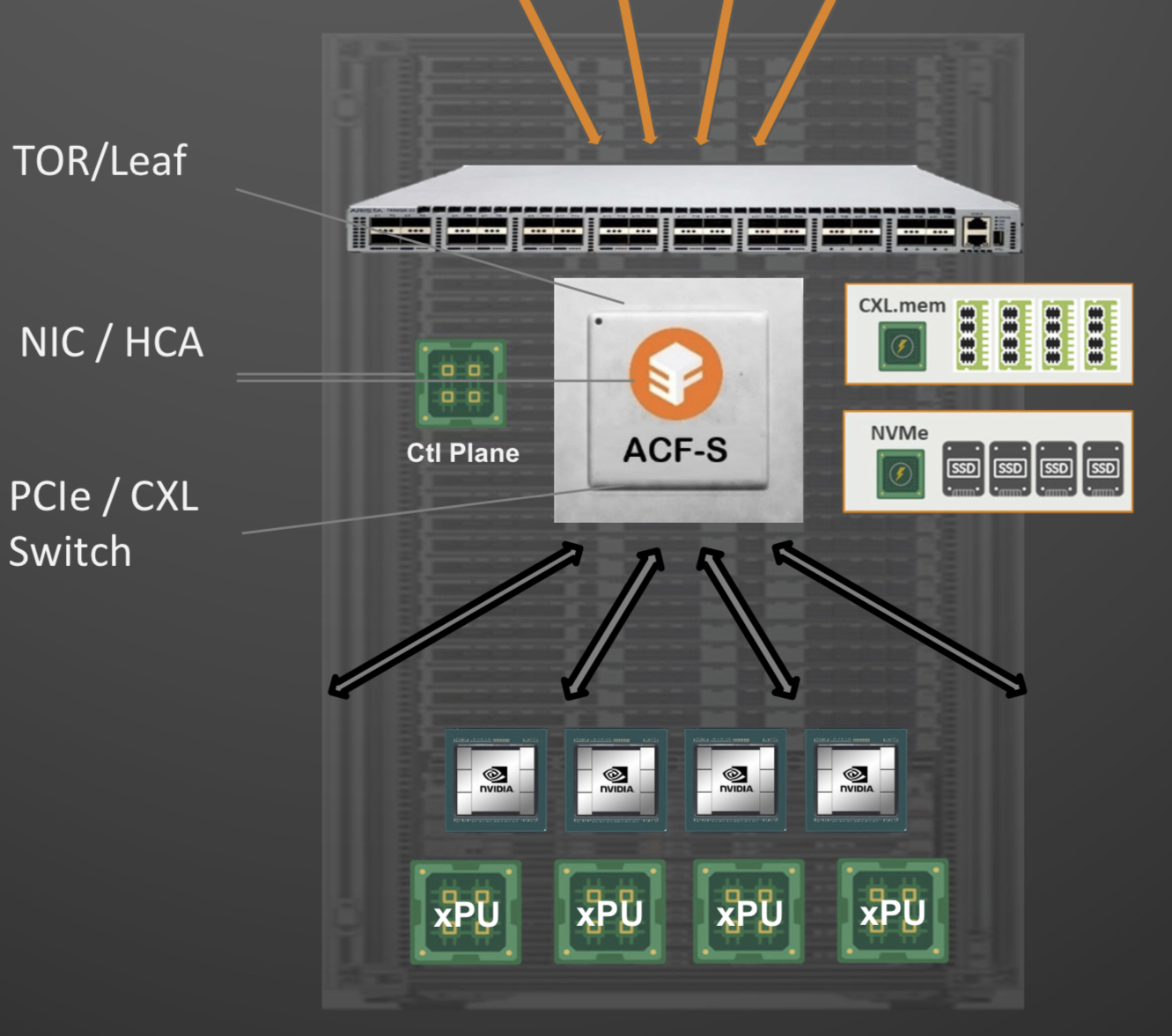
In turn, the accelerated compute fabric uses memory mapping to connect CPUs, accelerators, disaggregated memory pools using CXL, and disaggregated storage (see diagram above).
The memory can be a CPU’s DDR DRAM, a GPU’s high-bandwidth memory (HBM), a disaggregated compute express link (CXL) memory array, or storage.
“It [the accelerated compute fabric] connects to them over standard memory-mapped interfaces such as PCI Express (PCIe) or CXL,” says Sankar.
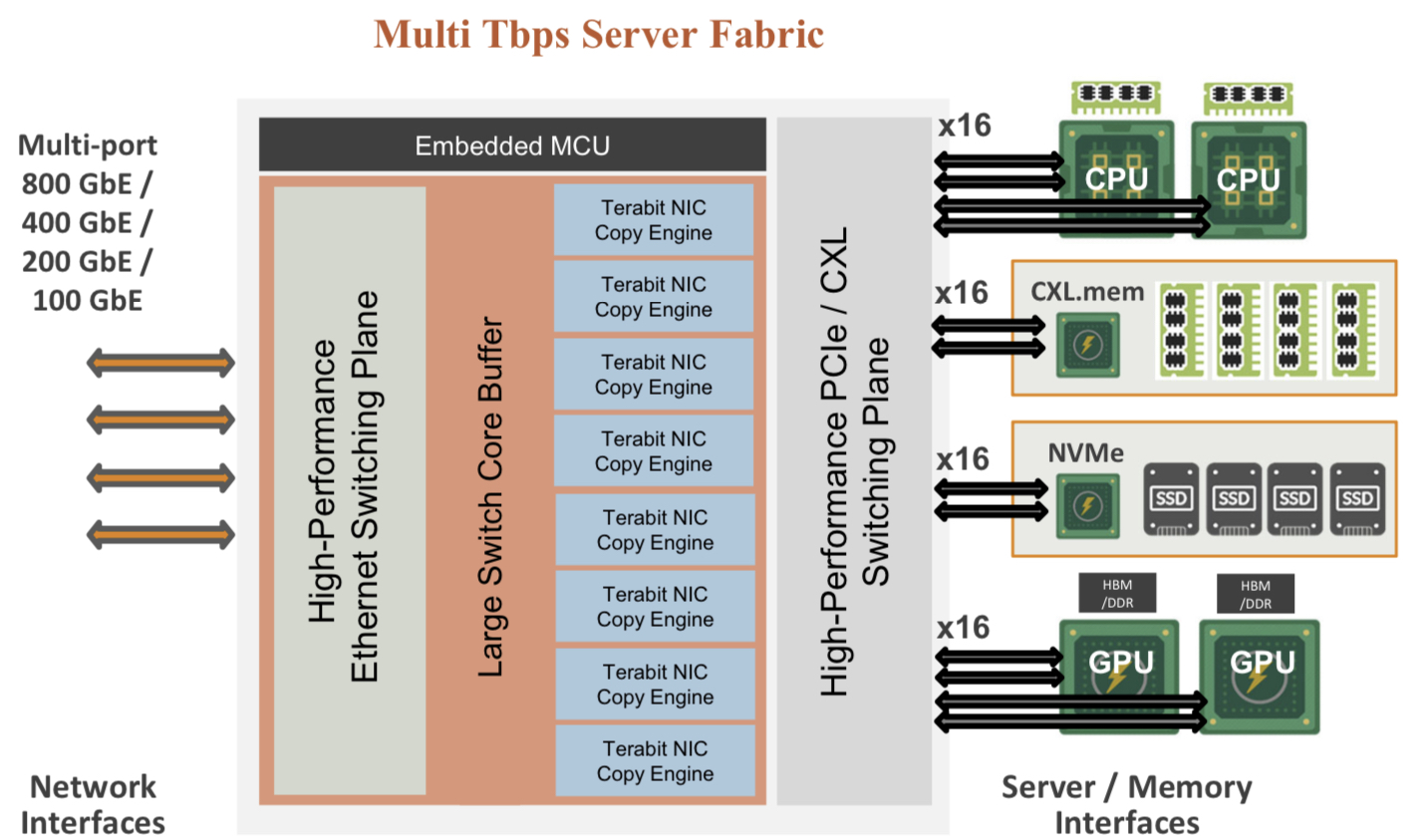
The chip uses ‘copy engines’ to move data to and from any processing element’s native memory. And by performing memory transfers in parallel, the chip is doing what until now has required PCIe switches, network interface cards (NICs), and top-of-rack switches.
The accelerated compute fabric also has 800-gigabit network interfaces so that, overall, the chip has terabits of bandwidth to move data across the network.
“CXL provides a standard way to decouple memories from CPUs, enabling DRAM disaggregation,” says Wheeler. “Enfabrica’s copy engines connect the GPUs to the pool of CXL memory. The network side, using RDMA (remote direct memory access), enables scaling beyond the limits of CXL.”
Sankar stresses that the accelerated compute fabric is much more than an integration exercise using an advanced 5nm CMOS process.
“If you were to integrate eight NICs, four PCIe switches and a top-of-rack switch, it would not fit into a single die,” says Sankar.
As for software, Enfabrica has designed its solution to fit in with how GPUs, CPUs and memory move data.
Significance
Sankar says the accelerated compute fabric IC will shorten job completion time because the scheduler is finer-grained and the chip can steer I/O to resources as required.
Computing clusters will also become larger using the IC’s high-density networking and CXL.
Wheeler says that CXL 3.x fabrics could provide the same capabilities as the accelerated compute fabric, but such advanced features won’t be available for years.
“History suggests some optional features included in the specifications will never gain adoption,” says Wheeler.
“The CXL/PCIe side of the [accelerated compute fabric] chip enables memory disaggregation without relying on CXL 3.x features that aren’t available, whereas the RNIC (RDMA NIC) side allows scaling to very large systems for workloads that can tolerate additional latency,” says Wheeler.
System benefits
Sankar cites two GPU platforms – one proprietary and one an open system – to highlight its chip benefits. The platforms are Nvidia’s DGX-H100 box and the open-design Grand Teton announced by Meta.
“The DGX has become a sort of fundamental commodity or a unit of AI computing,” says Shankar.
The DGX uses eight H100 GPUs, CPUs (typically two), I/O devices that link the GPUs using NVlink, and Infiniband for networking. The Meta platform has a similar specification but uses Ethernet.
Both systems have eight 400-gigabit interfaces. “That is 3.2 terabits coming out of the appliance, and inside the device, there is 3.2 terabit connected to a bunch of compute resources,” says Sankar.
The Meta platform includes layers of PCIe switches, and Open Compute Project (OCP 3.0) NICs running at 200 gigabits, going to 400 gigabits in the next generation.
The Grand Teton platform also uses eight NICs, four PCIe switches, and likely a top-of-rack switch to connect multiple systems.
Enfabrica’s vision is to enable a similarly composable [GPU] system. However, instead of eight NICs, four PCIe switches and the external top-of-rack switch, only three devices would be needed: two Enfabrica accelerated compute fabric chips and a control processor.
Enfabrica says the design would halve the power compared to the existing NICs, PCIe switches and the top-of-rack switch. “That represents 10 per cent of the rack’s power,” says Sankar.
And low-latency memory could be added to the space saved by using three chips instead of 12. Then, the eight GPUs would have tens of terabytes of memory to share whereas now each GPU has 80 gigabytes of HBM.
What next?
Enfabrica is unveiling the architecture first, and will detail its product later this year.
It is key to unveil the accelerated compute fabric concept now given how AI architectures are still nascent, says Sankar.
But to succeed, the start-up must win a sizeable data-centre customer such as a hyperscaler, says Wheeler: “That means there’s a very short list of customers, and winning one is paramount.”
The supplier must deliver high volumes from the start and guarantee supply continuity, and may also have to provide the source code to ensure that a customer can maintain the product under any circumstances.
“These are high hurdles, but Innovium proved it can be done and was rewarded with an exit at a valuation of greater than $1 billion,” says Wheeler.

OpenLight's CEO on its silicon photonics strategy
Adam Carter, recently appointed the CEO of OpenLight, discusses the company’s strategy and the market opportunities for silicon photonics.
Adam Carter’s path to becoming OpenLight’s first CEO is a circuitous one.
OpenLight, a start-up, offers the marketplace an open silicon photonics platform with integrated lasers and gain blocks.
Having worked at Cisco and Oclaro, which was acquired by Lumentum in 2018, Carter decided to take six months off. Covid then hit, prolonging his time out.
Carter returned as a consultant working with firms, including a venture capitalist (VC). The VC alerted him about OpenLight’s search for a CEO.
Carter’s interest in OpenLight was immediate. He already knew the technology and OpenLight’s engineering team and recognised the platform’s market potential.
“If it works in the way I think it can work, it [the platform] could be very interesting for many companies who don’t have access to the [silicon photonics] technology,” says Carter.
Offerings and strategy
OpenLight’s silicon photonics technology originated at Aurrion, a fabless silicon photonics start-up from the University of California, Santa Barbara.
Aurrion’s heterogeneous integration silicon photonics technology included III-V materials, enabling lasers to be part of the photonic integrated circuit (PIC).
Juniper Networks bought Aurrion in 2016 and, in 2022, spun out the unit that became OpenLight, with Synopsys joining Juniper in backing the start-up.
OpenLight offers companies two services.
The first is design services for firms with no silicon photonics design expertise. OpenLight will develop a silicon photonics chip to meet the company’s specifications and take the design to production.
“If you don’t have a silicon photonics design team, we will do reference architectures for you,” says Carter.
The design is passed to Tower Semiconductor, a silicon photonics foundry that OpenLight, and before that, Juniper, worked with. Chip prototype runs are wafer-level tested and passed to the customer.
OpenLight gives the company the Graphic Data Stream (GDS) file, which defines the mask set the company orders from Tower for the PIC’s production.
OpenLight also serves companies with in-house silicon photonics expertise that until now have not had access to a silicon photonics process with active components: lasers, semiconductor optical amplifiers (SOAs), and modulators.
The components are part of the process design kit (PDK), the set of files that models a foundry’s fabrication process. A company can choose a PDK that best suits its silicon photonics design for the foundry to then make the device.
OpenLight offers two PDKs via Tower Semiconductor: a Synopsys PDK and one from Luceda Photonics.
OpenLight does not make components, but offers reference designs. OpenLight gets a small royalty with every wafer shipped when a company’s design goes to production.
“They [Tower] handle the purchasing orders, the shipments, and if required, they’ll send it to the test house to produce known good die on each wafer,” says Carter
OpenLight plans to expand the foundries it works with. “You have to give customers the maximum choice,” says Carter.
Design focus
OpenLight’s design team continues to add components to its library.
At the OFC show in March, held in San Diego, OpenLight announced a 224-gigabit indium phosphide optical modulator to enable 200-gigabit optical lanes. OpenLight also demoed an eight-by-100-gigabit transmitter alongside Synopsys’s 112-gigabit serialiser-deserialiser (serdes).
OpenLight also offers a ‘PDK sampler’ for firms to gain confidence in its process and designs.
The sampler comes with two PICs. One PIC has every component offered in OpenLight’s PDK so a customer can probe and compare test results with the simulation models of Tower’s PDKs.
”You can get confidence that the process and the design are stable,” says Carter.
The second PIC is the eight by 100 gigabit DR8 design demoed at OFC.
The company is also working on different laser structures to improve the picojoule-per-bit performance of its existing design.
“Three picojoules per bit will be the benchmark, and it will go lower as we understand more about reducing these numbers through design and process,” says Carter.
The company wants to offer the most updated components via its PDK, says Carter.
OpenLight’s small design team can’t do everything at once, he says: “And if I have to license other people’s designs into my PDK, I will, to make sure my customer has a maximum choice.”
Market opportunities
OpenLight’s primary market focus is communications, an established and significant market that will continue to grow in the coming years.
To that can be added artificial intelligence (AI) and machine learning, memory, and high-speed computing, says Carter.
“If you listen to companies like Google, Meta, and Amazon, what they’re saying is that most of their investment in hardware is going into what is needed to support AI and machine learning,” says Carter. “There is a race going on right now.”
When AI and machine learning take off, the volumes of optical connections will grow considerably since the interfaces will not just be for networking but also computing, storage, and memory.
“The industry is not quite ready yet to do that ramp at the bandwidths and the densities needed,” he says, but this will be needed in three to four years.
Large contract manufacturers also see volumes coming and are looking at how to offer optical subassembly, he says.
Another market opportunity is telecoms and, in particular coherent optics for metro networks. However, unit volumes will be critical. “Because I am in a foundry, at scale, I have to fill it with wafers,” says Carter.
Simpler coherent designs – ‘coherent lite’ – connecting data centre buildings could be helpful. There is much interest in short-reach connections, for 10km distances, at 1.6 terabit or higher capacity where coherent could be important and deliver large volumes, he says.
Emerging markets for OpenLight’s platform include lidar, where OpenLight is seeing interest, high-performance computing, and healthcare.
“Lidar is different as it is not standardised,” he says. It is a lucrative market, given how the industry has been funded.
OpenLight wants to offer lidar companies early access to components that they need. Many of these companies have silicon photonics design teams but may not have the actives needed for next-generation products, he says.
“I have a thesis that says everywhere a long-wavelength single-mode laser goes is potential for a PIC,” says Carter
Healthcare opportunities include a monitoring PIC placed on a person’s wrist. Carter also cites machine vision, and cell phone makers who want improved camera depth perception in handsets.
Carter is excited by these emerging silicon photonics markets that promise new incremental revenue streams. But timing will be key.
“We have to get into the right market at the right time with the right product,” says Carter. “If we can do that, then there are opportunities to grow and not rely on one market segment.”
As CEO, how does he view success at OpenLight?
“The employees here, some of whom have been here since the start of Aurrion, have never experienced commercial success,” says Carter. “If that happens, and I think it will because that is why I joined, that would be something I could be proud of.”