

Industry underestimating 25 Gigabit parallel optics challenge
Ten Gigabit-based parallel optics is set to dominate the marketplace for several years to come. So claims datacom module specialist, Avago Technologies.

"One customer told us it has to keep the interface speed below 20Gbps due to the cost of the SerDes"
Sharon Hall, Avago
"People are underestimating what is going to be involved in doing 25 Gigabit [channels]," says Sharon Hall, product line manager for embedded optics at Avago Technologies. "Ten Gigabit is going to last quite a bit longer because of the price point it can provide."
Eventually 25 Gig-based parallel optics, with its lower lane count, will be cheaper than 10 Gigabit - but is will take several years. One challenge is the cost of 25 Gigabit-per-second (Gbps) electrical interfaces, due to the large relative size of the circuitry. One customer told Avago that it has to keep the interface speed below 20Gbps for now due to the cost of the serial/ deserialiser (SerDes).
Avago has announced that its 120 Gigabit aggregate bandwidth (12x10Gbps) MiniPod and CXP parallel optics products are now in volume production. The company first detailed the MiniPod and CXP technologies in late 2010 yet many equipment makers are still to launch their first designs.
The CXP is a pluggable optical transceiver while the MiniPod is Avago's packaged optical engine used for embedded designs. The 22x18mm MiniPod is based on Avago's 8x8mm MicroPod optical engine but uses a 9x9 electrical MegArray connector with its more relaxed pitch.
Equipment makers face a non-trivial decision as to whether to adopt copper or optical interfaces for their platform designs. "This is a major design decision with a lot of customers going back and forth deciding which way to go," says Hall. "They might do a mix with some short connections staying copper but if they need 10 Gig at anything longer than a few meters then they are going to go optical."
Having chosen parallel optics, the style of form factor - pluggable or embedded - is largely based on the interface density required. "Certain customers prefer field pluggability [of CXP] with its pay-as-you-go and ease of installation features, but are limited on port density due to the number of CXP transceivers that can physically fit on a 19 inch board," says Hall.
Up to 14 CXPs can fit onto a 19-inch board. In contrast, some 50-100 transmit and receive MiniPod pairs can fit on the 19-inch board. "You have the whole board space to work with," she says. The embedded optics sit closer to the board's ASICs, shortening the electrical path and solving signal integrity issues that can arise using edge-mounted pluggables. Thermal management - not having all the pluggable optics at the card edge furthest from the fans - is also simplified using embedded optics.
Generally, connections to data centre top-of-rack switches and between chassis use the pluggable CXP while internal backplane and mid-plane designs use the MiniPod. The CXP is also used by core switches and routers; Alcatel-Lucent's recently announced 7950 core router has a four-port CXP-based card. But Avago stresses that there are no hard rules: It has customers that have chosen the CXP and others the MiniPod for the same class of platform.
 Source: Gazettabyte
25 Gigabit parallel optics
Finisar recently demonstrated its board mounted optical assembly that it says will support channel speeds of 10, 14, 25 and 28Gbps, while silicon photonics vendors Luxtera and Kotura have announced 4x25Gbps optical engines. OneChip Photonics has announced photonic integrated circuits for the 4x25Gbps, 100GBase-LR4 10km standard that will also address short and mid-reach applications
Avago has yet to make an announcement regarding higher speed parallel optics. "It is just a matter of time," says Hall. "We have done a demonstration of our 25Gbps VCSEL in an SFP+ package over a year ago, and we are developing parallel optics 25Gbps solutions."
But 25Gbps will take time before it gets to volume production, says Hall: "It is going to be a long, long design cycle for system companies - doing 25Gbps on their boards and their systems is a completely new design."
Supercomputers and system mid-plane and backplane applications could happen a lot earlier than 4x25GbE applications. "Some customers are interested in getting 4x25Gbps samples in the 2013 timeframe," says Hall. "But we expect that volume is going to take at least another year from that."
Meanwhile, Avago says it has already shipped 600,000 MicroPods which has been generally available for over a year.

OneChip Photonics targets the data centre with its PICs
OneChip Photonics is developing integrated optical components for the IEEE 40GBASE-LR4 and 100GBASE-LR4 interface standards.
The company believes its photonic integrated circuits (PICs) will more than halve the cost of the 40 and 100 Gigabit 10km-reach interfaces, enough for LR4 to cost-competitively address shorter reach applications in the data centre.

"I think we can cut the price [of LR4 modules] by half or better”
Andy Weirich, OneChip Photonics
The products mark an expansion of the Canadian startup's offerings. Until now OneChip has concentrated on bringing PIC-based passive optical network (PON) transceivers to market.
LR4 PICs
The startup is developing separate LR4 transmitter and receiver PICs. The 40 and 100GBASE-LR4 receivers are due in the third quarter of 2012, while the transmitters are expected by the year end.
The 40GBASE-LR4 receiver comprises a wavelength demultiplexer - a 4-channel arrayed waveguide grating (AWG) - and four photo-detectors operating around 1300nm. A spot-size converter - an integrated lens - couples the receiver's waveguide's mode field to the connecting fibre.
"[Data centre operators] are saying that they are having to significantly bend out of shape their data centre architecture to accommodate even 300m reaches”
The 40GBASE-LR4 transmitter PIC comprises four directly-modulated distributed feedback (DFB) lasers while the 100GBASE-LR4 use four electro-absorption modulator DFB lasers. Different lasers for the two PICs are required since the four wavelengths at 100 Gig, also around 1300nm, are more tightly spaced: 5nm versus 20nm. "They are much closer together than the 40 Gig version,” says Andy Weirich, OneChip Photonics' vice president of product line management.
Another consequence of the wider wavelength spacings is that the 40 Gig transmitter uses four discrete lasers. “Because the 40 Gig wavelengths are much further apart, putting all the lasers on the one die is problematic," says Weirich. The 40GBASE-LR4 design thus uses five indium phosphide components: four lasers and the AWG, while the 40GBASE-LR4 receiver and the two 100GBASE-LR4 devices are all monolithic PICs.
Both LR4 transmitter designs also include monitor photo-diodes for laser control
Lower size and cost
OneChip says the resulting PICs are tiny, measuring less than 3mm in length. “We think the PICs will enable the packaging of LR4 in a QSFP,” says Weirich. 40GBASE-LR4 products already exists in the QSFP form factor but the 100GBASE-LR4 uses a CFP module.
The startup expects module makers to use its receiver chips once they become available rather than wait for the receiver-transmitter PIC pair. "Reducing the size of one half the solution is possibly good enough to fit the whole hybrid design - the PIC for the receive and discretes for the transmit - into a QSFP,” says Weirich.
The PICs are expected to reduce significantly the cost of LR4 modules. "I think we can cut the price by half or better,” says Weirich. “Right now the LR4 is far too expensive to be used for data centre interconnect.” OneChip expects its LR4 PICs to be cost-competitive with the 2km reach 10x10 MSA interface.
Meanwhile, short-reach 40 and 100 Gig interfaces use VCSEL technology and multi-mode fibre to address 100m reach requirements. In larger data centres this reach is limiting. Extended reach - 300-400m - multimode interfaces have emerged but so far these are at 40 Gig only.
"[Data centre operators] are saying that they are having to significantly bend out of shape their data centre architecture to accommodate even 300m reaches,” says Weirich. “They really want more than that.”
OneChip believes interfaces distances of 200m-2km is underserved and it is this market opportunity that it is seeking to address with its LR4 designs.
Roadmap
Will OneChip integrate the design further to product a single PIC LR4 transceiver?
"It can be put into one chip but it is not clear that there is an economic advantage,” says Weirich. Indeed one PIC might even be more costly than the two-PIC chipset.
Another factor is that at 100 Gig, the 25Gbps electronics present a considerable signal integrity design challenge. “It is very important to keep the electronics very close to the photo-detectors and the modulators,” he says. “That becomes more difficult if you put it all on the one chip.” The fabrication yield of a larger single PIC would also be reduced, impacting cost.
OneChip, meanwhile, has started limited production of its PON optical network unit (ONU) transceivers based on its EPON and GPON PICs. The company's EPON transceivers are becoming generally available while the GPON transceivers are due in two months’ time.
The company has yet to decide whether it will make its own LR4 optical modules. For now OneChip is solely an LR4 component supplier.
Further reading:
See OFC/ NFOEC 2012 highlights, the Kotura story in the Optical Engines section
Photonic integration specialist OneChip tackles PON
Briefing: PON
Part 1: Monolithic integrated transceivers
OneChip Photonics is moving to volume production of PON transceivers based on its photonic integrated circuit (PIC) design. The company believes that its transceivers can achieve a 20% price advantage.
"We will be able to sell [our integrated PON transceivers] at a 20% price differential when we reach high volumes"
Andy Weirich, OneChip Photonics
OneChip Photonics has already provided transceiver engineering samples to prospective customers and will start the qualification process with some customers this month. It expects to start delivering limited quantities of its optical transceivers in the next quarter.
The company's primary products are Ethernet PON (EPON) and Gigabit PON (GPON) transceivers. But it is also considering selling a bi-directional optical sub-assembly (BOSA), a component of its transceivers, to those system providers that want to attach the BOSA directly to the printed circuit board (PCB) in their optical network units (ONUs).
"The BOSA is the sub-assembly that contains all the optics, usually the TIA [trans-impedance amplifier] and sometimes the laser driver," says Andy Weirich, OneChip Photonics' vice president of product line management.
The company will roll out its Ethernet PON (EPON) ONU transceivers in the second quarter of 2012, followed by GPON ONU transceivers in the third quarter.
PON Technologies
EPON operates at 1.25 Gigabit-per-second (Gbps) upstream and downstream. OneChip had planned to develop a 2.5Gbps EPON variant which, says OneChip, has been standardised by the China Communications Standards Association (CCSA). But the company has abandoned the design since volumes have been extremely small and there have been no deployments in China.
GPON is a 2.5Gbps downstream/ 1.25Gbps upstream technology. The main differences between GPON and EPON transceiver optical components are the requirement of the ONU's receiver optics and circuitry, and the laser type, says Weirich. GPON's Class B+ specification, used for nearly all the GPON deployments, calls for a 28-29dB sensitivity. This is a more demanding specification requirement to meet than EPON's. GPON also calls for a Distributed Feedback (DFB) laser, whereas an EPON ONU may use either a Fabry-Perot laser or a DFB laser.
OneChip uses the same DFB for GPON and EPON ONUs. Where the PIC designs differ is the receiver assembly where GPON requires amplification. This, says Weirich, is achieved using either an avalanche photodiode (APD) or a semiconductor optical amplifier (SOA).
OneChip will start with an APD but will progress to an SOA. Once it integrates an SOA as part of the PIC, a simpler, cheaper photo-detector can be used.
Weirich admits that it has taken OneChip longer than it expected to develop its monolithically-integrated design.
Part of the challenge has been the issue of packaging the PIC. "Because of our integrated approach and non-alignment-requiring assembly, we have had to solve a few more technology problems," he says. "Our suppliers have had a challenge with some of those issues, and it has taken a couple of iterations to solve."
OneChip says that the good news is that the price erosion of EPON transceivers has slowed down in the last two years. So while Weirich admits the market is more competitive now, what is promising is that volumes have continued to grow.
"There is no sign of saturation happening either in the EPON or GPON markets," he says. And OneChip believes it can compete on price. "What we are saying is that we will be able to sell [our monolithically integrated PON transceivers) at a 20% price differential when we reach high volumes." That is because the monolithic design is simpler and the optical components that make up the design are cheaper, says the company.
10G EPON and XGPON
OneChip believes the end of 2012 will be when 10G EPON volumes start to ramp. "10G EPON is a significantly larger market than 10G GPON [XGPON]," says Weirich, pointing out that some of the largest operators such as China Telecom have backed 10G EPON.
With 10G EPON there are two flavours: the asymmetric (10Gbps downstream and 1.25Gbps upstream) and the symmetric (10Gbps bidirectional) versions.
For an asymmetric 10Gbps ONU transceiver, the laser does not need to change but the optics and electronics at the receiver do, because of the 10Gbps receive signal and because operators want 28-29dB optical link budgets so that 10G EPON can run on the same fibre plant as EPON. "This is an order of magnitude more difficult from a sensitivity perspective than for EPON," says Weirich.
There is demand for the 10G symmetric EPON but it is much lower than the asymmetric version primarily due to cost. "The ONU transceiver with its 10 Gbps laser and photo-detector is quite a bit more costly," says Weirich, complicating the PON's business case.
OneChip says it has a 10G EPON in its product roadmap, but it has not yet made any announcements or made any demonstrations to customers.
Challenges
OneChip is not aware of any other company developing a monolithic integrated design for PON transceivers, in part due to the challenge. It has to be made cheaply enough to compete with the traditional TO-can design. The key is to develop low-cost integration techniques and processes right at the start of the PIC design, he says.
The company says that it is also exploring using its PIC technology to address data centre connectivity.
OneChip Photonics at a glance
OneChip employs some 80 staff and is headquartered in Ottawa, Canada, where it has a 4,000 sq. ft. cleanroom. The start-up also has a regional office in Shenzhen, China which includes a test lab to serve regional customers.
The company is primarily a transceiver supplier and its main target customers are the tier-one system vendors that supply OLT and ONU equipment. "When you think of the big three players in China, Huawei, ZTE and Fiberhome would be among those we are targeting," says Steve Bauer, vice president of marketing and communications, as well as players such as Alcatel-Lucent and Motorola. As mentioned, the company is also considering selling its BOSA design to ONU makers.
In May 2011 the company received $18M in its latest round of funding. "We are transitioning from product development to becoming operationally ready to manufacture in volume," says Bauer.
Fabrinet and Sanmina-SCI are two contract manufacturers that the company is using for transceiver testing and assembly while it has partnerships with several other fabs for supply of wafers, wafer fabrication and silicon optical benches.
40 Gigabit Ethernet QSFPs boost port density and reach
 "For the larger data centres being built today, reach is becoming more and more important"
I Hsing Tan, Avago
Avago’s eSR4 QSFP+ transceiver extends the reach of 40GbE over multimode fibre beyond the IEEE 40GBASE-SR4 specification, to 300m over OM3 and 400m over OM4 multimode fibre.
Reflex Photonics’ 40GbE QSFP also achieves 300m over OM3 fibre and while it has not tested the transceiver over OM4 fibre, the company is using the same optics that it uses for its CFP which meets 450m over OM4.
“This [QSFP] is aimed at large data centres operated by the likes of a Google or a Facebook,” says Robert Coenen, vice president, sales and marketing at Reflex Photonics. Such data centres can have link requirements of 1000m. “The more reach you can give over multimode fibre, the more money they [data centre operators] can save.”
The eSR4, like Avago's already announced iSR4 (interoperable SR4) 40GbE QSFP+ transceiver, supports either 40GbE or four independent 10GbE channels. When used as a multichannel 10GbE interface, the QSFP+ can interface to various 10GbE form factors such as X2, XFP and SFP+, says Avago.
The iSR4 also increases the faceplate port density of equipment from 48, 10 Gigabit Ethernet (GbE) SFP+ ports to up to 44 QSFP+ 40GbE ports. Avago says that one equipment vendor has already announced a card with 36 QSFP+ ports. The iSR4 QSFP+ also reduces the overall Gigabit/Watt power consumption to 37.5mW/Gbps compared to 100mW /Gbps for the SFP+. The eSR4 has half the power consumption, which puts it around 50mW/Gbps.
But the iSR4 matches the reach of the IEEE 40GBASE-SR4 40GbE standard: 100m for OM3 and 150m for OM4-based fibre. "This [reduced reach at 40GbE] creates an issue for data centre operations," says I Hsing Tan, Ethernet segment marketing manager in the fiber optics product division at Avago. "They require additional investment to redo all the wiring in current 10GbE infrastructure to support a shorter reach."
With the extended reach 40GbE QSFPs the reach associated with 10GbE interfaces on OM3 and OM4 multimode fibre is now restored.
The iSR4 module is available now, says Avago, while the eSR4 will be available from mid-2012. Reflex’s Coenen says it will have samples of its 40GbE QSFP, which also supports 40GbE and 4x10GbE, by May 2012.
What has been done
For Avago's iSR4 QSFP+ to operate as four, 10GbE channels, it has to comply with the 10GBASE-SR optical standard. That is because 10GBASE-SR supports a maximum receive power of -1dBm whereas the 40GBASE-SR4 has a maximum output power of 2.4dBm. The transmitter power of the iSR4 has thus been reduced. "We force the output of the transmitter down to -1dBm," says Tan.
To achieve the greater reach, the eSR4 uses a VCSEL design with a tighter spectral width. Other parameters include the optical modulation amplitude power and the wavelength. These affect the resulting fibre dispersion. “Once you control the spectral width, you can design the other two to meet the specs," says Tan.
The Avago 40GbE QSFP+ modules use an integrated 4- channel VCSEL array and a 4-channel photo-detector array.
Significance
The 40GbE short reach interfaces play an important role in the data centre. As servers move from using 1GbE to 10GbE interfaces, the uplink from aggregation 'top-of-rack' switches must also scale from 10GbE to higher speeds of 40GbE or 100GbE.
However existing 100GbE interfaces make use of the CFP module which is relatively large and expensive. And although the 100GbE standard has a clear roadmap leading to CFP2 and CFP4 modules, half and a quarter of the size of the CFP, respectively, these are not yet available.
40GbE QSFP+ transceivers do exist and offer the equipment faceplate density improvement vendors want.
The QSFP+ also benefits existing 10GbE designs by supporting nearly 4x the number of 10GbE on a card. Thus a new blade supporting up to 44, 40GbE QSFP+ transceivers can interface to up to 176 10GbE transceivers, a near fourfold capacity increase.
According to Avago, between 10% and 20% of interface requirements in the data centre are beyond 150m. Without the advent of extended reach 40GbE modules, data centre operators would need to deploy single mode fibre and a 40GBASE-LR4 module, it says. And while that can be fitted inside a QSFP, its power consumption is up to 3.5W, compared to the 1.5W of the QSFP+ eSR4. "The cost of the LR4 is also increased by at least a factor of three," says Tan.
Avago says that some 95% of all fibre in the data centre is multimode fibre. As for OM3 and OM4 deployments the ratio is 80% to 20%, respectively.
ECOC 2011: Products and market trends
There were several noteworthy announcements at the European Conference on Optical Communications (ECOC) held in Geneva in September. Gazettabyte spoke to Finisar, Oclaro and Opnext about their ECOC announcements and the associated market trends.
100 Gig module
Opnext announced the first 100 Gigabit-per-second (Gbps) transponder at ECOC, a much anticipated industry development.
 "Quite a few system vendors .... are looking at 'make-versus-buy' for the next-generation [of 100 Gig]."
Ross Saunders, Opnext
The OTM-100 is a dual-polarisation, quadrature phase-shift keying (DP-QPSK) coherent design that fits into a 5x7-inch module and meets the Optical Internetworking Forum's (OIF) multi-source agreement (MSA). The module's coherent receiver uses a digital signal processor (DSP) developed by NTT Electronics.
"At the moment we are going through the bring-up in the lab," says Ross Saunders, general manager, next-gen transport for Opnext Subsystems.
According to Opnext, system vendors that have their own 100Gbps coherent designs are also interested in the 100Gbps module.
"There are a few developing in-house [100Gbps designs] that are not interested in going for the module solution," says Saunders. "But there is another camp - quite a few system vendors - who have their first-generation solution that are looking at 'make-versus-buy' for the next-generation."
System vendors' first-generation 100Gbps designs use hard-decision forward error correction (FEC). But customers want a 100Gbps design with a reach that gets close to matching that of 10Gbps, 40Gbps DPSK and 40Gbps coherent designs, says Opnext.
"There is demand to go to the next-generation with its higher overhead and soft-decision FEC," says Saunders. "That [soft-decision FEC] buys another 2-3dB of performance so you don't need as many regeneration stages." Translated into distances, the reach using soft-decision FEC is 1500-1600km rather than 800-900km, says Saunders.
Opnext expects to deliver samples to lead customers before the year end.
Meanwhile, Oclaro is also developing a 100Gbps coherent module. "It is on track and we expect to ship in early 2012," says Per Hansen, vice president of product marketing, optical networks solutions at Oclaro.
100 Gig receiver
Oclaro announced an integrated 100Gbps coherent receiver at ECOC.
The company claims the device takes less than half the board area as defined by the OIF. "Board space is at a premium on line cards," says Robert Blum, director of product marketing for Oclaro's photonic components. "If you can increase functionality, that translates to lower cost."
 100 Gig indium phosphide integrated receiver Source: OclaroThe device has two inputs and four outputs. The inputs are the received 100Gbps optical signal and the local oscillator and the outputs are from the four balanced detectors.
"The entire 90-degree hybrid mixing and the photo detection are all done in an indium phosphide single chip," says Blum.
40 Gig modules
Oclaro also announced it is shipping in volume its 40Gbps coherent transponder.
"There is a lot of interest from equipment vendors and service providers to use coherent in their networks," says Hansen "Coherent has advantages in the way it can overcome impairments."
Hansen says coherent will be used in the majority of new network deployments in future: "If you are deploying a network that is geared to 40Gbps and above, people will most likely deploy an all-coherent solution."
One reason why coherent is favoured is that the same technology can be scaled to 100Gbps, 400Gbps and even a Terabit.
Coherent technology, whose DSP is used for dispersion compensation, is also suited for mesh networks where switching wavelengths occurs. The coherent technology can compensate when it encounters new dispersion conditions following the switching.
In contrast 40Gbps direct-detection modules interest vendors for use in existing networks alongside 2.5Gbps and 10Gbps wavelengths, says Oclaro.

For networks geared to 40Gbps and above, people will most likely deploy an all-coherent solution
Per Hansen, Oclaro
"They can have very high power which can make it difficult for a new [high-speed] channel to live next to them but direct-detection modules are robust for those types of applications," says Hansen. "Where you will see people upgrading their existing networks, they will use DPSK or DQPSK transponders."
But Oclaro says that the split is not that clear-cut: 40Gbps coherent for new builds and direct-detection schemes when used alongside existing 10Gbps wavelengths. "There is a lot of variability in both of these approaches such that you can tailor them to different applications," says Hansen. "In the end, what it will come down to is what the customer is happy with and the price points, more than fundamental technology capabilities."
40G client-side interfaces
Finisar demonstrated at ECOC a serial 40Gbps CFP module that meets the 2km 40GBASE-FR standard.
"This will be the first 40 Gig serial module that is in a pluggable form factor," says Rafik Ward, vice president of marketing at Finisar. Indeed Finisar's CFP is a tri-rate design that also supports the ITU-T OC-768 SONET/SDH very short reach (VSR) and OTU3 standards.
The FR interface is the IEEE's 40 Gigabit Ethernet equivalent of the existing OC-768 VSR interface. The original 300pin VSR interface has a 16-channel electrical interface, each operating at 2.5Gbps, while the CFP module uses 10Gbps electrical channels.
IP routers can now be connected to DWDM platforms using the pluggable module, says Finisar. The pluggable will also enable system vendors to design denser line cards with two or even four CFP interfaces, as well as the option of changing the CFP to support other standards as required.
The tri-rate FR pluggable module's power consumption will be below 8W, says Finisar, which is shipping samples to customers.
Meanwhile, Opnext has announced it is sampling its 40GBASE-LR4, the 10km 40 Gigabit Ethernet interface, in a QSFP module. "It will be readily available by the end of the year," says Jon Anderson, director of technology programme at Opnext.
 "The 40GBASE-LR4 [QSFP] will be readily available by the end of the year"
Jon Anderson, Opnext
Tunable laser XFP
Opnext and Oclaro have both announced 10Gbps tunable XFPs at ECOC. Having two new suppliers of tunable XFPs joining JDS Uniphase will increase market competition and reduce the price of the tunable pluggable.
"It really is a replacement for 300-pin transponders," says Blum. "You can now migrate 10Gbps links to a pluggable form factor."
Oclaro's tunable XFP is released for production. Opnext says its tunable XFP will be in volume production by early 2012.
ROADMs get 1x20 WSS
Finisar announced a 1x20 high-port count wavelength selective switch (WSS). The WSS supports a flexible spectrum grid that allows the channel width to be varied in increments of 12.5GHz, enabling future line rates above 100Gbps to be supported.
"This [1x20 WSS] has the possibility to enable some pretty interesting applications for next generation - colourless, directionless, contentionless networks," says Ward.

"This [40GBASE-FR] will be the first 40 Gig serial module that is in a pluggable form factor"
Rafik Ward, Finisar.
One common application of the 1x20 WSS is implementing a multi-degree node. The degree refers to the number of points that node branches out to in a mesh network, says Finisar. "The fundamental question is how many ports do you have in that node?" explains Ward.
For example, an 8-degree node communicates with eight other points in the mesh. With a 1x20 WSS, the architecture uses eight of the 20 as express ports - those 8 ports interfacing with other WSSs in the node - while the remaining 12 ports on that 1x20 WSS are used as add and drop ports.
"The advantage of a 1x20 WSS in this case is enabling a large number of express ports and a large number of add ports," says Ward.
A second application is for colourless or tunable multiplexing.
"One of the problems today enabling colourless ROADM operation is that typically the muxes and demuxes used are AWGs," says Ward. Having a tunable laser is all well and good but it becomes hardwired to a specific port because of the arrayed waveguide grating (AWG). "That specific port is configured for that particular wavelength," he says.
To make an 80-channel colourless design, that does not require manual intervention, four 1x20 WSSs are placed side-by-side with a 1x4 WSS connecting the four. This is a more elegant and compact than using existing 1x9 WSSs, which requires more than twice as many WSS units.
Pump lasers
Oclaro announced two 980nm pump laser products that enable more compact, lower-power amplifier designs.
 "Board space is at a premium on line cards"
Robert Blum, Oclaro
One is an uncooled 980nm 500mW pump laser and the second is two 600mW pump lasers in a single package. The dual-pump laser product halves the footprint and requires a single thermo-electric cooler only.
"The power consumption is significantly lower than what it would be for two discrete pump lasers," says Blum. "The 300mW uncooled pump laser doesn't go away but for dual-stage or mid-stage optical amplifiers instead of using multiple [300mW] lasers, you can use a single package," says Blum.
GPON-on a-stick
Finisar announced a 'GPON-on-a-stick' SFP module. The result of its acquisition of Broadway Networks in 2010, the SFP-based GPON optical network unit (ONU) enables an Ethernet switch to be connected to a PON. The product is aimed at enterprises as well as large residential premises. The GPON stick complements the company's existing EPON stick.
Further information:
ECOC 2011 Market focus presentations, click here
Rapid progress in optical transport seen at ECOC 2011, Ovum's Karen Liu, click here
Finisar and Capella enter 1×20 WSS market; signals shift, Ovum's Daryl Inniss, click here
MultiPhy boosts 100 Gig direct-detection using digital signal processing
The MP1100Q chip is being aimed at two cost-conscious metro networking requirements: 100 Gigabit point-to-point links and dense wavelength-division multiplexing (DWDM) metro networks.
 The MP1100Q as part of a 100 Gig CFP module design. Source: MultiPhy
The 100 Gigabit market is still in its infancy and the technology has so far been used to carry traffic across operators’ core networks. Now 100 Gigabit metro applications are emerging.
Data centre operators want short links that go beyond the IEEE-specified 10km (100GBASE-LR4) and 40km (100GBASE-ER4) reach interfaces, while enterprises are looking to 100 Gigabit-per-second (Gbps) DWDM solutions to boost the capacity and reach of their rented fibre. Existing 100Gbps coherent technologies, designed for long-haul, are too expensive and bulky for the metro.
“There is long-haul and the [IEEE] client interfaces and a huge gap in between,” says Avishay Mor, vice president of product management at MultiPhy.
It is this metro 'gap' that MultiPhy is targeting with its MQ1100Q chip. And the fabless chip company's announcement is one of several that have been made in recent weeks.
ADVA Optical Networking has launched a 100Gbps metro line card that uses a direct-detection CFP, while Transmode has detailed a 100Gbps coherent design tailored for the metro. The 10x10 MSA announced in August a 10km interface as well as a 40km WDM design alongside its existing 10x10Gbps MSA that has a 2km reach.
MultiPhy's MP1100Q IC will enable two CFP module designs: a point-to-point module to connect data centres with a reach of up to 80km, and a DWDM design for metro core and regional networks with a reach up to 800km.
"MLSE is recognised as the best solution for mitigating inter-symbol interference."
Design details
The M1100Q uses a 4x28Gbps direct-detection design, the same approach announced by ADVA Optical Networking for its 100Gbps metro card. But MultiPhy claims that the 100Gbps DWDM CFP module will squeeze the four bands that make up the 100Gbps signal into a 100GHz-wide channel rather than 200GHz, while its IC implements the maximum likelihood sequence estimation (MLSE) algorithm to achieve the 800km reach.
The four optical channels received by a CFP are converted to electrical signals using four receiver optical subassemblies (ROSAs) and sampled using the MP1100Q’s four analogue-to-digital (a/d) converters operating at 28Gbps.
The CFP design using MultiPhy’s chip need only use 10Gbps opto-electronics for the transmit and receive paths. The result is a 100Gbps module with a cost structure based on 4x10Gbps optics.
The lower bill-of-materials impacts performance, however. “When you over-drive these 10Gbps opto-electronics - on the transmit and the receive side - you create what is called inter-symbol interference," says Neal Neslusan, vice president of sales and marketing at MultiPhy.
Inter-symbol interference is an unwanted effect where the energy of a transmitted bit leaks into neighboring signals. This increases the bit-error rate and makes the detector's task harder. "The way that we get around it is using MLSE, recognised as the best solution for mitigating inter-symbol interference," says Neslusan.
Unwanted channel effects introduced by the fibre, like chromatic dispersion, also induce inter-symbol interference and are also countered by the MLSE algorithm on the MP1100Q.
MultiPhy is proposing two CFP designs for its chip. One is based on on-off-keying modulation to achieve 80km point-to-point links and which will require a 200GHz channel to accommodate the 100Gbps signal. The second uses optical duo-binary modulation to achieve the longer reach and more spectrally efficient 100GHz spacings.
The company says the resulting direct-detection CFP using its IC will cost some US $10,000 compared to an estimated $50,000 for a coherent design. In turn the 100G metro CFP’s power consumption is estimated at 24W whereas a coherent design consumes 70W.
MP1100Q samples have been with the company since June, says Mor. First samples will be with customers in the fourth quarter of this year, with general availability starting in early 2012.
If all goes to plan, first CFP module designs using the chip will appear in the second half of 2012, claims MultiPhy.
Optical engines bring Terabit bandwidth on a card
Such a parallel optics design offer several advantages when used on a motherboard. It offer greater flexibility when cooling since traditional optics are normally in pluggable slots at the card edge, furthest away from the fans. Such optical engines also simplify high-speed signal routing and electromagnetic interference issues since fibre is used rather than copper traces.
 Figure 1: Fourteen 120Gbps MiniPods on a board. Source: Avago Technologies
Avago has two designs – the 8x8mm MicroPod and the 22x18mm MiniPod. The 12x10.3125 Gigabit-per-second (Gbps) MicroPods are being used in IBM’s Blue Gene computer and Avago says it is already shipping tens of thousands of the devices a month.
“The [MicroPod’s] signal pins have a very tight pitch and some of our customers find that difficult to do,” says Victor Krutul, director of marketing for the fibre optics division at Avago Technologies. The MiniPod design tackles this by using the MicroPod optical engine but a more relaxed pitch. The MiniPod uses a 9x9 electrical MegArray connector and is now sampling, says Avago.
Figure 1 shows 14 MiniPod optical engines on a board, each operating at 12x10Gbps. “If you were trying to route all those signals electrically on the board, it would be impossible,” says Krutul. All 14 MiniPods go to one connector, equating to a 1.68Tbps interface.
 Figure 2: Sixteen MicroPods in a 4x4 array. Source: Avago Technologies
Figure 2 shows 16 MicroPods in a 4x4 array. “Those [MicroPods] can get even closer,” says Krutul. Also shown are the connectors to the MicroPod array. Avago has worked with US Conec to design connectors whereby the flat ribbon fibres linking the MicroPods can stack on top of each other. In this example, there are four connections for each row of MicroPods.
OFC announcements and market trends
More compact transceiver designs at 10, 40 and 100 Gigabit, advancements in reconfigurable optical add-drop multiplexer (ROADM) technology and parallel optical engine developments were all in evidence at this year’s OFC/NFOEC show held in Los Angeles in March.
 “MSAs are designed by committee, and when you have a committee you throw away innovation and you throw away time-to-market”
Victor Krutul, Avago Technologies
Finisar said that the show was one of the busiest in recent years. “There was an increasing system-vendor presence at OFC, and there was a lot more interest from investor analysts,” says Rafik Ward, vice president of marketing at Finisar.
Ethernet interfaces
Opnext demonstrated an IEEE 100GBASE-ER4 module design at the show, the 100 Gigabit Ethernet (GbE) standard with a 40km reach. Based on the company’s CFP-based 100GBASE-LR4 10km module, the design uses a semiconductor optical amplifier (SOA) on the receive path to achieve the extended reach. The IEEE standard calls for an SOA in front of the photo-detectors for the 100GBASE-ER4 interface.
“We don’t have that [SOA] integrated yet, we are just showing the [design] feasibility,” says Jon Anderson, director of technology programme at Opnext. The extended reach interface will be used to connect IP core routers to transport system when the two platforms reside in separate facilities. Such a 40km requirement for a 100GbE interface is not common but is an important one to meet, says Anderson.
Opnext’s first-generation LR4, currently shipping, is a discrete design comprising four discrete transmitter optical sub-assemblies (TOSAs) and four receiver optical sub-assemblies (ROSAs) and an optical multiplexer and demultiplexer. The company’s next-generation design will integrate the four lasers and the optical multiplexer into a package and will be used in future more compact CFP2 and CFP4 modules.
The CFP2 module is half the size of the CFP module and the CFP4 is a quarter. In terms of maximum power, the CFP module is rated at 32W, the CFP2 12W and the CFP4 5W. “The CFP4 is a little bit wider and longer than the QSFP,” says Anderson. The first CFP2 modules are expected to become available in 2012 and the CFP4 in 2013.
System vendors are interested in the CFP4 as they want to support over one terabit of capacity on a 15-inch faceplate. Up to 16 ports can be supported –1.6Tbps – on a faceplate using the CFP4, and using a “belly-to-belly” configuration two rows of 16 ports will be possible, says Anderson.
Finisar demonstrated a distributed feedback laser (DFB) laser-based CFP module at OFC that implements the 10km 100GBASE-LR4 standard. The adoption of DFB lasers promises significant advantages compared to existing first-generation -LR4 modules that use electro-absorption modulated lasers (EMLs). “If you look at current designs, ours included, not only do they use EMLs which are significantly more expensive, but each is in its own package and has its own thermo-electric cooler,” says Ward.
Finisar’s use of DFBs means an integrated array of the lasers can be packaged and cooled using a single thermo-electric cooler, significantly reducing cost and nearly halving the power to 12W. “Now that the power [of the DFB-based] LR4 is 12W, we can place it within a CFP2 with its 25-28 Gigabit-per-second (Gbps) electrical I/O,” says Ward.
Moving to the faster input/output (I/O) compared to the CFP’s 10Gbps I/O means that that serialiser/ deserialiser (serdes) chipset can be replaced with simpler clock data recovery (CDR) circuitry. “By the time we move to the CFP4, we remove the CDRs completely,” says Ward. “It’s an un-retimed interface.” Finisar’s existing -LR4 design already uses an integrated four-photodetector array.
An early application of the 100GbE -LR4, as with the -ER4, is linking core routers with optical transport systems in operators’ central offices. Many Ethernet switch vendors have chosen to focus their early high-data efforts at 40GbE but Finisar says the move to 100GbE has started.
Finisar argues that the adoption of DFBs will ultimately prove the cost-benefits of a 4-channel 100GbE design which faces competition from the emerging 10x10 multi-source agreement (MSA). “Everything we have heard about the 10x10 [MSA] has been around cost,” says Ward. “The simple view inside Finisar is that by the time the Gen2 100GbE module that we showed at OFC gets to market, this argument [4x25Gig vs. 10x10Gig] will be a moot point.”
 “40Gig is definitely still strong and healthy”
Jon Anderson, Opnext
By then the second-generation -LR4 module design will be cost competitive if not even lower cost than the 10x10 MSA. “If you look at optoelectronic components, at the end of the day what really drives cost is yield,” says Ward. “If we can get our yields of 25Gig DFBs down to a level that is similar to 10Gig DFB yields- it doesn’t have to match, just in the ballpark - then we have a solution where the 4x25Gig looks like a 4x10Gig solution and then I believe everyone will agree that 4x25Gig is a less expensive architecture.” Finisar expects the Gen2 CFP -LR4 in production by the first half of 2012.
Opnext demonstrated a 40GBASE- LR4 (40Gbps, up to 10km) standard in a QSFP+ module at OFC. Anderson says it is seeing demand for such a design from data centre operators and from switch and transport vendors.
Avago Technologies announced a 40Gbps QSFP+ module at OFC that implements the 100m IEEE 40GBASE-SR4. “It will interoperate with Avago’s SFP+ modules,” says Victor Krutul, director of marketing for the fibre optics division at Avago Technologies. The QSFP+ can interface to another QSFP+ module or to four 10Gbps SFP+ modules.
Avago also announced a proprietary mini-SFP+ design, 30% smaller than the standard SFP+ but which is electrically compatible. According to Krutul, the design came about following a request from one of its customers: “What it allows is the ability to have 64 ports on the front [panel] rather than 48.”
Did Avago consider making the mini-SFP+ design an MSA? “What we found with MSAs is that they are designed by committee, and when you have a committee you throw away innovation and you throw away time-to-market,” says Krutul.
Krutul was previously a marketing manager for Intel’s LightPeak before joining Avago over half a year ago.
“There was an increasing system-vendor presence at OFC, and there was a lot more interest from investor analysts”
Rafik Ward, Finisar.
Line-side interfaces
Opnext will be providing select customers with its 100Gbps DP-QPSK coherent module for trialling this quarter. The module has a 5-inch by 7-inch footprint and uses a 168-pin connector. “We are working to try and meet the OIF spec [with regard power consumption] which is 80W.” says Anderson. “It is challenging and it may not be met in the first generation [design].”
The company is also moving its 40Gbps 2km very short reach (VSR) transponder to support the IEEE 40GBASE-FR standard within a CFP module, dubbed the “tri-rate” design. “The 40BASE-FR has been approved, with the specification building on the ITU’s 40Gig VSR,” says Anderson. “It continues to support the [OC-768] SONET/SDH rate, it will support the new OTN ODU3 40Gbps and the intermediate 40 Gigabit Ethernet.”
Opnext and Finisar are both watching with interest the emerging 100Gbps direct detection market, an alternative to 100 Gigabit coherent aimed shorter reach metro applications.
“We certainly are watching this segment and do have an interest, but we don’t have any product plans to share at this point,” says Anderson.
“The [100Gbps] direct-detection market is very interesting,” says Ward. Coherent is not going to be the only way people will deploy 100Gbps light paths. “There will be a market for shorter reach, lower performance 100 Gigabit DWDM that will be used primarily in datacentre-to-datacentre,” he says. Tier 2 and tier 3 carriers will also be interested in the technology for use in shorter metro reaches. “There is definitely a market for that,” says Ward.
Opnext also announced its small form-factor – 3.5-inch by 4.5-inch - 40Gbps DPSK module. “With a smaller form factor, the next generation could move to a CFP type pluggable,” says Anderson. “But that is if our customers are interested in migrating to a pluggable design for DPSK and DQPSK.”
Are there signs that the advent of 100 Gigabit is affecting 40Gbps uptake? “We definitely not seeing that,” says Anderson. “We are continuing to see good solid demand for both 40G line side – DPSK and DQPSK – and a lot of pull to being this tri-rate VSR.”
Such demand is not just from China but also North Ametican carriers. “40 Gig is definitely still strong and healthy,” says Anderson “But there are some operators that are waiting to see how 100G does and approved in for major build-outs.”
At 10Gbps, Opnext also had on show a tunable TOSA for use in an XFP module, while Finisar announced an 80km, 10Gbps SFP+ module. “SFP+ has become a very successful form factor at 10Gbps,” says Ward. “All the market data I see show SFP+ leads in overall volumes deployed by a significant margin.” Its success has been achieved despite being a form factor was not designed to achieve all the 10Gbps reaches required initially. This is some achievement, says Ward, since the XFP+ form factor used for 80km has a power rating of 3.5W while the 80km SFP+ has to work within a less than 2W upper limit.
Parallel Optics
Avago detailed its main parallel optic designs: the CXP module and its two optical engine designs.
The company claims it seeing much interested from high-performance computing vendors such as IBM and Fujitsu for its CXP 120 Gigabit (12x10Gbps) parallel transceiver module. Avago is sampling the module and it will start shipping in the summer.
The company also announced the status of its embedded parallel optics devices (PODs). Such parallel optic designs offer several advantages, says Krutul. Embedding the optics on the motherboard offers greater flexibility in cooling since the traditional optics is normally at the edge of the card, furthest away from the fans. Such optics also simplify high-speed signal routing on the printed circuit board since fibre is used.
Avago offers two designs – the 8x8mm MicroPod and the 22x18mm MiniPod. The 12x10Gbps MicroPods are being used in IBM’s Blue Gene computer and Avago says it is already shipping tens of thousands of the devices a month. “The [MicroPod’s] signal pins have a very tight pitch and some of our customers find that difficult to do,” says Krutul. The MiniPod design tackles this by using the MicroPod optical engine but a more relaxed pitch. At OFC, Avago said that the MiniPod is now sampling.
Gridless ROADMs
Finisar demonstrated what it claims is the first gridless wavelength-selective switch (WSS) module at the show. A gridless ROADM supports variable channel widths beyond the fixed International Telecommunication Union's (ITU) defined spacings. Such a capability enables ROADMs to support variable channel spacings that may be required for transmission rates beyond 100Gbps: 400Gbps, 1Tbps and beyond.
“We have an increasing amount of customer interest in this [FlexGrid], and from what we can tell, there is also an increasing amount of carrier interest as well,” says Ward, adding that the company is already shipping FlexGrid WSSs to customers.
Finisar is a contributing to the ongoing ITU work to define what the grid spacings and the central channels should be for future ROADM deployments. Finisar demonstrated its FlexGrid design implementing integer increments of 12.5GHz spacing. “We could probably go down to 1GHz or even lower than that,” says Ward. “But the network management system required to manage such [fine] granularity would become incredibly complicated.” What is required for gridless is a balance between making good use of the fibre’s spectrum while ensuring the system in manageable, says Ward.
Ten years gone: Optical components after the boom
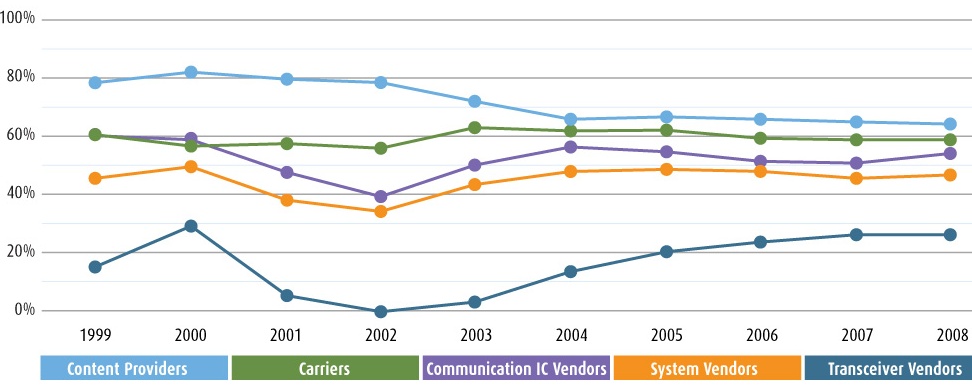 Average gross margin by industry. Source: LightCounting
The biggest change in the last decade has been the way optics is perceived. That is the view of Vladimir Kozlov, boss of optical transceiver market research firm, LightCounting. “In 2000, optics was set to change the world,” he says. “The intelligent optical network would do all the work for the carrier; nothing would be done electrically.”
The boom of 1999-2000 saw hundreds of start-ups enter the market. Ten years on and a handful only remain; none changed the industry dramatically.
 “The worse is definitely behind us”
Vladimir Kozlov, LightCounting
Kozlov cites tunable lasers as an example. In 2000, the CEO of one start-up claimed the market for tunable lasers would grow to US$1 billion. Today the tunable laser market is worth several tens of millions. “It [the tunable laser] is a useful product that is selling but expectation didn’t match reality,” says Kozlov.
Another example is planar lightwave circuits used to make devices such as arrayed waveguide gratings used to multiplex and demultiplex wavelengths. “Intel was the biggest cheerleader,” says Kozlov. “Did planar lightwave circuits change the industry? No, but it is a useful technology.”
Where significant progress has been made is in the reliability, compactness and cost reduction of optical components. High-end lasers with complex control electronics have been replaced by small, single-chip devices that have minimal associated circuitry, says Kozlov.
Pragmatism not euphoria
The biggest surprise for Kozlov has been how many companies have survived the extremely tough market conditions. “There were almost no sales in 2001 and the market didn’t recover till 2004,” he says. Companies latched on to niche markets outside telecom to get by while many of the start-ups survived on their funding before folding, merging or being acquired by larger players.
“The leading companies such as Finisar, Excelight (now merged with Eudyna to form Sumitomo Electric Device Innovations), Avago Technologies and Opnext were also leading companies 10 years ago,” said Kozlov, who adds Oclaro, created with the merger of Bookham and Avanex.
The market has experienced hiccups since 2004 such as the dip of 2008-2009. “The worse is definitely behind us,” says Kozlov. Many vendors have a good vision as to what to do and plan accordingly. He notes companies are maintaining resources to be well placed to respond to rapid increases in demand. And profitability is rising sharply after the belt-tightening of 2008-09. “Whoever gets in first makes the profit,” says Kozlov. “That is what happened in 1999, although that was an extreme.”
Transceiver vendors and gross margins
Another notable development of the last decade has been the advent of optical transceivers. In the late 1990s system vendors such as Alcatel, Fujitsu, Marconi, NEC and Nortel designed their own optical systems before divesting their optical component arms. Optical component companies exploited the opportunity by developing optical transceivers to sell to the systems vendors.
LightCounting forecasts that the global optical transceiver market will total $2.2 billion in 2010, yet Kozlov still has doubts about the optical transceiver vendors’ business model. “Optical transceiver vendors still have to prove they are profitable and viable, that they are a real layer in the food chain.”
Comparing the gross margin performance of the industry layers that make up the telecom industry, optical transceiver vendors are last (see chart at the top of the page). Gross margin is an efficiency measure as to how well a vendor turns what they manufacture into income. Companies such as Cisco Systems have impressive gross margins of 75%. “You have to own a market, to have something unique to maintain such a margin,” says Kozlov.
Cisco has a unique position and to a degree so do semiconductors players which have gross margins twice those of the transceiver vendors. Contract manufacturers, however, have even lower margins than the 25% achieved by the transceiver vendors, adds Kozlov, but they benefit from large manufacturing volumes.
The main challenge for transceiver vendors is differentiating their products. There is also fierce competition across product segments. “A gross margin of 25% is not the end of the world as long as there are sufficient volumes,” says Kozlov. “And of course 25% in China is a lot – local [optical transceiver] vendors don’t think twice about entering the market.”
Kozlov says there are now between 20-30 Chinese optical transceiver vendors. “Some two thirds are benefiting from government funding but a third are building laser manufacturing and making transceivers, are real, and are here to stay.”
Bandwidth drives components
LightCounting collects quarterly shipment data from leading optical transceiver vendors worldwide. It also forecasts market demand based on a traffic model. Kozlov stresses the importance of the adoption of broadband schemes such as fibre-to-the-x (FTTx) as a traffic driver and ultimately transceiver sales.
A small change in the bandwidth utilisation of the access network has a huge impact on the network core. The advent of a killer application or the emergence of devices such as the iPhone and iPad that change user habits and drive access network utilisation from 2% to 5% would have a marked impact on operators’ networks. “This would require a significant upgrade and would result in a very nice bubble,” says Kozlov.
 Utilised bandwidth (terabits-per-second). Scenario 2 with the higher utilisation in the access network quickly impacts core network capacity. Source: LightCounting
Another effect LightCounting has noted is that the total transceiver capacity is not keeping pace with growth in network traffic. This discrepancy is caused by operators running their networks more efficiently, explains Kozlov. Collapsing the number of platforms when operators adopt newer, more integrated systems is removing interfaces from the network.
LightCounting does not see operators’ traffic data such that Kozlov can’t know to what degrees operators are running their networks closer to capacity but given the rapid clip in traffic growth this is not a sustainable policy and hence does not explain this overall trend.
The next decade
Kozlov expects the next decade to continue like recent years with optical component companies being conservative and pragmatic. He is optimistic about optics’ adoption in the data centre as interface speeds move to 10Gbps and above, pushing copper to its limit. He also believes active optical cables are here to stay, while photonic integration will play an increasingly important role over time.
Kozlov also believes another bubble could occur especially if there is a need for more bandwidth at the network edge that will with a knock-on effect on the core.
But what gives him most optimism is that he simply doesn’t know. “We were all really wrong 10 years ago, maybe we will be again.”
- Lightwave July 2010: Interview with Vladimir Kozlov. "Can the optical transceiver industry sustain double-digit growth?
Ofidium to enter 100Gbps module market using OFDM
Part 1: The start-up
Ofidium is a 100 Gigabit start-up that refuses to follow the herd.
While the optical industry has chosen polarisation-multiplexing quadrature phase-shift keying (PM-QPSK) for 100 Gigabit-per-second (Gbps) transmission, the Australian start-up is developing a module based on orthogonal frequency division multiplexing (OFDM) modulation.

"For data rates higher than 100Gbps, it [OFDM] is the only way to go"
Jonathan Lacey, CEO
Orthogonality refers to how more than one signal, each carrying a data stream, can be sent over a fibre before being recovered at the receiver.
Polarisation multiplexing, as used by PM-QPSK and Ofidium’s OFDM, makes use of two independent signals, exploiting the fibre’s orthogonal polarisations. But OFDM also uses orthogonality in the form of multiple independent carriers.
PM-QPSK is referred to as a single-carrier scheme. Ofidium’s OFDM approach, in contrast, uses digital processing at the transmitter to generate a signal that has many hundreds of very closely-spaced, independent sub-carriers, each tolerant to optical impairments. At the receiver, digital processing transforms this comb-like signal back into a single data stream.
Ofidium claims OFDM line-side transmission delivers several advantages when compared with PM-QPSK.
OFDM lends itself to very high spectral efficiency, claims Jonathan Lacey, Ofidium's CEO: “For 100Gbps at 25GHz channel spacing – and for data rates higher than 100Gbps – it [OFDM] is the only way to go.” The spectrally efficiency gives OFDM higher tolerance to optical filtering and to polarisation-dependent loss encountered at 100Gbps. “It is very tolerant to optical filtering and to polarisation-dependent loss,” says Lacey.
OFDM also has implementation benefits.
Despite adopting an alternative modulation scheme to the rest of the industry, Ofidium benefits from the same optical components being developed for PM-QPSK as stipulated by the Optical Internetworking Forum (OIF) in its Framework Document.
And one costly aspect of a single-carrier PM-QPSK design is the fast analogue-to-digital converters (ADCs) used. Sampling rates of up to 64 Gsamples/s are required. According to Ofidium, its OFDM design uses a sampling rate 40% lower than single-carrier PM-QPSK. Ofidium is working with German mixed signal specialist Micram for its ADCs.
OFDM also uses the fast Fourier transform, a commonly available digital signal processor (DSP) design block. “The wireless world has been optimising DSPs for OFDM for decades,” says Lacey. “We borrow from the wireless guys.”
Lacey says the start-up never considered using its OFDM expertise to become an equipment maker. “If I look at the expertise of the company, that isn’t where we add value,” he says. In turn the level of investment needed for a system vendor start-up is 10x that of a module maker. “With Australian venture capital $10 to $100m is possible, not hundreds of millions.”
Lacey says its module design is already being tested by a leading equipment maker and that more details will be announced in coming months.
The start-up can also take encouragement from the views of Verizon, the first operator to deploy 100Gbps.
Verizon and AT&T have both been vocal in backing PM-QPSK as the 100Gbps modulation scheme, partly to encourage the industry to focus their R&D spending on developing one common technology.
Yet Glenn Wellbrock, director of backbone network design at Verizon Business, accepts that Ofidium is ‘most likely” OIF Framework Document compliant, and admits that the operator could use OFDM technology. However two requirements must first be met.
When a system vendor says it meets Verizon’s system link performance requirements, all the 300-pin optical module suppliers’ designs used by the system vendor meet the specification. Any OFDM-based module must also meet Verizon’s specifications to be considered.
The OFDM module also needs to be as cheap as - ideally cheaper than - the 300-pin PM-QPSK transponders.
If both these conditions are met then OFDM-based transponders “can be successful”, says Wellbrock.
References:
[1] “Modulation and multiplexing in optical communication systems,” by Peter Winzer, IEEE LEOS newsletter, February 2009
[2] Ofidium’s technology resources