

FSAN close to choosing the next generation of PON
Briefing: Next-gen PON
Part 1: NG-PON2
The next-generation passive optical network (PON) will mark a departure from existing PON technologies. Some operators want systems based on the emerging standard for deployment by 2015.

“One of the goals in FSAN is to converge on one solution that can serve all the markets"
Derek Nesset, co-chair of FSAN's NGPON task group
The Full Service Access Network (FSAN) industry group is close to finalising the next optical access technology that will follow on from 10 Gigabit GPON.
FSAN - the pre-standards forum consisting of telecommunications service providers, testing labs and equipment manufacturers - crafted what became the International Telecommunication Union's (ITU) standards for GPON (Gigabit PON) and 10 Gigabit GPON (XGPON1). In the past year FSAN has been working on NG-PON2, the PON technology that comes next.
“One of the goals in FSAN is to converge on one solution that can serve all the markets - residential users, enterprise and mobile backhaul," says Derek Nesset, co-chair of FSAN's NGPON task group.
Some mobile operators are talking about backhaul demands that will require multiple 10 Gigabit-per-second (Gbps) links to carry the common public radio interface (CPRI), for example. The key design goal, however, is that NG-PON2 retains the capability to serve residential users cost-effectively, stresses Nesset.
FSAN says it has a good description of each of the candidate technologies: what each system looks like and its associated power consumption. "We are trying to narrow down the solutions and the ideal is to get down to one,” says Nesset.
The power consumption of the proposed access scheme is of key interest for many operators, he says. Another consideration is the risk associated with moving to a novel architecture rather than adopting an approach that builds on existing PON schemes.
Operators such as NTT of Japan and Verizon in the USA have a huge installed base of PON and want to avoid having to amend their infrastructure for any next-generation PON scheme unable to re-use power splitters. Other operators such as former European incumbents are in the early phases of their rollout of PON and have Greenfield sites that could deploy other passive infrastructure technologies such as arrayed waveguide gratings (AWG).
"The ideal is we select a system that operates with both types of infrastructure," says Nesset. "Certain flavours of WDM-PON (wavelength division multiplexing PON) don't need the wavelength splitting device at the splitter node; some form of wavelength-tuning can be installed at the customer premises." That said, the power loss of existing optical splitters is higher than AWGs which impacts PON reach – one of several trade-offs that need to be considered.
Once FSAN has concluded its studies, member companies will generate 'contributions' for the ITU, intended for standardisation. The ITU has started work on defining high-level requirements for NG-PON2 through contributions from FSAN operators. Once the NG-PON2 technology is chosen, more contributions that describe the physical layer, the media access controller and the customer premise equipment's management requirements will follow.
Nesset says the target is to get such documents into the ITU by September 2012 but achieving wide consensus is the priority rather than meeting this deadline. "Once we select something in FSAN, we expect to see the industry ramp up its contributions based on that selected technology to the ITU," says Nesset. FSAN will select the NG-PON2 technology before September.
NG-PON2 technologies
Candidate technologies include an extension to the existing GPON and XGPON1 based on time-division multiplexing (TDM). Already vendors such as Huawei have demonstrated prototype 40 Gigabit capacity PON systems that also support hybrid TDM and WDM-PON (TWDM-PON). Other schemes include WDM-PON, ultra-dense WDM-PON and orthogonal frequency division multiplexing (OFDM).
Nesset says there are several OFDM variants being proposed. He views OFDM as 'DSL in the optical domain’: sub-carriers finely spaced in the frequency domain, each carrying low-bit-rate signals.
One advantage of OFDM technology, says Nesset, includes taking a narrowband component to achieve a broadband signal: a narrowband 10Gbps transmitter and receiver can achieve 40Gbps using sub-carriers, each carrying quadrature amplitude modulation (QAM). "All the clever work is done in CMOS - the digital signal processing and the analogue-to-digital conversion," he says. The DSP executes the fast Fourier transform (FFT) and the inverse FFT.
"We are trying to narrow down the solutions and the ideal is to get down to one"
Another technology candidate is WDM-PON including an ultra-dense variant that promises a reach of up to 100km and 1,000 wavelengths. Such a technology uses a coherent receiver to tune to the finely spaced wavelengths.
In addition to being compatible with existing infrastructure, another FSAN consideration is compatibility with existing PON standards. This is to avoid having to do a wholesale upgrade of users. For example, with XGPON1, the optical line terminal (OLT) using an additional pair of wavelengths - a wavelength overlay - sits alongside the existing GPON OLT. ”The same principle is desirable for NG-PON2,” says Nesset.
However, an issue is that spectrum is being gobbled up with each generation of PON. PON systems have been designed to be low cost and the transmit lasers used are not wavelength-locked and drift with ambient temperature. As such they consume spectrum similar to coarse WDM wavelength bands. Some operators such as Verizon and NTT also have a large installed base of analogue video overlay at 1550nm.
”So in the 1500 band you've got 1490nm for GPON, 1550nm for RF (radio frequency) video, and 1577nm for XGPON; there are only a few small gaps,” says Nesset. A technology that can exploit such gaps is both desirable and a challenge. “This is where ultra-dense WDM-PON could come into play,” he says. This technology could fit tens of channels in the small remaining spectrum gaps.
The technological challenges implementing advanced WDM-PON systems that will likely require photonic integration is also a concern for the operators. "The message from the vendors is that ’when you tell us what to do, we have got the technology to do it’,” says Nesset. ”But they need the see the volume applications to justify the investment.” However, operators need to weigh up the technological risks in developing these new technologies and the potential for not realising the expected cost reductions.
Timetable
Nesset points out that each generation of PON has built on previous generations: GPON built on BPON and XGPON on GPON. But NG-PON2 will inevitably be based on new approaches. These include TWDM-PON which is an evolution of XG-PON into the wavelength domain, virtual point-to-point approaches such as WDM-PON that may also use an AWG, and the use of digital signal processing with OFDM or coherent ultra dense WDM-PON. ”It is quite a challenge to weigh up such diverse technological approaches,” says Nesset.
If all goes smoothly it will take two ITU plenary meetings, held every nine months, to finalise the bulk of the NG-PON2 standard. That could mean mid-2013 at the earliest.
FSAN's timetable is based on operators wanting systems deployable in 2015. That requires systems to be ready for testing in 2014.
“[Once deployed] we want NG-PON2 to last quite a while and be scalable and flexible enough to meet future applications and markets as they emerge,” says Nesset.

The post-100 Gigabit era
Feature: Beyond 100G - Part 4
The latest coherent ASICs from Ciena and Alcatel-Lucent coupled with announcements from Cisco and Huawei highlight where the industry is heading with regard high-speed optical transport. But the announcements also raise questions too.
 Source: Gazettabyte
Observations and queries
- Optical transport has had a clear roadmap: 10 to 40 to 100 Gigabit-per-second (Gbps). 100Gbps optical transport will be the last of the fixed line-side speeds.
- After 100Gbps will come flexible speed-reach deployments. Line-side optics will be able to implement 50Gbps, 100Gbps, 200Gbps or even faster speeds with super-channels, tailored to the particular link.
- Variable speed-reach designs will blur the lines between metro and ultra long-haul. Does a traditional metro platform become a trans-Pacific submarine system simply by adding a new line card with the latest coherent ASIC boasting transmit and receive digital signal processors (DSPs), flexible modulation and soft-decision forward error correction?
 Source: Gazettabyte
- The cleverness of optical transport has shifted towards electronics and digital signal processing and away from photonics. Optical system engineers are being taxed as never before as they try to extend the reach of 100, 200 and 400Gbps to match that of 10 and 40Gbps but what is key for platform differentiation is the DSP algorithms and ASIC design.
- Optical is the new radio. This is evident with the adding of a coherent transmit DSP that supports the various modulation schemes and allows spectral shaping, bunching carriers closer to make best use of the fibre's bandwidth.
- The radio analogy is fitting because fibre bandwidth is becoming a scarce resource. Usable fibre capacity has more than doubled with these latest ASIC announcements. Moving to 400Gbps doubles overall capacity to some 18 Terabits. Spectral shaping boosts that even further to over 23 Terabits. Last week 8.8 Terabits (88x100Gbps) was impressive.
- Maximising fibre capacity is why implementing single-carrier 100Gbps signals in 50GHz channels is now important.
- Super-channels, combining multiple carriers, have a lot of operational merits (see the super-channel section in the Cisco story). Infinera announced its 500Gbps super-channel over 250GHz last year. Now Ciena and Alcatel-Lucent highlight how a dual-carrier, dual-polarisation 16-QAM approach in 100GHz implements a 400Gbps signal.
- Despite all the talk of 16-QAM and 400Gbps wavelengths, 100Gbps is still in its infancy and will remain a key technology for years to come. Alcatel-Lucent, one of the early leaders in 100Gbps, has deployed 1,450 100 Gig line units since it launched its system in June 2010.
- Photonic integration for coherent will remain of key importance. Not so much in making yet more complex optical structures than at 100Gbps but shrinking what has already been done.
- Is there a next speed after 100Gbps? Is it 200Gbps until 400Gbps becomes established? Is it 500Gbps as Infinera argues? The answer is that it no longer matters. But then what exactly will operators use to assess the merits of the different vendors' platforms? Reach, power, platform density, spectral efficiency and line speeds are all key performance parameters but assessing each vendor's platform has clearly got harder.
- It is the system vendors not the merchant chip makers that are driving coherent ASIC innovation. The market for 100Gbps coherent merchant chips will remain an important opportunity given the early status of the market but how will coherent merchant chip vendors compete, several of them startups, with the system vendors' deeper pockets and sophisticated ASIC designs?
- Optical transponder vendors at least have more scope for differentiation but it is now also harder. Will one or two of the larger module makers even acquire a coherent ASSP maker?
- Infinera announced its 100G coherent system last year. Clearly it is already working on its next-generation ASIC. And while its DTN-X platform boasts a 500Gbps super-channel photonic chip, its overall system capacity is 8 Terabit (160x50Gbps, each in 25GHz channels). How will Infinera respond, not only with its next ASIC but also its next-generation PIC, to these latest announcements from Ciena and Alcatel-Lucent?
Will LTE lead to new revenues for the operators?

The opportunities and challenges the Long Term Evolution (LTE) standard poses for mobile operators. An article for the Mobile World Congress show for the magazine Informilo, click here.
Huawei boosts its optical roadmap with CIP acquisition
Huawei has acquired UK photonic integration specialist, CIP Technologies, from the East of England Development Agency (EEDA) for an undisclosed fee. The acquisition gives the Chinese system vendor a wealth of optical component expertise and access to advanced European Union R&D projects.
"By acquiring CIP and integrating the company’s R&D team into Huawei’s own research team, Huawei’s optic R&D capabilities can be significantly enhanced," says Peter Wharton, CEO at the Centre for Integrated Photonics (CIP). CIP Technologies is the trading name of the Centre for Integrated Photonics.
 Huawei now has six European R&D centres with the acquisition of CIP.
CIP Technologies has indium phosphide as well as planar lightwave circuit (PLC) technology which it uses as the basis for its HyBoard hybrid integration technology. HyBoard allows actives to be added to a silica-on-silicon motherboard to create complex integrated optical systems.
CIP has been using its photonic integration expertise to develop compact, more cost-competitive WDM-PON optical line terminal (OLT) and optical network unit (ONU) designs, including the development of an integrated transmitter array.
The company employs 50 staff, with 70% of its work coming from the telecom and datacom sectors. About a third of its revenues are from advanced products and two thirds from technical services.
The CEO of CIP says all current projects for its customers will be carried out as planned but CIP’s main research and development service will be focused on Huawei’s business priorities. “We expect all contracted projects to be completed and current customers are being assisted to find alternate sources of supply," says Wharton.
CIP is also part of several EU Seventh Framework programme R&D projects. These include BIANCHO, a project to reduce significantly the power consumption of optical components and systems, and 3CPO, which is developing colourless and coolerless optical components for low-power optical networks.
Huawei's acquisition will not affect CIP's continuing participation in such projects. "For EU framework and other collaborative R&D projects, the ultimate share ownership does not matter so long as it is a research organisation based in Europe, which CIP will continue to be," says Wharton.
CIP said it had interest from several potential acquirers but that the company favoured Huawei.
What this means
CIP has a rich heritage. It started as BT's fibre optics group. But during the optical boom of 1999-2000, BT shed its unit, a move also adopted by such system vendors as Nortel and Lucent.
The unit was acquired by Corning in 2000 but the acquisition did not prove a success and in 2002 the group faced closure before being rescued by the East of England Development Agency (EEDA).
CIP has always been an R&D organisation in character rather than a start-up. Now with Huawei's ambition, focus and deep pockets coupled with CIP's R&D prowess, the combination could prove highly successful if the acquisition is managed well.
Huawei's acquisition looks shrewd. Optical integration has been discussed for years but its time is finally arriving. The technologies of 40 Gigabit and 100 Gigabit is based on designs with optical functions in parallel; at 400 Gigabit the number of channels only increases.
Optical access will also benefit from photonic integration - from board optical sub-assemblies for GPON and EPON to WDM-PON to ultra dense WDM-PON. China is also the biggest fibre-to-the-x (FTTx) market by far.
A BT executive talking about the operator's 21CN mentioned how system vendors used to ask him repeatedly about Huawei. Huawei, in contrast, used to ask him about Infinera.
Huawei, like all the other systems vendors, has much to do to match Infinera's photonic integrated circuit expertise and experience. But the Chinese vendor's optical roadmap just got a whole lot stronger with the acquisition of CIP.
Further reading:
Reflecting light to save power, click here
Chinese optical component vendors set for change

“If [Chinese optical component] companies get $100m from an IPO, they have the resources to really do things”
Vladimir Kozlov, LightCounting
The local OC players have benefitted from the prolonged growth of China’s economy, the rise of global telecom system vendors Huawei and ZTE, and the significant expansion in Chinese operators’ networks. But such domestic growth will not continue and will likely lead to a shake-up of the local OC firms.
“They [Chinese OC players] all have the same industry pitch: they all have huge capacity, they have tons of people and they are growing fast but when you research that, you uncover different approaches to doing business,” says Vladimir Kozlov, CEO at LightCounting.
The market research firm has identified several classes of OC player. There are quite a few mid-size companies that focus on niche local opportunities. “Very few of them have an ambition of becoming a global player,” says Kozlov. “They have been set up with local government support, primarily with the aim of employing local people and being involved in local telecom projects.”
But there are other players with broader ambitions and resources. Companies such as HiSense Broadband and HG Genuine, acknowledged manufacturers of electronics and consumer products, have formed OC business units recognising the growth potential of optical communications.
Another category that Western firms will do well to note, says Kozlov, is the Chinese OC players with a long history such as WTD and Accelink. “WTD is 30-years-old and grew from the Wuhan Research Institute that is also a founding body for Chinese system vendor FiberHome,” says Kozlov. WTD has been growing steadily and the pace has accelerated in the last two years. “WTD is becoming more aggressive and is gaining market share while Accelink has a successful IPO that brought in $100m,” he says.
Other companies will likely follow Accelink’s example and raise money through IPOs. But what will be interesting is whether such companies continue to focus on the Chinese market or start addressing issues such as what technologies they are missing and even make acquisitions, he says.
“A lot more companies will have access to financial markets as the regulation that limits how many companies can become public is relaxed,” says Kozlov. “If [Chinese OC] companies get [US] $100m from an IPO, they have the resources to really do things.”
“It is unlikely that Huawei will keep on growing as fast as it did over recent years and continue to take market share from Alcatel-Lucent, Ericsson and others for much longer”
Yet another Chinese OC player segment is start-ups funded by venture capitalists (VCs). One example is Innolight which has received funding from local VCs and a Western company. “VCs will push firms to be as ambitious as possible as they are after returns,” says Kozlov. Interest among the financial investment community is also growing given the rise of the stock price of the OC industry’s leading firms in the last year. Such interest will likely lead to investment and restructuring of local Chinese firms, he says.
Chinese OC vendors have been helped by the rise of the system vendors Huawei and ZTE. The Chinese equipment makers have been disruptive in adopting technology quickly while reducing their costs. But having become global players, Huawei and ZTE now face their own challenges.
“Both [system vendors] companies have caught up on the technology and the next step for them is to see whether they can become leaders in technology and stay ahead of an Alcatel-Lucent or a Ciena,” says Kozlov. “They have the ambition but can they do it?” Kozlov notes that Chinese companies are now highly active with patent applications: “Chinese firms recognise that this is how they will achieve a longer-term advantage and protect their own technologies.”
Another challenge facing the system vendors, common to many technology industries, is that no one player dominates a market. “Usually three global companies share the dominance; the same if it is a local market,” says Kozlov. “It is therefore unlikely that Huawei will keep on growing as fast as it did over recent years and continue to take market share from Alcatel-Lucent, Ericsson and others for much longer.”
This will require Huawei and ZTE to adapt to more moderate growth in future. Meanwhile North American and European system vendors have long responded to the competitive threat, moving their manufacturing to Asia Pacific - and China in particular - to benefit from reduced operating costs. For the Chinese OC vendors, yet to become global players, the chance to be as disruptive as the Chinese system vendors has gone since leading OC vendors have established local manufacturing.
Can Western companies learn from the experience of Chinese system and OC vendors? Kozlov is not so sure.
The Chinese have proved adept at learning the business and mastering new technologies. The examples of Huawei and ZTE that have disrupted the market by being as efficient as possible have proved a wake-up call for Western companies. “I don’t see anything beyond that that Western companies can learn; it is still the Chinese that are learning from Western companies,” says Kozlov. “This does not mean that the Western companies have nothing to worry about; there is plenty of room for improvement in the industry supply chain.”
Looking at the decade ahead, Kozlov expects Huawei to have a much greater penetration in the North American telecom market. “And as it [Huawei] builds up its own intellectual property, it will be better able to compete with Cisco Systems and H-P in the datacom market,” says Kozlov. And as Chinese companies get access to greater finance he also expects they will start acquiring Western firms to gain expertise and greater access to markets.
LightReading Market Spotlight: ROADMs

Click here for the market spotlight ROADM article written for LightReading. See also the comment discussions.
Wireless backhaul: The many routes to packet
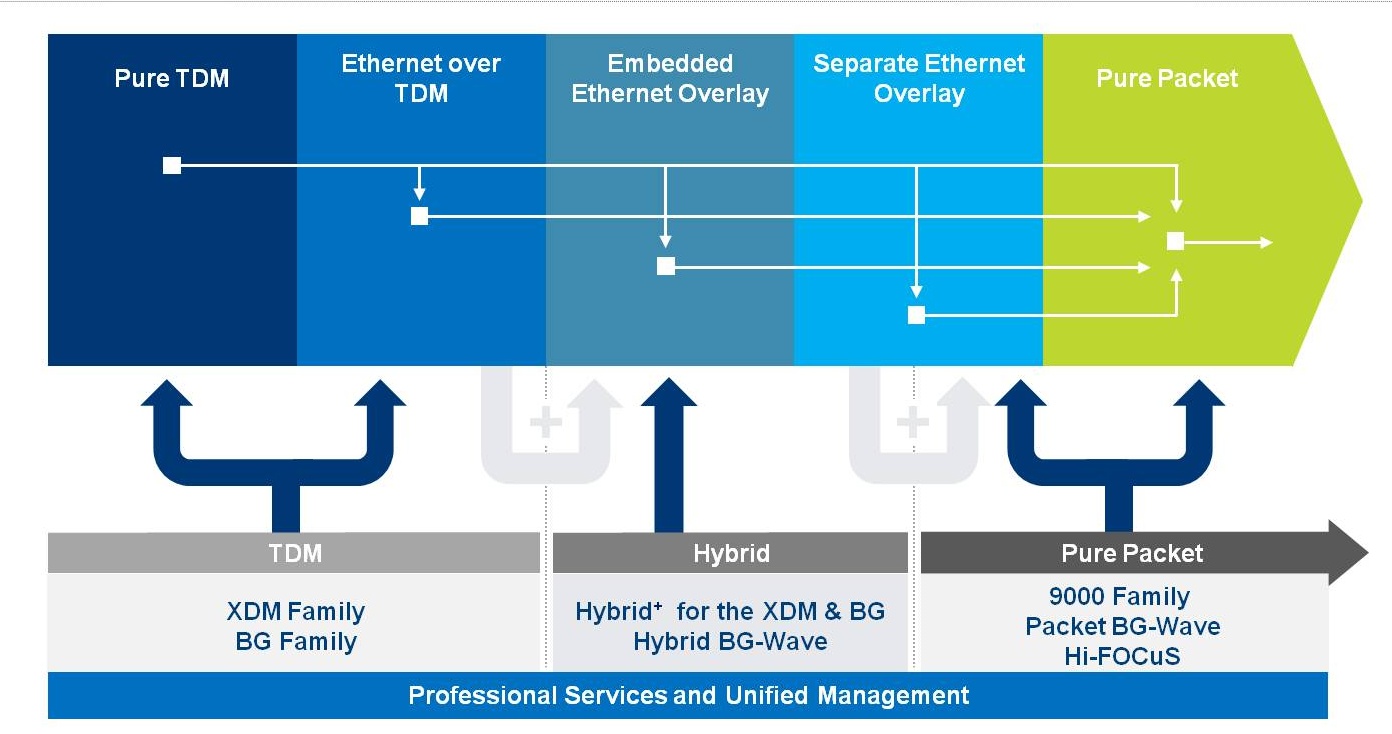
ECI Telecom has detailed its wireless backhaul offering that spans the cell tower to the metro network. The 1Net wireless backhaul architecture supports traditional Sonet/SDH to full packet transport, with hybrid options in between, across various physical media.
“We can support any migration scheme an operator may have over any type of technology and physical medium, be it copper, fibre or microwave,” says Gil Epshtein, senior product marketing manager, network solutions division at ECI Telecom.
Why is this important?
Operators are experiencing unprecedented growth in wireless data due to the rise of smart phones and notebooks with 3G dongles for mobile broadband.
Mobile data surpassed voice traffic for the first time in December 2009, according to Ericsson, with the crossover occurring at approximately 140,000 terabytes per month in both voice and data traffic. According to Infonetics Research, mobile broadband subscribers surpassed digital subscriber line (DSL) subscribers in 2009, and will grow to 1.5 billion worldwide in 2014. By then, there will be 3.6 exabytes (3.6 billion gigabytes) per month of mobile data traffic, with two thirds being wireless video, forecasts Cisco Systems.
“The challenge is that almost all the growth is packet internet traffic, and that is not well suited to sit on the classic TDM backhaul network originally designed for voice,” says Michael Howard, principal analyst, carrier and data center networks at Infonetics Research. TDM refers to time division multiplexing based on Sonet/SDH where for wireless backhaul T1/E1lines are used.

“There is a gap between the technology hype and real life”
Gil Epshtein, ECI Telecom
The fast growth also implies an issue of scale, with the larger mobile operators having many cell sites to backhaul. E1/TI lines are also expensive even if prices are coming down, says Howard: “It is much cheaper to use Ethernet as a transport – the cost per bit is enormously better.”
This is why operators are keen to upgrade their wireless backhaul networks from Sonet/SDH to packet-based Ethernet transport. “But there is a gap between the technology hype and real life,” says Epshtein. Operators have already invested heavily in existing backhaul infrastructure and upgrading to packet will be costly. The operators also know that projected revenues from data services will not keep pace with traffic growth.
“Operators are faced with how to build out their backhaul infrastructures to meet service demands at cost points that provide an adequate return on investment,” says Glen Hunt, principal analyst, carrier transport and routing at Current Analysis. Such costs are multi-faceted, he says, on the capital side and the operational side. “Carriers do not want to buy an inexpensive device that adds complexity to network operations which then offsets any capital savings.”
“It is much cheaper to use Ethernet as a transport –the cost per bit is enormously better.”
Michael Howard, Infonetics Research
To this aim, ECI offers operators a choice of migration schemes to packet-based backhaul. Its solution supports T1/E1lines and Ethernet frame encapsulation over TDM, Ethernet overlay networks, and packet-only networks (see chart above).
With Ethernet overlay, an Ethernet network runs alongside the TDM network. The two can co-exist within a common network element, what ECI calls embedded Ethernet overlay, or separately using distinct TDM and packet switch platforms. And when an operator adopts all-packet, legacy TDM traffic can be carried over packets using circuit emulation pseudo-wire technology.
“ECI’s offering is significant since it includes all the components and systems necessary to handle nearly any type of backhaul requirement,” says Hunt. The same is true for most of the larger system vendors, he says. However, many vendors integrate third party devices to complete their solutions – ECI itself has done this with microwave. But with 1NET for wireless backhaul, ECI will now offer its own microwave backhaul systems.
According to Infonetics, between 55% and 60% of all backhaul links are microwave outside of North America. And 80% of all microwave sales are for mobile backhaul. Moreover, Infonetics estimates that 70 to 80% of operator spending on mobile backhaul through 2012 will be on microwave. “Those are the figures that explain why ECI has decided to go it alone,” says Howard. Until now ECI has used products from its microwave specialist partner, Ceragon Networks.
“ECI has all the essential features that the other big players have like Ericsson, Alcatel-Lucent, Nokia Siemens Networks and Huawei,” says Howard. What is different is that ECI does not supply radio access network (RAN) equipment such as basestations. “It is ok, though, because almost all of the [operator] backhaul tenders separate between RAN and backhaul,” says Howard.
ECI argues that by adopting a technology-agnostic approach, it can address operators’ requirements without forcing them down a particular path. “Operators are looking for guidance as to which path is best from this transition,” says Epshtein. There is no one-model fits all. “We have so many exceptions you really need to look on a case-by-case basis.”
In developed markets, for example, the building of packet overlay is generally happening faster. Some operators with fixed line networks have already moved to packet and that, in theory, simplifies upgrading the backhaul to packet. But organisational issues across an operator’s business units can complicate and delay matters, he says.
And Epshtein cites one European operator that will use its existing network to accommodate growth in data services over the coming years: “It is putting aside the technology hype and looking at the bottom line."
In emerging markets, moving to packet is happening more slowly as mobile users’ income is limited. But on closer inspection this too varies. In Africa, certain operators are moving straight to all-IP, says Ephstein, whereas others are taking a gradual approach.
What’s been done?
ECI has launched new products as well as upgraded existing ones as part of its 1NET wireless backhaul offering.
The company has announced its BG-Wave microwave systems. There are two offerings: an all-packet microwave system and a hybrid one that supports both TDM and Ethernet traffic. ECI says that having its own microwave products will allow it to gain a foothold with operators it has not had design wins before.
“ECI will need to prove the value of its microwave products with actual field deployments”
Glen Hunt, Current Analysis
ECI has announced two additional 9000 carrier Ethernet switch routers (CESR) families: the 9300 and 9600. These have switching capacities and a product size more suited to backhaul. The switches support Layer 3 IP-MPLS and Layer 2 MPLS-TP, as well as the SyncE and IEEE 1588 Version 2 synchronisation protocols.
ECI has also upgraded its XDM multi-service provisioning platform (MSPP) to enable an embedded overlay with Ethernet and TDM traffic supported within the platform.
“When an operator is choosing to add packet backhaul to existing TDM backhaul, typically it is a separate network – they keep voice on TDM and add a second network for packet,” says Howard. This hybrid approach involves adding another set of equipment. “ECI has added functions to existing equipment, which operators may already have, that allows two networks to run over a single set of products.”
Also included in the solution are ECI’s BroadGate and its Hi-FOCuS multi-service access node (MSAN). This is not for operators to deploy the platform for wireless backhaul but rather those operators that have the MSAN can now use it for backhauling traffic, says Ephstein. This is useful in dense urban areas and for operators offering wholesale services to other operators.
All the network elements are controlled using ECI’s LightSoft management system.
“ECI’s solution has the advantage that all the systems use the same operating system and support the same features,” says Hunt. He cites the example of MPLS-TP which is implemented on ECI’s carrier Ethernet and optical platforms.
“ECI has a full range of platforms that all work together to meet the needs of mobile as well as fixed operator,” says Hunt. “ECI will need to prove the value of its microwave products with actual field deployments.”
Operator interest
ECI has secured general telecom wins with large incumbent operators in Western Europe and has been winning business in Eastern Europe, Russia, India and parts of Asia.
ECI’s sweet spot has been its relationship with Tier 2 and Tier 3 operators, says Hunt, and since the company offers broadband access, optical transport, and carrier Ethernet, it can use these successes to help expand into areas such as wireless backhaul.
But wireless backhaul is already a key part of the company’s business, accounting for over 30% of revenues, says Ephstein. Late last year ECI estimated that it was carrying between 30% and 40% of the mobile backbone traffic in India, a rapidly growing market.
As for 1NET wireless backhaul, ECI has announced one win so far - Israeli mobile operator Cellcom which has selected the 9000 CESR family. “Cellcom shows that ECI can continue to expand its presence in the network - in this case leveraging business Ethernet services to add backhaul,” says Hunt.
In addition one European operator, as yet unnamed, has selected ECI’s embedded overlay. “Several other operators are in various stages of selecting the right option for them,” says Ephstein.
- For some ECI wireless backhaul papers and case studies, click here