

OFC 2025: industry reflections
Gazettabyte is asking industry figures for their thoughts after attending the recent 50th-anniversary OFC show in San Francisco. Here are the first contributions from Huawei’s Maxim Kuschnerov, NLM Photonics’ Brad Booth, LightCounting’s Vladimir Kozlov, and Jürgen Hatheier, Chief Technology Officer, International, at Ciena.
Maxim Kuschnerov, Director of R&D, Huawei
The excitement of last year’s Nvidia’s Blackwell graphics processing unit (GPU) announcement has worn off, and there was a slight hangover at OFC from the market frenzy then.
The 224 gigabit-per-second (Gbps) opto-electronic signalling is reaching mainstream in the data centre. The last remaining question is how far VCSELs will go—30 m or perhaps even further. The clear focus of classical Ethernet data centre optics for scale-out architectures is on the step to 448Gbps-per-lane signalling, and it was great to see many feasibility demonstrations of optical signalling showing that PAM-4 and PAM-6 modulation schemes will be doable.
The show demonstrations either relied on thin-film lithium niobate (TFLN) or the more compact indium-phosphide-based electro-absorption modulated lasers (EMLs), with thin-film lithium niobate having the higher overall optical bandwidth.
Higher bandwidth pure silicon Mach-Zehnder modulators have also been shown to work at a 160-175 gigabaud symbol rate, sufficient to enable PAM-6 but not high enough for PAM-4 modulation, which the industry prefers for the optical domain.
Since silicon photonics has been the workhorse at 224 gigabits per lane for parallel single-mode transceivers, a move away to thin-film lithium niobate would affect the density of the optics and make co-packaged optics more challenging.
With PAM-6 being the preferred modulation option in the electrical channel for 448 gigabit, it begs the question of whether the industry should spend more effort on enabling PAM-6 optical to kill two birds with one stone: enabling native signalling in the optical and electrical domains would open the door to all linear drive architectures, and keep the compact pure-silicon platform in the technology mix for optical modulators. Just as people like to say, “Never bet against copper,” I’ll add, “Silicon photonics isn’t done until Chris Doerr says so.”
If there was one topic hotter than the classical Ethernet evolution, it was the scale-up domain for AI compute architectures. The industry has gone from scale-up in a server to a rack-level scale-up based on a copper backplane. But future growth will eventually require optics.
While the big data centre operators have yet to reach a conclusion about the specifications of density, reach, or power, it is clear that such optics must be disruptive to challenge the classical Ethernet layer, especially in terms of cost.
Silicon photonics appears to be the preferred platform for a potential scale-up, but some vendors are also considering VCSEL arrays. The challenge of merging optics onto the silicon interposer along with the xPU is a disadvantage for VCSELs in terms of tolerance to high-temperature environments.
Reliability is always discussed when discussing integrated optics, and several studies were presented showing that optical chips hardly ever fail. After years of discussing how unreliable lasers seem, it’s time to shift the blame to electronics.
But before the market can reasonably attack optical input-output for scale-up, it has to be seen what the adoption speed of co-packaged optics will be. Until then, linear pluggable optics (LPO) or linear retimed optics (LRO) pluggables will be fair game in scaling up AI ‘pods’ stuffed with GPUs.
Brad Booth, CEO of NLM Photonics
At OFC, the current excitement in the photonics industry was evident due to the growth in AI and quantum technologies. Many of the industry’s companies were represented at the trade show, and attendance was excellent.
Nvidia’s jump on the co-packaged optics bandwagon has tipped the scales in favour of the industry rethinking networking and optics.
What surprised me at OFC was the hype around thin-film lithium niobate. I’m always concerned when I don’t understand why the hype is so large, yet I have still to see the material being adopted in the datacom industry.
Vladimir Kozlov, CEO of LightCounting
This year’s OFC was a turning point for the industry, a mix of excitement and concern for the future. The timing of the tariffs announced during the show made the event even more memorable.
This period might prove to be a peak of the economic boom enabled by several decades of globalisation. It may also be the peak in the power of global companies like Google and Meta and their impact on our industry.
More turbulence should be expected, but new technologies will find their way to the market.
Progress is like a flood. It flows around and over barriers, no matter what they are. The last 25 years of our industry is a great case study.
We are now off for another wild ride, but I look forward to OFC 2050.
Jürgen Hatheier, Chief Technology Officer, International, at Ciena
This was my first trip to OFC, and I was blown away. What an incredible showcase of the industry’s most innovative technology
One takeaway is how AI is creating a transformative effect on our industry, much like the cloud did 10 years ago and smartphones did 20 years ago.
This is an unsurprising observation. However, many outside our industry do not realise the critical importance of optical technology and its role in the underlying communication network. While most of the buzz has been on new AI data centre builds and services, the underlying network has, until recently, been something of an afterthought.
All the advanced demonstrations and technical discussions at OFC emphasise that AI would not be possible without high-performance network infrastructure.
There is a massive opportunity for the optical industry, with innovation accelerating and networking capacity scaling up far beyond the confines of the data centre.
The nature of AI — its need for intensive training, real-time inferencing at the edge, and the constant movement of data across vast distances between data centres — means that networks are evolving at pace. We’re seeing a significant architectural shift toward more agile, scalable, and intelligent infrastructure with networks that can adapt dynamically to AI’s distributed, data-hungry nature.
The diversity of optical innovation presented at the conference ranged from futuristic Quantum technologies to technology on the cusp of mainstream adoption, such as 448-gigabit electrical lanes.
The increased activity and development around high-speed pluggables also show how critical coherent optics has become for the world’s most prominent computing players.


Books of 2024: Part 1
Gazettabyte asks industry figures to pick their notable reads during the year. Harald Bock, Jonathan Homa, and Maxim Kuschenrov kick off with their chosen books.
Harald Bock, Vice President Network Architecture, Infinera
I love reading but have not read as many books as I would have liked in recent years. I decided to change that in 2024.
My pick of fictional books this year was mainly classic science fiction after seeing the movie Dune Part 2 with my family. I read the book Dune by Frank Herbert, published in 1965, a while ago, and I wasn’t sure that the movies did the book justice.
My son advised me to launch myself into all five sequels of Dune, which kept me busy. While the sequels are for die-hard fans, I recommend the first of the books whether or not you’ve seen the movie. Frank Herbert’s modern and sophisticated thinking adds unconventional perspectives to up-to-date societal, environmental and political questions.
I went on to read Ray Bradbury’s The Martian Chronicles and H.G. Wells’ Time Machine, published in 1950 and 1895, respectively. The two books are fascinating as they are timeless and do not require any adaptation to modern times. They are classics of their genre.
I also found time for non-fictional books. I was looking for unconventional thoughts by unlikely authors to challenge my thinking.
One that adds to the discussions about sustainability is a book by Fred Vargas, a French author who normally writes crime fiction and is an archaeologist and historian. ‘L’humanité en péril: Virons de bord, toute !‘ was published as a follow-up to an older, shorter text by the same author read on the occasion of the conference on climate change COP24 in Paris in 2018. Surprisingly, the book does not yet exist in English.
Another interesting author is a professor of computer science, Katharina Zweig. Her books: Awkward Intelligence: Where AI Goes Wrong, Why It Matters, and What We Can Do about It and Die KI war’s: Von absurd bis tödlich: Die Tücken der künstlichen Intelligenz (‘It was the AI: From absurd to deadly: The pitfalls of artificial intelligence’, in German only to date) do a good job exploring considerations, boundary conditions, and limits of using AI systems in practical decision-making.
Jonathan Homa, Senior Director of Solutions Marketing at Ribbon Communications
I recommend a book I re-read this year: The Name of the Rose by Umberto Eco. As my wife points out, re-reading a book is its own recommendation.
This is an intricate and beautifully written murder mystery novel set in late medieval Europe. Through the eyes of the protagonist, Brother William of Baskerville, we begin to see glimpses of enlightenment. I also recommend the 1986 movie by the same name, starring Sean Connery.
Maxim Kuschnerov, director of R&D at Huawei
I had a light year of reading. One book I did read was Nuclear War: A Scenario by Annie Jacobsen which details the scenario of how a nuclear war would go down if someone started it. The answer: a surprisingly quick annihilation of humankind.
I also read Angela Merkel’s autobiography, Freedom: Memoirs 1954 – 2021 – that was published recently. I was hoping for more insight into her thinking when dealing with the immigration crisis or with Vladimir Putin, but the book added nothing that I didn’t already know about her. The book clarified how Angela Merkel was profoundly shaped in her upbringing by Eastern German communism and Russia.
The request to highlight my reads of 2024 made me think about what I have been reading this past year. Perhaps disappointingly, it turned out to be mostly not-noteworthy fiction.

ECOC 2024 industry reflections
Gazettabyte is asking industry figures for their thoughts after attending the recent 50th-anniversary ECOC show in Frankfurt. Here are the first contributions from Huawei's Maxim Kuschnerov, Coherent's Vipul Bhatt, and Broadcom's Rajiv Pancholy.
Maxim Kuschnerov, Director R&D, Optical & Quantum Communication Laboratory at Huawei.
At ECOC, my main interest concerned the evolution of data centre networking to 400 gigabits per lane for optics and electronics. Historically, the adoption of new optical line rates always preceded the serdes electrical interconnects but now copper cables are likely to drive much of the leading development work at 400 gigabit per lane.
Arista Networks argued that 448G-PAM6 works better for copper, while 448G-PAM4 is the better choice for optics – a recurring argument. While PAM6 signalling is certainly more suitable for longer copper cables, it will face even tougher challenges on the optical side with increasing reflection requirements in newly built, dusty data centres. Also, a linear drive option for future Ethernet will be imperative, given the DSP’s increasing share of the the consumption in pluggable modules. Here, a native 448G-PAM4 format for the serdes (the attachment unit interface or AUI) and optics looks more practical.
My most important takeaway regarding components was the initial feasibility of electro-absorption modulated lasers (EMLs) with a greater than 100GHz analogue bandwidth, presented by Lumentum and Mitsubishi publicly and other companies privately. Along with thin-film lithium niobate (TFLN) Mach–Zehnder modulators suited for Direct Reach (DR) applications with shared lasers, EMLs have historically offered low cost, small size and native laser integration.
For 1.6-terabit modules, everyone is waiting on the system availability of 224-gigabit serdes at a switch and network interface card (NIC) level. The power consumption of 1.6-terabit optical modules will improve with 3nm CMOS DSPs and native 200 gigabit per lane. Still, it gets into an unhealthy region where the network cable power consumption is in the same ballpark as the system function of switching. Here, the bet on LPO certainly didn’t pay off at 100 gigabits per lane and will not pay off at 200 gigabits per lane at scale. The question is whether linear receive optics (LRO)/ half-retimed approaches will enter the market. Technically, it’s feasible. So, it might take one big market player with enough vertical integration capability and a need to reduce power consumption to move the needle into this more proprietary, closed-system direction. Nvidia showcased their PAM4 DSP at the show. Just saying…
212G VCSELs are still uncertain. There is a tight initial deployment window to be hit if these high-speed VCSELS are to displace single-mode fibre-based optics at the major operators. Coherent’s results of 34GHz bandwidth are not sufficient and don’t look like something that could yet be produced at scale. Claims by some companies that a 400 gigabit per lane VCSEL is feasible sound hollow for now, with the industry crawling around the 30GHz bandwidth window.
Last but not least, co-packaged optics. For years, this technology couldn’t escape gimmick status. Certainly, reliability, serviceability, and testability of co-packaged optics using today’s methodology would make a deployment impractical. However, the big prize at 400 gigabit per lane is saving power – a significant operational expense for operators – something that is too attractive to ignore.
The targets of improving optics diagnostics, developing higher-performance dust-reflection DSP algorithms to deal with multi-path interference, adopting more resiliency to failure in the network, and introducing a higher degree of laser sparing are not insurmountable tasks if the industry sets its mind to them. Given the ludicrous goals of the AI industry, which is reactivating and rebranding nuclear power plants, a significant reduction in network power might finally serve a higher purpose than just building a plumber’s pipe.
Vipul Bhatt, Vice President of Marketing, Datacom Vertical, Coherent
ECOC 2024 was the most convincing testimony that the optical transceiver industry has risen to the challenge of AI’s explosive growth. There was hype, but I saw more solid work than hype. I saw demonstrations and presentations affirming that the 800-gigabit generation was maturing quickly, while preparations are underway for the next leap to 1.6 terabit and then 3.2 terabit.
This is no small feat, because the optics for AI is more demanding in three ways. I call them the three P’s of AI optics: performance, proliferation, and pace.
Performance because 200 gigabit PAM4 optical lanes must work with a low error rate at higher bandwidth. Proliferation because the drive to reduce power consumption has added new transceiver variants like linear packaged optics (LPO) and linear receive optics (LRO). And pace because the specifications of AI optics are evolving at a faster pace than traditional IEEE standards.
Rajiv Pancholy, Director of Hyperscale Strategy and Products, Optical Systems Division, Broadcom
As generative AI systems move to unsupervised, transformer-based parallel architectures, there is less time for resending packets due to data transmission errors. Improved bit error rates are thus required to reduce training times while higher interconnect bandwidth and data rates are needed to support larger GPU clusters. These compute networks are already moving to 224 gigabit PAM4 well before the previous generation at 112 gigabit PAM4 was allowed to reach hyperscale deployment volumes.
The problem is scalability with a high-radix supporting all-to-all connectivity. The power for a single rack of 72 GPUs is 120kW, and even with liquid cooling, this becomes challenging. Interconnecting larger scale-up and scale-out AI computing clusters requires more switching layers which increases latency.
Furthermore, after 224 gigabit PAM4, the losses through copper at 448 gigabit PAM4 make link distances from the ASIC too short. Moving to modulation schemes like PAM-6 or PAM-8 presents a problem for the optics, which would need to stay at 448 gigabit PAM4 to minimize crosstalk and insertion losses.
Supporting 448 gigabit PAM4 with optics then potentially requires new materials to be integrated into silicon, like thin-film lithium niobate (TFLN) and Barium Titanate (BaTiO3), electro-optic (EO) polymers, and III-V materials like Indium Phosphate (InP) and Gallium Arsenide (GaAs). So now we have a gearbox and, potentially, a higher forward error correction (FEC) coding gain is required, adding more power and latency before the signal even gets to the transmit-side optics.
There were 1.6-terabit OSFP transceivers operating with eight lanes of 212.5 gigabit PAM4 while vendors continue to work towards a 3.2-terabit OSFP-XD. With 32 x 3.2Tbps pluggables operating at 40W each, the optical interconnect power would be 1.3kW for a 102.4Tbps switch. And if you use 64 x 1.6Tbps OSFP at 25W each, the optical interconnect power will be eben higher, at 1.6kW. I wonder how linear pluggable optics can compensate for all the path impairments and reflections at high data rates from pluggable solutions. Perhaps you can relax link budgets, temperature requirements, and interoperability compliance.
The best session this year was the last ECOC Market Focus panel on the Tuesday, which kept everyone a bit longer before they could figure out where in Frankfurt Oktoberfest beer was on tap. The panel addressed “Next-Gen Networking Optics like 1.6T or 3.2T”. All but one of the participants discussed the need and a migration to co-packaged optics, which we at Broadcom first demonstrated in March 2022.
It was great to also present at the ECOC Market Focus forum. My presentation was titled “Will you need CPO in 3 years?” Last year in Glasgow, I gave a similar presentation: “Will you need CPO in 5 years?”

OFC 2024 industry reflections
Gazettabyte is asking industry figures for their thoughts after attending the recent OFC show in San Diego. In particular, what developments and trends they noted, what they learned and what, if anything, surprised them. Here are the first responses from Huawei, Drut Technologies and Aloe Semiconductor.
Maxim Kuschnerov, Director R&D, Optical & Quantum Communication Laboratory at Huawei.
Some ten years ago datacom took the helm of the optical transceiver market from legacy telecom operators to command a much larger volume of short-reach optics and extend its vision into dense wavelength division multiplexing (DWDM).
At OFC, the industry witnessed another passing-of-the-torch moment as Nvidia took over the dominant position in the optics market where AI compute is driving optical communication. The old guard of Google is now following while others are closely watching.
Nvidia’s Blackwell NVL72 architecture was the talk of the conference and its exclusive reliance on passive copper cables for intra-rack GPU-to-GPU interconnects dampened the hopes of Wall Street optics investors at the show.
Since the copper backplane is using 224-gigabit serdes, last year’s hot topics of 100 gigabit-based linear pluggable optics or dense optical interconnects based on 16×100 gigabits suddenly felt dated and disconnected from where the market already is. It is also in no shape to respond to where the compute market is rapidly going next: 400-gigabit-per-lane signalling.
Here, the main question is which type of connectivity for the GPU scale-up in the intra-rack domain would be employed and whether this might be the crossover point to go to optical cables? But as often is the case in the optical business, one should never fully bet against CMOS and copper.
The long-term evolution of AI compute will impact optical access and this was also a theme of some of the OFC panels.
6G is envisioned to be the first wireless network supporting devices primarily, not humans, and it’s fair to assume that a majority of those distributed devices will be AI-enabled. Since it will be uneconomical to send the raw training or inference bandwidth to the network core, the long term evolution of AI compute might see a regionalisation and a distribution towards the network edge, where there would be a strong interdependence of 6G, fronthaul/ backhaul & metro edge networks, and the AI edge compute cloud.
While a majority of coherent PON presentations failed to quantify the market driver for introducing the more expensive technology in future access networks, AI-data powered 6G fronthauling over installed optical distribution networks will drive the bandwidth need for this technology, while residential fibre-to-the-home – “PON for humans” – can still evolve to 200 gigabit using low cost intensity modulation direct detection (IMDD) optics.
The times are over where the talk of cheaper datacom ZR optics dominated the show and commanded attendance at the Market Watch sessions. Don’t misunderstand, the step to 1600ZR is technologically important and market-relevant, but since coherent doesn’t have “AI” written all over it, the ZR evolution was more a footnote of the exhibition. However, in a necessary move away from electro-absorption-modulated lasers (EMLs), 400-gigabit-per-lane optics for intensity modulation direct detection will share similar Mach-Zehnder modulator structures as coherent optics.
Thus, start-ups crowding the thin-film lithium niobate modulator market in the US, Europe and China are going for both: the coherent and the intensity modulation direct detection dollar.
Meanwhile, the established silicon photonics ecosystem will have to wrap its head around what their value-add in this domain will be since silicon photonics would be just the carrier of other materials enabling lasers, modulators and photodetectors.
Bill Goss, CEO of Drut Technologies
The last time I attended OFC, the conference was in Los Angeles at the Staples Center.
One thing I found super interesting at this year’s event was the number of companies working on optically-connected memory solutions. But the biggest noteworthy item to us was a number of presentations on using optical circuit switching (OCS) for AI/ML workloads.
Nvidia and some universities presented projects using OCS in the data centre and Coherent actually showed a new 300×300 switch in their booth. There also seemed to be a feeling that the world has been waiting on co-packaged optics for years.
One thing evident in talking with optical companies that typically focus on service provider networks, is that they all want to get inside the data centre. That is where the big market explosion is going to be in the next decade and companies are thinking about how to gain share in the data centre with optical solutions.
You could almost feel the gloom around service provider capital expenditure and the companies that normally play in this market are looking at all the spending going on inside the data centre and trying to figure out how to access this spend.
Drut Technologies did not exhibit at OFC. Instead, we used the show to listen to presentations and talk to suppliers and customers. Surprises were the amount of pluggable optics available.
Walking through the show floor, it seemed like a sea of pluggables and I had multiple meetings with companies looking to put coherent optics inside the data centre. Visually too, the amount of pluggables was noticeable.
I was also surprised at the absence of certain companies. It seems companies opted for a private meeting room rather than a booth. I do not know what that means, if anything, but if the trend continues, the show floor is going to be half-filled with private meeting spaces. It will be like walking through a maze of white walls.
I was not surprised with all the AI excitement, but the show did not seem to have a lot of energy.
Chris Doerr, CEO of Aloe Semiconductor
The first most noteworthy trend of this OFC was the acceleration of pluggable module data rates. There were demonstrations of 1.6-terabit pluggables by almost every module vendor. This was supposed to be the year of 800 gigabit not 1.6 terabit.
Digging into it more, most of the demonstrated 1.6 terabit modules were not fully operational – the receiver was not there, all the channels not running simultaneously, etc. – but some EML-based modules were complete.
The second most noteworthy trend was supply constraint and the subsequent driving of new technology. For example, it was said that Nvidia bought up all the VCSEL supply capacity. This is driving up VCSEL prices and seems to be allowing a surge of silicon photonics in the lower speed markets that were previously thought to be done and closed, such as active optical cables. There was an increasing polarity in opinion on linear pluggable optics, with opposing opinions by well-known technologists.
It seems that Nvidia is already deploying 100 gigabit per lane linear pluggable optics, and Arista will be deploying it soon. For 200 gigabit per lane, it seems the trend is to favour half-linear pluggable optics, or linear receive optics (LRO), in which the transmit is still retimed.
Large-scale co-packaged optics (not to be confused with small-scale CPO of a coherent ASIC and coherent optics) was exhibited by more vendors this year. It seems very little, if any, is deployed. Large-scale CPO is inevitable, but it on a significantly slower time scale than previously thought.
For 200 gigabit per lane, there were many demonstrations using EMLs and quite a few using silicon photonics. Most of the silicon photonics demonstrations seemed to require driver ICs to overcome the reduced modulation efficiency, sacrificed to achieve the higher bandwidth. Consequently, most companies appear to be throwing in the towel on silicon photonics for 200 gigabaud (GBd) applications, instead moving toward indium phosphide and thin-film LiNbO3 (TFLN). This is surprising.
This author strongly believes in the trend usually followed by silicon electronics in that innovation will allow silicon photonics to achieve 200GBd. It is unreasonable to expect indium phosphide or TFLN to meet the volumes, density, and pricepoints required for 3.2-terabit modules and beyond.
There is no widely accepted solution for 400-gigabit-per-lane intensity modulation direct detection. Proposals include two wavelengths x 200 gigabit, going for 200GBd early, and dual-polarization intensity modulation direct detection.
There was significant discussion about optoelectronic interposers, with start-ups LightMatter and Celestial AI receiving large funding in this area. However, the end customers do not seem to have a need for this technology, so it is unclear where it is headed.
OFC was highly noteworthy this year, driven by the surging demand for high-performance computing interconnects. Probably the biggest takeaway is the amount of uncertainty and polarised views, including linear pluggable optics, silicon-photonic’s future, and optoelectronic interposers.

The OIF's coherent optics work gets a ZR+ rating
The OIF has started work on a 1600ZR+ standard to enable the sending of 1.6 terabits of data across hundreds of kilometres of optical fibre.The initiative follows the OIF's announcement last September that it had kicked off 1600ZR. ZR refers to an extended reach standard, sending 1.6 terabits over an 80-120km point-to-point link.
600ZR follows the OIF’s previous work standardising the 400-gigabit 400ZR and the 800-gigabit 800ZR coherent pluggable optics.
The decision to address a ‘ZR+’ standard is a first for the OIF. Until now, only the OpenZR+ Multi-Source Agreement (MSA) and the OpenROADM MSA developed interoperable ZR+ optics.
The OIF’s members’ decision to back the 1600ZR+ coherent modem work was straightforward, says Karl Gass, optical vice chair of the OIF’s physical link layer (PLL) working group. Several companies wanted it, and there was sufficient backing. “One hyperscaler in particular said: ‘We really need that solution’,” says Gass.
OIF, OpenZR+, and OpenROADM
Developing a 1600ZR+ standard will interest telecom operators who, like with 400ZR and the advent of 800ZR, can take advantage of large volumes of coherent pluggables driven by hyperscaler demand. However, Gass says no telecom operator is participating in the OIF 1600ZR+ work.
“It appears that they are happy with whatever the result [of the ZR+ work] will be,” says Gass. Telecom operators are active in the OpenROADM MSA.
Now that the OIF has joined OpenZR+ and the OpenROADM MSA in developing ZR+ designs, opinions differ on whether the industry needs all three.
“There is significant overlap between the membership of the OpenZR+ MSA and the OIF, and the two groups have always maintained positive collaboration,” says Tom Williams, director of technical marketing at Acacia, a leading member of the OpenZR+. “We view the adoption of 1600ZR+ in the OIF as a reinforcement of the value that the OpenZR+ has brought to the market.”
Robert Maher, Infinera’s CTO, believes the industry does not need three standards. However, having three organisations does provide different perspectives and considerations.
Meanwhile, Maxim Kuschnerov, director R&D at Huawei, says the OIF’s decision to tackle ZR+ changes things.”OpenZR+ kickstarted the additional use cases in the industry, and OpenROADM took it away but going forward, it doesn’t seem that we need additional MSAs if the OIF is covering ZR+ for Ethernet clients in ROADM networks,” says Kuschnerov. “Only the OTN [framing] modes need to be covered, and the ITU-T can do that.”
Kuschnerov also would like more end-user involvement in the OIF group. “It would help shape the evolving use cases and not be guided by a single cloud operator,” he says.
ZR history
The OIF is a 25-year-old industry organisation with over 150 members, including hyperscalers, telecom operators, systems and test equipment vendors, and component companies.
In October 2016, the OIF started the 400ZR project, the first pluggable 400-gigabit Ethernet coherent optics specification. The principal backers of the 400ZR work were Google and Microsoft. The standard was designed to link equipment in data centres up to 120km apart.
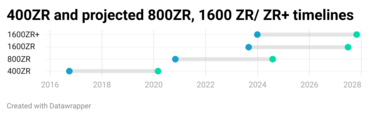
The OIF 400ZR specification also included an un-amplified version with a reach of several tens of kilometres. The first 400ZR specification document, which the OIF calls an Implementation Agreement, was completed in March 2020 (see chart above).
The OIF started the follow-up on the 800ZR specification in November 2020, a development promoted by Google. Gass says the OIF is nearing completion of the 800ZR Implementation Agreement document, expected in the second half of 2024.
If the 1600ZR and ZR+ coherent work projects take a similar duration, the first 1600ZR and 1600ZR+ products will appear in 2027.
Symbol rate and other challenges
Moving to a 1.6-terabit coherent pluggable module using the same modulation scheme – 16-ary quadrature amplitude modulation or 16-QAM – used for 400ZR and 800ZR suggests a symbol rate of 240 gigabaud (GBd).
“That is the maths, but there might be concerns with technical feasibility,” says Gass. “That’s not to say it won’t come together.”
The highest symbol rate coherent modem to date is Ciena’s WaveLogic 6e, which was announced a year ago. The design uses a 3nm CMOS coherent digital signal processor (DSP) and a 200GBd symbol rate. It is also an embedded coherent design, not one required to fit inside a pluggable optical module with a constrained power consumption.
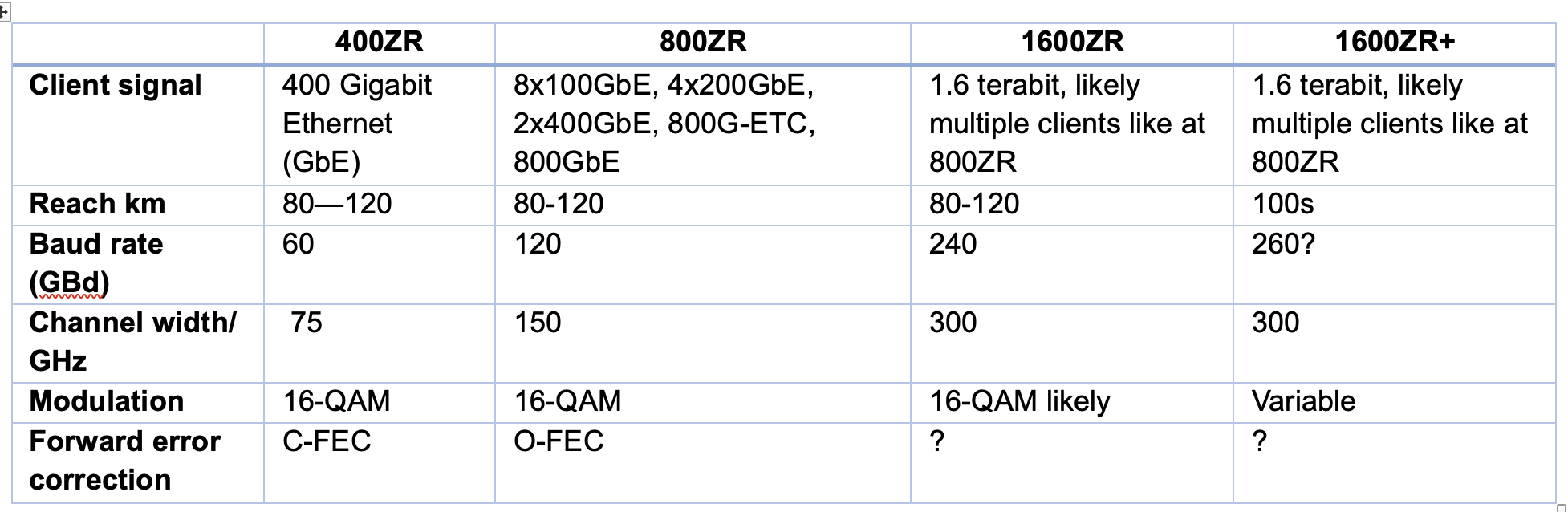
Kuschnerov points out that the baud rates of ZR and ZR+ have differed. And this will likely continue. 800ZR, using Ethernet with no probabilistic constellation shaping, has a baud rate of 118.2GBd, while 800ZR+, which uses OTN and probabilistic constellation shaping, has a baud rate of up to 131.35GBd. Every symbol has a varying probability when probabilistic constellation shaping is used. “This decreases the information per symbol, and thus, the baud rate must be increased,“ says Kuschnerov.
Doubling up for 1600ZR/ ZR+, those numbers become around 236GBd and 262GBd, subject to future standardisation. “So, saying that 1600ZR is likely to be at 240GBd is correct, but one cannot state the same for a potential 1600ZR+,” says Kuschnerov.
Nokia’s view is that for 1600ZR, the industry will look at operating modes that include 16QAM at 240 GBd. Other explored options include 64-QAM with probabilistic constellation shaping at 200GBd and even dual optical carrier solutions with each carrier operating at approximately 130GBd. “However, this last option may be challenging from a power envelope perspective,” says Szilárd Zsigmond, head of Nokia’s optical subsystems group.
In turn, if 1600ZR+ reaches 1,000km distances, the emphasis will be on higher baud rate options than those used for 1600ZR. “This will be needed to enable longer reaches, which will also put pressure on managing power dissipation,” says Zsigmond.
The coherent DSP must also have digital-to-analogue (DACs) and analogue-to-digital converters (ADCs) to sample at least at 240 giga-samples per second. Indeed, the consensus among the players is that achieving the required electronics and optics will be challenging.
“All component bandwidths have to double and that is a significant challenge,” says Josef Berger, associate vice president, cloud optics marketing at Marvell.
The coherent optics – the modulators and receivers – must extend their analogue bandwidth of 120GHz. Infinera is one company that is confident this will be achieved. “Infinera, with our highly integrated Indium Phosphide-based photonic integrated circuits, will be producing a TROSA [transmitter-receiver optical sub-assembly] capable of supporting 1.6-terabit transmission that will fit in a pluggable form factor,” says Maher.
The coherent DSP and optics operating must also meet the pluggable modules’ power and heat limits. “That is an extra challenge here: the development needs to maintain focus on cost and power simultaneously to bring the value network operators need,” says Williams. “Scaling baud rate by itself doesn’t solve the challenge. We need to do this in a cost and power-efficient way.”
Current 800ZR modules consume 30W or more, and since the aim of ZR modules is to be used within Ethernet switches and routers, this is challenging. In comparison, 400ZR modules now consume 20W or less.
“For 800ZR and 800ZR+, the target is to be within the 28W range, and this target is not changing for 1600ZR and 1600ZR+,” says Zsigmond. Coherent design engineers are being asked to double the bit rate yet keep the power envelope constant.
Certain OIF members are also interested in backward compatibility with 800ZR or 400ZR. “That also might affect the design,” says Gass.
Given the rising cost to tape out a coherent DSP using 3nm and even 2nm CMOS process nodes required to reduce power per bit, most companies designing ASICs will look to develop one design for the 1600ZR and ZR+ applications to maximise their return on investment, says Zsigmond, who notes that the risk was lower for the first generations of ZR and ZR+ applications. Most companies had already developed components for long-haul applications that could be optimised for ZR and ZR+ applications.
For 400ZR, which used a symbol rate of 60 GBd, 60-70 GBd optics already existed. For 800 gigabit transmissions, high-performance embedded coherent optics and pluggable, low-power ZR/ZR+ modules have been developed in parallel. “For 1600ZR/ZR+, it appears that the pluggable modules will be developed first,” says Zsigmond. “There will be more technology challenges to address than previous ZR/ZR+ projects.”
The pace of innovation is faster than traditional coherent transmission systems and will continue to reduce cost and power per bit, notes Marvell’s Berger: “This innovation creates technologies that will migrate into traditional coherent applications as well.”
Gass is optimistic despite the challenges ahead: “You’ve got smart people in the room, and they want this to happen.”
OIF's OFC 2024 demo
The OIF has yet to finalise what it will show for the upcoming coherent pluggable module interoperable event at OFC to be held in San Diego in March. But there will likely be 400ZR and 800ZR demonstrations operating over 75km-plus spans and 400-gigabit OpenZR+ optics operating over greater distance spans.

ECOC 2023 industry reflections
Gazettabyte is asking industry figures for their thoughts after attending the recent ECOC show in Glasgow. In particular, what developments and trends they noted, what they learned and what, if anything, surprised them. Here are the first responses from BT, Huawei, and Teramount.
Andrew Lord, Senior Manager, Optical Networks and Quantum Research at BT
I was hugely privileged to be the Technical Co-Chair of ECOC in Glasgow, Scotland and have been working on the event for over a year. The overriding impression was that the industry is fully functioning again, post-covid, with a bumper crop of submitted papers and a full exhibition. Chairing the conference left little time to indulge in content. I will need to do my regular ECOC using the playback option. But specific themes struck me as interesting.
There were solid sessions and papers around free space optics, including satellite. The activities here are more intense than we would typically see at ECOC. This reflects a growing interest and the specific expertise within the Scottish research community. Similarly, more quantum-related papers demonstrated how quantum is integrating into the mainstream optical industry.
I was impressed by the progress towards 800-gigabit ZR (800ZR) pluggables in the exhibition. This will make for some interesting future design decisions, mainly if these can be used instead of the increasingly ubiquitous 400 gigabit ZR. I am still unclear whether 800-gigabit coherent can hit the required power consumption points for plugging directly into routers. The costs for these plugs, driven by volumes, will have a significant impact.
I also enjoyed a lively and packed rump session debating the invasion of artificial intelligence (AI) into our industry. I believe considerable care is needed, particularly where AI might have a role in network management and optimisation.
Maxim Kuschnerov, Director R&D at Huawei
ECOC usually has fewer major announcements than the OFC show. But ECOC was full of technical progress this time, making the OFC held in March seem a distant memory.
What was already apparent in September at the CIOE in Shenzhen was on full display on the exhibition floor in Glasgow: the linear drive pluggable optics (LPO) trend has swept everyone off their feet. The performance of 100-gigabit native signalling using LPO can not be ignored for single-mode fibre and VCSELs.
Arista gave a technical deep-dive at the Market Focus with a surprising level of detail that went beyond the usual marketing. There was also a complete switch set-up at the Eoptolink booth, and the OIF interop demonstration.
While we must wait for a significant end user to adopt LPO, it begs the question: is this a one-off technological accident or should the industry embrace this trend and have research set its eyes on 200 gigabits per lane? The latter would require a rearchitecting of today’s switches, a more powerful digital signal processor (DSP) and likely a new forward error corrections (FEC) scheme, making the weak legacy KP4 for the 224-gigabit serdes in the IEEE 802.3dj look like a poor choice.
There was less emphasis on Ethernet 1.6 terabits per second (Tb/s) interfaces with 8x200G optical lanes. However, the arrival of a second DSP source with better performance was noted at the show.
The module power of 1.6-terabit DR8 modules showed no significant technological improvement compared with 800Gbps DSP-based modules and looked even more out of place when benchmarking against 800G LPO pluggables. Arista drove home that we can’t continue increasing the power consumption of the modules at the faceplate despite the 50W QSFP-DD1600 announcement.
The same is true for coherent optics.
Although the demonstration of the first 800ZR live modules was technically impressive, the efficiency of the power per bit hardly improved compared to 400ZR, making the 1600ZR project of OIF look like a tremendous technological challenge.
To explain, a symbol rate of 240 gigabaud (GBd) will drive the optics for 1600ZR. Using 240Gbaud with two levels per symbol to create 16QAM over two dimensions is a 400Gbps net rate or 480Gbps gross rate electrical per lane, albeit very short reach. Coherent has four lanes – 2 polarisations & in-phase and quadrature – to deliver four by 400G or 1.6Tbps. This is like what we have now: 200G on the optical side of 1.6T 8x200G PAM4 and 4x200G on 800ZR, while the electrical (longer reach) host still uses 100 gigabits per lane.
The industry will have to analyse which data centre scenarios direct detection will be able to cover with the same analogue-to-digital & digital-to-analogue converters and how deeply coherent could be driven within the data centre.
ECOC also featured optical access evolution. With the 50G FTTx standard completed with components sampling at the show and products shipping next year, the industry has set its eyes on the next generation of very high-speed PON.
There is some initial agreement on the technological choice for 200 gigabits with a dual-lambda non-return to zero (NRZ) signalling. Much of the industry debate was around the use cases. It is unrealistic to assume that private consumers will continue driving bandwidth demand. Therefore, a stronger focus on 6G wireless fronthaul or enterprise seems a likely scenario for point-to-multi-point technology.
Hesham Taha, CEO of Teramount
Co-packaged optics had renewed vigour in ECOC, thanks partly to the recent announcements of leading foundries and other semiconductor vendors collaborating in silicon photonics.
One crucial issue, though, is that scalable fibre assembly remains an unsolved problem that is getting worse due to the challenging requirements of high-performance systems for AI and high-performance computing. These requirements include a denser “shoreline” with a higher fibre count and a denser fibre pitch, and support for an interposer architecture with different photonic integrated component (PIC) geometries.
Despite customers having different requirements for co-packaged optics fibre assembly, detachable fibres now have wide backing. Having fibre ribbons that can be separated from the co-packaged optics packaging process increases manufacturing yield and reliability. It also allows the costly co-packaged optics-based servers/ switches to be serviced in the field ro replace faulty fibre.
Our company, Teramount, had an ECOC demo showing the availability of such a detachable fibre connector for CPO, dubbed Teraverse.
It is increasingly apparent that the solution for a commercially viable fibre assembly on chip lies with a robust manufacturing ecosystem rather than something tackled by any one system vendor. This fabless model has proven itself in semiconductors and must be extended to silicon photonics. This will allow each part of the production chain – IC designers, foundries, and outsourced semiconductor assembly and test (OSAT) players – to focus on what they do best.

ECOC 2022 Reflections - Part 1

Gazettabyte is asking industry and academic figures for their thoughts after attending ECOC 2022, held in Basel, Switzerland. In particular, what developments and trends they noted, what they learned, and what, if anything, surprised them.
In Part 1, Infinera’s David Welch, Cignal AI’s Scott Wilkinson, University of Cambridge’s Professor Seb Savory, and Huawei’s Maxim Kuschnerov share their thoughts.
David Welch, Chief Innovation Officer and Founder of Infinera
First, we had great meetings. It was exciting to be back to a live, face-to-face industry event. It was also great to see strong attendance from so many European carriers.
Point-to-multipoint developments were a hot topic in our engagements with service providers and component suppliers. It was also evident in the attendance and excitement at the Open XR Forum Symposium, as well as the vendor demos.
We’re seeing that QSFP-DD ZR+ is a book-ended solution for carriers; interoperability requirements are centred on the CFEC (concatenated or cascaded FEC) market; oFEC (Open FEC) is not being deployed.
Management of pluggables in the optical layer is critical to their network deployment, while network efficiency and power reduction are top of mind.
The definition of ZR and ZR+ needs to be subdivided further into ZR – CFEC, ZR+ – oFEC, and ZR+-HP (high performance), which is a book-ended solution.
Scott T. Wilkinson, Lead Analyst, Optical Components, Cignal AI.
The show was invaluable, given this was our first ECOC since Cignal AI launched its optical components coverage.
Coherent optics announcements from the show did not follow the usual bigger-faster-stronger pattern, as the success of 400ZR has convinced operators and vendors to look at coherent at the edge and inside the data centre.
100ZR for access, the upcoming 800ZR specifications from the OIF, and coherent LR (coherent designed for 2km-10km) will revolutionise how coherent optics are used in networks.
Alongside the coherent announcements were developments from the direct-detect vendors demonstrating or previewing key technologies for 800 Gigabit Ethernet (GbE) and 1.6 Terabit Ethernet (TbE) modules.
800GbE is nearly ready for prime time, awaiting completion of systems based on the newest 112 gigabit-per-second (Gbps) serialiser-deserialiser (serdes) switches. The technology for 224Gbps serdes is just starting to emerge and looks promising for products in late 2024 or 2025.
While there were no unexpected developments at the show, it was great to compare developments across the industry and understand the impact of supply chain issues, operator deployment plans, and any hints of oversupply.
We came away optimistic about continued growth in optical components shipments and revenue into 2023.
Seb Savory, Professor of Optical Fibre Communication, University of Cambridge
My overwhelming sense from ECOC was it was great to be meeting in person again. I must confess I was looking at logistics as much as content with a view to ECOC 2023 in Glasgow where I will be a technical programme committee chair.
Maxim Kuschnerov, Director of the Optical and Quantum Communications Laboratory at Huawei
In the last 12 months, the industry has got more technical clarification regarding next-generation 800ZR and 800LR coherent pluggables.
While 800ZR’s use case seems to be definitely in the ZR+ regime, including 400 gigabit covering metro and long-haul, the case for 800LR is less clear.
Some proponents argue that this is a building block toward 1.6TbE and the path of coherence inside the data centre.
Although intensity-modulation direct detection (IMDD) faces technical barriers to scaling wavelength division multiplexing to 8×200 gigabit, the technological options for beyond 800-gigabit coherent aren’t converging either.
In the mix are 4×400 gigabit, 2×800 gigabit and 1×1.6 terabit, making the question of how low-cost and low-power coherent can scale into data centre applications one of the most interesting technical challenges for the coming years.
Arista continues making a case for a pluggable roadmap through the decade based on 200-gigabit serdes.
With module power envelopes of around 40W at the faceplate, it shows the challenge that the industry is facing and the case co-packaged optics is trying to make.
However, putting all the power into, or next to, the switching chip doesn’t make the cooling problem any less problematic. Here, I wonder if Avicena’s microLED technology could benefit next-generation chip-to-chip or die-to-die interconnects by dropping the high-speed serdes altogether and thus avoiding the huge overhead current input-output (I/O) is placing on data centre networking.
It was great to see the demo of the 200-gigabit PAM-4 externally modulated laser (EML) at Coherent’s booth delivering high-quality eye diagrams. The technology is getting more mature, and next year will receive much exposure in the broader ecosystem.
As for every conference, we have seen the usual presentations on Infinera’s XR Optics. Point-to-multipoint coherent is a great technology looking for a use case, but it is several years too early.
At ECOC’s Market Focus, Dave Welch put up a slide on the XR ecosystem, showing several end users, several system OEMs and a single component vendor – Infinera. I think one can leave it at this for now without further comment.


Huawei sets transmission record with new modulator

Coherent discourse: Part 1
A paper from Huawei and Sun Yat-Sen University in the January issue of the Optica journal describes a thin-film lithium niobate modulator. The modulator enabled a world-record coherent optical transmission, sending nearly 2 terabits of data over a single wavelength.
Much of the industry’s focus in recent years has been to fit coherent optical technology within a pluggable module.
Such pluggables allow 400-gigabit coherent interfaces to be added to IP routers and switches, serving the needs of the data centre operators and telecom operators.
But research labs of the leading optical transport vendors continue to advance high-end coherent systems beyond 800-gigabit-per-wavelength transmissions.
Optical transport systems from Ciena, Infinera and Huawei can send 800-gigabit wavelengths using a symbol rate of 96-100 gigabaud (GBd).
Acacia Communications, part of Cisco, detailed late last year the first 1.2-terabit single-wavelength coherent pluggable transceiver that will operate at 140GBd, twice the symbol rate of 400-gigabit modules such as 400ZR.
Now Huawei has demonstrated in the lab a thin-film lithium niobate modulator that supports a symbol rate of 220GBd and beyond.
Maxim Kuschnerov, director of the optical and quantum communications laboratory at Huawei, says the modulator has a 110GHz 3dB bandwidth but that it can be operated at higher frequencies, suggesting a symbol rate as high as 240GBd.
Thin-film lithium niobate modulator
Huawei says research is taking place into new materials besides the established materials of indium phosphide and silicon photonics. “It is a very exciting topic lately,” says Kuschnerov.
He views the demonstrated thin-film lithium niobate optical modulator as disruptive: “It can cover up several deficiencies of today’s modulators.”
Besides the substantial increase in bandwidth – the objective of any new coherent technology – the modulator has performance metrics that benefit the coherent system such as a low driving voltage and low insertion loss.
A driving voltage of a modulator is a key performance parameter. For the modulator, it is sub-1V.
The signal driving the modulator comes from a digital-to-analogue (D/A) converter, part of the coherent digital signal processor (DSP). The D/A output is fed into a modulator driver. “That [driver] requires power, footprint, and increases the complexity of integrating the [modem’s] modules tighter,” says Kuschnerov.
The modulator’s sub-1V drive voltage is sufficiently small that the DSP’s CMOS-based D/A can drive it directly, removing the modulator driver circuit that also has bandwidth performance limitations. The modulator thus reduces the transmitter’s overall cost.
The low-loss modulator also improves the overall optical link budget. And for certain applications, it could even make the difference as to whether optical amplification is needed.
“The modulator checks the box of very high bandwidth,” says Kuschnerov. “And it helps by not having to add a semiconductor optical amplifier for some applications, nor needing a driver amplifier.”
One issue with the thin-film modulator is its relative size. While not large – it has a length of 23.5mm – it is larger than indium phosphide and silicon photonics modulators.
1.96-terabit wavelength
Huawei’s lab set-up used a transmit coherent DSP with D/As operating at 130 Giga-samples-per-second (GS/s) to drive the modulator. The modulation used was a 400-quadrature amplitude modulation (400-QAM) constellation coupled with probabilistic constellation shaping.
A 10 per cent forward error correction scheme was used such that, overall, 1.96-terabits per second of data was sent using a single wavelength.
The D/A converter was implemented in silicon germanium using high-end lab equipment to generate the signal at 130GS/s.
“This experiment shows how much we still need to go,” says Kuschnerov. “What we have done at 130GBd shows there is a clear limitation with the D/A [compared to the 220GBd modulator].”
Baud-rate benefits
Increasing the baud rate of systems is not the only approach but is the favoured implementation choice.
What customers want is more capacity and reducing the cost per bit for the same power consumption. Increasing the baud rate decreases the cost and power consumption of the optical transceiver.
By doubling the baud rate, an optical transceiver delivers twice the capacity for a given modulation scheme. The cost per bit of the transceiver decreases as does the power consumed per bit. Instead of two transceivers and two sets of components, one transceiver and one set are used instead.
But doubling the baud rate doesn’t improve the optical system’s spectral efficiency since doubling the baud rate doubles the channel width. That said, algorithmic enhancements are added to each new generation of coherent modem but technically, the spectral efficiency practically no longer improves.
Huawei acknowledges that while the modulator promises many benefits, all the coherent modem’s components – the coherent ASIC, the D/A and analogue-to-digital (D/A) converters, the optics, and the analogue circuitry – must equally scale. This represents a significant challenge.
Kuschnerov says optical research is finding disruptive answers but scaling performance, especially on the electrical side, remains a critical issue. “How do you increase the D/A sampling rates to match these kinds of modulator technologies?” he says. “It is not straightforward.”
The same is true for the other electrical components: the driver technologies and the trans-impedance amplifier circuits at the receiver.
Another issue is combining the electrical and optical components into a working system. Doubling the signalling of today’s optical systems is a huge radio frequency design and packaging challenge.
But the industry consensus is that with newer CMOS processes and development in components and materials, doubling the symbol rate again to 240GB will be possible.
But companies don’t know – at least they are not saying – what the upper symbol rate limit will be. The consensus is that increasing the baud rate will end. Then, other approaches will be pursued.
Kuschnerov notes that if a 1.6-terabit transceiver could be implemented using a single wavelength or with eight 200Gbps ones with the same spectral performance, cost, footprint and power consumption, end users wouldn’t care which of the two were used.
However, does optics enable such greater parallelism?
Kuschnerov says that while decades of investment has gone into silicon photonics, it is still not there yet.
“It doesn’t have the cost-effectiveness at 16, 32 or 64 lanes because the yield goes down significantly,” he says. “We as an industry can’t do it yet.”
He is confident that, soon enough, the industry will figure out how to scale the optics: “With each generation, we are getting better at it.”
Coherent engineers will then have more design options to meet the system objectives.
And just like with microprocessors, it will no longer be upping the clock frequency but rather adopting parallel processing i.e. multiple cores. Except, in this case, it will be parallel coherent optics.

Books read in 2021: Part 1

Each year Gazettabyte asks industry figures to pick their reads of the year. Paul Brooks and Maxim Kuschnerov kick off this year’s recommended reads.
Dr. Paul Brooks, Optical Transport Director, VIAVI Solutions
Having spent a very happy time serving in the Royal Navy, I am always reading about all things connected with its history.
As a young midshipman, I managed to sleep through many of the history lessons at BRNC Dartmouth so I am using my spare time to catch up on the lessons I missed all those years ago.
One book which I have very much enjoyed this year has been Stephen Taylor’s Sons of the Waves: The Common Seaman in the Heroic Age of Sail.
While many books are written about major figures such as Nelson and Blake, the ordinary sailor with his robustness, loyalty and sense of duty was the key element in the success of the Royal Navy.
This well-researched book is a joy to read as it brings to life the heroic men. I must confess I did hum ‘Heart of Oak’ as I reached for my tot of rum as I read about the jolly Jack Tar on the Victory at Trafalgar!
For any student of history, and indeed anyone interested in social history, this is one for your Christmas list.
Dr. Maxim Kuschnerov, Director of the Optical & Quantum Communications Laboratory
No Rules Rules: Netflix and the Culture of Reinvention, by Reed Hastings and Erin Meyer, got good press last year, so when I saw it at the airport, it was a no brainer to get it.
The book offers a radical approach to management, focusing on totally open feedback and the removal of most controls, whether it’s the lack of vacation policy (take as much as you want) or the absence of higher approvals for most business dealings. Salary adjustments are governed by external market references and not internal processes, which is generally not a bad thing.
Naturally, looking at this corporate culture through the glasses of a German dependency of a Chinese company makes for a big contrast and it would be hard to imagine a German company functioning without any kind of rules. But what the book achieves is to shift the normal operational bias towards a more modern view of team management and it helped me to make adjustments in everyday work, changing the way that I interpreted my role within my team.
This brings me straight to another, older, book by Erin Meyer, The Culture Map: Breaking Through the Invisible Boundaries of Global Business. It reads like a compressed tutorial of inter-cultural communication and decision making, although I have to admit it was almost more fun to naively learn all of this in the field than to have all the findings confirmed at a later point by the conclusions in this book.
I found it particularly interesting to see the historical context for some present cultural behaviour, by which I don’t mean the obvious teaching of Confucius for Chinese people but also current social traits in Europe dating back to the Roman Empire.
So when a Chinese colleague, who recently moved to Germany, described the German personality as a coconut after the first weeks of adjusting to life in Munich, it made me think that we should be providing this book as a compulsory read within the company, just to soften the blow.
Lastly, looking at how big data and analytics started to change our lives in many domains and found their way into sport in the classic Moneyball book, I believe that no other sport has been changed as drastically by a statistical approach to analytics as basketball.
Kirk Goldberry’s Sprawlball: A Visual Tour of the New Era of the NBA explains the dramatic change in the game by findings that, in hindsight, are so obvious that one can only wonder how we all didn’t see it coming in the 1990s when the GOAT Michael Jordan redefined the art of playing ball.
Goldberry explains the historical context for modern-day greats like LeBron James, James Harden and Steph Curry, while also giving a shout-out to my other personal favourite, Dirk Nowitzki, whose 2011 finals run will stay at the top of my sporting moments.
I just wish I could have told my 14-year-old self to stop practising baby hooks and post ups and go straight to 3-point drills.

Infinera’s ICE6 sends 800 gigabits over a 950km link

Infinera has demonstrated the coherent transmission of an 800-gigabit signal across a 950km span of an operational network.
Infinera used its Infinite Capacity Engine 6 (ICE6), comprising an indium-phosphide photonic integrated circuit (PIC) and its FlexCoherent 6 coherent digital signal processor (DSP).
The ICE6 supports 1.6 terabits of traffic: two channels, each supporting up to 800-gigabit of data.
The trial, conducted over an unnamed operator’s network in North America, sent the 800-gigabit signal as an alien wavelength over a third-party line-system carrying live traffic.
“We have proved not only the state of our 800-gigabit with ICE6 but also the distances it can achieve,” says Robert Shore, senior vice president of marketing at Infinera.
800G trials
Several systems vendors have undertaken 800-gigabit optical trials.
Ciena detailed two demonstrations using its WaveLogic 5 Extreme (WL5e). One was an interoperability trial involving Verizon and Juniper Networks while the second connected two data centres belonging to the operator, Southern Cross Cable, to confirm the deployment of the WL5e cards in a live network environment.
Neither Ciena trial was designed to demonstrated WL5e’s limit of optical performance. Accordingly, no distances were quoted although both links were sub-100km, according to Ciena.
Meanwhile, Huawei has trialled its 800-gigabit technology in the networks of operators Turkcell and China Mobile.
The motivation for vendors to increase the speed of line-side optical transceivers is to reduce the cost of data transport. “One laser generating more data,” says Shore. “But it is not just high-speed transmissions, it is high-speed transmissions over distance.”
Infinera’s first 800-gigabit demonstration involved the ICE6 sending the signal over 800km of Corning’s TXF low-loss fibre.
“We did the demo on that fibre and we realised we had a ton of margin left over after completing the 800-gigabit circuit,” says Shore. The company then looked for a suitable network trial using standard optical fibre.
Infinera used a third-party’s optical line system to highlight that the 950km reach wasn’t due to a combination of the ICE6 module and the company’s own line system.
“What we have shown is that you can take any link anywhere, use anyone’s line system, carrying any kind of traffic, drop in the ICE6 and get 800-gigabit connections over 950km,” says Shore.
ICE 6
Infinera attributes the ICE6’s optical performance to its advanced coherent toolkit and the fact that the company has both photonics and coherent DSP technology, enabling their co-design to optimise the system’s performance.
One toolkit technique is Nyquist sub-carriers. Here, data is sent using several Nyquist sub-carriers across the channel instead of modulating the data onto a single carrier. The ICE6 is Infinera’s second-generation design to use sub-carriers, the first being ICE4, that doubles the number from four to eight.
The benefit of using sub-carriers is that high data rates can be achieved while the baud rate used for each one is much lower. And a lower baud rate is more tolerant to non-linear channel impairments during optical transmission.
Sub-carriers also improve spectral efficiency as the channels have sharper edges and can be packed tightly.
Infinera applies probabilistic constellation shaping to each sub-carrier, allowing fine-tuning of the data each carries. As a result, more data can be sent on the inner sub-carriers and less on the outer two outer sub-carrier where signal recovering is harder.
The sweet spot for sub-carriers is a symbol rate of 8-11 gigabaud (GBd). For the Infinera trial, eight sub-carriers were used, each at 12GBd, for an overall symbol rate of 96GBd.
“While it is best to stay as close to 8-11GBd, the coding gain you get as you go from 11GBd to 12GBd per sub-carrier is greater than the increased non-linear penalties,” says Shore.
Another feature of the coherent DSP is its use of soft-decision forward-error correction (SD-FEC) gain sharing. By sharing the FEC codes, processing resources can be shifted to one of the PIC’s two optical channels that needs it the most.
The result is that some of the strength of the stronger signal can be traded to bolster the weaker one, extending its reach or potentially allowing a higher modulation scheme to be used.
Applications
Linking data centres is one application where the ICE6 will be used. Another is sub-sea optical transmission involving spans that can be thousands of kilometres long, requiring lower modulation schemes and lower data rates.
“It’s not just cost-per-bit and power-per-bit, it is also spectral efficiency,” says Shore. “And a higher-performing optical signal can maintain a higher modulation rate over longer distances as well.”
Infinera says that at 600 gigabits-per-second (Gbps), link distances will be “significantly better” than 1,600km. The company is exploring suitable links to quantify ICE6’s reach at 600Gbps.
The ICE6 is packaged in a 5×7-inch optical module. Infinera’s Groove series will first adopt the ICE6 followed by the XTC platforms, part of the DTN-X series. First network deployments will occur in the second half of this year.
Infinera is also selling the ICE6 5×7-inch module to interested parties.
XR Optics
Infinera is not addressing the 400ZR coherent pluggable module market. The 400ZR is the OIF-defined 400-gigabit coherent standard developed to connect equipment in data centres up to 120km apart.
Infinera is, however, eyeing the emerging ZR+ opportunity using XR Optics. ZR+ is not a standard but it extends the features of 400ZR.
XR Optics is the brainchild of Infinera that is based on coherent sub-carriers. All the sub-carriers can be sent to the same destination for point-to-point links, but they can also be sent to different locations to allow for point-to-multipoint communications. Such an arrangement allows for traffic aggregation.
“You can steer all the sub-carriers coming out of an XR transceiver to the same destination to get a 400-gigabit point-to-point link to compete with ZR+,” says Shore. “And because we are using sub-carriers instead of a single carrier, we expect to get significantly better performance.”
Infinera is developing the coherent DSPs for XR Optics and has teamed up with optical module makers, Lumentum and II-VI.
Other unnamed partners have joined Infinera to bring the technology to market. Shore says that the partners include network operators that have contributed to the technology’s development.
Infinera planned to showcase XR Optics at the OFC conference and exhibition held recently in San Diego.
Shore says to expect XR Optics announcements in late summer, from Infinera and perhaps others. These will detail the XR Optics form factors and how they function as well as the products’ schedules.