

JDSU's Brandon Collings on silicon photonics, optical transport & the tunable SFP+
JDSU's CTO for communications and commercial optical products, Brandon Collings, discusses reconfigurable optical add/drop multiplexers (ROADMs), 100 Gigabit, silicon photonics, and the status of JDSU's tunable SFP+.

"We have been continually monitoring to find ways to use the technology [silicon photonics] for telecom but we are not really seeing that happen”
Brandon Collings, JDSU
Brandon Collings highlights two developments that summarise the state of the optical transport industry.
The industry is now aligned on the next-generation ROADM architecture of choice, while experiencing a ’heavy component ramp’ in high-speed optical components to meet demand for 100 Gigabit optical transmission.
The industry has converged on the twin wavelength-selective switch (WSS) route-and-select ROADM architecture for optical transport. "This is in large networks and looking forward, even in smaller sized networks," says Collings.
In a route-and-select architecture, a pair of WSSes reside at each degree of the ROADM. The second WSS is used in place of splitters and improves the overall optical performance by better suppressing possible interference paths.
JDSU showcased its TrueFlex portfolio of components and subsystems for next-generation ROADMs at the recent European Conference on Optical Communications (ECOC) show. The company first discussed the TrueFlex products a year ago. "We are now in the final process of completing those developments," says Collings.
Meanwhile, the 100 Gigabit-per-second (Gbps) component market is progressing well, says Collings. The issues that interest him include next-generation designs such as a pluggable 100Gbps transmission form factor.
Direct detection and coherent
JDSU remains uncertain about the market opportunities for 100Gbps direct-detection solutions for point-to-point and metro applications. "That area remains murky," says Collings. "It is clearly an easy way into 100 Gig - you don't have to have a huge ASIC developed - but its long-term prospects are unclear."
The price point of 100Gbps direct-detection, while attractive, is competing against coherent transmission solutions which Collings describes as volatile. "As coherent becomes comparable [in cost], the situation will change for the 4x25 Gig [direct detection] quite quickly," he says. "Coherent seems to be the long-term, robust cost-effective way to go, capturing most of the market."
At present, coherent solutions are for long-haul that require a large, power-consuming ASIC. Equally the accompanying optical components - the lasers and modulators - are also relatively large. For the coherent metro market, the optics must become cheaper and smaller as must the coherent ASIC.
"If you are looking to put that [coherent ASIC and optics] into a CFP or CFP2, the problem is based on power; cost is important but power is the black-and-white issue," says Collings. Engineers are investigating what features can be removed from the long-haul solution to achieve the target 15-20W power consumption. "That is pretty challenging from an ASIC perspective and leaves little-to-no headroom in a pluggable," says Collings.
The same applies to the optics. "Is there a lesser set of photonics that can sit on a board that is much lower cost and perhaps has some weaker performance versus today's high-performance long-haul?" says Collings. These are the issues designers are grappling with.
Silicon photonics
Another area in flux is the silicon photonics marketplace. "It is a very fluid and active area," says Collings. "We are not highly active in the area but we are very active with outside organisations to keep track of its progress, its capabilities and its overall evolution in terms of what the technology is capable of."
The silicon photonics industry has shifted towards datacom and interconnect technology in the last year, says Collings. The performance levels silicon photonics achieves are better suited to datacom than telecom's more demanding requirements. "We have been continually monitoring to find ways to use the technology for telecom but we are not really seeing that happen,” says Collings.
Tunable SFP+
JDSU demonstrated its tunable laser in an SFP+ pluggable optical module at the ECOC exhibition.
The company was first to market with the tunable XFP, claiming it secured JDSU an almost two-year lead in the marketplace. "We are aiming to repeat that with the SFP+," says Collings.
The SFP+ doubles a line card's interface density compared to the XFP module. The SFP+ supports both 10Gbps client-side and wavelength-division multiplexing (WDM) interfaces. "Most of the cards have transitioned from supporting the XFP to the SFP+," says Collings. This [having a tunable SFP+] completes that portfolio of capability."
JDSU has provided samples of the tunable pluggable to customers. "We are working with a handful of leading customers and they typically have a preference on chirp or no-chirp [lasers], APD [avalanche photo-diode] or no APD, that sort of thing," says Collings.
JDSU has not said when it will start production of the tunable SFP+. "It won't be long," says Collings, who points out that JDSU has been demonstrating the pluggable for over six months.
The company plans a two-stage rollout. JDSU will launch a slightly higher power-dissipating tunable SFP+ "a handful of months" before the standard-complaint device. "The SFP+ standard calls for 1.5W but for some customers that want to hit the market earlier, we can discuss other options," says Collings.
Further reading

AppliedMicro samples 100Gbps CMOS multiplexer
AppliedMicro has announced the first CMOS merchant multiplexer chip for 100Gbps coherent optical transmission. The S28032 device supports dual polarisation, quadrature phase-shift keying (DP-QPSK) and has a power consumption of 4W, half that of current multiplexer chip designs implemented in BiCMOS.
 The S28032 100 Gig multiplexer IC. Source: AppliedMicro
"CMOS has a very low gain-bandwidth product, typically 100GHz," says Tim Warland, product marketing manager, connectivity solutions at AppliedMicro. “Running at 32GHz, we have been able to achieve a very high bandwidth with CMOS."
Significance
The availability of a CMOS merchant device will be welcome news for optical transport suppliers and 100Gbps coherent module makers. CMOS has better economics than BiCMOS due to the larger silicon wafers used and the chip yields achieved. The reduced power consumption also promotes the move to smaller-sized optical modules than the current 5x7-inch multi-source agreement (MSA).
"By reducing the power and the size, we can get to a 4x6-inch next-generation module,” says Warland. “And perhaps if we go for a shorter [optical transmission] reach - 400-600km - we could get into a CFP; then you can get four modules on a card.”
"Coherent ultimately is the solution people want to go to [in the metro] but optical duo-binary will do just fine for now"
Tim Warland, AppliedMicro
Chip details
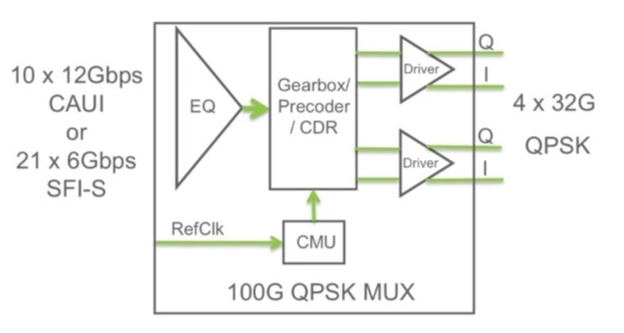
The S28032 has a CAUI interface: 10x12Gbps input lanes that are multiplexed into four lanes at 28Gbps to 32Gbps. The particular data rate depends on the forward error correction (FEC) scheme used. The four lanes are DQPSK-precoded before being fed to the polarisation multiplexer to create the DP-QPSK waveforms.
The device also supports the SFI-S interface - 21 input channels, each at 6Gbps. This is significant as it enables the S28032 to be interfaced to NTT Electronics' (NEL) DSP-ASIC coherent receiver chip that has been adopted by 100Gbps module makers Oclaro and Opnext (now merged) as well as system vendors including Fujitsu Optical Systems and NEC.
 The mux IC within a 100Gbps coherent 5x7-inch optical module. Source: AppliedMicro
The AppliedMicro multiplexer IC, which is on the transmit path, interfaces with NEL's DSP-ASIC that is on the receiver path, because the FEC needs to be a closed loop to achieve the best efficiency, says Warland. "If you know what you are transmitting and receiving, you can improve the gain and modify the coherent receiver sampling points if you know what the transmit path looks like," he says.
The DSP-ASIC creates the transmission payloads and uses the S28032 to multiplex those into 28Gbps or greater speed signals.
The SFI-S interface is also suited to interface to FPGAs, for those system vendors that have their own custom FPGA-based FEC designs.
"Packet optical transport systems is more a potential growth engine as the OTN network evolves to become a real network like SONET used to be"
Francesco Caggioni. AppliedMicro
The multiplexer chip's particular lane rate is set by the strength of the FEC code used and its associated overhead. Using OTU4 frames with its 7% overhead FEC, the resulting data rate is 27.95Gbps. With a stronger 15% hard-decision FEC, each of the 4 channel's data rate is 30Gbps while it is 31.79Gbps with soft-decision FEC.
"It [the chip] has got sufficient headroom to accommodate everything that is available today and that we are considering in the OIF [Optical Internetworking Forum],” says Warland. The multiplexer is expected to be suitable for coherent designs that achieve a reach of up to 2,000-2,500km but the sweet spot is likely to be for metro networks with a reach of up to 1,000km, he says.
But while the CMOS device can achieve 32Gbps, it has its limitations. "For ultra long haul, we can't support a FEC rate higher than 20%," says Warland. "For that, a 25% to 30% FEC is needed."
AppliedMicro is sampling the device to lead customers and will start production in 1Q 2013.
What next
The S28032 joins AppliedMicro's existing S28010 IC suited for the 10km 100 Gigabit Ethernet 100GBASE-LR4 standard, and for optical duo-binary 100Gbps direct detection that has a reach of 200-1,000km.
"Our next step is to try and get a receiver to match this chip," says Warland. But it will be different to NEL's coherent receiver: "NEL's is long haul." Instead, AppliedMicro is eyeing the metro market where a smaller, less power-hungry chip is needed.
"Coherent ultimately is the solution people want to go to [in the metro] but optical duo-binary will do just fine for now," says Warland.
Two million 10Gbps OTN ports
AppliedMicro has also announced that it has shipped 2M 10Gbps OTN silicon ports. This comes 18 months after it announced that it had shipped its first million.
"OTN is showing similar growth to the 10 Gigabit Ethernet market but with a four-year lag," says Francesco Caggioni, strategic marketing director, connectivity solutions at AppliedMicro.
The company sees OTN growth in the IP edge router market and for transponder and muxponder designs, while packet optical transport systems (P-OTS) is an emerging market.
"Packet optical transport systems is more a potential growth engine as the OTN network evolves to become a real network like SONET used to be," says Caggioni. "We are seeing development but not a lot of deployment."
Further reading:
Optical components enter an era of technology-pull
Gazettabyte asked ADVA Optical Networking, Ciena, Cisco Systems and Ovum about their impressions following the recent OFC/NFOEC 2012 exhibition and conference.
OFC/NFOEC reflections: Part 2
 "As the economy continues to navigate its way through yet another very difficult period, it was good to see so many companies innovating and introducing solutions."
Massimo Prati, Cisco Systems
Massimo Prati, Cisco Systems
For Cisco Systems, 100 Gigabit was a key focus at the show. "There were many system and component vendors, including Cisco, demonstrating newly available, economically feasible 100 Gig innovations," says Massimo Prati, vice president and general manager for Cisco.
Linking data centres was another conference theme. "Inter-data centre connectivity continues to focus on scalable and simple solutions in long-haul and metro networks connecting data centres worldwide." Cisco believes metro 100 Gigabit deployments will become prevalent in 2013 and 2014, especially if low‐cost coherent technology becomes available.
"A dedicated workshop focused on data centre architectures, held on the first day of the conference, was heavily attended," says Prati. "So certainly the link between cloud and optical is being established and is a key driver for high-speed transport networks."
Another conference theme was interconnect within the data centre, and the need for photonic integration for low‐cost, low‐power links, says Prati: "From a Cisco standpoint, several of our customers were pleasantly surprised by our recently completed acquisition of Lightwire, which develops advanced optical interconnect technology for high-speed networking applications." Lightwire is a silicon photonics startup that Cisco acquired recently for US $271 million.
What Cisco says it learned from OFC/ NFOEC was that service providers are planning 100Gbps deployments within the next 12 months and are looking at second- and third-generation solutions. "There is quite a bit of energy around future upgrades to 400 Gig and one Terabit transport solutions, but service providers continue to monitor if and how these solutions will operate within their existing fibre plants."
Prati expects more industry consolidation. "With the influx of 100 Gig solutions, it appears we may be ripe for further consolidation within the industry, particularly further down the technology food chain," he says.
He also remains optimistic about the industry's prospects.
"We believe that the excitement around high-speed, long-haul transport, combined with cloud and data centre innovation, continues to fuel a lot of new product solutions and architectures," he says. "Content providers like Google and Facebook have clearly expressed interest in optical technologies addressing their issues with bandwidth demands and need for high-speed interconnect for their data centres."
Joe Berthold, Ciena
Whereas last year there was much discussion about of the next rate for Ethernet - 400 Gig or one Terabit - this year 400 Gigabit had most mindshare, says Joe Berthold, vice president of network architecture at Ciena. "I barely heard any mention of one Terabit in the context of a contest with 400 Gigabit," he says.
 "I could hear some rumblings about alternative form factors – which might lead to fragmentation of the market"
Joe Berthold, Ciena
400 Gigabit was given a boost with the line-side transmission component announcements. Ciena announced its WaveLogic3 and Alcatel-Lucent detailed its Photonic Service Engine.
Another noteworthy development was the buzz around silicon photonics, stirred in part by Cisco's Lightwire acquisition. "Silicon photonics has passed from a technology of research interest to one that has progressed to serious development," says Berthold. "Data centre interconnects look like a promising initial application."
There was no developments at the show that surprised Berthold. But he is concerned about the potential for proliferation of 100 Gigabit client-side form factors, especially for pluggable modules.
"I am going under the assumption that there is still broad industry support for the CFP progression - from the current CFP to a CFP2 followed by a CFP4 for single-mode fiber applications over metro distances," he says.
Even though there are a variety of technologies appearing in the CFP form factor, this common physical module has helped control system development cost. "I could hear some rumblings about alternative form factors – which might lead to fragmentation of the market," he says.
Berthold is encouraged by the broad base of development efforts underway, particularly for 100Gbps transceivers, but also lower-cost 10Gbps and 40Gbps client-side modules. He notes the progress in reducing the cost of 100 Gigabit client interfaces over the next year. "Their high cost has held back adoption of 100 Gig," says Berthold. "We have had very cost effective 10 Gig multiplexing technology to fall back on, but it looks like native 100G interfaces are poised for growth."
Jörg-Peter Elbers, ADVA Optical Networking
Jörg-Peter Elbers, vice president, advanced technology at ADVA Optical Networking, was struck by the wide range of hot topics discussed at the show.
These include software-defined optics based on programmable transceivers that use advanced DSP technology and flexgrid ROADMs as the basis of a new coherent express layer. He also notes that control plane technologies are becoming an essential asset in managing network complexity when unleashing untapped network capacity.
 "Traffic and content keeps growing at exponential scale - the fundamental demand-drivers are intact"
Jörg-Peter Elbers, ADVA Optical Networking
Meanwhile, the rapid increase in end-user traffic, specifically mobile, is driving PON. As a result WDM is moving closer to the network edge, entering aggregation and access networks. He believes dense WDM-PON is gaining traction for mobile backhaul as fibre becomes the bottleneck when moving from Long Term Evolution (LTE) to the LTE-Advanced cellular technology.
Other trends to note, he says, are software-defined networking (SDN) and OpenFlow. "Originating from the campus and data centre world, network programmability is increasingly seen as key for tighter integration, more automation, and virtualisation of IT and computing services," says Elbers.
The industry increasingly sees the metro market as important to ramp up 100Gbps volumes, with different modulation solutions being promoted by vendors. These include performance reduced 100Gbps DP-QPSK (dual polarisation, quadrature phase-shift keying), 200Gbps DP-16QAM (dual polarisation, 16-quadrature amplitude modulation) and 4x28G direct-detection.
While some people expressed concerns about a fragmentation of the 100 Gig market, power consumption, footprint and cost are of primary importance in the metro, he says. "One analyst at the Ovum 100Gbps metro workshop at OFC said: 'Maybe, for a hammer everything looks like a nail…'," says Elbers. "With 4x28G optical duobinary being able to make use of 10Gbps T-XFP/SFP+, IEEE 802.3ba and CFP technologies, we believe there is a justification to differentiate."
ADVA demonstrated its 4x28Gbps optical duobinary direct-detection product at the show.
Elbers noted an interest in multi-core and few-mode fibres. "The next x10 in bandwidth is difficult to reach as additional gains from amplification, modulation, FEC and denser carrier spacing will be limited." he says. "The research community therefore is looking into new fibre types to add the spatial and modal dimensions alongside the current optimisation strategy." An area interesting to watch, but fundamental technical and economic challenges remain, he says.
He too is optimistic about the industry's prospects: "Traffic and content keeps growing at exponential scale - the fundamental demand drivers are intact." As a result, optical innovation will play an even bigger role in the future to keep pace with the bandwidth growth, he says.
Karen Liu, Ovum
"We're clearly in a technology-pull phase rather than technology-push phase with multiple system vendors doing 400Gbps-capable stuff instead of component guys showing demonstrations years in advance of system activity," says Karen Liu, principal analyst, components telecoms at Ovum.
 "Optical burst mode switching may be crossing over from rather 'pie-in-the-sky' to practical"
Karen Liu, Ovum
It is not that that the components vendors aren't making innovative products, she says, just that they are not making announcements until there is real demand. "Corning, for example, showed a fiber that has already been shipping into Lightpeak," says Liu.
What surprised Liu at the show was Huawei's optical burst transport network prototype. "Optical burst mode switching may be crossing over from rather 'pie-in-the-sky' to practical," says Liu.
She notes how there isn't as much optics-versus-electronics positioning anymore but more a case of optics working with electronics. "Huawei's OBTN is an example," says Liu. "Instead of using optical burst mode to make an all-optical network, optics is part of a hybrid design."
Liu says there are now multiple relationships between silicon and optics including the two working together instead of in competition. "In networking, the term translucent networks seems to have gained popularity."
Dan Sadot on coherent's role in the metro and the data centre
Gazettabyte went to visit Professor Dan Sadot, academic, entrepreneur and founder of chip start-up MultiPhy, to discuss his involvement in start-ups, his research interests and why he believes coherent technology will not only play an important role in the metro but also the data centre.

"Moore's Law is probably the most dangerous enemy of optics"
Professor Dan Sadot
The Ben-Gurion University campus in Beer-Sheba, Israel, is a mixture of brightly lit, sharp-edged glass-fronted buildings and decades-old Palm trees.
The first thing you notice on entering Dan Sadot's office is its tidiness; a paperless desk on which sits a MacBook Air. "For reading maybe the iPad could be better but I prefer a single device on which I can do everything," says Sadot, hinting at a need to be organised, unsurprising given his dual role as CTO of MultiPhy and chairman of Ben-Gurion University's Electrical and Computer Engineering Department.
The department, ranked in the country's top three, is multi-disciplinary. Just within the Electrical and Electronics Department there are eight tracks including signal processing, traditional communications and electro-optics. "That [system-oriented nature] is what gives you a clear advantage compared to experts in just optics," he says.
The same applies to optical companies: there are companies specialising in optics and ASIC companies that are expert in algorithms, but few have both. "Those that do are the giants: [Alcatel-Lucent's] Bell Labs, Nortel, Ciena," says Sadot. "But their business models don't necessarily fit that of start-ups so there is an opportunity here."
MultiPhy
MultiPhy is a fabless start-up that specialises in high-speed digital signal processing-based chips for optical transmission. In particular it is developing 100Gbps ICs for direct detection and coherent.
Sadot cites a rule of thumb that he adheres to religiously: "Everything you can do electronically, do not do optically. And vice versa: do optically only the things you can't do electronically." This is because using optics turns out to be more expensive.
And it is this that MultiPhy wants to exploit by being an ASIC-only company with specialist knowledge of the algorithms required for optical transmission.
"Electronics is catching up," says Sadot. "Moore's Law is probably the most dangerous enemy of optics."
 Ben-Gurion University Source: Gazettabyte
Direct detection
Not only have developments in electronics made coherent transmission possible but also advances in hardware. For coherent, accurate retrieval of phase information is needed and that was not possible with available hardware until recently. In particular the phase noise of lasers was too high, says Sadot. Now optics is enabling coherent, and the issues that arise with coherent transmission can be solved electronically using DSP.
MultiPhy has entered the market with its MP1100Q chip for 100Gbps direct detection. According to Sadot, 100Gbps is the boundary data rate between direct detection and coherent. Below 100Gbps coherent is not really needed, he says, even though some operators are using the technology for superior long-haul optical transmission performance at 40Gbps.
"Beyond 100 Gig you need the spectral efficiency, you need to do denser [data] constellations so you must have coherent," says Sadot. "You are also much more vulnerable to distortions such as chromatic dispersion and you must have the coherent capability to do that."
But at 100 Gig the two - coherent and direct detection - will co-exist.
MultiPhy's first device runs the maximum likelihood sequence estimation (MLSE) algorithm that is used to counter fibre transmission distortions. "MLSE offers the best possible theoretical solution on a statistical basis without retrieving the exact phase," says Sadot. "That is the maximum you can squeeze out of direct detection."
The MLSE algorithm benefits optical performance by extending the link's reach while allowing lower cost, reduced-bandwidth optical components to be used. MultiPhy claims 4x10Gbps can be used for the transmit and the receive path to implement the 4x28Gbps (100Gbps) design.
Sadot describes MLSE as a safety net in its ability to handle transmitter and/or receiver imperfections. "We have shown that performance is almost identical with a high quality transmitter and a lower quality transmitter; MLSE is an important addition." he says.
 Ben-Gurion University Source: Gazettabyte
Coherent metro
System vendors such as Ciena and Alcatel-Lucent have recently announced their latest generation coherent ASICs designed to deliver long-haul transmission performance. But this, argues Sadot, is overkill for most applications when ultra-long haul is not needed: metro alone accounts for 75% of all the line side ports.
He also says that the power consumption of long-haul solutions is over 3x what is required for metro: 75W versus the CFP pluggable module's 24W. This means the power available solely for the ASIC would be 15W.
"This is not fine-tuning; you really need to design the [coherent metro ASIC] from scratch," says Sadot. "This is what we are doing."
To achieve this, MultiPhy has developed patents that involve “sub-Nyquist” sampling. This allows the analogue-to-digital converters and the DSP to operate at half the sampling rate, saving power. To use sub-Nyquist sampling, a low-pass anti-aliasing filter is applied but this harms the received signal. Using the filter, sampling at half the rate can occur and using the MLSE algorithm, the effects of the low-pass filtering can be countered. And because of the low pass filtering, reduced bandwidth opto-electronics can be used which reduces cost.
The result is a low power, cost-conscious design suited for metro networks.
Coherent elsewhere
Next-generation PON is also a likely user of coherent technology for such schemes as ultra-dense WDM-PON.
Sadot believes coherent will also find its way into the data centre. "Again you will have to optimise the technology to fit the environment - you will not find an over-design here," he says.
Why would coherent, a technology associated with metro and long-haul, be needed in the data centre?
"Even though there is the 10x10 MSA, eventually you will be limited by spectral efficiency," he says. Although there is a tremendous amount of fibre in the data centre, there will be a need to use this resource to the maximum. "Here it will be all about spectral efficiency, not reach and optical signal-to-noise," says Sadot.
Sadot's start-ups
Sadot had a research posting at the optical communications lab at Stanford University. The inter-disciplinary and systems-oriented nature of the lab was an influence on Sadot when he founded the optical communications lab at Ben-Gurion University around the time of the optical boom. "A pleasant time to come up with ideas," is how he describes that period - 1999-2000.
The lab's research focus is split between optical and signal processing topics. Work there resulted in two start-ups during the optical bubble which Sadot was involved in: Xlight Photonics and TeraCross.
Xlight focused on ultra-fast lasers as part of a tunable transponder. Xlight eventually merged with another Israeli start-up Civcom, which in turn was acquired by Padtek.
The second start-up, TeraCross, looked at scheduling issues to improve throughput in Terabit routers. "The start-up led to a reference design that was plugged into routers in Cisco's Labs in Santa Clara [California]," says Sadot. "It was the first time a scheduler showed the capability to support a one Terabit data stream, and route in a sophisticated, global manner."
But with the downturn of the market, the need for terabit routers disappeared and the company folded.
Sadot's third and latest start-up, MultiPhy, also has its origins in Ben-Gurion's optical communications lab's work on enabling system upgrades without adding to system cost.
MultiPhy started as a PON company looking at how to upgrade GPON and EPON to 10 Gigabit PON without changing the hardware. "The magic was to use previous-generation hardware which introduces distortion as it doesn't really fit this upgrade speed, and then to compensate by signal processing," says Sadot.
After several rounds of venture funding the company shifted its focus from PON, applying the concept to 100 Gigabit optical transmission instead.
Oclaro-Opnext merger will create second largest optical component company
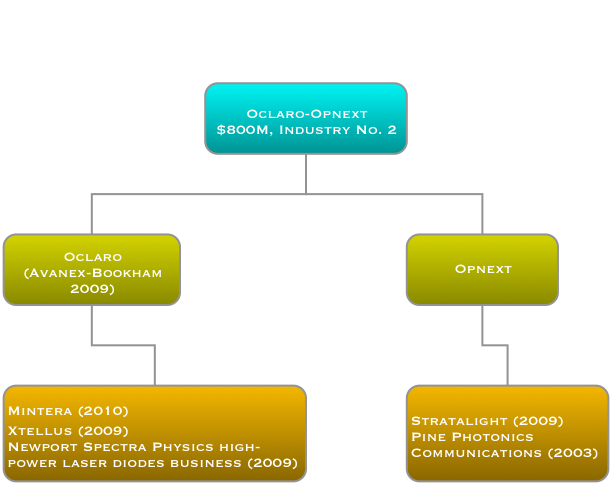
Oclaro has announced its plan to merge with Opnext. The deal, valued at US $177M, will result in Opnext's shareholders owning 42% of the combined company. The merger of the fifth and sixth largest optical component players, according to Ovum, will create a company with annual revenues of $800M, second only to Finisar. The deal is expected to be completed in the next 3-6 months.
 Source: Gazettabyte
Other details of the merger include:
- Combining the two companies will save between $35M-45M but will take 18 months to achieve.
- Restructuring and system integration will cost $20M-$30M.
- All five of the new company's fabs will be kept. The fabs are viewed as key assets.
- The new company will continue its use of contract manufacturers in Asia. Oclaro announced a recent deal with Venture, and that included the possibility of an Oclaro-Opnext merger.
- Oclaro's CEO, Alain Couder, will become the CEO of the new company. Harry Bosco, Opnext's CEO, will join the company's board of directors, made up of six Oclaro and four Opnext members.
- In 4Q 2011, Oclaro reported three customers, each accounting for greater than 10% sales: Fujitsu, Infinera and Ciena. Opnext reported 43% of its sales to Cisco Systems and Hitachi in the same period.
Industry scale
The motivation for the merger is to achieve industry scale, says Oclaro. "We have never been shy [of mergers and acquisitions] - we did Avanex and Bookham," says Yves LeMaitre, chief marketing officer for Oclaro. "We believe industry scale allows you to absorb certain fixed costs like fab infrastructure and the sales force." Scale also increases the absolute amount that can be invested in R&D, estimated at 12-13% of its revenues.
"It [the acquisition] is really about building a company that directly competes with Finisar," says Daryl Inniss, practice leader, components at Ovum. "It creates a stronger, vertically integrated company that starts at chips and goes all the way to the line card."

"We will be one of the most vertically integrated suppliers for 100 Gigabit coherent technology"
Mike Chan, Opnext
LightCounting believes the Oclaro-Opnext merger will be a success. Moreover, the market research firm expects further optical component M&As. Since the Oclaro-Opnext was announced, Sumitomo Electric Device Innovations has announced it will acquire Emcore's VCSEL and associated transceiver technology for $17M.
Meanwhile, Morgan Stanley Research is less positive about the merger, believing that the Opnext acquisition carries 'material risk'. It argues that the stated synergies are aggressive and that the integration of the two firms could distract Oclaro and lower its share price.
Products and technology
The deal expands Oclaro's transceiver portfolio, enhancing its offerings in telecom and strengthening its presence in datacom. It also expands the customer base: Opnext supplies Juniper, Google and H-P, new customers for Oclaro.
Common products shared by the two firms are limited, for high-end products the overlap is mainly 100 Gigabit coherent and tunable laser XFPs. LightCounting also points out that the two share some legacy SONET/SDH, WDM and Ethernet products: "Nothing that reduces competition significantly," it says in a research note.
"[With the Avanex-Bookham merger] There was a little bit of overlap in a few areas which we managed," says Oclaro's LeMaitre. "It is even easier in this case."

"We see potential, further down the road, for new very-short-reach optical interfaces"
Yves LeMaitre, Oclaro
Opnext acquired optical transmission subsystem vendor StrataLight in 2009 while Oclaro acquired Mintera in 2010. Both Oclaro and Opnext have used the expertise of the two subsystem vendors to become early market entrants of 100 Gigabit 168-pin multi-source modules.
But Oclaro makes the optical components for the modules - tunable lasers, lithium niobate modulators and integrated coherent transceivers - items that Opnext has to buy for its 100 Gig coherent module, says Ovum's Inniss: "Opnext has built decent gross margins when you consider that a lot of the optics they don't own themselves.” Oclaro's components will be used within Opnext's modules.
"We will be one of the most vertically integrated suppliers for key 100 Gigabit coherent technology moving forward," says Mike Chan, executive vice president of business development and marketing at Opnext.
Opnext stresses that it has its own programmes for integrated photonics. "We have been telling our customers that we have been working on some of these integrated photonics [for 100G coherent]," says Chan. "The StrataLight portion of Opnext also has a lot of work done, and IP created, in the coherent modem area."
Currently both companies' 100 Gigabit modules use NEL's coherent receiver DSP-ASIC. Oclaro has also made an investment in coherent chip start-up, ClariPhy. But for future coherent adaptive-rate designs, the joint company will be able to develop its own coherent chip. "We have the in-house know-how for the coherent modem chip," says Chan.
The merged company is well positioned to address client-side 100 Gigabit-ber-second (Gbps) transceivers. "Here the challenge is to achieve high density and low power [interfaces]," says Chan. Oclaro has VCSEL technology that can be used for very short reach 4x28Gbps arrays. Oclaro says it is the world's leading supplier of VCSELs for a variety of commercial applications and has now shipped over 150M units.
At OFC/NFOEC Opnext demonstrated a 1310nm LISEL (Lens-integrated Surface-Emitting distributed feedback Laser) array operating at 25-40Gbps. The surface-emitting distributed feedback (DFB) laser can also be used for the same 4x28Gbps design, says Chan. "Within the data centre 500m is the sweet-spot," says Chan. "It is not just the physical distance but the link-budget as the signal may have to go through a patch panel." The DFB can be used with multi-mode and single-mode fibre and Opnext believes it can achieve a 1km reach.
Oclaro does not rule out using its VCSEL technology to address such applications as optical engines, connecting racks and for backplanes. "We see potential, further down the road, for new very-short-reach optical interfaces into consumer, backplane, and board-to-board to really expand our addressable market," says LeMaitre
Further mergers
LightCounting argues that the 2011 floods in Thailand have added urgency to industry consolidation, with the Oclaro and Opnext merger being the first of several. Oclaro and Opnext were among the most impacted by the flood with Q4 2011 revenues being down 18% and 38%, respectively, says LightCounting.
Ovum also expects further mergers as companies strengthen their coherent and ROADM technologies.
Inniss believes ROADMs is the next area that Oclaro is likely to strengthen. Oclaro has acquired Xtellus but Ovum says the main ROADM leaders are Finisar, JDS Uniphase and CoAdna. Companies to watch include JDS Uniphase, Fujitsu Optical Components, CoAdna and Sumitomo, says Inniss.
A day after Ovum's and LightCounting's M&A comments, Sumitomo announced the acquisition of Emcore's VCSEL business unit.
100 Gigabit direct detection gains wider backing
More vendors are coming to market with 100 Gigabit direct detection products for metro and private networks.
The emergence of a second de-facto 100 Gigabit standard, a complement to 100 Gigabit coherent, has gained credence with 4x28 Gigabit-per-second (Gbps) direct detection announcements from Finisar and Oclaro, as well as backing from system vendor, ECI Telecom.

"We believe that in some cases operators will prefer to go with this technology instead of coherent"
Shai Stein, CTO, ECI Telecom
ECI Telecom and chip vendor MultiPhy announced at OFC/NFOEC that they have been collaborating to develop a 168-pin MSA, 5x7-inch 100 Gigabit-per-second (Gbps) direct detection module. Finisar and Oclaro used the show held in Los Angeles to announce their market entry with 100Gbps direct detection CFP pluggable optical modules.
Late last year ADVA Optical Networking announced the industry's first 100Gbps direct detection product. At the same time, MultiPhy detailed its MP1100Q receiver chip designed for 100Gbps direct detection.
According to ECI, by having the 168-pin MSA interface, one line card can support a 100Gbps coherent transponder or the 100Gbps direct detection. "This is important as it enables us to fit the technology and price to the needs of end customers," says Shai Stern, CTO of ECI Telecom.
100 Gigabit transmission
Coherent technology has become the de-facto standard for 100Gbps long-haul transmission. Using dense wavelength division multiplexing (DWDM), system vendors can achieve 1,500km and greater reaches using a 50GHz channel.
But coherent designs are relatively costly and 100Gbps direct detection offers a cost-conscious alternative for metro networks and for linking data centres, achieving a reach of up to 800km.
"It [100 Gig direct detection] provides needed performance at an attractive cost, in particular when you are looking at private optical networks," says Per Hansen, vice president of product marketing, optical networks solutions at Oclaro.
Such networks need not be owned by private enterprises, they can belong to operators, says Hansen, but they are typically simple point-to-point connections or 3- to 4-node rings serving enterprises. "Bonding adjacent [4x28Gbps] wavelengths to create a 100Gbps channel that connects efficiently to your [IP] router is very attractive in such networks," says Hansen.
For more complex mesh metro networks, coherent is more attractive. "Simply because of the spectral resources being taken up through the mesh [with 4x28Gbps], and the operational aspect of routeing that," says Hansen.
ECI Telecom says that it has yet to decide whether it will adopt 100Gbps direct detection. But it does see a role for the technology in the metro since the 100Gbps technology works well alongside networks with 10 and 40 Gigabit on-off keying (OOK) channels. "We believe that in some cases operators will prefer to go with this technology instead of coherent," says Stein.
Some operators have chosen to deploy coherent over new overlay networks, to avoid the non-linear transmission effects that result from mixing old and new technologies on the one network. "With this technology, operators can stay with their existing networks yet benefit from 100 Gig high capacity links," says Stein.
Finisar says 100Gbps direct detection is also suited to low-latency applications. "The fact that it is not coherent means it doesn't include a DSP chip, enabling it to be used for low latency applications," says Rafik Ward, vice president of marketing at Finisar.
Implementation
The announced 100Gbps direct detection designs all use 4x28Gbps channels and optical duo-binary (ODB) modulation, although MultiPhy also promotes an 80km point-to-point OOK version (see Table).
 Source: Gazettabyte
The module input is a 10x10Gbps electrical interface: a CFP interface or the 168-pin line side MSA. A 'gearbox' IC is used to translate between the 10x10Gbps electrical interface and the four 28Gbps channels feeding the optics.
"There are a few suppliers that are offering that [gearbox IC]," says Robert Blum, director of product marketing for Oclaro's photonic components. AppliedMicro recently announced a duplex multiplexer-demultiplexer IC.
MultiPhy's receiver chip has a digital signal processor (DSP) that implements the maximum likelihood sequence estimation (MLSE) algorithm, which is says enables 10 Gig opto-electronics to be used for each channel. The result is a 100Gbps module based on the cost of 4x10Gbps optics. However, over-driving the 10Gbps opto-electronics creates inter-symbol interference, where the energy of a transmitted bit leaks into neighbouring signals. MultiPhy's DSP using MLSE counters the inter-symbol interference.
 100G direct detection module showing MultiPhy's MP1100Q chip. Source: MultiPhy
Oclaro and Finisar claim that using ODB alone enables the use of lower-speed opto-electronics. "This is irrespective of whether you use MLSE or hard decision," says Blum. "The advantage of using optical duo-binary modulation is that you can use 10G-type optics."
Finisar's Ward points out that by using ODB, the 100Gbps direct-detection module avoids the price/ power penalty associated with a receiver DSP running MLSE to compensate for sub-optimal optical components.
Oclaro, however, has not ruled out using MLSE in future. The company endorsed MultiPhy's MLSE device when the product was first announced but its first 100G transceiver is not using the IC.
Finisar and Oclaro's modules require 200GHz to transmit the 100Gbps signal: 4x50GHz channels, each carrying the 28Gbps signal. "This architecture will enable 2.5x the spectral efficiency of tunable XFPs," says Ward. Using XFPs, ten would be needed for a 100Gbps throughput, each channel requiring 50GHz or 500GHz in total.
MultiPhy claims that it can implement the 100Gbps in a 100GHz channel, 5x the efficiency but still twice the spectrum used for 100Gbps coherent.
Finisar demonstrated its 100Gbps CFP module with SpectraWave, a 1 rack unit (1U) DWDM transport chassis, at OFC/NFOEC. "It provides all the things you need in line to enable a metro Ethernet link: an optical multiplexer and demultiplexer, amplification and dispersion compensation," says Ward. Up to four CFPs can be plugged into the SpectraWave unit.
Operator interest
In a recent survey published by Infonetics Research, operators had yet to show interest in 100Gbps direct detection. Infonetics attributed the finding to the technology still being unavailable and that operators hadn't yet assessed its merits.
"Operators are aware of this technology," says ECI's Stein. "It is true they are waiting to get a proof-of-concept and to test it in their networks and see the value they can get.
"That is why ECI has not yet decided to go for a generally-available product: we will deliver to potential customers, get their feedback and then take a decision regarding a commercial product," says Stein.
However MultiPhy claims that this is the first technology that enables 100Gbps in a pluggable module to achieve a reach beyond 40km. That fact coupled with the technology's unmatched cost-performance is what is getting the interest. "Every time you show a potential user some way they can save on cost, they are interested," says Neal Neslusan, vice president of sales and marketing at MultiPhy.
Direct detection roadmap
Recent announcements by Cisco Systems, Ciena, Alcatel-Lucent and Huawei highlight how the system vendors will use advanced modulation and super-channels to evolve coherent to speeds beyond 100Gbps. Does direct detection have a similar roadmap?
"I don't think that this on-off keying technology is coming instead of coherent," says Stein. "Once we move to super-channel and the spectral densities it can achieve, coherent technology is a must and will be used." But for 40Gbps and 100Gbps, what ECI calls intermediate rates, direct detection extends the life of OOK and existing network infrastructure.
ECI and MultiPhy are members of the Tera Santa Consortium developing 1 Terabit coherent technology, and MultiPhy stresses that as well as its direct detection DSP chips, it is also developing coherent ICs.
Further reading: 100 Gigabit: The coming metro opportunity
100 Gigabit 'unstoppable'
A Q&A with Andrew Schmitt (@aschmitt), directing analyst for optical at Infonetics Research.

"40Gbps has even less value in the metro than in the core"
Andrew Schmitt, Infonetics Research
A study from market research firm, Infonetics Research, has found that operators have a strong preference for deploying 100 Gigabit-per-second (Gbps) technology as they upgrade their networks.
Infonetics interviewed 21 incumbent service providers, competitive operators and mobile operators that have either 40Gbps, 100Gbps or both wavelength types installed in their networks, or that plan to install by next year (2013).
The operators surveyed, from all the major regions, account for over a quarter (28%) of worldwide telecom carrier revenue and capital expenditure.
The study's findings include:
- A strong preference by the carriers for 100Gbps transport in both Brownfield and Greenfield installations. Carriers will use 40 and 100Gbps to the same degree in existing Brownfield networks while favouring 100Gbps for new, Greenfield builds.
- The reasons to deploy 40Gbps and 100Gbps optical transport equipment include lowering the cost per bit, taking advantage of the superior dispersion performance of coherent optics, and lowering incremental common equipment costs due to the increased spectral efficiency.
- Most respondents indicate 40Gbps is only a short-term solution and will move the majority of installations to 100Gbps once those products become widely available.
- Non-coherent 100Gbps is not yet viewed as an important technology.
- Colourless and directionless ROADMs and Optical Transport Network (OTN) switching are important components of Greenfield builds; gridless and contentionless ROADMs are much less so.
Q&A with Andrew Schmitt
Q. A key finding is that 40Gbps and 100Gbps are equally favoured for Brownfield routes. And is it correct that Brownfield refers to existing routes carrying 10Gbps and maybe 40Gbps wavelengths while Greenfield involves new 100Gbps wavelengths? What is it about Brownfield that 40Gbps and 100Gbps have equal footing? Equally, for Greenfield, is the thinking: "If we are deploying a new lit fibre, we might as well start with the newest and fastest"?
A: The assumptions on Brownfield versus Greenfield are correct, the definitions in the survey and the report are more detailed but that is right.
It is more an issue that they [carriers] are building with 40Gbps now but will transition to 100Gbps where it can be used. Where it can't be used they stick with 40Gbps. There are many reasons why 100Gbps may not work in existing networks.
Q: Another finding is that 40Gbps is seen as a short-term solution. What is short term? And will that also be true for the metro or does metro have its own dynamic?
A: We didn't test timing explicitly for Greenfield versus Brownfield networks. It [40Gbps] doesn't necessarily peak, it is just not growing at the same rate as 100Gbps. And 40Gbps has even less value in the metro than in the core, particularly in Greenfield builds. With Greenfield 100Gbps combined with soft-decision forward error correction (SD-FEC), it is almost as good as 40Gbps.
Q: The study found that non-coherent 100Gbps isn't yet viewed as an important technology. Why do you think that is so? And what is your take on the non-coherent 100Gbps opportunity?
A: The jury is still out.
The large customers I spoke with haven't looked at it and therefore can't form an opinion. A lot of promises and marketing at this point but that doesn't mean it won't work. Module vendors are pretty excited about it and they aren't stupid.
Q: You say colourless and directionless is seen as important ROADM attributes, gridless and contentionless much less so. If operators are building 100Gbps Greenfield overlays, is not gridless a must to future-proof the network investment?
A: The gridless requirement is completely overblown and folks positioning it as a requirement today haven't done the work to understand the issues trying to use it today. This survey was even more negative than I expected.
100 Gigabit: The Coming Metro Opportunity
Gazettabyte has published a Position Paper on the coming 100 Gigabit metro opportunity. (Click here to download a copy.) There has been several announcements in recent weeks from system and component vendors addressing 100 Gigabit metro networks.

The 19-page report looks at the status of the 100 Gigabit market, the drivers for 100 Gigabit deployment, the technology options and their merits. The paper then states how 100 Gigabit technologies such as direct-detection point-to-point, direct-detection WDM and coherent will fare in the metro.
Gazettabyte interviewed over 20 operators, system vendors, optical module and component makers for the Position Paper.
These include ADVA Optical Networks, Alcatel-Lucent, Brocade, BT, BTI Systems, Ciena, Cisco Systems, Cyoptics, John D'Ambrosia - chair of IEEE 100 Gig backplane study group, ECI Telecom, Ericsson, Finisar, Huawei, Infinera, Ixia, Juniper Networks, MultiPhy, Nokia Siemens Networks, Oclaro, Opnext, Level 3 Communications, Transmode, Verizon and ZTE.
Look forward to any comments you may have regarding the report, its position and conclusions.
Transmode chooses coherent for 100 Gigabit metro
Transmode has detailed its 100 Gigabit metro strategy based on a stackable rack, a concept borrowed from the datacom world.
The Swedish system vendor has adopted coherent detection technology for 100 Gigabit-per-second (Gbps) optical transmission, unlike other recent metro announcements from ADVA Optical Networking and MultiPhy based on 100Gbps direct-detection.

"Metro is a little bit diverse. You see different requirements that you have to adapt to."
Sten Nordell, Transmode
"We are getting requests for this and we think 2012 is when people are going to put in a low number of [100Gbps] links into the metro," says Sten Nordell, CTO at Transmode.
The 100Gbps requirements Transmode is seeing include connecting data centres over various distances. The data centres can be close - tens of kilometers - or hundreds of kilometers apart.
"They [data centre operators] want to get more capacity over longer distances over the fibre they have rented," says Nordell. "That is why we are going down the standards path of coherent technology that gives you that boost in power and distance."
Nordell says that customers typically only want one or two 100Gbps light paths to expand fibre capacity or to connect IP routers over a link already carrying multiple 10Gbps light paths. "Metro is a little bit diverse," he says. "You see different requirements that you have to adapt to."
Rack system approach
Transmode has adopted a stackable approach to its 100Gbps TM-series of chassis. The TM-2000 is a 4U-high dual 100Gbps rack that implements transponder, muxponder or regeneration functions. "We have borrowed from Ethernet switches - you add as you grow," says Nordell.
Up to four TM-2000 are used with one TM-301 or TM-3000 master rack, with the architecture supporting up to 80, 100Gbps wavelengths overall.
"If you have too many ROADMs in the way it is going to hurt you. We have seen that with 40 Gig."
The system also uses daughter boards that support various client-side interfaces while keeping the 100Gbps line-side interface - the most expensive system component - intact. "You can install a muxponder of 10x10Gig modules,” says Nordell. "When an IP router upgrades to a 100 Gig interface, you take out the daughter board and put in a 100 Gig transponder."
Transmode will offer two line-side coherent options, with a reach of 750km or 1,500km. "We want to make sure that customers' metro and long-haul requirements will be covered," says Nordell.
 The reach of various 100Gbps technologies for the metro edge, core and regional networks. Source: Gazettabyte
The company chose coherent technology because it is an industry-backed standard. "We can benefit from coherent technology," he says. "If the industry aligns, the volumes of the components come down in price."
Coherent also simplifies the setting up and commissioning of agile photonic networks, especially as more ROADMs are introduced in the metro. "Coherent will help simplify this. All the others are more complex," he says. "Beforehand metro was more point-to-point, now we are seeing more flexibility."
Transmode recently announced it is supplying its systems to Virgin Mobile for mobile backhaul. "That is a metro network with all ROADMs in it," says Nordell. Such networks support multiple paths and that translates to a need for greater reach. "The power budget we need to have in the metro is going up a little bit."
Direct-detection technology was considered by Transmode but it chose coherent as it gives customers a better networking design capability.
Direct detection is also not as spectrally efficient as coherent: 200GHz or 100GHz-wide channels for a 100Gbps signal rather that coherent's 50GHz. "If you have too many ROADMs in the way it is going to hurt you, says Nordell.”We have seen that with 40 Gig."
The TM-2000 rack will begin testing in customers' networks at the start of 2012, with limited availability from mid-2012. The platform and daughter boards will be available in volume by year-end 2012.
MultiPhy boosts 100 Gig direct-detection using digital signal processing
The MP1100Q chip is being aimed at two cost-conscious metro networking requirements: 100 Gigabit point-to-point links and dense wavelength-division multiplexing (DWDM) metro networks.
 The MP1100Q as part of a 100 Gig CFP module design. Source: MultiPhy
The 100 Gigabit market is still in its infancy and the technology has so far been used to carry traffic across operators’ core networks. Now 100 Gigabit metro applications are emerging.
Data centre operators want short links that go beyond the IEEE-specified 10km (100GBASE-LR4) and 40km (100GBASE-ER4) reach interfaces, while enterprises are looking to 100 Gigabit-per-second (Gbps) DWDM solutions to boost the capacity and reach of their rented fibre. Existing 100Gbps coherent technologies, designed for long-haul, are too expensive and bulky for the metro.
“There is long-haul and the [IEEE] client interfaces and a huge gap in between,” says Avishay Mor, vice president of product management at MultiPhy.
It is this metro 'gap' that MultiPhy is targeting with its MQ1100Q chip. And the fabless chip company's announcement is one of several that have been made in recent weeks.
ADVA Optical Networking has launched a 100Gbps metro line card that uses a direct-detection CFP, while Transmode has detailed a 100Gbps coherent design tailored for the metro. The 10x10 MSA announced in August a 10km interface as well as a 40km WDM design alongside its existing 10x10Gbps MSA that has a 2km reach.
MultiPhy's MP1100Q IC will enable two CFP module designs: a point-to-point module to connect data centres with a reach of up to 80km, and a DWDM design for metro core and regional networks with a reach up to 800km.
"MLSE is recognised as the best solution for mitigating inter-symbol interference."
Design details
The M1100Q uses a 4x28Gbps direct-detection design, the same approach announced by ADVA Optical Networking for its 100Gbps metro card. But MultiPhy claims that the 100Gbps DWDM CFP module will squeeze the four bands that make up the 100Gbps signal into a 100GHz-wide channel rather than 200GHz, while its IC implements the maximum likelihood sequence estimation (MLSE) algorithm to achieve the 800km reach.
The four optical channels received by a CFP are converted to electrical signals using four receiver optical subassemblies (ROSAs) and sampled using the MP1100Q’s four analogue-to-digital (a/d) converters operating at 28Gbps.
The CFP design using MultiPhy’s chip need only use 10Gbps opto-electronics for the transmit and receive paths. The result is a 100Gbps module with a cost structure based on 4x10Gbps optics.
The lower bill-of-materials impacts performance, however. “When you over-drive these 10Gbps opto-electronics - on the transmit and the receive side - you create what is called inter-symbol interference," says Neal Neslusan, vice president of sales and marketing at MultiPhy.
Inter-symbol interference is an unwanted effect where the energy of a transmitted bit leaks into neighboring signals. This increases the bit-error rate and makes the detector's task harder. "The way that we get around it is using MLSE, recognised as the best solution for mitigating inter-symbol interference," says Neslusan.
Unwanted channel effects introduced by the fibre, like chromatic dispersion, also induce inter-symbol interference and are also countered by the MLSE algorithm on the MP1100Q.
MultiPhy is proposing two CFP designs for its chip. One is based on on-off-keying modulation to achieve 80km point-to-point links and which will require a 200GHz channel to accommodate the 100Gbps signal. The second uses optical duo-binary modulation to achieve the longer reach and more spectrally efficient 100GHz spacings.
The company says the resulting direct-detection CFP using its IC will cost some US $10,000 compared to an estimated $50,000 for a coherent design. In turn the 100G metro CFP’s power consumption is estimated at 24W whereas a coherent design consumes 70W.
MP1100Q samples have been with the company since June, says Mor. First samples will be with customers in the fourth quarter of this year, with general availability starting in early 2012.
If all goes to plan, first CFP module designs using the chip will appear in the second half of 2012, claims MultiPhy.