
ECOC '22 Reflections - Final Part
Gazettabyte has been asking industry and academic figures for their thoughts after attending ECOC 2022, held last month in Basel, Switzerland. In particular, what developments and trends they noted, what they learned, and what, if anything, surprised them.
In the final part, Dr. Sanjai Parthasarathi of Coherent, Acacia’s Tom Williams, ADVA’s Jörg-Peter Elbers and Fabio Pittalà of Keysight Technologies share their thoughts.
Dr. Sanjai Parthasarathi, Chief Marketing Officer, Coherent
The ECOC event represents an excellent opportunity for us – a vertically-integrated manufacturer selling at all levels of the value chain – to meet with customers, end-customers and partners/ suppliers.
There was a refreshing sense of optimism and excitement for optical communications, driven by relentless bandwidth growth, despite the macroeconomic backdrop.
The roadmap for optical transceivers is dictated by the electrical interface used for Ethernet switch chips. We have seen that play out yet again for 100-gigabit electrical lanes used for 25-terabit and 50-terabit Ethernet switches.
Several transceiver suppliers demonstrated products with 100 gigabit-per-lane electrical interfaces in quad and octal form factors. The optical lane of a transceiver typically begins at the same speed as the electrical lane and then progresses to a faster rate. This transition should be expected for 800-gigabit transceivers as well.
While 100 gigabit-per-lane transceivers, such as the 800G-DR8 and the 2x400G-FR4 devices, there were devices demonstrated that enable the transition to optical 200-gigabit lanes. It was satisfying to see a warm response for the demonstration of Coherent’s 200-gigabit electro-absorption modulated laser (EML) and Semtech’s 200-gigabit EML driver. I am confident that direct detection will play a predominant role in 800-gigabit and 1.6-terabit data centre links.
Despite the great interest in co-packaged optics, nearly all the working demonstrations at the show used pluggable transceiver modules. Industry colleagues are preparing for pluggable transceiver modules using the next 200-gigabit electrical interface. Indeed, at ECOC, there was an OIF-CEI 224G demo by Keysight and Synopsys.
One key topic at the show concerned whether ‘coherent lite’ or direct detect is the preferred solution for data centres and edge aggregation. The debate remains open and no one solution fits all. It will depend on the specific application and architecture. A broad portfolio supported by different technology platforms frees you to select the best approach to serve the customer’s needs.
I saw the industry responding to the need for disaggregation and innovative solutions for access and telecom. Coherent’s 100G ZR announcement is one such example, as well as the extra performance of high-power 400ZR+ coherent transceivers.
We started this trend and we now see others announcing similar solutions.
Arista’s demo, which featured 400ZR connections over a 120km data centre interconnect (DCI) link, enabled by our pluggable optical line system in a QSFP form factor, received much attention and interest.
Tom Williams, Senior Director of Marketing for Acacia, now part of Cisco.
Many of us are still of a mindset where any opportunity to get together and see industry friends and colleagues is a great show.
My focus is very much on the success of 400-gigabit pluggable coherent solutions.
We’ve been talking about these products for a long time, back to the initial OIF 400ZR project starting in late 2016. Since then, 400ZR/ZR+ has been a hot topic at every conference.
The commercial success of these solutions, and the impact that they’re having on network architectures, has been gratifying. These products have ramped in volumes not seen by any previous coherent technology.
The industry has done a great job at 400 gigabits, striking the right balance of power and performance. Now, we’re looking at 800 gigabits and working through some of the same questions. Discussions around 1.6 terabits have even started.
Much work is still required but what we heard from customers at ECOC is that the trend toward pluggable coherent will likely continue.
Jörg-Peter Elbers, Senior Vice President, Advanced Technology, Standards and IPR at ADVA
‘Never say never’ captures well ECOC’s content. There was no one groundbreaking idea but topics discussed in the past are back on the agenda, either because of a need or the technology has progressed.
Here are several of my ECOC takeaways:
- The 130 gigabaud (GBd) class of coherent optics is coming, and the generation after that – 240GBd – is on the horizon.
- Coherent optics continue to push towards the edge. Will there be a Very-High Speed Coherent PON after 50G High-Speed PON?
- Whether co-packaged optics or front-pluggable modules, electro-photonic integration is rapidly advancing with some interesting industry insights shared at the conference.
- Quantum-safe communication is becoming part of the regular conference program.
- Optical Satcom is gaining traction. Optical ground-to-space links are promising yet challenging.
Fabio Pittalà, Product Planner, Broadband and Photonics – Center of Excellence, Keysight Technologies
This was my first ECOC as an employee of Keysight. I spent most of my time at the exhibition introducing the new high-speed Keysight M8199B Arbitrary Waveform Generator.
There were a lot of discussions focusing on technologies enabling the next Ethernet rates. There is a debate about intensity-modulation direct detection (IMDD) versus coherent but also what modulation format, symbol rate or degree of parallelisation.
While the industry is figuring out the best solution, researchers achieved important milestones by transmitting the highest symbol rate and the highest net bitrate.
Nokia Bell-Labs demonstrated record-breaking transmission of 260-gigabaud dual-polarisation quadrature phase-shift keying (DP-QPSK) over 100km single-mode fibre.
Meanwhile, NTT broke the net bitrate record by transmitting more than 2 terabit-per-second using a probabilistic-constellation-shaped dual-polarisation quadrature amplitude modulation (DP-QAM) over different data centre links.

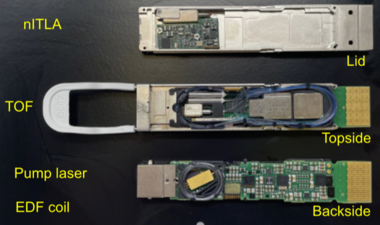
Ciena's multi-format 400G coherent QSFP-DD pluggable
Ciena showcased a working 400-gigabit Universal coherent pluggable module at the ECOC 2022 conference and exhibition in Basel, Switzerland.
Ciena is using its WaveLogic 5 Nano coherent digital signal processor (DSP) for the Universal QSFP-DD coherent pluggable module.
“We call it universal because it supports many transmission modes – interoperable and high performance; the most in the industry,” says Helen Xenos, senior director of portfolio marketing at Ciena.
The pluggable has custom extended-performance modes and supports three industry formats: the 400ZR interoperable standard, the 400ZR+ multi-source agreement (MSA), and the OpenROADM MSA. (See tables below).
IP over DWDM
Communications service providers (CSPs) want to add pluggable coherent modules to their IP routers, removing the need for a separate transponder card or box linking the router to the optical line system.
The advent of coherent QSFP-DD pluggables has meant the same form factor can be used for client-side and line-side optics, ensuring efficient use of the router ports.
The CSPs want the coherent QSFP-DD module to have sufficient optical performance to meet their demanding networking requirements. For example, the module’s output signal can pass through the filtering stages of reconfigurable optical add-drop multiplexers (ROADMs) along the optical link.
Optical amplification and filtering
Ciena’s coherent QSFP-DD adds a fibre-based optical amplifier and a tunable optical filter to the coherent photonics and electronic ICs.
The optical amplification enables the high-performance mode and the launching of a 4dBm output signal. In contrast, 400ZR and 400ZR+ have a launch power of -10dBm.
“This is the industry’s highest [QSDP-DD] transmit power,” says Xenos.
The tunable optical filter improves the optical performance of the coherent receiver.
In an optical line system with colourless ROADMs, the Erbium-doped fibre amplifiers (EDFAs) generate out-of-band transmission noise – amplified spontaneous emission (ASE). The noise sources superimpose and become significant, impairing wavelength and system performance dramatically.
The tunable optical filter eliminates this effect and simplifies deployment over any photonics line system. In addition, Ciena says the pluggables can now work alongside high-baud rate transponders in existing ROADM applications.
The QSFP-DD’s tunable optical filter means its optical performance closely matches that of the CFP2-DCO, aiding the two classes of pluggables working together.
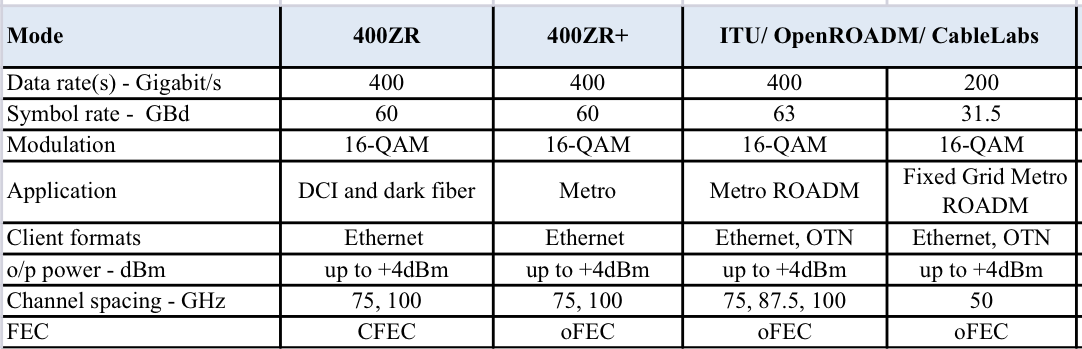
Modes of operation
400ZR defines the module’s baseline coherent performance. The OIF developed the 400ZR standard so hyperscalers can link their equipment in two separate data centres up to 120km apart.
The 400ZR specification delivers just enough optical performance to meet the optical link budget. The OIF produced a low-cost, interoperable, pluggable coherent specification.
400ZR supports a single baud rate – 60 gigabaud (GBd), and modulation scheme – dual-polarisation 16-QAM, and carries Ethernet frames.
Google, Meta, Microsoft and Alibaba were all involved in the OIF development, with the 400ZR Implementation Agreement published in early 2020.
400ZR supports two-channel widths: 75GHz and 100GHz, while the forward error correction scheme used is CFEC.
The 400ZR+ MSA enhances the performance by supporting other data rates – 100, 200 and 300 gigabits-per-second (Gbps) – as well as 400Gbps. In addition, it uses several modulation schemes and the enhanced O-FEC error correction scheme that extends reach.
Ciena’s module also meets the OpenROADM MSA, supporting Ethernet and OTN and an enhanced reach at 400Gbps.

Ciena’s Universal module’s extended performance modes up the symbol rate to 65 and 70 gigabaud (GBd) and uses probabilistic constellation shaping (PCS).
PCS maps the bitstream onto the constellation to maximise the data recovery at the coherent receiver, thereby improving overall optical performance. The scheme also allows the fine-tuning of the data rate sent.
At ECOC, Ciena showed the module implementing the high-performance mode at 70GBd and PCS.
ECOC innovation award
The ECOC Exhibition Market Focus Advisory Committee awarded the most innovative product award to Ciena’s WaveLogic 5 Nano 400G Universal QSFP-DD.

Hyperscalers' needs drive a new class of coherent DSP

Coherent digital signal processors (DSPs) companies have supported two families of coherent chips for some time. That’s because no single coherent DSP can meet all the market’s requirements.
The coherent DSP used for highest-performance optical transmissions must include advanced coding techniques, forward error correction, and a high symbol rate to send as much data as possible on a single wavelength and maximise reach.
In contrast, a DSP for coherent pluggable modules needs to be power-efficient and compact to meet the optical module’s power envelope and size constraints; a 400ZR QSFP-DD and a CFP2-DCO 400ZR+ being examples.
According to Ciena, now there is a need for a third category of coherent DSP for 1.6 terabit-per-second (Tbps) and 3.2Tbps transmissions over short distances for next-generation switch routers.
Carrying data centre payloads
The need comes from the hyperscalers, as with most emerging coherent optical applications. The new coherent DSP design is needed since it is the only way to support multi-terabit data rates for this application, says Ciena.
“Data centre switch routers with new 51.2- and 102.4-terabit switch chipsets will need greater than 400 gigabit-per-wavelength connectivity,” said Helen Xenos, senior director, portfolio marketing at Ciena, during a talk at NGON & DCI World, held in Barcelona in June.
The coherent DSP will connect equipment within a data centre and between data centre buildings on campus. A 1-10km reach for the 1.6Tbps or 3.2Tbps wavelength transmissions is needed using an industry-standard pluggable such as a QSFP-DD or a OSFP pluggable form factor.
“It would have to be a specific, very low-cost design,” says Xenos.
Coherent evolution
Applications using coherent optical technology continue to grow.
Subsea, long-haul, metro, and 80-120km data centre interconnect are all well-known markets for coherent optics, said Xenos. Now, coherent is moving to the access network and for unamplified single-channel links.
“There is no one coherent optical design that will be cost-optimal across all of these applications,” said Xenos. “This is why multiple coherent optical modem designs are required.”
Xenos last presented at NGON & DCI World in pre-pandemic 2019. Then, the questions were whether 800-gigabit wavelengths would be needed and what optical performance 400-gigabit coherent pluggables would deliver.
Much has since changed. There has been a broad deployment of optical transport equipment using 800-gigabit wavelengths while the coherent pluggable market has gone from strength to strength.
For the high-end, up to 800 gigabits per wavelength, 7nm CMOS DSPs are used, operating at a symbol rate of 90-110 gigabaud (GBd).
For 400-gigabit coherent pluggables operating, the symbol rate is 60-70GBd, while the optics used is mainly silicon photonics.
800-gigabit market
Ciena started shipping 800-gigabit capable optical modules in April 2020.
Since then, the company has seen strong uptake, with hyperscalers leading the way.

Also, a broad deployment of colourless, flexible grid optical line systems has helped 800-gigabit technology adoption.
Xenos cited, among others, Altibox, which brings high capacity connectivity from Norway to key digital hubs in Europe.
“They turned up the longest 800-gigabit wavelength between Copenhagen and Amsterdam, and that was over 1,100 kilometres,” she said.
400-gigabit pluggables
Xenos points out that there has been a halving of the power-per-bit at 400Gbps.
 Source: Ciena.
In 2017, Ciena offered a 400-gigabit 60GBd modem design in a 5×7-inch package.
“Now we have a pluggable 400-gigabit QSFP-DD at 60GBd pluggable, so the same type of design, the same simple feature set required with a 400ZR,” said Xenos.
Optical performance is also being pushed to 70GBd in the QSFP-DD, with the module having a higher output power.
Near-term designs
Ciena says the next two to three generations of coherent DSPs will use 5nm and 3nm CMOS.
New promising materials for optical modulation are emerging, such as thin-film lithium niobite, and barium titanate, which is compatible with silicon photonics.
“[A] Higher baud [rate] will reduce cost-per-bit and get more capacity using a single wavelength,” says Xenos. “Also, there will be more intelligence and programmability as we move forward to enable more automated networks.”
She says a 160GBd symbol rate is needed to send 800 gigabits over long-distance spans.
The key for all the different modem designs is to develop something better while choosing the right technologies so that new products are available promptly.
“It’s essential to make the right technology choice that will give the right reliability and be commercially available,” says Xenos.
Three nanometre CMOS promises more significant performance benefits for a DSP design, but developing the process technology is challenging for the leading chip fabrication plants. In addition, a 3nm CMOS process will be costly.
Award
Ciena won the optical vendor of the year award, one of the five prizes presented at the NGON & DCI World show.

OFC highlights a burgeoning coherent pluggable market

A trend evident at the OFC show earlier this month was the growing variety of coherent pluggable modules on display.
Whereas a coherent module maker would offer a product based on a coherent digital signal processor (DSP) and a basic design and then add a few minor tweaks, now the variety of modules offered reflects the growing needs of the network operators.
Acacia, part of Cisco, announced two coherent pluggable to coincide with OFC. The Bright 400ZR+ QSFP-DD pluggable form factor is based on Acacia’s existing 400ZR+ offering. It has a higher transmit power of up to 5dBm and includes a tunable filter to improve the optical signal-to-noise ratio (OSNR) performance.
Acacia’s second coherent module is the fixed wavelength 400-gigabit 400G ER1 module designed for point-to-point applications.
“I can understand it being a little bit confusing,” says Tom Williams, vice president of marketing at Acacia. “We have maybe five or six configurations of modules based on the same underlying DSP and optical technology.”
Bright 400ZR+
The Bright 400ZR+ pluggable addresses a range of network architectures using the high-density QSFP-DD form factor, says Williams.
“Before you had to use the [larger] CFP2-DCO module, now we are bringing some of the functionality into the -DD,” he says. “The Bright 400ZR+ doesn’t replace the CFP2-DCO but it does move us closer to that.” As such, the module also supports OTN framing.
The Bright 400ZR+ has a higher launch power than the optical specification of the OpenZR+ standard but supports the same protocol so it can operate with OpenZR+ compliant pluggables.
The module uses internal optical amplification to achieve the 5dB launch power. The higher launch power is designed for various architectures and ROADM configurations.
“It is not that it allows a certain greater reach so much as the module can address a wider range of applications,” says Williams. “When you talk about colourless, directionless or colourless-directionless-contentionless (CDC-) reconfigurable optical add-drop multiplexing (ROADM) architectures, these are the types of applications this opens up.”
The integrated tunable filter tackles noise. In colourless ROADM-based networks, because the optical multiplexing occurs without filtering, the broadband out-of-band noise can raise the overall noise floor. This then decreases the overall OSNR. Amplification also increases the noise floor.
The tunable filter is used to knock down the overall noise floor, thereby improving the transmit OSNR.
The output power of the Bright 400ZR+ is configurable. The 5dBm launch power is used for ROADMs with array-waveguide gratings while for colourless multiplexing the tunable filter is used, reducing the output power to just above 1dBm.
“You are seeing an anchoring of interoperability that operators can use and then you are seeing people build on top of that with enhancements that add value and expand the use cases,” says Williams.
400 gigabits over 40km
As part of the OIF industry organisation’s work that defined the 400ZR specification, a 40km point-to-point unamplified link was also included. Acacia’s 400G ER1 is such an implementation with the ‘ER’ referring to extended reach, which IEEE defines as 40km.
“At every data rate there has always been an application for these ER reaches in access and enterprise,” says Williams. “The link is just a fibre, it’s like the 10km LR specification, but this goes over 40km.”
The ER1 has been designed to reduce cost and uses a fixed laser. ”We are not doing OSNR testing, it is based on a power-limited 40km link,” says Williams.
The OIF standard uses concatenated forward-error correction (CFEC) while Acacia employs its openFEC (oFEC) that enhances the reach somewhat.
Shipment updates
Acacia also reported a significant ramp in the shipment of its pluggables that use its Greylock coherent DSP.
It has shipped over 50,000 such pluggables, 20,000 alone shipped in Cisco’s last (second) fiscal quarter. “This is being driven by the expected early adopters of 400ZR, as well as a range of other applications,” says Williams.
Acacia says it has also shipped over 100,000 Pico DSP ports. Each AC1200 multi-haul module has two such ports.
The AC1200 sends up to 1.2 terabits over two wavelengths using Acacia’s 7nm CMOS Pico DSP. The multi-haul module is being used in over 100 networks while three of the four largest hyperscalers use the technology.
Acacia also demonstrated at OFC its latest multi-haul module announced last year, a 1.2 terabits single-wavelength design that uses its latest 5nm CMOS Jannu DSP and which operates at a symbol rate of up to 140 gigabaud.
Acacia says samples of its latest multi-haul module that uses its own Coherent Interconnect Module 8 (CIM 8) form factor will be available this year while general availability will be in 2023.
Post-deadline
Williams also presented a post-deadline paper at OFC.
The work outlined was the demonstration of the optical transmission of 400 Gigabit Ethernet flows over a 927km link. The trial comprised transmission through several networks and showed the interoperability of 400-gigabit QSFP-DD and CFP2 modules.
The work involved Orange Labs, Lumentum, Neophotonics, EXFO and Acacia.


Building the data rate out of smaller baud rates

In the second article addressing the challenges of increasing the symbol rate of coherent optical transport systems, Professor Andrew Lord, BT’s head of optical network research, argues that the time is fast approaching to consider alternative approaches.
Coherent discourse 2
Coherent optical transport systems have advanced considerably in the last decade to cope with the relentless growth of internet traffic.
One-hundred-gigabit wavelengths, long the networking standard, have been replaced by 400-gigabit ones while state-of-the-art networks now use 800 gigabits.
Increasing the data carried by a single wavelength requires advancing the coherent digital signal processor (DSP), electronics and optics.
It also requires faster symbol rates.
Moving from 32 to 64 to 96 gigabaud (GBd) has increased the capacity of coherent transceivers from 100 to 800 gigabits.
Last year, Acacia, now part of Cisco, announced the first 1-terabit-plus wavelength coherent modem that uses a 128GBd symbol rate.
Other vendors will also be detailing their terabit coherent designs, perhaps as soon as the OFC show, to be held in San Diego in March.
The industry consensus is that 240GBd systems will be possible towards the end of this decade although all admit that achieving this target is a huge challenge.
Baud rate
Upping the baud rate delivers several benefits.
A higher baud rate increases the capacity of a single coherent transceiver while lowering the cost and power used to transport data. Simply put, operators get more bits for the buck by upgrading their coherent modems.
But some voices in the industry question the relentless pursuit of higher baud rates. One is Professor Andrew Lord, head of optical network research at BT.
“Higher baud rate isn’t necessarily a panacea,” says Lord. “There is probably a stopping point where there are other ways to crack this problem.”
Parallelism
Lord, who took part in a workshop at ECOC 2021 addressing whether 200+ GBd transmission systems are feasible, says he used his talk to get people to think about this continual thirst for higher and higher baud rates.
“I was asking the community, ‘Are you pushing this high baud rate because it is a competition to see who builds the biggest rate?’ because there are other ways of doing this,” says Lord.
One such approach is to adopt a parallel design, integrating two channels into a transceiver instead of pushing a single channel’s symbol rate.
“What is wrong with putting two lasers next to each other in my pluggable?” says Lord. “Why do I have to have one? Is that much cheaper?”
For an operator, what matters is the capacity rather than how that capacity is achieved.
Lord also argues that having a pluggable with two lasers gives an operator flexibility.
A single-laser transceiver can only go in one direction but with two, networking is possible. “The baud rate stops that, it’s just one laser so I can’t do any of that anymore,” says Lord.
The point is being reached, he says, where having two lasers, each at 100GBd, probably runs better than a single laser at 200GBd.
Excess capacity
Lord cites other issues arising from the use of ever-faster symbol rates.
What about links that don’t require the kind of capacity offered by very high baud rate transceivers?
If the link spans a short distance, it may be possibe to use a higher modulation scheme such as 32-ary quadrature amplitude modulation (32-QAM) or even 64-QAM. With a 200GBd symbol rate transceiver, that equates to a 3.2-terabit transceiver. “Yet what if I only need 100 gigabits,” says Lord.
One option is to turn down the data rate using, say, probabilistic constellation shaping. But then the high-symbol rate would still require a 200GHz channel. Baud rate equals spectrum, says Lord, and that would be wasting the fibre’s valuable spectrum.
Another solution would be to insert a different transceiver but that causes sparing issues for the operators.
Alternatively, the baud rate could be turned down. “But would operators do that?” says Lord. “If I buy a device capable of 200GBd, wouldn’t I always operate it at its maximum or would I turn it down because I want to save spectrum in some places?”
Turning the baud rate down also requires the freed spectrum to be used and that is an optical network management challenge.
“If I need to have to think about defragmenting the network, I don’t think operators will be very keen to do that,” says Lord.
Pushing electronics
Lord raises another challenge: the coherent DSP’s analogue-to-digital and digital-to-analogue converters.
Operating at a 200+ GBd symbol rate means the analogue-to-digital converters at the coherent receiver must operate at least at 200 giga-samples per second.
“You have to start sampling incredibly fast and that sampling doesn’t work very well,” says Lord. “It’s just hard to make the electronics work together and there will be penalties.”
Lord cites research work at UCL that suggests that the limitations of the electronics – and the converters in particular – are not negligible. Just connecting two transponders over a short piece of fibre shows a penalty.
“There shouldn’t be any penalty but there will be, and the higher the baud rate, you will get a penalty back-to-back because the electronics are not perfect,” he says.
He suspects the penalty is of the order of 1 or 2dB. That is a penalty lost to the system margin of the link before the optical transmission even starts.
Such loss is clearly unacceptable especially when considering how hard engineers are working to enhance algorithms for even a few tenths of a dB gain.
Lord expects that such compromised back-to-back performance will ultimately lead to the use of multiple adjacent carriers.
“Advertising the highest baudrate is obviously good for publicity and shows industry leadership,” he concludes. “But it does feel that we are approaching a limit for this, and then the way forward will be to build aggregate data rates out of smaller baud rates.”


Huawei sets transmission record with new modulator

Coherent discourse: Part 1
A paper from Huawei and Sun Yat-Sen University in the January issue of the Optica journal describes a thin-film lithium niobate modulator. The modulator enabled a world-record coherent optical transmission, sending nearly 2 terabits of data over a single wavelength.
Much of the industry’s focus in recent years has been to fit coherent optical technology within a pluggable module.
Such pluggables allow 400-gigabit coherent interfaces to be added to IP routers and switches, serving the needs of the data centre operators and telecom operators.
But research labs of the leading optical transport vendors continue to advance high-end coherent systems beyond 800-gigabit-per-wavelength transmissions.
Optical transport systems from Ciena, Infinera and Huawei can send 800-gigabit wavelengths using a symbol rate of 96-100 gigabaud (GBd).
Acacia Communications, part of Cisco, detailed late last year the first 1.2-terabit single-wavelength coherent pluggable transceiver that will operate at 140GBd, twice the symbol rate of 400-gigabit modules such as 400ZR.
Now Huawei has demonstrated in the lab a thin-film lithium niobate modulator that supports a symbol rate of 220GBd and beyond.
Maxim Kuschnerov, director of the optical and quantum communications laboratory at Huawei, says the modulator has a 110GHz 3dB bandwidth but that it can be operated at higher frequencies, suggesting a symbol rate as high as 240GBd.
Thin-film lithium niobate modulator
Huawei says research is taking place into new materials besides the established materials of indium phosphide and silicon photonics. “It is a very exciting topic lately,” says Kuschnerov.
He views the demonstrated thin-film lithium niobate optical modulator as disruptive: “It can cover up several deficiencies of today’s modulators.”
Besides the substantial increase in bandwidth – the objective of any new coherent technology – the modulator has performance metrics that benefit the coherent system such as a low driving voltage and low insertion loss.
A driving voltage of a modulator is a key performance parameter. For the modulator, it is sub-1V.
The signal driving the modulator comes from a digital-to-analogue (D/A) converter, part of the coherent digital signal processor (DSP). The D/A output is fed into a modulator driver. “That [driver] requires power, footprint, and increases the complexity of integrating the [modem’s] modules tighter,” says Kuschnerov.
The modulator’s sub-1V drive voltage is sufficiently small that the DSP’s CMOS-based D/A can drive it directly, removing the modulator driver circuit that also has bandwidth performance limitations. The modulator thus reduces the transmitter’s overall cost.
The low-loss modulator also improves the overall optical link budget. And for certain applications, it could even make the difference as to whether optical amplification is needed.
“The modulator checks the box of very high bandwidth,” says Kuschnerov. “And it helps by not having to add a semiconductor optical amplifier for some applications, nor needing a driver amplifier.”
One issue with the thin-film modulator is its relative size. While not large – it has a length of 23.5mm – it is larger than indium phosphide and silicon photonics modulators.
1.96-terabit wavelength
Huawei’s lab set-up used a transmit coherent DSP with D/As operating at 130 Giga-samples-per-second (GS/s) to drive the modulator. The modulation used was a 400-quadrature amplitude modulation (400-QAM) constellation coupled with probabilistic constellation shaping.
A 10 per cent forward error correction scheme was used such that, overall, 1.96-terabits per second of data was sent using a single wavelength.
The D/A converter was implemented in silicon germanium using high-end lab equipment to generate the signal at 130GS/s.
“This experiment shows how much we still need to go,” says Kuschnerov. “What we have done at 130GBd shows there is a clear limitation with the D/A [compared to the 220GBd modulator].”
Baud-rate benefits
Increasing the baud rate of systems is not the only approach but is the favoured implementation choice.
What customers want is more capacity and reducing the cost per bit for the same power consumption. Increasing the baud rate decreases the cost and power consumption of the optical transceiver.
By doubling the baud rate, an optical transceiver delivers twice the capacity for a given modulation scheme. The cost per bit of the transceiver decreases as does the power consumed per bit. Instead of two transceivers and two sets of components, one transceiver and one set are used instead.
But doubling the baud rate doesn’t improve the optical system’s spectral efficiency since doubling the baud rate doubles the channel width. That said, algorithmic enhancements are added to each new generation of coherent modem but technically, the spectral efficiency practically no longer improves.
Huawei acknowledges that while the modulator promises many benefits, all the coherent modem’s components – the coherent ASIC, the D/A and analogue-to-digital (D/A) converters, the optics, and the analogue circuitry – must equally scale. This represents a significant challenge.
Kuschnerov says optical research is finding disruptive answers but scaling performance, especially on the electrical side, remains a critical issue. “How do you increase the D/A sampling rates to match these kinds of modulator technologies?” he says. “It is not straightforward.”
The same is true for the other electrical components: the driver technologies and the trans-impedance amplifier circuits at the receiver.
Another issue is combining the electrical and optical components into a working system. Doubling the signalling of today’s optical systems is a huge radio frequency design and packaging challenge.
But the industry consensus is that with newer CMOS processes and development in components and materials, doubling the symbol rate again to 240GB will be possible.
But companies don’t know – at least they are not saying – what the upper symbol rate limit will be. The consensus is that increasing the baud rate will end. Then, other approaches will be pursued.
Kuschnerov notes that if a 1.6-terabit transceiver could be implemented using a single wavelength or with eight 200Gbps ones with the same spectral performance, cost, footprint and power consumption, end users wouldn’t care which of the two were used.
However, does optics enable such greater parallelism?
Kuschnerov says that while decades of investment has gone into silicon photonics, it is still not there yet.
“It doesn’t have the cost-effectiveness at 16, 32 or 64 lanes because the yield goes down significantly,” he says. “We as an industry can’t do it yet.”
He is confident that, soon enough, the industry will figure out how to scale the optics: “With each generation, we are getting better at it.”
Coherent engineers will then have more design options to meet the system objectives.
And just like with microprocessors, it will no longer be upping the clock frequency but rather adopting parallel processing i.e. multiple cores. Except, in this case, it will be parallel coherent optics.

Nokia shares its vision for cost-reduced coherent optics

Nokia explains why coherent optics will be key for high-speed short-reach links and shares some of its R&D activities. The latest in a series of articles addressing what next for coherent.
Part 3: Reducing cost, size and power
Coherent optics will play a key role in the network evolution of the telecom and webscale players.
The modules will be used for ever-shorter links to enable future cloud services delivered over 5G and fixed-access networks.
The first uses will be to link data centres and support traffic growth at the network edge.
This will be followed with coherent optics being used within the data centre, once traffic growth requires solutions that 4-level pulse-amplitude modulation (PAM4) direct-detect optics can no longer address.
“If you look at PAM4 up to 100 gigabit for long reach and extended reach optics – distances below 80km – it does not scale to higher data rates,” says Marc Bohn, part of product management for Nokia’s optical subsystem group. ”It only scales if you use 100-gigabit in parallel.”
However, to enable short-reach coherent optics, its cost, size and power consumption will need to be reduced significantly. Semiconductor packaging techniques will need to be embraced as will a new generation of coherent digital signal processors (DSPs).
Capacity growth
The adoption of network-edge and on-premise cloud technologies are fueling capacity growth, says Tod Sizer, smart optical fabric & devices research lab leader at Nokia Bell Labs.
Nokia says capacity growth is at 50 per cent per annum and is even faster within the data centre; for every gigabyte entering a data centre, ten gigabytes are transported within the data centre.
“All of this is driving huge amounts of growth in optical capacity at shorter distances,” says Sizer. “To meet that [demand], we need to have coherent solutions to take over where PAM-4 stops.”
Sizer oversees 130 engineers whose research interests include silicon photonics, coherent components and coherent algorithms.
Applications
As well as data centre interconnect, coherent optics will be used for 5G, access and cable networks; markets also highlighted by Infinera and Acacia Communications.

Nokia says the first driver is data centre interconnect.
The large-scale data centre operators triggered the market for 80-120km coherent pluggables with the 400ZR specification for data centre interconnect.
“Right now, with the different architectures in data centres, these guys are saying 80-120km may be an overshoot, maybe we need something for shorter distances to be more efficient,” says Bohn. “Certainly, coherent can tackle that and that is what we are preparing for because there is no alternative, only coherent can cover that space.”
5G is also driving the need for greater bandwidth.
“Traditionally a whole load of processing has been done at the remote ratio head but increasingly, for cost and performance reasons, people are looking at pulling the processing back into the data centre,” says Sizer.
Another traffic driver is how each cellular antenna has three sectors and can use multiple frequency bands.
“Some research we are looking at requires 400 gigabits and above,” says Sizer. “If you want to do a full [mobile] front haul for a massive MIMO (multiple input, multiple output) array, for example.”
Challenges
Several challenges need to be overcome before coherent modules are used widely for shorter-reach links.
To reduce coherent module cost, the optics and DSP need to be co-packaged, borrowing techniques developed by the chip industry.
“Optical and electrical should be brought close together,” says Bohn. “[They should be] co-designed and co-packaged, and the ideal candidate for that is to combine silicon photonics and the DSP.”
The aim is to turn complex designs into a system-on-chip. “Both [the DSP and silicon photonics] are CMOS and you can apply 2D and 3D [die] stacking multi-chip module techniques,” says Bohn, who contrasts it with the custom and manual manufacturing techniques used today.
The coherent DSP also needs to be much simpler than the high-end DSPs used for long-distance optical transport.
For example, the dispersion compensation, which accounts for a significant portion of the chip’s circuitry, is less demanding for shorter links. The forward-error-correction scheme used can also be relaxed as can the bit precision of the analogue-to-digital and digital-to-analogue converters.
Nokia can co-design the silicon photonics and the DSP following its acquisition of Elenion. Nokia is also exploiting Elenion’s packaging know-how and the partnerships it has developed.
Inside the data centre
Nokia highlights two reasons why coherent will eventually be used within the data centre.
The first is the growth in capacity needed inside the data centre. “For the same reason we believe coherent will be the right solution for data centre interconnect and access, the same argument can be made within the data centre,” says Sizer.
A campus data centre is distributed across several buildings and linking them is driving a need for 400-gigabit lanes or more.
This requires a ZR-like solution but for 2km or so rather than 80km.
“It is one of the solutions certainly but that will be driven an awful lot by whether we can make cost-effective solutions to meet the cost targets of the data centre,” says Sizer. That said, there are other ways this can be addressed such as adding fibre.
“Having parallel systems is another area of ongoing research,” says Sizer. “We may need to have unique solutions if traffic grows faster inside the data centre than outside such as spatial-division multiplexing as well as coherent.”
The use of coherent interfaces for networking inside the data centre will take longer.
Bohn points out that 51.2-terabit and 102.4-terabit switches will continue to be served using direct-detect optics but after that, it is unclear because direct-detect optics tops out at 100-gigabits or perhaps 200-gigabits per lane.
“With coherent, it is much easier to get to higher data rates especially over shorter distances,” says Bohn.
Another development benefitting the use of coherent is the next Ethernet standard after 400 Gigabit Ethernet (GbE).
“My research team is looking at that and, in particular, 1.6 Terabit Ethernet (TbE) which is fairly out in the future,” says Sizer. “It will demand a coherent solution, as I expect 800GbE will as well.”
Work to define the next Ethernet standard is starting now and will only be completed in 2025 at the earliest.

Acacia targets access networks with coherent QSFP-DD

- Acacia Communications has announced a 100-gigabit coherent QSFP-DD pluggable module.
- The module is the first of several for aggregation in the access network.
The second article addressing what next for coherent
Part 2: 100-gigabit coherent QSFP-DD
Acacia Communications has revisited 100-gigabit coherent but this time for access rather than metro networks.
Acacia’s metro 100-gigabit coherent pluggable product, a CFP, was launched in 2014. The pluggable has a reach from 80km to 1,200km and consumes 24-26W.
The latest coherent module is the first QSFP-DD to support a speed lower than the 400-gigabit 400ZR and ZR+ applications that have spurred the coherent pluggable market.
The launching of a 100-gigabit coherent QSFP-DD reflects a growing need to aggregate 10 Gigabit Ethernet (GbE) links at the network edge as 5G and fibre are deployed.
“The 10GbE links in all the different types of access networks highlight a need for a cost-effective way to do this aggregation,” says Tom Williams, vice president of marketing at Acacia.
Why coherent?
The deployment of 5G, business services, 10-gigabit passive optical networking (PON) and distributed access architecture (DAA) are driving greater traffic at the network edge.
Direct-detection optics is the main approach used for aggregation but Acacia argues coherent is now a contender.
Until now, Acacia has only been able to offer coherent metro products for access. The company believes a 100-gigabit coherent module is timely given the network edge traffic growth coupled with the QSFP-DD form factor being suited for the latest aggregation and switch platforms. Such platforms are not the high-capacity switches used in data centres yet port density still matters.
“We think we can trigger a tipping point and drive coherent adoption for these applications,” says Williams.
Using coherent brings robustness long associated with optical transport networks. “You just plug both ends in and it works,” he says.
In access, the quality of fibre in the network varies. With coherent, there is no need for an engineer to do detailed characterisations of the link thereby benefiting operational costs.
Adopting coherent technology for access also provides a way to scale. “You may only need 100 gigabits today but there is a clear path to 200 and 400 gigabit and the use of DWDM [dense wavelength-division multiplexing],” says Williams.
100-gigabit QDFP-DD
Acacia’s 100-gigabit QSFP-DD uses a temperature-controlled fixed laser and has a reach of 120km. The 120km span may rarely be needed in practice – up to 80km will meet most applications – but the extra margin will accommodate any vagaries in links.
The module uses Acacia’s 7nm CMOS low-power Greylock coherent digital signal processor (DSP). The Greylock is Acacia’s third-generation low power DSP chip that is used for its 400ZR and ZR+ modules.
The 100-gigabit QSFP-DD shares the same packaging as the 400ZR and ZR+ modules. The DSP, silicon-photonics photonic integrated circuit (PIC), modulator driver and trans-impedance amplifier (TIA) are all assembled into one package using chip-stacking techniques, what Acacia calls an opto-electronic multi-chip module (OEMCM).
“Everything other than the laser is in a single package,” says Williams. “The more we make optics look like electronics and the fewer interconnect points we have, the higher the reliability will be.”
The packaging approach brings size and optical performance benefits. The optics and DSP must be tightly coupled to ensure signal integrity as the symbol rates go up for 400-gigabit and soon 800-gigabit data rates. But this is less of an issue at 100-gigabit given the symbol rate is 32-gigabaud only.
Opportunities
The 100-gigabit QSFP-DD is now sampling and undergoing qualification. Acacia has yet to announce its general availability.
The company is planning other coherent modules for access including a tunable laser-based QSFP-DD as well as designs that meet various environmental requirements.
“We view coherent as moving into the access market and that will require solutions that address the entire market,” says Williams. That said, Acacia admits uncertainty remains as to how widely coherent will be adopted.
“The market has to play out and there are other competitive solutions,” says Williams. “We believe coherent will be the right solution but how that plays out near- to mid-term is uncertain.”

Is traffic aggregation the next role for coherent?
Ciena and Infinera have each demonstrated the transmission of 800-gigabit wavelengths over near-1,000km distances, continuing coherent's marked progress. But what next for coherent now that high-end optical transmission is approaching the theoretical limit? Can coherent compete over shorter spans and will it find new uses?
Part 1: XR Optics
“I’m going to be a bit of a historian here,” says Dave Welch, when asked about the future of coherent.
Interest in coherent started with the idea of using electronics rather than optics to tackle dispersion in fibre. Using electronics for dispersion compensation made optical link engineering simpler.

Dave Welch
Coherent then evolved as a way to improve spectral efficiency and reduce the cost of sending traffic, measured in gigabit-per-dollar.
“By moving up the QAM (quadrature amplitude modulation) scale, you got both these benefits,” says Welch, the chief innovation officer at Infinera.
Improving the economics of traffic transmission still drives coherent. Coherent transmission offers predictable performance over a range of distances while non-coherent optics links have limited spans.
But coherent comes at a cost. The receiver needs a local oscillator - a laser source - and a coherent digital signal processor (DSP).
Infinera believes coherent is now entering a phase that will add value to networking. “This is less about coherent and more about the processor that sits within that DSP,” says Welch.
Aggregation
Infinera is developing technology - dubbed XR Optics - that uses coherent for traffic aggregate in the optical domain.
The 'XR’ label is a play on 400ZR, the 400-gigabit pluggable optics coherent standard. XR will enable point-to-point spans like ZR optics but also point-to-multipoint links.
Infinera, working with network operators, has been assessing XR optics’ role in the network. The studies highlight how traffic aggregation dictates networking costs.
“If you aggregate traffic in the optical realm and avoid going through a digital conversion to aggregate information, your network costs plummet,” says Welch.
Are there network developments that are ripe for such optical aggregation?
“The expansion of bandwidth demand at the network edge,” says Rob Shore, Infinera’s senior vice president of marketing. “It is growing, and it is growing unpredictably.”
XR Optics
XR optics uses coherent technology and Nyquist sub-carriers. Instead of a laser generating a single carrier, pulse-shaping at the optical transmitter is used to create multiple carriers, dubbed Nyquist sub-carriers.
The sub-carriers carry the same information as a single carrier but each one has a lower symbol rate. The lower symbol rate improves tolerance to non-linear fibre effects and enables the use of lower-speed electronics. This benefits long-distance transmissions.
But sub-carriers also enable traffic aggregation. Traffic is fanned out over the Nyquist sub-carriers. This enables modules with different capacities to communicate, using the sub-carrier as a basic data rate. For example, a 25-gigabit single sub-carrier XR module and a 100-gigabit XR module based on four sub-carriers can talk to a 400-gigabit module that supports 16.
It means that optics is no longer limited to a fixed point-to-point link but can support point-to-multipoint links where capacities can be changed adaptively.
“You are not using coherent to improve performance but to increase flexibility and allow dynamic reconfigurability,” says Shore.

Rob Shore
XR optics makes an intermediate-stage aggregation switch redundant since the higher-capacity XR coherent module aggregates the traffic from the lower-capacity edge modules.
The result is a 70 per cent reduction in networking costs: the transceiver count is halved and platforms can be removed from the network.
XR Optics starts to make economic sense at 10-gigabit data rates, says Shore. “It depends on the rest of the architecture and how much of it you can drive out,” he says. “For 25-gigabit data rates, it becomes a virtual no-brainer.”
There may be the coherent ‘tax’ associated with XR Optics but it removes so much networking cost that it proves itself much earlier than a 400ZR module, says Shore.
Applications
First uses of XR Optics will include 5G and distributed access architecture (DAA) whereby cable operators bring fibre closer to the network edge.
XR Optics will likely be adopted in two phases. The first is traditional point-to-point links, just as with 400ZR pluggables.
“For mobile backhaul, what is fascinating is that XR Optics dramatically reduces the expense of your router upgrade cost,” says Welch. “With the ZR model I have to upgrade every router on that ring; in XR I only have to upgrade the routers needing more bandwidth.”
Phase two will be for point-to-multipoint aggregation networks: 5G, followed by cable operators as they expand their fibre footprint.
Aggregation also takes place in the data centre, has coherent a role there?
“The intra-data centre application [of XR Optics] is intriguing in how much you can change in that environment but it is far from proven,” says Welch.
Coherent for point-to-point links will not be used inside the data centre as it doesn’t add value but configurable point-to-multiple links do have merit.
“It is less about coherent and more about the management of how content is sent to various locations in a point-to-multiple or multipoint-to-multipoint way,” says Welch. “That is where the game can be had.”
Uptake
Infinera is working with leading mobile operators regarding using XR Optics for optical aggregation. Infinera is talking to their network architects and technologists at this stage, says Shore.
Given how bandwidth at the network edge is set to expand, operators are keen to explore approaches that promise cost savings. “The people that build mobile networks or cable have told us they need help,” says Shore.
Infinera is developing the coherent DSPs for XR Optics and has teamed with optical module makers Lumentum and II-VI. Other unnamed partners have also joined Infinera to bring the technology to market.
The company will detail its pluggable module strategy including XR Optics and ZR+ later this year.

Acacia unveils its 400G coherent module portfolio

Acacia Communications has unveiled a full portfolio of 400-gigabit coherent optics and has provided test samples to customers, one being Arista Networks.
Delivering a complete set of modules offers a comprehensive approach to address the next phase of coherent optics, the company says.
The 400-gigabit coherent designs detailed by Acacia are implemented using the QSFP-DD, OSFP and CFP2 pluggable form factors.
Collectively, the pluggables support three performance categories: the 400ZR standard, OpenZR+ that is backed by several companies, and the coherent optics specification used for the Open ROADM multi-source agreement (MSA).
OIF-defined 400ZR standard designed for hyperscalers
“These are challenging specifications,” says Tom Williams, vice president of marketing at Acacia. “Even the 400ZR, where the objective has been to simplify the requirements.”
400ZR and OpenZR+
The OIF-defined 400ZR standard is designed for hyperscalers to enable the connection of switches or routers in data centres up to 120km apart.
The 400ZR standard takes in a 400 Gigabit Ethernet (GbE) client signal and outputs a 400-gigabit coherent signal for optical transmission.
“Hyperscaler customers want a limited subset of performance [with the ZR] because they don’t want to introduce operational complexity,” says Williams.
Acacia is implementing the 400ZR standard with two module offerings: the QSFP-DD and the OSFP.
Acacia is also a founding member of OpenZR+, the industry initiative that supports both 400ZR and extended optical performance modes. The other OpenZR+ members are NEL, Fujitsu Optical Components, Lumentum, Juniper Networks and Cisco Systems which is in the process of acquiring Acacia.
OpenZR+ supports 100GbE and its multiples (200GbE and 300GbE) input signals, not just 400GbE as used for ZR. To transmit the 200- 300- and 400GbE client signals, OpenZR+ uses quadrature phase-shift keying (QPSK), 8-ary quadrature amplitude modulation (8-QAM), and 16-QAM, respectively.
OpenZR+ also employs an enhanced forward-error correction (oFEC) used for the Open ROADM specification and delivers improved dispersion compensation performance.
“OpenZR+ is not just about going further but also being able to offer more functionality than 400ZR,” says Williams.
Acacia is implementing OpenZR+ using the QSFP-DD and OSFP form factors.
Open ROADM
The Open ROADM specification is the most demanding of the three modes and is targeted for use by the telecom operators. Here, a CFP2-DCO module is used due to its greater power envelope. And while the Open ROADM optics is aimed at telcos, the CFP2-DCO also supports OpenZR+ and 400ZR modes.
“The telcos are not as focussed on [face plate] density,” says Williams. “The CFP2-DCO has a higher output and is not limited to just Ethernet but also multiplexed client signals and OTN.”
Since line cards already use CFP2-DCO modules, the Open ROADM module enables a system upgrade. Existing line cards using the 200-gigabit CFP2-DCO may not support 400GbE client signals but with the Open ROADM CFP2’s higher symbol rate, it offers enhanced reach performance.
This is because the Open ROADM CFP2-DCO uses a 64 gigabaud (GBd) symbol rate enabling a 200-gigabit signal to be transmitted using QPSK modulation. In contrast, 32GBd is used for the existing 200-gigabit CFP2-DCOs requiring 16-QAM. Using QPSK rather than 16-QAM enables better signal recovery.
There is also an interoperability advantage to the new CFP2-DCO in that its 200-gigabit mode is compliant with the CableLabs specification.
All three designs – 400ZR, OpenZR+ and Open ROADM – use Acacia’s latest 7nm CMOS Greylock low-power coherent digital signal processor (DSP).
This is the company’s third-generation low-power DSP following on from its Sky and Meru DSPs. The Meru DSP is used in existing 32GBd 100/ 200-gigabit CFP2-DCOs.
3D stacking
Acacia has spent the last year and a half focusing on packaging, using techniques from the semiconductor industry to ensure the pluggable form factors can be made in volume.
The higher baud rate used for the 400-gigabit coherent modules means that the electronic ICs and the optics need to be closely coupled. “Moving up the baud rate means that the interconnection between the [modulator] driver [chip] and the modulator can become a limiting factor,” says Williams.
Acacia is not detailing the 3D design except to say that the Greylock DSP, its silicon-photonics photonic integrated circuit (PIC), and the modulator driver and trans-impedance amplifier (TIA) are all assembled into one package using chip-stacking techniques. The chip is then mounted onto a printed circuit board much like a BGA chip, resulting in a more scalable process, says Acacia.
“We have taken the DSP and optics and turned that into an electronic component,” says Williams. “Ultimately, we believe it will lead to improvements in reliability using this volume-repeatable process.”
Acacia says its modules will undergo qualification during most of this year after which production will ramp.
No one module design will be prioritised, says Williams: “There are a lot of benefits of doing all three, leveraging a lot of common elements.”