

OIF addresses 800-gigabit coherent interfaces
The OIF has started work on 800-gigabit coherent interfaces, a follow-on to its 400-gigabit 400ZR specification work.
Two requirements are being addressed: an 800-gigabit dense wavelength division (DWDM) interface with a 80-120km span for data centre interconnect, and an unamplified single-channel fixed-wavelength 2-10km coherent link for campuses.
The need for 800 gigabit
“When we hit that 90 per cent mark on 400ZR, we had people stand up and say: ‘We are ready to start 800ZR’,” says Karl Gass, OIF, physical link layer working group – optical vice-chair.

Tad Hofmeister
But completing the work has taken time. “The first 90 per cent of a project takes about half the time and the last 10 per cent takes the other half,” says Gass.
So only in mid-2020 did the OIF’s attention turn to the new standard, starting with determining the use cases.
“For some time there has been a subset of folks that felt this was the next logical step after 400ZR and I think 800 gigabit in general has been building momentum,“ says Tad Hofmeister, technical lead, optical networking technologies at Google and OIF vice president. “That has helped reach the critical mass to take this formal next step.”
800-gigabit specification
Recent developments for 800-gigabit include the maturing of 800-gigabit pluggable multi-source agreements (MSAs), the emergence of 25.6-terabit Ethernet switch-chips and network processing silicon using 100-gigabit electrical interfaces.
The IEEE has also started work on the next Ethernet standard after 400 Gigabit Ethernet (GbE).
With 400ZR, it took time to develop the required coherent digital signal processors (DSPs) and the optical components that could operate at the required symbol rate, says Hofmeister, so it is the right time to start the 800-gigabit coherent work.
The OIF’s 400ZR specification is known for its 80-120km DWDM interface but it also specified an unamplified single-channel fixed-wavelength 2-10km link.
“One reason there wasn't nearly as much attention paid to that application was that there were at 400 gigabit, direct-detect solutions that go to 10km, at LR8 and LR4 now,” says Hofmeister.
For 800 gigabit, however, it is unclear the reach of a direct-detect solution, hence the interest in pursuing a coherent solution, says Hofmeister.
The two 800-gigabit applications are independent but the goal is to make the two designs as common as possible in terms of the components, DSPs and modules.
“The 2-10km application is going to be more cost-sensitive so there may be opportunities to pare down the specs,“ says Hofmeister.
A tunable laser is not needed for the 2-10km link, reducing significantly the module cost.
“In that case, somebody may choose to develop a modulator with a fixed laser that only meets that 2-10km application,” says Hofmeister. “Yet internally it may have the same DSP and the same transmitter optical subassembly and optical receiver as the DWDM variant.”
As for demand for each of the applications, it is too early to say, notes Hofmeister.
Design considerations
The OIF says its latest work will be similar to what was done for 400ZR in that the OIF will not specify the modules to be used.
400ZR uses QSFP-DD and OSPF pluggable form factors while 800-gigabit coherent will use the OSFP and QSFP-800DD modules.
The client-side rates supported will be 8x100-gigabit, 2x400-gigabit and 800-gigabit while the optical output will be a single 800-gigabit wavelength.
The 400ZR uses a 64 gigabaud (GBd) symbol rate and 16-ary quadrature amplitude modulation (16-QAM). The 800-gigabit coherent interfaces won’t necessarily double the symbol rate used for 400ZR.

Karl Gass
Instead, the symbol rate may reside between 64GBd and 128GBd which will determine the modulation scheme used. The choice will depend on the state of the component technologies when the decision is made.
“This will be one of the early steps of the OIF discussion,” says Tom Williams, vice president of marketing at Acacia Communications. “My personal opinion is that doubling the baud rate is likely because it would be simpler from a link budget perspective.”
The forward error correction (FEC) scheme also needs to be determined. The signal gain achieved is dependent on the symbol rate and modulation scheme used; the higher the symbol rate, the less powerful the FEC needs to be for a given reach.
Also, the more complex the FEC scheme is, the higher the latency it introduces.
“On latency, it’s not as simple as higher gain means higher latency; the class of algorithm chosen can have a bigger effect,” says Acacia’s Williams. “Of course, the 800ZR application is very power-sensitive as well, so these decisions need to be discussed and worked out in the OIF.”
Gass says the DSP power consumption is one of the concerns with a higher-gain FEC.
The 2-10km 800-gigabit campus link will also require FEC but not as high-gain as the data centre interconnect interface.
“Most likely a higher-gain FEC will be needed than what Ethernet includes, even for the 2-10km application,” says Hofmeister. “If a different scheme is used, we could reduce latency and power consumption for the 2-10km application. For the shorter distance, the latency of the FEC is a larger impact as there is less latency on the fibre path.”
The symbol rate chosen also affects channel spacing.
“For 400ZR, the original effort used 100GHz channels, but there is active work in IEEE and OIF to support 75GHz channels,” says Williams. “Most people are assuming that 800ZR will utilise 150GHz channels.”
Timescales
The OIF has not given a date as to when the 800-gigabit interfaces will be completed.
It took over three years to complete the 400ZR specification work which suggests it will be late 2023 at the earliest.
But Gass says OIF members now have more experience including issues such as interoperability.
“We have a maintenance effort for 400ZR to add the 75GHz grid spacing, but are also updating performance parameters that weren’t normative in the original 400ZR release,” says Gass.


DT chooses Nokia for a major optical network upgrade
Deutsche Telekom is redesigning its domestic optical network and has chosen Nokia as its equipment supplier.
“They are re-architecting and rolling out, in a short time, a huge portion of their optical network,” says Kyle Hollasch, director of optical portfolio marketing, Nokia. “We are displacing in many parts of the network four different vendors.”

Kyle Hollasch
Network architecture
Deutsche Telekom’s legacy mesh-based wavelength-division multiplexing (WDM) network uses equipment from several vendors. In the last decade, Deutsche Telekom also added to the core an IP-optical solution from Cisco Systems.
Now, the CSP is replacing the mesh-WDM network and the Cisco IP-optical core with an OTN-WDM core from Nokia.
“They are unifying their traffic from all of their business services, government services, 5G anyhaul and the core IP network onto one core WDM network,” says Hollasch.
The pandemic made obvious that government was not prepared in terms of their WAN connectivity while businesses are re-evaluating the connectivity requirements they have, he says.
Nokia is the key vendor supplying the OTN-WDM core and ‘close-to-sole-vendor’ for some 900 aggregation sites.
Sitting between the core and the 900 sites are regional horseshoes: open WDM rings that collect traffic from the aggregation sites and passed to the core.
“That is yet to be awarded and we hope to have a portion with another vendor at a later phase of the project,” says Hollasch.
The deployment provides an end-to-end OTN network that offers diverse path, 50-millisecond protection and guaranteed bandwidth. “That is something government and businesses require and that wasn’t easily possible on the existing legacy infrastructure,” he says.
Deployment will start in the second half of this year.
Equipment
Nokia is supplying various chassis from its 1830 Photonic Service Switch (PSS) portfolio that use its PSE-V coherent digital signal processor (DSP) technology and it is also providing its WaveSuite and WaveHub software.
“In the core, it is what you’d expect: it’s scalable WDM with the PSE-V transponders and muxponders, and CDC-F (colourless, directionless, contentionless with flexible grid) multi-degree ROADMs (reconfigurable optical add-drop multiplexers),” says Hollasch.
“It is all about 400 Gigabit Ethernet (GbE) so they can use combinations of the high-end PSE-Vs [super coherent DSP] and we can do 600-gigabit wavelengths anywhere in the country,” he says, enabling combinations of 400GbE and 100-gigabit wavelengths.
For the metro regional, Nokia offers pluggable solutions using its PSE-Vc Compact DSP in a CFP2-DCO pluggable module.
OTN will be supported by Nokia’s 1830 PSS 24x, 12x and 8x platforms, depending on the location in the network. “That platform is largely used in the 900 aggregation sites,” says Hollasch. “For these 900 sites, one of our OTN boxes has 3 terabits of capacity.”
A further Nokia product is the 1830 PSD (photonic service demarcation), a 10-gigabit network interface device (NID) that is the size of a hardback book.
“It can be an OTN NID or an Ethernet NID,” says Hollasch. “That is part of our end-to-end business services solution; they can use that at customer locations.” Nokia also has a product for 100-gigabit demarcation.
WaveSuite and WaveHub software
Nokia is providing what it calls its “digital twin” service which allows real-time simulation of complex networks and preparation for the end-to-end management and control of the network. This software is part of Nokia’s WaveHub ecosystem programme.
“One example of what Deutsche Telekom can do with it is third-party integration with open APIs (application programming interfaces) into a digital twin of their exact network,” says Hollasch. “So even before any box has shipped, they can start integrating ther multi-vendor end-to-end transport controller onto our gear.”
One element of Nokia’s WaveSuite software tools offered is the Commission Expert that simplifies the deployment of customer premise devices. Another component is Network Insight which uses telemetry data from the DSPs as input to machine learning techniques to manage optical wavelengths, make best use of network capacity and predict network failures.
“This [Network Insight] is a product that has almost become a selling point in any large core network,” says Hollasch.
Nokia offers its software to CSPs and points to the value it believes it adds. “But the table stakes are the APIs and being able to integrate to those,” says Hollasch.
Transition year
Nokia says 2021 is a transition year for the industry regarding the emergence of pluggable coherent modules: 400ZR, ZR+ and CFP2-DCOs.
“We need to see hardware in networks sending bits and we haven’t yet, except for small trials,” says Hollasch.
There will also be industry announcements regarding next-generation pluggables that will use 5nm CMOS DSPs and operate at a symbol rate of up to 130 gigabaud.
Such pluggables will send 800-gigabit wavelengths over longer distances and be able to transmit two 400GbE streams.
“400GbE will be the predominant interface for a long time; the IEEE doesn’t even know what the next Ethernet rate will be,” says Hollasch.
Enabling 800-gigabit optics with physical layer ICs
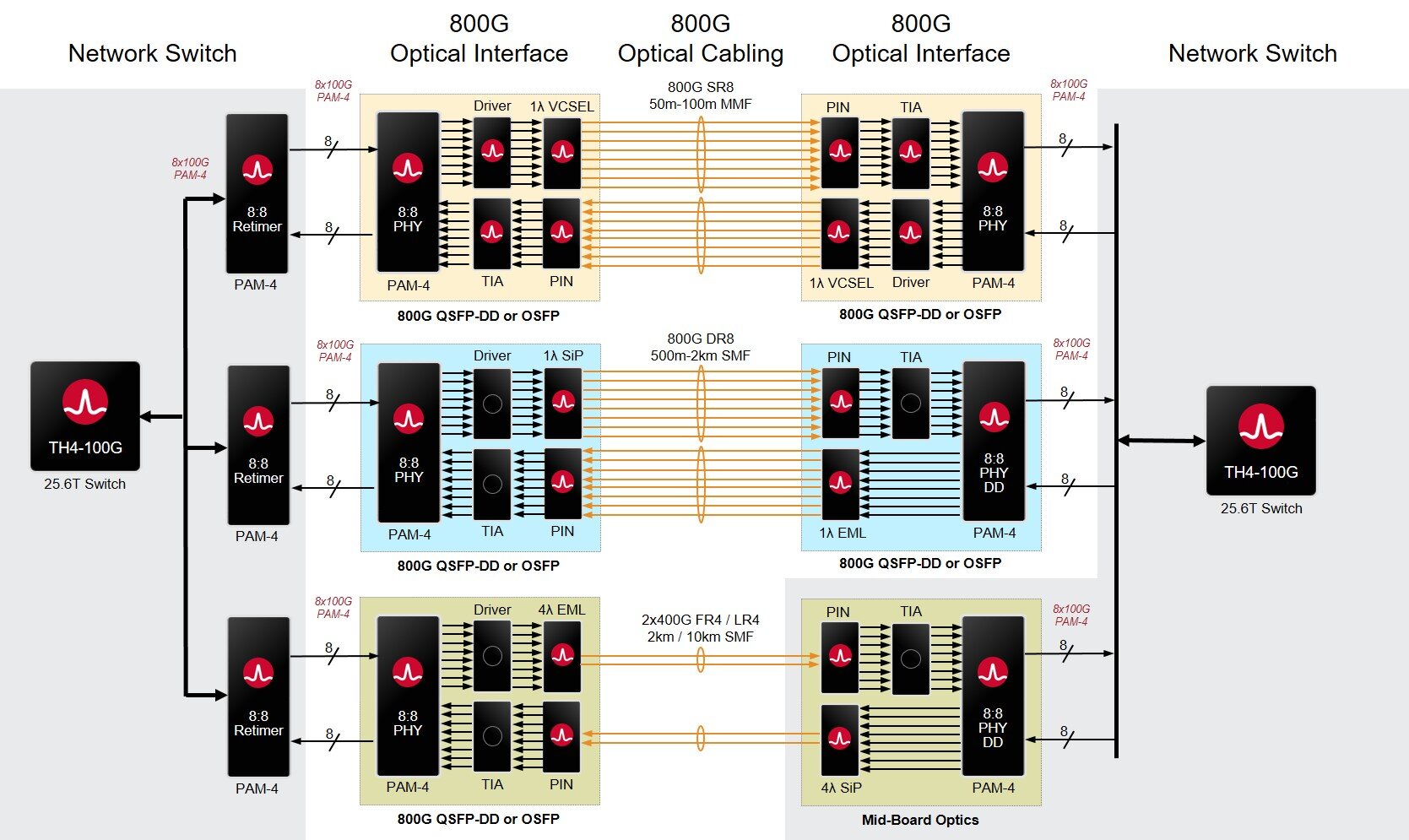
Broadcom recently announced a family of 800-gigabit physical layer (PHY) chips. The device family is the company’s first 800-gigabit ICs with 100-gigabit input-output (I/O) interfaces.
Source: Broadcom
Moving from 50-gigabit to 100-gigabit-based I/O enables a new generation of 800-gigabit modules aligned with the latest switch chips.
“With the switch chip having 100-gigabit I/Os, PHYs are needed with the same interfaces,” says Machhi Khushrow, senior director of marketing, physical layer products division at Broadcom.
Broadcom’s latest 25.6 terabit-per-second (Tbps) Tomahawk 4 switch chip using 100-gigabit I/O was revealed at the same time.
800-gigabit PHY devices
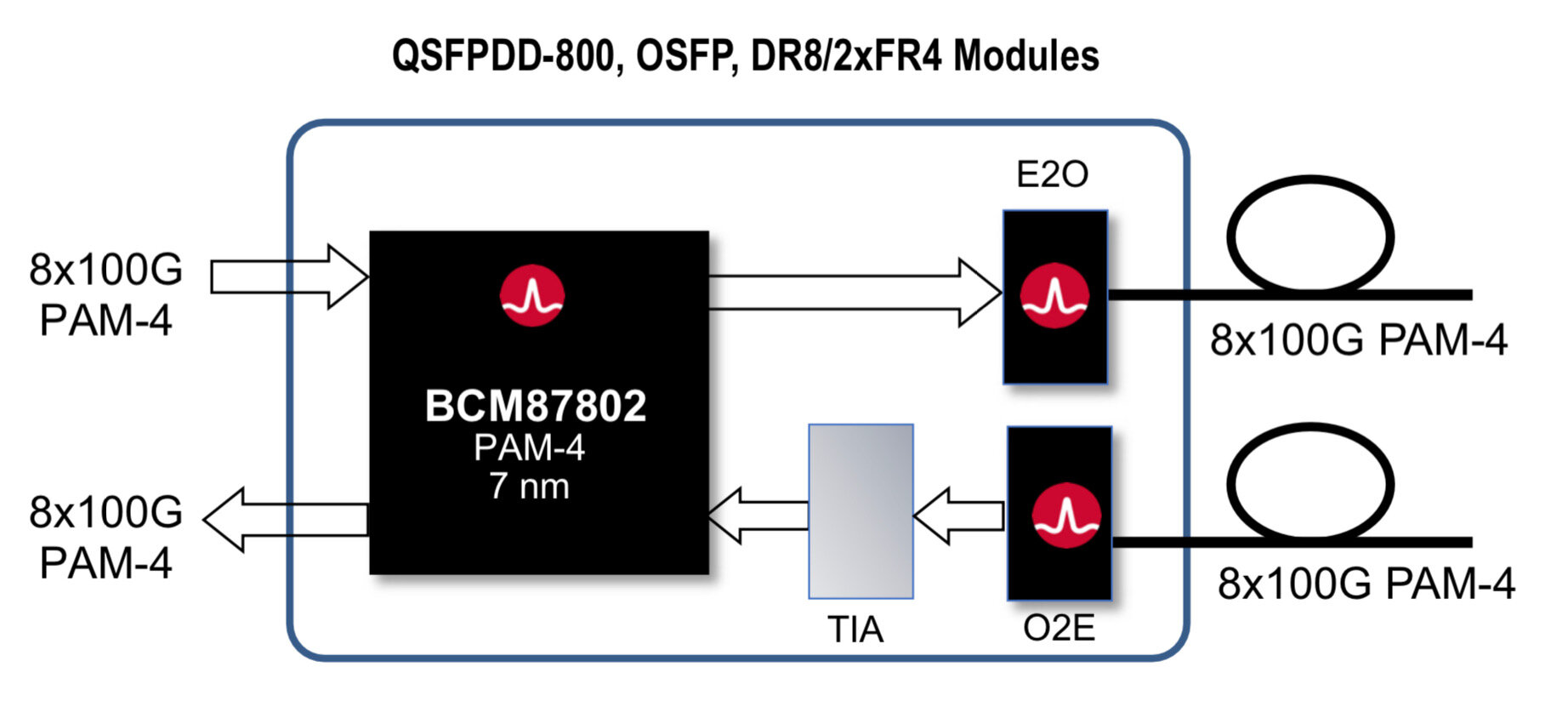
The portfolio comprises three 800-gigabit PHY ICs. All operate at a symbol rate of 53 gigabaud, use 4-level pulse amplitude modulation (PAM-4) and are implemented in a 7nm CMOS process.
Two devices are optical PHYs: the BCM87800 and the BCM87802. These ICs are used within 800-gigabit optical modules such as the QSFP-DD800 and the OSFP form factors. The difference between the two chips is that the BCM87802 includes an integrated driver.
The third PHY - the BCM87360 - is a retimer IC used on line cards. Whether the chip is needed depends on the line card design and signal-integrity requirements; for example, whether the line card is used within a pizza box or part of a chassis-based platform.
Source: Broadcom
“If it is a higher-density card that is relatively small, it may only need 15 per cent of the ports with retimers,” says Khushrow. “If the line card is larger, where things fan out to longer traces, retimers may be needed for all the ports.”
All three 800-gigabit PHYs have eight 100-gigabit transmit and eight receive channels (8:8, as shown in the top diagram).
Applications
The optical devices support several 800-gigabit module designs that use either silicon photonics, directly modulated lasers (DMLs) or externally-modulated lasers (EMLs).
The 800-gigabit PHYs support the DR8 module (8 single-mode fibres, 500m reach), two 400-gigabit DR4 (4 single-mode fibres, 500m) or two FR4 in a module (each 4 wavelengths on a single-mode fibre, 2km) as well as the SR8, a parallel VCSEL-based design with a reach of 100m over parallel multi-mode fibre.
Timescales
Given the availability of these PHYs and that 800-gigabit modules will soon appear, will the development diminish the 400-gigabit market opportinity?
“This is independent of 400-gigabit [module] deployments,” says Khushrow.
The hyperscalers are deploying different architectures. There are hyperscalers that are only now transitioning to 200-gigabit modules while others are transitioning to 400- gigabit. They will all transition to 800 gigabit, he says: “How and when they transition are all at different points.”
Some of the hyperscalers deploying 400-gigabit modules are looking at 800 gigabit, and their deployment plans are maybe two to three years out. “We don’t expect 800 gigabit to cannibalise 400 gigabit, at least not in the near term,” he says.
Broadcom says 800-gigabit modules to ship in the second half of this year. “It all depends on how the switch infrastructure, line cards and optics become available,” says Khushrow.
Next developments
The landscape for high-speed networking in the data centre is changing and optics is moving closer to the switch chip, whether it is on-board optics or co-packaged optics.
“People are looking at both options,” says Khushrow.”It depends on the architecture of the data centre whether they use on-board optics or co-packaged optics.”
Meanwhile, the OIF is working on a 200-gigabit electrical interface standard.
Co-packaged optics is challenging and the technology has its own issues whereas optical transceivers are easier to use and deploy, says Khushrow.
Current industry thinking is that some form of co-packaged optics will be used with the adevnt of next-generation 51.2-terabit switch chips. But even with such capacity switches, pluggables will continue to be used, he says.
There will still be a need for PHYs, whether for pluggables, co-packaged designs or on the linecard.
“We will continue to provide those on our roadmap,” says Khushrow. “It is just a matter of what the form factor will be, whether it will be a packaged part or a die part.”

Rebooting telecom innovation
Last summer several individuals, including representatives from Telefonica and Deutsche Telekom, published a White Paper on the need to boost innovation in the telecom industry.

Don Clarke
Six months and many conversations later, the group published its second paper, this time focussing on the communications service providers (CSPs), vendors and the investor community.
The paper, entitled Developing a Code of Conduct Framework for the Telecom Ecosystem, highlights four areas to spur innovation: Funding, Innovation Processes, Competition and Procurement.
The code-of-conduct paper offers guidelines as to how CSPs can work with vendors, especially small and medium-sized ones that lack the resources of the larger established vendors.
Innovation
The group’s White Paper argues that, in an era of accelerating and disruptive change, the CSPs are proving to be an impediment.
The CSPs’ networking infrastructure has its own inertia; networks are complex, vast, and have long-investment cycles, measured in years. Operators also need a solid business case before undertaking expensive network upgrades.
Meanwhile, the return on investment for vendors bringing new products to market is lengthy, making it harder to justify product development and limiting the risk vendors are willing to take.
Accordingly, diminished innovation is costly, not just for the CSPs but for the industries dependent on their connectivity services. Practices must change if the CSPs are to boost innovation.
This is what the group’s latest paper tackles: it pinpoints areas that must be improved if CSPs are to attract smaller players and startup that can inject much-needed innovation.
“We have initiated a conversation in the industry that hasn’t been had before,” says Don Clarke, formerly of BT and CableLabs and co-author of the two papers.
The conversation Clarke refers to is how to solve the issues of deploying technology that has nothing to do with the technology itself.
These barriers are caused by issues of organisations and processes, what Clarke calls ‘the telco culture’.
Issues addressed
The Code of Conduct paper lists practical steps for each of the four categories. “Each one on its own isn’t going to solve the problem,” says Clarke.
Under Funding, the paper considers how the telecom industry can become more appealing for investors and how capital can be injected to help smaller vendors and start-ups.
“If venture capitalists are not willing to invest in start-ups in our industry because it takes too long before their stuff gets into the network, or telcos don’t want to buy from them because they are too small, what do we do about the funding problem?” says Clarke.
He also highlights telecom’s lack of high-profile entrepreneurs, the equivalent of an Elon Musk or a Jeff Bezos. “There is no supernova that is pulling people into our industry; the industry is moribund,” says Clarke.
One idea the paper promotes is for the CSPs to set up a fund to help start-ups. Another refers to actions to attract investors to the telecom industry.
Governments can also play a role in aiding Competition, the second issue addressed.
“Governments might give tax breaks to smaller companies,” says Clarke. The group is in discussion with the UK Government’s Steering Committee on Telecoms.
One issue for Innovation Processes, says Clarke, is that the operations departments of the CSPs have so much to deal with daily that they have little time for anything new: “How does innovation get consumed by telecom companies when operations is so reluctant to take on new things?”
Suggestions include highlighting innovative new technology requirements in Request For Information (RFI) and Request for Proposal (RFP) documents and limiting the time it takes for new technology to get to the lab (6 months) and field trials (18 months).
Procurement, the fourth and final category, must be streamlined since the demands exclude smaller companies from getting a foothold. For example, CSPs could pay software licences up-front and not when the code is finally used.
“We are talking about procurement processes that are too onerous; it doesn’t matter what the technology is, the procurement process is broken,” says Clarke.
Next steps
The group aims to expand its influence by adding individuals that will help drive these threads in parallel. One person that has joined the group and that contributed to the second paper is Andrew Coward, the CEO of Lumina Networks, a software-defined networking start-up that folded in August 2020 yet was working with AT&T and Verizon.
The group will also meet strategic staff at CSPs. “We already know they are aware of our work,” he says.
What gives the group confidence its initiative will spur innovation?
Telecoms must retain control of its destiny, says Clarke eventually; it is so fundamentally important, to countries and the world.
“Telecoms must continue to evolve; it can’t afford to decay with a stagnant infrastructure,” he says. However, such evolution is threatened because of diminished innovation.
“This initiative is about figuring out how to reboot innovation in the industry,” says Clarke. “I don’t know which of these areas is the most important; maybe all have a role to play as all influence the culture.”
The output of innovation in the telecoms industry is a Request For Proposal (RFP), he says, an order for a capability or something being bought from the industry.
If CSPs buy only from large vendors, they become less motivated to innovate. Equally, the vendors depend on the CSPs moving fast enough. “If there is no buying, there is no investment,” he says.
Telecoms is also experiencing disruption. The global pandemic has if anything made telecom even more important. There are also geopolitical issues such as Brexit, and the trade war between the US and China.
“What we are experiencing and the disruption will force the changes that need to be done,” says Clarke.
A successful outcome of the group’s work will be if two or three of the initiatives highlighted in the Code of Conduct document are embraced by several CSPs, says Clarke.
Further Information:
The Telecom Ecosystem Group, click here

Books 2020: Part III
Gazettabyte asked industry figures to pick their reads during last year. In the final post - Part III - Alexis Bjorlin and Don Clarke choose theirs.

Alexis Bjorlin, Senior Vice President and General Manager, Optical Systems Division, Broadcom
In 1996, during my first semester as a graduate student in Santa Barbara, I both lost myself and found companionship in Gabriel Garcia Marquez’s epic saga, One Hundred Years of Solitude. This work of magical realism has become my comparand against which all other works of fiction are measured.
In 2020, I revisited the town of Macondo and the Buendia family, and discovered a whole new world, offering striking comparisons to our current history, replete with juxtaposed conservative and progressive narratives, luring me into a suspension of disbelief to enjoy the richness of the family and their century-long story unfolding.
I was similarly swept away by Isabel Allende’s recent work, A Long Petal of the Sea. It is essentially a love story – between man and woman, between oneself and one’s cultural identity -- that spans the Spanish Civil War through the rise and fall of Pinochet’s regime in Chile.
There is a prevailing sense of displacement that permeates the book that is accessible to all through the global pandemic experience. While a work of fiction, it is threaded with historical facts - from Pablo Neruda chartering ships to bring Spanish refugees to Chile, to the coup d’etat that overthrew Chile’s first democratically elected President, Salvador Allende - that gave me opportunities to reflect on the fragility of our own democracy.
The most beautiful piece of fiction I read was On Earth We’re Briefly Gorgeous, by Ocean Vuong. Set in modern-day Connecticut (close to my childhood home), it is the story of a Vietnamese immigrant family, written as a letter from son “little dog” to his illiterate mother. In it, some sentences vibrate with raw humanity - not for the faint of heart.
The non-fiction I read in 2020 included Good Economics for Hard Times: Better Answers to Our Biggest Problems, by Abhijit Banerjee and Esther Duflo. This team from MIT brings a thoughtful perspective to pressing macro-economic issues such as inequality, immigration, technology disruption, universal basic income, and the environment.
Immensely readable, Good Economics for Hard Times examines economic theory and provides empirical evidence in the developing and developed worlds, debunking some commonly held beliefs. They call for active dialogue and intelligent intervention in an increasingly polarised world. “Economics,” they maintain, “is too important to be left to economists.”
Finally, I recommend Sapiens, A Brief History of Humankind, by Yuval Noah Harari. This book had been collecting dust on my shelf; it took the global pandemic and threat to our comfortable existence for me to crack it open. It is thoroughly enjoyable - a sweeping history of homo sapiens, how we’ve evolved, all the way to the future of genetic engineering and the potential end of the human race itself.
What made this book good, as with any I’ve read and recommended, was its ability to pique my curiosity and spark lively conversation and debate at the dinner table.
Whereas many have opined that Harari is overly pessimistic about the future, Sapiens gives ample thought-provoking opportunities to consider the accelerating pace of change and our ability as individuals and collectively to impact the future.
Don Clarke, consultant, formerly at BT and CableLabs
I haven’t been a prolific reader since childhood when I would bury myself in science fiction and history books to get away from the daily insecurities of a chaotic childhood.
I grew up in England, which has engendered a moderate political outlook and a keen sense of fair play. I am now living in the United States, bewildered by the tumult of the past year and trying to make sense of the xenophobia and disintegration of societal and political norms here.
It is profoundly depressing to observe what appears to be the re-emergence of fascism around the globe and, over the past year, I have read more books than in the previous forty in an attempt to make sense of it all. Of all of the books listed below, the one that made the strongest impression was The Choice: Escaping the Past and Embracing the Possible, by Dr Edith Eva Eger.
The Choice is a powerful first-hand account of the Holocaust. It begins with a vivid description of the author’s happy family life as a Jewish girl growing up in Hungary. She describes her love of dancing, her oldest sister’s exceptional talent as a musician, the sometimes fraught relationship between her hard-working parents, and her first teenage love - a tragically poignant aspect that propagates through the book.
Her style of writing puts you right there in the room with her as the brutal events unfold which will change the trajectory of her life forever.
The description of the eviction of the family from their home when she was 16 is heartbreaking, and everything that follows is an unspeakable tragedy to which no words I would write could do justice. Her descriptive narrative is vivid and at times very hard to take. Upon arrival at Auschwitz, she describes the moment, in Josef Mengele’s selection line, when her mother was sent to the gas chamber. I was reading a chapter from the book aloud to my wife each evening and I would often break down in tears.
We have all asked at various times during our lives, how could human beings inflict such suffering on others, and not feel any empathy or remorse? But throughout the book, Dr Eger emphasises the importance of hope, and that it is a choice to hold onto hope, or to allow what is happening to you to consume and destroy you. She saw, first-hand, that all who gave up, died.
Eva and her sister Magda survived Auschwitz and the death march that followed - which she describes in horrifying detail, and were ultimately pulled barely alive from a pile of bodies by American soldiers.
In the book, Dr Eger describes her journey after World War II to realise her dream to become a clinical psychologist in the United States, helping others suffering from the effects of trauma.
In the latter pages of the book, she describes several interesting case studies. Now, well into her 90s, she is still practising and giving talks, which she always concludes with a high kick to remind herself of her thwarted career as a ballerina, and to prove to her audience that hope is alive and kicking.
The book does not answer the question of why human beings do what they do, but it is a powerful reminder that we must all play our part to prevent it from happening again.
Some of the other books I recommend from my literary journey over the past year:
Disloyal: A Memoir: The True Story of the Former Personal Attorney To President Donald Trump by Michael Cohen, which provides insight on how Trump ran his businesses before being elected, and how Trump learned how to get what he wanted by observing the techniques used by the mob bosses in his New York circle.
Rage, by acclaimed journalist Bob Woodward, which, through numerous recorded interviews with Trump and other key figures in the administration, provides practical insight on Trump’s approach to the US Presidency, including the mismanagement of the pandemic.
Too Much and Never Enough: How My Family Created the World’s Most Dangerous Man, by Donald Trump’s niece, Mary Trump, a clinical psychologist, provides deep insight on Trump’s family and the toxic relationship dynamics that shaped his personality.
Lastly, My Friend the Enemy: An English Boy in Nazi Germany, by Paul Briscoe, the British born father of a former colleague of mine who, by a curious quirk of fate, was brought up in Hitler’s Germany.
His description as a small boy and proud member of the Hitler Youth of his participation in the destruction of a synagogue and witnessing attacks on Jews by people who were previously their friends and neighbours is profoundly disturbing.

The compound complexity of co-packaged optics
Large-scale data centres consume huge amounts of power; one building on a data centre campus can consume 100MW. But there is a limit as to the overall power that can be supplied.

Jeff Hutchins
The challenge facing data centre operators is that networking, used to link the equipment inside the data centre, is consuming more and more of the power.
That means less power remains for the servers; the computing that does the revenue-generating work.
This is forcing a rethink regarding networking and explains the growing interest in co-packaged optics, a technique that effectively adds optical input-output (I/O) to a chip.
Two industry organisations - the OIF and The Consortium for On-Board Optics (COBO) - have each started work to identify the requirements needed for co-packaged optics adoption.
“We are seeing this activity because co-packaged optics is hard and requires prework to figure out how and when it is going to happen, and how the ecosystem changes,” says Nathan Tracy, TE Connectivity and the OIF’s vice president of marketing.
All change
Semiconductors and optics have always been separate domains but with a co-packaged design, silicon is suddenly only a handful of millimetres away from the optics, says Tracy: “It’s a very different environment.”
Hot chips sit next to the optics, so thermal characteristics must be shared and the cooling needs worked out. The electrical interface linking the optics to the chip will need to be optimised while there are new challenges such as how faults are dealt with.
“All these things come together and it changes what is done in the industry,” says Jeff Hutchins, Ranovus and OIF Physical and Link Layer (PLL) Working Group – Co-Packaging Vice-Chair.
“To be fair, there are companies that are not totally on-board with co-packaging,” says Hutchins. “But if you think about what is driving it, as you go to higher and higher electrical rates to connect things, you start to run more power and it is just more difficult to get a signal from Point A to Point B.”
For next-generation designs, companies are also considering ‘fly-over’ cables as well as the intermediate step of on-board optics, moving optics from the front panel onto the line card to be closer to the ASIC.
“But a good part of the industry thinks that, if you look forward, the only way to get there is co-packaging,” says Hutchins.
Using co-packaged optics will also impact the supply chain. The switch and pluggable modules are typically bought separately whereas a co-packaged design integrates the two. “Economically, it changes the way the industry works,” says Hutchins.
OIF and COBO

Nathan Tracy
Hutchins, who is also a board member of COBO, says the co-packaging work of the two organisations will be complementary.
Co-packaged optics resides deep on the line card and fibre must connect the package to the system’s front panel. In turn, an external laser is commonly used as the light source for the optics. Such a laser is linked to the package using fibre.
“What COBO is doing is focussing on the optical connectivity part of this solution; the stuff outside the co-packaged assembly,” says Hutchins. “The OIF is concentrating on what the co-package assembly is, what goes inside, and what agreements can be made for interoperability for the whole assembly.”
The membership of the two organisations also differs: the OIF members include hyperscalers as well as optical and switch companies. “We have a good cross-section of the membership of this ecosystem,” says Tracy. COBO’s membership includes companies with connector and materials expertise.
Framework project
The OIF Framework Project will first study the applications where co-packaged optics will be used, identifying commonalities. It will then address the technology to determine what interoperability agreements are needed.
Applications for co-packaged optics besides Ethernet switches include machine learning and disaggregation. A disaggregated design refers to separating the chips found on a server motherboard - general processors (CPUs), graphics processor units (GPUs) and memory - into separate pools. A workload can then access the pools and configure the hardware elements it needs.
For each application, issues such as density, power, latency, and wavelength-count-per-fibre will be explored. “These must be understood as they differ as you go across the applications,” says Hutchins.
The OIF will identify what interoperability agreements to pursue and what should remain open for now before kicking-off specific Implementation Agreements.
Hutchins stresses that are many aspects that can be standardised such as the mechanical design, environmental issues, power, electrical interfaces and reliability. “That is enough work to keep the whole group busy for quite a while,” he says
As an example, such work could lead to a common socket design that would allow different optical specifications and reliability requirements, says Hutchins.
The OIF expects to complete the first two stages within the coming year.
“People are ready to go but they need to see the whole picture,” says Hutchins.
Roadmap
The OIF expects a gradual introduction of co-packaged Ethernet switches in the data centre with the technology spanning several generations.
Demonstrations could start with 25.6-terabit switches emerging now whereas many think the next-generation 51.2-terabit platforms will be the place to do initial demonstrations and small-scale deployments. After that, 100-terabit switches will likely be the sweet spot for co-packaged optics. And once 200-terabit switches appear, co-packaged optics will be a necessity.
This may be a wide range of entry points, says Hutchins, but technology is being put together in a new way.
“The industry has to learn how to make this cost-effectively and achieve good yields,” says Hutchins. “There has to be a starting point somewhere but where the intercept point is, I don’t know.”
“Pluggables have served the market really well; they are flexible and [optical module] innovation continues,” adds Tracy. “The methodology is working so the question is when does it no longer suit the market.”
Tracy does not rule out pluggables being used for 100-terabit switches but inevitably it will be much harder to satisfy that requirement. “That is when co-packaged optics starts to become compelling,” says Tracy.

100-gigabaud optics usher in the era of terabit transmissions
Telecom operators are in a continual battle to improve the economics of their optical transport networks to keep pace with the relentless growth of IP traffic.
One approach is to increase the symbol rate used for optical transmission. By operating at a higher baud rate, more data can be carried on an optical wavelength.

Ferris Lipscomb
Alternatively, a higher baud rate allows a simpler modulation scheme to be used, sending the same amount of data over greater distances. That is because the fewer constellation points of the simpler modulation scheme help data recovery at the receiver.
NeoPhotonics has detailed two optical components - a coherent driver-modulator and an intradyne coherent receiver (micro-ICR) - that operate at over 100 gigabaud (GBd). The symbol rate suits 800-gigabit systems and can enable one-terabit transmissions.
NeoPhotonics’ coherent devices were announced to coincide with the ECOC 2020 show.
Class 60 components
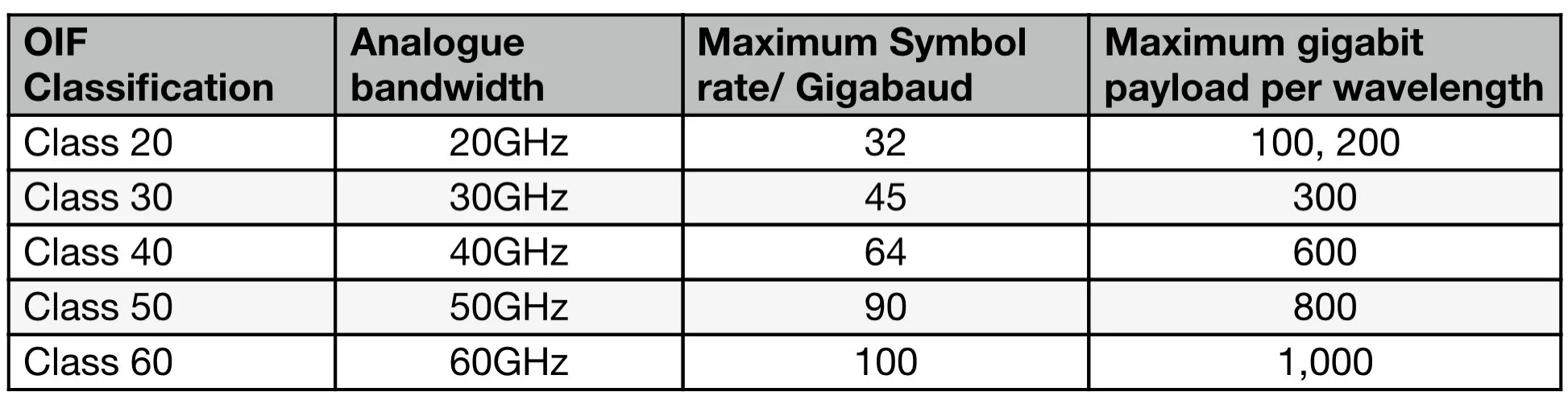
The OIF has a classification scheme for coherent optical components based on their analogue bandwidth performance.
A Class 20 receiver, for example, has a 3-decibel (dB) bandwidth of 20GHz. NeoPhotonics announced at the OFC 2019 show Class 50 devices with a 50GHz 3dB bandwidth. The Class 50 modulator and receiver devices are now deployed in 800-gigabit coherent systems.
NeoPhotonics stresses the classes are not the only possible operating points. “It is possible to use baud rates in between these standard numbers,” says Ferris Lipscomb, vice president of marketing at NeoPhotonics. “These classes are shorthand for a range of possible baud rates.”
“To get to 96 gigabaud, you have to be a little bit above 50GHz, typically a 55GHz 3dB bandwidth,” says Lipscomb. “With Class 60, you can go to 100 gigabaud and approach a terabit.”
It is unclear whether one-terabit coherent transponders will be widely used. Instead, Class 60 devices will likely be the mainstay for transmissions up to 800 gigabits, he says.
Source: NeoPhotonics, Gazettabyte
Design improvements
Several aspects of the components are enhanced to achieve Class-60 performance.
At the receiver, the photodetector’s bandwidth needs to be enhanced, as does that of the trans-impedance amplifier (TIA) used to boost the received signals before digitisation. In turn, the modulator driver must also be able to operate at a higher symbol rate.
“This is mainly analogue circuit design,” says Lipscomb. “You have to have a detector that will respond at those speeds so that means it can’t be a very big area; you can’t have much capacitance in the device.”
Similarly, the silicon germanium drivers and TIAs, to work at those speeds, must also keep the capacitance down given that the 3dB bandwidth is inversely proportional to the capacitance.
Systems vendors Ciena, Infinera, and Huawei all have platforms supporting 800-gigabit wavelengths while Nokia‘s latest PSE-Vs coherent digital signal processor (DSP) supports up to 600 gigabit-per-wavelength.
Next-generation symbol rate
The next jump in symbol rate will be in the 120+ gigabaud range, enabling 1.2-terabit transmissions.
“As you push the baud rate higher, you have to increase the channel spacing,” says Lipscomb. “Channels can’t be arbitrary if you want to have any backward compatibility.”
A 50GHz channel is used for 100- and 200-gigabit transmissions at 32GBd. Doubling the symbol rate to 64GBd requires a 75GHz channel while a 100GBd Class 60 design occupies a 100GHZ channel. For 128GBd, a 150GHz channel will be needed. “For 1.2 terabit, this spacing matches well with 75GHz channels,” says Lipscomb.
It remains unclear when 128GBd systems will be trialled but Lipscomb expects it will be 2022, with deployments in 2023.
Upping the baud rate enhances the reach and reduces channel count but it does not improve spectral efficiency. “You don’t start getting more data down a fibre,” says Lipscomb.
To boost transport capacity, a fibre’s C-band can be extended to span 6THz, dubbed the C++ band, adding up to 50 per cent more capacity. The L-band can also be used and that too can be extended. But two sets of optics and optical amplification are required when the C and L bands are used.
400ZR and OpenZR+
Lipscomb says the first 400ZR coherent pluggable deployments that link data centres up to 120km apart will start next year. The OIF 400ZR coherent standard is implemented using QSFP-DD or OSFP client-side pluggable modules.
“There is also an effort to standardise around OpenZR+ that has a little bit more robust definition and that may be 2022 before it is deployed,” says Lipscomb.
NeoPhotonics is a contributor member to the OpenZR+ industry initiative that extends optical performance beyond 400ZR’s 120km.
800-gigabit coherent pluggable
The OIF has just announced it is developing the next-generation of ZR optics, an 800-gigabit coherent line interface supporting links up to 120km. The 800-gigabit specification will also support unamplified fixed-wavelength links 2-10km apart.
“This [800ZR standard] will use between Class 50 and Class 60 optics and a 5nm CMOS digital signal processor,” says Lipscomb.
NeoPhotonics’ Class 60 coherent modulator and receiver components are indium phosphide-based. For the future 800-gigabit coherent pluggable, a silicon photonics coherent optical subassembly (COSA) integrating the modulator with the receiver is required.
NeoPhotonics has published work showing its silicon photonics operating at around 90GBd required for 800-gigabit coherent pluggables.
“This is a couple of years out, requiring another generation of DSP and another generation of optics,” says Lipscomb.

Ayar Labs’ TeraPhy chiplet nears volume production
Moving data between processing nodes - whether servers in a data centre or specialised computing nodes used for supercomputing and artificial intelligence (AI) - is becoming a performance bottleneck.
Workloads continue to grow yet networking isn’t keeping pace with processing hardware, resulting in the inefficient use of costly hardware.
Networking also accounts for an increasing proportion of the overall power consumed by such computing systems.
These trends explain the increasing interest in placing optics alongside chips and co-packaging the two to boost input-output (I/O) capacity and reach.
At the ECOC 2020 exhibition and conference held virtually, start-up Ayar Labs showcased its first working TeraPHY, an optical I/O chiplet, manufactured using GlobalFoundries’ 45nm silicon-photonics process.
GlobalFoundries is a strategic investor in Ayar Labs and has been supplying Ayar Labs with TeraPHY chips made using its existing 45nm silicon-on-insulator process for radio frequency (RF) designs.
The foundry’s new 300mm wafer 45nm silicon-photonics process follows joint work with Ayar Labs, including the development of the process design kit (PDK) and standard cells.
“This is a process that mixes optics and electronics,” says Hugo Saleh, vice president of marketing and business development at Ayar Labs (pictured). “We build a monolithic die that has all the logic to control the optics, as well as the optics,” he says.
The latest TeraPHY design is an important milestone for Ayar Labs as it looks to become a volume supplier. “None of the semiconductor manufacturers would consider integrating a solution into their package if it wasn’t produced on a qualified high-volume manufacturing process,” says Saleh.
Applications
The TeraPHY chiplet can be co-packaged with such devices as Ethernet switch chips, general-purpose processors (CPUs), graphics processing units (GPUs), AI processors, and field-programmable gate arrays (FPGAs).
Ayar Labs says it is engaged in several efforts to add optics to Ethernet switch chips, the application most associated with co-packaged optics, but its focus is AI, high-performance computing and aerospace applications.
Last year, Intel and Ayar Labs detailed a Stratix 10 FPGA co-packaged with two TeraPHYs for a phased-array radar design as part of a DARPA PIPES and the Electronics Resurgence Initiative backed by the US government.
Adding optical I/O chiplets to FPGAs suits several aerospace applications including avionics, satellite and electronic warfare.
TeraPHY chiplet
The ECOC-showcased TeraPHY uses eight transmitter-receiver pairs, each pair supporting eight channels operating at either 16, 25 or 32 gigabit-per-second (Gbps), to achieve an optical I/O of up to 2.048 terabits.
The chiplet can use either a serial electrical interface or Intel’s Advanced Interface Bus (AIB), a wide-bus design that uses slower 2Gbps channels. The latest TeraPHY uses a 32Gbps non-return-to-zero (NRZ) serial interface and Saleh says the company is working on a 56Gbps version.
The company has also demonstrated 4-level pulse-amplitude modulation (PAM-4) technology but many applications require the lowest latency links possible.
“PAM-4 gives you a higher data rate but it comes with the tax of forward-error correction,” says Saleh. With PAM-4 and forward-error correction, the latency is hundreds of nanoseconds (ns), whereas the latency is 5ns using a NRZ link.
Ayar Labs’s next parallel I/O AIB-based TeraPHY design will use Intel’s AIB 1.0 specification and will use 16 cells, each having 80, 2Gbps channels, to achieve a 2.5Tbps electrical interface.
In contrast, the TeraPHY used with the Stratix 10 FPGA has 24 AIB cells, each having 20, 2Gbps channels for an overall electrical bandwidth of 960 gigabits, while its optical I/O is 2.56Tbps since 10 transmit-receive pairs are used.
The optical bandwidth is deliberately higher than the electrical bandwidth. First, not all the transmit-receive macros on the die need to be used. Second, the chiplet has a crossbar switch that allows one-to-many connections such that an electrical channel can be sent out on more than one optical interface and vice versa.
Architectures
Saleh points to several recent announcements that highlight the changes taking place in the industry that are driving new architectural developments.
He cites AMD acquiring programmable logic player, Xilinx; how Apple instances are now being hosted in Amazon Web Services’ (AWS) cloud to aid developers and Apple's processors, and how AWS and Microsoft are developing their own processors.
“Processors can now be built by companies using TSMC’s leading process technology using the ARM and RISC-V processor ecosystems,” he says. “AWS and Microsoft can target their codebase to whatever processor they want, including one developed by themselves.”
Saleh notes that Ethernet remains a key networking technology in the data centre and will continue to evolve but certain developments do need something else.
Applications such as AI and high-performance computing would benefit from a disaggregated design whereby CPUs, GPUs, AI devices and memory are separated and pooled. An application can then select the hardware it needs for the relevant pools to create the exact architecture it needs.
“Some of these new applications and processors that are popping up, there is a lot of benefit in a one-to-one and one-to-many connections,” he says. “The Achilles heel has always been how you disaggregate the memory because of latency and power concerns. Co-packaged optics with the host ASIC is the only way to do that.”
It will also be the only way such disaggregated designs will work given that far greater connectivity - estimated to be up to 100x that of existing systems - will be needed.
Expansion
Ayar Labs announced in November that it had raised $35 million in the second round of funding which, it says, was oversubscribed. This adds to its previous funding of $25 million.
The latest round includes four new investors and will help the start-up expand and address new markets.
One investor is a UK firm, Downing, that will connect Ayar Labs to European R&D and product opportunities. Saleh mentions the European Processor Initiative (EPI) that is designing a family of low-power European processors for extreme-scale computing. “Working with Downing, we are getting introduced into some of these initiatives including EPI and having conversations with the principals,” he says.
In turn, SGInnovate, a venture capitalist funded by the Singapore government, will help expand Ayar Labs’ activities in Asia. The two other investors are Castor Ventures and Applied Ventures, the investment arm of Applied Materials, the supplier of chip fabrication plant equipment.
“Applied Materials want to partner with us to develop the methodologies and tools to bring the technology to market,” says Saleh.
Meanwhile, Ayar Labs continues to grow, with a staff count approaching 100.

Books 2020: Part II
Gazettabyte asks industry figures to pick their reads of the year. In Part II, Maxim Kuschnerov, Professor Roel Baets and Yves LeMaître share their favourites.

Maxim Kuschnerov, Director of the Optical & Quantum Communications Laboratory, Huawei
Beyond Weird: Why Everything You Thought You Knew about Physic is Different by Philip Ball is one of my favourite books about physics. It offers an intuitive and math-free view on the beauty of quantum mechanics, which, in its approach, is almost philosophical.
As the author states, one of the problems that people have with the inherent unpredictability of quantum effects is the lack of analogies from real life that would make quantum phenomena relatable.
Although I didn’t last four weeks on my quantum course at university due to the mathematics, I find my world full of quantum analogies. As planners, we always need to think about a running project in terms of the possible outcomes mitigating future risks until the deliverables materialise. Also, it’s clear to every marketing person that a product’s success is partly due to its features and in part (and maybe even more so) due to customer perception. So, in that sense, one should be puzzled that observation changes the state of a quantum system .. or the next smartphone’s success.
John Bolton’s The Room Where It Happened: A White House Memoir provides an open view into the daily work of President Donald Trump and his security advisors. It’s surprising that seemingly solid and experienced advisors like Bolton still act like it’s the 1980s and, en passant, suggest to bomb North Korea. While Bolton dedicates himself to criticising a still-sitting president, he is a relic and one should be glad that he is no longer in politics.
After binge-watching The Last Dance, the 10-part Michael Jordon documentary during the first lockdown, I ordered the legendary book from the 1990s, Jordan Rules, which described the tough, win-at-all-costs persona of a then young Michael Jordan.
Having discovered that the only copy of this book that I found and ordered on Amazon was in Polish (yikes!), I settled for the next best historical basketball account of how Larry and Earvin “Magic” Johnson made basketball into primetime television in the 1980s.
Larry Bird and Magic Johnson’s book When the Game Was Ours is a joint biography by two formerly bitter rivals. It provide a compassionate view of their relationship, which saw Magic call Larry to inform him about being HIV positive before telling the press, a reflection of the respect the two competitors held for each other.
Chris Voss’s Never Split the Difference: Negotiating As if Your Life Depended On It is a true highlight for all the occasions in life where you need to make a deal. This is a highly psychological book, what is required is to develop a deep sense of empathy for the other party as a foundation for any agreement. And if the author can negotiate with terrorists and bring the ransom down by two orders of magnitude, this book should prepare you well for your next salary review.
Professor Roel Baets, director of the multidisciplinary Centre for Nano- and Biophotonics at Ghent University, Belgium.
Two books, both non-fiction, impressed me a lot in 2020. The first is Humankind: A Hopeful History by Rutger Bregman. I read both in Dutch but one English translation exists and the other is coming next year. Bregman’s book is thought-provoking. The second book, Bart Van Loo’s The Burgundians: The Vanished Empire is history narrated in a sublime way.
Yves LeMaître, president of Rio Lasers, an Optasense business.
Well, I guess there is always a silver lining. The new working-from-home COVID world allowed me to discover more books than I had in ages, turning the daily mindless and soul-destroying commute on Highway 101 into an opportunity to learn about California and US history.
Let me start with Junipero Serra: California’s Founding Father by Steven W. Hackell. From his statue pointing an accusing finger at me on my drive to San Francisco to his name present all across California missions, streets, cities and schools, Father Serra is hard to ignore. I had heard about his critical role in the first Spanish expedition into Alta California in 1769 and establishing the Mission system but knew little beyond that.
Serra became a highly controversial figure due to his role in creating a system that fostered harsh repression of Native American cultures. Serra was canonized in 2015 and is one of the two Californians selected to represent the State in the US Capitol Statuary Hall, the other being Ronald Reagan. As part of the 2020 cultural and social debate surrounding historical figures and their roles shaping race relations, the biography by Steven Hackell could hardly be more relevant and is a must-read to get a deeper understanding of the colonisation of California by the Spanish empire and the role of Serra and his Franciscan religious order in establishing modern California.
Imperfect Union: How Jessie and John Frémont Mapped the West, Invented Celebrity, and Helped Cause the Civil War by Steve Inskeep is my next recommendation. The book is about one of the most famous men of his time; so famous that he was compared to Jesus, Christopher Columbus and George Washington. His name was John Charles Fremont and his wife, the daughter of a US senator, became major celebrities in the 1850s. Think of them as the Kardashians of the times, albeit with accomplishments like mapping the road to the Pacific and leading the US army in its conquest of California during the Mexican-American war. The book covers the fascinating life stories of Fremont and his wife that led him to be the first Republican Presidential candidate, four years before Lincoln was elected.
Another book read is Andrew Jackson: His Life and Times by H.W. Brands. What could be more relevant these days than learning about Andrew Jackson, another controversial US figure, the President pictured on the $20 bill and who made a recent comeback in the public interest as part of the 2020 US presidential election. Much has been written about Jackson but this book by H.W. Brands is an easy-to-read, one-volume biography of a man widely considered to have been the most popular US president and who remains a polarizing figure almost two hundred years later.
Lastly, there is Blood Meridian: Or the Evening Redness in the Sky by Cormac McCarthy. This is a bonus for readers who prefer fiction and want to get a sense of life in the West in the 19th century. A masterpiece by Cormac McCarthy although not one for the faint-hearted.

Books in 2020
Each year Gazettabyte asks industry figures to pick their reads of the year. Industry analysts and regular contributors Dana Cooperson and Andrew Schmitt kick off this year's highlighted books.

Dana Cooperson, independent analyst
I had difficulty concentrating enough to read during the lockdown despite having more time. Eventually, events spurred my overdue fiction/ non-fiction exploration of the underpinnings of systemic racism as well as some escapism through journeys that the pandemic made impossible.
Five of my books fit the first category: four explore the legacy of human slavery in the US and the African-American experience, while the fifth, Trevor Noah’s memoir, traces similar terrain in apartheid/ post-apartheid South Africa.
Just Mercy: A Story of Justice and Redemption by the lawyer and equal justice advocate, Bryan Stevenson, uses statistics and egregious cases of the miscarriage of justice that lead to the unequal application of capital punishment.
Stevenson intersperses the shocking case of Walter McMillian, a young, self-sufficient Black man who was wrongly accused of killing a white woman, with tales of his founding of the Montgomery, Alabama-based non-profit Equal Justice Initiative (EJI), and a procession of cases EJI litigated on behalf of poor, minority, and juvenile clients.
One wonders how Stevenson and his team could work doggedly on these cases while facing death threats and obstacles. There are few happy endings for the accused yet the book is ultimately hopeful.
The Warmth of Other Suns: The Epic Story of America's Great Migration by journalist Isabel Wilkerson is a history of the migration of six million African Americans from the agrarian Jim Crow South to the urban north and west of the country between 1915 and 1970.
The book weaves broad historical and sociological data with the bittersweet stories of three individuals who migrated to escape terrorism and lack of opportunity. It also helped me piece together historical underpinnings of today’s fight for justice, as epitomised by the Black Lives Matter movement.
If the statistics don’t move you, the stories of Ida Mae Brandon Gladney, George Swanson, and Robert Joseph Pershing Foster will. (Note: Wilkerson recently published a follow-up, Caste, which my reading buddies recommend.)
James Baldwin’s Go Tell It on the Mountain is a semi-autobiographical novel about an African-American boy growing up in 1930s Harlem. This beautifully written, structurally interesting book focusses on fourteen-year-old John, who is struggling with poverty, abuse, and religious faith; and John’s father, Gabriel, mother Elizabeth, and Aunt Florence, all of whom escaped Jim Crow and who all struggle. Baldwin writes with imagery and passion. I had not read Baldwin before.
This year I also returned to Tony Morrison, with Sula, another tale of African-American diaspora that begins in 1919 Ohio. Like Baldwin’s book, Sula deals with intergenerational trauma and features indelible characters and powerful prose. A slim book, deep in characterisation and emotional punch.
A no less passionate book, infused with its author’s gift for making people laugh, is comedian Trevor Noah’s memoir, Born a Crime: Stories From a South African Childhood.
The book’s title refers to South Africa’s Immorality Act of 1927, which made his birth by a black Xhosa mother and white Swiss father in the waning days of apartheid punishable by five years in prison.
The book details the hoops his family jumped through to avoid incarceration during apartheid and Noah’s chameleon-like abilities to navigate South Africa’s bizarre race-based caste system and a thriving black-market economy.
A polyglot, Noah’s facility with languages was key to his ability to navigate situations, some of which were life-and-death serious.
Rounding out this year’s recommendations are four excellent books that took me to different times and places.
The Awakening, published in 1899, deals with protagonist Edna Pontellier’s search for meaning and escape from the strict social customs of nineteenth-century New Orleans society.
The book, which treats adultery unapologetically, created such a backlash against author Kate Chopin that she stopped writing. My daughters, who read the book in school, tipped me off to this classic. The ending, which I won’t spoil, leaves one wondering whether this a feminist tale and the ending's meaning.
If you are looking for a diverting read, you can’t do better than something— anything— by Bill Bryson. Bryson is an Iowa-born journalist and author who ruminates on such topics as language, culture and history.
This year I read Bryson’s At Home: A Short History of Private Life which uses the Victorian parsonage where he lived in “a part of England where nothing of any great significance has happened since the Romans decamped” to anchor a room-by-room history and cultural reflection on the evolution of private life.
His writing roams across ten thousand years of history, etymology, and sociology, such as how the “hall” evolved from the most important room in a domicile to “a place to wipe feet and hang hats” and how “limelight” became associated with the theatre.
Circe by Madeline Miller is a retelling of Homer’s The Odyssey from the perspective of the titular sorceress, who is banished by Zeus to a remote island. Confusing at first, the novel is ultimately rewarding for those interested in mythology. Spoiler alert: Odysseus does not fare well in this version of the tale.
News of the World by Paulette Giles is a sweet little book "soon to be a major motion picture" starring Tom Hanks.
The book is set in the aftermath of the US Civil War in 1870s Texas. Septuagenarian war veteran, Captain Jefferson Kyle Kidd, is an honourable man who makes his living travelling to towns and charging a fee for reading newspapers from around the world. He agrees to take a young German orphan girl, who has been recaptured (and questionably “liberated”) from the Kiowa tribe that killed her parents, to her relatives 400 miles away. What is the right path for the Captain and his charge? Don’t wait for the movie to find out.
Let’s hope 2021 is a better year for all.
Andrew Schmitt, founder and Directing analyst at Cignal AI
I was told The Bitcoin Standard was the book to read to get a perspective on the technology. It is indeed a good book though heavily biased in favour of bitcoin and against the global government fiat money scheme. It keeps the politics in the background and is a good primer to understand what is supposedly happening with Bitcoin.
I re-read Dune by Frank Herbert in anticipation of the new movie after first reading it decades ago. It's a great book but requires investment, and the payoff is just entertainment. I never read the sequels after reading the first book and I don't want to now.
In American War by Omar El Akkad, a future America is torn by civil war due to climate change. The book was recommended to me; I can't recommend it myself. I'm just not into bleak disaster themes anymore. It will probably become another Netflix series.
I also re-read The Good Shepherd by C. S. Forester in anticipation of the movie that was never generally released. I read it when I was young; I don't remember why. It's well-written and now I want to look at his other works.
I ended up seeing the movie on AppleTV, which tried to capture the captain's deep thinking that the book expresses so well. But this was a battle fought in the captain's mind and you need to read the book to see it correctly.