

2020 vision
In a panel discussion at the recent Level123 Terabit Optical and Data Networking conference, Kim Roberts, senior director coherent systems at Ciena, shared his thoughts about the future of optical transmission.
Final part : Optical transmission in 2020
 "Four hundred Gigabit and one Terabit are not going to start in long-haul"
Kim Roberts, Ciena
Kim Roberts starts on a cautionary note, warning of the dangers when predicting the future. "It is always wrong," he says. But in his role as a developer of systems, he must consider what technologies are going to be useful in 2020.
The simple answer is cheap, flexible optical spectrum and coherent modems (DSP-ASICs).
Since DSP-ASICs will become cheaper and consume less power as they are implemented using the latest CMOS processes, they will migrate from their initial use in long-haul/ regional networks to the metro and even the campus. "Four hundred Gigabit and one Terabit are not going to start in long-haul," says Roberts.
Traditionally, the long-haul network has been where new technology is introduced since it is the part of the network where premium prices can first be justified. "It is not going to start there; it won't have that reach," he says. Instead 400 Gigabit-per-second (Gbps) and one Terabit wavelengths will start over medium reaches - 500-700km - once they become more economical.
One consequence is that when going distances beyond medium reach, more spectrum will be required. "You'll have to light up more fibres [for long-haul], whereas in metro-regional you can put more down one fibre," says Roberts.
The current trend of greater functionality and intelligence being encapsulated in an ASIC will continue but Roberts does not rule out a new kind of optical device delivering a useful function. "It can happen quite suddenly - optical amplifiers happened really suddenly." That said, he does not see any such candidate optical technology for now.
The trends Roberts does expect through to 2020 are as follows:
- Optical pulse shaping: Technologies such as optical regeneration and optical demultiplexing have existed in the labs. But such techniques are not spectrally efficiency and are hot, large and expensive, he says. As a result, he does not expect them to become economical for commercial products by 2020.
- Photonic Switching: Optical burst switch, optical label switching, optical packet switching, all will not prove themselves to be economical by 2020. "Optics is not the right answer in the medium term," says Roberts.
- Optical wavelength conversion, optical logic, optical CDMA and optical solitons are other technologies in Roberts' view that will not be economical by 2020.
What Roberts does identify as being useful through 2020 are:
- Low loss, high dispersion, low non-linearities fibre: "New fibres from the likes of Sumitomo and Corning allow the exploitation of coherent modems," says Roberts. "High dispersion is good, it is your friend: it helps minimise non-linearities." This was not an accepted view as recently as 2005, he says, but now it is well accepted.
- Low cost, heat and noise, high-powered optical amplifiers: "This is a fairly simple function, let's just make them better and better," he says.
- Low cost, frequency-selective switching: This refers to taking a wavelength-selective switch (WSS) and getting rid of the ITU grid; making the WSS more flexible while lowering its cost and size.
- Coherent modems: As mentioned, these will improve in efficiency in terms of bits/s/dollar as well as higher performance in terms of decibels (dBs), reach and spectral efficiency. "Polishing these [metrics]," says Roberts.
Roberts admits that his useful items listed are not exciting, radical breakthroughs: "I think we are in an interval of improving on the trends we already have until there is some breakthrough."
Part 1: The capacity limits facing optical networking
Part 2: Optical transmission's era of rapid capacity growth
Further reading on photonic switching:
Packet optical transport: Hollowing the network core

Optical transmission's era of rapid capacity growth
Kim Roberts, senior director coherent systems at Ciena, moves from theory to practice with a discussion of practical optical transmission systems supporting 100Gbps, and in future, 400 Gigabit and 1 Terabit line rates. This discussion is based on a talk Roberts gave at the Layer123's Terabit Optical and Data Networking conference held in Cannes recently.
Part 2: Commercial systems
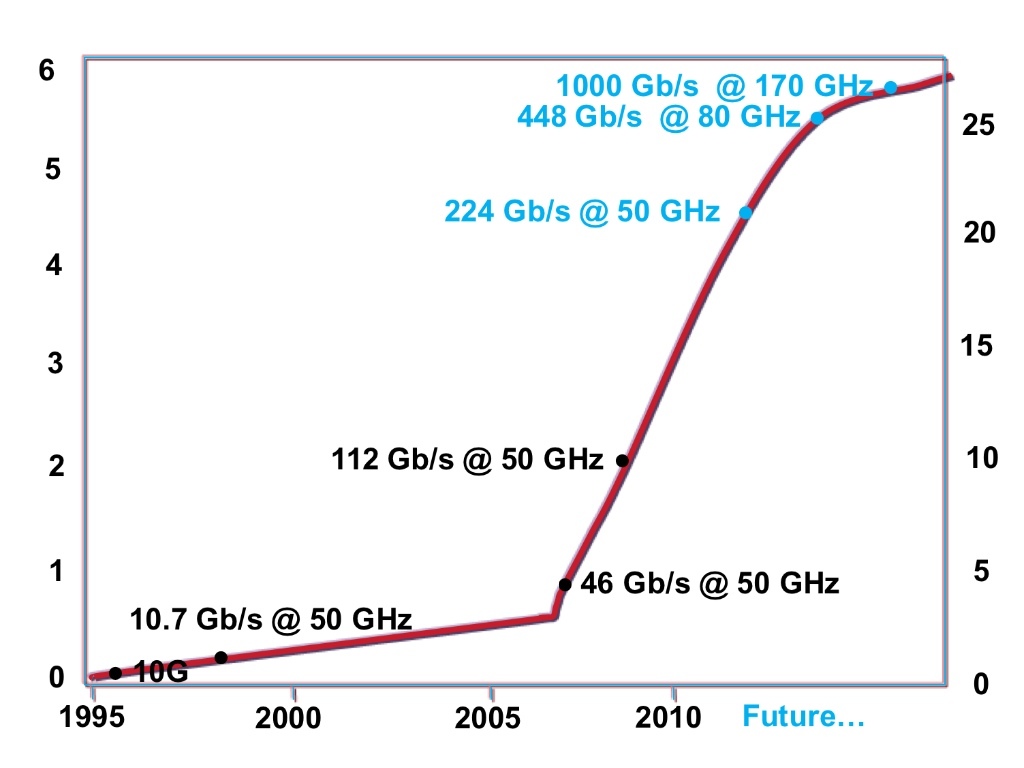
The industry is experiencing a period of rapid growth in optical transmission capacity. The years 1995 till 2006 were marked by a gradual increase in system capacity with the move to 10 Gigabit-per-second (Gbps) wavelengths. But the pace picked up with the advent of first 40Gbps direct detection and then coherent transmission, as shown by the red curve in the chart.
 Source: Ciena
The chart's left y-axis shows bits-per-second-Hertz (bits/s/Hz). The y-axis on the right is an alternative representation of capacity expressed in Terabits in the C-band. "The C-band remains, on most types of fibre, the lowest cost and the most efficient," says Roberts.
The notable increase started with 40Gbps in a 50GHz ITU channel - 46Gbps to accommodate forward error correction (FEC) - and then, in 2009, 100Gbps (112Gbps) in the same width channel. In Ciena's (Nortel's) case, 100Gbps transmission was achieved using two carriers, each carrying 56Gbps, in one 50GHz channel.
"It is going to get hard to achieve spectral efficiencies much beyond 5bits/s/Hz. Getting hard means it is going to take the industry longer"
The chart's blue labels represent future optical transmission implementations. The 224Gbps in a 50GHz channel (200Gbps data) is achieve using more advanced modulation. Instead of dual polarisation, quadrature phase-shift keying (DP-QPSK) coherent transmission, DP-16-QAM will be used based on phase and amplitude modulation.
At 448Gbps, two carriers will be used, each carrying 224Gbps DP-16-QAM in a 50GHz band. "Two carriers, two polarisations on each, and 16-QAM on each," says Roberts.
As explained in Part 1, two carriers are needed because squeezing 400Gbps into the 50GHz channel will have unacceptable transmission performance. But instead of using two 50GHz channels - one for each carrier - 80GHz of spectrum will be needed overall. That is because the latest DSP-ASICs, in this case Ciena's WaveLogic 3 chipset, use waveform shaping, packing the carriers closer and making better use of the spectrum available. For the scheme to be practical, however, the optical network will also require flexible-spectrum ROADMs.
One Terabit transmission extends the concept by using five carriers, each carrying 200Gbps. This requires an overall spectrum of 160-170GHz. "The measurement in the lab that I have shown requires 200GHz using WaveLogic 3 technology," says Roberts, who stresses that these are labs measurements and not a product.
Slowing down
Roberts expects progress in line rate and overall transmission capacity to slow down once 400Gbps transmission is achieved, as indicated by the chart's curve's lesser gradient in future years.
"It is going to get hard to achieve spectral efficiencies much beyond 5bits/s/Hz" says Roberts. "Getting hard means it is going to take the industry longer." The curve is an indication of what is likely to happen, says Roberts: "We are reaching closer and closer to the Shannon bound, so it gets hard."
Roberts says that lab "hero" experiments can go far beyond 5 or 6 bits/s/Hz but that what the chart is showing are system product trends: "Commercial products that can handle commercial amounts of noise, commercial margins and FEC; all the things that make it a useful product."
Reach
What the chart does not show is how transmission reach changes with the modulation scheme used. To this aim, Roberts refers to the chart discussed in Part 1.
 Source: Ciena
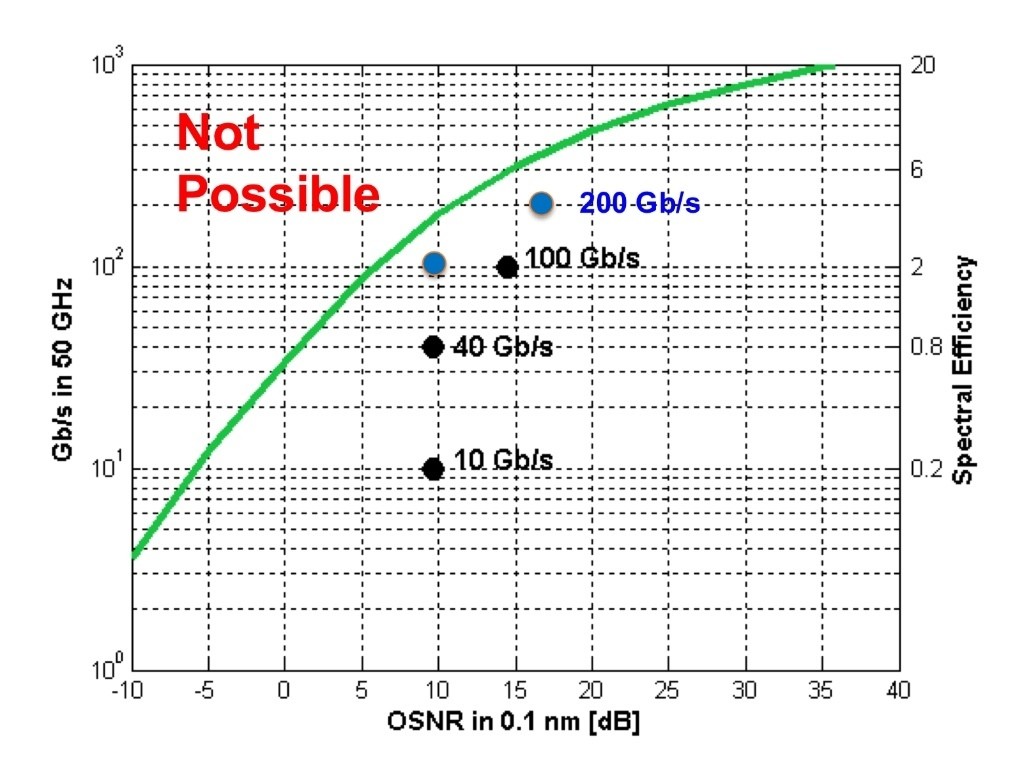
The 100Gbps blue dot is the WaveLogic 3 performance achieved with the same optical signal-to-noise ratio (ONSR) as used at 10Gbps.
"If you apply the same technology, the same FEC at 16-QAM at the same symbol rate, you get 200Gbps or twice the throughput," says Roberts. "But as you can see on the curve, you get a 4.6dB penalty [at 200Gbps] inherent in the modulation."
What this means is that the reach of an optical transport system is no longer 3,000km but rather 500-700km regional reaches, says Roberts.
Part 1: The capacity limits facing optical networking
Part 3: 2020 vision
The capacity limits facing optical networking
Ever wondered just how close systems vendors are in approaching the limits of fibre capacity in optical networks? Kim Roberts, senior director coherent systems at Ciena, adds some mathematical rigour with his explanation of Shannon's bound, from a workshop he gave at the recent Layer123's Terabit Optical and Data Networking conference held in Cannes.
Part 1 Shannon's bound
Source: Ciena
One positive message from Kim Roberts is that optical networking engineers are doing very well at squeezing information down a fibre. But a consequence of their success is that the scope for sending yet more information is diminishing.
"The key message is we are reaching that boundary," says Roberts. "We are not going to have factors of 10 improvement in spectral efficiency."
Shannon's bound
The boundary in question - the green line in the chart above - is based on the work of famed mathematician and information theorist, Claude Shannon. The chart shows how the amount of information that can be sent across a fibre is ultimately dictated by the optical signal-to-noise ratio (OSNR).
To understand the chart, the axes need to be explained. The y-axis represents the Gigabits-per-second (Gbps) of information to be communicated error free in a 50GHz ITU-defined channel. The second, right hand y-axis is an alternative representation, based on spectral efficiency: How many bits/s are transmitted, error free, per Hertz of optical spectrum. For example, 100Gbps fitted within a 50GHz channel (see 100Gbps black dot) has 2bits/s/Hz spectral efficiency.
The horizontal axis is the OSNR, measured as the total power in the signal divided by the noise in a tenth of a nanometer of spectrum.
The curve, in green, shows where communication is possible and where it is not, based on Shannon's bound. "Shannon described that for a given bandwidth - 50GHz in this example - based on the amount of noise present, specifically the signal-to-noise ratio - is the limit of the amount of information that can be communicated error free."
Roberts points out that Shannon's work was based on a linear communication channel with added Gaussian noise. Fibre is a more complex channel but the same Shannon bound applies, although some assumptions must be made. "There are certain assumptions for the non-linearities in the fibre," says Roberts. "If you make reasonable assumptions, you can draw this [Shannon] bound which shows where it is possible - and where it is not - to operate."
The dots on the chart represent the different generations of Ciena's optical transmission systems based on its WaveLogic coherent ASIC technology. The 10Gbps black dot is the performance of Ciena's first generation WaveLogic silicon. The black dot at 40Gbps and 100Gbps represent the performance achieved using Ciena's WaveLogic 2 40 and 100Gbps ASICs, shipping since 2009.
The two blue dots - at 100Gbps and 200Gbps - represent the performance achieved using Ciena's latest WaveLogic 3 silicon shipping this year. The 100Gbps is achieved using dual-polarisation, quadrature phase-shift keying (DP-QPSK) and the 200Gbps using DP-16QAM (quadrature amplitude modulation). The 200Gbps data after forward error correction in a 50GHz channel achieves 4bits/s per Hertz of spectrum.
The 100Gbps WaveLogic 3 (blue dot) delivers improved performance compared to the 100Gbps WaveLogic 2 (black dot) silicon by shifting the performance to the left, closer to the bound.
"Moving to the left means tolerating more noise, which can be translated to longer reach or higher-noise bands or more tolerance for imperfections in the network." Just how this improved performance - in terms of gained decibels (dBs) - is used depends on whether the network deployment is a long-haul or metro one, says Roberts.
What next?
Moving to faster data rates - vertically on the graph - raises its own issues. A Terabit - 1,000Gbit/s - in a 50GHz channel requires an OSNR in excess of 35dB. "That is not something that can be achieved in the network," says Roberts. "For a robust network you want to tolerate 20dB, or at least be left of 25dB." As a result, a practicable 1Tbps signal is not going to fit in a 50GHz channel.
The chart does imply that 400Gbps might be practicable in a 50GHz channel but as Roberts points out, while it might be theoretically possible, the closer you get to the theoretical limit, the harder it is to achieve.
"To increase capacity we need to find ways of reducing the noise on the line to move more to the right [on the chart]," says Roberts. "We [optical networking engineers] also need to push the data points to the left and vertically, but we are not going to push beyond the green."
Further Reading:
Capacity Trends and Limits of Optical Communication Networks, Proceedings of the IEEE, May 2012.
Part 2: Optical transmission's era of rapid capacity growth
Part 3: 2020 vision
OFC/NFOEC 2012: Some of the exhibition highlights
A round-up of some of the main announcements and demonstrations at the recent OFC/NFOEC 2012 exhibition and conference.
100 Gigabit coherent
Finisar demonstrated its first 100 Gigabit coherent receiver transponder. The 5x7inch dual-polarisation, quadrature phase-shift keying (DP-QPSK) module complies with the Optical Internetworking Forum's (OIF) multi-source specification. The companies joins Fujitsu Optical Components, Opnext and Oclaro that have already detailed their 100 Gigabit coherent modules. Since OFC/NFOEC, Oclaro and Opnext have announced their intention to merge.
"We can take off-the-shelf DSP technology and match it with vertically-integrated optics and come up with a module that is cost effective while enabling higher density for system vendors," says Rafik Ward, vice president of marketing at Finisar. "This will start the shift away from the system vendors' proprietary line cards."
Opnext announced it has demonstrated interoperability between its OMT-100 100 Gigabit-per-second (Gbps) coherent module and 100 Gigabit systems from Fujitsu Optical Systems and NEC. All three designs use NTT Electronics' (NEL) DSP-ASIC coherent receiver chip. "For those that use the same NEL modem chip, we can interoperate with each other," says Ross Saunders, general manager, next-generation transport for Opnext Subsystems.

They come back to folks like us and say: 'If you can hit this price point, then we will use you'
Ross Saunders, Opnext
Oclaro's MI 8000XM 100Gbps module also uses the NEL DSP-ASIC but was not part of the interoperability test sponsored by Japanese operator, NTT.
Oclaro announced its 100Gbps coherent module is now being manufactured using all its own optical components. These include a micro integrated tunable laser assembly (ITLA) - the latest ratified MSA that is more compact and has a higher output power, its modulator and its coherent receiver module.
Using its components enables the company to control performance-cost tradeoffs, says Per Hansen, vice president of product marketing, optical networks solutions at Oclaro: "This [vertical integration] gives us a flexibility we didn’t have in the past."
Finisar is not saying which merchant DSP-ASIC it is using. But like the NEL device, the DSP-ASIC supports soft-decision forward error correction (SD-FEC) to achieve a reach of over 2,000km.
Meanwhile, the module makers' 100Gbps modules are starting to be shipped to customers.
"We shipped [samples] to four customers last quarter and we are probably going to ship to another four or five by the end of this quarter," says Opnext's Saunders.
Opnext says nearly all of its early customers do not have their own in-house 100Gbps developments. However, the systems vendors that have internal 100Gbps programmes have designed their line cards using the same 168-pin interface. This allows them to replace their own 100Gbps daughter cards with a merchant 5x7-inch module.
 "This [vertical integration] gives us a flexibility we didn’t have in the past."
Per Hansen, Oclaro
The company also announced its OTS-100FLX 100Gbps muxponder, transponder and regenerator line cards that use the OTM-100 module and which slot into its OTS-4000 chassis. The chassis supports eight 100Gbps cards. Opnext's smaller 4RU OTS-mini platform hosts two 100Gbps line cards, mounted horizontally. Over half of Opnext's revenues are from subsystems sales which it brands and sells to system vendors.
As for the other 100Gbps transponder makers, Oclaro is sending out its first module samples now. Finisar says its module will be generally available by the year-end, while Fujitsu Optical Components' module was released in April.
Optical components for 200Gbps DP-QPSK
u2t Photonics announced its latest 64Gbaud photo-detector that points to the next speed shift in line-side transmission. The photo-detector is one key building block to the eventual development of a single-carrier DP-QPSK capable of 200Gbps or using 16-QAM, 400Gbps.

"We can already support the higher interface speed and data throughput"
Jens Fiedler, u2t Photonics
"System companies are looking for two things: to increase the baud rate and to use more complex modulation schemes," says Jens Fiedler, vice president sales and marketing at u2t Photonics. "[With this announcement] from the optical component perspective, we can already support the higher interface speed and data throughput."
1x23 Wavelength-selective switch
Oclaro announced a 1x23 wavelength selective switch at OFC. According to Oclaro, the 1x23 WSS has come about due to the operators' desire to support 12-degree nodes: an input port (1 degree) and through-connections on 11 other ports. The remaining 12 [of the WSS's 24 ports] are used as drop ports.
"If for each of those ports you have a fan-out that is steerable to 8 ports, you have 12x8 or 96 as the total channels you can support for a full add-drop," says Hansen. Such a 12-degree, 96-channel requirement was set by operators early on, or at least it was an industry desire, says Hansen.
Switching elements that address these drop requirements - multicast switches - were announced by NeoPhotonics and Enablence Technologies at OFC. The switches, planar lightwave circuit (PLC) hybrid integration designs, implement 8x16 multicast switches.
"The multicast switch takes signals from eight different inputs - 8 different directions in a ROADMs node and distributes those signals to up to 16 drop ports," says Ferris Lipscomb, vice president of marketing at NeoPhotonics.
Such PLC designs are complex, comprising power splitters, waveguide switching, variable optical attenuators and photo-detectors for channel monitoring.
According to NeoPhotonics, the number of optical functions used to implement the multicast switch is in the hundreds.
Enablence already has 8x8 and 8x12 multicast switches and has launched its 8x16 device. Although the company is a hybrid PIC specialist and has PLC technology, it uses polymer PLCs for the multicast designs, claiming they are lower power. NEL is another company offering 8x8 and 8x12 multicast switches.
Passive optical networking
Finisar also demonstrated a mini-PON network, highlighting its optical line terminal (OLT) transceivers, splitters and its latest GPON-stick, an GPON optical network unit built into an SFP. The demo involved using the ONU SFP transceiver in an Ethernet switch port as part of a PON network to deliver high-definition video and audio from the OLT to a high-definition TV.
The company also introduced two splitter products a 1:128 port splitter and a 2:64 (used for redundancy). These high-split ratios are being prepared for the advent of 10 Gigabit PON.
Enablence also demonstrated a WDM-PON 32-channel receiver module at OFC. "It takes 32 TO-can receivers and replaces them with a small module which includes the AWG (arrayed waveguide grating demultiplexer) and the 32 receivers," says Matt Pearson, vice president, technology, optical components division at Enablence Technologies. The design promises to increase system density by fitting two such receivers on a single blade.
Optical engines
Silicon photonics firm, Kotura, detailed its 100Gbps optical engine chip, implemented as a 4x25Gbps design. The optical engine consumes 5W and has a reach of at least 10km, making it suitable for requirements in the data centre including the 100 Gigabit Ethernet IEEE 100GBASE-LR4 standard.

"The 100Gbps chip - 5mmx6mm - is small enough to fit in the QSFP+ and emerging CFP4 optical modules
Arlon Martin, Kotura
Kotura demonstrated to select customers its optical engine. "We are not announcing the product yet," says Arlon Martin, vice president of marketing at Kotura.
Optical engines are used in several applications: pluggable modules on a system's face-plate, the optics at each end of an active optical cable, and for board-mounted embedded applications.
For embedded applications, the optical engine is mounted deeper within the line card, close to high-speed chips, for example, with the signals routed over fibre to the face-plate connector. Using optics rather than high-speed copper traces simplifies the printed circuit board design.Embedded optical engines will also be used for optical backplane-based platforms.
Kotura's silicon photonics-based optical engine integrates all the functions needed for the transmitter and receiver on-chip. These include the 25Gbps optical modulators and drivers, the 4:1 multiplexer and 1:4 demultiplexer and four photo-detectors. To create the lasers, an array of four gain blocks are coupled to the chip. Each of laser's wavelength, around 1550nm, is set using on-chip gratings.
The 100Gbps chip, measuring about 5mmx6mm, is small enough to fit in the QSFP+ and emerging CFP4 optical modules, says Martin. The QSFP+ is likely to be the first application for Kotura's 100Gbps optical engine, used to connect switches within the data centre.
Finisar demonstrated its own VCSEL-based board mount optical assembly - also an optical engine - to highlight the use of the technology for future optical backplanes.
The demonstration, involving Vario-optics and Huber + Suhner, included boards in a chassis. The board includes the optical engine coupled to polymer waveguides from Vario-optics which connect it to a backplane connector, built by Huber + Suhner. "The idea is to show what an integrated optical chassis will look like," says Ward.
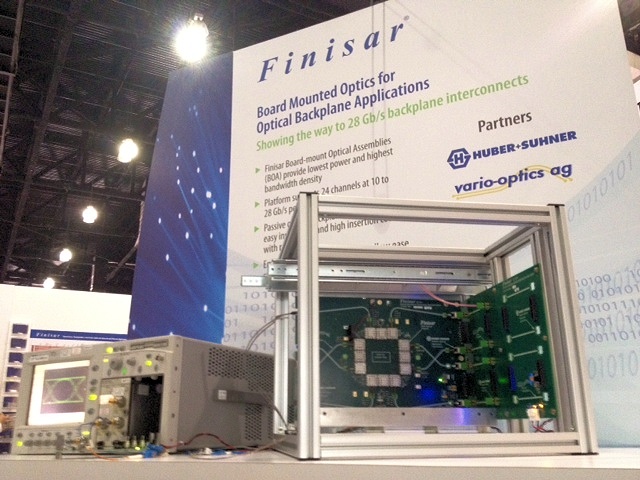 Finisar's optical backplane demo using board-mounted optics. Source: Finisar
The optical engine comprises 24 channels - 12 transmitters at 10Gbps and 12 receivers in a single board-mounted package. The optics can operate at 10, 12, 14, 25 and 28Gbps, says Finisar. The connector allows the optical engines on different cards to interface via the waveguides. The advantage of polymer waveguides is that they are relatively easy to etch on printed circuit boards and since they replace fibre, they remove fibre management issues. However the technology needs to be proven before system vendors will use such waveguides as standard in their platforms.
Interconnect specialist Reflex Photonics demonstrated an 8.6Tbps optical backplane at OFC. The demonstrator uses Reflex's LightABLE optical engines to implement 864 point-to-point optical fibre links to achieve 8.6Tbps in a single chassis.
The optical fabric comprises six layers of 12x12 fully connected broadcast meshes. Each line card supports 720Gbps into the optical backplane and 60Gbps direct bandwidth between any two cards.
32G Fibre channel
Finisar also highlighted its 28Gbps VCSEL that will be used for the 32 Gigabit Fibre Channel standard. The actual line rate for 32Gbps Fibre Channel is 28.05Gbps. The VCSEL is packaged into a transmitter optical sub-assembly (TOSA) that fits inside a SFP+ module.
"We view 28Gbps VCSEL as strategic due to all the applications it will enable," says Ward.
Besides 32Gbps Fibre Channel, the high-speed VCSEL is suited for the next Infiniband data rate - enhanced data rate (EDR) at 4x25Gbps or 12x25Gbps. There is also standards work in the IEEE for a new 100Gbps Ethernet standard that can use 4x25Gbps VCSELs.
Further reading:
Gazettabyte's full OFC NFOEC 2012 coverage
LightCounting: Notes from OFC 2012: Onset of the Terabit Age
Ovum's OFC coverage
Optical components enter an era of technology-pull
Gazettabyte asked ADVA Optical Networking, Ciena, Cisco Systems and Ovum about their impressions following the recent OFC/NFOEC 2012 exhibition and conference.
OFC/NFOEC reflections: Part 2
 "As the economy continues to navigate its way through yet another very difficult period, it was good to see so many companies innovating and introducing solutions."
Massimo Prati, Cisco Systems
Massimo Prati, Cisco Systems
For Cisco Systems, 100 Gigabit was a key focus at the show. "There were many system and component vendors, including Cisco, demonstrating newly available, economically feasible 100 Gig innovations," says Massimo Prati, vice president and general manager for Cisco.
Linking data centres was another conference theme. "Inter-data centre connectivity continues to focus on scalable and simple solutions in long-haul and metro networks connecting data centres worldwide." Cisco believes metro 100 Gigabit deployments will become prevalent in 2013 and 2014, especially if low‐cost coherent technology becomes available.
"A dedicated workshop focused on data centre architectures, held on the first day of the conference, was heavily attended," says Prati. "So certainly the link between cloud and optical is being established and is a key driver for high-speed transport networks."
Another conference theme was interconnect within the data centre, and the need for photonic integration for low‐cost, low‐power links, says Prati: "From a Cisco standpoint, several of our customers were pleasantly surprised by our recently completed acquisition of Lightwire, which develops advanced optical interconnect technology for high-speed networking applications." Lightwire is a silicon photonics startup that Cisco acquired recently for US $271 million.
What Cisco says it learned from OFC/ NFOEC was that service providers are planning 100Gbps deployments within the next 12 months and are looking at second- and third-generation solutions. "There is quite a bit of energy around future upgrades to 400 Gig and one Terabit transport solutions, but service providers continue to monitor if and how these solutions will operate within their existing fibre plants."
Prati expects more industry consolidation. "With the influx of 100 Gig solutions, it appears we may be ripe for further consolidation within the industry, particularly further down the technology food chain," he says.
He also remains optimistic about the industry's prospects.
"We believe that the excitement around high-speed, long-haul transport, combined with cloud and data centre innovation, continues to fuel a lot of new product solutions and architectures," he says. "Content providers like Google and Facebook have clearly expressed interest in optical technologies addressing their issues with bandwidth demands and need for high-speed interconnect for their data centres."
Joe Berthold, Ciena
Whereas last year there was much discussion about of the next rate for Ethernet - 400 Gig or one Terabit - this year 400 Gigabit had most mindshare, says Joe Berthold, vice president of network architecture at Ciena. "I barely heard any mention of one Terabit in the context of a contest with 400 Gigabit," he says.
 "I could hear some rumblings about alternative form factors – which might lead to fragmentation of the market"
Joe Berthold, Ciena
400 Gigabit was given a boost with the line-side transmission component announcements. Ciena announced its WaveLogic3 and Alcatel-Lucent detailed its Photonic Service Engine.
Another noteworthy development was the buzz around silicon photonics, stirred in part by Cisco's Lightwire acquisition. "Silicon photonics has passed from a technology of research interest to one that has progressed to serious development," says Berthold. "Data centre interconnects look like a promising initial application."
There was no developments at the show that surprised Berthold. But he is concerned about the potential for proliferation of 100 Gigabit client-side form factors, especially for pluggable modules.
"I am going under the assumption that there is still broad industry support for the CFP progression - from the current CFP to a CFP2 followed by a CFP4 for single-mode fiber applications over metro distances," he says.
Even though there are a variety of technologies appearing in the CFP form factor, this common physical module has helped control system development cost. "I could hear some rumblings about alternative form factors – which might lead to fragmentation of the market," he says.
Berthold is encouraged by the broad base of development efforts underway, particularly for 100Gbps transceivers, but also lower-cost 10Gbps and 40Gbps client-side modules. He notes the progress in reducing the cost of 100 Gigabit client interfaces over the next year. "Their high cost has held back adoption of 100 Gig," says Berthold. "We have had very cost effective 10 Gig multiplexing technology to fall back on, but it looks like native 100G interfaces are poised for growth."
Jörg-Peter Elbers, ADVA Optical Networking
Jörg-Peter Elbers, vice president, advanced technology at ADVA Optical Networking, was struck by the wide range of hot topics discussed at the show.
These include software-defined optics based on programmable transceivers that use advanced DSP technology and flexgrid ROADMs as the basis of a new coherent express layer. He also notes that control plane technologies are becoming an essential asset in managing network complexity when unleashing untapped network capacity.
 "Traffic and content keeps growing at exponential scale - the fundamental demand-drivers are intact"
Jörg-Peter Elbers, ADVA Optical Networking
Meanwhile, the rapid increase in end-user traffic, specifically mobile, is driving PON. As a result WDM is moving closer to the network edge, entering aggregation and access networks. He believes dense WDM-PON is gaining traction for mobile backhaul as fibre becomes the bottleneck when moving from Long Term Evolution (LTE) to the LTE-Advanced cellular technology.
Other trends to note, he says, are software-defined networking (SDN) and OpenFlow. "Originating from the campus and data centre world, network programmability is increasingly seen as key for tighter integration, more automation, and virtualisation of IT and computing services," says Elbers.
The industry increasingly sees the metro market as important to ramp up 100Gbps volumes, with different modulation solutions being promoted by vendors. These include performance reduced 100Gbps DP-QPSK (dual polarisation, quadrature phase-shift keying), 200Gbps DP-16QAM (dual polarisation, 16-quadrature amplitude modulation) and 4x28G direct-detection.
While some people expressed concerns about a fragmentation of the 100 Gig market, power consumption, footprint and cost are of primary importance in the metro, he says. "One analyst at the Ovum 100Gbps metro workshop at OFC said: 'Maybe, for a hammer everything looks like a nail…'," says Elbers. "With 4x28G optical duobinary being able to make use of 10Gbps T-XFP/SFP+, IEEE 802.3ba and CFP technologies, we believe there is a justification to differentiate."
ADVA demonstrated its 4x28Gbps optical duobinary direct-detection product at the show.
Elbers noted an interest in multi-core and few-mode fibres. "The next x10 in bandwidth is difficult to reach as additional gains from amplification, modulation, FEC and denser carrier spacing will be limited." he says. "The research community therefore is looking into new fibre types to add the spatial and modal dimensions alongside the current optimisation strategy." An area interesting to watch, but fundamental technical and economic challenges remain, he says.
He too is optimistic about the industry's prospects: "Traffic and content keeps growing at exponential scale - the fundamental demand drivers are intact." As a result, optical innovation will play an even bigger role in the future to keep pace with the bandwidth growth, he says.
Karen Liu, Ovum
"We're clearly in a technology-pull phase rather than technology-push phase with multiple system vendors doing 400Gbps-capable stuff instead of component guys showing demonstrations years in advance of system activity," says Karen Liu, principal analyst, components telecoms at Ovum.
 "Optical burst mode switching may be crossing over from rather 'pie-in-the-sky' to practical"
Karen Liu, Ovum
It is not that that the components vendors aren't making innovative products, she says, just that they are not making announcements until there is real demand. "Corning, for example, showed a fiber that has already been shipping into Lightpeak," says Liu.
What surprised Liu at the show was Huawei's optical burst transport network prototype. "Optical burst mode switching may be crossing over from rather 'pie-in-the-sky' to practical," says Liu.
She notes how there isn't as much optics-versus-electronics positioning anymore but more a case of optics working with electronics. "Huawei's OBTN is an example," says Liu. "Instead of using optical burst mode to make an all-optical network, optics is part of a hybrid design."
Liu says there are now multiple relationships between silicon and optics including the two working together instead of in competition. "In networking, the term translucent networks seems to have gained popularity."
ZTE takes PON optical line terminal lead
ZTE shipped 1.8 million passive optical network (PON) optical line terminals (OLTs) in 2011 to become the leading supplier with 41 percent of the global market, according to Ovum.
 "ZTE is co-operating with some Tier 1 operators in Europe and the US for 10GEPON and XGPON1 testing"
Song Shi Jie, ZTE
The market research firm also ranks the Chinese equipment maker as the second largest supplier of PON optical network terminals (ONT), with 28 per cent global market share in 2011.
China now accounts for over half the total fibre-to-the-x (FTTx) deployments worldwide. ZTE says 1.05 million of its OLTs were deploy in China, with 70 percent for the EPON standard and the rest GPON. Overall EPON accounts for 85% of deployments in China. However GPON deployments are growing and ZTE expects the technology to gain market share in China.
There are some 300 million broadband users in China, made up of DSL, fibre-to-the-building (FTTB) and -curb (FTTC), says Song Shi Jie, director of fixed network product line at ZTE.
Of the three main operators, China Telecom is the largest. It is deploying FTTB and is moving to fibre-to-the-home (FTTH) deployments using GPON. China Unicom has a similar strategy. China Mobile is focussed on FTTB and LAN technology; because it is a mobile operator and has no copper line assets it uses LAN cabling for networking within the building.
The split ratio - the number of PON ONTs connected to each OLT - varies depending on the deployment. "In the fibre-to-the-building scenario, the typical ratio is 1:8 or 1:16; for fibre-to-the-home the typical ratio is 1:64," says Song.
ZTE has also deployed 200,000 10 Gigabit EPON (10GEPON) lines in China but none elsewhere, either 10GEPON or XGPON1 (10 Gigabit GPON). "ZTE is co-operating with some Tier 1 operators in Europe and the US for 10GEPON and XGPON1 testing," says Song.
Song attributes ZTE's success to such factors as reduced power consumption of its PON systems and its strong R&D in access.
The vendor says its PON platforms consume a quarter less power than the industry average. Its systems use such techniques as shutting down those OLT ports that are not connected to ONTs. It also employs port idle and sleep modes to save power when there is no traffic. Meanwhile, ZTE has 3,000 engineers engaged in fixed access product R&D.
As for the next-generation NGPON2 being development by industry body FSAN, Song says there are a variety of technologies being proposed but that the picture is still unclear.
ZTE is focussing on three main next-generation PON technologies: wavelength division multiplexing PON (WDM-PON), hybrid time division multiplexing (TDM)/ WDM-PON (or TWDM-PON) and orthogonal frequency division multiplexing (OFDM) PON. "We think OFDM PON can provide high security, high bandwidth and easy network maintenance," says Song.
ZTE says that the NGPON2 standard will be mature in 2015 but that commercial deployments will only start in 2018.
Huawei's novel Petabit switch
The Chinese equipment maker showcased a prototype optical switch at this year's OFC/NFOEC that can scale to 10 Petabit.

"Although the numbers [400,000 lasers] appear quite staggering, they point to a need for photonic integration"
Reg Wilcox, Huawei
Huawei has demonstrated a concept Petabit Packet Cross Connect (PPXC), a switching platform to meet future metro and data centre requirements. The demonstrator is not expected to be a commercial product before 2017.
Current platforms have switching capacities of several Terabits. Yet Huawei believes a one thousand-fold increase in switching capacity will be needed. Fibre capacity will be filled to 20 and eventually 50 Terabits using higher-order modulation schemes and flexible spectrum. This will add up to a Petabit (one million Gigabits) per site, assuming 200 switched fibres at busy network exchanges.
"We are not saying we will introduce a 10 Petabit product in five years' time, although the technology is capable of that," says Reg Wilcox, vice president of network marketing and product management at Huawei. "We will size it to what we deem the market needs at that time."
 Source: Huawei
The PPXC uses optical burst transmission to implement the switching. Such burst transmission uses ultra-fast switching lasers, each set to a particular wavelength in nanoseconds. Like Intune Networks’ Verisma iVX8000 optical packet switching and transport system, each wavelength is assigned to a particular destination port. As OTN traffic or packets arrive, they are assigned a wavelength before being sent to a destination port.
Huawei's switch demonstration linked two Huawei OSN8800 32-slot platforms, each with an Optical Transport Network (OTN) switching capacity of 2.56 Terabit-per-second (Tbps), to either side of the core optical switch, to implement what is known as a three-stage Clos switching matrix.
With each OSN8800, half the slots are for inter-machine trunks to the core optical switch, the middle stage of the Clos switch. "The other half [of the OSN8800] would be dedicated to whatever services you want to have: Gigabit Ethernet, 10 Gigabit Ethernet; whatever traffic you want riding over OTN," says Wilcox.
The core optical switch implements an 80x80 matrix using 80 wavelengths, each operating at 25Gbps. The 80x80 matrix is surrounded by MxM fast optical switches to implement a larger 320x320 matrix that has an 8 Terabit capacity. It is these larger matrices - 'switch planes' - that are stacked to achieve 10 Petabit. The PPXC grooms traffic starting at 1 Gigabit rates and can switch 100Gbps and even higher speed incoming wavelengths in future.
Oclaro provided Huawei with the ultra-fast lasers for the demonstrator. The laser - a digital supermode-distributed Bragg reflector (DS-DBR) - has an electro-optic tuning mechanism, says Robert Blum, director of product marketing for Oclaro's photonic component. Here current is applied to the grating to set the laser's wavelength. The resulting tuning speed is in nanoseconds although Oclaro will not say the exact switching speed specified for the switch.
Each switch plane uses 4x80 or 320, 25Gbps lasers. A 10 Petabit switch requires 400,000 (320x1250) lasers. "Although the numbers appear quite staggering, they point to a need for photonic integration," says Wilcox. Huawei recently acquired photonic integration specialist CIP Technologies.
The demonstration highlighted the PPXC switching OTN traffic but Wilcox stresses that the architecture is cell-based and can support all packet types: "We are flexible in the technology as the world evolves to all-packet.” The design is therefore also suited to large data centres to switch traffic between servers and for linking aggregation routers. "It is applicable in the data centre as a flattened [switch] architecture," says Wilcox.
Huawei claims the Petabit switch will deliver other benefits besides scalability. "Rough estimates comparing this device to OTN switches, MPLS switches and routers yields savings of greater than 60% on power, anywhere from 15-80% on footprint and at least a halving of fibre interconnect," says Wilcox.
Meanwhile Oclaro says Huawei is not the only vendor interested in the technology. "We have seen quite some interest recently in this area [of optical burst transmission]." says Oclaro's Blum. "I wouldn't be surprised if other companies make announcements in this space."
Further reading:
- OFC/ NFOEC 2012 paper: An Optical Burst Switching Fabric of Multi-Granularity for Petabit/s Multi-Chassis Switches and Routers
OFC/NFOEC 2012 industry reflections - Part 1
The recent OFC/NFOEC show, held in Los Angeles, had a strong vendor presence. Gazettabyte spoke with Infinera's Dave Welch, chief strategy officer and executive vice president, about his impressions of the show, capacity challenges facing the industry, and the importance of the company's photonic integrated circuit technology in light of recent competitor announcements.
OFC/NFOEC reflections: Part 1

"I need as much fibre capacity as I can get, but I also need reach"
Dave Welch, Infinera
Dave Welch values shows such as OFC/NFOEC: "I view the show's benefit as everyone getting together in one place and hearing the same chatter." This helps identify areas of consensus and subjects where there is less agreement.
And while there were no significant surprises at the show, it did highlight several shifts in how the network is evolving, he says.
"The first [shift] is the realisation that the layers are going to physically converge; the architectural layers may still exist but they are going to sit within a box as opposed to multiple boxes," says Welch.
The implementation of this started with the convergence of the Optical Transport Network (OTN) and dense wavelength division multiplexing (DWDM) layers, and the efficiencies that brings to the network.
That is a big deal, says Welch.
Optical designers have long been making transponders for optical transport. But now the transponder isn't an element in the integrated OTN-DWDM layer, rather it is the transceiver. "Even that subtlety means quite a bit," say Welch. "It means that my metrics are no longer 'gray optics in, long-haul optics out', it is 'switch-fabric to fibre'."
Infinera has its own OTN-DWDM platform convergence with the DTN-X platform, and the trend was reaffirmed at the show by the likes of Huawei and Ciena, says Welch: "Everyone is talking about that integration."
The second layer integration stage involves multi-protocol label switching (MPLS). Instead of transponder point-to-point technology, what is being considered is a common platform with an optical management layer, an OTN layer and, in future, an MPLS layer.
"The drive for that box is that you can't continue to scale the network in terms of bandwidth, power and cost by taking each layer as a silo and reducing it down," says Welch. "You have to gain benefits across silos for the scaling to keep up with bandwidth and economic demands."
Super-channels
Optical transport has always been about increasing the data rates carried over wavelengths. At 100 Gigabit-per-second (Gbps), however, companies now use one or two wavelengths - carriers - onto which data is encoded. As vendors look to the next generation of line-side optical transport, what follows 100Gbps, the use of multiple carriers - super-channels - will continue and this was another show trend.
Infinera's technology uses a 500Gbps super-channel based on dual polarisation, quadrature phase-shift keying (DP-QPSK). The company's transmit and receive photonic integrated circuit pair comprise 10 wavelengths (two 50Gbps carriers per 50GHz band).
Ciena and Alcatel-Lucent detailed their next-generation ASICs at OFC. These chips, to appear later this year, include higher-order modulation schemes such as 16-QAM (quadrature amplitude modulation) which can be carried over multiple wavelengths. Going from DP-QPSK to 16-QAM doubles the data rate of a carrier from 100Gbps to 200Gbps, using two carriers each at 16-QAM, enables the two vendors to deliver 400Gbps.
"The concept of this all having to sit on one wavelength is going by the wayside," say Welch.
Capacity challenges
"Over the next five years there are some difficult trends we are going to have to deal with, where there aren't technical solutions," says Welch.
The industry is already talking about fibre capacities of 24 Terabit using coherent technology. Greater capacity is also starting to be traded with reach. "A lot of the higher QAM rate coherent doesn't go very far," says Welch. "16-QAM in true applications is probably a 500km technology."
This is new for the industry. In the past a 10Gbps service could be scaled to 800 Gigabit system using 80 DWDM wavelengths. The same applies to 100Gbps which scales to 8 Terabit.
"I'm used to having high-capacity services and I'm used to having 80 of them, maybe 50 of them," says Welch. "When I get to a Terabit service - not that far out - we haven't come up with a technology that allows the fibre plant to go to 50-100 Terabit."
This issue is already leading to fundamental research looking at techniques to boost the capacity of fibre.
PICs
However, in the shorter term, the smarts to enable high-speed transmission and higher capacity over the fibre are coming from the next-generation DSP-ASICs.
Is Infinera's monolithic integration expertise, with its 500 Gigabit PIC, becoming a less important element of system design?
"PICs have a greater differentiation now than they did then," says Welch.
Unlike Infinera's 500Gbps super-channel, the recently announced ASICs use two carriers and 16-QAM to deliver 400Gbps. But the issue is the reach that can be achieved with 16-QAM: "The difference is 16-QAM doesn't satisfy any long-haul applications," says Welch.
Infinera argues that a fairer comparison with its 500Gbps PIC is dual-carrier QPSK, each carrier at 100Gbps. Once the ASIC and optics deliver 400Gbps using 16-QAM, it is no longer a valid comparison because of reach, he says.
Three parameters must be considered here, says Welch: dollars/Gigabit, reach and fibre capacity. "I have to satisfy all three for my application," he says.
Long-haul operators are extremely sensitive to fibre capacity. "I need as much fibre capacity as I can get," he says. "But I also need reach."
In data centre applications, for example, reach is becoming an issue. "For the data centre there are fewer on and off ramps and I need to ship truly massive amounts of data from one end of the country to the other, or one end of Europe to the other."
The lower reach of 16-QAM is suited to the metro but Welch argues that is one segment that doesn't need the highest capacity but rather lower cost. Here 16-QAM does reduce cost by delivering more bandwidth from the same hardware.
Meanwhile, Infinera is working on its next-generation PIC that will deliver a Terabit super-channel using DP-QPSK, says Welch. The PIC and the accompanying next-generation ASIC will likely appear in the next two years.
Such a 1 Terabit PIC will reduce the cost of optics further but it remains to be seen how Infinera will increase the overall fibre capacity beyond its current 80x100Gbps. The integrated PIC will double the 100Gbps wavelengths that will make up the super-channel, increasing the long-haul line card density and benefiting the dollars/ Gigabit and reach metrics.
In part two, ADVA Optical Networking, Ciena, Cisco Systems and market research firm Ovum reflect on OFC/NFOEC. Click here
Dan Sadot on coherent's role in the metro and the data centre
Gazettabyte went to visit Professor Dan Sadot, academic, entrepreneur and founder of chip start-up MultiPhy, to discuss his involvement in start-ups, his research interests and why he believes coherent technology will not only play an important role in the metro but also the data centre.

"Moore's Law is probably the most dangerous enemy of optics"
Professor Dan Sadot
The Ben-Gurion University campus in Beer-Sheba, Israel, is a mixture of brightly lit, sharp-edged glass-fronted buildings and decades-old Palm trees.
The first thing you notice on entering Dan Sadot's office is its tidiness; a paperless desk on which sits a MacBook Air. "For reading maybe the iPad could be better but I prefer a single device on which I can do everything," says Sadot, hinting at a need to be organised, unsurprising given his dual role as CTO of MultiPhy and chairman of Ben-Gurion University's Electrical and Computer Engineering Department.
The department, ranked in the country's top three, is multi-disciplinary. Just within the Electrical and Electronics Department there are eight tracks including signal processing, traditional communications and electro-optics. "That [system-oriented nature] is what gives you a clear advantage compared to experts in just optics," he says.
The same applies to optical companies: there are companies specialising in optics and ASIC companies that are expert in algorithms, but few have both. "Those that do are the giants: [Alcatel-Lucent's] Bell Labs, Nortel, Ciena," says Sadot. "But their business models don't necessarily fit that of start-ups so there is an opportunity here."
MultiPhy
MultiPhy is a fabless start-up that specialises in high-speed digital signal processing-based chips for optical transmission. In particular it is developing 100Gbps ICs for direct detection and coherent.
Sadot cites a rule of thumb that he adheres to religiously: "Everything you can do electronically, do not do optically. And vice versa: do optically only the things you can't do electronically." This is because using optics turns out to be more expensive.
And it is this that MultiPhy wants to exploit by being an ASIC-only company with specialist knowledge of the algorithms required for optical transmission.
"Electronics is catching up," says Sadot. "Moore's Law is probably the most dangerous enemy of optics."
 Ben-Gurion University Source: Gazettabyte
Direct detection
Not only have developments in electronics made coherent transmission possible but also advances in hardware. For coherent, accurate retrieval of phase information is needed and that was not possible with available hardware until recently. In particular the phase noise of lasers was too high, says Sadot. Now optics is enabling coherent, and the issues that arise with coherent transmission can be solved electronically using DSP.
MultiPhy has entered the market with its MP1100Q chip for 100Gbps direct detection. According to Sadot, 100Gbps is the boundary data rate between direct detection and coherent. Below 100Gbps coherent is not really needed, he says, even though some operators are using the technology for superior long-haul optical transmission performance at 40Gbps.
"Beyond 100 Gig you need the spectral efficiency, you need to do denser [data] constellations so you must have coherent," says Sadot. "You are also much more vulnerable to distortions such as chromatic dispersion and you must have the coherent capability to do that."
But at 100 Gig the two - coherent and direct detection - will co-exist.
MultiPhy's first device runs the maximum likelihood sequence estimation (MLSE) algorithm that is used to counter fibre transmission distortions. "MLSE offers the best possible theoretical solution on a statistical basis without retrieving the exact phase," says Sadot. "That is the maximum you can squeeze out of direct detection."
The MLSE algorithm benefits optical performance by extending the link's reach while allowing lower cost, reduced-bandwidth optical components to be used. MultiPhy claims 4x10Gbps can be used for the transmit and the receive path to implement the 4x28Gbps (100Gbps) design.
Sadot describes MLSE as a safety net in its ability to handle transmitter and/or receiver imperfections. "We have shown that performance is almost identical with a high quality transmitter and a lower quality transmitter; MLSE is an important addition." he says.
 Ben-Gurion University Source: Gazettabyte
Coherent metro
System vendors such as Ciena and Alcatel-Lucent have recently announced their latest generation coherent ASICs designed to deliver long-haul transmission performance. But this, argues Sadot, is overkill for most applications when ultra-long haul is not needed: metro alone accounts for 75% of all the line side ports.
He also says that the power consumption of long-haul solutions is over 3x what is required for metro: 75W versus the CFP pluggable module's 24W. This means the power available solely for the ASIC would be 15W.
"This is not fine-tuning; you really need to design the [coherent metro ASIC] from scratch," says Sadot. "This is what we are doing."
To achieve this, MultiPhy has developed patents that involve “sub-Nyquist” sampling. This allows the analogue-to-digital converters and the DSP to operate at half the sampling rate, saving power. To use sub-Nyquist sampling, a low-pass anti-aliasing filter is applied but this harms the received signal. Using the filter, sampling at half the rate can occur and using the MLSE algorithm, the effects of the low-pass filtering can be countered. And because of the low pass filtering, reduced bandwidth opto-electronics can be used which reduces cost.
The result is a low power, cost-conscious design suited for metro networks.
Coherent elsewhere
Next-generation PON is also a likely user of coherent technology for such schemes as ultra-dense WDM-PON.
Sadot believes coherent will also find its way into the data centre. "Again you will have to optimise the technology to fit the environment - you will not find an over-design here," he says.
Why would coherent, a technology associated with metro and long-haul, be needed in the data centre?
"Even though there is the 10x10 MSA, eventually you will be limited by spectral efficiency," he says. Although there is a tremendous amount of fibre in the data centre, there will be a need to use this resource to the maximum. "Here it will be all about spectral efficiency, not reach and optical signal-to-noise," says Sadot.
Sadot's start-ups
Sadot had a research posting at the optical communications lab at Stanford University. The inter-disciplinary and systems-oriented nature of the lab was an influence on Sadot when he founded the optical communications lab at Ben-Gurion University around the time of the optical boom. "A pleasant time to come up with ideas," is how he describes that period - 1999-2000.
The lab's research focus is split between optical and signal processing topics. Work there resulted in two start-ups during the optical bubble which Sadot was involved in: Xlight Photonics and TeraCross.
Xlight focused on ultra-fast lasers as part of a tunable transponder. Xlight eventually merged with another Israeli start-up Civcom, which in turn was acquired by Padtek.
The second start-up, TeraCross, looked at scheduling issues to improve throughput in Terabit routers. "The start-up led to a reference design that was plugged into routers in Cisco's Labs in Santa Clara [California]," says Sadot. "It was the first time a scheduler showed the capability to support a one Terabit data stream, and route in a sophisticated, global manner."
But with the downturn of the market, the need for terabit routers disappeared and the company folded.
Sadot's third and latest start-up, MultiPhy, also has its origins in Ben-Gurion's optical communications lab's work on enabling system upgrades without adding to system cost.
MultiPhy started as a PON company looking at how to upgrade GPON and EPON to 10 Gigabit PON without changing the hardware. "The magic was to use previous-generation hardware which introduces distortion as it doesn't really fit this upgrade speed, and then to compensate by signal processing," says Sadot.
After several rounds of venture funding the company shifted its focus from PON, applying the concept to 100 Gigabit optical transmission instead.
FSAN close to choosing the next generation of PON
Briefing: Next-gen PON
Part 1: NG-PON2
The next-generation passive optical network (PON) will mark a departure from existing PON technologies. Some operators want systems based on the emerging standard for deployment by 2015.

“One of the goals in FSAN is to converge on one solution that can serve all the markets"
Derek Nesset, co-chair of FSAN's NGPON task group
The Full Service Access Network (FSAN) industry group is close to finalising the next optical access technology that will follow on from 10 Gigabit GPON.
FSAN - the pre-standards forum consisting of telecommunications service providers, testing labs and equipment manufacturers - crafted what became the International Telecommunication Union's (ITU) standards for GPON (Gigabit PON) and 10 Gigabit GPON (XGPON1). In the past year FSAN has been working on NG-PON2, the PON technology that comes next.
“One of the goals in FSAN is to converge on one solution that can serve all the markets - residential users, enterprise and mobile backhaul," says Derek Nesset, co-chair of FSAN's NGPON task group.
Some mobile operators are talking about backhaul demands that will require multiple 10 Gigabit-per-second (Gbps) links to carry the common public radio interface (CPRI), for example. The key design goal, however, is that NG-PON2 retains the capability to serve residential users cost-effectively, stresses Nesset.
FSAN says it has a good description of each of the candidate technologies: what each system looks like and its associated power consumption. "We are trying to narrow down the solutions and the ideal is to get down to one,” says Nesset.
The power consumption of the proposed access scheme is of key interest for many operators, he says. Another consideration is the risk associated with moving to a novel architecture rather than adopting an approach that builds on existing PON schemes.
Operators such as NTT of Japan and Verizon in the USA have a huge installed base of PON and want to avoid having to amend their infrastructure for any next-generation PON scheme unable to re-use power splitters. Other operators such as former European incumbents are in the early phases of their rollout of PON and have Greenfield sites that could deploy other passive infrastructure technologies such as arrayed waveguide gratings (AWG).
"The ideal is we select a system that operates with both types of infrastructure," says Nesset. "Certain flavours of WDM-PON (wavelength division multiplexing PON) don't need the wavelength splitting device at the splitter node; some form of wavelength-tuning can be installed at the customer premises." That said, the power loss of existing optical splitters is higher than AWGs which impacts PON reach – one of several trade-offs that need to be considered.
Once FSAN has concluded its studies, member companies will generate 'contributions' for the ITU, intended for standardisation. The ITU has started work on defining high-level requirements for NG-PON2 through contributions from FSAN operators. Once the NG-PON2 technology is chosen, more contributions that describe the physical layer, the media access controller and the customer premise equipment's management requirements will follow.
Nesset says the target is to get such documents into the ITU by September 2012 but achieving wide consensus is the priority rather than meeting this deadline. "Once we select something in FSAN, we expect to see the industry ramp up its contributions based on that selected technology to the ITU," says Nesset. FSAN will select the NG-PON2 technology before September.
NG-PON2 technologies
Candidate technologies include an extension to the existing GPON and XGPON1 based on time-division multiplexing (TDM). Already vendors such as Huawei have demonstrated prototype 40 Gigabit capacity PON systems that also support hybrid TDM and WDM-PON (TWDM-PON). Other schemes include WDM-PON, ultra-dense WDM-PON and orthogonal frequency division multiplexing (OFDM).
Nesset says there are several OFDM variants being proposed. He views OFDM as 'DSL in the optical domain’: sub-carriers finely spaced in the frequency domain, each carrying low-bit-rate signals.
One advantage of OFDM technology, says Nesset, includes taking a narrowband component to achieve a broadband signal: a narrowband 10Gbps transmitter and receiver can achieve 40Gbps using sub-carriers, each carrying quadrature amplitude modulation (QAM). "All the clever work is done in CMOS - the digital signal processing and the analogue-to-digital conversion," he says. The DSP executes the fast Fourier transform (FFT) and the inverse FFT.
"We are trying to narrow down the solutions and the ideal is to get down to one"
Another technology candidate is WDM-PON including an ultra-dense variant that promises a reach of up to 100km and 1,000 wavelengths. Such a technology uses a coherent receiver to tune to the finely spaced wavelengths.
In addition to being compatible with existing infrastructure, another FSAN consideration is compatibility with existing PON standards. This is to avoid having to do a wholesale upgrade of users. For example, with XGPON1, the optical line terminal (OLT) using an additional pair of wavelengths - a wavelength overlay - sits alongside the existing GPON OLT. ”The same principle is desirable for NG-PON2,” says Nesset.
However, an issue is that spectrum is being gobbled up with each generation of PON. PON systems have been designed to be low cost and the transmit lasers used are not wavelength-locked and drift with ambient temperature. As such they consume spectrum similar to coarse WDM wavelength bands. Some operators such as Verizon and NTT also have a large installed base of analogue video overlay at 1550nm.
”So in the 1500 band you've got 1490nm for GPON, 1550nm for RF (radio frequency) video, and 1577nm for XGPON; there are only a few small gaps,” says Nesset. A technology that can exploit such gaps is both desirable and a challenge. “This is where ultra-dense WDM-PON could come into play,” he says. This technology could fit tens of channels in the small remaining spectrum gaps.
The technological challenges implementing advanced WDM-PON systems that will likely require photonic integration is also a concern for the operators. "The message from the vendors is that ’when you tell us what to do, we have got the technology to do it’,” says Nesset. ”But they need the see the volume applications to justify the investment.” However, operators need to weigh up the technological risks in developing these new technologies and the potential for not realising the expected cost reductions.
Timetable
Nesset points out that each generation of PON has built on previous generations: GPON built on BPON and XGPON on GPON. But NG-PON2 will inevitably be based on new approaches. These include TWDM-PON which is an evolution of XG-PON into the wavelength domain, virtual point-to-point approaches such as WDM-PON that may also use an AWG, and the use of digital signal processing with OFDM or coherent ultra dense WDM-PON. ”It is quite a challenge to weigh up such diverse technological approaches,” says Nesset.
If all goes smoothly it will take two ITU plenary meetings, held every nine months, to finalise the bulk of the NG-PON2 standard. That could mean mid-2013 at the earliest.
FSAN's timetable is based on operators wanting systems deployable in 2015. That requires systems to be ready for testing in 2014.
“[Once deployed] we want NG-PON2 to last quite a while and be scalable and flexible enough to meet future applications and markets as they emerge,” says Nesset.