

How Oclaro's CTO keeps on top of the data deluge
Being creative, taking notes, learning and organising data are challenges that all company executives and engineers face. Andy Carter, CTO of Oclaro, is renown for his sketched diagrams and his ability to explain stuff. Gazettabyte asked him to share his experiences and thoughts on the matter.
 Andy Carter, CTO
"To be honest, I am an absolutely terrible note-taker. I always have been. At university, I could either listen to a lecture and try and understand it or take notes. I couldn’t do both.
If I did manage to take some notes, I rarely looked at them afterwards or found them useful.
At conferences, in the days of printed outlines, I’d make a few comments in the margins or underline items, but rarely in a separate notebook.
I remember one work colleague who would note-take in detail in real time on a Blackberry or laptop and circulate his notes immediately after meetings or a conference. He seemed to remember stuff, but it was quite off-putting as it was hard to believe he was actually listening. But he was.
The great Roman philosopher/ general Marcus Aurelius was reputed to be able to carry on five independent trains of thought at once, but one is all I can really manage.
I rely on my memory far too much. It works much better with concepts and scientific data than it does with people and names, but I can generally remember most of the key points at conferences. Maybe not exactly when and where I heard them, but enough to point a search in the right direction.
If data or a meeting or spontaneous thought leads to ideas, I will make some notes or sketches, often on longer and longer Powerpoint slide sets with simple diagrams.
I don’t understand how my memory works. Things I want to remember, that I’m interested in, just stick; things like languages and vocabulary just don’t. I was hopeless at languages at school.
"Most of my time is spent connecting observations, people, actions and past experience, and trying to make people and teams think and act scientifically and methodically"
I’m rather disorganised with email also. Everything goes into a bundle and I rely on a combination of memory and search to find what I want. It is more or less the same with documents etc. on my computer. Putting things in different boxes/ files doesn’t seem to help much, it just takes time. And with the search facilities on computers getting better and faster all the time, it is not worth structuring the data.
Maybe it is the sort of role I have now at Oclaro that I don't really need to master note-taking as such. Most of my time is spent connecting observations, people, actions and past experience, and trying to make people and teams think and act scientifically and methodically. If things go wrong, there is much more of a tendency to ‘tweak’ rather than ‘think’ these days.
One item I always have in the office is a white board. Not the write on/ rub off melamine ones but a proper one with a pad of A0 paper. I’ll pull off a sheet and have it on the table for small meetings and discussions. I will make sketches and comments on this, including concept sketches and dimensionless ‘what if’ diagrams. Others at the meeting sketch or write on this also, and often take it away at the end.
In restaurants, the ‘best’ have paper tablecloths to draw on (don’t worry about the food), or decent-sized paper menus. But beware! It can lead to trouble and secure disposal may be a problem. Certainly don’t do this at events like OFC and ECOC.
I remember explaining to our head of human resources what a WDM-PON was on a tablecloth at a restaurant in Torquay, and she remembered most of the concepts. That probably put me in Geek category 10!"

Finisar adds silicon photonics to its technology toolkit
- Finisar revealed its in-house silicon photonics design capability at ECOC
- The company also showed its latest ROADM technologies: a dual wavelength-selective switch and a high-resolution optical channel monitor.
- Also shown was an optical amplifier that spans 400km fibre links

These two complementary technologies [VCSELs and silicon photonics] work well together as we think about the next-generation Ethernet applications.
Rafik Ward
Finisar demonstrated at ECOC its first optical design implemented using silicon photonics. The photonic integrated circuit (PIC) uses a silicon photonics modulator and receiver and was shown operating at 50 Gigabit-per-second.
The light source used with the PIC was a continuous wave distributed feedback (DFB) laser. One Finisar ECOC demonstration showed the eye diagram of the 50 Gig transmitter using non-return-to-zero (NRZ) signalling. Separately, a 40 Gig link using this technology was shown operating error-free over 12km of single mode fibre.
"Finisar, and its fab partner STMicroelectronics, surprised the market with the 50 Gig silicon photonics demonstration,” says Daryl Inniss, practice leader of components at Ovum.
"This, to our knowledge, was the first public demonstration of silicon photonics running at such a high speed," says Rafik Ward, vice president of marketing at Finisar. However, the demonstrations were solely to show the technology's potential. "We are not announcing any new products," he says.
Potential applications for the PIC include the future 50 Gig IEEE Ethernet standard, as well as a possible 40 Gig serial Ethernet standard. "Also next-generation 400 Gig Ethernet and 100 Gig Ethernet using 50 Gig lanes," says Ward. "All these things are being discussed within the IEEE."
Jerry Rawls, co-founder and chairman of Finisar, said in an interview a year ago that the company had not developed any silicon photonics-based products as the technology had not shown any compelling advantage compared to its existing optical technologies.
Now Finisar has decided to reveal its in-house design capability as the technology is at a suitable stage of development to show to the industry. It is also timely, says Ward, given the many topics and applications being discussed in the standards work.
The company sees silicon photonics as part of its technology toolkit available to its engineers as they tackle next-generation module designs.
Finisar unveiled a vertical-cavity surface-emitting laser (VCSEL) operating at 40 Gig at the OFC show held in March. The 40 Gig VCSEL demonstration also used NRZ signalling. IBM has also published a technical paper that used Finisar's VCSEL technology operating at 50 Gbps.
"What we are trying to do is come up with solutions where we can enable a common architecture between the short wave and the long wave optical modules," says Ward. "These two complementary technologies [VCSELs and silicon photonics] work well together as we think about the next-generation Ethernet applications."
Cisco Systems, also a silicon photonics proponent, was quoted in the accompanying Finisar ECOC press release as being 'excited' to see Finisar advancing the development of silicon photonics technology. "Cisco is our biggest customer," says Ward. "We see this as a significant endorsement from a very large user of optical modules." Cisco acquired silicon photonics start-up Lightwire for $271 million in March 2012.
ROADM technologies
Finisar also demonstrated two products for reconfigurable optical add/ drop multiplexers (ROADM): a dual configuration wavelength-selective switch (WSS) and an optical channel monitor (OCM).
The dual-configuration WSS is suited to route-and-select ROADM architectures.
Two architectures are used for ROADMs: broadcast-and-select and route-and-select. With broadcast-and-select, incoming channels are routed in the various directions using a passive splitter that in effect makes copies of the incoming signal. To route signals in the outgoing direction, a 1xN WSS is used. However, due to the optical losses of the splitters, such an architecture is used for low node-degree applications. For higher-degree nodes, the optical loss becomes a barrier, such that a WSS is also used for the incoming signals, resulting in the route-and-select architecture. A dual-configuration WSS thus benefits a route-and-select ROADM design.
Finisar's WSS module is sufficiently slim that it occupies a single-chassis slot, unlike existing designs that require two. "It enables system designers to free up slots for other applications such as transponder line cards inside their chassis," says Ward.
The dual WSS modules support flexible grid and come in 2x1x20, 2x1x9 and 2x8x12 configurations. "There are some architectures being discussed for add/ drop that would utilise the WSS in that [2x8x12] configuration," says Ward.
The ECOC demonstrations included different traffic patterns passing through the WSS, as well as attenuation control and the management of super-channels.
Finisar also showed an accompanying high-resolution OCM that also occupies a single-chassis slot. The OCM can resolve the spectral power of channels as narrow as 6.25GHz. The OCM, a single-channel device, can scan a fibre's C-band in 200ms.
A rule of thumb is that an OCM is used for each WSS. A customer often monitors channels on a single fibre, says Ward, and must pick which fibres to monitor. The OCM is typically connected to each fibre or to an optical switch to scan multiple fibres.
"People are looking to use the spectrum in a fibre in a much more optimised way," says Ward. The advent of flexible grid and super-channels requires a much tighter packing of channels. "So, being able to see and identify all of the key elements of these channels and manage them is going to become more and more difficult," he says, with the issue growing in importance as operators move to line speeds greater than 100 Gig.
Finisar also used the ECOC show to demonstrate repeater-less transmission using an amplifier that can span 400km of fibre. Such an amplifier is used in harsh environments where it is difficult to build amplifier huts. The amplifier can also be used for certain submarine applications known as 'festooning' where the cable follows a coastline and returns to land each time amplification is required. Using such a long-span amplifier reduces the overall hops back to the coast.
Oclaro demonstrates flexible rate coherent pluggable module
- The CFP2 coherent optical module operates at 100 and 200 Gig
- Samples are already with customers, with general availability in the first half of 2015
- Oclaro to also make more CFP2 100GBASE-LR4 products

The CFP2 is not just used in metro/ regional networks but also in long-haul applications
Robert Blum
The advent of a pluggable CFP2, capable of multi-rate long-distance optical transmission, has moved a step closer with a demonstration by Oclaro. The optical transmission specialist showed a CFP2 transmitting data at 200 Gigabits-per-second.
The coherent analogue module demonstration, where the DSP-ASIC resides alongside rather than within the CFP2, took place at ECOC 2014 held in September at Cannes. Oclaro showcased the CFP2 to potential customers in March, at OFC 2014, but then the line side module supported 100 Gig only.
"What has been somewhat surprising to us is that the CFP2 is not just used in metro/ regional networks but also in long-haul applications," says Robert Blum, director of strategic marketing at Oclaro. "We are also seeing quite significant interest in data centre interconnect, where you want to get 400 Gig between sites using two CFP2s and two DSPs." Oclaro says that the typical distances are from 200km to 1,000km.
The CFP2 achieves 200 Gig using polarisation multiplexing, 16-quadrature amplitude modulation (PM-16-QAM) while working alongside ClariPhy's merchant DSP-ASIC. ClariPhy announced at ECOC that it is now shipping its 200 Gig LightSpeed-II CL20010 coherent system-on-chip, implemented using a 28nm CMOS process.
"One of the beauties of an analogue CFP2 is that it works with a variety of DSPs," says Blum. Other merchant coherent DSPs are becoming available, while leading long-haul optical equipment vendors have their own custom coherent DSPs.
Oclaro's CFP2, even when operating at 200 Gig, falls within the 12W module's power rating. "One of the things you need to have for 200 Gig is a linear modulator driver, and such drivers consume slightly more power [200mW] than limiting modulator drivers [used for 100 Gig only]," says Blum.
Oclaro will offer two CFP2 line-side variants, one with linear drivers and one using limiting ones. The limiting driver CFP2 will be used for 100 Gig only whereas the linear driver CFP2 supports 100 Gig PM-QPSK and 200 Gig PM-16-QAM schemes. "Some customers prefer the simplicity of a limiting interface; for the linear interface you have to do more calibration or set-up," says Blum. "Linear also allows you to do pre-emphasis of the signal path, from the DSP all the way to the modulator." Pre-emphasis is used to compensate for signal path impairments.
By consuming under 12W, up to eight line-side CFP2 interfaces can fit on a line card, says Blum, who also stresses the CFP2 has a 0dBm output power at 200 Gig. Achieving such an output power level means the 200 Gig signal is on a par with 100 Gig wavelengths. "When you launch a 200 Gig signal, you want to make sure that there is not a big difference between signals," says Blum.
To achieve the higher output power, the micro integrable tunable laser assembly (micro-iTLA) includes a semiconductor optical amplifier (SOA) with the laser, while SOAs are also added to the Mach–Zehnder modulator chip. "That allows us to compensate for some of the [optical] losses," says Blum.
Customers received first CFP2 samples in May, with the module currently at the design validation stage. Oclaro expects volume shipments to begin in the first half of 2015.
100 Gig and the data centre
Oclaro also announced at ECOC that it has expanded manufacturing capacity for its CFP2-based 100GBASE-LR4 10km-reach module.
One reason for the flurry of activity around 100 Gig mid-reach interfaces that span 500m-2km in the data centre is that the 100GBASE-LR4 module is relatively expensive. Oclaro itself has said it will support the PSM-4, CWDM4 and CLR4 Alliance mid-reach 100 Gig interfaces. So why is Oclaro expanding manufacturing of its CFP2-based 100GBASE-LR4?
It is about being pragmatic and finding the most cost-effective solution for a given problem
"There is no clear good solution to get 100 Gig over 500m or 2km right now," says Blum. "CFP2 is here, it is a mature technology and we have made improvements both in performance and cost."
Oclaro has improved its EML design such that the laser needs less cooling, reducing overall power dissipation. The accompanying electronic functions such as clock data recovery have also been redesigned using one IC instead of two such that the CFP2 -LR4's overall power consumption is below 8W.
Demand has been so significant, says Blum, that the company has been unable to meet customer demand. Oclaro expects that towards year-end, it will have increased its CFP2 100GBASE-LR4 manufacturing capacity by 50 percent compared to six months earlier.
"It is about being pragmatic and finding the most cost-effective solution for a given problem," says Blum. "There are other [module] variants that are of interest [to us], such as the CWDM4 MSA that offers a cost-effective way to get to 2km."
An interview with John D'Ambrosia
The chairman of the Ethernet Alliance talks to Gazettabyte about the many ways Ethernet is evolving due to industry requirements.

"We are witnessing the evolution of Ethernet in ways that many of us never planned because there are markets that are demanding different things from it."
John D'Ambrosia describes the industry as feeling like nuts right now. "There is just so much stuff going on in terms of Ethernet," he says.
Besides the development of 400 Gigabit Ethernet (GbE) - the specification work for the emerging Ethernet standard being well underway - new applications are creating requirements that the existing Ethernet specifications cannot meet. These requirements include additional Ethernet speeds; the IEEE 802.3 Ethernet Working Group has created a Study Group to develop single-lane 25GbE for server interconnect.
One busy Ethernet activity involves 100 Gig mid-reach interfaces. Mid-reach covers distances from 500m to 2km. The interfaces are needed in the data centre to connect switches, such as the leaf-spine switch architecture, and to connect switches to the data centre's edge router. The existing IEEE 802.3 Ethernet 100 Gig multi-mode standards - the 100GBASE-SR4 and the 100GBASE-SR10 span 100m only (150m over OM4 fibre), too short for certain data centre applications.
"As we go faster, multimode's reach capabilities are coming down," says D'Ambrosia. "It has got to do with those pesky laws of physics." The next IEEE 802.3 100 Gig interface option, 100GBASE-LR4, has a 10km span, too much for many data centre applications. The 100GBASE-LR4 is also expensive, seven times the cost of the 100GBASE-SR4 interface, according to market research firm, LightCounting.
One of the reasons the IEEE 802.3 Ethernet Working Group created the 802.3bm Task Force was to develop an inexpensive 500m-reach specification. Four proposals resulted: parallel single mode (PSM4), coarse WDM (CWDM), pulse amplitude modulation and discrete multi-tone. None were adopted since each failed to muster sufficient backing. The optical industry then pursued a multi-source agreement (MSA) approach, and since January 2014, four single-mode mid-reach interfaces have emerged: the CLR4 Alliance, the CWDM4, the PSM4 and OpenOptics.
D'Ambrosia says the mid-reach optics debate first arose in 2007 when the IEEE 802.3ba group, developing 40 GbE and 100 GbE standards, discussed whether a 3-4km 100 Gig reach interface was required. "There was still enough people that needed 10km," says D'Ambrosia, and if 3-4km had been chosen then the 10km requirement would have been addressed with an even more complex 40km interface. "In hindsight, I'm not sure that was the right decision but it was the right decision at the time," says D'Ambrosia.
The PSM4 100 GbE mid-reach MSA used four individual fibres for each direction, each fibre operating at 25 Gig. The other three mid-reach interfaces have a 2km reach and use 4x25 Gig wavelengths and duplex fibre, a single fibre in each direction.
The decision to use the ribbon fibre PSM4 or one of the other three WDM-based schemes depends on the existing fibre plant used in a data centre, and the link distance required. The PSM4 module may prove to be less costly that the other three module types but its ribbon fibre is more expensive compared to similar length duplex fibre; the longer the link, the more significant the fibre becomes as part of the overall link cost. "What someone really wants is the lowest cost solution for their application," says D'Ambrosia.
The PSM4 has other, secondary uses that are part of its appeal. "With a breakout solution, even in copper, you can get to lower speeds," says D'Ambrosia. For example, a 40 GbE QSFP optical module using parallel fibre can be viewed as a 40 Gig interface or as a dense 4x10 Gig interface, with each fibre a 10 Gig interface. Such a 'breakout' solution is likely to be attractive earlier on, as applications transition to higher speeds.
Does it serve the industry to have four mid-reach solutions? D'Ambrosia says opinion varies. "My own personal belief is that it would be better for the industry overall if we didn't have so many choices," he says. "But the reality is there are a lot of different applications out there."

25 Gigabit Ethernet
Work has also started on a 25 GbE standard. An IEEE 802.3 Study Group has been created to investigate a copper-based and a multi-mode server interconnect at 25 Gig. In July, the 25G Ethernet Consortium was also announced by firms Google, Microsoft, Arista, Mellanox and Broadcom that is also backing 25 GbE for server interconnect.
"There are a lot of people who are worried that 25 GbE will go everywhere; you just don't introduce a new rate of Ethernet," says D'Ambrosia. And as with 100 Gig mid-reach with its proliferation of MSAs, now there is a concern about a proliferation of Ethernet speeds, he says.
But if there is one thing that D'Ambrosia has learned in his years active in Ethernet standards, it is not to second-guess the market. "If there is a cool application out there that will help save money, the market will figure it out and it [the solution] will become popular."
For now, the IEEE 802.3 25G Study Group has chosen to focus on single lane server interconnects. "That is what the charter is," says D'Ambrosia. "But that doesn't mean 25 Gigabit Ethernet will end there; there is never a single rate project."
400 Gigabit Ethernet
D'Ambrosia, who is also chair of the IEEE 802.3 400G Ethernet Task Force, also highlights the latest developments of the next Ethernet speed increment. There is a multi-mode 400 GbE fibre standard being worked on as well as three single mode fibre objectives.
The multi-mode solution will have a reach of 100m while the single mode options will span 500m, 2km and 10km. "For 500m, that is where everyone thinks parallel fibre can be used," says D'Ambrosia. At 10km, not surprisingly, it will be duplex fibre, while at 2km it is likely to be duplex simply because of the cost of long spans of parallel fibre.
In November, at the next Task Force meeting, proposals will be made as to how best to implement these differing requirements. For the multi-mode, talk is of a 16x25 Gig implementation. "I believe that is what we will see in the proposals in November," says D'Ambrosia. The Task Force is also looking at 50 Gig electrical interfaces for the longer 400 Gig reaches. Such an interface is likely to be ready by the time the 400G Task Force work is completed in 2017.
No one has suggested a 16x25 Gig single mode fibre optical interface, he says: "Do we do it as 50 Gig or 100 Gig?" Non-return-to-zero [NRZ], PAM4 and discrete multi-tone modulation schemes are all being considered. "For NRZ, we might see 8x50 Gig though that is not solidifying yet," he says. "For 500m there is talk of a x4 bundle and also pulse amplitude modulation for a single 100 Gig wavelength."
The November meeting is the last one for new proposals and in January 2015 decisions will be made.
The Ethernet Alliance is sponsoring an industry event this month entitled: "The Rate Debate" at the TEF 2014 event in Santa Clara, CA, on October 16th. The event will look at whether 40 Gig or 50 Gig Ethernet makes more sense, and the likely evolution. And if 50Gig is adopted, will 100 GbE based on 4 channels evolve to 200 Gigabit? There is also interest in extending Category 5 cable from 1 Gig to 2.5 Gig and even 5 Gig to extend the useful life of campus cabling, and that will also be addressed. More recently, there have been two Calls-For-Interest: for a Next Generation Enterprise Access BASE-T PHY and a 25GBASE-T and these will also likely be discussed.
Ethernet speeds used to evolve by a factor of 10, then by a factor of 4 and now 2.5. In future, with 50 Gig, it might also double. "With 40 Gig and 50 Gig, which one will dominate?" says D'Ambrosia. "But they are so close, why can't we come up with a solution that shares technology at both [speeds]?" These are just some of the issues to be discussed at the event.
"We are witnessing the evolution of Ethernet in ways that many of us never planned because there are markets that are demanding different things from it," says D'Ambrosia.
Module makers rush to fill the 100 Gig mid-reach void
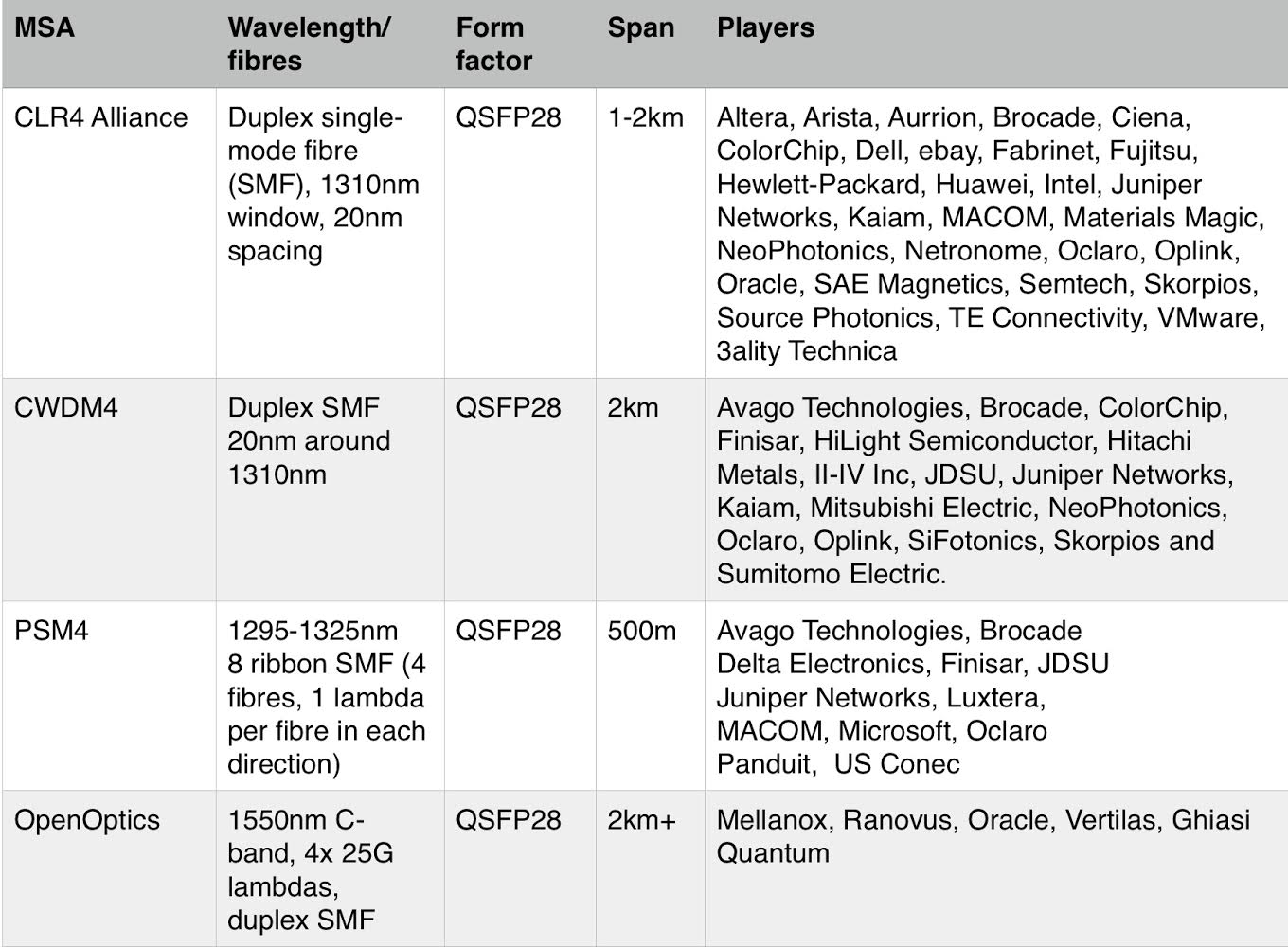
You may give little thought as to how your Facebook page is constructed each time you log in, or the data centre ramifications when you access Gmail. But for the internet giants, what is clear is that they need cheaper, higher-speed optical links to connect their equipment that match the growing size of their hyper-scale data centres.
The challenge for the web players is that existing 100 Gig links are either too short or too expensive. Ten and 40 Gig multimode interfaces span 300m, but at 100 Gig the reach plummets; the existing IEEE 802.3 Ethernet 100GBASE-SR10 and 100GBASE-SR4 multi-mode standards are 100m only. Meanwhile, the 10km reach of the next IEEE interface option, the 100 Gig single-mode 100GBASE-LR4, is overkill and expensive; the LR4 being sevenfold the cost of the 100GBASE-SR10, according to market research firm, LightCounting.
"The largest data centre operators will tell you less than 1km, less than 500m, is their sweet spot," says Martin Hull, director of product management at switch vendor, Arista Networks. Hyperscale data centres use a flatter switching architecture known as leaf and spine. "The flatter switching architectures require larger quantities of economical links between the leaf and spine switches," says Dale Murray, principal analyst at LightCounting.
A 'leaf' can be a top-of-rack switch connecting the servers to the larger-capacity 'spine' of the switch architecture. Operators want 100GbE interfaces with sufficient optical link budget to span 500m and greater distances, to interconnect the leaf and spine, or the spine to the data centre's edge router.
The optical industry has been heeding the web companies' request.
One reason the IEEE 802.3 Ethernet Working Group created the 802.3bm Task Force is to address mid-reach demand by creating a specification for a cheaper 500m interface. Four proposals emerged: parallel single mode (PSM4), coarse WDM (CWDM), pulse amplitude modulation, and discrete multi-tone. But none of the proposals passed the 75% voting threshold to become a standard.
The optical industry has since pursued a multi-source agreement (MSA) strategy to bring the much-needed solutions to market. In the last year, no fewer than four single-mode interfaces have emerged: the CLR4 Alliance, and the CWDM4, PSM4 and OpenOptics MSAs.
"The MSA-based solutions will have two important advantages," says Murray. "All will be much less expensive than a 10km 100Gig LR4 module and all can be accommodated by a QSFP28 form factor."
The 100 GbE PSM4, backed by the leading optical module makers (see table above), differs from the other three designs in using parallel ribbon fibre and having a 500m rather than a 2km reach. The PSM4 uses four 25 Gig channels, each sent over a fibre, such that four fibres are used in each direction. The PSM4 is technically straightforward and is likely to be the most economical for links up to 500m. In contrast, the CLR4, CWDM4 and OpenOptical all use 4x25 Gig WDM over duplex fibre. Thus, while the PSM4 will likely be the cheapest of the four modules, the link's cost advantage is eroded with distance due to the ribbon fibre cost.
The PSM4 is also attractive for secondary applications; the 25 Gig channels could be used as individual 'breakout' links. Already there is industry interest in 25GbE, while the module could be used in future for 32 Gig Fibre Channel and high-density 128 Gig Fibre Channel.
The OpenOptics MSA, backed by Mellanox and start-up Ranovus, operates in the 1550nm C-band and uses dense WDM, whereas the CLR4 Alliance and CWDM4 operate around 1310nm and use CWDM. The 100 GbE OpenOptics is also 4x25 Gig, such that the wavelengths can be spaced far apart but DWDM promises a roadmap for even higher speed interfaces.
The CLR4 Alliance is an Intel-Arista initiative that has garnered wide industry backing, but it is not an MSA. The specification is very similar to the CWDM4. Both the CLR4 and the CWDM4 include forward error correction (FEC) but whereas FEC is fundamental to the CWDM4, it is an option with the CLR4.
"We have focussed on the FEC-enabled [CWDM4] version so that optical manufacturers can develop the lowest possible cost components to support the interface," says Mitchell Fields, senior director, product marketing and strategy, fiber-optics product division at Avago. FEC adds flexibility, he says, not just in relaxing the components' specification but also simplifying module testing.
The backers of CWDM4 and CLR4 are working to align their specifications and while it is likely the two will interoperate, it remains unclear whether the two will merge.
The CWDM4 specification is likely to be completed in September with first products appearing as early as one or two quarters later. Arista points out that it already has a switch that could use CWDM4/ CLR4 modules now if they were available.
John D'Ambrosia, chairman of the Ethernet Alliance, regrets that four specifications have emerged. "My own personal belief is that it would be better for the industry overall if we didn't have so many choices," he says. "But the reality is there are a lot of different applications out there."
LightCounting expects the PSM4 and a merged CWDM offering will find strong market traction. "Avago, Finisar, JDSU and Oclaro are participating in both categories, demonstrating that each has its own value proposition," says Murray.
This article first appeared in the Optical Connections ECOC '14 magazine issue.
For a more detailed article on mid-reach optics, see p28 of the Autumn issue of Fibre Systems, click here
Article Revision: 30/10/2014: Updated members list of the OpenOptics MSA
Ciena adds software to enhance network control
Engineers at Ciena have developed software to provide service providers with greater control over their networks. The operators' customers will also benefit from the software control, using a web portal to meet their own networking needs.
 Source: Ciena
"Networks can become more dynamic," says Tom Mock, senior vice president, corporate communications at Ciena. "Operators can now offer more on-demand services." If much work has been done in recent years to make the network's lower layers dynamic, attention is turning to software to make the networks programmable, he says.
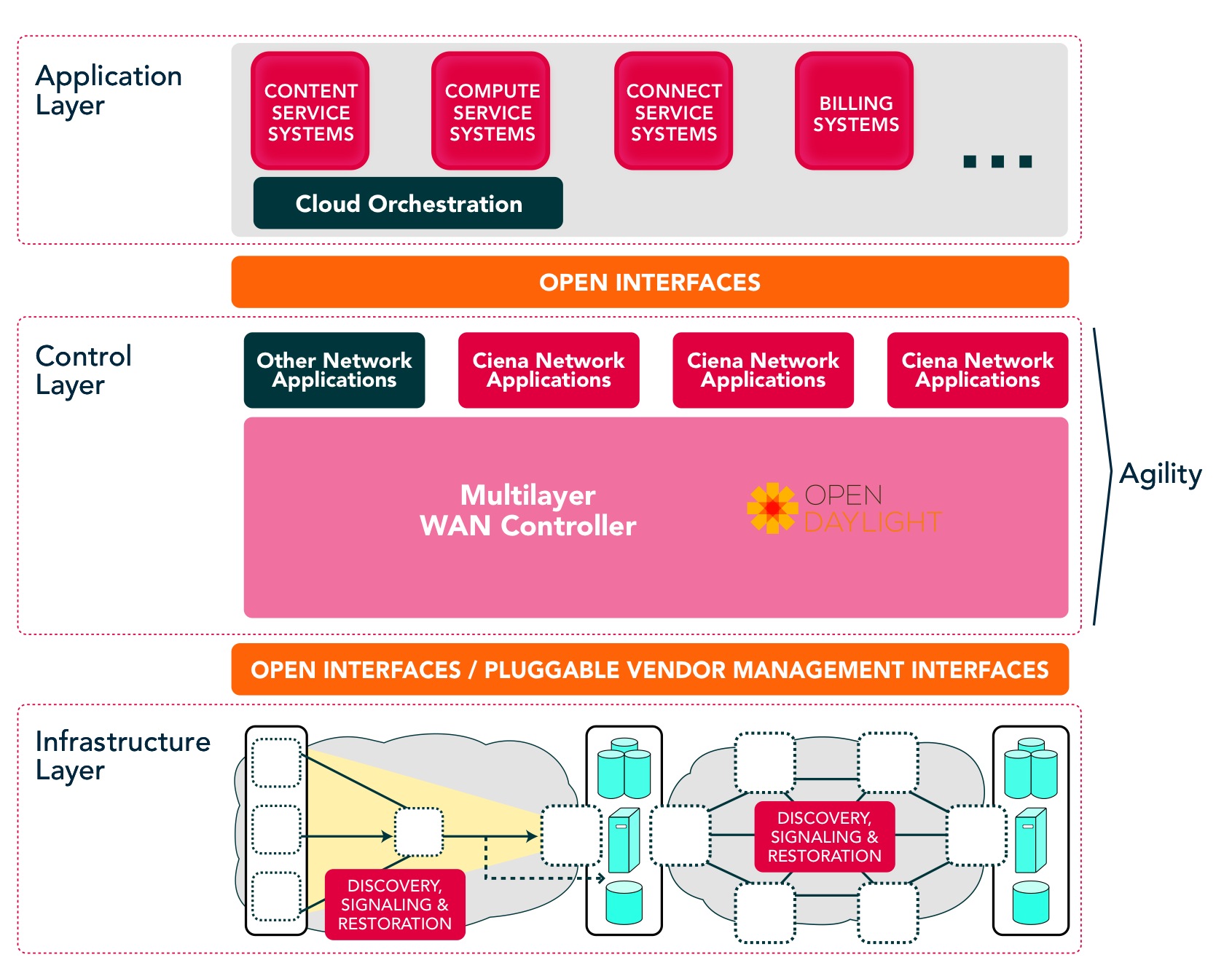
Ciena's announced Agility software portfolio, which resides in the network management centre running on standard computing hardware, includes:
- A multi-layer software-defined networking (SDN) controller
- Three networking applications: Navigate, Protect and Optimize. Navigate is used to determine the ideal route for a connection, Protect is a restoration path calculator used to protect against network failures, while Optimize frees up stranded bandwidth across the network's layers.
- Enhancements to Ciena's existing V-WAN network services module.
Ciena chose to implement the SDN controller using the OpenDaylight framework to ensure it will work with other vendors' equipment, while third-party developers writing software using the open source framework will benefit from Ciena's apps and platforms.
"We think the market is evolving so quickly that there isn't any one company that can deal with all the things end users will require," says Mock. "This idea of openness is not so much a nice thing as a requirement; it is going to require the cooperation of multiple vendors to build the kind of network that service providers are going to require."
At the top of the SDN architecture is the application layer, which resides above the control layer that, in turn, oversees the underlying infrastructure layer where the equipment resides. Agility's three network applications sit above the SDN controller while still being part of the control layer (see diagram).
This idea of openness is not so much a nice thing as a requirement; it is going to require the cooperation of multiple vendors to build the kind of network that service providers are going to require
End users can now control their network requirements using the V-WAN orchestrator. Ciena has added monitoring and control interfaces to enhance V-WAN. End users can now control their networking requirements using a web portal. The operator and the end user also have improved visibility about the network's health due to the performance monitoring. More plug-in adaptors have also been added to interface the platform to more equipment, while service providers can use V-WAN to set up VPNs for multiple users.
"[V-WAN] provides for an outside application to control the network directly," says Mock. "A service provider doesn't have to change the connectivity map, or establish or take down a connection."
V-WAN sits between the SDN's upper two layers, allowing applications in the applications layer to access the SDN controller. Ciena has already detailed work with Brocade that allows the vendor's data centre orchestrator - the Application Resource Broker (ARB) used to set up storage and compute resources - can request cloud resources in a remote data centre when demand can no longer be fulfilled in the existing one. Ciena has provided a plug-in adapter between Brocade's orchestrator and V-WAN to establish a connection between the data centres to allow workload transfers as required.
V-WAN will also be used by Equinix to allow end users to connect its data centres with other cloud computing providers. "If an Equinix end user today wants to run part of their applications on Amazon, they can do that, and if tomorrow they have a different set of applications that they want to run on Microsoft, they can do that as well, without changing a real lot of their physical infrastructure," says Mock.
The Agility software portfolio is Ciena's own work, developed prior to its strategic partnership with Ericsson that was announced earlier this year. However, the two companies are now working to add Ericsson's layer-3 capability to the OpenDaylight SDN controller. Mock says the enhanced SDN controller will be available in 2015.
Meanwhile, the V-WAN product is available now. The SDN controller and the three network applications are being trialled and will be available later this year.
10 Gigabit Plain Old Telephone Service
Bell Labs has sent unprecedented amounts of data down a telephone wire. The research arm of Alcatel-Lucent has achieved one-gigabit streams in both directions over 70m of wire, and 10-gigabit one-way over 30m using a bonded pair of telephone wires.
 Keith RussellThe demonstrations show how gigabit-speed broadband could use telephone wire to bridge the gap between a local optical fibre point and a home. The optical fibre point may be located at the curbside, on a wall or in an apartment's basement.
Service providers want to deliver gigabit services to compete with cable operators and developments like Google Fiber, the Web giant's one-gigabit broadband initiative in the US. Such technology will help the operators deploy gigabit broadband, saving them time and expense.
"This kind of a technology is really going to be an enabler of fibre-to-the-home," says Keith Russell, senior marketing manager, fixed networks business at Alcatel-Lucent. "Service providers will have another tool, addressing those parts of the network where it is hard to drive fibre right to the home, whether it is a multi-dwelling unit or where they can't trench fibre those last few meters."
Bell Labs delivers gigabits of data down the telephone wire by using more spectrum. VDSL2 uses 17MHz of spectrum while the first implementation of the emerging G.fast standard extends the frequency band to 106MHz. Alcatel-Lucent has gone beyond G.fast and uses even more spectrum: 350MHz for symmetrical 1 Gigabit, and up to 500MHz to demonstrate 10 Gigabit. Bell Labs calls its technology XG-FAST.
BT's chief executive, Gavin Patterson, has already described G.fast as a very exciting technology. "It allows us to get speeds of up to one-gigabit, and it builds on VDSL," said Patterson during BT's most recent quarterly results call. "It takes the fibre closer to the premise, so effectively you get a glass transmission closer to the premise but not always all the way in."
XG-FAST will take longer and will likely be commercially available only from 2018, says Teresa Mastrangelo, principal analyst at Broadbandtrends: "That timeline may still provide a quicker means to deploying gigabit services than having to deploy a full-blown fibre-to-the-home network."
 Source: Alcatel-Lucent Bell Labs
Using such a broad spectrum of the telephone wire, designed a century ago to carry voice signals several kilohertz wide, creates two challenges.
One is that signal attenuation grows with frequency. Hence the wider the spectrum, the shorter the copper loop length over which data can travel. VDSL2 has a loop-length of some 1,500 meters while XG-FAST achieves tens of meters.
The second issue is crosstalk, where the signal on a copper pair leaks into a neighbouring pair, generating electrical noise. The leakage can be so noisy at the higher frequencies that it can exceed the desired signal.
For the Bell Labs demonstration, crosstalk was only an issue in the 10-gigabit example that uses two wire pairs. However, for VDSL2 and for the emerging G.fast standard, crosstalk is a significant problem. Systems vendors have developed advanced digital signal processing techniques, known as vectoring, to reject such noise.
Russell says that the G.fast standard's first phase - based on 106MHz of spectrum - will be ratified by year end. G.fast's second phase proposes doubling the spectrum to 212MHz. Alcatel-Lucent demonstrations using XG-FAST shows that digital subscriber line technology need not stop there.
"A lot of work is needed to take it [XG-FAST] into production," says Russell. First, there are engineering challenges, the broad spectrum used makes the analogue front-end chip design significantly more complex and expensive. Engineering effort will be needed before the cost of such a solution will match that of VDSL.
XG-FAST would also need to be considered along with other proposals and the chosen outcome standardised before operators will embrace the technology in their networks. Meanwhile, operators will start testing G.fast from next year with products appearing mid-2015.
Another issue is the need for extensive copper characterisation in order to understand the state of the copper and whether it can even support this type of technology, says Mastrangelo.
"It will be very interesting to see what happens with G.fast given the operator interest in gigabit services," says Russell. "[G.fast] is a very strong option for operators wanting to offer such services quickly."
BT estimates that the technology is two years away before it will play a role in the network.
* The article was further edited and added to on July 16th.
EZchip targets multi-core processing with Tilera purchase
Network processor specialist, EZchip Semiconductor, is to acquire Tilera. The deal is valued at $130 million in cash: $50 million when the deal closes, and up to $80 million more depending on performance targets being met.
 Bob Wheeler, The Linley Group
Tilera's products include multi-core processors, intelligent network interface cards (NICs) and one rack-unit (1RU) network - 'whitebox' - appliances used for security applications.
Acquiring Tilera will broaden EZchip's market. Tilera's devices are used for network appliances, enterprise routers, cloud computing, video and voice encoders, security, deep-packet inspection, load-balancing, and emerging applications such as software-defined networking (SDN) and network functions virtualisation (NFV).
EZchip's first acquisition will also broaden the company's US presence and customers: Tilera has 100 customers including Brocade, Check Point Software Technologies, Cisco, Fujitsu, Harmonic, MikroTik and ZTE.
EZchip estimates that with the acquisition, its total addressable market will double to $2 billion by 2016.
EZchip's flagship NPS is a high-end network processor family while Tilera's multi-core general processors include the Tile-GX family with 9, 16, 36 and 72, 64-bit cores, programmed using the C-language and which supports the Linux operating system.
"The two companies are highly complementary," says Bob Wheeler, principal analyst for networking at the Linley Group. "Beyond the obvious addition of products, markets, and customers, I see Tilera’s software and systems expertise as important to the success of EZchip’s existing NPS programme."
Eli Fruchter, CEO of EZchip, says that the two companies have been discussing co-development of a next-generation multi-core family that will add specialist networking accelerator hardware from EZchip. The resulting family will have the highest core count at the lowest power, while achieving leading networking and packet-processing performance, says the CEO.
Tilera's designs are noted for their processing performance per watt. Wheeler also highlights the company's iMesh tiled architecture which enables efficient scaling as cores are added to a chip. "Tilera’s proprietary 64-bit VLIW [very long instruction word] CPU design is also important in delivering leading power efficiency," he says.
The next-generation device family will use a standard processing core and move away from Tilera's proprietary technology. EZchip's NPS uses the 32-bit ARC core which EZchip has redesigned. "Network security and monitoring are the primary targets [for the next-gen devices]," says Wheeler. "Tilera currently serves other applications, including videoconferencing, but these won’t benefit from EZchip’s accelerators."
Tilera's revenues were $35 million in 2013, suggesting single-digit percent market share using EZchip's $1 billion TAM estimate. It thus has some way to go to compete with Broadcom and Cavium. Near term, customers may be more willing to work with a profitable public company, notes Wheeler, but for EZchip to achieve major share gains will depend on delivering next-generation processors.
Tilera's revenues declined in the first half of 2014. EZchip would not detail why, except to suggest that the decline in orders is temporary and that growth will return in the second half of 2014. EZchip is confident Tilera's revenues will exceed $35 million in 2015.
EZchip will pay Tilera's shareholders up to $80 million if revenue targets are met: $50 million in cash if revenues reach $45 million between when the deal closes in Q3 2014 and June 2015, and a further $30 million if revenues of $31 million are achieved in the second half of 2015.
Colt's network transformation
Colt's technology and architecture specialist, Mirko Voltolini, talks to Gazettabyte about how the service provider has transformed its network from one based on custom platforms to an open, modular design.
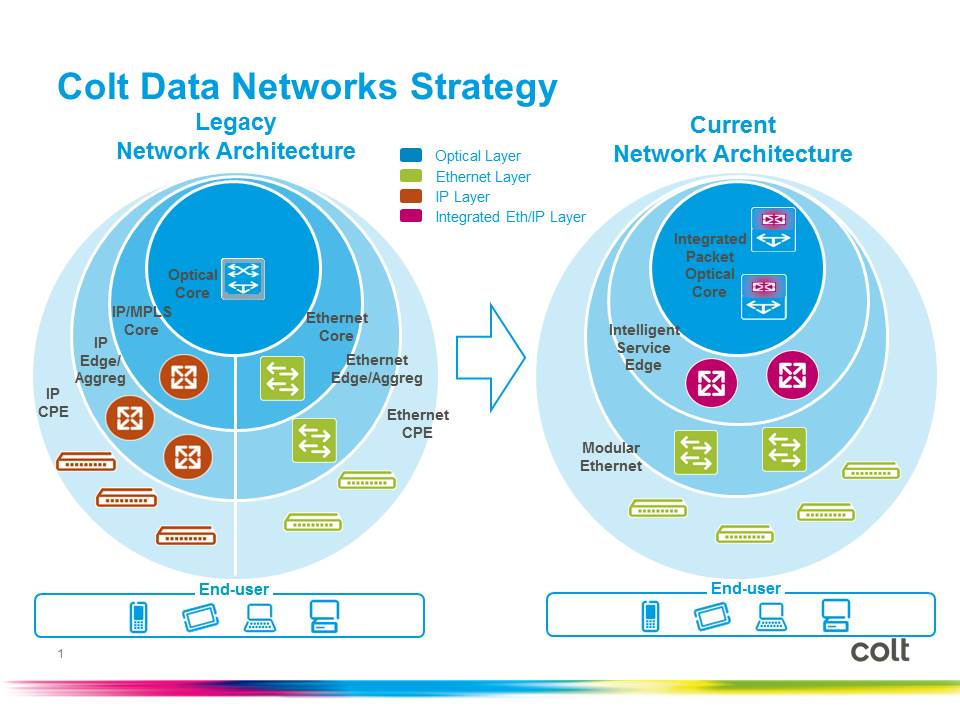
It was obvious to Colt that something had to change. Its network architecture based on proprietary platforms running custom software was not sustainable; the highly customised network was cumbersome, resistant to change and expensive to run. The network also required a platform to be replaced - or at least a new platform added alongside an existing one - every five to seven years.
 Mirko Voltolini
"The cost of this approach is enormous," says Mirko Voltolini, vice president technology and architecture at Colt Technology Services. "Not just in money but the time it takes to roll out a new platform."
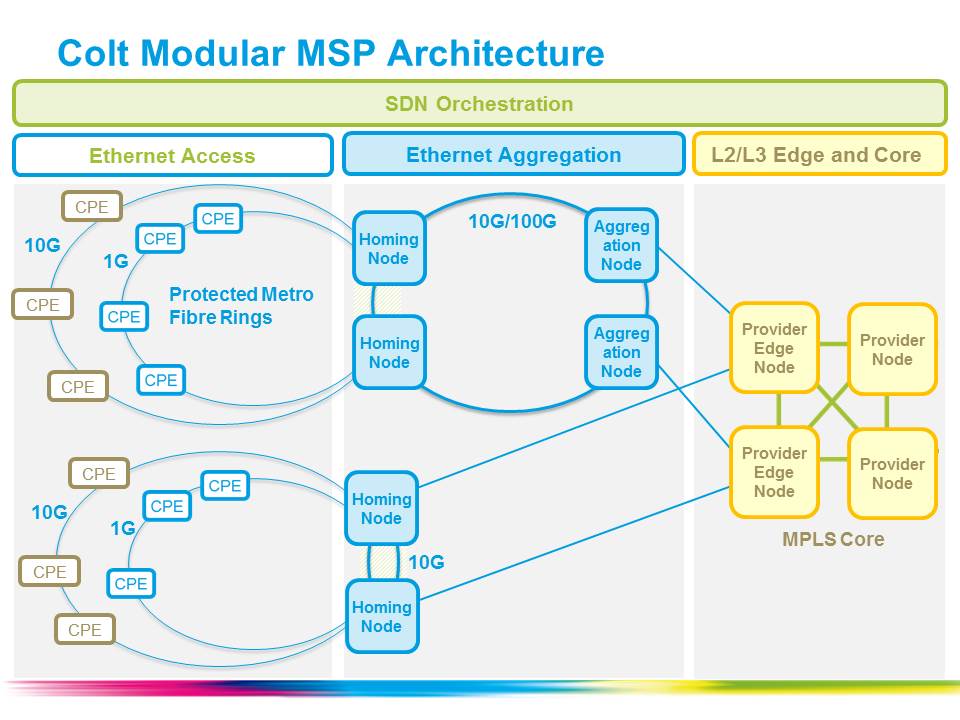
Instead, the service provider has sought a modular approach to network design using standardised platforms that are separated from each other. That way, a new platform with a better feature set or improved economics can be slotted in without impacted the other platforms. Colt calls its resulting network a modular multi-service platform (MSP).
The MSP now delivers the majority of Colt's data networking and all-IP services. These includes Carrier Ethernet point-to-point, hub-and-spoke and private networks services, as well as internet access, IP VPNs and VoIP IP-based services.
The vendors chosen for the MSP include Cyan with its Z-Series packet-optical transport system (P-OTS) and Blue Planet software-defined networking (SDN) platform and Accedian Networks' customer premise equipment (CPE). Cyan's Z-Series does not support IP, so Colt uses Juniper Networks' and Alcatel-Lucent's IP edge platforms. Colt also has a legacy 20-year-old SDH network but despite using a P-OTS platform, it has decided to leave the SDH platform alone, with the modular MSP running alongside it.
Colt chose its vendors based on certain design goals. "The key was openness," says Voltolini. "We didn't want to have a closed system." It was Cyan's management system, the Blue Planet platform, that led Colt to choose Cyan.
Associated with Blue Planet is an ecosystem that allows the management software to control other vendors' platforms. Cyan uses 'element adapters' that mediate between its SDN interface software and the proprietary interfaces of its vendor partners. Cyan says that its Z-Series P-OTS appears as a third-party piece of equipment to its Blue Planet software in the same way as the other vendors' equipment are; a view confirmed by Colt. "Because of its openness, we have been able to integrate other vendors to use the same management system as if they were Cyan components," says Voltolini.

"Cyan was probably the best option available and we decided to go with it," says Voltolini. The company was looking at what was available two years ago and Voltolini points out that the market has evolved significantly since then. "In the end, if you want to move ahead, you need to make decisions," he says. "We are quite happy with what we have picked and we continue to improve it."
Colt says that as well as SDN, network functions virtualisation (NFV) is also important. "With the same modular platform we have created a virtual component which is a layer-3 CPE," says Voltolini. The company is issuing a request-for-information (RFI) regarding other CPE functions like firewalls, load-balancers and other networking components.
Benefits and lessons learned
Adopting the MSP has speeded up Colt's service delivery. Before the modular network, it would take between 30 and 45 days for Colt to fulfil a customer's request for a three-month-long Ethernet link upgrade, from 100 Megabit to 200 Megabit. Now, such a request can be fulfilled in seconds. "We didn't need any more layer-3 CPE and we can upgrade remotely the bandwidth," says Voltolini.
Colt also estimates that it will halve its operational costs once the new network is fully deployed; the network went live in November 2013 and has not been deployed in all locations. The operational expense improvement and the greater service flexibility both benefit Colt's bottom line, says Voltolini.
A key lesson learned from the network transformation is the importance of leading staff through change rather than any technological issues. "The technology has been a challenge but in the end, with the suppliers, you can design anything you want if you have the right level of collaboration," says Voltolini. "But when you completely transform the way you deliver services, you are touching everything that is part of the engine of the company."
Colt cites aspects such as engineering solutions, service delivery, service operations, systems and processes, and the sales process. "You need to lead the transition is such a way that everybody is going to follow you," says Voltolini.
Colt encountered obstacles created because of the staff's natural resistance to change. "Certain things took longer," says Voltolini. "We had to overcome obstacles that weren't really obstacles, just people's fear of change."
OIF prepares for virtual network services
The Optical Internetworking Forum has begun specification work for virtual network services (VNS) that will enable customers of telcos to define their own networks. VNS will enable a user to define a multi-layer network (layer-1 and layer-2, for now) more flexibly than existing schemes such as virtual private networks.
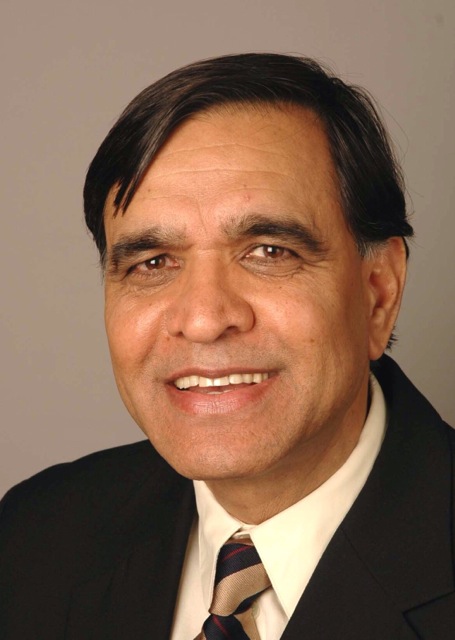 Vishnu Shukla"Here, we are talking about service, and a simple way to describe it [VNS] is network slicing," says OIF president, Vishnu Shukla. "With transport SDN [software-defined networking], such value-added services become available."
The OIF work will identify what carriers and system vendors must do to implement VNS. Shukla says the OIF already has experience working across multiple networking layers, and is undertaking transport SDN work. "VNS is a really valuable extension of the transport SDN work," says Shukla.
The OIF expects to complete its VNS Implementation Agreement work by year-end 2015.
Meanwhile, the OIF's Carrier Working Group has published its recommendations document, entitled OIF Carrier WG Requirements for Intermediate Reach 100G DWDM for Metro Type Applications, that provides input for the OIF's Physical Link Layer (PLL) Working Group.
The PLL Working Group is defining the requirements needed for a compact, low-cost and low-power 100 Gig interface for metro and regional networks. This is similar to the OIF work that successfully defined the first 100 Gig coherent modules in a 5x7-inch MSA.
The Carrier Working Group report highlights key metro issues facing operators. One is the rapid growth of metro traffic which, according to Cisco Systems, will surpass long-haul traffic in 2014. Another is the change metro networks are undergoing. The metro is moving from a traditional ring to a mesh architecture with the increasing use of reconfigurable optical add/drop multiplexers (ROADMs). As a result, optical wavelengths have further to travel, must contend with passing through more ROADMs stages and more fibre-induced signal impairments.
Shukla stresses there are differences among operators as to what is considered a metro network. For example, metro networks in North America span 400-600km typically and can be as much as 1,000km. In Europe such spans are considered regional or even long-haul networks. Metro networks also vary greatly in their characteristics. "Because of these variations, the requirements on optical modules varies so much, from unit to unit and area to area," says Shukla.
Given these challenges, operators want a module with sufficient optical performance to contend with the ROADM stages, and variable distances and network conditions encountered. "Sometimes we feel that the requirements [between metro and long-haul] won't be that much [different]," says Shukla. Indeed, the Carrier Working Group report discusses how the boundaries between metro and long-haul networks are blurring.
Yet operators also want such robust optical module performance at a greatly reduced price. One of the report's listed requirements is the need for the 100 Gig intermediate-reach interfaces to cost 'significantly' less than the cheapest long-haul 100 Gig.
To this aim, the report recommends that the 100 Gig pluggable optical modules such as the CFP or CFP2 be used. Standardising on industry-accepted pluggable MSAs will drive down cost as happened with the introduction of 100 Gig long haul 5x7-inch MSA modules.
Metro and regional coherent interfaces will also allow the specifications to be relaxed in terms of the DSP-ASIC requirements and the modulation schemes used. "When we come to the metro area, chances are that some of the technologies can be done more simply, and the cost will go down," says Shukla. Using pluggables will also increase 100 Gig line card densities, further reducing cost, while the report also favours the DSP-ASIC being integrated into the pluggable module, where possible.
Contributors to the Carrier Working Group report include representatives from China Telecom, Deutsche Telekom, Orange, Telus and Verizon, as well as module maker Acacia.