

Reflecting light to save power
System vendors will be held increasingly responsible for the power consumption of their telecom and datacom platforms. That’s because for each watt the equipment generates, up to six watts is required for cooling. It is a burden that will only get heavier given the relentless growth in network traffic.
 "Enterprises are looking for huge capacity at low cost and are increasingly concerned about the overall impact on power consumption"
David Smith, CIP Technologies
No surprise, then, that the European 7th Framework Programme has kicked-off a research project to tackle power consumption. The Colorless and Coolerless Components for Low-Power Optical Networks (C-3PO) project involves six partners that include component specialist CIP Technologies and system vendors ADVA Optical Networking.

CIP is the project’s sole opto-electronics provider while ADVA Optical Networking's role is as system integrator.
“It’s not the power consumption of the optics alone,” says David Smith, CTO of CIP Technologies. “The project is looking at component technology and architectural issues which can reduce overall power consumption.”
The data centre is an obvious culprit, requiring up to 5 megawatts. Power is consumed by IT and networking equipment within the data centre – not a C-3PO project focus – and by optical networking equipment that links the data centre to other sites. “Large enterprises have to transport huge amounts of capacity between data centres, and requirements are growing exponentially,” says Smith. “They [enterprises] are looking for huge capacity at low cost and are increasingly concerned about the overall impact on power consumption.”
One C-3PO goal is to explore how to scale traffic without impacting the data centre’s overall power consumption. Conventional dense wavelength division multiplexing (DWDM) equipment isn’t necessarily the most power-efficient given that DWDM tunable lasers requires their own cooling. “There is the power that goes into cooling the transponder, and to get the heat away you need to multiply again by the power needed for air conditioning,” says Smith.
Another idea gaining attention is operating data centres at higher ambient temperatures to reduce the air conditioning needed. This idea works with chips that have a wide operating temperature but the performance of optics - indium phosphide-based actives - degrade with temperature such that extra cooling is required. As such, power consumption could even be worse, says Smith
A more controversial optical transport idea is changing how line-side transport is done. Adding transceivers directly to IP core routers saves on the overall DWDM equipment deployed. This is not a new idea, says Smith, and an argument against this is it places tunable lasers and their cooling on an IP router which operates at a relatively high ambient temperature. The power reduction sought may not be achieved.
But by adopting a new transceiver design, using coolerless and colourless (reflective) components, operating at a wider temperature range without needing significant cooling is possible. “It is speculative but there is a good commercial argument that this could be effective,” says Smith.
C-3PO will also exploit material systems to extend devices’ temperature range - 75oC to 85oC - to eliminate as much cooling as possible. Such material systems expertise is the result of CIP’s involvement in other collaborative projects.
"If the [WDM-PON] technology is deployed on a broad scale - that is millions of user lines – every single watt counts"
Klaus Grobe, ADVA Optical Networking
Indeed a companion project, to be announced soon, will run alongside C-3PO based on what Smith describes as ‘revolutionary new material systems’. These systems will greatly improve the temperature performance of opto-electronics. “C-3PO is not dependent on this [project] but may benefit from it,” he says.
Colourless and coolerless
CIP’s role in the project will be to integrate modulators and arrays of lasers and detectors to make coolerless and colourless optical transmission technology. CIP has its own hybrid optical integration technology called HyBoard.
“Coolerless is something that will always be aspirational,” says Smith. C-3PO will develop technology to reduce and even eliminate cooling where possible to reduce overall power consumption. “Whether you can get all parts coolerless, that is something to be strived for,” he says.
Colourless implies wavelength independence. For light sources, one way to achieve colourless operation is by using tunable lasers, another is to use reflective optics.
CIP Technologies has been working on reflective optics as part of its work on wavelength division multiplexing, passive optical networks (WDM-PON). Given such reflective optics work for distances up to 100km for optical access, CIP has considered using the technology for metro and enterprise networking applications.
Smith expects the technology to work over 200-300km, at data rates from 10 to 28 Gigabit-per-second (Gbps) per channel. Four 28Gbps channels would enable low-cost 100Gbps DWDM interfaces.
Reflective transmission
CIP’s building-block components used for colourless transmission include a multi-wavelength laser, an arrayed waveguide grating (AWG), reflective modulators and receivers (see diagram).
 Reflective DWDM architecture. Source: CIP Technologies
Smith describes the multi-wavelength laser as an integrated component, effectively an array of sources. This is more efficient for longer distances than using a broadband source that is sliced to create particular wavelengths. “Each line is very narrow, pure and controlled,” says Smith.
The laser source is passed through the AWG which feds individual wavelengths to the reflective modulators where they are modulated and passed back through the AWG. The benefit of using a reflective modulator rather than a pass-through one is a simpler system. If the light source is passed through the modulator, a second AWG is needed to combine all the sources, as well as a second fibre. Single-ended fibre is also simpler to package.
For data rates of 1 or 2Gbps, the reflective modulator used can be a reflective semiconductor optical amplifier (RSOA). At speeds of 10Gbps and above, the complementary SOA-REAM (reflective electro-absorption modulator) is used; the REAM offers a broader bandwidth while the SOA offers gain.
The benefit of a reflective scheme is that the laser source, made athermal and coolerless, consumes far less power than tunable lasers. “It has to be at least half the cost and we think that is achievable,” says Smith.
Using the example of the IP router, the colourless SFP transceiver – made up of a modulator and detector - would be placed on each line card. And the multi-wavelength laser source would be fed to each card’s module.
Another part of the project is looking at using arrays of REAMs for WDM-PON. Such an modulator array would be used at the central office optical line terminal (OLT). “Here there are real space and cost savings using arrays of reflective electro-absorption modulators given their low power requirements,” says Smith. “If we can do this with little or no cooling required there will be significant savings compared to a tunable laser solution.”
ADVA Optical Networking points out that with an 80-channel WDM-PON system, there will be a total of 160 wavelengths (see the business case for WDM-PON). “If you consider 80 clients at the OLT being terminated with 80 SFPs, there will be a cost, energy consumption and form-factor overkill,” says Klaus Grobe, senior principal engineer at ADVA Optical Networking. “The only known solution for this is high integration of the transceiver arrays and that is exactly what C-3PO is about.”
The low-power aspect of C-3PO for WDM-PON is also key. “In next-gen access, it is absolutely vital,” says Grobe. “If the technology is deployed on a broad scale - that is millions of user lines – every single watt counts, otherwise you end up with differences in the approaches that go into the megawatts and even gigawatts.”
 There is also a benchmarking issue: the WDM-PON OLT will be compared to the XG-PON standard, the next-generation 10Gbps Gigabit passive optical network (GPON) scheme. Since XG-PON will use time-division multiplexing, there will be only one transceiver at the OLT. But this is what a 40- or 80-channel WDM-PON OLT will be compared with.
CIP will also be working closely with 3-CPO partner, IMEC, as part of the design of the low-power ICs to drive the modulators.
Project timescales
The C-3PO project started in June 2010 and will last three years. The total funding of the project is €2.6 million with the European Union contributing €1.99 million.
The project will start by defining system requirements for the WDM-PON and optical transmission designs.
At CIP the project will employ the equivalent of two full-time staff for the project’s duration though Smith estimates that 15 CIP staff will be involved overall.
ADVA Optical Networking plans to use the results of the project – the WDM-PON and possibly the high-speed transmission interfaces - as part of its FSP 3000 WDM platform.
CIP expects that the technology developed as part of 3-CPO will be part of its advanced product offerings.

WDM-PON: Can it save operators over €10bn in total cost of ownership?
 Source: ADVA Optical Networking
“The focus of operators to squeeze the last dollar out of the system and optical component vendors is really nonsense.”
Klaus Grobe, ADVA Optical Networking.
Key findings
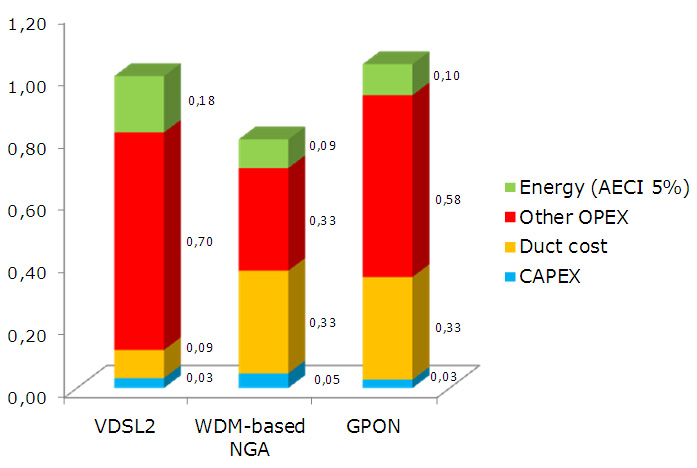
The total cost of ownership (TCO) of a widely deployed WDM-PON network is at least 20 percent cheaper than the broadband alternatives of VDSL and GPON. Given that the cost of deploying a wide-scale access network in a large western European country is €60bn, a 20 percent cost saving is huge, even if spread over 25 years.
What was modelled?
ADVA Optical Networking wanted to quantify the TCO of three access schemes: wavelength-division-multiplexing passive optical networking (WDM-PON), gigabit PON (GPON) - the PON scheme favoured by European incumbents, and copper-based VDSL (very high bit-rate digital subscriber line).
The company modelled a deployment serving 1 million residences and 10,000 enterprises. “We took seriously the idea of broadband roll out especially when operators talk about it being a strategic goal,” says Klaus Grobe, principal engineer at ADVA Optical Networking. “We wanted a single number that says it all.”
Assumptions
ADVA Optical Networking splits the TCO into four categories:
- Duct cost
- Other operational expense (OpEx)
- Energy consumption
- Capital expenditure (CapEx)
For ducting, it is assumed that VDSL already has fibre to the cabinet and the copper linking the user, whereas for optical access - WDM-PON and GPON - the feeder fibre is present but distribution fibre must be added to connect each home and enterprise. “There is also a certain upgrade of the feeder fibre required but it is 5 percent of the distribution fibre costs,” says Grobe. Hence the ducting costs of GPON and WDM-PON are similar and higher than VDSL.
A 25-year lifetime was also used for the TCO analysis during which three generations of upgrades are envisaged. For the end device like a PON optical network unit (ONU) the cost is the same for each generation, even if performance is significant improved each time.
The ‘other OpEx’ includes all the elements of OpEx except energy costs. The category includes planning and provisioning; operations, administration and maintenance (OA&M); and general overhead.
Planning and provisioning, as the name implies, covers the planning and provisioning of system links and bandwidth, says Grobe. Also the WDM-PON network serves both residential and enterprises whereas duplicate networks are required for GPON and VDSL, adding cost.
The ‘general overheads’ category includes an operator’s sales department. Grobe admits there is huge variation here depending on the operator and thus a common figure for all three cases was used.
Energy consumption is clearly important here. Three annual energy cost increase (AECI) rates were explored – 2, 5 and 10 percent (shown in the chart is the 5% case), with a cost of 80 €/MWh assumed for the first year.
The energy cost savings for WDM-PON come not from the individual equipment but from the reduced number of sites deploying the access technology allows. The power consumed of a WDM-PON ONU is 1W, greater than VDSL, says Grobe, but a lot more local exchanges and cabinets are used for VDSL than for WDM-PON.
And this is where the biggest savings arise: the difference in OA&M due to there being fewer sites for WDM-PON than for GPON and VDSL. That’s because WDM-PON has a larger, up to 100km, reach from the central office to the end user. And, as mentioned, a WDM-PON network caters for enterprise and residential users whereas GPON and VDSL require two distinct networks. This explains the large differences between VDSL, GPON and WDM-PON in the ‘other OpEX’ category.
Grobe says it is difficult to estimate the site reduction deploying WDM-PON will deliver. Operators are less forthcoming with such figures. However, the model and assumptions have been presented to operators and no objections were raised. Equally, the model is robust – varying wildly any one parameter does not change the main findings of the model.
Lastly, for CapEx, WDM-PON equipment is, as expected, the most expensive. CapEx for all three cases, however, is by far the smallest contributor to TCO.
Mass roll outs on the way?
So will operators now deploy WDM-PON on a huge scale? Sadly no, says Grobe. Up-front costs are paramount in operators’ thinking despite the vast cost saving if the lifetime of the network is considered.
But the analysis highlights something else for Grobe that will resonate with the optical community. “The focus of operators to squeeze the last dollar out of system and optical component vendors is really nonsense,” he says.
See ADVA Optical Networking's White Paper
See an associated presentation
Next-Gen PON: An interview with BT
 Peter Bell, Access Platform Director, BT Innovate & Design
Q: The status of 10 Gigabit PON – 10G EPON and 10G GPON (XG-PON): Applications, where it will be likely be used, and why is it needed?
PB: IEEE 10G EPON: BT not directly involved but we have been tracking it and believe the standard is close to completion (gazettabyte: The standard was ratified in September 2009.)
ITU-T 10Gbps PON: This has been worked on in the Full Service Access Network group (FSAN) where it became known as XG-PON. The first version XG-PON1 is 10Gbps downstream and 2.5Gbps upstream and work has started on this in ITU-T with a view to completion in the 2010 timeframe. The second version XG-PON2 is 10Gbps symmetrical and would follow later.
Not specific to BT’s plans but an operator may use 10Gbps PON where its higher capacity justified the extra cost. For example: business customers, feeding multi-dwelling units (MDUs) or VDSL street cabinets
Q: BT's interest in WDM-PON and how would it use it?
PB: BT is actively researching WDM-PON. In a paper presented at ECOC '09 conference in Vienna (24th September 2009) we reported the operation of a compact DWDM comb source on an integrated platform in a 32-channel, 50km WDM-PON system using 1.25Gbps reflective modulation.
We see WDM-PON as a longer term solution providing significantly higher capacity than GPON. As such we are interested in the 1Gbps per wavelength variants of WDM-PON and not the 100Mbps per wavelength variants.
Q: FSAN has two areas of research regarding NG PON: What is the status of this work?
PB: NG-PON1 work is focussed on 10 Gbps PON (known as XG-PON) and has advanced quite quickly into standardisation in ITU-T.
NG-PON2 work is longer term and progressing in parallel to NG-PON1
Q: BT's activities in next gen PON – 10G PON and WDM-PON?
PB: It is fair to say BT has led research on 10Gbps PONs. For example an early 10Gbps PON paper by Nesset et al from ECOC 2005 we documented the first, error-free physical layer transmission at 10Gbps, over a 100km reach PON architecture for up and downstream.
We then partnered with vendors to achieve early proof-of-concepts via two EU funded collaborations.
Firstly in MUSE we collaborated with NSN et al to essentially do first proof-of-concept of what has become known as XG-PON1 (see attached long reach PON paper).
Secondly, our work with NSN, Alcatel-Lucent et al on 10Gbps symmetrical hybrid WDM/TDMA PONs in EU project PIEMAN has very recently been completed.
Q: What are the technical challenges associated with 10G PON and especially WDM-PON?
For 10Gbps PONs in general the technical challenges are:
- Achieving the same loss budgets - reach - as GPON despite operating at higher bitrate and without pushing up the cost.
- Coexistence on same fibres as GPON to aid migration.
- For the specific case of 10Gbps symmetrical (XG-PON2) the 10 Gbps burst mode receiver to use in the headend is especially challenging. This has been a major achievement of our work in PIEMAN.
For WDM-PONs the technical challenges are:
- Reducing the cost and footprint of the headend equipment (requires optical component innovation)
- Standardisation to increase volumes of WDM-PON specific optical components thereby reducing costs.
- Upgrade from live GPON/EPON network to WDM-PON (e.g. changing splitter technology)
Q: There are several ways in which WDM-PON can be implemented, does BT favour one and why, or is it less fussed about the implementation and more meeting its cost points?
PB: We are only interested in WDM-PONs giving 1Gbps per wavelength or more and not the 100Mbps per wavelength variants. In terms of detailed implementation we would support the variant giving lowest cost, footprint and power consumption.
Q: What has been happening with BT's Long Reach PON work
PB: We have done lots of work on the long reach PON concept which is summarised in a review published paper from IEEE JLT and includes details of our work to prototype a next-generation PON capable of 10Gbps, 100km reach and 512-way split. This includes EU collaborations MUSE and PIEMAN
From a technical perspective, Class B+ and C+ GPON (G.984.2) could reach a high percentage of UK customers from a significantly reduced number of BT exchanges. Longer reach PONs would then increase the coverage further.
Following our widely published work in amplified GPON, extended reach GPON has now been standardised (G.984.6) to have 60 km reach and 128-way split, and some vendors have early products. And 10Gbps PON standards are expected to have same reach as GPON.