

5G-PON: SK Telecom’s unified distribution network
SK Telecom has detailed a networking architecture based on wavelength division multiplexing-passive optical network (WDM-PON) technology that it says will simplify the rollout of 5G while delivering significant cost savings.
 The telecom operator has already deployed the networking architecture, dubbed 5G-PON, for its LTE network and is offering the design to the 5G network standards of the ITU-T.
“SK Telecom is already witnessing a great amount of cost reductions from the deployment of 5G-PON,” says Seungjoo Hong, manager of the Broadband Technology Lab at SK Telecom (pictured).
5G-PON
5G-PON provides a single distribution network for both cellular - LTE and 5G - and high-speed wireline broadband (see diagram).
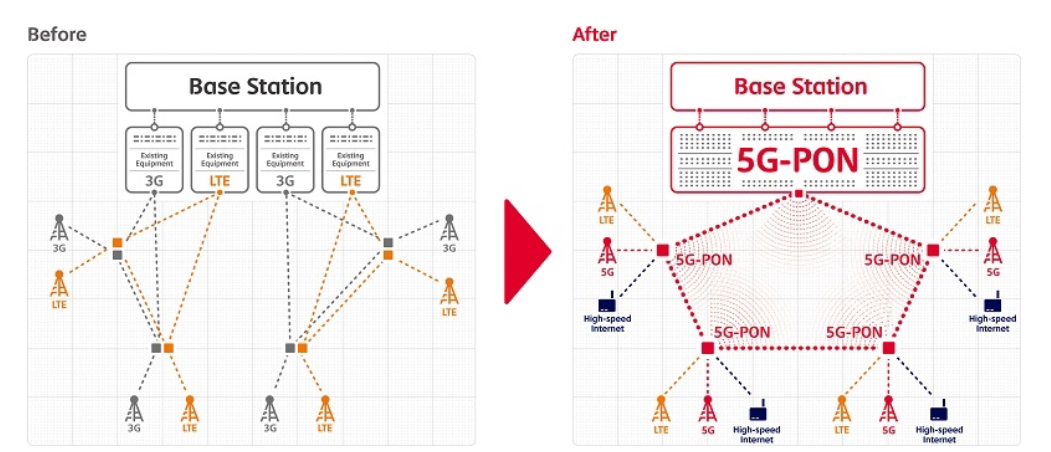 Source: SK Telecom
The architecture reduces networking costs by reusing existing fibre and optical filters while expanding capacity to support different and growing traffic streams. The architecture also uses passive nodes that do not require electrical power.
The 5G-PON network comprises three main elements: a central office terminal, the remote node and a tunable SFP pluggable module.
The central office terminal is located at the cellular base band unit (BBU) and performs such functions as wavelength conversion for WDM transmission, the monitoring of the optical link, and the management and configuration - location and order - of the remote nodes. The central office terminal also collects and analyses digital diagnostic monitoring information sent over an auxiliary management and control channel.
SK Telecom is already witnessing a great amount of cost reductions from the deployment of 5G-PON
The second element, the remote node, is a passive optical wavelength router, says Hong, and can be placed indoors or outdoors at a remote site. The remote node comprises a filter for coarse WDM (CWDM) and a filter for dense WDM (DWDM) and supports an optical ring topology between the first stage nodes - called the main radio node - as well as multi-stage node configurations such as a main and sub radio nodes (see the diagram below).
 Different 5G-PON configurations. SK Telecom favours a single-fibre ring arrangement. Source: SK Telecom
The central office terminal has knowledge of the order and location of the remote site nodes. This ensures a seamless service by performing delay equalisation due to optical path differences while executing ring protection switching within 50ms when a fibre is cut.
Meanwhile, the tunable SFP is installed at the cellular remote radio head (RRH). The tunable SFP is a low-cost design; it does not use a wavelength locker such that the SFP’s tunable laser is not dependent on a specific wavelength grid. The SFP is operated at the remote radio head using a software wavelength locking function that tracks the centre of the WDM filter using received optical power information from the central office terminal sent via an auxiliary management and control channel.
5G-PON has halved the cost of installation while operations and maintenance costs have been reduced 70 percent
CWDM architecture
5G-PON’s WDM-PON architecture uses CWDM with sub-channels.
The architecture can use existing installed fibre and filters while expanding capacity to a total of 256 wavelengths (16 sub-channels in each of 16 CWDM 20nm-wide bands), such that it can work alongside existing CWDM, DWDM and time-division multiplexing PON (TDM-PON) deployments.
“To expand network capacity in an area, operators can easily deploy a basestation using their existing fibre infrastructure, saving a great amount of installation cost,” says Hong. “5G-PON also allows operators to cover new areas with the least amount of cost.”
Hong says deploying 5G-PON has halved the cost of installation while operations and maintenance costs have been reduced 70 percent due to the intelligent operation and management of the passive nodes and the use of tunable SFPs at the remote sites.
SK Telecom has worked with local vendors including Solid, HFR, SunwaveTec and Coweaver to develop the 5G-PON architecture.
Status
The 5G-PON deployed for SK Telecom’s LTE front-haul network uses single-fibre bidirectional 3-gigabit and 6-gigabit 20km tunable SFPs that support 96 optical links on CPRI/ OBSAI interface channel cards.
Hong says that in 2018, SK Telecom will have bidirectional 10-gigabit tunable SFPs and will start developing of 25-gigabit bidirectional tunable SFPs and eCPRI interface channel cards for its 5G radio access network.
SK Telecom’s own preference is to use 5G-PON in a ring architecture to ensure service continuity in the event of a fibre cut. But depending on the operator, various topologies can be supported.
The operator plans to roll out 5G-PON in 85 areas nationwide, with further deployments expected thereafter.

OFC 2015 digest: Part 1
- Several vendors announced CFP2 analogue coherent optics
- 5x7-inch coherent MSAs: from 40 Gig submarine and ultra-long haul to 400 Gig metro
- Dual micro-ITLAs, dual modulators and dual ICRs as vendors prepare for 400 Gig
- WDM-PON demonstration from ADVA Optical Networking and Oclaro
- More compact and modular ROADM building blocks
JDSU also showed a dual-carrier coherent lithium niobate modulator capable of 400 Gig for long-reach applications. The company is also sampling a dual 100 Gig micro-ICR also for multiple sub-channel applications.
Avago announced a micro-ITLA device using its external cavity laser that has a line-width less than 100kHz. The micro-ITLA is suited for 100 Gig PM-QPSK and 200 Gig 16-QAM modulation formats and supports a flex-grid or gridless architecture.

Business services and mobile revive WDM-PON interest

"WDM-PON is many things to many people" - Jon Baldry
It was in 2005 that Novera Optics, a pioneer of WDM-PON (wavelength-division multiplexing, passive optical networking), was working with Korea Telecom in a trial involving 50,000 residential lines. Yet, one decade later, WDM-PON remains an emerging technology. And when a WDM-PON deployment does occur, it is for business services and mobile backhaul rather than residential broadband.
WDM-PON delivers high-capacity, symmetrical links using a dedicated wavelength. The links are also secure, an important consideration for businesses, and in contrast to PON where data is shared between all the end points, each selecting its addressed data.
One issue hindering the uptake of WDM-PON is the lack of a common specification. "WDM-PON is many things to many people," says Jon Baldry, technical marketing director at Transmode.
One view of WDM-PON is as the ultimate broadband technology; this was Novera's vision. Other vendors, such as Transmode, emphasise the WDM component of the technology, seeing it as a way to push metro-style networking towards the network edge, to increase bandwidth and for operational simplicity.
WDM-PON's uptake for residential access has not yet happened because the high bandwidth it offers is still not needed, while the system economics do not match those of PON.
Gigabit PON (GPON) and Ethernet PON (EPON) are now deployed in the tens of millions worldwide. And operators can turn to 10G-EPON and XG-PON when the bandwidth of GPON and EPON are insufficient. Beyond that, TWDM-PON (Time and Wavelength Division Multiplexing PON) is an emerging approach, promoted by the likes of Alcatel-Lucent and Huawei. TWDM-PON uses wavelength-division multiplexing as a way to scale PON, effectively supporting multiple 10 Gigabit PONs, each riding on a wavelength.
Carriers like the reassurance a technology roadmap such as PON's provides, but their broadband priority is wireless rather than wireline. The bigger portion of their spending is on rolling out LTE since wireless is their revenue earner.
As for fixed broadband, operators are being creative.
G.fast is one fixed broadband example. G.fast is the latest DSL standard that supports gigabit speeds over telephone wire. Using G.fast, operators can combine fibre and DSL to achieve gigabit rates and avoid the expense of taking fibre all the way to the home. BT is one operator backing G.fast, with pilot schemes scheduled for the summer. And if the trials are successful, G.fast deployments could start next year.
Deutsche Telekom is promoting a hybrid router to customers that combines fixed and wireless broadband, with LTE broadband kicking in when the DSL line becomes loaded.
Meanwhile, vendors with a WDM background see WDM-PON as a promising way to deliver high-volume business services, while also benefiting from the operator's cellular push by supporting mobile backhaul and mobile fronthaul. They don't dismiss WDM-PON for residential broadband but accept that the technology must first mature.
Transmode announced recently its first public customer, US operator RST Global Communications, which is using the vendor's iWDM-PON platform for business services.
"Our primary focus is business and mobile backhaul, and we are pushing WDM deeper into access networks," says Baldry. "We don't want a closed network where we treat WDM-PON differently to the way we treat the rest of the network." This means using the C-band wavelength grid for metro and WDM-PON. This avoids having to use optical-electrical-optical translation, as required between PON and WDM networks, says Baldry.
 The iWDM-PON system showing the seeder light source at the central office (CO) optical line terminal (OLT), and the multiplexer (MDU) that selects the individual light band for the end point customer premise equipment (CPE). Source: Transmode.
Transmode's iWDM-PON
Several schemes are being pursued to implement WDM-PON. One approach is seeded or self-tuning, where a broadband light source is transmitted down the fibre from the central office. An optical multiplexer is then used to pick off narrow bands of the light, each a seeder source to set the individual wavelength of each end point optical transceiver. An alternative approach is to use a tunable laser transceiver to set the upstream wavelength. A third scheme combines the broadband light source concept with coherent technology that picks off each transceiver's wavelength. The coherent approach promises extremely dense, 1,000 wavelength WDM-PONs.
Transmode has chosen the seeded scheme for the iWDM-PON platform. The system delivers 40, 1 Gigabit-per-second (Gbps) wavelengths spaced 50 GHz apart. The reach between the WDM-PON optical line terminal (OLT) and the optical network unit (ONU) end-points is 20 km without dispersion compensation fibre, or 30 km using such fibre. The platform uses WDM-PON SFP pluggable modules. The SFPs are MSA-compliant and use a fabry-perot laser and an avalanche photo-detector optimised for the injection-locked signal.
"We use the C-band and pluggable optics, so the choice of using WDM-PON optics or not is up to the customer," says Baldry. "It should not be a complicated decision, and the system should work seamlessly with everything else you do, enabling a mix of WDM-PON and regular higher speed or longer reach WDM over the same access network, as needed."
Baldry claims the approach has economic advantages as well as operational benefits. While there is a need for a broadband light source, the end point SFP WDM-PON transceivers are cheaper compared to fixed or tunable optics. Also setting the wavelengths is automated; the engineers do not need to set and lock the wavelength as they do using a tunable laser.
"The real advantage is operational simplicity," says Baldry, especially when an operator needs to scale optically connected end-points as they grow business and mobile backhaul services. "That is the intention of a PON-like network; if you are ramping up the end points then you have to think of the skill levels of the installation crews as you move to higher service volumes," he says.
RST Global Communications uses Transmode's Carrier Ethernet 2.0 as the service layer between the demarcation device (network interface device or NID) at the customer's premises, while using Transmode's packet-optical cards in the central office. WDM-PON provides the optical layer linking the two.
An early customer application for RST was upgrading a hotel's business connection from a few megabits to 1Gbps to carry Wi-Fi traffic in advance of a major conference it was hosting.
Overall, Transmode has a small number of operators deploying the iWDM-PON, with more testing or trialing it, says Baldry. The operators are interested in using the WDM-PON platform for mobile backhaul, mobile fronthaul and business services.
There are also operators that use installed access/ customer premise equipment from other vendors, exploring whether Transmode's WDM-PON platform can simplify the optical layer in their access networks.
Further developments
Transmode's iWDM-PON upgrade plans include moving the system from a two fibre design - one for the downstream traffic and one for the upstream traffic - to a single fibre one. To do this, the vendor will segment the C-band into two: half the C-band for the uplink and half for the downlink.
Another system requirement is to increase the data rate carried by each wavelength beyond a gigabit. Mobile fronthaul uses the Common Public Radio Interface (CPRI) standard to connect the remote radio head unit that typically resides on the antenna and the baseband unit.
CPRI data rates are multiples of the basic rate of 614.4 Mbps. As such 3 Gbps, 6 Gbps and rates over 10 Gbps are used. Baldry says the current iWDM-PON system can be extended beyond 1 Gbps to 2.5 Gbps and potentially 3 Gbps but because the system in noise-limited, the seeder light scheme will not stretch to 10 Gbps. A different optical scheme will be needed for 10 Gigabit. The iWDM-PON's passive infrastructure will allow for an in-service upgrade to 10 Gigabit WDM-PON technology once it becomes technically and economically viable.
Transmode has already conducted mobile fronthaul field trials in Russia and in Asia, and lab trials in Europe, using standard active and passive WDM and covering the necessary CPRI rates. "We are not mixing it with WDM-PON just yet; that is the next step," says Baldry.
Further information
WDM-PON Forum, click here
Lightwave Magazine: WDM-PON is a key component in next generation access
ECOC reflections: final part
Gazettabyte asked several attendees at the recent ECOC show, held in Cannes, to comment on key developments and trends they noted, as well as the issues they will track in the coming year.
Dr. Ioannis Tomkos, Fellow of OSA & Fellow of IET, Athens Information Technology Center (AIT)
With ECOC 2014 celebrating its 40th anniversary, the technical programme committee did its best to mark the occasion. For example, at the anniversary symposium, notable speakers presented the history of optical communications. Actual breakthroughs discussed during the conference sessions were limited, however.
 Ioannis Tomkos
It appears that after 2008 to 2012, a period of significant advancements, the industry is now more mainstream, and significant shifts in technologies are limited. It is clear that the original focus four decades ago on novel photonics technologies is long gone. Instead, there is more and more of a focus on high-speed electronics, signal processing algorithms, and networking. These have little to do with photonics even if they greatly improve the overall efficient operation of optical communication systems and networks.
Coherent detection technology is making its way in metro with commercial offerings becoming available, while in academia it is also discussed as a possible solution for future access network applications where long-reach, very-high power budgets and high-bit rates per customer are required. However, this will only happen if someone can come up with cost-effective implementations.
Advanced modulation formats and the associated digital signal processing are now well established for ultra-high capacity spectral-efficient transmission. The focus in now on forward-error-correction codes and their efficient implementations to deliver the required differentiation and competitive advantage of one offering versus another. This explains why so many of the relevant sessions and talks were so well attended.
There were several dedicated sessions covering flexible/ elastic optical networking. It was also mentioned in the plenary session by operator Orange. It looks like a field that started only fives years ago is maturing and people are now convinced about the significant short-term commercial potential of related solutions. Regarding latest research efforts in this field, people have realised that flexible networking using spectral super-channels will offer the most benefit if it becomes possible to access the contents of the super-channels at intermediate network locations/ nodes. To achieve that, besides traditional traffic grooming approaches such as those based on OTN, there were also several ground-breaking presentations proposing all-optical techniques to add/ drop sub-channels out of the super-channel.
Progress made so far on long-haul high-capacity space-division-multiplexed systems, as reported in a tutorial, invited talks and some contributed presentations, is amazing, yet the potential for wide-scale deployment of such technology was discussed by many as being at least a decade away. Certainly, this research generates a lot of interesting know-how but the impact in the industry might come with a long delay, after flexible networking and terabit transmission becomes mainstream.
Much attention was also given at ECOC to the application of optical communications in data centre networks, from data-centre interconnection to chip-to-chip links. There were many dedicated sessions and all were well attended.
Besides short-term work on high-bit-rate transceivers, there is also much effort towards novel silicon photonic integration approaches for realising optical interconnects, space-division-multiplexing approaches that for sure will first find their way in data centres, and even efforts related with the application of optical switching in data centres.
At the networking sessions, the buzz was around software-defined networking (SDN) and network functions virtualisation (NFV) now at the top of the “hype-cycle”. Both technologies have great potential to disrupt the industry structure, but scientific breakthroughs are obviously limited.
As for my interests going forward, I intend to look for more developments in the field of mobile traffic front-haul/ back-haul for the emerging 5G networks, as well as optical networking solutions for data centres since I feel that both markets present significant growth opportunities for the optical communications/ networking industry and the ECOC scientific community.
Dr. Jörg-Peter Elbers, vice president advanced technology, CTO Office, ADVA Optical Networking
The top topics at ECOC 2014 for me were elastic networks covering flexible grid, super-channels and selectable higher-order modulation; transport SDN; 100-Gigabit-plus data centre interconnects; mobile back- and front-hauling; and next-generation access networks.
For elastic networks, an optical layer with a flexible wavelength grid has become the de-facto standard. Investigations on the transceiver side are not just focussed on increasing the spectral efficiency, but also at increasing the symbol rate as a prospect for lowering the number of carriers for 400-Gigabit-plus super-channels and cost while maintaining the reach.
 Jörg-Peter Elbers
As we approach the Shannon limit, spectral efficiency gains are becoming limited. More papers were focussed on multi-core and/or few-mode fibres as a way to increase fibre capacity.
Transport SDN work is focussing on multi-tenancy network operation and multi-layer/ multi-domain network optimisation as the main use cases. Due to a lack of a standard for north-bound interfaces and a commonly agreed information model, many published papers are relying on vendor-specific implementations and proprietary protocol extensions.
Direct detect technologies for 400 Gigabit data centre interconnects are a hot topic in the IEEE and the industry. Consequently, there were a multitude of presentations, discussions and demonstrations on this topic with non-return-to-zero (NRZ), pulse amplitude modulation (PAM) and discrete multi-tone (DMT) being considered as the main modulation options. 100 Gigabit per wavelength is a desirable target for 400 Gig interconnects, to limit the overall number of parallel wavelengths. The obtainable optical performance on long links, specifically between geographically-dispersed data centres, though, may require staying at 50 Gig wavelengths.
In mobile back- and front-hauling, people increasingly recognise the timing challenges associated with LTE-Advanced networks and are looking for WDM-based networks as solutions. In the next-generation access space, components and solutions around NG-PON2 and its evolution gained most interest. Low-cost tunable lasers are a prerequisite and several companies are working on such solutions with some of them presenting results at the conference.
Questions around the use of SDN and NFV in optical networks beyond transport SDN point to the access and aggregation networks as a primary application area. The capability to programme the forwarding behaviour of the networks, and place and chain software network functions where they best fit, is seen as a way of lowering operational costs, increasing network efficiency and providing service agility and elasticity.
What did I learn at the show/ conference? There is a lot of development in optical components, leading to innovation cycles not always compatible with those of routers and switches. In turn, the cost, density and power consumption of short-reach interconnects is continually improving and these performance metrics are all lower than what can be achieved with line interfaces. This raises the question whether separating the photonic layer equipment from the electronic switching and routing equipment is not a better approach than building integrated multi-layer god-boxes.
There were no notable new trends or surprises at ECOC this year. Most of the presented work continued and elaborated on topics already identified.
As for what we will track closely in the coming year, all of the above developments are of interesting. Inter-data centre connectivity, WDM-PON and open programmable optical core networks are three to mention in particular.
For the first ECOC reflections, click here
OFC/NFOEC 2013 to highlight a period of change
Next week's OFC/NFOEC conference and exhibition, to be held in Anaheim, California, provides an opportunity to assess developments in the network and the data centre and get an update on emerging, potentially disruptive technologies.
 Source: Gazettabyte
Several networking developments suggest a period of change and opportunity for the industry. Yet the impact on optical component players will be subtle, with players being spared the full effects of any disruption. Meanwhile, industry players must contend with the ongoing challenges of fierce competition and price erosion while also funding much needed innovation.
The last year has seen the rise of software-defined networking (SDN), the operator-backed Network Functions Virtualization (NFV) initiative and growing interest in silicon photonics.
SDN has already being deployed in the data centre. Large data centre adopters are using an open standard implementation of SDN, OpenFlow, to control and tackle changing traffic flow requirements and workloads.
Telcos are also interested in SDN. They view the emerging technology as providing a more fundamental way to optimise their all-IP networks in terms of processing, storage and transport.
Carrier requirements are broader than those of data centre operators; unsurprising given their more complex networks. It is also unclear how open and interoperable SDN will be, given that established vendors are less keen to enable their switches and IP routers to be externally controlled. But the consensus is that the telcos and large content service providers backing SDN are too important to ignore. If traditional switching and routers hamper the initiative with proprietary add-ons, newer players will willing fulfill requirements.
Optical component players must assess how SDN will impact the optical layer and perhaps even components, a topic the OIF is already investigating, while keeping an eye on whether SDN causes market share shifts among switch and router vendors.
The ETSI Network Functions Virtualization (NFV) is an operator-backed initiative that has received far less media attention than SDN. With NFV, telcos want to embrace IT server technology to replace the many specialist hardware boxes that take up valuable space, consume power, add to their already complex operations support systems (OSS) while requiring specialist staff. By moving functions such as firewalls, gateways, and deep packet inspection onto cheap servers scaled using Ethernet switches, operators want lower cost systems running virtualised implementations of these functions.
The two-year NFV initiative could prove disruptive for many specialist vendors albeit ones whose equipment operate at higher layers of the network, removed from the optical layer. But the takeaway for optical component players is how pervasive virtualisation technology is becoming and the continual rise of the data centre.
Silicon photonics is one technology set to impact the data centre. The technology is already being used in active optical cables and optical engines to connect data centre equipment, and soon will appear in optical transceivers such as Cisco Systems' own 100Gbps CPAK module.
Silicon photonics promises to enable designs that disrupt existing equipment. Start-up Compass-EOS has announced a compact IP core router that is already running live operator traffic. The router makes use of a scalable chip coupled to huge-bandwidth optical interfaces based on 168, 8 Gigabit-per-second (Gbps) vertical-cavity surface-emitting lasers (VCSELs) and photodetectors. The Terabit-plus bandwidth enables all the router chips to be connected in a mesh, doing away with the need for the router's midplane and switching fabric.
The integrated silicon-optics design is not strictly silicon photonics - silicon used as a medium for light - but it shows how optics is starting to be used for short distance links to enable disruptive system designs.
Some financial analysts are beating the drum of silicon photonics. But integrated designs using VCSELs, traditional photonic integration and silicon photonics will all co-exist for years to come and even though silicon photonics is expected to make a big impact in the data centre, the Compass-EOS router highlights how disruptive designs can occur in telecoms.
Market status
The optical component industry continues to contend with more immediate challenges after experiencing sharp price declines in 2012.
The good news is that market research companies do not expect a repeat of the harsh price declines anytime soon. They also forecast better market prospects: The Dell'Oro Group expects optical transport to grow through 2017 at a compound annual growth rate (CAGR) of 10 percent, while LightCounting expects the optical transceiver market to grow 50 percent, to US $5.1bn in 2017. Meanwhile Ovum estimates the optical component market will grow by a mid-single-digit percent in 2013 after a contraction in 2012.
In the last year it has become clear how high-speed optical transport will evolve. The equipment makers' latest generation coherent ASICs use advanced modulation techniques, add flexibility by trading transport speed with reach, and use super-channels to support 400 Gigabit and 1 Terabit transmissions. Vendors are also looking longer term to techniques such as spatial-division multiplexing as fibre spectrum usage starts to approach the theoretical limit.
Yet the emphasis on 400 Gigabit and even 1 Terabit is somewhat surprising given how 100 Gigabit deployment is still in its infancy. And if the high-speed optical transmission roadmap is now clear, issues remain.
OFC/NFOEC 2013 will highlight the progress in 100 Gigabit transponder form factors that follow the 5x7-inch MSA, 100 Gigabit pluggable coherent modules, and the uptake of 100 Gigabit direct-detection modules for shorter reach links - tens or hundreds of kilometers - to connect data centres, for example.
There is also an industry consensus regarding wavelength-selective switches (WSSes) - the key building block of ROADMs - with the industry choosing a route-and-select architecture, although that was already the case a year ago.
There will also be announcements at OFC/NFOEC regarding client-side 40 and 100 Gigabit Ethernet developments based on the CFP2 and CFP4 that promise denser interfaces and Terabit capacity blades. Oclaro has already detailed its 100GBASE-LR4 10km CFP2 while Avago Technologies has announced its 100GBASE-SR10 parallel fibre CFP2 with a reach of 150m over OM4 fibre.
The CFP2 and QSFP+ make use of integrated photonic designs. Progress in optical integration, as always, is one topic to watch for at the show.
PON and WDM-PON remain areas of interest. Not so much developments in state-of-the-art transceivers such as for 10 Gigabit EPON and XG-PON1, though clearly of interest, but rather enhancements of existing technologies that benefit the economics of deployment.
The article is based on a news analysis published by the organisers before this year's OFC/NFOEC event.
OFC/NFOEC 2012: Some of the exhibition highlights
A round-up of some of the main announcements and demonstrations at the recent OFC/NFOEC 2012 exhibition and conference.
100 Gigabit coherent
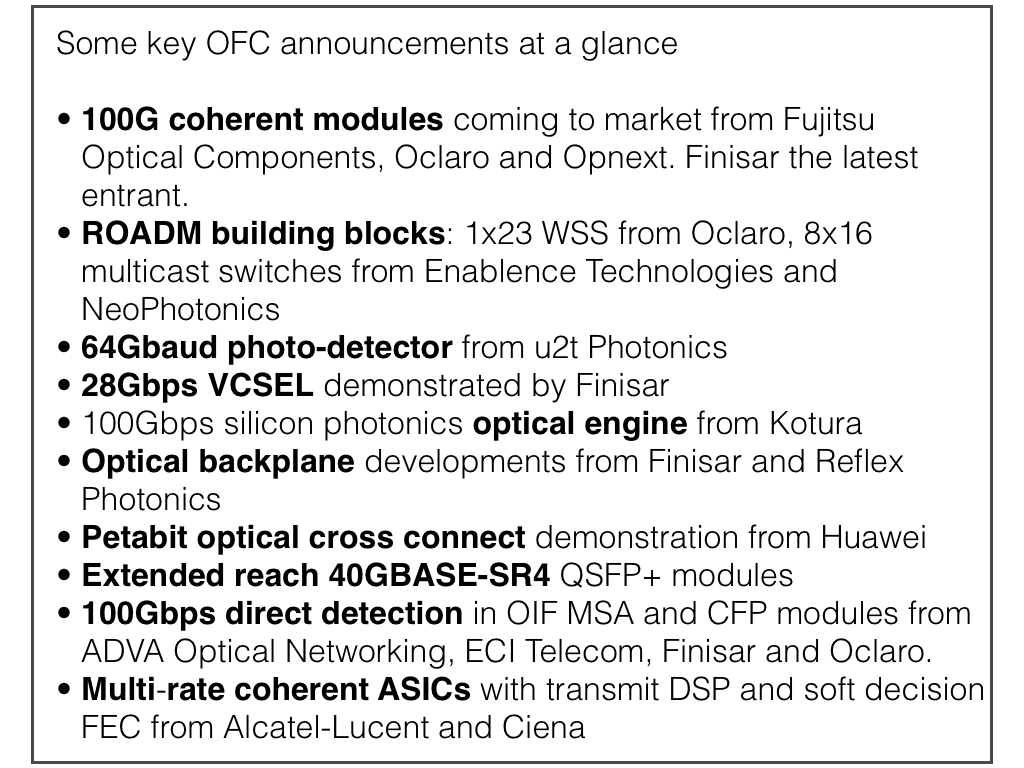
Finisar demonstrated its first 100 Gigabit coherent receiver transponder. The 5x7inch dual-polarisation, quadrature phase-shift keying (DP-QPSK) module complies with the Optical Internetworking Forum's (OIF) multi-source specification. The companies joins Fujitsu Optical Components, Opnext and Oclaro that have already detailed their 100 Gigabit coherent modules. Since OFC/NFOEC, Oclaro and Opnext have announced their intention to merge.
"We can take off-the-shelf DSP technology and match it with vertically-integrated optics and come up with a module that is cost effective while enabling higher density for system vendors," says Rafik Ward, vice president of marketing at Finisar. "This will start the shift away from the system vendors' proprietary line cards."
Opnext announced it has demonstrated interoperability between its OMT-100 100 Gigabit-per-second (Gbps) coherent module and 100 Gigabit systems from Fujitsu Optical Systems and NEC. All three designs use NTT Electronics' (NEL) DSP-ASIC coherent receiver chip. "For those that use the same NEL modem chip, we can interoperate with each other," says Ross Saunders, general manager, next-generation transport for Opnext Subsystems.

They come back to folks like us and say: 'If you can hit this price point, then we will use you'
Ross Saunders, Opnext
Oclaro's MI 8000XM 100Gbps module also uses the NEL DSP-ASIC but was not part of the interoperability test sponsored by Japanese operator, NTT.
Oclaro announced its 100Gbps coherent module is now being manufactured using all its own optical components. These include a micro integrated tunable laser assembly (ITLA) - the latest ratified MSA that is more compact and has a higher output power, its modulator and its coherent receiver module.
Using its components enables the company to control performance-cost tradeoffs, says Per Hansen, vice president of product marketing, optical networks solutions at Oclaro: "This [vertical integration] gives us a flexibility we didn’t have in the past."
Finisar is not saying which merchant DSP-ASIC it is using. But like the NEL device, the DSP-ASIC supports soft-decision forward error correction (SD-FEC) to achieve a reach of over 2,000km.
Meanwhile, the module makers' 100Gbps modules are starting to be shipped to customers.
"We shipped [samples] to four customers last quarter and we are probably going to ship to another four or five by the end of this quarter," says Opnext's Saunders.
Opnext says nearly all of its early customers do not have their own in-house 100Gbps developments. However, the systems vendors that have internal 100Gbps programmes have designed their line cards using the same 168-pin interface. This allows them to replace their own 100Gbps daughter cards with a merchant 5x7-inch module.
 "This [vertical integration] gives us a flexibility we didn’t have in the past."
Per Hansen, Oclaro
The company also announced its OTS-100FLX 100Gbps muxponder, transponder and regenerator line cards that use the OTM-100 module and which slot into its OTS-4000 chassis. The chassis supports eight 100Gbps cards. Opnext's smaller 4RU OTS-mini platform hosts two 100Gbps line cards, mounted horizontally. Over half of Opnext's revenues are from subsystems sales which it brands and sells to system vendors.
As for the other 100Gbps transponder makers, Oclaro is sending out its first module samples now. Finisar says its module will be generally available by the year-end, while Fujitsu Optical Components' module was released in April.
Optical components for 200Gbps DP-QPSK
u2t Photonics announced its latest 64Gbaud photo-detector that points to the next speed shift in line-side transmission. The photo-detector is one key building block to the eventual development of a single-carrier DP-QPSK capable of 200Gbps or using 16-QAM, 400Gbps.

"We can already support the higher interface speed and data throughput"
Jens Fiedler, u2t Photonics
"System companies are looking for two things: to increase the baud rate and to use more complex modulation schemes," says Jens Fiedler, vice president sales and marketing at u2t Photonics. "[With this announcement] from the optical component perspective, we can already support the higher interface speed and data throughput."
1x23 Wavelength-selective switch
Oclaro announced a 1x23 wavelength selective switch at OFC. According to Oclaro, the 1x23 WSS has come about due to the operators' desire to support 12-degree nodes: an input port (1 degree) and through-connections on 11 other ports. The remaining 12 [of the WSS's 24 ports] are used as drop ports.
"If for each of those ports you have a fan-out that is steerable to 8 ports, you have 12x8 or 96 as the total channels you can support for a full add-drop," says Hansen. Such a 12-degree, 96-channel requirement was set by operators early on, or at least it was an industry desire, says Hansen.
Switching elements that address these drop requirements - multicast switches - were announced by NeoPhotonics and Enablence Technologies at OFC. The switches, planar lightwave circuit (PLC) hybrid integration designs, implement 8x16 multicast switches.
"The multicast switch takes signals from eight different inputs - 8 different directions in a ROADMs node and distributes those signals to up to 16 drop ports," says Ferris Lipscomb, vice president of marketing at NeoPhotonics.
Such PLC designs are complex, comprising power splitters, waveguide switching, variable optical attenuators and photo-detectors for channel monitoring.
According to NeoPhotonics, the number of optical functions used to implement the multicast switch is in the hundreds.
Enablence already has 8x8 and 8x12 multicast switches and has launched its 8x16 device. Although the company is a hybrid PIC specialist and has PLC technology, it uses polymer PLCs for the multicast designs, claiming they are lower power. NEL is another company offering 8x8 and 8x12 multicast switches.
Passive optical networking
Finisar also demonstrated a mini-PON network, highlighting its optical line terminal (OLT) transceivers, splitters and its latest GPON-stick, an GPON optical network unit built into an SFP. The demo involved using the ONU SFP transceiver in an Ethernet switch port as part of a PON network to deliver high-definition video and audio from the OLT to a high-definition TV.
The company also introduced two splitter products a 1:128 port splitter and a 2:64 (used for redundancy). These high-split ratios are being prepared for the advent of 10 Gigabit PON.
Enablence also demonstrated a WDM-PON 32-channel receiver module at OFC. "It takes 32 TO-can receivers and replaces them with a small module which includes the AWG (arrayed waveguide grating demultiplexer) and the 32 receivers," says Matt Pearson, vice president, technology, optical components division at Enablence Technologies. The design promises to increase system density by fitting two such receivers on a single blade.
Optical engines
Silicon photonics firm, Kotura, detailed its 100Gbps optical engine chip, implemented as a 4x25Gbps design. The optical engine consumes 5W and has a reach of at least 10km, making it suitable for requirements in the data centre including the 100 Gigabit Ethernet IEEE 100GBASE-LR4 standard.

"The 100Gbps chip - 5mmx6mm - is small enough to fit in the QSFP+ and emerging CFP4 optical modules
Arlon Martin, Kotura
Kotura demonstrated to select customers its optical engine. "We are not announcing the product yet," says Arlon Martin, vice president of marketing at Kotura.
Optical engines are used in several applications: pluggable modules on a system's face-plate, the optics at each end of an active optical cable, and for board-mounted embedded applications.
For embedded applications, the optical engine is mounted deeper within the line card, close to high-speed chips, for example, with the signals routed over fibre to the face-plate connector. Using optics rather than high-speed copper traces simplifies the printed circuit board design.Embedded optical engines will also be used for optical backplane-based platforms.
Kotura's silicon photonics-based optical engine integrates all the functions needed for the transmitter and receiver on-chip. These include the 25Gbps optical modulators and drivers, the 4:1 multiplexer and 1:4 demultiplexer and four photo-detectors. To create the lasers, an array of four gain blocks are coupled to the chip. Each of laser's wavelength, around 1550nm, is set using on-chip gratings.
The 100Gbps chip, measuring about 5mmx6mm, is small enough to fit in the QSFP+ and emerging CFP4 optical modules, says Martin. The QSFP+ is likely to be the first application for Kotura's 100Gbps optical engine, used to connect switches within the data centre.
Finisar demonstrated its own VCSEL-based board mount optical assembly - also an optical engine - to highlight the use of the technology for future optical backplanes.
The demonstration, involving Vario-optics and Huber + Suhner, included boards in a chassis. The board includes the optical engine coupled to polymer waveguides from Vario-optics which connect it to a backplane connector, built by Huber + Suhner. "The idea is to show what an integrated optical chassis will look like," says Ward.
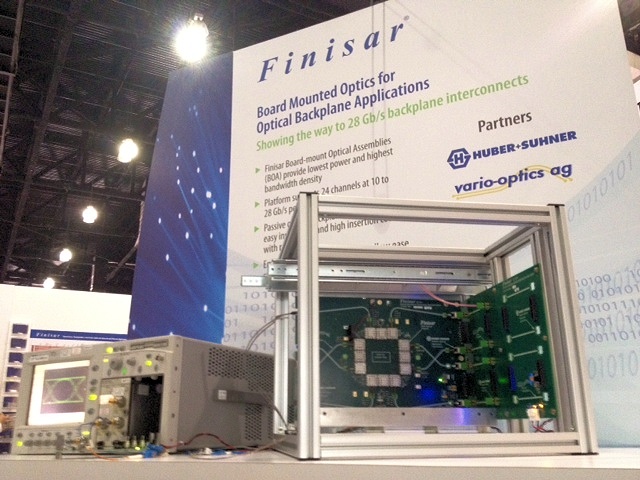 Finisar's optical backplane demo using board-mounted optics. Source: Finisar
The optical engine comprises 24 channels - 12 transmitters at 10Gbps and 12 receivers in a single board-mounted package. The optics can operate at 10, 12, 14, 25 and 28Gbps, says Finisar. The connector allows the optical engines on different cards to interface via the waveguides. The advantage of polymer waveguides is that they are relatively easy to etch on printed circuit boards and since they replace fibre, they remove fibre management issues. However the technology needs to be proven before system vendors will use such waveguides as standard in their platforms.
Interconnect specialist Reflex Photonics demonstrated an 8.6Tbps optical backplane at OFC. The demonstrator uses Reflex's LightABLE optical engines to implement 864 point-to-point optical fibre links to achieve 8.6Tbps in a single chassis.
The optical fabric comprises six layers of 12x12 fully connected broadcast meshes. Each line card supports 720Gbps into the optical backplane and 60Gbps direct bandwidth between any two cards.
32G Fibre channel
Finisar also highlighted its 28Gbps VCSEL that will be used for the 32 Gigabit Fibre Channel standard. The actual line rate for 32Gbps Fibre Channel is 28.05Gbps. The VCSEL is packaged into a transmitter optical sub-assembly (TOSA) that fits inside a SFP+ module.
"We view 28Gbps VCSEL as strategic due to all the applications it will enable," says Ward.
Besides 32Gbps Fibre Channel, the high-speed VCSEL is suited for the next Infiniband data rate - enhanced data rate (EDR) at 4x25Gbps or 12x25Gbps. There is also standards work in the IEEE for a new 100Gbps Ethernet standard that can use 4x25Gbps VCSELs.
Further reading:
Gazettabyte's full OFC NFOEC 2012 coverage
LightCounting: Notes from OFC 2012: Onset of the Terabit Age
Ovum's OFC coverage
FSAN close to choosing the next generation of PON
Briefing: Next-gen PON
Part 1: NG-PON2
The next-generation passive optical network (PON) will mark a departure from existing PON technologies. Some operators want systems based on the emerging standard for deployment by 2015.

“One of the goals in FSAN is to converge on one solution that can serve all the markets"
Derek Nesset, co-chair of FSAN's NGPON task group
The Full Service Access Network (FSAN) industry group is close to finalising the next optical access technology that will follow on from 10 Gigabit GPON.
FSAN - the pre-standards forum consisting of telecommunications service providers, testing labs and equipment manufacturers - crafted what became the International Telecommunication Union's (ITU) standards for GPON (Gigabit PON) and 10 Gigabit GPON (XGPON1). In the past year FSAN has been working on NG-PON2, the PON technology that comes next.
“One of the goals in FSAN is to converge on one solution that can serve all the markets - residential users, enterprise and mobile backhaul," says Derek Nesset, co-chair of FSAN's NGPON task group.
Some mobile operators are talking about backhaul demands that will require multiple 10 Gigabit-per-second (Gbps) links to carry the common public radio interface (CPRI), for example. The key design goal, however, is that NG-PON2 retains the capability to serve residential users cost-effectively, stresses Nesset.
FSAN says it has a good description of each of the candidate technologies: what each system looks like and its associated power consumption. "We are trying to narrow down the solutions and the ideal is to get down to one,” says Nesset.
The power consumption of the proposed access scheme is of key interest for many operators, he says. Another consideration is the risk associated with moving to a novel architecture rather than adopting an approach that builds on existing PON schemes.
Operators such as NTT of Japan and Verizon in the USA have a huge installed base of PON and want to avoid having to amend their infrastructure for any next-generation PON scheme unable to re-use power splitters. Other operators such as former European incumbents are in the early phases of their rollout of PON and have Greenfield sites that could deploy other passive infrastructure technologies such as arrayed waveguide gratings (AWG).
"The ideal is we select a system that operates with both types of infrastructure," says Nesset. "Certain flavours of WDM-PON (wavelength division multiplexing PON) don't need the wavelength splitting device at the splitter node; some form of wavelength-tuning can be installed at the customer premises." That said, the power loss of existing optical splitters is higher than AWGs which impacts PON reach – one of several trade-offs that need to be considered.
Once FSAN has concluded its studies, member companies will generate 'contributions' for the ITU, intended for standardisation. The ITU has started work on defining high-level requirements for NG-PON2 through contributions from FSAN operators. Once the NG-PON2 technology is chosen, more contributions that describe the physical layer, the media access controller and the customer premise equipment's management requirements will follow.
Nesset says the target is to get such documents into the ITU by September 2012 but achieving wide consensus is the priority rather than meeting this deadline. "Once we select something in FSAN, we expect to see the industry ramp up its contributions based on that selected technology to the ITU," says Nesset. FSAN will select the NG-PON2 technology before September.
NG-PON2 technologies
Candidate technologies include an extension to the existing GPON and XGPON1 based on time-division multiplexing (TDM). Already vendors such as Huawei have demonstrated prototype 40 Gigabit capacity PON systems that also support hybrid TDM and WDM-PON (TWDM-PON). Other schemes include WDM-PON, ultra-dense WDM-PON and orthogonal frequency division multiplexing (OFDM).
Nesset says there are several OFDM variants being proposed. He views OFDM as 'DSL in the optical domain’: sub-carriers finely spaced in the frequency domain, each carrying low-bit-rate signals.
One advantage of OFDM technology, says Nesset, includes taking a narrowband component to achieve a broadband signal: a narrowband 10Gbps transmitter and receiver can achieve 40Gbps using sub-carriers, each carrying quadrature amplitude modulation (QAM). "All the clever work is done in CMOS - the digital signal processing and the analogue-to-digital conversion," he says. The DSP executes the fast Fourier transform (FFT) and the inverse FFT.
"We are trying to narrow down the solutions and the ideal is to get down to one"
Another technology candidate is WDM-PON including an ultra-dense variant that promises a reach of up to 100km and 1,000 wavelengths. Such a technology uses a coherent receiver to tune to the finely spaced wavelengths.
In addition to being compatible with existing infrastructure, another FSAN consideration is compatibility with existing PON standards. This is to avoid having to do a wholesale upgrade of users. For example, with XGPON1, the optical line terminal (OLT) using an additional pair of wavelengths - a wavelength overlay - sits alongside the existing GPON OLT. ”The same principle is desirable for NG-PON2,” says Nesset.
However, an issue is that spectrum is being gobbled up with each generation of PON. PON systems have been designed to be low cost and the transmit lasers used are not wavelength-locked and drift with ambient temperature. As such they consume spectrum similar to coarse WDM wavelength bands. Some operators such as Verizon and NTT also have a large installed base of analogue video overlay at 1550nm.
”So in the 1500 band you've got 1490nm for GPON, 1550nm for RF (radio frequency) video, and 1577nm for XGPON; there are only a few small gaps,” says Nesset. A technology that can exploit such gaps is both desirable and a challenge. “This is where ultra-dense WDM-PON could come into play,” he says. This technology could fit tens of channels in the small remaining spectrum gaps.
The technological challenges implementing advanced WDM-PON systems that will likely require photonic integration is also a concern for the operators. "The message from the vendors is that ’when you tell us what to do, we have got the technology to do it’,” says Nesset. ”But they need the see the volume applications to justify the investment.” However, operators need to weigh up the technological risks in developing these new technologies and the potential for not realising the expected cost reductions.
Timetable
Nesset points out that each generation of PON has built on previous generations: GPON built on BPON and XGPON on GPON. But NG-PON2 will inevitably be based on new approaches. These include TWDM-PON which is an evolution of XG-PON into the wavelength domain, virtual point-to-point approaches such as WDM-PON that may also use an AWG, and the use of digital signal processing with OFDM or coherent ultra dense WDM-PON. ”It is quite a challenge to weigh up such diverse technological approaches,” says Nesset.
If all goes smoothly it will take two ITU plenary meetings, held every nine months, to finalise the bulk of the NG-PON2 standard. That could mean mid-2013 at the earliest.
FSAN's timetable is based on operators wanting systems deployable in 2015. That requires systems to be ready for testing in 2014.
“[Once deployed] we want NG-PON2 to last quite a while and be scalable and flexible enough to meet future applications and markets as they emerge,” says Nesset.
Huawei boosts its optical roadmap with CIP acquisition
Huawei has acquired UK photonic integration specialist, CIP Technologies, from the East of England Development Agency (EEDA) for an undisclosed fee. The acquisition gives the Chinese system vendor a wealth of optical component expertise and access to advanced European Union R&D projects.
"By acquiring CIP and integrating the company’s R&D team into Huawei’s own research team, Huawei’s optic R&D capabilities can be significantly enhanced," says Peter Wharton, CEO at the Centre for Integrated Photonics (CIP). CIP Technologies is the trading name of the Centre for Integrated Photonics.
 Huawei now has six European R&D centres with the acquisition of CIP.
CIP Technologies has indium phosphide as well as planar lightwave circuit (PLC) technology which it uses as the basis for its HyBoard hybrid integration technology. HyBoard allows actives to be added to a silica-on-silicon motherboard to create complex integrated optical systems.
CIP has been using its photonic integration expertise to develop compact, more cost-competitive WDM-PON optical line terminal (OLT) and optical network unit (ONU) designs, including the development of an integrated transmitter array.
The company employs 50 staff, with 70% of its work coming from the telecom and datacom sectors. About a third of its revenues are from advanced products and two thirds from technical services.
The CEO of CIP says all current projects for its customers will be carried out as planned but CIP’s main research and development service will be focused on Huawei’s business priorities. “We expect all contracted projects to be completed and current customers are being assisted to find alternate sources of supply," says Wharton.
CIP is also part of several EU Seventh Framework programme R&D projects. These include BIANCHO, a project to reduce significantly the power consumption of optical components and systems, and 3CPO, which is developing colourless and coolerless optical components for low-power optical networks.
Huawei's acquisition will not affect CIP's continuing participation in such projects. "For EU framework and other collaborative R&D projects, the ultimate share ownership does not matter so long as it is a research organisation based in Europe, which CIP will continue to be," says Wharton.
CIP said it had interest from several potential acquirers but that the company favoured Huawei.
What this means
CIP has a rich heritage. It started as BT's fibre optics group. But during the optical boom of 1999-2000, BT shed its unit, a move also adopted by such system vendors as Nortel and Lucent.
The unit was acquired by Corning in 2000 but the acquisition did not prove a success and in 2002 the group faced closure before being rescued by the East of England Development Agency (EEDA).
CIP has always been an R&D organisation in character rather than a start-up. Now with Huawei's ambition, focus and deep pockets coupled with CIP's R&D prowess, the combination could prove highly successful if the acquisition is managed well.
Huawei's acquisition looks shrewd. Optical integration has been discussed for years but its time is finally arriving. The technologies of 40 Gigabit and 100 Gigabit is based on designs with optical functions in parallel; at 400 Gigabit the number of channels only increases.
Optical access will also benefit from photonic integration - from board optical sub-assemblies for GPON and EPON to WDM-PON to ultra dense WDM-PON. China is also the biggest fibre-to-the-x (FTTx) market by far.
A BT executive talking about the operator's 21CN mentioned how system vendors used to ask him repeatedly about Huawei. Huawei, in contrast, used to ask him about Infinera.
Huawei, like all the other systems vendors, has much to do to match Infinera's photonic integrated circuit expertise and experience. But the Chinese vendor's optical roadmap just got a whole lot stronger with the acquisition of CIP.
Further reading:
Reflecting light to save power, click here
Next-generation access will redefine the telcos
Gazettabyte caught up with him to understand the goals of his new company, Diffraction Analysis, and why he believes next-generation access is critical for service providers.

"As soon as you, the operator, make that investment decision, it has fundamental implications as to who you are as a company"
Benoît Felten, CEO, Diffraction Analysis
Gazettabyte: There are several established market research companies addressing access. What is Diffraction Analysis offering that is unique?
BF: There are two reasons [for setting up Diffraction Analysis]. The first came to me when I was doing consultancy work for a [Yankee Group] customer. He said: “You are the only guy I know working for an established company that only covers next-generation access.” All the other guys cover broadband, with next-generation access being a sub-topic.
At that moment it coalesced something that I had been thinking about for some time: the migration from legacy to next-generation access networks is probably the single most challenging issue that established players will face, and the single biggest opportunity for challengers to grab. If you drown that [topic] among legacy [broadband] issues you might be missing the point.
The second reason, much more pragmatic, is that there are many small companies that simply cannot afford the cost of generic telecom research from established market research companies. To access research affordably, for me, that is a market opportunity.
When you say next-generation access, what do you mean?
BF: It refers to the replacement of the legacy copper network in all its incarnations – most cell towers are connected with copper today - with a fibre-rich network. Cable networks, wireline copper networks, mobile networks are all going to be fibre-rich.
What are the key issues facing operators regarding next-generation access?
BF: The first for the operators is: How do we finance a network deployment and why do we do it? The established players all agree that they have to do it, sooner or later and probably sooner, and the core question is: How do we do it?
The problem is that it places access at the core of the telco business model. Ever since the internet started being successful, most legacy players – and that includes cable players - have seen themselves as service providers rather than access providers. Effectively, they are faced with a major investment which if they don’t do opens up opportunities for others to displace them. We are seeing that happen is small markets like Hong Kong, where a competitive player is on the path to eliminate the access network of the incumbent.
The threat is real, the customer need is real. The problem is operators don’t know how to use the network for their own revenues. They are faced with the choice of becoming a long-term utility – investing in the network for 20 years and reaping revenues for another 50 years – but that is unpalatable for them, or they find another way to use the network for revenues, keeping in mind that most new services do not come from telcos these days but from over-the-top players.
What we plan to examine are the alternative paths: What will be the operators’ role and where will the operators’ revenues come from once they have made this investment?
As soon as you, the operator, make that investment decision, it has fundamental implications as to who you are as a company. It is not just an upgrade.
I was at a conference last year and a guy from NTT said: “We didn’t realise that when we made that [fibre access network] investment decision, we were rebuilding the company from scratch.” He said: “Now, 10-years-on, at a strategy level, we have understood that – we are in a different business now.”
What is Diffraction Analysis going to do?
BF: We are a market research and consultancy firm. It is important to do both: consultancy keeps you grounded in what is happening in the market. Research is your ability to step back and articulate the global view.
I have already signed a couple of companies for whom I do advisory services. We also have classic consultancy projects. We are working for a vendor right now who is asking us to look at opportunities for them to enter the access market. They have disruptive technology and are looking to partner with companies and take a stake in the access market. We are in the middle of this and our advice might be: don’t do it.
One of the things we want to do is build modelling tools that allow legacy service providers to map the network deployment in time and not just based on a single investment decision. Right now the question is do I deploy fibre or not? But the reality is even if the answer is yes, the deployment will take 15 years. If it takes 15 years, what happens to all the people that don’t have fibre as I – the operator - gradually connect them?
We are trying to build a model that will optimise the cost and the service offered to end customers with a variety of technologies. This is where fibre-to-the-curb and various flavours like phantom mode DSL come into play.
We are aiming to do this by geographical area, to model where you should deploy fibre first and what you should do in non-fibre areas, and for how long, looking at the lifetime of these various technology options.*
What are the key lessons you learnt as a Yankee Group analyst?
BF: One of the things that strike me is that in this economic shift we have experienced in the last 30 years, something has been lost and that is long-term vision. That leads many organisations to make hugely inefficient decisions. These decisions may be rational but the long term is no longer part of the equation. In the telecom business it is striking how far this can lead people into making wrong decisions.
The second thing that I learnt interacting with many industry players is that the single toughest challenge each organisation has is fighting against their own culture. There is a culture of business-as-usual which is at odds with the challenges of an ever shifting technology market. Even companies in the internet space that everyone views as agile and willing to reassess themselves, you find these cultural issues.
I’m not saying anything original but interacting with these companies all around the world for the three years at Yankee highlighted this for me.
Most broadband users are still DSL-based. How will fibre-based access become massively deployed?
BF: Essentially there are three drivers for telcos to deploy. In order of importance they are: competition, network reboot and meeting customer demand.
Competition is a clear driver. When as an organisation your network access business is threatened, every consideration about how fast you deploy for payback goes out of the window - you have to deploy. And then you learn the hard way since by responding and not anticipating, you make mistakes.
The second driver [network reboot] is not mature today. Smart CTOs around the world are seeing fibre deployments as an opportunity to rethink way more than just their access infrastructure. And WDM-PON [wavelength division multiplexing – passive optical network] technology in access plays a significant part in that thinking.
If they deploy now, they may make savings and achieve network concentration but it is not massive. If they wait they might be able to save more which is why this driver isn’t working right now.
The third driver is meeting customer needs. Now, in their public discourse, operators say this is first and foremost but the reality is that since they have not found ways to make money out of traffic, they don’t want more traffic. So meeting customer needs is not a priority except if you are in a competitive market and someone else is meeting customers’ needs in which case you have to do it.
Diffraction Analysis’s team comprises people with wireline experience but the company does plan to also cover mobile. “I do think that there is a great deal of sense in having a mobile arm too but I can’t build that myself – I don’t have the credibility or the knowledge,” says Felten, who is looking at partnerships or recruitment to add mobile to the operation.
*Diffraction Analysis has just published its research programme till June 2011.
Bringing WDM-PON to market

"We see just one way to bring down the cost, form-factor and energy consumption of the OLT’s multiple transceivers: high integration of transceiver arrays"
Klaus Grobe, ADVA Optical Networking
Considerable engineering effort will be needed to make next-generation optical access schemes using multiple wavelengths competitive with existing passive optical networks (PONs).
Such a multi-wavelength access scheme, known as a wavelength division multiplexing-passive optical network (WDM-PON), will need to embrace new architectures based on laser arrays and reflective optics, and use advanced photonic integration to meet the required size, power consumption and cost targets.
Current PON technology uses a single wavelength to deliver downstream traffic to end users. A separate wavelength is used for upstream data, with each user having an assigned time slot to transmit.
Gigabit PON (GPON) delivers 2.5 Gigabit-per-second (Gbps) to between 32 or 64 users, while the next development, XG-PON, will extend GPON’s downstream data rate to 10 Gbps. The alternative PON scheme, Ethernet PON (EPON), already has a 10 Gbps variant. Vendors are also extending PON’s reach from 20km to 80km or more using signal amplification.
But the industry view is that after 10 Gigabit PON, the next step will be to introduce multiple wavelengths to extend the capacity beyond what a time-sharing approach can support. Extending the access network's reach to 100km will also be straightforward using WDM transport technology.
The advent of WDM-PON is also an opportunity for new entrants, traditional WDM optical transport vendors, to enter the access market. ADVA Optical Networking is one firm that has been vocal about its plans to develop next-generation access systems.
“We are seriously investigating and developing a next-generation access system and it is very likely that it will be a flavour of WDM-PON,” says Klaus Grobe, senior principal engineer at ADVA Optical Networking. “It [next-generation access] must be based on WDM simply because of bandwidth requirements.”
The system vendor views WDM-PON as addressing three main applications: wireless backhaul, enterprise connectivity and residential broadband. But despite WDM-PON’s potential to reduce operating costs significantly, the challenge facing vendors is reducing the cost of WDM-PON hardware. Indeed it is the expense of WDM-PON systems that so far has assigned the technology to specialist applications only.
 A non-reflective tunable laser-based WDM-PON ONU. Source: ADVA Optical NetworkingAccording to Grobe, cost reduction is needed at both ends of the WDM-PON: the client receiver equipment known as the optical networking unit (ONU) and the optical line terminal (OLT) housed within an operator’s central office.
ADVA Optical Networking plans to use low-cost tunable lasers rather than a broadband light source and reflective optics for the ONU transceivers. “For the OLT, we see just one way to bring down the cost, form-factor and energy consumption of the OLT’s multiple transceivers: high integration of transceiver arrays,” says Grobe.
This is a considerable photonic integration challenge: a 40- or 80-wavelength WDM-PON uses 40 or 80 transceiver bi-directional clients, equating to 80 and 160 wavelengths. If 80 SFPs optical modules were used at the OLT, the resulting cost, size and power consumption would be prohibitive, says Grobe.
ADVA Optical Networking is working with several firms, one being CIP Technologies, to develop integrated transceiver arrays. ADVA Optical Networking and CIP Technologies are part of the EU-funded project, C-3PO, that includes the development of integrated transceiver arrays for WDM-PON.
Splitters versus filters
One issue with WDM-PON is that there is no industry-accepted definition. ADVA Optical Networking views WDM-PON as an architecture based on optical filters rather than splitters. Two consequences result once that choice is made, says Grobe.
One is insertion loss. Choosing filters implies arrayed waveguide gratings (AWGs), says Grobe. “No other filter technology is seriously considered for WDM-PON if filters are used,” he says.
With an AWG, the insertion loss is independent of the number of wavelengths supported. This differs from using a splitter-based architecture where every 1x2 device introduces a 3dB loss - “closer to 3.5dB”, he says. Using a 1x64 splitter, the insertion loss is 14 or 15dB whereas for a 40-channel AWG the loss can be as low as 4dB. “I just saw specs of a first 96-channel AWG, even that one isn’t much higher [than 4dB],” says Grobe. Thus using filters rather than splitters, the insertion loss is much lower for a comparable number of client ONUs.
There is also a cost benefit associated with a low insertion loss. To limit the cost of next-generation PON, the transceiver design must be constrained to a 25dB power budget associated with existing PON transceivers. “This is necessary to keep these things cheap, possibly dirt cheap,” says Grobe.
The alternative, using XG-PON’s sophisticated 10 Gbps burst-mode transceiver with its associated 35dB power budget, achieving low cost is simply not possible, he says. To live with transceivers with a 25dB power budget, the insertion loss of the passive distribution network must be minimised, explaining why filters are favoured.
The other main benefit of using filters is security. With a filter-based PON, wavelength point-to-point connections result. “You are not doing broadcast,” says Grobe. “You immediately get rid of almost all security aspects.” This is an issue with PON where traffic is shared.
Low power
Achieving a low-power WDM-PON system is another key design consideration. “In next-gen access, it is absolutely vital,” says Grobe. “If the technology is deployed on a broad scale - that is millions of user lines – every single watt counts, otherwise you end up with differences in the approaches that go into the megawatts and even gigawatts.”
There is also a benchmarking issue, says Grobe: the WDM-PON OLT will be compared to XG-PON’s even if the two schemes differ. Since XG-PON uses time-division multiplexing, there will be only one transceiver at the OLT. But this is what a 40- or 80-channel WDM-PON OLT will be compared with, even if the comparison is apples to pears, says Grobe.
WDM-PON workings
There are two approaches to WDM-PON.
In a fully reflective architecture, the OLT array and the ONUs are seeded using multi-wavelength laser arrays; both ends use the lasers arrays in combination with reflective optics for optical transmission.
ADVA Optical Networking is interested in using a reflective approach at the OLT but for the ONU it will use tunable lasers due to technical advantages. For example, using the same wavelength for the incoming and modulated streams in a reflective approach, Rayleigh crosstalk is an issue when the ONUs are 100km from the OLT. In contrast, Rayleigh crosstalk at the OLT is avoided because the multi-wavelength laser array is located only a few metres from the reflective electro-absorption modulators (REAMs).
REAMs are used rather than semiconductor optical amplifiers (SOAs) to modulate data at the OLT because they support higher bandwidth 10 Gbps wavelengths. Indeed the C-3PO project is likely to use a monolithically integrated SOA-REAM for this task. “The reflective SOA is narrower in bandwidth but has inherent gain while the REAM has loss rather than gain – it is just a modulator,” says Grobe. “The combination of the two is the ideal: giving high modulation bandwidth and high transmit power.”
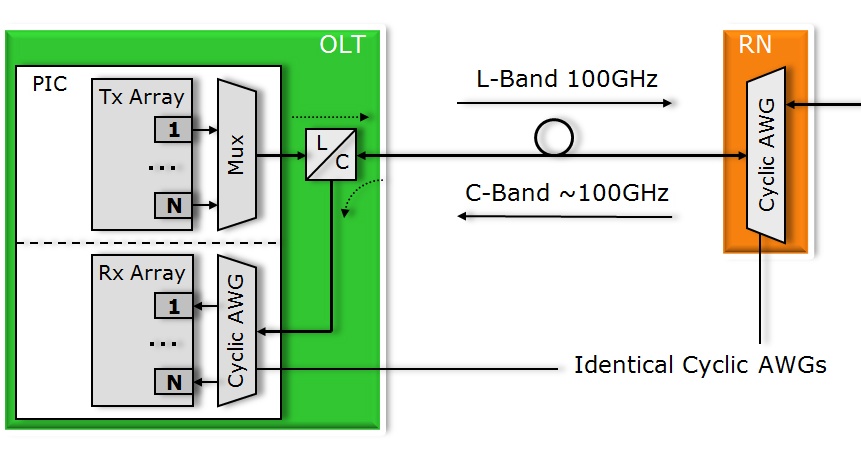 The integrated WDM-PON OLT. In practice the transmit array uses a reflective architecture based on SOA-REAMs and is fed with a multi-wavelength laser source. Source: ADVA Optical Networking
For the OLT, a multi-wavelength laser is fed via an AWG into an array of SOA-REAMs which modulate the wavelengths and return them through the AWG where they are multiplexed and transmitted to the ONUs via a demultiplexing AWG. An added benefit of this approach, says Grobe, is that the same multi-wavelength laser source can be use to feed several WDM-PON OLTs, further decreasing system cost.
For the upstream path, each ONU’s wavelength is separated by the OLT’s AWG and fed to the receiver array. In a WDM-PON system, the OLT transmit wavelengths and receive wavelengths (from the ONUs) operate in separate optical bands.
Grobe expects its resulting WDM-PON system to use 40 or 80 channels. And to best meet size, power and cost constraints, the OLT design will likely implemented as a photonic integrated circuit. “We are after a single PIC solution,” he says. “It is clear that with the OLT, integration is the only way to meet requirements.” A photonically-integrated OLT design is one of the products expected from the C-3PO project, using CIP Technologies' hybrid integration technology.
ADVA Optical Networking has already said that its WDM-PON OLT will be implemented using its FSP 3000 platform.
- To see some WDM-PON architecture slides, click here.