

PMC unveils OTN framer for IP core and edge routers
The Meta-240G frames IP router traffic using OTN before passing the traffic to the transport network. Line-rate encryption is included on-chip to secure traffic between data centres and traffic in the cloud.
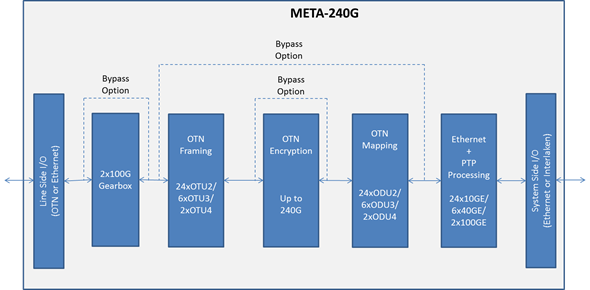 Source: PMC-Sierra
Adding OTN to a router delivers several benefits, says PMC. OTN helps identify networking faults more quickly and simplifies the monitoring and enforcement of service-level agreements. OTN also includes forward-error correction which benefits optical link performance.
Ethernet is the default router protocol interface while OTN is the dominant protocol in the transport network, says PMC. By moving OTN onto the router’s line port, the transport network extends its end-point reach to the router, says Stephen Docking, senior product line manager, communications unit at PMC. This leads to faster fault isolation and fault recovery.
“The transport network can now communicate with the router in a standard way, providing an extra level of protection that is faster than just IP layer protection,” says Docking.
OTN also supports the monitoring of error rates across the link.“By making the router part of the link, the service provider can not only monitor performance within the transport network but across the entire end-to-end link including the router,” says Docking. Such monitoring helps verify service-level agreements.
Meta-240G features
The Meta-240G is PMC’s third-generation framer for routers. The previous generation device, the 120 gigabit Meta-120G was PMC’s first to support OTU4 100 gigabit frames and was implemented in 40nm CMOS.
The Meta-240G doubles the total bandwidth: 240 gigabit facing the front panel optics and 240 gigabit interfacing to the network processor on the router’s line card. The device can thus support two 100 gigabit interfaces, six 40 gigabit interfaces and 24, 10 gigabit interfaces. “You can even have two 100 Gig and one 40 Gig, or two 100 Gig and four 10 Gig but most customers will just use 100 Gig [interfaces],” says Docking.
PMC has doubled the framer’s capacity while keeping overall power consumption fixed, in effect halving the power per port compared to its previous generation Meta-120G framer. Yet the chip also supports new features including a low-latency AES-256 encryption engine and an on-chip gearbox. The Meta-240G achieves the power savings by making the chip in 28nm CMOS and by improving the serdes design.
The gearbox function translates between 10 gigabit streams and 25 gigabit ones. Many devices use 10 gigabit serdes but to connect to a CFP2 or CFP4 100 gigabit optical modules, 25 gigabit electrical channels are required.
“Designers have had to use discrete gearbox devices [on the line card] which adds space, power and cost,” says Docking. “With the Meta-240G, the gearbox function is integrated into the device.”
Given IP traffic trends, will a 400 gigabit Meta device be needed in 2017? “It may be a bit longer - two to three years’ time - but we would need to [have such a device] to follow the existing trend,” says Docking.
Further information
PMC advances OTN with 400 Gigabit processor, click here

PMC advances OTN with 400 Gigabit processor
Optical modules for the line-side are moving beyond 100 Gigabits to 200 Gigabit and now 400 Gigabit transmission rates. Such designs are possible thanks to compact photonics designs and coherent DSP-ASICs implemented using advanced CMOS processes.
 An example switching application showing different configurations of the DIGi-G4 OTN processor on the line cards. Source: PMC
For engineers, the advent of higher-speed line-side interfaces sets new challenges when designing the line cards for optical networking equipment. In particular, the framer silicon that interfaces to the coherent DSP-ASIC, on the far side of the optics, must cope with a doubling and quadrupling of traffic.
Such line cards for metro network platforms is where PMC-Sierra is targeting its latest 400 Gigabit DIGI-G4 Optical Transport Network (OTN) processor.
The OTN standard, defined by the telecom standards body of the International Telecommunication Union (ITU-T), performs several roles in the network. It is a layer-one technology that packages packet and circuit-switched traffic. OTN wraps traffic in a variety of container sizes for transport, from 1 Gigabit (OTU1) to 100 Gigabit (OTU4). And now 100 Gigabit can be viewed as a sub-frame, multiples of which can be combined to create even larger frames, dubbed OTUCn, where n is a multiple of 100 Gig.
Using OTN, container traffic can be broken up, switched and recombined within new containers before being transmitted optically. OTN also provides forward error correction and network management features.
PMC’s DIGI-G4 OTN processor is aimed at next-generation packet-optical transport systems (P-OTS) adopting 400 Gig line cards, and for platforms for the burgeoning data centre interconnect market.
“The amounts of traffic internet content providers need between their data centres is astonishing; they are talking hundreds of terabits of traffic,” says Hamish Dobson, director of strategic marketing at PMC. Hyper-scale data centre operators, unlike telcos, do not require OTN switching but they are keen on OTN as the DWDM management layer, he says: “I’m not aware of any of the hyper-scale players who are deploying their own networks who are not using OTN as the un-channelised digital wrapper on their systems.”
The DIGI-G4 does more than simply quadruple OTN traffic throughput compared to PMC’s existing DIGI 120G OTN processor. The chip also adds encryption hardware to secure links while supporting the emerging Transport Software-Defined Networking (Transport SDN).
DIGI-G4
The DIGI-G4 increases by fourfold the traffic throughput while halving the power-per-port compared to PMC's DIGI 120G. System designers must control the total power consumption of the line card, given the greater interface density, and when metro equipment platforms’ power profile is already at 500W-per-slot, says Dobson. PMC has halved the power consumption-per-port by implementing the latest OTN processor in a 28 nm CMOS process and by using more power-efficient serialisers/ deserialisers (serdes).
Internet content providers with their use of distributed data centres is one reason for the device’s introduction of the Advanced Encryption Standard (AES-256). Another is the emergence of cloud services and the need to secure individual customer’s traffic.
“We have added a channelised hardware [encryption] engine,” says Dobson. “The encryption engine is capable of being applied to any OTN channel in the device.”
Other features of the Digi-G4 include input/ output (I/O) capable of 28 Gigabit-per-second (Gbps). This enables the DIGI-G4 to connect directly to CFP2 and CFP4 pluggable optics without the need for gearbox devices on the line card, reducing power and overall cost.
The OTN chip is a hybrid design capable of processing 400 Gigabit of packet traffic or 400 Gig of circuit (time-division multiplexed) traffic, or any combination of the two, with a granularity of one gigabit channels. “It can switch a full 400 Gig's worth of one Gigabit ODU0 channels,” says Dobson.
The Digi-G4 also support a pre-standard implementation of the OTUC2 and OTUC4 transport units that are two and four multiples of 100 Gigabit, respectively. The OTUCn standard is not expected to be ratified before 2017.

We will see the capabilities of these new packet-optical systems coming together with SDN to enable interesting things to be done in the metro
Hamish Dobson
Transport SDN
SDN will have a significant effect on the transport network, says Dobson. In particular Transport SDN where SDN is applied to the transport layers of the wide area network (WAN). As such, OTN plays an important role in multi-layer optimisation. Packet-optical transport systems, which support packet and optical within the same platform, are ideal for getting much more efficiency out of the optical spectrum, he says.
Using Transport SDN to co-ordinate packet, OTN and the optical layer, routing decisions can be made aware of available capacity in the optical domain. In turn, network protection decisions can also be based on optical capacity availability. “The DIGI-G4, being a hybrid processor to enable these multi-layer platforms, is an important element to bring this all together,” says Dobson.
OTN also aids the virtualisation of optical resources whereby individual enterprises can be given a simpler, subset view of the network. “We need more than just wavelength granularity in the network,” says Dobson. Since 100 Gigabit and, in future, 200 and 400 Gig lightwaves, are such large pipes, these are inevitably filled with multiple traffic flows. “Channelised OTN and OTN switching are how carriers are going to break down these massive amounts of optical capacity and partition them for various uses,” says Dobson.
A third element whereby OTN aids Transport SDN is the move to on-demand provisioning by adapting capacity at the OTN layer. Dobson cites the ITU-T G.7044/Y.1347 (G.HAO) standard, which the DIGI-G4 supports, whereby frame size can be adjusted using ODUflex without impacting existing network traffic.
“We will see the capabilities of these new packet-optical systems coming together with SDN to enable interesting things to be done in the metro,” says Dobson.
Samples of the DIGI-G4 are already with customers.
Further reading
White Paper: Benefits of OTN in Transport SDN, click here and then 'documentation'
Mobile backhaul chips rise to the LTE challenge
The Long Term Evolution (LTE) cellular standard has a demanding set of mobile backhaul requirements. Gazettabyte looks at two different chip designs for LTE mobile backhaul, from PMC-Sierra and from Broadcom.
 "Each [LTE Advanced cell] sector will be over 1 Gig and there will be a need to migrate the backhaul to 10 Gig"
Liviu Pinchas, PMC-Sierra
LTE is placing new demands on the mobile backhaul network. The standard, with its use of macro and small cells, increases the number of network end points, while the more efficient bandwidth usage of LTE is driving strong mobile traffic growth. Smartphone mobile data traffic is forecast to grow by a factor of 19 globally from 2012 to 2017, a compound annual growth rate of 81 percent, according to Cisco's visual networking index global mobile data traffic forecast.
Mobile networks backhaul links are typically 1 Gigabit. The advent of LTE does not require an automatic upgrade since each LTE cell sector is about 400Mbps, such that with several sectors, the 1 Gigabit Ethernet (GbE) link is sufficient. But as the standard evolves to LTE Advanced, the data rate will be 3x higher. "Each sector will be over 1 Gig and there will be a need to migrate the backhaul to 10 Gig," says Liviu Pinchas, director of technical marketing at PMC.
One example of LTE's more demanding networking requirements is the need for Layer 3 addressing and routing rather than just Layer 2 Ethernet. LTE base stations, known as eNodeBs, must be linked to their neighbours for call handover between radio cells. To do this efficiently requires IP (IPv6), according to PMC.
The chip makers must also take into account system design considerations.
Equipment manufacturers make several systems for the various backhaul media that are used: microwave, digital subscriber line (DSL) and fibre. The vendors would like common silicon and software that can be used for the various platforms.
Broadcom highlights how reducing the board space used is another important design goal, given that backhaul chips are now being deployed in small cells. An integrated design reduces the total integrated circuits (ICs) needed on a card. A power-efficient chip is also important due to thermal constraints and the limited power available at certain sites.
"Integration itself improves system-level power efficiency," says Nick Kucharewski, senior director for Broadcom’s infrastructure and networking group. "We have taken several external components and integrated them in one device."
WinPath4
PMC's WinPath4 supports existing 2G and 3G backhaul requirements, as well as LTE small and macro cells. A cell-side routers that previously served one macrocell will now have to serve one macrocell and up to 10 small cells, says PMC. This means everything is scaled up: a larger routing table, more users and more services.
To support LTE and LTE Advanced, WinPath4 has added additional programmable packet processors - WinGines - and hardware accelerators to meet new protocol requirements and the greater data throughput.
The previous generation 10Gbps WinPath3 has up to 12 WinGines, WinGines are multi-threaded processors, with each thread involving packet processing. Tasks performed include receiving, classifying, modifying, shaping and transmitting a packet.
The 40Gbps WinPath4 uses 48 WinGines and micro-programmable hardware accelerators for such tasks as packet parsing, packet header extraction and traffic matching, tasks too processing-intensive for the WinGines.
WinPath4 also support tables with up to two million IP destination addresses, up to 48,000 queues with four levels of hierarchical traffic shaping, encryption engines to implement the IP Security (IPsec) protocol and supports the IEEE 1588v2 timing protocol.
Two MIPs processor core are used for the control tasks, such as setting up and removing connections.
WinPath4 also supports the emerging software-defined networking (SDN) standard that aims to enhance network flexibility by making underlying switches and routers appear as virtual resources. For OpenFlow, the open standard use for SDN, the processor acts as a switching element with the MIPS core used to decode the OpenFlow commands.
StrataXGS BCM56450
Broadcom says its latest device, the BCM56450, will support the transition from 1GbE to 10GbE backhaul links, and the greater number of cells needed for LTE.
The BCM56450 will be used in what Broadcom calls the pre-aggregation network. This is a first level of aggregation in the wireline network that connects the radio access network's macro and small cells.
Pre-aggregation connects to the aggregation network, defined by Broadcom as having 10GbE uplinks and 1GbE downlinks. The BCM56450 meets these requirements but is referred as a pre-aggregating device since it also supports slower links such as microwave links or Fast Ethernet.
The BCM56450 is a follow-on to Broadcom's 56440 device announced two years ago. The BCM56450 upgrades the switching capacity to 100 Gigabit and doubles the size of the Layer 2 and Layer 3 forwarding tables.
The BCM56450 is one of a family of devices offering aggregation, from the edge through to 100GbE links deep in the network.
The network edge BCM56240 has 1GbE links and is designed for small cell applications, microwave units and small outdoor units. The 56450 is next in terms of capacity, aggregating the uplinks from the 240 device or linking directly to the backhaul end points.
The uplinks of the 56450 are 10GbE interfaces and these can be interfaced to the third family member, the BCM56540. The 56540, announced half a year ago, supports 10GbE downlinks and up to 40GbE uplinks.
The largest device, the BCM56640, used in large aggregation platforms takes 10GbE and 40GbE inputs and has the option for 100GbE uplinks for subsequent optical transport or routing. The 56640 is classed as a broadband aggregation device rather than just for mobile.
Features of the BCM56450 include support for MPLS (MultiProtocol Label Switching) and Ethernet OAM (operations, administration and maintenance), QoS and hardware protection switching. OAM performs such tasks as checking the link for faults, as well as performing link delay and packet loss measurements. This enables service providers to monitor the network's links quality. The device also supports the 1588 timing protocol used to synchronise the cell sites.
Another chip feature is sub-channelisation over Ethernet that allows the multiplexing of many end points into an Ethernet link. "We can support a higher number of downlinks than we have physical serdes on the device by multiplexing the ports in this way," says Kucharewski.
The on-chip traffic manager can also use additional, external memory if increasing the system's packet buffering size is needed. Additional buffering is typically required when a 10GbE interface's traffic is streamed to lower speed 1GbE or a Fast Ethernet port, or when the traffic manager is shaping multiple queues that are scheduled out of a lower speed port.
The BCM56450 integrates a dual-core ARM Cortex-A9 processor to configure and control the Ethernet switch and run the control plane software. The chip also has 10GbE serdes enabling the direct interfacing to optical transceivers.
Analysis
The differing nature of the two devices - the WinPath4 is a programmable chip whereas Broadcom's is a configurable Ethernet switch - means that the WinPath4 is more flexible. However, the greater throughput of the BCM56450 - at 100Gbps - makes it more suited to Carrier Ethernet switch router platforms. So says Jag Bolaria, a senior analyst at The Linley Group.
The WinPath4 also supports legacy T1/E1 TDM traffic whereas Broadcom's BCM56450 supports Ethernet backhaul only
The Linley Group also argues that the WinPath4 is more attractive for backhaul designers needing SDN OpenFlow support, given the chip's programmability and larger forwarding tables.
The WinPath4 and the BCM56450 are available in sample form. Both devices are expected to be generally available during the first half of 2014.
Further reading:
A more detailed piece on the WinPath4 and its protocol support is in New Electronics. Click here
The Linley Group: Networking Report, "Broadcom focuses on mobile backhaul", July 22nd, 2013. Click here (subscription is required)
PMC-Sierra delivers silicon for 10 Gigabit EPON
PMC-Sierra has announced the availability of symmetric 10 Gigabit EPON chips. The devices complete the company's 10 Gigabit PON portfolio which also includes XGPON designs.
The 10G-EPON devices comprise two PAS9000 optical networking unit (ONU) and four PAS8000 optical line terminal (OLT) chips that support asymmetrical and symmetrical 10G-EPON: 10Gbps downstream (to the user) and 1Gbps upstream, and 10Gbps downstream and upstream, respectively. PMC-Sierra claims it is the first to market with a dual-mode 10G-EPON ONU device.
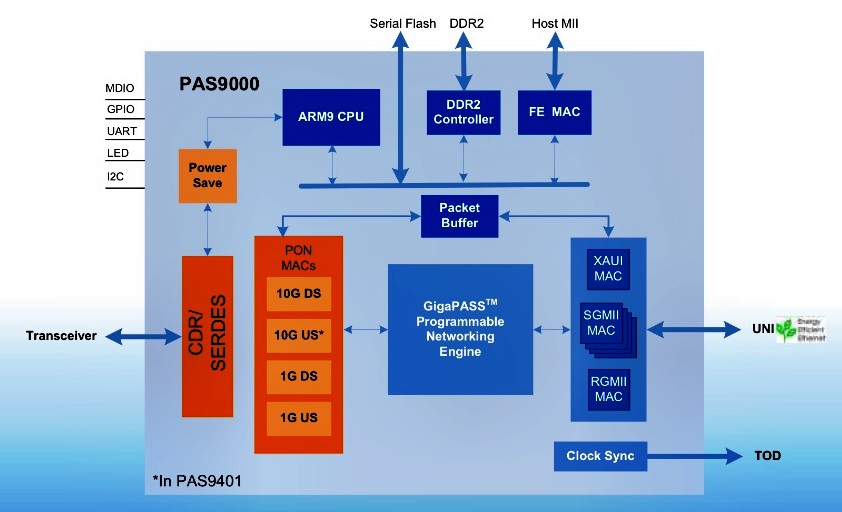 The PAS9000 optical network unit chip architecture. There are two devices in the family. One, the PAS9401, also supports 10G-EPON symmetric mode. Source: PMC-Sierra.
PON Market
PMC-Sierra says that the total market for PON is set for strong growth through 2015.
Using market data from Gartner and IDC, PMC says the 2010 market for EPON silicon was US $120M, growing to $180M for EPON and 10G-EPON speeds in 2015. In contrast, the GPON market was $35M in 2010 but will total $175M for both GPON and XGPON by 2015.
"China is going to be a very large market [for PON] compared to elsewhere," says Rammy Bahalul, senior marketing manager, FTTH division at PMC-Sierra.
Field trials of 10G-EPON have already been conducted in South Korea, Japan and China, says Bahalul: "We see Japan being the first to move to 10G-EPON, followed by Korea and China."
PMC expects 10G-EPON deployments to start in 2013, with the first application being multi-dwelling units. Meanwhile, the company expects first deployments of XGPON in 2014, with field trials starting in 2013. China is expected to deploy XGPON first, followed by North America.
10G-EPON ICs
The 40nm CMOS PAS8000 OLT family comprises four devices.
The PAS8301 and PAS8311 support asymmetric (1Gbps upstream) 10G-EPON. The two chips differ in that the PAS8311 has an on-chip traffic manager/ packet processor which inspects and classifies packets as well as rate-limits particular service flows.
The remaining two devices, the PAS8401 and PAS8411, support symmetric and asymmetric modes. However, the PAS8401 does not include the traffic manager/ packet processor.
All four have the Power Save mode which PMC claims halves the power consumption compared to existing ONUs. For example, it allows the ONU to be shut down when appropriate. The OLT devices also support synchronisation protocols required for mobile backhaul.
Another feature of the PAS8000 family is an on-chip optical time-domain reflectometer (OTDR). The OTDR function enables operators to locate fibre faults without using standalone test equipment, and can diagnose the nature and location of a fault to within a 2m accuracy, says Bahalul.
The PAS9000 ONU family comprises two devices: the asymmetric PAS9301 and the asymmetric/ symmetric PAS9401. The devices support the power save mode and mobile backhaul. And by delivering 10G-EPON symmetric and asymmetric modes, the PAS9401 ONU IC enables operators to plan five years ahead using silicon available now, says Bahalul.
Meanwhile, the company's XGPON OLT and ONU are asymmetric designs - 10Gbps downstream and 2.5Gbps upstream. The system-on-chip XGPON versions have still to be taped out with the designs currently implemented as FPGAs. The XGPON design was part of a recent successful interoperability test, conducted by industry body FSAN (Full Service Access Network), says PMC.
PMC-Sierra says it has a single software development kit that allows software developed on one platform to be reused across all its products.