

Infinera unveils its next-gen packet-optical platforms
 Source: Infinera
Infinera has unveiled its latest metro products that support up to 200-gigabit wavelengths using CFP2-DCO pluggable modules.
The XTM II platform family is designed to support growing metro traffic, low-latency services and the trend to move sophisticated equipment towards the network edge. Placing computing, storage and even switching near the network edge contrasts with the classical approach of backhauling traffic, sometimes deep within the network.
“If you backhaul everything, you really do not know if it belongs in that part of the network,” says Geoff Bennett, director, solutions and technology at Infinera. Backhauling inherently magnifies traffic whereas operators want greater efficiencies in dealing with bandwidth growth, he says: “This is where the more cloud-like architectures towards the network edge come in.”
But locating equipment at the network edge means it must fit within existing premises or in installed prefabricated huts where space and the power supplied are constrained.
“If you are asking service providers to put more complex equipment there, then you need low power utilisation,” says Bennett. “This has been a key piece of feedback from customers we have been asking as to how they want our existing products to evolve in the metro-access.”
Having a distributed switch fabric is a long-term advantage for Infinera
Infinera says its latest XTM II products are eight times denser in terms of tranmission capacity while setting a new power-consumption low of 20W-27W per 100 gigabits depending on the operating temperature (25oC to 55oC). Infinera claims its nearest metro equipment competitor achieves 47W per 100 gigabits.
Sterling Perrin, principal analyst, optical networking and transport at Heavy Reading, says Infinera has achieved the power-efficient design by using a distributed switch architecture rather that a central switch fabric and adopting the CFP2-DCO pluggable module with its low-power coherent DSP.
“If you have a centralised fabric and you put it into an edge application then for some cases it will be a perfect fit but for many applications, it will be overkill in terms of capacity and hence power,” says Perrin. “Infinera is able to do it in a modular fashion in terms of just how much capacity and power is put in an application.”
Having a distributed switch fabric is a long-term advantage for Infinera for these applications, says Perrin, whereas competitor vendors will also benefit from the CFP2-DCO for their next designs.
And even if a competitor uses a distributed design, they will not leapfrog Infinera, says Perrin, although he expects competitors’ designs to come down considerably in power with the adoption of the CFP2-DCO.
Infinera has chosen not to use its photonic integrated circuit (PIC) technology for its latest metro platform given the large installed base of XTM chassis that already use pluggable modules. “It would make sense that customers would give feedback that they want a product that has industry-leading performance but which is also backwards compatible,” says Bennett.
Infinera has said it will evaluate whether its PIC technology will be applied to each new generation of the product line. “So when you get to the XTM III they will have another round looking at it,” says Perrin. “If I were placing bets on the XTM III, I would say they are going to continue down this route [of using pluggables].”
Perrin expects line-side pluggable technology to continue to progress with companies such as Acacia Communications and the collaboration between Ciena with its WaveLogic DSP technology and several optical module makers.
“At what point is the PIC going to be better than what is available with the pluggables?” says Perrin. “For this application, I don’t see it.”
XTM II family
Infinera has already been shipping upgraded XTM chassis for the last 18 months in advance of the launch of its latest metro cards. The upgraded chassis - the one rack unit (1RU) TM-102/II, the 3RU TM-301/II and the 11RU TM-3000/II - all feature enhanced power management and cooling.
What Infinera is unveiling now are three cards that enhance the capacity and features of the enhanced chassis. The new cards will work with the older generation XTM chassis (without the ‘II’ suffix) as long as a vacant card slot is available and the chassis’ total power supply is not exceeded. This is important given over 30,000 XTM chassis have been deployed.
The Infinera cards announced are the 400-flexponder, a 200-gigabit muxponder, and the EMXP440 packet-optical transport switch. The distributed switch architecture is implemented using the EMXP440 card.
Operators will also be offered Infinera’s Instant Bandwidth feature as part of the XTM II whereby they can pay for the line side capacity they use: either 100-gigabit or 200-gigabit wavelengths using the CFP2-DCO. The Instant Bandwidth offered is not the superchannel format available for Infinera’s other platforms that use its PIC but it does offer operators the option of deploying a higher-speed wavelength when needed and paying later.
400G flexponder
The flexponder can operate as a transponder and as a muxponder. For a transponder, the client signal and line-side data rate operate at the same data rate. In contrast, a muxponder aggregates lower data-rate client signals for transport on a single wavelength.
Infinera’s 400-gigabit flexponder card uses four 100 Gigabit Ethernet QSFP28 client interfaces and two 200-gigabit CFP2-DCO pluggable line-side modules. Each CFP2-DCO can transport data at 100 gigabits using polarisation-multiplexing, quadrature phase-shift keying (PM-QPSK) modulation or at 200 gigabits using 16-ary quadrature amplitude modulation (PM-16QAM).
The 400-gigabit card can thus operate as a transponder when the CFP2-DCO transports at 100 gigabits and as a muxponder when it carries two 100-gigabit signals over a 200-gigabit lambda. Given the card has two CFP2 line-side modules, it can even operate as a transponder and muxponder simultaneously.
The flexponder card also supports OTN block encryption using the AES-256 symmetric key protocol.
The flexponder is an upgrade on Infinera’s existing 100-gigabit muxponder card. The eightfold increase in capacity is achieved by using two 200-gigabit ports instead of a single 100-gigabit module and halving the width of the line card.
Using the flexponder card, the TM-102/II chassis has a transport capacity of 400 gigabits, up to 1.6 terabits with the TM-301/II and a total of 4 terabits using the TM-3000/II platform.
We can dial back the FEC if you need low latency and don't need the reach
200G muxponder
The double-width 200G card includes all the electronics needed for multi-service multiplexing. The line-side optics is a single CFP2-DCO module whereas the client side can accommodate two QSFP28s and 12 SFP+ 10-gigabit modules. The card can multiplex a mix of services including 10GbE, 40GbE, and 100GbE; 8-, 16- and 32-gigabit Fibre Channel; OTN and legacy SONET/SDH traffic.
Other features include support for OTN block encryption using the AES-256 symmetric key protocol.
The card’s forward error correction performance can also be traded to reduce the traffic latency. “We can dial back the FEC if you need low latency and don't need the reach,” says Bennett.
OTN add-drop multiplexing can also be implemented by pairing two of the multiplexer cards.
EMXP440 switch and flexible open line system
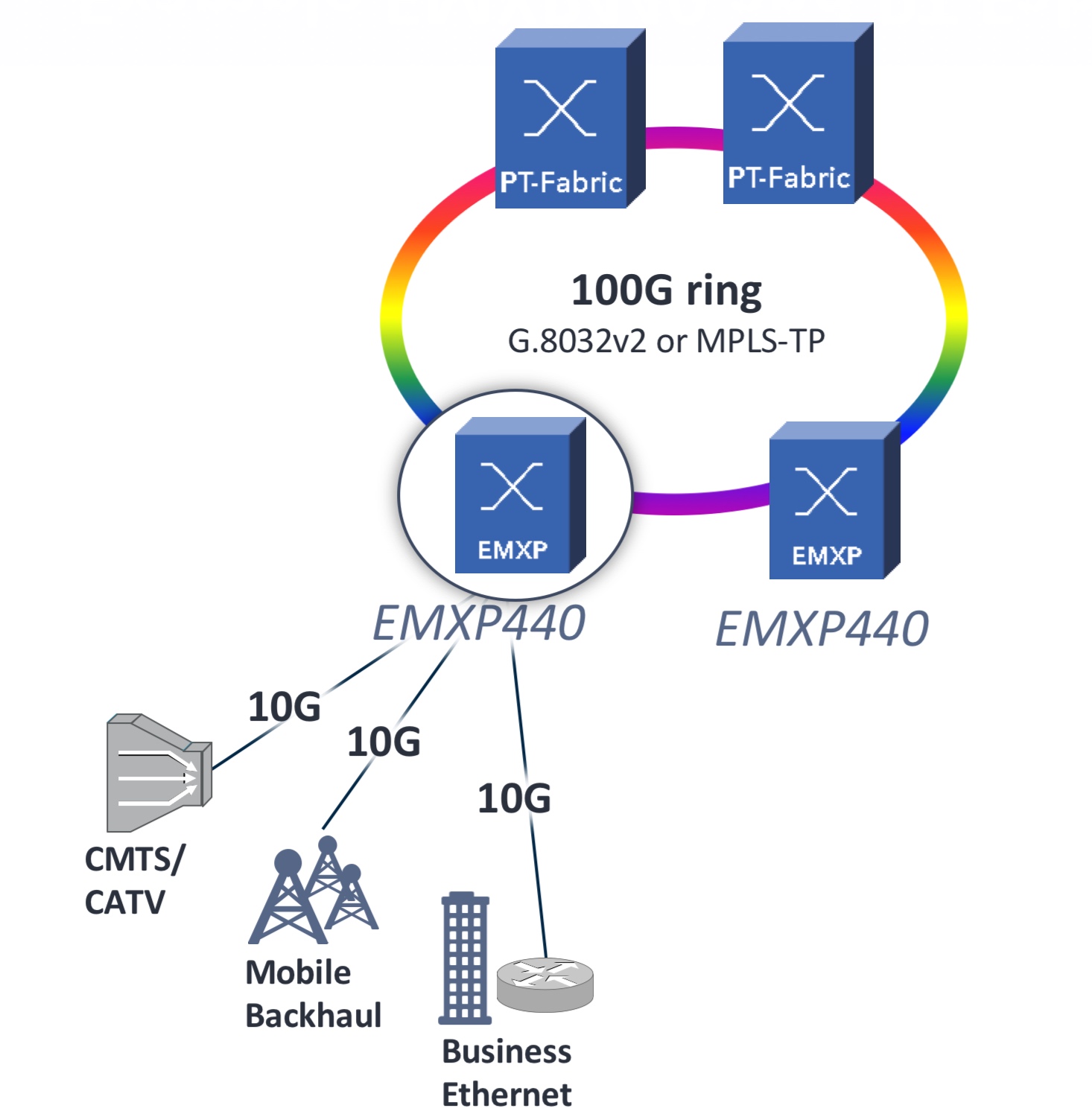
The EMXP440 packet-optical transport switch card supports layer-two functionality such as Carrier Ethernet 2.0 and MPLS-TP. “Mobile backhaul and residential broadband, these are the cards the operators tend to use,” says Bennett.
The two-slot EMXP440 card has two CFP2-DCOs and 12 SFP+ client-side interfaces. The reason why the line side and client side interface capacity differ (400 gigabits versus 120 gigabits) is that the card can be used to build simple packet rings (see diagram, top).
The line-side interfaces can be used for ‘East’ and ‘West' traffic while the SFP+ modules can be used to add and drop signals. The EMXP440 card also has an MPO port such that up to 12 SFP+ further ports can be added using Infinera’s PTIO-10G card, part of its PT Fabric products.
A flexible grid open line system is also available for the XTM II. The XTM II’s 100-gigabit and 200-gigabit wavelengths fit within a 50GHz-wide fixed grid channel but Infinera is already anticipating future higher baud rates that will require channels wider than 50GHz. A flexible grid also improves the use of the fibre’s overall capacity. In turn, RAMAN amplification will also be needed to extend the reach using future higher order modulation schemes such as 32- and 64-QAM.
Infinera says the 400-gigabit flexponder card will be available in the next quarter while the 200-gigabit muxponder and the EMXP440 cards will ship in the final quarter of 2017.

Nokia’s PSE-2s delivers 400 gigabit on a wavelength
Four hundred gigabit transmission over a single carrier is enabled using Nokia’s second-generation programmable Photonic Service Engine coherent processor, the PSE2, part of several upgrades to Nokia's flagship PSS 1830 family of packet-optical transport platforms.
 Kyle Hollasch“One thing that is clear is that performance will have a key role to play in optics for a long time to come, including distance, capacity per fiber, and density,” says Sterling Perrin, senior analyst at Heavy Reading.
This limits the appeal of the so-called “white box” trend for many applications in optics, he says: “We will continue to see proprietary advances that boost performance in specific ways and which gain market traction with operators as a result”.
The 1830 Photonic Service Switch
The 1830 PSS family comprises dense wavelength-division multiplexing (DWDM) platforms and packet-OTN (Optical Transport Network) switches.
The DWDM platform includes line amplifiers, reconfigurable optical add-drop multiplexers (ROADMs), transponder and muxponder cards. The 1830 platforms span the PSS-4, -8, -16 and the largest and original -32, while the 1830 PSS packet-OTN switches include the PSS-36 and the PSS-64 platforms. The switches include their own coherent uplinks but can be linked to the 1830 DWDM platforms for their line amps and ROADMs.
The 1830 PSS upgrades include a 500-gigabit muxponder card for the DWDM platforms that feature the PSE2, new ROADM and line amplifiers that will support the L-band alongside the C-band to double fibre capacity, and the PSS-24x that complements the two existing OTN switch platforms.
100-gigabit as a service
In DWDM transmissions, 100-gigabit wavelengths are commonly used to transport multiplexed 10-gigabit signals. Nokia says it is now seeing increasing demand to transport 100-gigabit client signals.
“One hundred gigabit is becoming the new currency,” says Kyle Hollasch, director, optical marketing at Nokia. “No longer is the thinking of 100 gigabit just as a DWDM line rate but 100 gigabit as a service, being handed from a customer for transport over the network.”
Current PSS 1830 platform line cards support 50-gigabit, 100-gigabit and 200-gigabit coherent transmission using polarisation-multiplexed, binary phase-shift keying (PM-BPSK), quadrature phase-shift keying (PM-QPSK) and 16 quadrature amplitude modulation (PM-16QAM), respectively. Nokia now offers a 500-gigabit muxponder card that aggregates and transports 100-gigabit client signals. The 500-gigabit muxponder card has been available since the first quarter and already several hundred cards have been shipped.
“The challenge is not just to crank up capacity but to do so profitably,” says Hollasch. “Keeping the cost-per-bit down, the power consumption down while pushing towards the Shannon limit [of fibre] to carry more capacity.”
 Source: Nokia
Modulation formats
The PSE2 family of coherent processors comprises two designs: the high-end super-coherent PSE-2s and the compact low-power PSE-2c.
Nokia joins the likes of Ciena and Infinera in developing several coherent ASICs, highlighting how optical transport requirements are best met using custom silicon. Infinera also announced its latest generation photonic integrated circuit that supports up to 2.4 terabits.
The high-end PSE-2s is a significant enhancement on the PSE coherent chipset first announced in 2012. Implemented using 28nm CMOS, the PSE-2s has a power consumption similar to the original PSE yet halves the power consumption-per-bit given its higher throughput.
The PSE-2s adds four modulation formats to the PSE’s existing three and supports two symbol rates: 32.5 gigabaud and 44.5 gigabaud. The modulation schemes and distances they enable are shown in the chart.

The 1.4 billion transistor PSE-2s has sufficient processing performance to support two coherent channels. Each channel can implement a different modulation format if desired, or the two can be tightly coupled to form a super-channel. The only exception is the 400-gigabit single wavelength format. Here the PSE-2s supports only one channel implemented using a 45 gigabaud symbol rate and PM-64QAM. The 400-gigabit wavelength has a relatively short 100-150km reach, but this suits data centre interconnect applications where links are short and maximising capacity is key.
Nokia recently conducted a lab experiment resulting in the sending of 31.2 terabits of data over 90km of standard single-mode fibre using 78, 400-gigabit channels spaced 50GHz apart across the C-band. "We were only limited by the available hardware from reaching 35 terabits," says Hollasch.
Using the 45-gigabaud rate and PM-16QAM enables two 250-gigabit channels. This is how the 500-gigabit muxponder card is achieved. The 250-gigabit wavelength has a reach of 900km, and this can be extended to 1,000km but at 200 gigabit by dropping to the 32-gigabaud symbol rate, as implemented with the current PSE chipset.
Nokia also offers 200 gigabit implemented using 45 gigabaud and 8-QAM. “The extra baud rate gets us [from 150 gigabit] to 200 gigabit; this is very valuable,” says Hollasch. The resulting reach is 2,000km and he expects this format to gain the most market traction.
The PSE-2s, like the PSE, also implements PM-QPSK and PM-BPSK but with reaches of 3,000-5,000km and 10,000km, respectively.
The PSE-2s introduces a fourth modulation format dubbed set-partition QPSK (SP-QPSK).
Standard QPSK uses amplitude and phase modulation resulting in a 4-point constellation. With SP-QPSK, only three out of the possible four constellation points are used for any given symbol. The downside of the approach is that a third fewer constellation points are used and hence less data is transported but the lost third can be restored using the higher 45-gigabaud symbol rate.
The benefit of SP-QPSK is its extended reach. “By properly mapping the sequence of symbols in time, you create a greater Euclidean distance between the symbol points,” says Hollasch. “What that gives you is gain.” This 2.5dB extra gain compared to PM-QPSK equates to a reach beyond 5,000km. “That is the territory most implementation are using BPSK and also addresses a lot of sub-sea applications,” says Hollasch. “Using SP-QPSK [at 100 gigabit] also means fewer carriers and hence, it is more spectrally efficient than [50-gigabit] BPSK.”
The PSE-2c
The second coherent DSP-ASIC in the new family is the PSE-2c compact, also implemented in 28nm CMOS, designed for smaller, low-power metro platforms and metro-regional reaches.
The PSE-2c supports a 100-gigabit line rate using PM-QPSK and will be used alongside the CFP2-ACO line-side pluggable module. The PSE-2c consumes a third of the power of the current PSE operating at 100 gigabit.
“We are putting the PSE2 [processors] in multiple form factors and multiple products,” says Hollasch.
The recent Infinera and Nokia announcements highlight the electronic processing versus photonic integration innovation dynamics, says Heavy Reading's Perrin. He notes how innovations in electronics are driving transmission across greater distances and greater capacities per fibre and finding applications in both long haul and metro networks as a result.
“Parallel photonic integration is a density play, but even Infinera’s ICE announcement is a combination of photonic integration and electronic processing advancements,” says Perrin. “In our view, electronic processing has taken a front seat in importance for addressing fibre capacity and transmission distance, which is why the need for parallel photonic integration in transport has not really spread beyond Infinera so far.”
 The PSS-24x showing the 24, 400 gigabit line cards and 3 switch fabric cards, 2 that are used and one for redundancy. Source: Nokia
PSS-24x OTN switch
Nokia has also unveiled its latest 28nm CMOS Transport Switch Engine, a 2.4-terabit non-blocking OTN switch chip that is central to its latest PSS-24x switch platform. Two such chips are used on a fabric card to achieve 4.8 terabits, and three such cards are used in the PSS-24x, two active cards and a third for redundancy. The result is 9.6 terabits of switching capacity instead of the current platforms' 4 terabits, while power consumption is halved.
Nokia says it already has a roadmap to 48-terabits of switching capacity. “The current generation [24x] shipping in just a few months is 400-gigabit per slot,” says Hollasch. The 24 slots that fit within the half chassis results in 9.6 terabits of switching capacity. However, Nokia's platform roadmap will achieve 1 terabit-per-slot by 2018-19. The backplane is already designed to support such higher speeds, says Hollasch. This would enable 24 terabits of switching capacity per shelf and with two shelves in a bay, a total switching capacity of 48 terabits.
The transport switch engine chip switches OTN only. It is not designed as a packet and OTN switch. “A cell-based agnostic switching architecture comes with a power and density penalty,” explains Hollasch, adding that customers prefer the lowest possible power consumption and highest possible density.
The result is a centralised OTN switch fabric with line-card packet switching. Nokia will introduce packet switching line cards next year that will support 300 gigabit per card. Two such cards will be ‘pair-able’ to boost capacity to 600 gigabit but Hollasch stresses that the PSS-24x will not switch packets through its central fabric.
Doubling capacity with the L-band
By extending the 1830 PSS platform to include the L-band, up to 70 terabits of data can be supported on a fibre, says Hollasch.
Nokia has developed a line card that supports both C-band and L-band amplification that will be available around the fourth quarter of this year. The ROADM and 500-gigabit muxponder card for the L-band will be launched in 2017.
Once the amplification is available, operators can start future-proofing their networks. Then when the L-band ROADMs and muxponder cards become available, operators can pay as they grow; extending wavelengths into the L-band, once all 96 channels of the C-band are used, says Hollasch.
Ciena enhances its 6500 packet-optical transport family
"The 6500 T-Series is a big deal as Ciena can offer two different systems depending on what the customer is looking for," says Andrew Schmitt, founder and principal analyst of market research firm, Cignal AI.
 Helen XenosIf customers want straightforward transport and the ability to reach a number of different distances, there is the existing 6500 S-series, says Schmitt. The T-series is a system specifically for metro-regional networks that can accommodate multiple traffic types – OTN or packet.
"It has very high density for a packet-optical system and offers pay-as-you-grow with CFP2-ACO [coherent pluggable] modules," says Schmitt.
Ciena says the T-series has been developed to address new connectivity requirements service providers face. Content is being shifted to the metro to improve the quality of experience for end users and reduce capacity on backbone networks. Such user consumption of content is one factor accounting for the strong annual 40 percent growth in metro traffic.
According to Ciena, service providers have to deploy multiple overlays of network elements to scale capacity, including at the photonic switch layer, because they need more than 8-degree reconfigurable optical add/ drop multiplexers (ROADMs).
Operators are looking for a next-generation platform for these very high-capacity switching locations to efficiently distribute content
But overlays add complexity to the metro network and slow the turn-up times of services, says Helen Xenos, director, product and technology marketing at Ciena: "Operators are looking for a next-generation platform for these very high-capacity switching locations to efficiently distribute content."
U.S. service provider Verizon is the first to announce the adoption of the 6500 T-series to modernise its metro and is now deploying the platform. "Verizon is dealing with a heterogeneous network in the metro with many competing requirements," says Schmitt. "They don’t have the luxury of starting over or specialising like some of the hyper-scale transport architectures."
The T-series, once deployed, will handle the evolving requirements of Verizon's network. "Sure, it comes with additional costs compared with bare-bones transport but my conversation with folks at Verizon would indicate flexibility is worth the price," says Schmitt.
Ciena has over 500 customers in 50 countries for its existing 6500 S-series. Customers include 18 of the top 25 communications service providers and three of the top five content providers.
Xenos says an increasing number of service providers are interested in its latest platform. The T-series is part of six request-for-proposals (RFPs) and is being evaluated in several service providers' labs. The 6500 T-series will be generally available this month.
6500 T-series
The existing 6500 S-series family comprises four platforms, from the 2 rack-unit (RU) 6500-D2 chassis to the 22RU 6500-S32 that supports Ethernet, time-division multiplexed traffic and wavelength division multiplexing, and 3.2 terabit-per-second (Tbps) packet/ Optical Transport Network (OTN) switching.
The two T-series platforms are the half rack 6500-12T and the full rack 6500-24T. The cards have been upgraded from 100-gigabit switching per slot to 500-gigabit per slot.
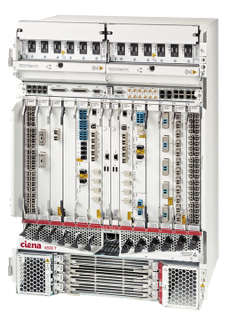 The 6500-T12 has 12 service slots which house either service interfaces or photonic modules. There are also 2 control modules. Shown at the base of the chassis are four 500 Gig switching modules. Source: Ciena
The 500 gigabit switching per slot means the 6500-12T supports 6 terabits of switching capacity while the -24T will support 12 terabits by year end. The platforms have been tested and will support 1 terabit per slot, such that the -24T will deliver the full 24 terabit. Over 100 terabit of switching capacity will be possible in a multiple-chassis configuration, managed as a single switching node.
The latest platforms can use Ciena's existing coherent line cards that support two 100 gigabit wavelengths. The T-Series also supports a 500-gigabit coherent line card with five CFP2-ACOs coupled with Ciena's WaveLogic 3 Nano DSP-ASIC.
"We will support higher-capacity wavelengths in a muxponder configuration using our existing S-series," says Xenos. "But for switching applications, switching lower-speed traffic across the shelf onto a very high-capacity wavelength, this is something that the T-series would be used for."
The T-series also adds a denser, larger-degree ROADM, from an existing 6500 S-series 8-degree to a 16-degree flexible grid, colourless, directionless and contentionless (CDC) design. Xenos says the ROADM design is also more compact such that the line amplifiers fit on the same card.
"The requirements of this platform is that it has full integration of layer 0, layer 1 and layer 2 functions," says Xenos.
The 6500 T-series supports open application programming interfaces (APIs) and is being incorporated as part of Ciena's Emulation Cloud. The Emulation Cloud enabling customers to test software on simulated network configurations without requiring 6500 hardware and is being demonstrated at OFC 2016.
The 6500 is also being integrated as part of Ciena's Blue Planet orchestration and management architecture.
Ciena shops for photonic technology for line-side edge
Part 3: Acquisitions and silicon photonics
Ciena is to acquire the high-speed photonics components division of Teraxion for $32 million. The deal includes 35 employees and Teraxion’s indium phosphide and silicon photonics technologies. The systems vendor is making the acquisition to benefit its coherent-based packet-optical transmission systems in metro and long-haul networks.
 Sterling Perrin
“Historically Ciena has been a step ahead of others in introducing new coherent capabilities to the market,” says Ron Kline, principal analyst, intelligent networks at market research company, Ovum. “The technology is critical to own if they want to maintain their edge.”
“Bringing in-house not everything, just piece parts, are becoming differentiators,” says Sterling Perrin, senior analyst at Heavy Reading.
Ciena designs its own WaveLogic coherent DSP-ASICs but buys its optical components. Having its own photonics design team with expertise in indium-phosphide and silicon photonics will allow Ciena to develop complete line-side systems, optimising the photonics and electronics to benefit system performance.
Owning both the photonics and optics also promises to reduce power consumption and improve line-side port density.
“These assets will give us greater control of a critical roadmap component for the advancement of those coherent solutions,” a Ciena spokesperson told Gazettabyte. “These assets will give us greater control of a critical enabling technology to accelerate the pace of our innovation and speed our time-to-market for key packet-optical solutions.”
Ciena have always been do-it-yourself when it comes to optics, and it is an area where they has a huge heritage. So it is an interesting admission that they need somebody else to help them.
The OME 6500 packet optical platform remains a critical system for Ciena in terms of revenues, according to a recent report from the financial analyst firm, Jefferies.
Ciena have always been do-it-yourself when it comes to optics, and it is an area where they have a huge heritage, says Perrin: “So it is an interesting admission that they need somebody else to help them.” It is the silicon photonics technology not just photonic integration that is of importance to Ciena, he says.
Coherent competition
Infinera, which designs its own photonic integrated circuits (PICs) and coherent DSP-ASIC, recently detailed its next-generation coherent toolkit prior to the launch of its terabit PIC and coherent DSP-ASIC. The toolkit uses sub-carriers, parallel processing soft-decision forward-error correction (SD-FEC) and enhanced modulation techniques. These improvements reflect the tighter integration between photonics and electronics for optical transport.
Cisco Systems is another system vendor that develops its own coherent ASICs and has silicon photonics expertise with its Lightwire acquisition in 2012, as does Coriant which works with strategic partners while using merchant coherent processors. Huawei has photonic integration expertise with its acquisitions of indium phosphide UK specialist CIP Technologies in 2012 and Belgian silicon photonics start-up Caliopa in 2013.
Cisco may have started the ball rolling when they acquired silicon photonics start-up Lightwire, and at the time they were criticised for doing so, says Perrin: “This [Ciena move] seems to be partially a response, at least a validation, to what Cisco did, bringing that in-house.”
Optical module maker Acacia also has silicon photonics and DSP-ASIC expertise. Acacia has launched 100 gigabit and 200-400 gigabit CFP optical modules that use silicon photonics.
Companies like Coriant and lots of mid-tier players can use Acacia and rely on the expertise the start-up is driving in photonic integration on the line side, says Perrin. ”Now Ciena wants to own the whole thing which, to me, means they need to move more rapidly, probably driven by the Acacia development.”
Teraxion
Ciena has been working with Canadian firm Teraxion for a long time and the two have a co-development agreement, says Perrin.
Teraxion was founded in 2000 during the optical boom, specialising in dispersion compensation modules and fibre Bragg gratings. In recent years, it has added indium-phosphide and silicon photonics expertise and in 2013 acquired Cogo Optronics, adding indium-phosphide modulator technology.
Teraxion detailed an indium phosphide modulator suited to 400 gigabit at ECOC 2015. Teraxion said at the time that it had demonstrated a 400-gigabit single-wavelength transmission over 500km using polarisation-multiplexed, 16-QAM (PM-16QAM), operating at a symbol rate of 56 gigabaud.
It also has a coherent receiver technology implemented using silicon photonics.
The remaining business of Teraxion covers fibre-optic communication, fibre lasers and optical-sensing applications which employs 120 staff will continue in Québec City.
Ericsson and Ciena collaborate on IP-over-WDM and SDN
 Jan Häglund
Ericsson and Ciena have signed a global strategic agreement that provides Ericsson with Ciena's optical networking technology, while Ciena benefits from Ericsson's broader service provider relationships.
In particular, Ciena's WaveLogic coherent optical processor will be integrated into a module and added to Ericsson's Smart Service IP routers, while Ericsson will resell Ciena's 6500 Packet-Optical Platform and 5400 Reconfigurable Switching Systems.
Both companies will also collaborate in developing SDN in the WAN, also known as service provider SDN or Transport SDN.
IP-over-WDM will grow rapidly, accounting for over 30 percent of the total market by 2020.
Ericsson says the IP market will reach US $15 billion and optical networking $10 billion in 2014. Jan Häglund, vice president, head of IP and broadband at Ericsson, says the two markets are not independent and that IP-over-WDM will grow rapidly, accounting for over 30 percent of the total market by 2020.
Ciena's motivation for the deal is somewhat different.
"We are focussed on packet optical convergence - Layer 2 down to Layer 0 - creating a scalable, cost effective WAN infrastructure for service providers," said James Frodsham, Ciena’s senior vice president and chief strategy officer. "We have been looking around our core value proposition, we have been looking to expand our distribution into geographies and customers where we lack presense." The deal with Ericsson clearly addresses that, he says.
 There is now more to think about. It is a very interesting time.
James Frodsham, Ciena
The company also has a different view regarding IP-over-WDM. IP routers are a vital part of the network but for cost reasons they are better used in centralised locations, interconnected using packet optical networking, said Tom Mock, senior vice president, corporate communications at Ciena.
Working with Ericsson widens the network applications Ciena can address. "But our view of the prevalence of IP-over-WDM hasn't really changed," said Mock.
 Tom MockEricsson and Ciena both highlight the changes taking place in the network, namely Network Functions Virtualisation (NFV) and SDN, as another reason for the tie-up.
NFV is turning telecom functions that previously required dedicated platforms into software that is virtualised and executed on servers. NFV promises to bring to telecom the benefits of IT and cloud computing, enabling operators to introduce services more quickly and scale them according to demand.
SDN, meanwhile, not only oversees such virtualised services, but also the network layers over which they run. This is where IP-over-WDM plays a role and why the two companies are working to develop Transport SDN.
It also gives us exposure to the Evolved Packet Core that is going into new wireless installations
Ciena's optical infrastructure and Ericsson's service-provider SDN and IP portfolio will result in a competitive solution, said Ericsson. "Combining the two network layers, and jointly making sure that the control protocol optimises the traffic network, will lead to CapEx and OpEx savings," said Ericsson's Häglund, in a company webcast announcing the deal.
Other benefits of the agreement include growing Ciena's relationships with services providers, especially in wireless. "It also gives us exposure to the Evolved Packet Core that is going into new wireless installations," said Mock.
Ciena also highlights Ericsson's strengths in operations and business support systems (OSS/ BSS). Ciena says the transition to SDN will be gradual. "That evolution is going to have to take into account OSS/ BSS technologies and having a partner that is strong in that area will help us both," said Mock.
Ciena believes more such industry collaboration should be expected. "We see that with programs like AT&T's Domain 2.0 Program, such thinking is also happening in the marketplace," said Mock. For the Supplier Domain 2.0 Program, AT&T is selecting vendors to provide a modern, cloud-based architecture that includes NFV and SDN technologies.
The collaboration between Ciena and Ericsson should boost their position as possible Domain 2.0 suppliers. "Both of us are suppliers under AT&T's current domain program, and as with any relationship, incumbency has advantages" said Mock. "The fact that we are beginning to collaborate on SDN-oriented applications ought to help."
Industry collaboration between telecom vendors and IT equipment providers will also likely increase.
"The data centre is a very important piece of real-estate in the future infrastructure," said Frodsham. The data centre hosts the storage and servers that manage the bulk of applications that pass across the network. Greater collaboration will be needed between telco and IT vendors to optimise how the data centre interacts with the WAN.
"There is now more to think about," said Frodsham. "It is a very interesting time."
Packet optical transport: Hollowing the network core
The platform enables a fully-meshed metropolitan network Intune Networks' CEO, Tim Fritzley (right) and John Dunne, co-founder and CTO with software support for web-based services, claims the Irish start-up.
“What we have designed allows for the sharing of the same fibre switching assets across multiple services in the metro,” says Tim Fritzley, Intune’s CEO.
The company is in talks with several operators about its OPST system, which is being used for a nationwide network in Ireland. The system is also part of an EC seventh framework project that includes Spanish operator Telefónica.
OPST architecture
Intune’s OPST system, dubbed the Verisma iVX8000, uses dense wavelength division multiplexing (DWDM) technology but with a twist. Each wavelength is assigned to a particular destination port, over which the data is transmitted in bursts. The result is an architecture that uses both wavelength-division and time-division multiplexing.
To enable the approach, Intune has developed a control algorithm that can switch and lock a tunable laser’s wavelength “in nanoseconds”. Such rapid laser switching enables wavelength addressing - assigning a dedicated wavelength to each destination port.
As packets arrive at the iVX8000, they are ‘coloured’ and queued before being sent on the required wavelength to their destination. In effect packets are routed at the optical layer, in contrast to traditional systems where traffic is packed onto a lightpath that has a fixed predefined point-to-point optical path.
The packets are sent in bursts based on their class-of-service. Intune uses a proprietary framing scheme for transmission, with Ethernet frames restored at the destination. At the input port, all the packets are queued based on their wavelength and class-of-service. The scheduler, which composes the bursts, picks bits to transmit from the queues based on their class, with the bits sent without having to be aligned with a frame’s boundaries.
 “Instead of assigning an electrical address to a fixed wavelength, we are assigning electrical addresses to dynamic wavelengths”
Tim Fritzley, Intune Networks
Intune also uses dynamic bandwidth allocation: any bandwidth unused by the higher classes of service is assigned to lower priority traffic. This achieves over 80 percent utilisation of the Ethernet switching and the fibre, says Fritzley.
“You are responding to the dynamic loading of the traffic as it comes in, on a destination-by-destination, colour-by-colour basis,” says Fritzley “Instead of assigning an electrical address to a fixed wavelength [as with traditional systems], we are assigning electrical addresses to dynamic wavelengths.”
The result is a fully meshed architecture with any transponder able to talk to any other transponder on the network, says Fritzley.
System’s span
The network architecture is arranged as a ring with up to a 300km span. The ring connects up to 16 iVX8000 nodes each comprising four 10 Gigabit-per-second (Gbps) ports and switching hardware. Each port is assigned a particular wavelength, equating to a total switch capacity of 640Gbps.
Intune has an 80-wavelength design even though only 64 are used. Indeed it uses two optical rings in parallel. The two rings run in opposite directions, providing optical protection for each port and effectively doubling overall capacity.
For the client side interfaces, the iVX8000 uses four 10 Gigabit Ethernet ports. Since transmissions are in bursts, multiple ports can transmit data to the same destination port even though they share the same wavelength.
The system’s 300km span is an artificial value set by Intune to guarantee “plug-and-play” performance. If the individual chassis are less than 65km apart and the total ring is 300km or under, Intune guarantees no DWDM engineering is required. “We auto-discover all the optical paths and nodes in the network; we automatically adjust all the amplification and set up the dispersion compensation,” says Fritzley. “This saves thousands of engineer-hours and truck rolls.”
Intune points out that it has engineered a 700km network but claims that for distances beyond 1,000km, point-to-point links connecting regions make more sense.
John Dunne, co-founder and CTO of Intune, claims the metro architecture simplifies networking greatly when connecting the network edge to the IP core. “It is different to what is there today because there are no routeing decisions to be made,” says Dunne. “All of the routes pre-exist, and that is because the tunable lasers contain all the colours of all the ports on the ring.”
As a result, setting up a flow of packets between the edge and core involves using a single interface to the ring. “You don’t have to talk to all the [ring’s] elements, you just talk to the ring,” says Dunne. “The ring is pre-engineered so it knows it’s a ring; it also knows how to guarantee the latency, the bandwidth, the jitter of any flow.”
This is the system’s main merit, says Dunne, the pre-engineered ring hides all the difficulty of building a control layer on top of a dynamic optical and layer-two switching system.
Bringing the web into the network
Intune realised that traditional telecom software would struggle to make best use of its distributed optical packet switch architecture. The company has adopted the representational state transfer (REST) software approach for its architecture instead.
“REST is the heart of web services,” says Fritzley. “The reason we did this is that there are hundreds of thousands of programmers that understand how to program it, so you are not into the arcane telecom languages of SNMP and TL1.” Adopting a 'RESTful' approach, claims Intune, reduces code development by 70 percent.
Moreover, REST by its nature is distributed such that it lends itself to supporting distributed transactions across Intune’s switch. “We have put a mini-http server on every card; we do not centralise control inside a node,” says Fritzley. “Every card peers with all of its peer-functions on the ring.”
In terms of the switch's operation, high-level XML commands are used instead of sending low-level instructions to numerous elements. “For example you ask the ring - set up this flow of packets with this bandwidth, this jitter and this delay,” says Dunne. “The ring replies that it can set this up and it performs the low-level stuff internal to the ring."
Such a capability will ultimately enable a machine to provision bandwidth for services, and enable machine-to-machine communications, says Intune. It will also enable third-party application developers to use the switch for service provisioning. This isn’t possible today because there is a lack of control, says Dunne.
“We have a full suite of XML-based interface commands,” he says. “All [the interface commands] would go to the carrier, the carrier would expose a subset to the Googles, the Googles would expose a subset to their application writers, and the application writers would expose a subset to the consumer.” Were the consumer to send a command to request some bandwidth, the call would be passed through the various layers directly into the switch, all in a controlled manner.
Provisioning of bandwidth in such an automated fashion is possible because Intune’s underlying network is bounded and predictable, says Dunne, with the optical path pre-engineered to work with the data path.
Meanwhile until XML becomes more commonplace, Intune uses a code translator that converts the XML code to SNMP or TL1 to interface to existing systems.
 “The ring is pre-engineered so it knows it’s a ring; it also knows how to guarantee the latency, the bandwidth, the jitter of any flow”
John Dunne, Intune Networks
Applications
The iVX8000 is being targetted at applications such as cloud computing services and the moving of virtualised environments between data centres. But the real target is using the platform to support multiple services – 3G and 4G wireless backhaul, on-demand IP TV as well as cloud. “No-one can do traffic planning anymore around such services,” says Fritzley.
The platform addresses what one large European operator calls ‘hollowing the core’. The operator wants to simplify its metro network by moving such networking elements as broadband remote access servers (BRASs) to the network edge. These will be connected using a simpler layer-two network that lessens the use of large, expensive IP core routers.”All the IP processing is on the edge and you go edge-to-edge on a flat layer two,” says Fritzley.
Market developments
Intune is using its system to enable the Exemplar network in Ireland. Backed by the Irish Government, the company’s systems will be used to build a nationwide network. The first phase involves a lab for application development and testing. So far 40 multi-nationals have signed up to use the network. Starting next year, a ring network will be up and running around Dublin to be followed with a nationwide roll-out in 2013.
The Irish start-up is also part of an EC Seventh Framework research project called MAINS. The project, which started in January, involves Telefónica which is using the iVX8000 to move virtualised resources between data centres depending on user demand and latency requirements. The project uses XML commands to call for bandwidth from the networking layer.
Meanwhile, Intune says that it is “deeply engaged” with four to five of the largest operators in North America and Europe.