

The APC’s blueprint for silicon photonics

The Advanced Photonics Coalition (APC) wants to smooth the path for silicon photonics to become a high-volume manufacturing technology.
The organisation is talking to companies to tackle issues whose solutions will benefit the photonics technology.
The Advanced Photonics Coalition wants to act as an industry catalyst to prove technologies and reduce the risk associated with their development, says Jeffery Maki, Distinguished Engineer at Juniper Networks and a member of the Advanced Photonics Coalition’s board.
Origins
The Advanced Photonics Coalition was unveiled at the Photonic-Enabled Cloud Computing (PECC) Industry Summit jointly held with Optica last October.
The Coalition was formerly known as the Coalition for On-Board Optics (COBO), an industry initiative led by Microsoft.
Microsoft wanted a standard for on-board optics, until then it was a proprietary technology. At the time, on-board optics was seen as an important stepping stone between pluggable optical modules and their ultimate successor, co-packaged optics.
After years of work developing specifications and products, Microsoft chose not to adopt on-board optics in its data centres. Although COBO added other work activities, such as co-packaged optics, the organisation lost momentum and members.
Maki stresses that COBO always intended to tackle other work besides its on-board optics starting point.
Now, this is the Advanced Photonics Coalition’s goal: to have a broad remit to create working groups to address a range of issues.
Tackling technologies
Many standards organisations publish specifications but leave the implementation technologies to their member companies. In contrast, the Advanced Photonics Coalition is taking a technology focus. It wants to remove hurdles associated with silicon photonics to ease its adoption.
“Today, we see the artificial intelligence and machine learning opportunities growing, both in software and hardware,” says Maki. “We see a need in the coming years for more hardware and innovative solutions, especially in power, latency, and interconnects.”
Work Groups
In the past, systems vendors like Cisco or Juniper drove industry initiatives, and other companies fell in line. More recently, it was the hyperscalers that took on the role.
There is less of that now, says Maki: “We have a lot of companies with technologies and good ideas, but there is not a strong leadership.”
The Advanced Photonics Coalition wants to fill that void and address companies’ common concerns in critical areas. “Key customers will then see the value of, and be able to access, that standard or technology that’s then fostered,” says Maki.
The Advanced Photonics Coalition has yet to announce new working groups but it expects to do so in 2024.
One area of interest is silicon photonics foundries and their process design kits (PDKs). Each foundry has a PDK, made up of tools, models, and documentation, to help engineers with the design and manufacture of photonic integrated devices.
“A starting point might be support for more than one foundry in a multi-foundry PDK,” says Maki. “Perhaps a menu item to select the desired foundry where more than one foundry has been verified to support.”
Silicon photonics has long been promoted as a high-volume manufacturing technology for the optical industry. “But it is not if it has been siloed into separate efforts such that there is not that common volume,” says Maki.
Such a PDK effort would identify gaps that each foundry would need to fill. “The point is to provide for more than one foundry to be able to produce the item,” he says.
A company is also talking to the Advanced Photonics Coalition about co-packaged optics. The company has developed an advanced co-packaged optics solution, but it is proprietary.
“Even with a proprietary offering, one can make changes to improve market acceptance,” says Maki. The aim is to identify the areas of greatest contention and remedy them first, for example, the external laser source. “Opening that up to other suppliers through standards adoption, existing or new, is one possibility,” he says.
The Advanced Photonics Coalition is also exploring optical interconnecting definitions with companies. “How we do fibre-attached to silicon photonics, there’s a desire that there is standardisation to open up the market more,” says Maki. “That’s more surgical but still valuable.”
And there are discussions about a working group to address co-packaged optics for the radio access network (RAN). Ericsson is one company interested in co-packaged optics for the RAN. Another working group being discussed could tackle optical backplanes.
Maki says there are opportunities here to benefit the industry.
“Companies should understand that nothing is slowing them down or blocking them from doing something other than their ingenuity or their own time,” he says.
Status
COBO had 50 members earlier in 2023. Now, the membership listed on the website has dropped to 39 and the number could further dip; companies that joined for COBO may still decide to leave.
At the time of writing, an new as yet unannounced member has joined the Advanced Photonics Coalition, taking the membership to 40.
“Some of those companies that left, we think they will return once we get the working groups formed,” says Maki, who remains confident that the organisation will play an important industry role.
“Every time I have a conversation with a company about the status of the market and the needs that they see for the coming years, there’s good alignment amongst multiple companies,” he says.
There is an opportunity for an organisation to focus on the implementation aspects and the various technology platforms and bring more harmony to them, something other standards organisations don’t do, says Maki.


Industry underestimating 25 Gigabit parallel optics challenge
Ten Gigabit-based parallel optics is set to dominate the marketplace for several years to come. So claims datacom module specialist, Avago Technologies.

"One customer told us it has to keep the interface speed below 20Gbps due to the cost of the SerDes"
Sharon Hall, Avago
"People are underestimating what is going to be involved in doing 25 Gigabit [channels]," says Sharon Hall, product line manager for embedded optics at Avago Technologies. "Ten Gigabit is going to last quite a bit longer because of the price point it can provide."
Eventually 25 Gig-based parallel optics, with its lower lane count, will be cheaper than 10 Gigabit - but is will take several years. One challenge is the cost of 25 Gigabit-per-second (Gbps) electrical interfaces, due to the large relative size of the circuitry. One customer told Avago that it has to keep the interface speed below 20Gbps for now due to the cost of the serial/ deserialiser (SerDes).
Avago has announced that its 120 Gigabit aggregate bandwidth (12x10Gbps) MiniPod and CXP parallel optics products are now in volume production. The company first detailed the MiniPod and CXP technologies in late 2010 yet many equipment makers are still to launch their first designs.
The CXP is a pluggable optical transceiver while the MiniPod is Avago's packaged optical engine used for embedded designs. The 22x18mm MiniPod is based on Avago's 8x8mm MicroPod optical engine but uses a 9x9 electrical MegArray connector with its more relaxed pitch.
Equipment makers face a non-trivial decision as to whether to adopt copper or optical interfaces for their platform designs. "This is a major design decision with a lot of customers going back and forth deciding which way to go," says Hall. "They might do a mix with some short connections staying copper but if they need 10 Gig at anything longer than a few meters then they are going to go optical."
Having chosen parallel optics, the style of form factor - pluggable or embedded - is largely based on the interface density required. "Certain customers prefer field pluggability [of CXP] with its pay-as-you-go and ease of installation features, but are limited on port density due to the number of CXP transceivers that can physically fit on a 19 inch board," says Hall.
Up to 14 CXPs can fit onto a 19-inch board. In contrast, some 50-100 transmit and receive MiniPod pairs can fit on the 19-inch board. "You have the whole board space to work with," she says. The embedded optics sit closer to the board's ASICs, shortening the electrical path and solving signal integrity issues that can arise using edge-mounted pluggables. Thermal management - not having all the pluggable optics at the card edge furthest from the fans - is also simplified using embedded optics.
Generally, connections to data centre top-of-rack switches and between chassis use the pluggable CXP while internal backplane and mid-plane designs use the MiniPod. The CXP is also used by core switches and routers; Alcatel-Lucent's recently announced 7950 core router has a four-port CXP-based card. But Avago stresses that there are no hard rules: It has customers that have chosen the CXP and others the MiniPod for the same class of platform.
 Source: Gazettabyte
25 Gigabit parallel optics
Finisar recently demonstrated its board mounted optical assembly that it says will support channel speeds of 10, 14, 25 and 28Gbps, while silicon photonics vendors Luxtera and Kotura have announced 4x25Gbps optical engines. OneChip Photonics has announced photonic integrated circuits for the 4x25Gbps, 100GBase-LR4 10km standard that will also address short and mid-reach applications
Avago has yet to make an announcement regarding higher speed parallel optics. "It is just a matter of time," says Hall. "We have done a demonstration of our 25Gbps VCSEL in an SFP+ package over a year ago, and we are developing parallel optics 25Gbps solutions."
But 25Gbps will take time before it gets to volume production, says Hall: "It is going to be a long, long design cycle for system companies - doing 25Gbps on their boards and their systems is a completely new design."
Supercomputers and system mid-plane and backplane applications could happen a lot earlier than 4x25GbE applications. "Some customers are interested in getting 4x25Gbps samples in the 2013 timeframe," says Hall. "But we expect that volume is going to take at least another year from that."
Meanwhile, Avago says it has already shipped 600,000 MicroPods which has been generally available for over a year.
OFC/NFOEC 2012: Some of the exhibition highlights
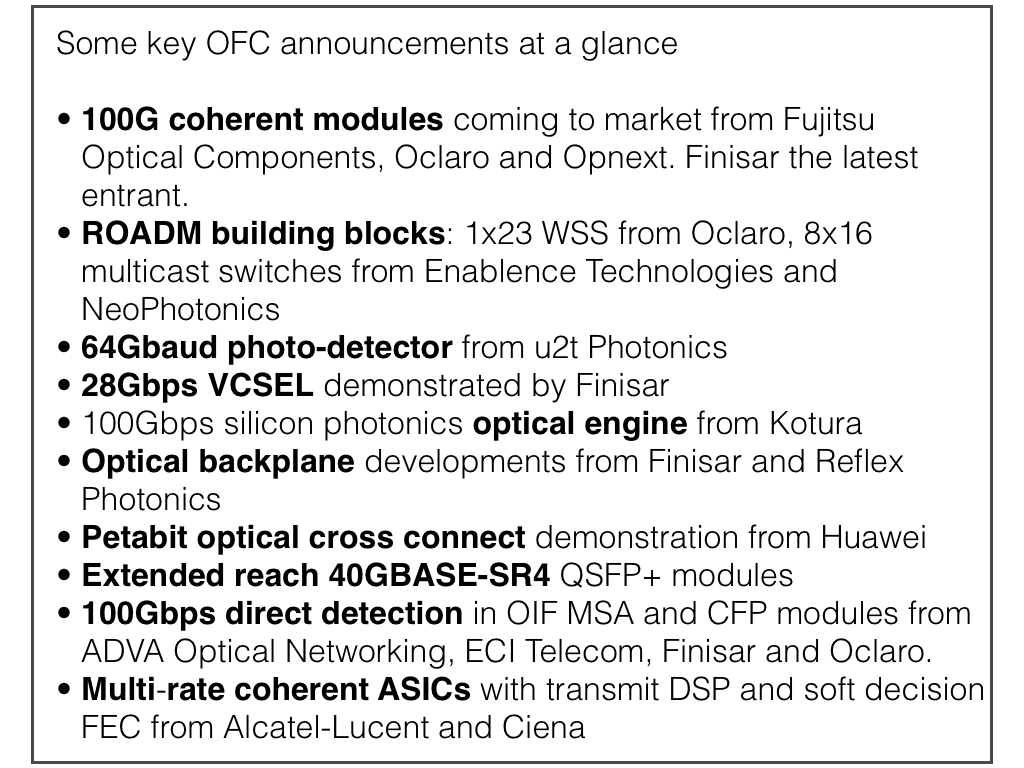
A round-up of some of the main announcements and demonstrations at the recent OFC/NFOEC 2012 exhibition and conference.
100 Gigabit coherent
Finisar demonstrated its first 100 Gigabit coherent receiver transponder. The 5x7inch dual-polarisation, quadrature phase-shift keying (DP-QPSK) module complies with the Optical Internetworking Forum's (OIF) multi-source specification. The companies joins Fujitsu Optical Components, Opnext and Oclaro that have already detailed their 100 Gigabit coherent modules. Since OFC/NFOEC, Oclaro and Opnext have announced their intention to merge.
"We can take off-the-shelf DSP technology and match it with vertically-integrated optics and come up with a module that is cost effective while enabling higher density for system vendors," says Rafik Ward, vice president of marketing at Finisar. "This will start the shift away from the system vendors' proprietary line cards."
Opnext announced it has demonstrated interoperability between its OMT-100 100 Gigabit-per-second (Gbps) coherent module and 100 Gigabit systems from Fujitsu Optical Systems and NEC. All three designs use NTT Electronics' (NEL) DSP-ASIC coherent receiver chip. "For those that use the same NEL modem chip, we can interoperate with each other," says Ross Saunders, general manager, next-generation transport for Opnext Subsystems.

They come back to folks like us and say: 'If you can hit this price point, then we will use you'
Ross Saunders, Opnext
Oclaro's MI 8000XM 100Gbps module also uses the NEL DSP-ASIC but was not part of the interoperability test sponsored by Japanese operator, NTT.
Oclaro announced its 100Gbps coherent module is now being manufactured using all its own optical components. These include a micro integrated tunable laser assembly (ITLA) - the latest ratified MSA that is more compact and has a higher output power, its modulator and its coherent receiver module.
Using its components enables the company to control performance-cost tradeoffs, says Per Hansen, vice president of product marketing, optical networks solutions at Oclaro: "This [vertical integration] gives us a flexibility we didn’t have in the past."
Finisar is not saying which merchant DSP-ASIC it is using. But like the NEL device, the DSP-ASIC supports soft-decision forward error correction (SD-FEC) to achieve a reach of over 2,000km.
Meanwhile, the module makers' 100Gbps modules are starting to be shipped to customers.
"We shipped [samples] to four customers last quarter and we are probably going to ship to another four or five by the end of this quarter," says Opnext's Saunders.
Opnext says nearly all of its early customers do not have their own in-house 100Gbps developments. However, the systems vendors that have internal 100Gbps programmes have designed their line cards using the same 168-pin interface. This allows them to replace their own 100Gbps daughter cards with a merchant 5x7-inch module.
 "This [vertical integration] gives us a flexibility we didn’t have in the past."
Per Hansen, Oclaro
The company also announced its OTS-100FLX 100Gbps muxponder, transponder and regenerator line cards that use the OTM-100 module and which slot into its OTS-4000 chassis. The chassis supports eight 100Gbps cards. Opnext's smaller 4RU OTS-mini platform hosts two 100Gbps line cards, mounted horizontally. Over half of Opnext's revenues are from subsystems sales which it brands and sells to system vendors.
As for the other 100Gbps transponder makers, Oclaro is sending out its first module samples now. Finisar says its module will be generally available by the year-end, while Fujitsu Optical Components' module was released in April.
Optical components for 200Gbps DP-QPSK
u2t Photonics announced its latest 64Gbaud photo-detector that points to the next speed shift in line-side transmission. The photo-detector is one key building block to the eventual development of a single-carrier DP-QPSK capable of 200Gbps or using 16-QAM, 400Gbps.

"We can already support the higher interface speed and data throughput"
Jens Fiedler, u2t Photonics
"System companies are looking for two things: to increase the baud rate and to use more complex modulation schemes," says Jens Fiedler, vice president sales and marketing at u2t Photonics. "[With this announcement] from the optical component perspective, we can already support the higher interface speed and data throughput."
1x23 Wavelength-selective switch
Oclaro announced a 1x23 wavelength selective switch at OFC. According to Oclaro, the 1x23 WSS has come about due to the operators' desire to support 12-degree nodes: an input port (1 degree) and through-connections on 11 other ports. The remaining 12 [of the WSS's 24 ports] are used as drop ports.
"If for each of those ports you have a fan-out that is steerable to 8 ports, you have 12x8 or 96 as the total channels you can support for a full add-drop," says Hansen. Such a 12-degree, 96-channel requirement was set by operators early on, or at least it was an industry desire, says Hansen.
Switching elements that address these drop requirements - multicast switches - were announced by NeoPhotonics and Enablence Technologies at OFC. The switches, planar lightwave circuit (PLC) hybrid integration designs, implement 8x16 multicast switches.
"The multicast switch takes signals from eight different inputs - 8 different directions in a ROADMs node and distributes those signals to up to 16 drop ports," says Ferris Lipscomb, vice president of marketing at NeoPhotonics.
Such PLC designs are complex, comprising power splitters, waveguide switching, variable optical attenuators and photo-detectors for channel monitoring.
According to NeoPhotonics, the number of optical functions used to implement the multicast switch is in the hundreds.
Enablence already has 8x8 and 8x12 multicast switches and has launched its 8x16 device. Although the company is a hybrid PIC specialist and has PLC technology, it uses polymer PLCs for the multicast designs, claiming they are lower power. NEL is another company offering 8x8 and 8x12 multicast switches.
Passive optical networking
Finisar also demonstrated a mini-PON network, highlighting its optical line terminal (OLT) transceivers, splitters and its latest GPON-stick, an GPON optical network unit built into an SFP. The demo involved using the ONU SFP transceiver in an Ethernet switch port as part of a PON network to deliver high-definition video and audio from the OLT to a high-definition TV.
The company also introduced two splitter products a 1:128 port splitter and a 2:64 (used for redundancy). These high-split ratios are being prepared for the advent of 10 Gigabit PON.
Enablence also demonstrated a WDM-PON 32-channel receiver module at OFC. "It takes 32 TO-can receivers and replaces them with a small module which includes the AWG (arrayed waveguide grating demultiplexer) and the 32 receivers," says Matt Pearson, vice president, technology, optical components division at Enablence Technologies. The design promises to increase system density by fitting two such receivers on a single blade.
Optical engines
Silicon photonics firm, Kotura, detailed its 100Gbps optical engine chip, implemented as a 4x25Gbps design. The optical engine consumes 5W and has a reach of at least 10km, making it suitable for requirements in the data centre including the 100 Gigabit Ethernet IEEE 100GBASE-LR4 standard.

"The 100Gbps chip - 5mmx6mm - is small enough to fit in the QSFP+ and emerging CFP4 optical modules
Arlon Martin, Kotura
Kotura demonstrated to select customers its optical engine. "We are not announcing the product yet," says Arlon Martin, vice president of marketing at Kotura.
Optical engines are used in several applications: pluggable modules on a system's face-plate, the optics at each end of an active optical cable, and for board-mounted embedded applications.
For embedded applications, the optical engine is mounted deeper within the line card, close to high-speed chips, for example, with the signals routed over fibre to the face-plate connector. Using optics rather than high-speed copper traces simplifies the printed circuit board design.Embedded optical engines will also be used for optical backplane-based platforms.
Kotura's silicon photonics-based optical engine integrates all the functions needed for the transmitter and receiver on-chip. These include the 25Gbps optical modulators and drivers, the 4:1 multiplexer and 1:4 demultiplexer and four photo-detectors. To create the lasers, an array of four gain blocks are coupled to the chip. Each of laser's wavelength, around 1550nm, is set using on-chip gratings.
The 100Gbps chip, measuring about 5mmx6mm, is small enough to fit in the QSFP+ and emerging CFP4 optical modules, says Martin. The QSFP+ is likely to be the first application for Kotura's 100Gbps optical engine, used to connect switches within the data centre.
Finisar demonstrated its own VCSEL-based board mount optical assembly - also an optical engine - to highlight the use of the technology for future optical backplanes.
The demonstration, involving Vario-optics and Huber + Suhner, included boards in a chassis. The board includes the optical engine coupled to polymer waveguides from Vario-optics which connect it to a backplane connector, built by Huber + Suhner. "The idea is to show what an integrated optical chassis will look like," says Ward.
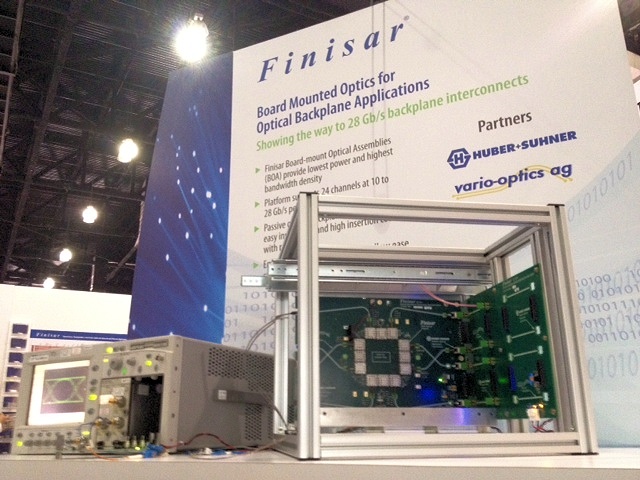 Finisar's optical backplane demo using board-mounted optics. Source: Finisar
The optical engine comprises 24 channels - 12 transmitters at 10Gbps and 12 receivers in a single board-mounted package. The optics can operate at 10, 12, 14, 25 and 28Gbps, says Finisar. The connector allows the optical engines on different cards to interface via the waveguides. The advantage of polymer waveguides is that they are relatively easy to etch on printed circuit boards and since they replace fibre, they remove fibre management issues. However the technology needs to be proven before system vendors will use such waveguides as standard in their platforms.
Interconnect specialist Reflex Photonics demonstrated an 8.6Tbps optical backplane at OFC. The demonstrator uses Reflex's LightABLE optical engines to implement 864 point-to-point optical fibre links to achieve 8.6Tbps in a single chassis.
The optical fabric comprises six layers of 12x12 fully connected broadcast meshes. Each line card supports 720Gbps into the optical backplane and 60Gbps direct bandwidth between any two cards.
32G Fibre channel
Finisar also highlighted its 28Gbps VCSEL that will be used for the 32 Gigabit Fibre Channel standard. The actual line rate for 32Gbps Fibre Channel is 28.05Gbps. The VCSEL is packaged into a transmitter optical sub-assembly (TOSA) that fits inside a SFP+ module.
"We view 28Gbps VCSEL as strategic due to all the applications it will enable," says Ward.
Besides 32Gbps Fibre Channel, the high-speed VCSEL is suited for the next Infiniband data rate - enhanced data rate (EDR) at 4x25Gbps or 12x25Gbps. There is also standards work in the IEEE for a new 100Gbps Ethernet standard that can use 4x25Gbps VCSELs.
Further reading:
Gazettabyte's full OFC NFOEC 2012 coverage
LightCounting: Notes from OFC 2012: Onset of the Terabit Age
Ovum's OFC coverage