

Briefing: Flexible elastic-bandwidth networks
Vendors and service providers are implementing the first examples of flexible, elastic-bandwidth networks. Infinera and Microsoft detailed one such network at the Layer123 Terabit Optical and Data Networking conference held earlier this year.
Optical networking expert Ioannis Tomkos of the Athens Information Technology Center explains what is flexible, elastic bandwidth.
Part 1: Flexible elastic bandwidth
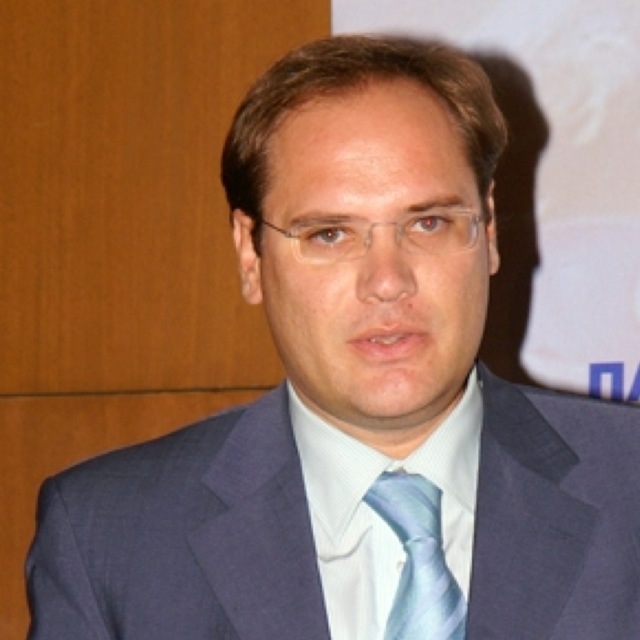
"We cannot design anymore optical networks assuming that the available fibre capacity is abundant"
Prof. Tomkos
Several developments are driving the evolution of optical networking. One is the incessant demand for bandwidth to cope with the 30+% annual growth in IP traffic. Another is the changing nature of the traffic due to new services such as video, mobile broadband and cloud computing.
"The characteristics of traffic are changing: A higher peak-to-average ratio during the day, more symmetric traffic, and the need to support higher quality-of-service traffic than in the past," says Professor Ioannis Tomkos of the Athens Information Technology Center.
"The growth of internet traffic will require core network interfaces to migrate from the current 10, 40 and 100Gbps to 1 Terabit by 2018-2020"
Operators want a more flexible infrastructure that can adapt to meet these changes, hence their interest in flexible elastic-bandwidth networks. The operators also want to grow bandwidth as required while making best use of the fibre's spectrum. They also require more advanced control plane technology to restore the network elegantly and promptly following a fault, and to simplify the provisioning of bandwidth.
The growth of internet traffic will require core network interfaces to migrate from the current 10, 40 and 100Gbps to 1 Terabit by 2018-2020, says Tomkos. Such bit-rates must be supported with very high spectral efficiencies, which according to latest demonstrations are only a factor of 2 away of the Shannon's limit. Simply put, optical fibre is rapidly approaching its maximum limit.
"We cannot design anymore optical networks assuming that the available fibre capacity is abundant," says Tomkos. "As is the case in wireless networks where the available wireless spectrum/ bandwidth is a scarce resource, the future optical communication systems and networks should become flexible in order to accommodate more efficiently the envisioned shortage of available bandwidth.”
The attraction of multi-carrier schemes and advanced modulation formats is the prospect of operators modifying capacity in a flexible and elastic way based on varying traffic demands, while maintaining cost-effective transport.
Elastic elements
Optical systems providers now realise they can no longer keep increasing a light path's data rate while expecting the signal to still fit in the standard International Telecommunication Union (ITU) - defined 50GHz band.
It may still be possible to fit a 200 Gigabit-per-second (Gbps) light path in a 50GHz channel but not a 400Gbps or 1 Terabit signal. At 400Gbps, 80GHz is needed and at 1 Terabit it rises to 170GHz, says Tomkos. This requires networks to move away from the standard ITU grid to a flexible-based one, especially if operators want to achieve the highest possible spectral efficiency.
Vendors can increase the data rate of a carrier signal by using more advanced modulation schemes than dual polarisation, quadrature phase-shift keying (DP-QPSK), the defacto 100Gbps standard. Such schemes include amplitude modulation at 16-QAM, 64-QAM and 256-QAM but the greater the amplitude levels used and hence the data rates, the shorter the resulting reach.
Another technique vendors are using to achieve 400Gbps and 1Tbps data rates is to move from a single carrier to multiple carriers or 'super-channels'. Such an approach boosts the data rate by encoding data on more than one carrier and avoids the loss in reach associated with higher order QAM. But this comes at a cost: using multiple carriers consumes more, precious spectrum.
As a result, vendors are looking at schemes to pack the carriers closely together. One is spectral shaping. Tomkos also details the growing interest in such schemes as optical orthogonal frequency division multiplexing (OFDM) and Nyquist WDM. For Nyquist WDM, the subcarriers are spectrally shaped so that they occupy a bandwidth close or equal to the Nyquist limit to avoid inter symbol interference and crosstalk during transmission.
Both approaches have their pros and cons, says Tomkos, but they promise optimum spectral efficiency of 2N bits-per-second-per-Hertz (2N bits/s/Hz), where N is the number of constellation points.
The attraction of these techniques - multi-carrier schemes and advanced modulation formats - is the prospect of operators modifying capacity in a flexible and elastic way based on varying traffic demands, while maintaining cost-effective transport.
"With flexible networks, we are not just talking about the introduction of super-channels, and with it the flexible grid," says Tomkos. "We are also talking about the possibility to change either dynamically."
According to Tomkos, vendors such as Infinera with its 5x100Gbps super-channel photonic integrated circuit (PIC) are making an important first step towards flexible, elastic-bandwidth networks. But for true elastic networks, a flexible grid is needed as is the ability to change the number of carriers on-the-fly.
"Once we have those introduced, in order to get to 1 Terabit, then you can think about playing with such parameters as modulation levels and the number of carriers, to make the bandwidth really elastic, according to the connections' requirements," he says.
Meanwhile, there are still technology advances needed before an elastic-bandwidth network is achieved, such as software-defined transponders and a new advanced control plane.
Tomkos says that operators are now using control plane technology that co-ordinates between layer three and the optical layer to reduce network restoration time from minutes to seconds. Microsoft and Infinera cite that they have gone from tens of minutes down to a few seconds using the more advanced optical infrastructure. "They [Microsoft] are very happy with it," says Tomkos.
But to provision new capacity at the optical layer, operators are talking about requirements in the tens of minutes; something they do not expect will change in the coming years. "Cloud services could speed up this timeframe," says Tomkos.
"There is usually a big lag between what operators and vendors do and what academics do," says Tomkos. "But for the topic of flexible, elastic networking, the lag between academics and the vendors has become very small."
Further reading:

2020 vision
In a panel discussion at the recent Level123 Terabit Optical and Data Networking conference, Kim Roberts, senior director coherent systems at Ciena, shared his thoughts about the future of optical transmission.
Final part : Optical transmission in 2020
 "Four hundred Gigabit and one Terabit are not going to start in long-haul"
Kim Roberts, Ciena
Kim Roberts starts on a cautionary note, warning of the dangers when predicting the future. "It is always wrong," he says. But in his role as a developer of systems, he must consider what technologies are going to be useful in 2020.
The simple answer is cheap, flexible optical spectrum and coherent modems (DSP-ASICs).
Since DSP-ASICs will become cheaper and consume less power as they are implemented using the latest CMOS processes, they will migrate from their initial use in long-haul/ regional networks to the metro and even the campus. "Four hundred Gigabit and one Terabit are not going to start in long-haul," says Roberts.
Traditionally, the long-haul network has been where new technology is introduced since it is the part of the network where premium prices can first be justified. "It is not going to start there; it won't have that reach," he says. Instead 400 Gigabit-per-second (Gbps) and one Terabit wavelengths will start over medium reaches - 500-700km - once they become more economical.
One consequence is that when going distances beyond medium reach, more spectrum will be required. "You'll have to light up more fibres [for long-haul], whereas in metro-regional you can put more down one fibre," says Roberts.
The current trend of greater functionality and intelligence being encapsulated in an ASIC will continue but Roberts does not rule out a new kind of optical device delivering a useful function. "It can happen quite suddenly - optical amplifiers happened really suddenly." That said, he does not see any such candidate optical technology for now.
The trends Roberts does expect through to 2020 are as follows:
- Optical pulse shaping: Technologies such as optical regeneration and optical demultiplexing have existed in the labs. But such techniques are not spectrally efficiency and are hot, large and expensive, he says. As a result, he does not expect them to become economical for commercial products by 2020.
- Photonic Switching: Optical burst switch, optical label switching, optical packet switching, all will not prove themselves to be economical by 2020. "Optics is not the right answer in the medium term," says Roberts.
- Optical wavelength conversion, optical logic, optical CDMA and optical solitons are other technologies in Roberts' view that will not be economical by 2020.
What Roberts does identify as being useful through 2020 are:
- Low loss, high dispersion, low non-linearities fibre: "New fibres from the likes of Sumitomo and Corning allow the exploitation of coherent modems," says Roberts. "High dispersion is good, it is your friend: it helps minimise non-linearities." This was not an accepted view as recently as 2005, he says, but now it is well accepted.
- Low cost, heat and noise, high-powered optical amplifiers: "This is a fairly simple function, let's just make them better and better," he says.
- Low cost, frequency-selective switching: This refers to taking a wavelength-selective switch (WSS) and getting rid of the ITU grid; making the WSS more flexible while lowering its cost and size.
- Coherent modems: As mentioned, these will improve in efficiency in terms of bits/s/dollar as well as higher performance in terms of decibels (dBs), reach and spectral efficiency. "Polishing these [metrics]," says Roberts.
Roberts admits that his useful items listed are not exciting, radical breakthroughs: "I think we are in an interval of improving on the trends we already have until there is some breakthrough."
Part 1: The capacity limits facing optical networking
Part 2: Optical transmission's era of rapid capacity growth
Further reading on photonic switching:
Packet optical transport: Hollowing the network core
Optical transmission's era of rapid capacity growth
Kim Roberts, senior director coherent systems at Ciena, moves from theory to practice with a discussion of practical optical transmission systems supporting 100Gbps, and in future, 400 Gigabit and 1 Terabit line rates. This discussion is based on a talk Roberts gave at the Layer123's Terabit Optical and Data Networking conference held in Cannes recently.
Part 2: Commercial systems
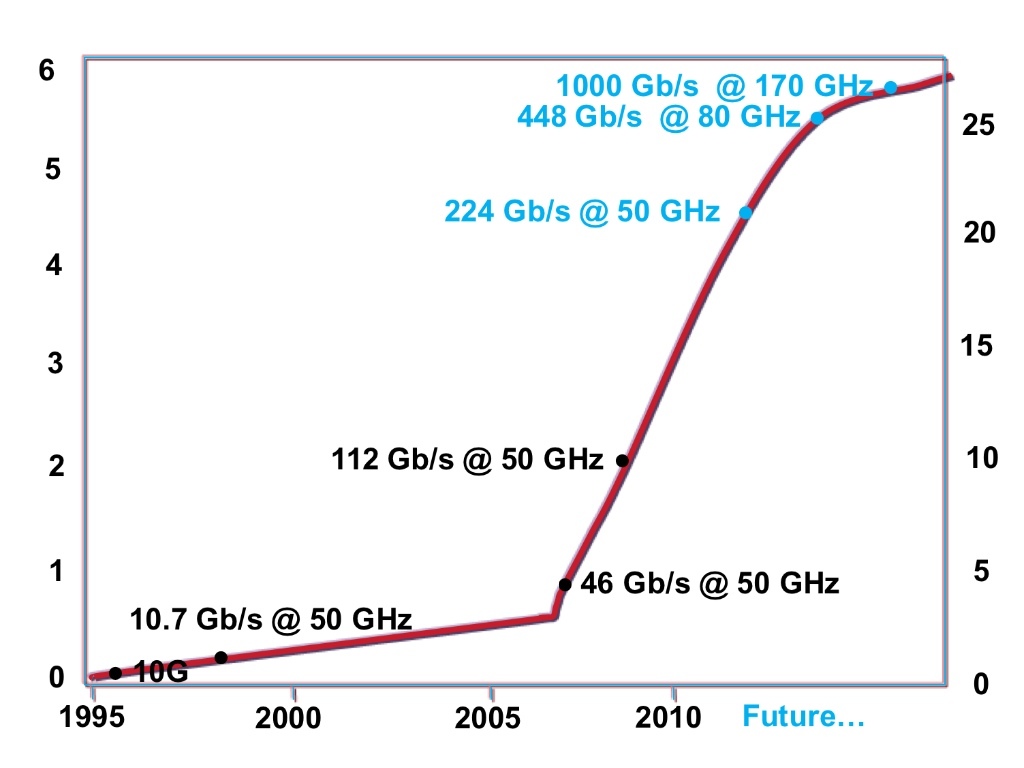
The industry is experiencing a period of rapid growth in optical transmission capacity. The years 1995 till 2006 were marked by a gradual increase in system capacity with the move to 10 Gigabit-per-second (Gbps) wavelengths. But the pace picked up with the advent of first 40Gbps direct detection and then coherent transmission, as shown by the red curve in the chart.
 Source: Ciena
The chart's left y-axis shows bits-per-second-Hertz (bits/s/Hz). The y-axis on the right is an alternative representation of capacity expressed in Terabits in the C-band. "The C-band remains, on most types of fibre, the lowest cost and the most efficient," says Roberts.
The notable increase started with 40Gbps in a 50GHz ITU channel - 46Gbps to accommodate forward error correction (FEC) - and then, in 2009, 100Gbps (112Gbps) in the same width channel. In Ciena's (Nortel's) case, 100Gbps transmission was achieved using two carriers, each carrying 56Gbps, in one 50GHz channel.
"It is going to get hard to achieve spectral efficiencies much beyond 5bits/s/Hz. Getting hard means it is going to take the industry longer"
The chart's blue labels represent future optical transmission implementations. The 224Gbps in a 50GHz channel (200Gbps data) is achieve using more advanced modulation. Instead of dual polarisation, quadrature phase-shift keying (DP-QPSK) coherent transmission, DP-16-QAM will be used based on phase and amplitude modulation.
At 448Gbps, two carriers will be used, each carrying 224Gbps DP-16-QAM in a 50GHz band. "Two carriers, two polarisations on each, and 16-QAM on each," says Roberts.
As explained in Part 1, two carriers are needed because squeezing 400Gbps into the 50GHz channel will have unacceptable transmission performance. But instead of using two 50GHz channels - one for each carrier - 80GHz of spectrum will be needed overall. That is because the latest DSP-ASICs, in this case Ciena's WaveLogic 3 chipset, use waveform shaping, packing the carriers closer and making better use of the spectrum available. For the scheme to be practical, however, the optical network will also require flexible-spectrum ROADMs.
One Terabit transmission extends the concept by using five carriers, each carrying 200Gbps. This requires an overall spectrum of 160-170GHz. "The measurement in the lab that I have shown requires 200GHz using WaveLogic 3 technology," says Roberts, who stresses that these are labs measurements and not a product.
Slowing down
Roberts expects progress in line rate and overall transmission capacity to slow down once 400Gbps transmission is achieved, as indicated by the chart's curve's lesser gradient in future years.
"It is going to get hard to achieve spectral efficiencies much beyond 5bits/s/Hz" says Roberts. "Getting hard means it is going to take the industry longer." The curve is an indication of what is likely to happen, says Roberts: "We are reaching closer and closer to the Shannon bound, so it gets hard."
Roberts says that lab "hero" experiments can go far beyond 5 or 6 bits/s/Hz but that what the chart is showing are system product trends: "Commercial products that can handle commercial amounts of noise, commercial margins and FEC; all the things that make it a useful product."
Reach
What the chart does not show is how transmission reach changes with the modulation scheme used. To this aim, Roberts refers to the chart discussed in Part 1.
 Source: Ciena
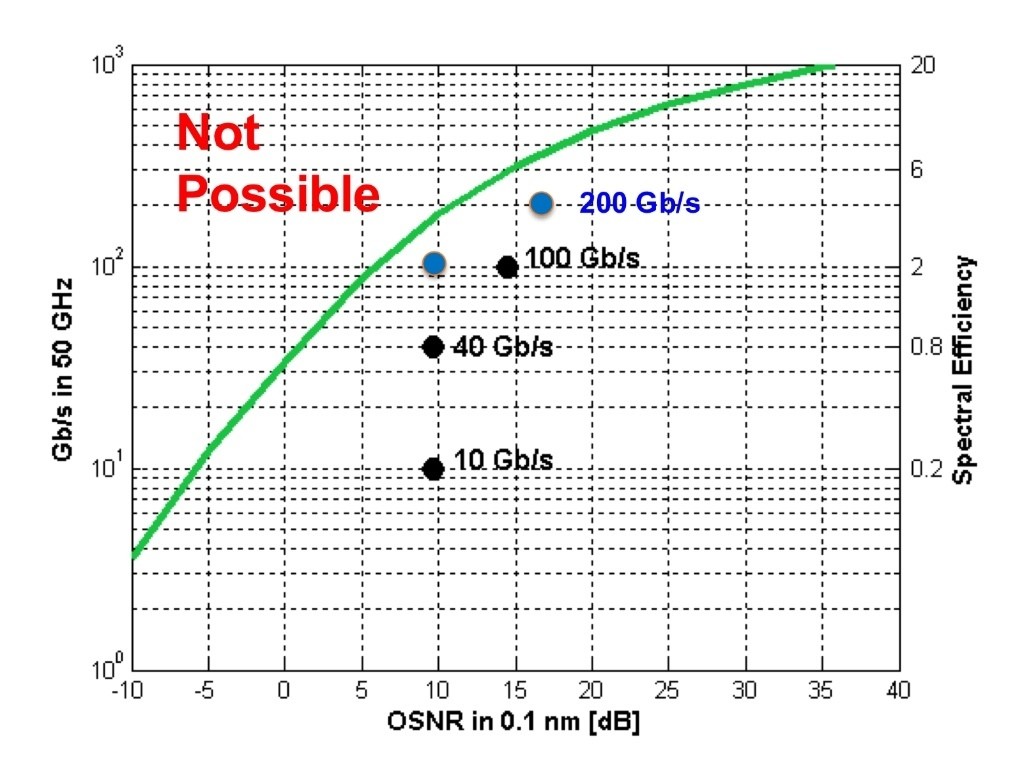
The 100Gbps blue dot is the WaveLogic 3 performance achieved with the same optical signal-to-noise ratio (ONSR) as used at 10Gbps.
"If you apply the same technology, the same FEC at 16-QAM at the same symbol rate, you get 200Gbps or twice the throughput," says Roberts. "But as you can see on the curve, you get a 4.6dB penalty [at 200Gbps] inherent in the modulation."
What this means is that the reach of an optical transport system is no longer 3,000km but rather 500-700km regional reaches, says Roberts.
Part 1: The capacity limits facing optical networking
Part 3: 2020 vision
The capacity limits facing optical networking
Ever wondered just how close systems vendors are in approaching the limits of fibre capacity in optical networks? Kim Roberts, senior director coherent systems at Ciena, adds some mathematical rigour with his explanation of Shannon's bound, from a workshop he gave at the recent Layer123's Terabit Optical and Data Networking conference held in Cannes.
Part 1 Shannon's bound
Source: Ciena
One positive message from Kim Roberts is that optical networking engineers are doing very well at squeezing information down a fibre. But a consequence of their success is that the scope for sending yet more information is diminishing.
"The key message is we are reaching that boundary," says Roberts. "We are not going to have factors of 10 improvement in spectral efficiency."
Shannon's bound
The boundary in question - the green line in the chart above - is based on the work of famed mathematician and information theorist, Claude Shannon. The chart shows how the amount of information that can be sent across a fibre is ultimately dictated by the optical signal-to-noise ratio (OSNR).
To understand the chart, the axes need to be explained. The y-axis represents the Gigabits-per-second (Gbps) of information to be communicated error free in a 50GHz ITU-defined channel. The second, right hand y-axis is an alternative representation, based on spectral efficiency: How many bits/s are transmitted, error free, per Hertz of optical spectrum. For example, 100Gbps fitted within a 50GHz channel (see 100Gbps black dot) has 2bits/s/Hz spectral efficiency.
The horizontal axis is the OSNR, measured as the total power in the signal divided by the noise in a tenth of a nanometer of spectrum.
The curve, in green, shows where communication is possible and where it is not, based on Shannon's bound. "Shannon described that for a given bandwidth - 50GHz in this example - based on the amount of noise present, specifically the signal-to-noise ratio - is the limit of the amount of information that can be communicated error free."
Roberts points out that Shannon's work was based on a linear communication channel with added Gaussian noise. Fibre is a more complex channel but the same Shannon bound applies, although some assumptions must be made. "There are certain assumptions for the non-linearities in the fibre," says Roberts. "If you make reasonable assumptions, you can draw this [Shannon] bound which shows where it is possible - and where it is not - to operate."
The dots on the chart represent the different generations of Ciena's optical transmission systems based on its WaveLogic coherent ASIC technology. The 10Gbps black dot is the performance of Ciena's first generation WaveLogic silicon. The black dot at 40Gbps and 100Gbps represent the performance achieved using Ciena's WaveLogic 2 40 and 100Gbps ASICs, shipping since 2009.
The two blue dots - at 100Gbps and 200Gbps - represent the performance achieved using Ciena's latest WaveLogic 3 silicon shipping this year. The 100Gbps is achieved using dual-polarisation, quadrature phase-shift keying (DP-QPSK) and the 200Gbps using DP-16QAM (quadrature amplitude modulation). The 200Gbps data after forward error correction in a 50GHz channel achieves 4bits/s per Hertz of spectrum.
The 100Gbps WaveLogic 3 (blue dot) delivers improved performance compared to the 100Gbps WaveLogic 2 (black dot) silicon by shifting the performance to the left, closer to the bound.
"Moving to the left means tolerating more noise, which can be translated to longer reach or higher-noise bands or more tolerance for imperfections in the network." Just how this improved performance - in terms of gained decibels (dBs) - is used depends on whether the network deployment is a long-haul or metro one, says Roberts.
What next?
Moving to faster data rates - vertically on the graph - raises its own issues. A Terabit - 1,000Gbit/s - in a 50GHz channel requires an OSNR in excess of 35dB. "That is not something that can be achieved in the network," says Roberts. "For a robust network you want to tolerate 20dB, or at least be left of 25dB." As a result, a practicable 1Tbps signal is not going to fit in a 50GHz channel.
The chart does imply that 400Gbps might be practicable in a 50GHz channel but as Roberts points out, while it might be theoretically possible, the closer you get to the theoretical limit, the harder it is to achieve.
"To increase capacity we need to find ways of reducing the noise on the line to move more to the right [on the chart]," says Roberts. "We [optical networking engineers] also need to push the data points to the left and vertically, but we are not going to push beyond the green."
Further Reading:
Capacity Trends and Limits of Optical Communication Networks, Proceedings of the IEEE, May 2012.
Part 2: Optical transmission's era of rapid capacity growth
Part 3: 2020 vision