

IOWN’s all-photonic network vision

What is the best way to send large amounts of data between locations? Its a question made all the more relevant with the advent of AI, and one that has been preoccupying the Innovative Optical and Wireless Network (IOWN) Global Forum that now has over 160 member companies and organisations
Optical networking has long established itself as the high-speed communications technology of choice for linking data centres or large enterprises’ sites.
The IOWN Global Forum aims to take optical networking a step further by enabling an all-optical network, to reduce the energy consumption and latency of communication links. Latency refers to the time it takes transmitted data to start arriving at the receiver site.
“The IOWN all-photonic network is the infrastructure for future enterprise networking,” says Masahisa Kawashima, IOWN technology director, IOWN development office, NTT Technology working group chair, IOWN Global Forum.

“The main significance of IOWN is setting a roadmap,” says Jimmy Yu, vice president and optical transport senior analyst at Dell’Oro. “It helps component and systems companies understand what technology and architectures that companies, such as NTT, are interested in for a next-generation optical and wireless network. It also fosters industry collaboration.”
IOWN architecture
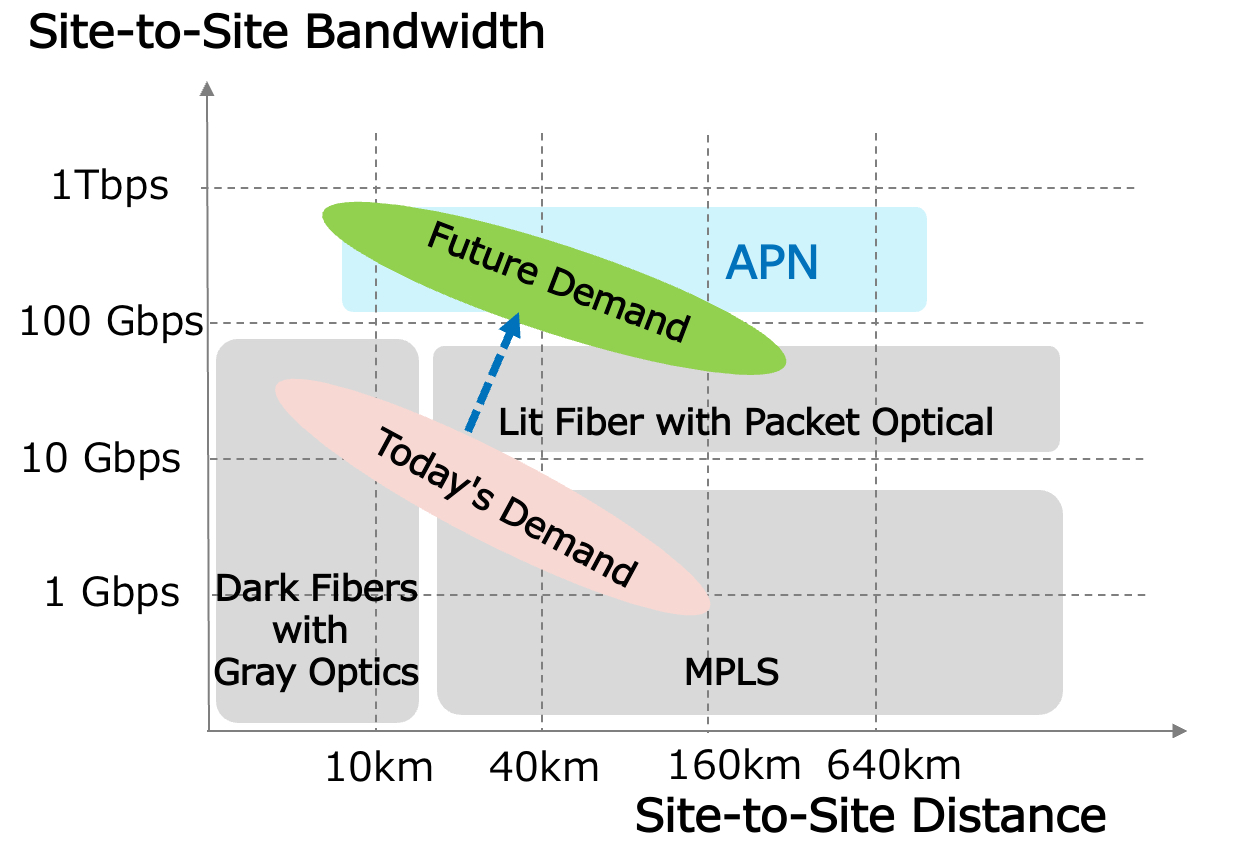
The IOWN Global Forum’s all-optical network (APN) is to enable optical connectivity from edge devices to data centres at speeds exceeding 100 gigabits-per-second (Gbps).
The Forum envisions energy and latency performance improvements by driving optics to the endpoints. Linking endpoints will require a staged adoption of photonic technology as it continues to mature.
Professor Ioannis Tomkos, a member of the Optical Communications Systems & Networks (OCSN) Research Lab/Group at the Electrical and Computer Engineering Department at the University of Patras, says the aim of the IOWN Global Forum is to gradually replace electronics-based transmission, switching, and even signal processing functions with photonics. The OCSN Group recently joined the IOWN Global Forum.
The Forum has defined a disaggregated design for the all-photonic network. The following stages will include using optics to replace copper interconnect within platforms, interfacing photonics to chips, and, ultimately, photonic communications within a chip.
“If information-carrying light signals can remain in the optical domain and avoid opto-electronic and electro-optical conversions, that will ensure enhanced bandwidth and much reduced power consumption per bit,” says Tomkos.
The IOWN Global Forum was created in 2019 by Japanese service provider, NTT, Sony, and Intel. Since then, it has grown to over 160 members, including cloud players Google, Microsoft, and Oracle, telecom service providers British Telecom, Orange, KDDI, Telefónica, and companies such as Nvidia.
The Forum has developed an IOWN framework that includes the all-photonic network, digital twin computing (DTC), and a ‘cognitive foundation’ (CF). Digital twin computing enables the creation of virtual representations of physical systems, while the cognitive foundation is the architecture’s brain, allocating networking and computing resources as required.
“We expect future societies will be more data-driven and there will be many applications that collect huge real-time sensor data and analyse them,” says Kawashima. “The IOWN all-photonic network and disaggregated computing platforms will enable us to deploy digital twin application systems in an energy-efficient way.”
Optical infrastructure
The IOWN Global Forum’s all-photonic network uses open standards, such as the OpenROADM (Open reconfigurable optical add-drop multiplexing) Multi-Source Agreement (MSA), the OIF and the OpenZR+ MSA pluggable coherent optics, and the OpenXR Optics Forum standards. The IOWN Global Forum also adheres to the ‘white box’ platform designs defined by the Telecom Infra Project (TIP).
“There is a lot of similarity with the approach and objectives of TIP,” says an unnamed industry veteran who has observed the IOWN Global Forum’s organisation since its start but whose current employer is not a member. “Although the scope is not the same, I cannot help but wonder why we don’t combine the two as an industry.”
Kawashima says that optical hardware, such as ROADMs, pluggable optics, and transponder boards, is located at one site and operated by one organisation. Now, the Forum has disaggregated the design to enable the ROADM and transponders to be in different locations: the transponder can be deployed at a customer’s premises, remote from the ROADM’s location.
“We allow the operator of the switch node to be different from the operator of the aggregator node, and we allow the operator of the transponder node to be different from the operator of the ROADM nodes,” says Kawashima.
The disaggregation goal is to encourage the growth of a multi-operator ecosystem, unlike how optical transport is currently implemented. It is also the first stage in making the infrastructure nodes all-optical. Separating the transponder and the ROADMs promises to reduce capital expenditure, as the transceiver nodes can be upgraded separately from the ROADMs that can be left unchanged for longer.
Kawashima says that reducing infrastructure capital expenditure promises reduced connectivity prices: “Bandwidth costs will be cheaper.”
Service providers can manage the remote transponders at the customers’ sites, creating a new business model for them.
Early use cases
IOWN has developed several use cases as it develops the technology.
One is a data centre interconnect for financial service institutions that conduct high-frequency trading across geographically dispersed sites.
Another is remote video production for the broadcast industry. Here, the broadcast industry would use an all-photonic network to connect the site where the video feed originates to the cloud, where the video production work is undertaken.
A third use case is for AI infrastructure. An enterprise would use the all-photonic network to link its AI product development engineers to GPU resources hosted in the cloud.
If the network is fast enough and has sufficiently low latency, the GPUs can source data from the site, store it in their memory, process it, and return the answer. The aim is for enterprises not to need to upload and store their data in the cloud. “So that customers do not have to be worried about data leakages,” says Kawashima.
The Forum also publishes documents. “Once the proof-of-concept is completed, that means that our solution is technically proven and is ready for delivery,” says Kawashima.
Goals
At OFC 2025, held earlier this year, NTT, NTTCom, Orange, and Telefónica showcased a one terabit-per-second optical wavelength circuit using the IOWN all-photonics network.

The demonstration featured a digital twin of the optical network, enabling automated configuration of high-speed optical wavelength circuits. The trial showcased the remote control of data centre communication devices using an optical supervisory channel.
The Forum wants to prove the technical feasibility of the infrastructure architecture by year-end. It looks to approve the remote GPUs and financial services use cases.
“What we are trying to achieve this year is that the all-photonic network is commercially operable, as are several use cases in the enterprise networking domain,” says Kawashima.
IOWN’s ultimate success will hinge on the all-photonic network’s adoption and economic viability. For Kawashima, the key to the system architecture is to bring significant optical performance advantages.
Tomkos cautions that this transformation will not happen overnight and not without the support of the global industry and academic community. But the promise is growth in the global network’s throughput and reduced latency in a cost and power-efficient way.

oDAC: Boosting data centre speeds with less power

Academics have developed an optical digital-to-analogue converter (oDAC) that promises to rethink how high-speed optical transmission is done.
Conceived under the European Commission-funded Flex-Scale project for 6G front-haul, the oDAC also promises terabit links inside the data centre.
The oDAC is expected to deliver a 40 per cent power savings for a 1.6 terabit optical transmitter, the ‘send’ path of an optical module.
“It might not be not 50 or 60 per cent, but in this field, even a 25 per cent power saving turns heads,” says Ioannis Tomkos, a professor at the Department of Electrical and Computer Engineering at the University of Patras, Greece, one of the researchers leading the work.
The first proof-of-concept oDAC photonic integrated circuit (PIC) has sent 250 gigabits per second (Gbps) over a single wavelength as part of the European Proteus programme.
The goal is to bring the oDAC to market in 2026.
High-speed optical transmission challenges
An optical interface acts as a gateway between the electrical and optical domains.
The main two classes of optical interfaces—pluggable modules for the data centre and coherent designs for longer-distance links—continue to grow in data rate.
The upcoming rate today is 1.6 terabits per second (Tbps), with 3.2Tbps optical links are in development. But going faster adds design complexity and consumes extra power.
Faster electrical signalling must use encoding schemes such as 4-level pulse amplitude modulation (PAM-4). And in the optical domain, PAM-4 is used in the data centre while higher-order modulation schemes such as 16-ary quadrature amplitude modulation (16-QAM) are used for long-haul optical transmissions. Quadrature amplitude modulation uses amplitude and phase modulation thyat doubles transmission capacity.
Such schemes require fast analogue-to-digital converters (ADCs), digital-to-analogue converters (DACs), and digital signal processing (DSPs) to compensate for transmission impairments. But as speeds increase, so does the signalling complexity and sampling rates, driving up the overall cost and power consumption.
The trends are leading researchers to consider alternative approaches, such as signal processing in the optical domain, to lessen the demands placed on the DSP and its DACs and ADCs. Researchers are even wondering if such an approach could remove the DSP altogether.
“Step by step,” cautions Tomkos.
Tomkos is working with Professor Moshe Nazarathy, a founder of the oDAC work, at the Faculty of Electrical Engineering at Technion University, Israel.
And it is developing the oDAC where they have first focussed their efforts.
Electronic DAC versus the oDAC
One way to view the oDAC is as a high-speed optical modulator. Another is as a multiplexer of multiple optical amplitude data streams.
The oDAC is a fundamental building block that trades extra optical components to simplify the electrical drivers for the high-speed transmitter. This is how the 40 per cent power saving is achieved.
The oDAC’s architecture is similar to that of a coherent optical transmitter but with notable differences.

In a coherent optical transmitter setup, the laser source is split evenly to feed the in-phase and quadrature Mach-Zehnder modulators (MZMs), with a 90-degree phase shifter in one of the modulator’s arms (see diagram above, left).
In contrast, the oDAC employs a variable splitter and a combiner at the input and output stages, paired with identical Mach-Zehnder modulators (no phase shifter is used in one of the modulator’s arms, see diagram, right). The ODACs can be used in a nested arrangement, as part of in-phase and quadrature arms, for coherent optical transmission.
Conventional electronic DACs (eDACs in the diagram) sample the data at least as high as the symbol rate and have a finite bit resolution, which limits the higher-order modulation schemes that can be used.
They are used to drive the optical Mach-Zehnder modulator, which has a non-linear sine-shaped response. The non-linearity forces the modulator to work only in the linear region of its transfer function. (See graph below.)

This curtailing of the driver saves power but results in ‘modulator loss’ – the full potential of the modulator is not being used, impacting signal recovery at the optical receiver.
In contrast, the oDAC can drive fully the modulator, thereby avoiding the modulator backoff loss.
Another key oDAC benefit is that each of its Mach-Zehnder modulators is driven using simpler PAM driver chips to produce higher-order PAM signals: two standard PAM-4 drivers can produce PAM-16 and using two oDAC PAM-16s can be used to generate PAM-256 (each symbol carrying 4- or 8-bits, respectively).
No commercial electronic PAM-16 drivers exist, says Tomkos.
Scaling data rates using PAM-4 drivers
A PAM-4 driver for the oDAC’s Mach-Zehnder modulator arm produces a four-level “staircase” waveform. Adjusting the oDAC’s splitter ratio to 4:1 and summing the outputs yields 16 distinct levels (diagram, below)

n effect, two simple signals can be stacked in multiple combinations to mimic a complex one. For PAM-16, one Mach-Zehnder modulator handles levels 0, 1, 2, and 3, while the other one, scaled differently (e.g., 0, 4, 8, 12), ensures a sum from 0 to 15.
The catch? Achieving a smooth staircase signal requires precise in-phase combining and level controls so there are no differences between the two Mach-Zehnder arms, which requires careful circuit control.
“Every programmable photonic circuit in general, for whatever application, needs some parametric control of the actual circuit,” says Tomkos. “For our case, it is so that it will not deviate if you change the temperature if you have vibrations or any other environmental changes.”

David Moor, a post-doctorate researcher at ETH-Zürich, part of the Flex-Scale project, and the director of photonic IC design at Emitera, the start-up tasked with bringing the oDAC to market, has been putting the prototype oDAC photonic integrated circuit through lab tests.
To send 500 Gbps over a single wavelength, a two-arm oDAC is used, with each PAM4-driven arm operating at 120 gigabaud symbol rate, or 250Gbps. While using two oDACs feeding an in-phase and quadrature coherent structure, doubles the data rate to 1Tbps.
Then, using a pair of PAM-16 oDACs (each driven by a pair of PAM-4 signals, in-phase and quadrature-combined in a coherent transmitter structure, further doubles the data rate to 1.6Tbps.

Transmissions at 3.2 terabits would need the symbol rate at 240 GBd.
What next?
Professor Nazarathy, working with Professor Birbas and his team at the University of Patras, are developing an FPGA-based control system to ensure the device operates optimally in real-world conditions.
“In the lab, the device has been quite stable,” says Moor. But any environmental changes throw it off track. oDAC device needs robust control to be a commercial product.
A second-generation oDAC photonic integrated circuit design and an FPGA-based control system are in the works and are expected to be up and running in six months.
Applications: Data centres and front-haul
“The higher-order the modulation format used, from 16-QAM to 256-QAM, the less the distance,” says Tomkos. “This is a law of information theory. You cannot do otherwise; nobody can.”
But the benefit of the design grows the higher the modulation order and the higher bit rate. Thus, the oDAC comes into its own when using 16-QAM and higher-order signalling schemes.
Accordingly, the ODAC’s sweet spot is for links up to 20 or even 40km, where terabits of data can be pushed over an optical wavelength. This makes the oDAC concept ideal for “coherent-lite” spans between campuses and when used inside the data centre.


Optical networking: The next 10 years
Predicting the future is a foolhardy endeavour, at best one can make educated guesses.
Ioannis Tomkos is better placed than most to comment on the future course of optical networking. Tomkos, a Fellow of the OSA and the IET at the Athens Information Technology Centre (AIT), is involved in several European research projects that are tackling head-on the challenges set to keep optical engineers busy for the next decade.
“We are reaching the total capacity limit of deployed single-mode, single-core fibre,” says Tomkos. “We can’t just scale capacity because there are limits now to the capacity of point-to-point connections.”
 Source: Infinera
The industry consensus is to develop flexible optical networking techniques that make best use of the existing deployed fibre. These techniques include using spectral super-channels, moving to a flexible grid, and introducing ‘sliceable’ transponders whose total capacity can be split and sent to different locations based on the traffic requirements.
Once these flexible networking techniques have exhausted the last Hertz of a fibre’s C-band, additional spectral bands of the fibre will likely be exploited such as the L-band and S-band.
After that, spatial-division multiplexing (SDM) of transmission systems will be used, first using already deployed single-mode fibre and then new types of optical transmission systems that use SDM within the same optical fibre. For this, operators will need to put novel fibre in the ground that have multiple modes and multiple cores.
SDM systems will bring about change not only with the fibre and terminal end points, but also the amplification and optical switching along the transmission path. SDM optical switching will be more complex but it also promises huge capacities and overall dollar-per-bit cost savings.
Tomkos is heading three European research projects - FOX-C, ASTRON & INSPACE.
FOX-C involves adding and dropping all-optically sub-channels from different types of spectral super-channels. ASTRON is undertaing the development of a one terabit transceiver photonic integrated circuit (PIC). The third, INSPACE, will undertake the development of new optical switch architectures for SDM-based networks.
FOX-C
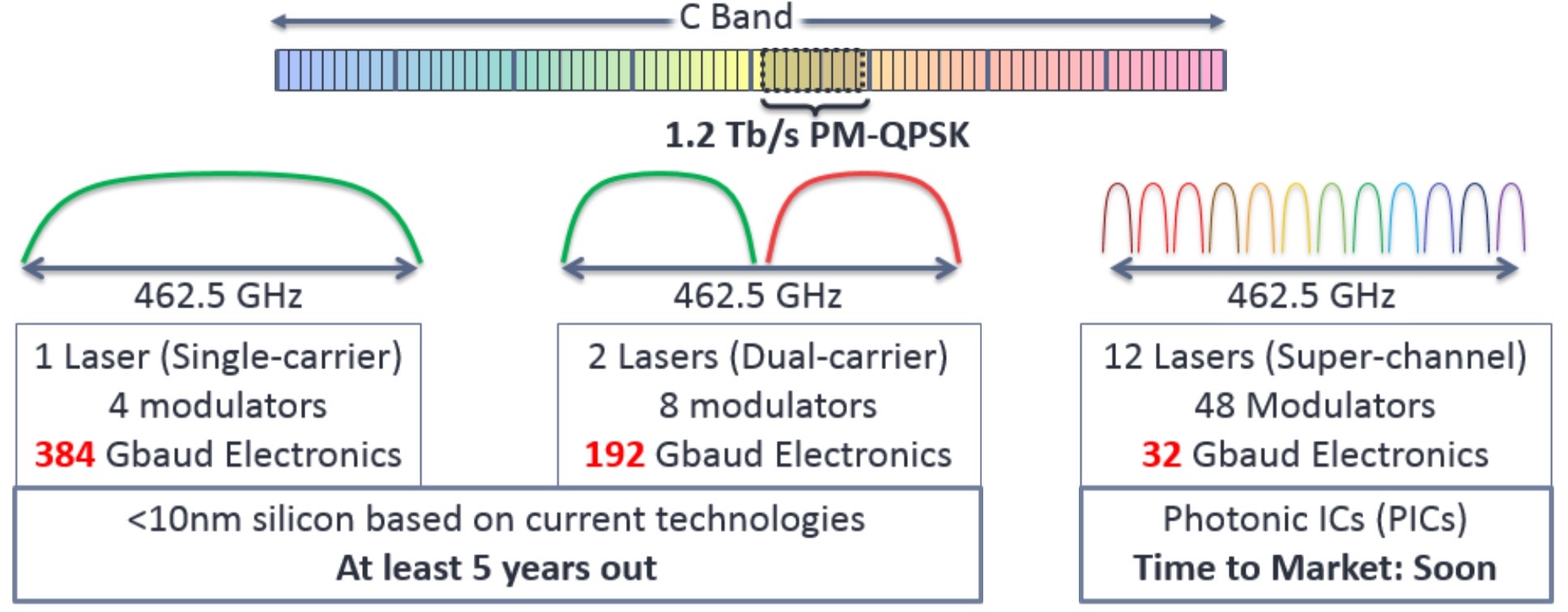
Spectral super-channels are used to create high bit-rate signals - 400 Gigabit and greater - by combining a number of sub-channels. Combining sub-channels is necessary since existing electronics can’t create such high bit rates using a single carrier.
Infinera points out that a 1.2 Terabit-per-second (Tbps) signal implemented using a single carrier would require 462.5 GHz of spectrum while the accompanying electronics to achieve the 384 Gigabaud (Gbaud) symbol rate would require a sub-10nm CMOS process, a technology at least five years away.
- Those that use non-overlapping sub-channels implemented using what is called Nyquist multiplexing.
- And those with overlapping sub-channels using orthogonal frequency division multiplexing (OFDM).

Briefing: Flexible elastic-bandwidth networks
Vendors and service providers are implementing the first examples of flexible, elastic-bandwidth networks. Infinera and Microsoft detailed one such network at the Layer123 Terabit Optical and Data Networking conference held earlier this year.
Optical networking expert Ioannis Tomkos of the Athens Information Technology Center explains what is flexible, elastic bandwidth.
Part 1: Flexible elastic bandwidth
"We cannot design anymore optical networks assuming that the available fibre capacity is abundant"
Prof. Tomkos
Several developments are driving the evolution of optical networking. One is the incessant demand for bandwidth to cope with the 30+% annual growth in IP traffic. Another is the changing nature of the traffic due to new services such as video, mobile broadband and cloud computing.
"The characteristics of traffic are changing: A higher peak-to-average ratio during the day, more symmetric traffic, and the need to support higher quality-of-service traffic than in the past," says Professor Ioannis Tomkos of the Athens Information Technology Center.
"The growth of internet traffic will require core network interfaces to migrate from the current 10, 40 and 100Gbps to 1 Terabit by 2018-2020"
Operators want a more flexible infrastructure that can adapt to meet these changes, hence their interest in flexible elastic-bandwidth networks. The operators also want to grow bandwidth as required while making best use of the fibre's spectrum. They also require more advanced control plane technology to restore the network elegantly and promptly following a fault, and to simplify the provisioning of bandwidth.
The growth of internet traffic will require core network interfaces to migrate from the current 10, 40 and 100Gbps to 1 Terabit by 2018-2020, says Tomkos. Such bit-rates must be supported with very high spectral efficiencies, which according to latest demonstrations are only a factor of 2 away of the Shannon's limit. Simply put, optical fibre is rapidly approaching its maximum limit.
"We cannot design anymore optical networks assuming that the available fibre capacity is abundant," says Tomkos. "As is the case in wireless networks where the available wireless spectrum/ bandwidth is a scarce resource, the future optical communication systems and networks should become flexible in order to accommodate more efficiently the envisioned shortage of available bandwidth.”
The attraction of multi-carrier schemes and advanced modulation formats is the prospect of operators modifying capacity in a flexible and elastic way based on varying traffic demands, while maintaining cost-effective transport.
Elastic elements
Optical systems providers now realise they can no longer keep increasing a light path's data rate while expecting the signal to still fit in the standard International Telecommunication Union (ITU) - defined 50GHz band.
It may still be possible to fit a 200 Gigabit-per-second (Gbps) light path in a 50GHz channel but not a 400Gbps or 1 Terabit signal. At 400Gbps, 80GHz is needed and at 1 Terabit it rises to 170GHz, says Tomkos. This requires networks to move away from the standard ITU grid to a flexible-based one, especially if operators want to achieve the highest possible spectral efficiency.
Vendors can increase the data rate of a carrier signal by using more advanced modulation schemes than dual polarisation, quadrature phase-shift keying (DP-QPSK), the defacto 100Gbps standard. Such schemes include amplitude modulation at 16-QAM, 64-QAM and 256-QAM but the greater the amplitude levels used and hence the data rates, the shorter the resulting reach.
Another technique vendors are using to achieve 400Gbps and 1Tbps data rates is to move from a single carrier to multiple carriers or 'super-channels'. Such an approach boosts the data rate by encoding data on more than one carrier and avoids the loss in reach associated with higher order QAM. But this comes at a cost: using multiple carriers consumes more, precious spectrum.
As a result, vendors are looking at schemes to pack the carriers closely together. One is spectral shaping. Tomkos also details the growing interest in such schemes as optical orthogonal frequency division multiplexing (OFDM) and Nyquist WDM. For Nyquist WDM, the subcarriers are spectrally shaped so that they occupy a bandwidth close or equal to the Nyquist limit to avoid inter symbol interference and crosstalk during transmission.
Both approaches have their pros and cons, says Tomkos, but they promise optimum spectral efficiency of 2N bits-per-second-per-Hertz (2N bits/s/Hz), where N is the number of constellation points.
The attraction of these techniques - multi-carrier schemes and advanced modulation formats - is the prospect of operators modifying capacity in a flexible and elastic way based on varying traffic demands, while maintaining cost-effective transport.
"With flexible networks, we are not just talking about the introduction of super-channels, and with it the flexible grid," says Tomkos. "We are also talking about the possibility to change either dynamically."
According to Tomkos, vendors such as Infinera with its 5x100Gbps super-channel photonic integrated circuit (PIC) are making an important first step towards flexible, elastic-bandwidth networks. But for true elastic networks, a flexible grid is needed as is the ability to change the number of carriers on-the-fly.
"Once we have those introduced, in order to get to 1 Terabit, then you can think about playing with such parameters as modulation levels and the number of carriers, to make the bandwidth really elastic, according to the connections' requirements," he says.
Meanwhile, there are still technology advances needed before an elastic-bandwidth network is achieved, such as software-defined transponders and a new advanced control plane.
Tomkos says that operators are now using control plane technology that co-ordinates between layer three and the optical layer to reduce network restoration time from minutes to seconds. Microsoft and Infinera cite that they have gone from tens of minutes down to a few seconds using the more advanced optical infrastructure. "They [Microsoft] are very happy with it," says Tomkos.
But to provision new capacity at the optical layer, operators are talking about requirements in the tens of minutes; something they do not expect will change in the coming years. "Cloud services could speed up this timeframe," says Tomkos.
"There is usually a big lag between what operators and vendors do and what academics do," says Tomkos. "But for the topic of flexible, elastic networking, the lag between academics and the vendors has become very small."
Further reading:
The evolution of optical networking
An upcoming issue of the Proceeedings of the IEEE will be dedicated solely to the topic of optical networking. This, says the lead editor, Professor Ioannis Tomkos at the Athens Information Technology Center, is a first in the journal's 100-year history. The issue, entitled The Evolution of Optical Networking, will be published in either April or May and will have a dozen invited papers.
One topic that will change the way we think about optical networks is flexible or elastic optical networks.
Professor Ioannis Tomkos
"If I have to pick one topic that will change the way we think about optical networks, it is flexible or elastic optical networks, and the associated technologies," says Tomkos.
A conventional dense wavelength division multiplexing (DWDM) network has fixed wavelengths. For long-haul optical transmission each wavelength has a fixed bit rate - 10, 40 or 100 Gigabit-per-second (Gbps), a fixed modulation format, and typically occupies a 50GHz channel. "Such a network is very rigid," says Tomkos. "It cannot respond easily to changes in the network's traffic patterns."
This arrangement has come about, says Tomkos, because the assumption has always been that fibre bandwidth is abundant. "But at the moment we are only a factor of two away from reaching the Shannon limit [in terms of spectral efficiency bits/s/Hz) so we are going to hit the fibre capacity wall by 2018-2020," he warns.
The maximum theoretically predicted spectral efficiency for an optical communication system based on standard single-mode fibres is about 9bits/s/Hz per polarisation for typical long-haul system reaches of 500km without regeneration, says Tomkos. "At the moment the most advanced hero experiments demonstrated in labs have achieved a spectral efficiency of about 4-6bits/s/Hz," he says. This equates to a total transmission capacity close to 100 Terabits-per-second (Tbps). After that, deploying more fibre will be the only way to further scale networks.
Accordingly, new thinking is required.
Two approaches are being proposed. One is to treat the optical network in the same way as the air interface in cellular networks: spectrum is scarce and must be used effectively.
"We are running close to fundamental limits, that's why the optical spectrum of available deployed standard single mode fibers should be utilized more efficiently from now on as is the case with wireless spectrum," says Tomkos.
 How optical communication is following in the footsteps of wireless.
The second technique - spatial multiplexing - looks to extend fibre capacity well beyond what can be achieved using the first approach alone. Such an option would need to deploy new fibre types that support multiple cores or multi-mode transmission.
Flexible spectrum
"We have to start thinking about techniques used in wireless networks to be adopted in optical networks," says Tomkos (See text box). With a flexible network, the thinking is to move from the 50GHz fixed grid, down to 12.50GHz, then 6.25GHz or 1.50GHz or even eliminate the ITU grid entirely, he says. Such an approach is dubbed flexible spectrum or a gridless network.
With such an approach, the optical transponders can tune the bit rate and the modulation format according to the reach and capacity requirements. The ROADMs or, more aptly, the wavelength-selective switches (WSSes) on which they are based, also have to support such gridless operation.
WSS vendors Finisar and Nistica already support such a flexible spectrum approach, while JDS Uniphase has just announced it is readying its first products. Meanwhile US operator Verizon is cheerleading the industry to support gridless. "I'm sure Verizon is going to make this happen, as it did at 100 Gigabit," says Tomkos.
Spatial multiplexing
The simplest way to implement spatial multiplexing is to use several fibres in parallel. However, this is not cost-effective. Instead, what is being proposed is to create multi-core fibres - fibres that have more than one core - seven, 19 or more cores in an hexagonal arrangement, down which light can be transmitted. "That will increase the fibre's capacity by a factor of ten of 20," says Tomkos.
Another consideration is to move from single-mode to multi-mode fibre that will support the transmission of multiple modes, as many as several hundred.
The issue with multi-mode fibre is its very high modal dispersion which limits its bandwidth-distance product. "Now with improved techniques from signal processing like MIMO [multiple-input, multiple out] processing, OFDM [orthogonal frequency division multiplexing] to more advanced optical technologies, you can think that all these multiple modes in the fibre can be used potentially as independent channels," says Tomkos. "Therefore you can potentially multiply your fibre capacity by 100x or 200x."
The Proceedings of the IEEE issue will have a paper on flexible networking by NEC Labs, USA, and a second, on the ultimate capacity limits in optical communications, authored by Bell Labs.
Further reading:
MODE-GAP EU Seventh Framework project, click here.