

Is ADVA Optical Networking looking to buy ECI Telecom?
Is ADVA Optical Networking preparing a bid for private company ECI Telecom? The latest consolidation rumour involving the two mid-tier metro players comes after Infinera’s announcement that it is acquiring Coriant, a deal that is expected to close this quarter.
According to a source in the financial sector, ADVA wanted to acquire Coriant but failed to raise the required funds. Infinera’s successful bid for Coriant has led ADVA to consider alternatives as it looks to secure its future in a consolidating marketplace, with ECI Telecom being viewed as an attractive target.
ECI Telecom is reportedly considering an initial public offering (IPO) on the London Stock Exchange to raise $170 million. A source close to ADVA confirmed that ‘ECI is looking for a home’ but declined to comment on whether ADVA is involved. Another source close to ADVA suggested that there may be some truth in such a bid.
ADVA declined to comment.
An ECI spokesperson said the company has issued no statement regarding an IPO and expressed surprise when asked if ECI was looking to merge. The spokesperson declined to comment when asked about ADVA acquiring ECI.
I wouldn't doubt that there are talks going on, I just don’t know how far they are. And, of course, things can always fall through.
If ADVA and ECI are in discussions, they are doing a good job keeping it quiet. This contrasts with Coriant where rumours started to circulate before the deal was announced.
Mike Genovese, managing director and senior equity research analyst at MKM Partners, who broke the news that Infinera was acquiring Coriant, has no knowledge of any ADVA deal. But he says such a deal fits the industry trend of vendors looking for scale and combining to focus their R&D resources on coherent optics.
Another financial analyst, George Notter, managing director, equity research, telecom and networking equipment analyst at Jefferies, is also unaware of any deal.
“It is a plausible concept,” says Sterling Perrin, principal analyst, optical networking and transport at Heavy Reading. He can see why ADVA is looking and why ECI might be a good fit. “I wouldn't doubt that there are talks going on, I just don’t know how far they are,” says Perrin. “And, of course, things can always fall through.”
Acquisition benefits
Perrin points to ADVA’s Euro 111 million ($131 million) revenues in 3Q 2017, a drop from its Euro 144 million ($165 million) revenues reported in the previous quarter.
ADVA attributed the drop in revenues to two major customers, one an internet content provider (ICP) and the other a large US carrier that was going through a merger. Amazon was the ICP, with ADVA losing some business to Ciena, says Heavy Reading. ADVA’s quarterly revenues have still not returned to their former levels.
“It made ADVA think of how they are going to replace that [business] going forward,” says Perrin. “The webscale business that they bet so heavily on is very competitive, and as they learned with Amazon, the customers are not very loyal.”
By acquiring ECI, ADVA would gain a packet-optical transport platform, a product it lacks, as well as a presence in new markets. ECI has benefitted in recent years from the growing telecom market in India. “Half of ECI’s revenues are coming from Asia, most of that being India,” says Perrin. In contrast, ADVA’s Asian business accounts for over 10 percent of in revenues.
The two firms overlap in wavelength-division multiplexing equipment but not in the data centre interconnect market.
“ADVA might be looking for a land grab and to essentially double down in traditional telecom to make up for losses on the webscale side,” says Perrin.
ADVA’s optical revenues in 2017 were $370 million while Heavy Reading estimates ECI’s optical revenues were $350 million last year
Mature market
Optical transport equipment has become a mature market with fewer than a dozen players remaining. Outside of Asia, the main players are Ciena, Nokia, Cisco, Infinera-Coriant, ADVA and ECI Telecom.
ADVA reported revenues of Euro 514 million in 2017 ($617 million). Heavy Reading says the two companies’ optical revenues are comparable: ADVA’s optical revenues in 2017 were $370 million while Heavy Reading estimates ECI’s optical revenues were $350 million last year. To put that in perspective, market leader Huawei’s optical revenues were $4 billion in 2017.
Both Coriant and ECI are privately held but Perrin says the fortunes of the two firms are very different.
Coriant was a company in decline which explains why its owners, Oaktree Capital Management, was keen for its sale. “ECI is doing really well right now,” says Perrin. ECI's revenues grew over 15 percent in 2017 compared to 2016 and the growth has continued this year. “Which is why you are hearing rumours of them floating publicly.”
ECI is thus in a strong position in any potential negotiations.

OFDM promises compact Terabit transceivers
 Source ECI Telecom
A one Terabit super-channel, crafted using orthogonal frequency-division multiplexing (OFDM), has been transmitted over a live network in Germany. The OFDM demonstration is the outcome of a three-year project conducted by the Tera Santa Consortium comprising Israeli companies and universities.
Current 100 Gig coherent networks use a single carrier for the optical transmission whereas OFDM imprints the transmitted data across multiple sub-carriers. OFDM is already used as a radio access technology, the Long Term Evolution (LTE) cellular standard being one example.
With OFDM, the sub-carriers are tightly packed with a spacing chosen to minimise the interference at the receiver. OFDM is being researched for optical transmission as it promises robustness to channel impairments as well as implementation benefits, especially as systems move to Terabit speeds.
"It is clear that the market has voted for single-carrier transmission for 400 Gig," says Shai Stein, chairman of the Tera Santa Consortium and CTO of system vendor, ECI Telecom. "But at higher rates, such as 1 Terabit, the challenge will be to achieve compact, low-power transceivers."

The real contribution [of OFDM] is implementation efficiency
Shai Stein
One finding of the project is that the OFDM optical performance matches that of traditional coherent transmission but that the digital signal processing required is halved. "The real contribution [of OFDM] is implementation efficiency," says Stein.
For the trial, the 175GHz-wide 1 Terabit super-channel signal was transmitted through several reconfigurable optical add/drop multiplexer (ROADM) stages. The 175GHz spectrum comprises seven, 25GHz bands. Two OFDM schemes were trialled: 128 sub-carriers and 1024 sub-carriers across each band.
To achieve 1 Terabit, the net data rate per band was 142 Gigabit-per-second (Gbps). Adding the overhead bits for forward error corrections and pilot signals, the gross data rate per band is closer to 200Gbps.
The 128 or 1024 sub-carriers per band are modulated using either quadrature phase-shift keying (QPSK) or 16-quadrature amplitude modulation (16-QAM). One modulation scheme - QPSK or 16-QAM - was used across a band, although Stein points out that the modulation scheme can be chosen on a sub-carrier by sub-carrier basis, depending on the transmission conditions.
The trial took place at the Technische Universität Dresden, using the Deutsches Forschungsnetz e.V. X-WiN research network. The signal recovery was achieved offline using MATLAB computational software. "It [the trial] was in real conditions, just the processing was performed offline," says Stein. The MATLAB algorithms will be captured in FPGA silicon and added to the transciever in the coming months.
Using a purpose-built simulator, the Tera Santa Consortium compared the OFDM results with traditional coherent super-channel transmission. "Both exhibited the same performance," says David Dahan, senior research engineer for optics at ECI Telecom. "You get a 1,000km reach without a problem." And with hybrid EDFA-Raman amplification, 2,000km is possible. The system also demonstrated robustness to chromatic dispersion. Using 1024 sub-carriers, the chromatic dispersion is sufficient low that no compensation is needed, says ECI.
Stein says the project has been hugely beneficial to the Israeli optical industry: "There has been silicon photonics, transceiver and algorithmic developments, and benefits at the networking level." For ECI, it is important that there is a healthy local optical supply chain. "The giants have that in-house, we do not," says Stein.
One Terabit transmission will be realised in the marketplace in the next two years. Due to the project, the consortium companies are now well placed to understand the requirements, says Stein.
Set up in 2011, the Tera Santa Consortium includes ECI Telecom, Finisar, MultiPhy, Cello, Civcom, Bezeq International, the Technion Israel Institute of Technology, Ben-Gurion University, and the Hebrew University in Jerusalem, Bar-Ilan University and Tel-Aviv University.
ECI Telecom demos 100 Gigabit over 4,600km
- 4,600km optical transmission over submarine cable
- The Tera Santa Consortium, chaired by ECI, will show a 400 Gigabit/ 1 Terabit transceiver prototype in the summer
- 100 Gigabit direct-detection module on hold as the company eyes new technology developments
 "When we started the project it was not clear whether the market would go for 400 Gig or 1 Terabit. Now it seems that the market will start with 400 Gig."
Jimmy Mizrahi, ECI Telecom
ECI Telecom has transmitted a 100 Gigabit signal over 4,600km without signal regeneration. Using Bezeq International's submarine cable between Israel and Italy, ECI sent the 100 Gigabit-per-second (Gbps) signal alongside live traffic. The Apollo optimised multi-layer transport (OMLT) platform was used, featuring a 5x7-inch MSA 100Gbps coherent module with soft-decision, forward error correction (SD-FEC).
"We set a target for the expected [optical] performance with our [module] partner and it was developed accordingly," says Jimmy Mizrahi, head of the optical networking line of business at ECI Telecom. "The [100Gbps] transceiver has superior performance; we have heard that from operators that have tested the module's capabilities and performance."
One geography that ECI serves is the former Soviet Union which has large-span networks and regions of older fibre.
Tera Santa Consortium
ECI used the Bezeq trial to also perform tests as part of the Tera Santa Consortium project involving Israeli optical companies and universities. The project is developing a transponder capable of 400 Gigabit and 1 Terabit rates. The project is funded by seven participating firms and the Israeli Government.
"When we started the project it was not clear whether the market would go for 400 Gig or 1 Terabit,” says Mizrahi. “Now it seems that the market will start with 400 Gig."
The Tera Santa Consortium expects to demonstrate a 1 Terabit prototype in August and is looking to extend the project a further three years.
100 Gigabit direct detection
In 2012 ECI announced it was working with chip company, MultiPhy, to develop a 100 Gigabit direct-detection module. The 100 Gigabit direct detection technology uses 4x28Gbps wavelengths and is a cheaper solution than 100Gbps coherent. The technology is aimed at short reach (up to 80km) links used to connect data centres, for example, and for metro applications.
“We have changed our priorities to speed up the [100Gbps] coherent solution,” says Mizrahi. “It [100Gbps direct detection] is still planned but has a lower priority.”
ECI says it is monitoring alternative technologies coming to market in the next year. “We are taking it slowly because we might jump to new technologies,” says Mizrahi. “The line cards will be ready, the decision will be whether to go for new technologies or for direct detection."
Mizrahi would not list the technologies but hinted they may enable cheaper coherent solutions. Such coherent modules would not need SD-FEC to meet the shorter reach, metro requirements. Such a module could also be pluggable, such as the CFP or even the CFP2, and use indium phosphide-based modulators.
“For certain customers pricing will always be the major issue,” says Mizrahi. “If you have a solution at half the price, they will take it.”
ECI Telecom’s next-generation metro packet transport family
- The Native Packet Transport (NPT) family targets the cost-conscious metro network
- Supports Ethernet, MPLS-TP and TDM
- ECI claims a 65% lower total cost of ownership using MPLS-TP and native TDM
 NPT's positioning as part of the overall network. Source: ECI Telecom
ECI Telecom has announced a product line for packet transport in the metro. The Native Packet Transport (NPT) family aims to reduce the cost of operating packet networks while supporting traditional time division multiplexing (TDM) traffic.
“Eventually, in terms of market segments, it [NPT] is going to replace the multi-service provisioning platform,” says Gil Epshtein, product market manager at ECI Telecom. “The metro is moving to packet and so it is moving to new equipment to support this shift.”
The NPT is ECI’s latest optimised multi-layer transport (OMLT) architecture, and is the feeder or aggregator platform to the optical backbone, addressed by the company's Apollo OMLT product family announced in 2011.
 “The whole point of shifting to packet is to lower the [transport] cost-per-bit”
Gil Epshtein, ECI Telecom
Packet transport issues
“Building carrier-grade packet transport is proving more costly than anticipated,” says Epshtein. “Yet the whole point of shifting to packet is to lower the [transport] cost-per-bit.”
Several packet control plane schemes can be used for the metro, a network that can be divided further into the metro core and metro access/ aggregation. The two metro segments can use either IP/MPLS (Internet Protocol/ Multiprotocol Label Switching) or MPLS-TP (Multiprotocol Label Switching Transport Profile). Alternatively, the two metro segments can use different schemes: the metro core IP/MPLS and metro access MPLS-TP, or MPLS-TP for the core and Ethernet for metro access.
Based on total cost of ownership (TCO) analysis, ECI argues that the most cost-effective packet control plane scheme is MPLS-TP. “The NPT product line is based on MPLS-TP, designed to simplify and make MPLS affordable for transport networks,” says Epshtein.
Three issues contribute to the cost of building and operating packet-based transport. The first is capital expenditure (capex) – the cost of the equipment and what is needed to make the network carrier grade such as redundancy and availability.
The second is operational expenditure or opex. Factors include the training and expertise needed by the staff, and their number and salaries. In turn, issues such as network availability, equipment footprint and the power consumption requirements.
“More and more operators view opex as a key factor in their TCO considerations,” says Epshtein. Operators look at the entire network and want to know what its cost of operation will be.
A third cost factor is the existence of both TDM and packet data in the operators’ networks. “When you look at the overall TCO, you need to take this into consideration,” says Epshtein. For some operators it [TDM] is more significant but it is always there, he says.
The NPT family is being aimed at various customers. One is operators that want to extend MPLS from the core to the metro network. “Here, TDM is not a factor,” says Epshtein. “We find this in wireless backhaul, in triple-play, carriers-of-carriers and business applications.” The second class of operators is those with legacy TDM traffic. Also being targeted are utilities. “Here reliability and security are key.”
Analysis
The choice of packet control plane - whether to use IP/MPLS or MPLS-TP - impacts both capex and opex. How the TDM traffic is handled, whether using circuit emulation over packets or native TDM, also impacts overall costs.
According to ECI, the number of network elements grows some tenfold with each segment transition towards the network edge. In the network core there are 100s of network elements, 1000s in the metro core and 10,000s in the metro access. The choice of packet control plane for these network elements clearly impacts the overall cost, especially in the cost-conscious metro as the number of platforms grows. “A network element based on MPLS-TP is lower cost than IP/MPLS,” says Epshtein. “The main reason being it is a lot less complex.”
He stresses that MPLS-TP is not a competing standard to IP/MPLS; IP/MPLS is the defacto standard in the network core. Rather, MPLS-TP is a derivative designed for transport. The debate here, says Epshtein, is what is best for metro.
“The main difference between the two standards is the control plane, not the data plane,” says Epshtein. MPLS-TP removes unnecessary control plane functions supported by IP/MPLS leading to simpler metro platform functionality, and simpler management and operation of the equipment. “We believe MPLS-TP is more suited to the metro due to its simplicity, scalability and capex benefits.”
Working with market research company, ACG Research, the TCO analysis (opex and capex) over five years using MPLS-TP was 55% lower than using IP/MPLS for metro packet transport (with no TDM traffic).
The cost savings was even greater with both packet and some TDM traffic.
Using the NPT, capex goes up 5% due to the line cards needed to support native TDM traffic. But for IP/MPLS using circuit emulation capex increases 37%, resulting in the NPT having a 66% lower capex overall. The resulting opex is also 64% lower. Overall TCO is lowered by 65% using MPLS-TP and native TDM compared to IP/MPLS and circuit emulation.
NPT portfolio
ECI says its NPT supports circuit emulation and native TDM. Having circuit emulation enables the network to converge to packet only. But native TDM simplifies the interfacing to legacy networks and also has lower latency than circuit emulation.
 The NPT packet switch and TDM switch fabrics and the traffic types carried over each. Source: ECI Telecom
There are five NPT platforms ranging from the NPT-1020 for metro access to the NPT-1800 for the metro core. The NPT-1020 has a 10 or 50 Gigabit packet switch capacity option and a TDM capacity of 2.5 Gigabit. The NPT-1800 has a packet switching capacity of 320 or 640 Gigabit and 120 Gigabit for TDM.
The metro aggregation NPT-1600 and 1600c (160 Gig packet/120 Gig TDM capacity) platforms are available now. The remaining platforms will be available in the first half of 2013.
ECI says it has already completed several trials with existing and new customers. "We have already won a few deals," says Epshtein.
The platforms are managed using ECI’s LightSoft software, the same network management system used for the Apollo. ECI has added software specifically for packet transport including service provisioning, performance management and troubleshooting.
Further information, click here.
100 Gigabit direct detection gains wider backing
More vendors are coming to market with 100 Gigabit direct detection products for metro and private networks.
The emergence of a second de-facto 100 Gigabit standard, a complement to 100 Gigabit coherent, has gained credence with 4x28 Gigabit-per-second (Gbps) direct detection announcements from Finisar and Oclaro, as well as backing from system vendor, ECI Telecom.

"We believe that in some cases operators will prefer to go with this technology instead of coherent"
Shai Stein, CTO, ECI Telecom
ECI Telecom and chip vendor MultiPhy announced at OFC/NFOEC that they have been collaborating to develop a 168-pin MSA, 5x7-inch 100 Gigabit-per-second (Gbps) direct detection module. Finisar and Oclaro used the show held in Los Angeles to announce their market entry with 100Gbps direct detection CFP pluggable optical modules.
Late last year ADVA Optical Networking announced the industry's first 100Gbps direct detection product. At the same time, MultiPhy detailed its MP1100Q receiver chip designed for 100Gbps direct detection.
According to ECI, by having the 168-pin MSA interface, one line card can support a 100Gbps coherent transponder or the 100Gbps direct detection. "This is important as it enables us to fit the technology and price to the needs of end customers," says Shai Stern, CTO of ECI Telecom.
100 Gigabit transmission
Coherent technology has become the de-facto standard for 100Gbps long-haul transmission. Using dense wavelength division multiplexing (DWDM), system vendors can achieve 1,500km and greater reaches using a 50GHz channel.
But coherent designs are relatively costly and 100Gbps direct detection offers a cost-conscious alternative for metro networks and for linking data centres, achieving a reach of up to 800km.
"It [100 Gig direct detection] provides needed performance at an attractive cost, in particular when you are looking at private optical networks," says Per Hansen, vice president of product marketing, optical networks solutions at Oclaro.
Such networks need not be owned by private enterprises, they can belong to operators, says Hansen, but they are typically simple point-to-point connections or 3- to 4-node rings serving enterprises. "Bonding adjacent [4x28Gbps] wavelengths to create a 100Gbps channel that connects efficiently to your [IP] router is very attractive in such networks," says Hansen.
For more complex mesh metro networks, coherent is more attractive. "Simply because of the spectral resources being taken up through the mesh [with 4x28Gbps], and the operational aspect of routeing that," says Hansen.
ECI Telecom says that it has yet to decide whether it will adopt 100Gbps direct detection. But it does see a role for the technology in the metro since the 100Gbps technology works well alongside networks with 10 and 40 Gigabit on-off keying (OOK) channels. "We believe that in some cases operators will prefer to go with this technology instead of coherent," says Stein.
Some operators have chosen to deploy coherent over new overlay networks, to avoid the non-linear transmission effects that result from mixing old and new technologies on the one network. "With this technology, operators can stay with their existing networks yet benefit from 100 Gig high capacity links," says Stein.
Finisar says 100Gbps direct detection is also suited to low-latency applications. "The fact that it is not coherent means it doesn't include a DSP chip, enabling it to be used for low latency applications," says Rafik Ward, vice president of marketing at Finisar.
Implementation
The announced 100Gbps direct detection designs all use 4x28Gbps channels and optical duo-binary (ODB) modulation, although MultiPhy also promotes an 80km point-to-point OOK version (see Table).
 Source: Gazettabyte
The module input is a 10x10Gbps electrical interface: a CFP interface or the 168-pin line side MSA. A 'gearbox' IC is used to translate between the 10x10Gbps electrical interface and the four 28Gbps channels feeding the optics.
"There are a few suppliers that are offering that [gearbox IC]," says Robert Blum, director of product marketing for Oclaro's photonic components. AppliedMicro recently announced a duplex multiplexer-demultiplexer IC.
MultiPhy's receiver chip has a digital signal processor (DSP) that implements the maximum likelihood sequence estimation (MLSE) algorithm, which is says enables 10 Gig opto-electronics to be used for each channel. The result is a 100Gbps module based on the cost of 4x10Gbps optics. However, over-driving the 10Gbps opto-electronics creates inter-symbol interference, where the energy of a transmitted bit leaks into neighbouring signals. MultiPhy's DSP using MLSE counters the inter-symbol interference.
 100G direct detection module showing MultiPhy's MP1100Q chip. Source: MultiPhy
Oclaro and Finisar claim that using ODB alone enables the use of lower-speed opto-electronics. "This is irrespective of whether you use MLSE or hard decision," says Blum. "The advantage of using optical duo-binary modulation is that you can use 10G-type optics."
Finisar's Ward points out that by using ODB, the 100Gbps direct-detection module avoids the price/ power penalty associated with a receiver DSP running MLSE to compensate for sub-optimal optical components.
Oclaro, however, has not ruled out using MLSE in future. The company endorsed MultiPhy's MLSE device when the product was first announced but its first 100G transceiver is not using the IC.
Finisar and Oclaro's modules require 200GHz to transmit the 100Gbps signal: 4x50GHz channels, each carrying the 28Gbps signal. "This architecture will enable 2.5x the spectral efficiency of tunable XFPs," says Ward. Using XFPs, ten would be needed for a 100Gbps throughput, each channel requiring 50GHz or 500GHz in total.
MultiPhy claims that it can implement the 100Gbps in a 100GHz channel, 5x the efficiency but still twice the spectrum used for 100Gbps coherent.
Finisar demonstrated its 100Gbps CFP module with SpectraWave, a 1 rack unit (1U) DWDM transport chassis, at OFC/NFOEC. "It provides all the things you need in line to enable a metro Ethernet link: an optical multiplexer and demultiplexer, amplification and dispersion compensation," says Ward. Up to four CFPs can be plugged into the SpectraWave unit.
Operator interest
In a recent survey published by Infonetics Research, operators had yet to show interest in 100Gbps direct detection. Infonetics attributed the finding to the technology still being unavailable and that operators hadn't yet assessed its merits.
"Operators are aware of this technology," says ECI's Stein. "It is true they are waiting to get a proof-of-concept and to test it in their networks and see the value they can get.
"That is why ECI has not yet decided to go for a generally-available product: we will deliver to potential customers, get their feedback and then take a decision regarding a commercial product," says Stein.
However MultiPhy claims that this is the first technology that enables 100Gbps in a pluggable module to achieve a reach beyond 40km. That fact coupled with the technology's unmatched cost-performance is what is getting the interest. "Every time you show a potential user some way they can save on cost, they are interested," says Neal Neslusan, vice president of sales and marketing at MultiPhy.
Direct detection roadmap
Recent announcements by Cisco Systems, Ciena, Alcatel-Lucent and Huawei highlight how the system vendors will use advanced modulation and super-channels to evolve coherent to speeds beyond 100Gbps. Does direct detection have a similar roadmap?
"I don't think that this on-off keying technology is coming instead of coherent," says Stein. "Once we move to super-channel and the spectral densities it can achieve, coherent technology is a must and will be used." But for 40Gbps and 100Gbps, what ECI calls intermediate rates, direct detection extends the life of OOK and existing network infrastructure.
ECI and MultiPhy are members of the Tera Santa Consortium developing 1 Terabit coherent technology, and MultiPhy stresses that as well as its direct detection DSP chips, it is also developing coherent ICs.
Further reading: 100 Gigabit: The coming metro opportunity
ECI Telecom's Apollo mission
The privately-owned system vendor has launched Apollo, a family of what it calls optimised multi-layer transport platforms.
Event
ECI Telecom has launched a family of platforms that combines optical transmission, Ethernet and optical transport network (OTN) switching and IP routing.
The 9600 series platforms, dubbed Apollo, combines the functionality of what until now has required a packet-optical transport system (P-OTS) and a carrier Ethernet switch router (CESR).
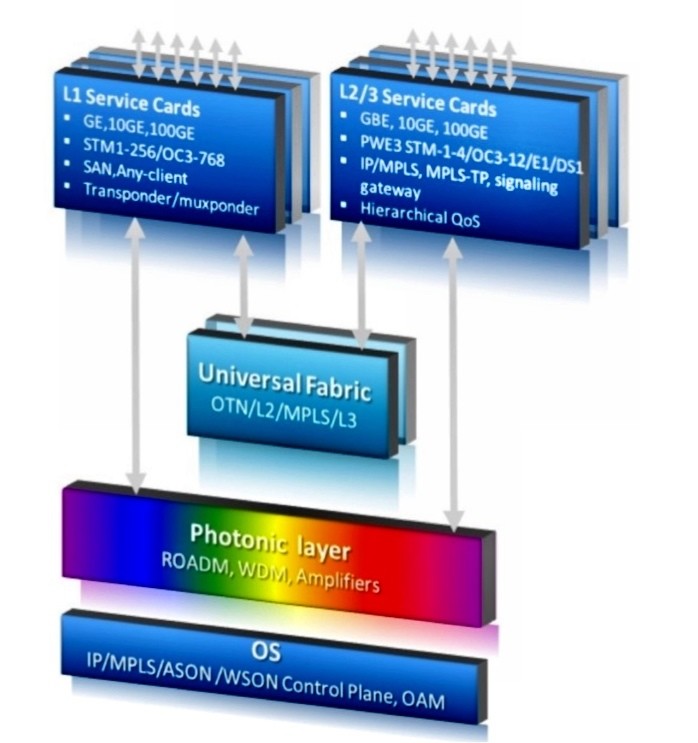 The Apollo 9600 series architecture. Source: ECI Telecom
ECI refers to the capabilities of such a combined platform as optimised multi-layer transport (OMLT). Analysts view the platform as a natural evolution of P-OTS rather than a new category of system.
Why is it important?
ECI's Apollo 9600 series is the first to combine dense wavelength-division multiplexing (DWDM) with carrier Ethernet switch routing. It is also one of the first platforms that bring OTN switching to the metro; until now OTN switching has been confined to the network core.
Apollo addresses a shortfall of packet optical transport, namely its limited layer 2 capabilities, says ECI. This is addressed with Apollo that also adds layer 3 routing, another first.
“In the buying cycle, operators start with optical networking and add carrier Ethernet switch routing,” says Oren Marmur, head of optical networking & CESR lines of Business at ECI Telecom. Now with Apollo, operators can simplify their networks: they don't have to provision, or maintain, two separate platforms.
ECI claims the Apollo platform, with 100 Gigabit-per-second (Gbps) transport and hybrid Ethernet and OTN cards, more than halves the equipment cost compared to using separate ROADM and CESR platforms. The company also says such an Apollo configuration reduces rack space by 38% and power consumption by some 60%.
What has been done
ECI has announced six Apollo platforms that span the access, metro and core networks. The platforms include the SR 9601 and OPT 9603 for metro access and the metro edge SR 9604 and OPT 9608 with four and eight input-output (I/O) cards respectively that support WDM or 100Gbps Ethernet MPLS packet switching. The final two platforms are the OPT 9624 for metro core and the OPT 9648 for regional and long haul, and both can accommodate a terabit universal switch.
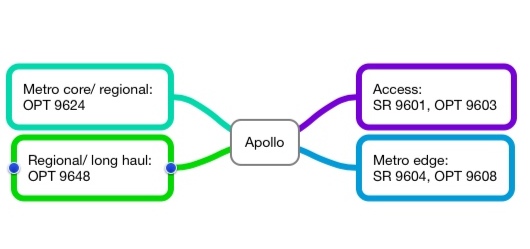
Overall Apollo can support 44 or 88 light paths at 10, 40 and 100Gbps, 2-degree and multi-degree colourless, directionless and contentionless ROADMs, OTN and Ethernet switching, and IP/ MPLS and MPLS-TP. "MPLS-TP versus IP/ MPLS is almost a religious issue yet both are valid," says Marmur, who adds that at 40 Gig, ECI will use coherent and direct detection technologies but at 100 Gig it will use only coherent.
The universal fabric of the OPT 9624 and 9648 is cell based - ODUs and packets, not lower-order SONET/SDH traffic. If an operator has any significant amount of SONET/SDH traffic, ECI’s XDM platform or another aggregation box is needed.
The platforms can be configured as CESR platforms, OTN switches, optical transport platforms or combinations of the three.
Analysis
Gazettabyte asked Sterling Perrin, senior analyst at Heavy Reading; Rick Talbot, senior analyst, optical infrastructure at Current Analysis and Dana Cooperson, vice president of the network infrastructure practice at Ovum for their views about the ECI announcement.
Sterling Perrin, Heavy Reading
Apollo has several noteworthy aspects, according to Heavy Reading.
“It is a big announcement for ECI and a big announcement for the industry," says Perrin. “They are doing with the technology some fundamental things that are new.” That said, it remains to be seen how quickly operators will embrace an OMLT-style platform, he says.
Apollo confirms one networking trend - moving the OTN switching fabric into the metro network. So far OTN has been confined largely to the core network. “I know operators are interested but they are still evaluating it,” says Perrin. “But OTN will migrate down from the core to the metro.” Others that have announced such a capability include Ciena and Huawei.
ECI has also put the DWDM transport with the CESR platform. “This is another trend we figured would happen,” he says. “This puts ECI very early, if not first, in doing that function.”
Perrin has his doubts about how quickly the layer 3 functionality added to the platform will be embraced by operators: “What I've seen from the industry is that MPLS-TP will give you that functionality over time as it matures, so this sort of platform may not need the full layer 3 functions.”
The modular nature of the design that allows operators to add the functionality they need helps avoid one issue associated with integrated platforms, paying for functionality that is not needed. And there are cost savings by having a single integrated platform. “You do want to save capex and opex and this is definitely a way to get that done,” says Perrin.
In the network core, the question remains whether packet needs to be combined with the optics. “Metro lends itself more to the integration than the core does,” he says.
ECI’s biggest competitor is probably Huawei and over time also ZTE, says Perrin. ECI has done well in India and other emerging markets that many of the system vendors were ignoring. “Now they have Huawei in the mix, it is definitely tougher,” he says. “This [Apollo] announcement will definitely help them.”
Rick Talbot, Current Analysis
Current Analysis categorises the smaller members of the Apollo family as a packet-optical access (POA) portfolio, playing the same role as Ericsson’s SPO 1400 family and Cisco’s CPT series. The market research firm views the largest two Apollo platforms - the OPT 9624 and 48 - as packet-optical transport systems.
The Apollo POAs bring protocol-agnostic packet switching to the aggregation network, says Talbot, a rarity in this part of the network. Several vendors offer P-OTS with universal switching fabrics but most do not extend that architecture into the aggregation network, Tellabs with the 7100 Nano OTS being the exception. Also the 9600 series IP/ MPLS and MPLS-TP options are very strong, providing what Cisco and Ericsson call unified MPLS, he says.
For Current Analysis, the significance of the portfolio is that the Apollo family delivers converged packet and time-division multiplexing (TDM) switching in a single switch fabric, and provides an infrastructure that extends from the network core to the access network edge.
The switching fabric provides the greatest efficiency for the ultimate traffic type - packets - while simplifying the network architecture and minimising equipment cost. In turn, the breadth of the portfolio provides a common set of capabilities across an operator’s network, minimising training costs and spares inventory.
As for the specification, the wide range of MPLS features integrated into this product family, its terabit universal switch and its 100Gbps DWDM transport capabilities are impressive, says Talbot.
“The primary gap in the portfolio, and it is hard to fault ECI for this, is that the highest capacity member of the family supports ’only’ 1 Terabit-per-second of switching capacity,” he says. “This is not large enough for a Tier 1 core optical switch.”
ECI must first execute on the production of the Apollo family, but if it does, Talbot believe that ECI will capture the interest of larger and more end-to-end operators in markets they already serve.
ECI will also have positioned itself to capture the attention of many European operators and, if it makes a push there, the North American market. However Talbot believes ECI will still be challenged to capture the attention of Tier 1 operators because of the family’s limited maximum scale.
Dana Cooperson, Ovum
Size and scale breeds specialisation, says Cooperson. “Large service providers, including the Tier 1s, won’t be so interested in the OMLT, but they aren’t the target anyway,” she says. Large service providers need plenty of scale when it comes to WDM and CESR functionality, while they also tend to have compartmentalised operations groups. “So an all-in-one product like the OMLT isn’t targeted at them,” she says.
ECI has always done well selling to the Tier 2 and Tier 3 carriers as well as enterprises such as utilities that have carrier-like networks. That is because ECI's modular, packet-based platforms are sized and priced to match such operators' and enterprises’ requirements. “I see the OMLT as a continuation of ECI's positioning of its XDM platform,” she says.
Cooperson says that it can be difficult to position vendors’ switch announcements and that they should do more to explain where they sit. But she stresses that the Apollo 9600 series is very different from Juniper's PTX, for example.
“The PTX is positioned in the core as a lower-cost alternative to core routers, while the OMLT as a CESR or even an OTN switch is meant more for smaller sites,” she says. Also the switch capacities of the smaller Apollo platforms fit with ECI's focus and positioning on smaller customers and smaller sites.
Cooperson also highlights the need for the XDM platform if an operator requires SONET/SDH support but says ECI has alluded to add/drop multiplexer blades as well as packet blades. "The [Apollo] focus is on the packet and photonic bits,” says Cooperson. “ECI did emphasize that the XDM isn’t going anywhere, but we’ll see what happens over time and how much SONET/SDH ECI builds in [if any to the Apollo].”
Further Reading
For accompanying White Papers, click here
R&D: At home or abroad?
 Omer Industrial Park in the Negev, Israel - the location of ECI Telecom's latest R&D centre.
Chaim Urbach likes working at the Omer Industrial Park site. Normally located at ECI’s headquarters in Petah Tikva, he visits the Omer site - some 100km away - once or twice a week and finds he is more productive there. Urbach employs an open door policy and has fewer interruptions at the Omer site since engineers are focussed solely on R&D work.
ECI set up its latest R&D centre in May 2010 with a staff of ten. “In 2009 we realised we needed more engineers,” says Urbach. One year on the site employs 150, by the end of the year it will be 200, and by year-end 2012 the company expects to employ 300. ECI has already taken one unit at the Industrial Park and its operations have already spilt over into a second building.
Urbach says that the decision to locate the new site in the south of Israel was not straightforward.
The company has 1,300 R&D staff, with research centres in the US, India and China. Having a second site in Israel helps in terms of issues of language and time zones but employing an R&D engineer in Israel is several times more costly than an engineer in India or China.
 The photos on the wall are part of the winning entries in an ECI company-wide photo competition.
But the Israeli Government’s Office of the Chief Scientist (OCS) is keen to encourage local high-tech ventures and has helped with the funding of the site. In return the backed-venture must undertake what is deemed innovative research with the OCS guaranteed royalties from sales of future telecom systems developed at the site.
One difficulty Urbach highlights is recruiting experienced hardware and software engineers given that there are few local high-tech companies in the south of the country. Instead ECI has relocated experienced engineering managers from Petah Tikva, tasked with building core knowledge by training graduates from nearby Ben-Gurion University and from local colleges.
Work on the majority of ECI’s new projects in being done at the Omer site, says Urbach. Projects include developing GPON access technology for a BT tender as well as extending its successful XDM hybrid+ SDH to all-IP transport platform, which has over 30% market share in India. ECI is undertaking the research on one terabit transmission using OFDM technology, part of the Tera Santa Consortium, at its HQ.
 “We realised we needed more engineers”
Chaim Urbach, ECI Telecom
Urbach admits it is a challenge to compete with leading Far Eastern system vendors on cost and given their R&D budgets. But he says the company is focussed on building innovative platforms delivered as part of a complete solution. “We do not just provide a box,” says Urbach. “And customers know if they have a problem, we go the extra mile to solve it.”
 Omer Industrial Park
The company is highly business oriented, he says, delivering solutions that fit customers’ needs. “Over 95% of all systems ECI has developed have been sold,” he says.
Urbach also argues that Israeli engineers are suited to R&D. “Engineers don’t do everything by the book,” he says. “And they are dedicated and motivated to succeed.”
For more photos of the Omer Industrial Park, click here
Terabit Consortium embraces OFDM
“This project is very challenging and very important”
Shai Stein, Tera Santa Consortium
Given the continual growth in IP traffic, higher-speed light paths are going to be needed, says Shai Stein, chairman of the Tera Santa Consortium and ECI Telecom’s CTO: “If 100 Gigabit is starting to be deployed, within five years we’ll start to see links with tenfold that capacity, meaning one Terabit.”
The project is funded by the seven participating firms and the Israeli Government. According to Stern, the Government has invested little in optical projects in recent years. “When we look at the [Israeli] academies and industry capabilities in optical, there is no justification for this,” says Stern. “We went with this initiative in order to get Government funding for something very challenging that will position us in a totally different place worldwide.”
Orthogonal frequency division multiplexing
OFDM differs from traditional dense wavelength division multiplexing (DWDM) technology in how fibre bandwidth is used. Rather than sending all the information on a lightpath within a single 50 or 100GHz channel – dubbed single-carrier transmission – OFDM uses multiple narrow carriers. “Instead of using the whole bandwidth in one bulk and transmitting the information over it, [with OFDM] you divide the spectrum into pieces and on each you transmit a portion of the data,” says Stein. “Each sub-carrier is very narrow and the summation of all of them is the transmission.”
“Each time there is a new arena in telecom we find that there is a battle between single carrier modulation and OFDM; VDSL began as single carrier and later moved to OFDM,” says Amitai Melamed, involved in the project and a member of ECI’s CTO office. “In the optical domain, before running to [use] single-carrier modulation as is currently done at 100 Gigabit, it is better to look at the OFDM domain in detail rather than jump at single-carrier modulation and question whether this was the right choice in future.”
OFDM delivers several benefits, says Stern, especially in the flexibility it brings in managing spectrum. OFDM allows a fibre’s spectrum band to be used right up to its edge. Indeed Melamed is confident that by adopting OFDM for optical, the spectrum efficiency achieved will eventually match that of wireless.
“OFDM is very tolerant to rate adaptation.”
Amitai Melamed, ECI Telecom
The technology also lends itself to parallel processing. “Each of the sub-carriers is orthogonal and in a way independent,” says Stern. “You can use multiple small machines to process the whole traffic instead of a single engine that processes it all.” With OFDM, chromatic dispersion is also reduced because each sub-carrier is narrow in the frequency domain.
Using OFDM, the modulation scheme used per sub-carrier can vary depending on channel conditions. This delivers a flexibility absent from existing single-carrier modulation schemes such as quadrature phase-shift keying (QPSK) that is used across all the channel bandwidth at 100 Gigabit-per-second (Gbps). “With OFDM, some of the bins [sub-carriers] could be QPSK but others could be 16-QAM or even more,” says Melamed.
The approach enables the concept of an adaptive transponder. “I don’t always need to handle fibre as a time-division multiplexed link – either you have all the capacity or nothing,” says Melamed. “We are trying to push this resource to be more tolerant to the media: We can sense the channels' and adapt the receiver to the real capacity.” Such an approach better suits the characteristics of packet traffic in general he says: “OFDM is very tolerant to rate adaptation.”
The Consortium’s goal is to deliver a 1 Terabit light path in a 175GHz channel. At present 160, 40Gbps can be crammed within the a fibre's C-band, equating to 6.4Tbps using 25GHz channels. At 100Gbps, 80 channels - or 8Tbps - is possible using 50GHz channels. A 175GHz channel spacing at 1Tbps would result in 23Tbps overall capacity. However this figure is likely to be reduced in practice since frequency guard-bands between channels are needed. The spectrum spacings at speeds greater than 100Gbps are still being worked out as part of ITU work on "gridless" channels (see OFC announcements and market trends story).
ECI stresses that fibre capacity is only one aspect of performance, however, and that at 1Tbps the optical reach achieved is reduced compared to transmissions at 100Gbps. “It is not just about having more Gigabit-per-second-per-Hertz but how we utilize the resource,” says Melamed. “A system with an adaptive rate optimises the resource in terms of how capacity is managed.” For example if there is no need for a 1Tbps link at a certain time of the day, the system can revert to a lower speed and use the spectrum freed up for other services. Such a concept will enable the DWDM system to be adaptive in capacity, time and reach.
Project focus
The project is split between digital and analogue, optical development work. The digital part concerns OFDM and how the signals are processed in a modular way.
The analogue work involves overcoming several challenges, says Stern. One is designing and building the optical functions needed for modulation and demodulation with the accuracy required for OFDM. Another is achieving a compact design that fits within an optical transceiver. Dividing the 1Tbps signal into several sub-bands will require optical components to be implemented as a photonic integrated circuit (PIC). The PIC will integrate arrays of components for sub-band processing and will be needed to achieve the required cost, space and power consumption targets.
Taking part in the project are seven Israeli companies - ECI Telecom, the Israeli subsidiary of Finisar, MultiPhy, Civcom, Orckit-Corrigent, Elisra-Elbit and Optiway- as well as five Israeli universities.
 Two of the companies in the Consortium
“There are three types of companies,” says Stern. “Companies at the component level – digital components like digital signal processors and analogue optical components, sub-systems such as transceivers, and system companies that have platforms and a network view of the whole concept.”
The project goal is to provide the technology enablers to build a terabit-enabled optical network. A simple prototype will be built to check the concepts and the algorithms before proceeding to the full 1Terabit proof-of-concept, says Stern. The five Israeli universities will provide a dozen research groups covering issues such as PIC design and digital signal processing algorithms.
Any intellectual property resulting from the project is owned by the company that generates it although it will be made available to any other interested Consortium partner for licensing.
Project definition work, architectures and simulation work have already started. The project will take between 3-5 years but it has a deadline after three years when the Consortium will need to demonstrate the project's achievements. “If the achievements justify continuation I believe we will get it [a funding extension],” says Stern. “But we have a lot to do to get to this milestone after three years.
Project funding for the three years is around US $25M, with the Israeli Office of the Chief Scientist (OCS) providing 50 million NIS (US $14.5M) via the Magnet programme, which ECI says is “over half” of the overall funding.
Further reading:
Wireless backhaul: The many routes to packet
ECI Telecom has detailed its wireless backhaul offering that spans the cell tower to the metro network. The 1Net wireless backhaul architecture supports traditional Sonet/SDH to full packet transport, with hybrid options in between, across various physical media.
“We can support any migration scheme an operator may have over any type of technology and physical medium, be it copper, fibre or microwave,” says Gil Epshtein, senior product marketing manager, network solutions division at ECI Telecom.
Why is this important?
Operators are experiencing unprecedented growth in wireless data due to the rise of smart phones and notebooks with 3G dongles for mobile broadband.
Mobile data surpassed voice traffic for the first time in December 2009, according to Ericsson, with the crossover occurring at approximately 140,000 terabytes per month in both voice and data traffic. According to Infonetics Research, mobile broadband subscribers surpassed digital subscriber line (DSL) subscribers in 2009, and will grow to 1.5 billion worldwide in 2014. By then, there will be 3.6 exabytes (3.6 billion gigabytes) per month of mobile data traffic, with two thirds being wireless video, forecasts Cisco Systems.
“The challenge is that almost all the growth is packet internet traffic, and that is not well suited to sit on the classic TDM backhaul network originally designed for voice,” says Michael Howard, principal analyst, carrier and data center networks at Infonetics Research. TDM refers to time division multiplexing based on Sonet/SDH where for wireless backhaul T1/E1lines are used.
“There is a gap between the technology hype and real life”
Gil Epshtein, ECI Telecom
The fast growth also implies an issue of scale, with the larger mobile operators having many cell sites to backhaul. E1/TI lines are also expensive even if prices are coming down, says Howard: “It is much cheaper to use Ethernet as a transport – the cost per bit is enormously better.”
This is why operators are keen to upgrade their wireless backhaul networks from Sonet/SDH to packet-based Ethernet transport. “But there is a gap between the technology hype and real life,” says Epshtein. Operators have already invested heavily in existing backhaul infrastructure and upgrading to packet will be costly. The operators also know that projected revenues from data services will not keep pace with traffic growth.
“Operators are faced with how to build out their backhaul infrastructures to meet service demands at cost points that provide an adequate return on investment,” says Glen Hunt, principal analyst, carrier transport and routing at Current Analysis. Such costs are multi-faceted, he says, on the capital side and the operational side. “Carriers do not want to buy an inexpensive device that adds complexity to network operations which then offsets any capital savings.”
“It is much cheaper to use Ethernet as a transport –the cost per bit is enormously better.”
Michael Howard, Infonetics Research
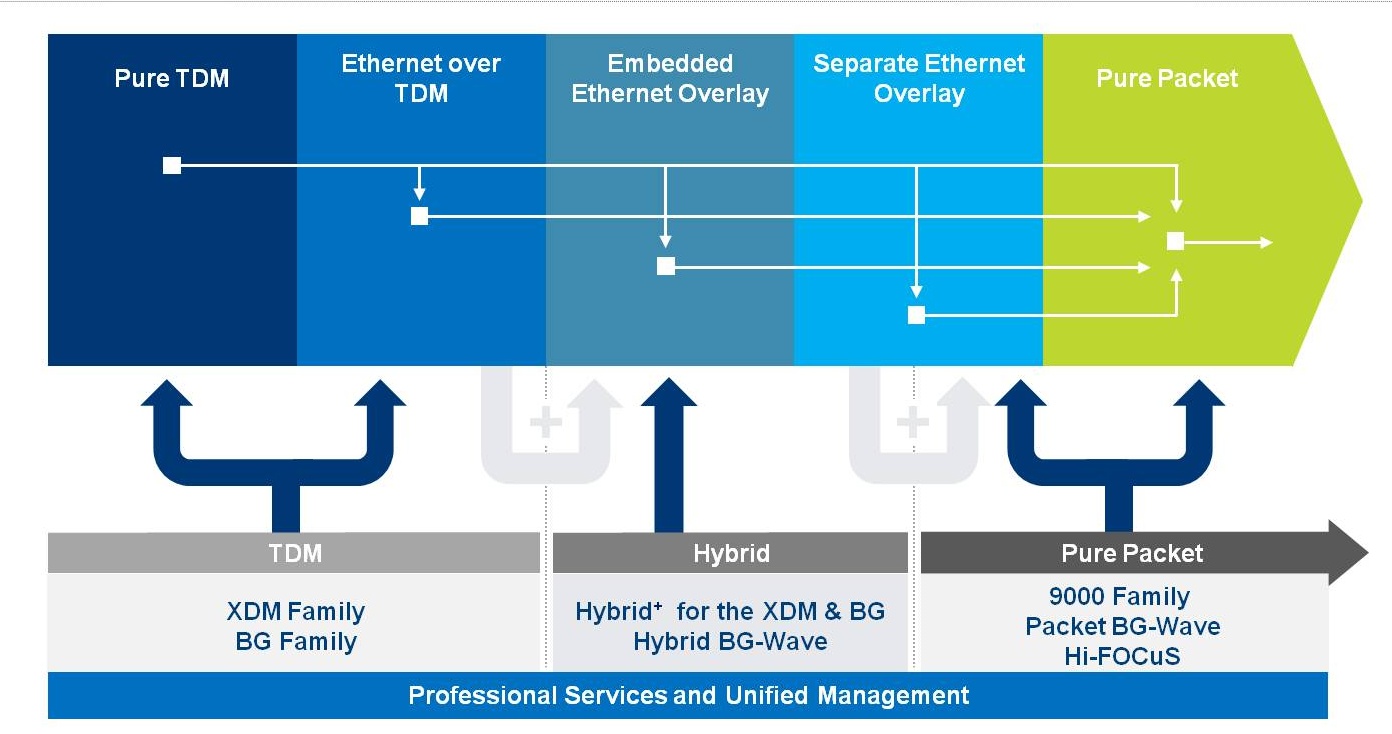
To this aim, ECI offers operators a choice of migration schemes to packet-based backhaul. Its solution supports T1/E1lines and Ethernet frame encapsulation over TDM, Ethernet overlay networks, and packet-only networks (see chart above).
With Ethernet overlay, an Ethernet network runs alongside the TDM network. The two can co-exist within a common network element, what ECI calls embedded Ethernet overlay, or separately using distinct TDM and packet switch platforms. And when an operator adopts all-packet, legacy TDM traffic can be carried over packets using circuit emulation pseudo-wire technology.
“ECI’s offering is significant since it includes all the components and systems necessary to handle nearly any type of backhaul requirement,” says Hunt. The same is true for most of the larger system vendors, he says. However, many vendors integrate third party devices to complete their solutions – ECI itself has done this with microwave. But with 1NET for wireless backhaul, ECI will now offer its own microwave backhaul systems.
According to Infonetics, between 55% and 60% of all backhaul links are microwave outside of North America. And 80% of all microwave sales are for mobile backhaul. Moreover, Infonetics estimates that 70 to 80% of operator spending on mobile backhaul through 2012 will be on microwave. “Those are the figures that explain why ECI has decided to go it alone,” says Howard. Until now ECI has used products from its microwave specialist partner, Ceragon Networks.
“ECI has all the essential features that the other big players have like Ericsson, Alcatel-Lucent, Nokia Siemens Networks and Huawei,” says Howard. What is different is that ECI does not supply radio access network (RAN) equipment such as basestations. “It is ok, though, because almost all of the [operator] backhaul tenders separate between RAN and backhaul,” says Howard.
ECI argues that by adopting a technology-agnostic approach, it can address operators’ requirements without forcing them down a particular path. “Operators are looking for guidance as to which path is best from this transition,” says Epshtein. There is no one-model fits all. “We have so many exceptions you really need to look on a case-by-case basis.”
In developed markets, for example, the building of packet overlay is generally happening faster. Some operators with fixed line networks have already moved to packet and that, in theory, simplifies upgrading the backhaul to packet. But organisational issues across an operator’s business units can complicate and delay matters, he says.
And Epshtein cites one European operator that will use its existing network to accommodate growth in data services over the coming years: “It is putting aside the technology hype and looking at the bottom line."
In emerging markets, moving to packet is happening more slowly as mobile users’ income is limited. But on closer inspection this too varies. In Africa, certain operators are moving straight to all-IP, says Ephstein, whereas others are taking a gradual approach.
What’s been done?
ECI has launched new products as well as upgraded existing ones as part of its 1NET wireless backhaul offering.
The company has announced its BG-Wave microwave systems. There are two offerings: an all-packet microwave system and a hybrid one that supports both TDM and Ethernet traffic. ECI says that having its own microwave products will allow it to gain a foothold with operators it has not had design wins before.
“ECI will need to prove the value of its microwave products with actual field deployments”
Glen Hunt, Current Analysis
ECI has announced two additional 9000 carrier Ethernet switch routers (CESR) families: the 9300 and 9600. These have switching capacities and a product size more suited to backhaul. The switches support Layer 3 IP-MPLS and Layer 2 MPLS-TP, as well as the SyncE and IEEE 1588 Version 2 synchronisation protocols.
ECI has also upgraded its XDM multi-service provisioning platform (MSPP) to enable an embedded overlay with Ethernet and TDM traffic supported within the platform.
“When an operator is choosing to add packet backhaul to existing TDM backhaul, typically it is a separate network – they keep voice on TDM and add a second network for packet,” says Howard. This hybrid approach involves adding another set of equipment. “ECI has added functions to existing equipment, which operators may already have, that allows two networks to run over a single set of products.”
Also included in the solution are ECI’s BroadGate and its Hi-FOCuS multi-service access node (MSAN). This is not for operators to deploy the platform for wireless backhaul but rather those operators that have the MSAN can now use it for backhauling traffic, says Ephstein. This is useful in dense urban areas and for operators offering wholesale services to other operators.
All the network elements are controlled using ECI’s LightSoft management system.
“ECI’s solution has the advantage that all the systems use the same operating system and support the same features,” says Hunt. He cites the example of MPLS-TP which is implemented on ECI’s carrier Ethernet and optical platforms.
“ECI has a full range of platforms that all work together to meet the needs of mobile as well as fixed operator,” says Hunt. “ECI will need to prove the value of its microwave products with actual field deployments.”
Operator interest
ECI has secured general telecom wins with large incumbent operators in Western Europe and has been winning business in Eastern Europe, Russia, India and parts of Asia.
ECI’s sweet spot has been its relationship with Tier 2 and Tier 3 operators, says Hunt, and since the company offers broadband access, optical transport, and carrier Ethernet, it can use these successes to help expand into areas such as wireless backhaul.
But wireless backhaul is already a key part of the company’s business, accounting for over 30% of revenues, says Ephstein. Late last year ECI estimated that it was carrying between 30% and 40% of the mobile backbone traffic in India, a rapidly growing market.
As for 1NET wireless backhaul, ECI has announced one win so far - Israeli mobile operator Cellcom which has selected the 9000 CESR family. “Cellcom shows that ECI can continue to expand its presence in the network - in this case leveraging business Ethernet services to add backhaul,” says Hunt.
In addition one European operator, as yet unnamed, has selected ECI’s embedded overlay. “Several other operators are in various stages of selecting the right option for them,” says Ephstein.
- For some ECI wireless backhaul papers and case studies, click here
Do multi-source agreements benefit the optical industry?
System vendors may adore optical transceivers but there is a concern about how multi-source agreements originate.
Optical transceiver form factors, defined through multi-source agreements (MSAs), benefit equipment vendors by ensuring there are several suppliers to choose from. No longer must a system vendor develop its own or be locked in with a supplier.
 “Personally, the MSA is the worst thing that has happened to the optical industry”
Marek Tlaka, Luxtera
Pluggables also decouple optics from the line card. A line card can address several applications simply by replacing the module. In contrast, with fixed optics the investment is tied to the line card. A system can also be upgraded by swapping the module with an enhanced specification version once it is available.
But given the variety of modules that datacom and telecom system vendors must support, there are those that argue the MSA process should be streamlined to benefit the industry.
Traditionally, several transceiver vendors collaborate before announcing an MSA. The CFP MSA announced in March 2009, for example, was defined by Finisar, Opnext and Sumitomo Electric Device Innovations. Since then Avago Technologies has become a member.
“The industry has an interesting model,” says Niall Robinson, vice president of product marketing at Mintera. “A couple of companies can get together, work behind closed doors and announce suddenly an MSA and try to make it defacto in the market.”
Robinson contrasts the MSA process with the Optical Interconnecting Forum’s (OIF) 100Gbps line side work that defined guidelines for integrated transmitter and receiver modules. Here service providers and system vendors also contributed. “It was a much more effective and fair process, allowing for industry collaboration,” says Robinson
Matt Traverso, senior manager, technical marketing at Opnext, and involved in the CFP MSA, also favours an open process. “But the view that the way MSAs are run is not open is a bit of a fallacy,” he says.
“Any MSA that is well run requires iteration with suppliers,” says Traverso. The opposite is also true: poorly run MSAs have short lives, he says. Having too open a forum also runs the risk of creating a one-size-fits-all: “One vendor may want to use the MSA as a copper interface while a carrier will want it for long-haul dense WDM.”
Optical transceiver vendors benefit in another way if they are the ones developing MSAs. “Transceiver vendors will not make life tough for themselves,” says Padraig OMathuna, product marketing director at optical device maker, GigOptix. “If MSAs are defined by system vendors, [transceiver] designs would be a lot more challenging.”
Avago Technologies argues for standards bodies to play a role especially as industry resources become more thinly spread.
“MSAs are not standards; there are items left unwritten and not enough double checking is done,” says Sami Nassar, director of marketing, fiber optic products division at Avago Technologies. There are always holes in the specifications, requiring patches and fixes. “If they [transceivers] were driven by standards bodies that would be better,” says Nassar.
Organisations such as the IEEE don’t address packaging and connectors as part of their standards work. But this may have to change. “The real challenge, as the industry thins out, is ensuring the [MSA] work is thorough,” says Dan Rausch, Avago’s senior technical marketing manager, fiber optic products division. “The challenge for the industry going forward is ensuring good engineering and more robust solutions.”
Marek Tlalka, vice president of marketing at Luxtera, goes further, questioning the very merits of the MSA: “Personally, the MSA is the worst thing that has happened to the optical industry.”
Unlike the semiconductor industry where a framer chip once on a line card delivers revenue for years, a transceiver company may design the best product yet six months later be replaced by a cheaper competitor. “The return on investment is lost; all that work for nothing,” says Tlalka.
“Is it a good development or not? MSAs are out there,” says Vladimir Kozlov, CEO of optical transceiver market research firm, LightCounting. “It helps system vendors, giving them a freedom to buy.”
But MSAs have squeezed transceiver makers, says Kozlov, and he worries that it is hindering innovation as companies cut costs to maximize their return on investment.
“There is continual pressure to reduce the price of optics,” adds Daryl Inniss, Ovum’s practice leader components. If operators are to provide video and high definition TV services and grow revenues then bandwidth needs to become dirt cheap. “Even today optics is not cheap,” says Inniss. Certainly MSAs play an important role in reducing costs.
“The transceiver vendors’ challenge is our benefit,” admits Oren Marmur, vice president, optical networking line of business, network solutions division at system vendor, ECI Telecom. “But we have our own challenges at the system level.”