

Effdon Networks extends the 10x10 MSA to 80km
Effdon Networks has demonstrated a 100 Gigabit CFP module with an 80km reach; a claimed industry first. The company has also developed the Qbox, a 1 rack unit (1RU) extended reach platform capable of 400-800 Gigabit-per-second (Gbps) with a reach of 80-200km.
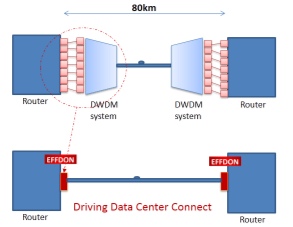 Effdon's CFP does not require the use of external DWDM multiplexing/ demultiplexing and can be added directly onto a router. Source: Effdon Networks
Available 100 Gigabit CFP modules have so far achieved 10km. Now with the Effdon module a 80km reach has been demonstrated that uses 10Gbps optics and no specialist silicon.
Effdon's design is based on the 10x10 MSA (multi-source agreement). "We have managed to resolve the technology barriers - using several techniques - to get to 80km," says Eitan Efron, CEO of Effdon Networks.
There is no 100 Gigabit standard for 80km. The IEEE has two 100 Gigabit standards: the 10km long reach 100GBASE-LR4 and the 40km extended reach 100GBASE-ER4.
Meanwhile, the 100 Gigabit 10x10 MSA based on arrays of 10, 10 Gigabit lasers and detectors, has three defined reaches: 2km, 10km and 40km. At the recent OFC/NFOEC exhibition, Oplink Communication and hybrid integration specialist, Kaiam, showed the 10x10 MSA CFP achieving 40km.
Effdon has not detailed how it has achieved 80km but says its designers have a systems background. "All the software that you need for managing wavelength-division multiplexing (WDM) systems is in our device," says Efron. "Basically we have built a system in a module."
These system elements include component expertise and algorithmic know-how. "Algorithms and software; this is the main IP of the company," says Efron. "We are using 40km components and we are getting 80km."
100 Gigabit landscape
Efron says that while there are alternative designs for 100 Gigabit transmission at 80km or more, each has challenges.
A 100Gbps coherent design achieves far greater reaches but is costly and requires a digital signal processor (DSP) receiver ASIC that consumes tens of watts. No coherent design has yet been implemented using a pluggable module.
Alternative CFP-based 100Gbps direct-detection designs based on a 4x28Gbps architecture exist. But their 28Gbps lanes experience greater dispersion that make achieving 80km a challenge.
MultiPhy's MP1100Q DSP chip counters dispersion. The chip used in a CFP module achieves a 55km point-to-point reach using on-off keying and 800km for dense WDM metro networks using duo-binary modulation.
Finisar and Oclaro also offer 100Gbps direct detection CFP modules for metro dense WDM using duo-binary modulation but without a receiver DSP. ADVA Optical Networking is one system vendor that has adopted such 100Gbps direct-detect modules. Another company developing a 4x28Gbps direct detect module is Oplink Communications.
But Effdon points out that its point-to-point CFP achieves 80km without using an external DWDM multiplexer and demultiplexer - the multiplexing/demultiplexing of the wavelengths is done within the CFP - or external amplification and dispersion compensation. As a result, the CFP plugs straight into IP routers and data centre switches.
"What they [data centre managers] want is what they have today at 10 Gig: ZR [80km] optical transceivers," says Efron

Market demand
"We see a lot of demand for this [80km] solution," says Efron. The design, based on 10 Gigabit optics, has the advantage of using mature high volume components while 25Gbps component technology is newer and available in far lower volumes.
"This [cost reduction associated with volume] will continue; we see 10 Gig lasers going into servers, base stations, data centre switches and next generation PON," says Efron. "Ten Gigabit optical components will remain in higher volume than 25 Gig in the coming years."
The 10x10 MSA CFP design can also be used to aggregate multiple 10 Gig signals in data centre and access networks. This is an emerging application and is not straightforward for the more compact, 4x25Gbps modules as they require a gearbox lane-translation IC.
Reach extension
Effdon Networks' Qbox platform provides data centre managers with 400-800Gbps capacity while offering a reach up to 200km. The box is used with data centre equipment that support CXP or QSFP modules but not the CFP. The 1RU box thus takes interfaces with a reach of several tens of meters to deliver extended transmission.
Qbox supports eight client-side ports - either 40 or 100 Gbps - and four line-facing ports at speeds of 100Gbps or 200Gbps for a reach of 80 to 200km. In future, the platform will deliver 400Gbps line speeds, says Efron.
Samples of the 80km CFP and Qbox are available for selected customers, says Effdon, while general availability of the products will start in the fourth quarter of 2013.


Industry underestimating 25 Gigabit parallel optics challenge
Ten Gigabit-based parallel optics is set to dominate the marketplace for several years to come. So claims datacom module specialist, Avago Technologies.

"One customer told us it has to keep the interface speed below 20Gbps due to the cost of the SerDes"
Sharon Hall, Avago
"People are underestimating what is going to be involved in doing 25 Gigabit [channels]," says Sharon Hall, product line manager for embedded optics at Avago Technologies. "Ten Gigabit is going to last quite a bit longer because of the price point it can provide."
Eventually 25 Gig-based parallel optics, with its lower lane count, will be cheaper than 10 Gigabit - but is will take several years. One challenge is the cost of 25 Gigabit-per-second (Gbps) electrical interfaces, due to the large relative size of the circuitry. One customer told Avago that it has to keep the interface speed below 20Gbps for now due to the cost of the serial/ deserialiser (SerDes).
Avago has announced that its 120 Gigabit aggregate bandwidth (12x10Gbps) MiniPod and CXP parallel optics products are now in volume production. The company first detailed the MiniPod and CXP technologies in late 2010 yet many equipment makers are still to launch their first designs.
The CXP is a pluggable optical transceiver while the MiniPod is Avago's packaged optical engine used for embedded designs. The 22x18mm MiniPod is based on Avago's 8x8mm MicroPod optical engine but uses a 9x9 electrical MegArray connector with its more relaxed pitch.
Equipment makers face a non-trivial decision as to whether to adopt copper or optical interfaces for their platform designs. "This is a major design decision with a lot of customers going back and forth deciding which way to go," says Hall. "They might do a mix with some short connections staying copper but if they need 10 Gig at anything longer than a few meters then they are going to go optical."
Having chosen parallel optics, the style of form factor - pluggable or embedded - is largely based on the interface density required. "Certain customers prefer field pluggability [of CXP] with its pay-as-you-go and ease of installation features, but are limited on port density due to the number of CXP transceivers that can physically fit on a 19 inch board," says Hall.
Up to 14 CXPs can fit onto a 19-inch board. In contrast, some 50-100 transmit and receive MiniPod pairs can fit on the 19-inch board. "You have the whole board space to work with," she says. The embedded optics sit closer to the board's ASICs, shortening the electrical path and solving signal integrity issues that can arise using edge-mounted pluggables. Thermal management - not having all the pluggable optics at the card edge furthest from the fans - is also simplified using embedded optics.
Generally, connections to data centre top-of-rack switches and between chassis use the pluggable CXP while internal backplane and mid-plane designs use the MiniPod. The CXP is also used by core switches and routers; Alcatel-Lucent's recently announced 7950 core router has a four-port CXP-based card. But Avago stresses that there are no hard rules: It has customers that have chosen the CXP and others the MiniPod for the same class of platform.
 Source: Gazettabyte
25 Gigabit parallel optics
Finisar recently demonstrated its board mounted optical assembly that it says will support channel speeds of 10, 14, 25 and 28Gbps, while silicon photonics vendors Luxtera and Kotura have announced 4x25Gbps optical engines. OneChip Photonics has announced photonic integrated circuits for the 4x25Gbps, 100GBase-LR4 10km standard that will also address short and mid-reach applications
Avago has yet to make an announcement regarding higher speed parallel optics. "It is just a matter of time," says Hall. "We have done a demonstration of our 25Gbps VCSEL in an SFP+ package over a year ago, and we are developing parallel optics 25Gbps solutions."
But 25Gbps will take time before it gets to volume production, says Hall: "It is going to be a long, long design cycle for system companies - doing 25Gbps on their boards and their systems is a completely new design."
Supercomputers and system mid-plane and backplane applications could happen a lot earlier than 4x25GbE applications. "Some customers are interested in getting 4x25Gbps samples in the 2013 timeframe," says Hall. "But we expect that volume is going to take at least another year from that."
Meanwhile, Avago says it has already shipped 600,000 MicroPods which has been generally available for over a year.
Transport processors now at 100 Gigabit
Cortina Systems has detailed its CS605x family of transport processors that support 100 Gigabit Ethernet and Optical Transport Network (OTN).
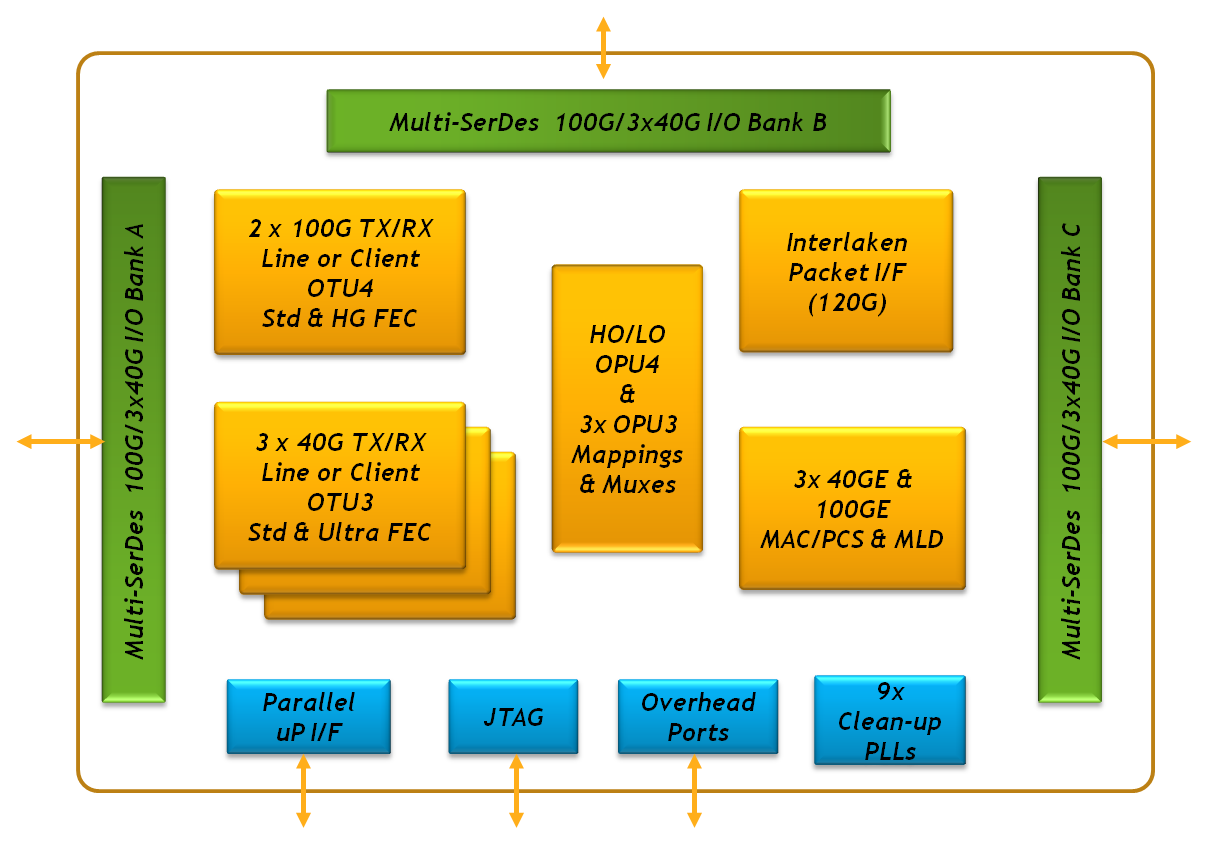 The CS6051 transport processor architecture. Source: Cortina Systems
The application-specific standard product (ASSP) family from Cortina Systems is aimed at dense wavelength division multiplexing (DWDM) platforms, packet optical transport systems, carrier Ethernet switch routers and Internet Protocol edge and core routers. The chip family can also be used in data centre top-of-rack Ethernet aggregation switches.
"Our traditional business in OTN has been in the WDM market," says Alex Afshar, product line manager, transport products at Cortina Systems. "What we see now is demand across all those platforms."
ASSP versus FPGA
Until now, equipment makers have used field programmable gate arrays (FPGAs) to implement 100 Gigabit-per-second (Gbps) designs. This is an important sector for FPGA vendors, with Altera and Xilinx making several company acquisitions to bolster their IP offerings to address the high end sector. System vendors have also used FPGA board-based designs from specialist firm TPACK, acquired by Applied Micro in 2010.
The advantage of an FPGA design is that it allows faster entry to market, while supporting relevant standards as they mature. FPGAs also enable equipment makers to use their proprietary intellectual property (IP); for example, advanced forward error correction (FEC) codes, to distinguish their designs.
However, once a market reaches a certain maturity, ASSPs become available. "ASSPs are more efficient in terms of cost, power and integration," says Afshar.
But industry analysts point out that ASSP vendors have a battle on their hands. "In this class of product, there is a lot of customisation and proprietary design and FPGAs are well suited for that," says Jag Bolaria, senior analyst at The Linley Group.
CS605x family
The CS605x extends Cortina's existing CS604x 40Gbps OTN transport processors launched in April 2011. The CS605x devices aggregate 40 Gigabit Ethernet or OTN streams into 100Gbps or map between 100 Gigabit Ethernet and OTN frames. Combining devices from the two families enables 10 and 40 Gigabit OTN/ Ethernet traffic to be aggregated into 100 Gigabit streams.
The CS6051 is the 100 Gigabit family's flagship device. The CS6051 can interface directly to three 40Gbps optical modules, a 100 Gigabit CFP or a 12x10Gbit/s CXP module. The device also supports the Interlaken interface to 120 Gigabit (10x12.5Gbps) to interface to devices such as network processors, traffic managers and FPGAs.
The CS6051 supports several forward error correction (FEC) codes including the standard G.709, a 9.4dB coding gain FEC with only a 7% overhead, and an 'ultra-FEC' whose strength can be varied with overhead, from 7% to 20%.
The CS6053 is similar to the CS6051 but uses a standard G.709 FEC only, aimed at system vendors with their own powerful FECs such as the latest soft-decision FEC. The CS6052 supports Ethernet and OTN mapping but not aggregation while the CS6054 supports Ethernet only. It is the C6054 which is used for top-of-rack switches in the data centre.
The devices consume between 10-12W. Samples of the CS605x family have been available since October 2011 and will be in volume production in the first half of this year.
Further reading:
For a more detailed discussion of the C605x family, click on the article featured in New Electronics
Optical transceivers: Useful references
Industry bodies
The CFP Multi-Source Agreement (MSA): The hot-pluggable optical transceiver form factor for 40Gbps and 100Gbps applications
Useful articles on optical transceivers
- CFP, CXP form factors complementary, not competitive, Lightwave magazine
- The difference between CFP and CXP, Lightspeed blog
|
Company |
Comment |
|
System vendors |
|
|
ZTE |
ZXR10 T8000 core router with up to 2,048 40Gbps or 1,024 100Gbps interfaces |
|
|
|
|
Optical transceivers |
|
|
Finisar |
40GBASE-LR4 CFP: A 40 Gigabit Ethernet (GbE) LR4 CFP transceiver |
|
Opnext |
100GBASE-LR4 CFP: The 100GbE optical transceiver standard for 10km. Sept 2009. |
|
Reflex Photonics |
Dual 40Gbps CFP: Two 40GBASE-SR4 specification for 40G Ethernet links up to 150m. Oct 2009 |
|
Sumitomo Electric |
40GBASE-LR4: The 40GbE CFP module for 10km transmission. Sept 2009 |
|
Menara Networks |
XFP OTN |
Table 1: Company announcements