

A career in technology market analysis
John Lively reflects on a 30-year career.
It was a typical workday in 1989, sitting through a meeting announcing the restructuring of Corning’s planar coupler business.
The speaker’s final words were, “Lively, you’ll be doing forecasting.” It changed my life and set my career path for the next 30-plus years.
No one grows up with a desire to be a market analyst. Indeed, I didn’t ask for the job. What made it possible was an IBM PC and LOTUS 1-2-3 in my marine biology lab in the early 1980s (a story for another time).
After a stop at MIT for an MBA, this led to a job in Corning’s fledgling PC support team in 1985. Then it was Corning’s optical fibre business cost-modelling fibre-to-the-home networks on a PC, working with Bellcore and General Instrument engineers. From there, it was to forecast market demand for planar couplers in the FTTH market.
In the following decade, I had various market forecasting roles within Corning’s optical fibre and photonics businesses.
Each time I tried to put forecasting behind me by taking a marketing or product management job, management said they needed me to return to forecasting due to some crisis or another (thank you, Bernie Ebbers).
In 1999, I had an epiphany. If Corning thinks I’m better at forecasting than anything else, perhaps I should become a professional forecaster in a company whose product is forecasts.
Just then, through fate or coincidence, I received a call from fellow MIT alum Dana Cooperson who said her firm, RHK, was desperate for people and did I know anyone who might be interested?
For the uninitiated, that’s code for ‘would you be interested in joining us?’.
I joined just in time to enjoy the remaining months of the boom, followed by a bust in 2001. But all the while learning to be a market analyst in a new context. While at Corning, I had been both a producer and procurer of market research. At RHK, I was strictly a producer.
More importantly, there was a direct link between my words and spreadsheets and money coming in. It was exhilarating.
Working remotely
Thanks to the newly deployed cable modem/ HFC technology that I had been cost-modelling a decade earlier, I was working from home.
I have worked from home ever since, and I can say that remote working does work well for some people and jobs.
Some lessons I’ve learned include:
- Working from home works best if the entire firm, not just a few people, are doing it.
- Home working doesn’t mean you can’t travel, pandemics notwithstanding.
- Home workers need to have clear deliverables that they can be judged against. Give them responsibility for something tangible, with an unambiguous deadline.
- Requiring time-tracking sheets or online monitoring of home workers is insulting and demotivating.
- Companies must support home workers by investing in quality internet services and conferencing software/ equipment on both sides of the link
Required skills
By joining RHK, I had moved from a Fortune 500 company to one of 100 employees. Over the next two decades, I would move between large and small companies. I prefer small companies because it’s clear who contributes to their success and who doesn’t. Poor performers have nowhere to hide in a company of six people.
After more than 30 years in the market research arena, I have views on the role of a market analyst and the talents necessary to be a good one.
The goal of market analysis is to find information, analyse it, draw conclusions, then package and communicate it.
Doing market research is like assembling a jigsaw puzzle, from which several pieces are missing. Or, like a chef who must create a healthy, enjoyable meal from an assortment of good and bad raw ingredients.
A technology market analyst should be intellectually curious, have a solid background in sciences and technology, and have broad industry knowledge, i.e., understand the jargon, the tech, and the companies.
The analyst also needs to write concisely and quickly, is fluent in Excel, PowerPoint, and Word, is a great communicator and is approachable, likeable, and outgoing.
Of course, finding all the requisite skills in one person is rare, and larger companies commonly divide duties into specialities like data collection, analysis, and communication.
In small companies, this may not be overt but happens to a degree just the same.
Most importantly, a market analyst must be comfortable with uncertainty.
One never has all the pieces, and you must be OK filling in missing data points via extrapolation, intuition, historical parallels, or other means. And be comfortable admitting your mistakes and adjusting your findings when new data surfaces.
I believe this is why those with a scientific background are better suited to market research than engineers. Scientists are taught scepticism and revision as a way of life, while engineers seek the certainty of the ‘right’ answer.
Periods of note
Throughout my career, I’ve lived through interesting times.
Starting in 1985, it was the introduction of the first PCs into Corning and establishing their first email system, electronic newsletter, word processing, and expert-learning systems.
Then, in the mid-1990s working in the early days of amplified DWDM systems and when the EDFA business doubled its output yearly.
Then came the Internet bubble and optical industry boom/bust of 1999-2001, when dozens of companies were founded by a couple of PhDs with a PowerPoint presentation. At one point in 2000, my optical components practice at RHK had over 100 subscribing companies.
It was weird living through an episode that we knew would someday be written about, like the Dutch tulip mania of 1634.
More recently, and I believe, with a more positive outcome, it is/ has been fascinating to watch companies like Alphabet, Amazon, and Meta utilise a globally connected internet to become the first truly global communications, media, and retail companies.
Moreover, these companies transcend national, cultural, and language boundaries, connecting a billion or more users. And in the process, inventing hyperscale data centres, which in turn allow hundreds and thousands of other companies to ‘cloudify’ as well, extending their global reach.
Of all the innovations and changes taking place today, this is one I will continue to follow with wonder and amazement.
The promise of these companies is so great that I’m hopeful they will become beacons of positive change around the world in the 21st century.
Innovation has been breathtaking in optics. For example, coherent transport, the far-out science stuff of technical talks at my first OFC in 1988, is in commercial use.
We blithely speak of optical transceivers capable of Terabit-per-second speeds without stopping to think how amazing it is that anything, anywhere, could be made to turn off and on again, one TRILLION times a second!
It simply defies human understanding, and yet we make it easy.
A view of now
Today, it’s easy to be convinced that things are falling apart, between Russia’s war against Ukraine, COVID, economic turmoil, screwed-up supply chains, and populist politicians.
But I take solace that I’ve seen things like this before and lived through them. As a child, scenes of the Vietnam war were on the news every evening. But finally, there was peace in Vietnam.
In the 1970s, we had an oil embargo and sky-high gas prices. It also ended.
In the 1980s, inflation ran hot, pushing my student loan interest rate to 13%. But I paid it off, and rates came down.
AIDS struck fear and stoked prejudice for years, claiming my aunt and uncle before scientists uncovered its secrets and developed effective treatments.
So it will be with COVID. History shows that humans tire of strife and disease and will work to conquer our worst problems eventually.
Surprises
Two things come to mind regarding industry surprises over the last 30 years.
One is that optical technology keeps advancing. Despite how challenging each new generation seems, bit by bit and idea by idea, the industry collectively comes up with a solution, and the subsequent speed hike is commercialised.
Another is how people find ways to use it no matter how much bandwidth is created. RHK founder, John Ryan, was fond of telling us, “Bandwidth is like cupboard space; it’s never left empty for long.”
Another surprising thing is how long the interpersonal bonds formed at RHK have lasted.
Though it was just a flash in time, many of those who were there in 2000 remain connected as friends and colleagues more than 20 years later.
Several such alumni work at LightCounting now.
Climate Change
While doing all this, looking backwards and reflecting on change, I couldn’t help dwelling on another major problem we face today: climate change.
Forestalling climate change is the one thing I believe where humans are failing. But unfortunately, the causes are so rooted in our global socio-economic systems that citizens and governments are not capable of inflicting the necessary sacrifices on themselves.
I fear the worst-case scenarios are coming soon, with shifting temperature zones and rising seas. In response, many people, plants, and animals will migrate, following favourable conditions north or south or inland as the case may be, significantly increasing competition for resources of all kinds.
I also fear authoritarian governments may prove more effective at providing protection for some, and avoiding utter chaos, than our precious but fragile democracies.
A role for tech giants
I think the internet and companies with global reach can play a role in combatting the worst impacts of climate change.
Some of the hyperscalers, telecom operators, and equipment companies have been leaders in reducing carbon emissions.
I hope the interconnectedness and massive computing power of companies like Meta and Alphabet can be used to solve these large-scale problems.
My last thought is the realisation that when I eventually ease into retirement and cut back on travel, I may never get a chance to personally thank all the friends and colleagues I have made along the way.
People who have assisted my career, believed in me, educated me, and made me think differently, smile, and laugh.
So, just in case, I’ll say it here – thank you one and all – you made a difference to me.
It’s also been fun.


Infinera’s ICE6 sends 800 gigabits over a 950km link

Infinera has demonstrated the coherent transmission of an 800-gigabit signal across a 950km span of an operational network.
Infinera used its Infinite Capacity Engine 6 (ICE6), comprising an indium-phosphide photonic integrated circuit (PIC) and its FlexCoherent 6 coherent digital signal processor (DSP).
The ICE6 supports 1.6 terabits of traffic: two channels, each supporting up to 800-gigabit of data.
The trial, conducted over an unnamed operator’s network in North America, sent the 800-gigabit signal as an alien wavelength over a third-party line-system carrying live traffic.
“We have proved not only the state of our 800-gigabit with ICE6 but also the distances it can achieve,” says Robert Shore, senior vice president of marketing at Infinera.
800G trials
Several systems vendors have undertaken 800-gigabit optical trials.
Ciena detailed two demonstrations using its WaveLogic 5 Extreme (WL5e). One was an interoperability trial involving Verizon and Juniper Networks while the second connected two data centres belonging to the operator, Southern Cross Cable, to confirm the deployment of the WL5e cards in a live network environment.
Neither Ciena trial was designed to demonstrated WL5e’s limit of optical performance. Accordingly, no distances were quoted although both links were sub-100km, according to Ciena.
Meanwhile, Huawei has trialled its 800-gigabit technology in the networks of operators Turkcell and China Mobile.
The motivation for vendors to increase the speed of line-side optical transceivers is to reduce the cost of data transport. “One laser generating more data,” says Shore. “But it is not just high-speed transmissions, it is high-speed transmissions over distance.”
Infinera’s first 800-gigabit demonstration involved the ICE6 sending the signal over 800km of Corning’s TXF low-loss fibre.
“We did the demo on that fibre and we realised we had a ton of margin left over after completing the 800-gigabit circuit,” says Shore. The company then looked for a suitable network trial using standard optical fibre.
Infinera used a third-party’s optical line system to highlight that the 950km reach wasn’t due to a combination of the ICE6 module and the company’s own line system.
“What we have shown is that you can take any link anywhere, use anyone’s line system, carrying any kind of traffic, drop in the ICE6 and get 800-gigabit connections over 950km,” says Shore.
ICE 6
Infinera attributes the ICE6’s optical performance to its advanced coherent toolkit and the fact that the company has both photonics and coherent DSP technology, enabling their co-design to optimise the system’s performance.
One toolkit technique is Nyquist sub-carriers. Here, data is sent using several Nyquist sub-carriers across the channel instead of modulating the data onto a single carrier. The ICE6 is Infinera’s second-generation design to use sub-carriers, the first being ICE4, that doubles the number from four to eight.
The benefit of using sub-carriers is that high data rates can be achieved while the baud rate used for each one is much lower. And a lower baud rate is more tolerant to non-linear channel impairments during optical transmission.
Sub-carriers also improve spectral efficiency as the channels have sharper edges and can be packed tightly.
Infinera applies probabilistic constellation shaping to each sub-carrier, allowing fine-tuning of the data each carries. As a result, more data can be sent on the inner sub-carriers and less on the outer two outer sub-carrier where signal recovering is harder.
The sweet spot for sub-carriers is a symbol rate of 8-11 gigabaud (GBd). For the Infinera trial, eight sub-carriers were used, each at 12GBd, for an overall symbol rate of 96GBd.
“While it is best to stay as close to 8-11GBd, the coding gain you get as you go from 11GBd to 12GBd per sub-carrier is greater than the increased non-linear penalties,” says Shore.
Another feature of the coherent DSP is its use of soft-decision forward-error correction (SD-FEC) gain sharing. By sharing the FEC codes, processing resources can be shifted to one of the PIC’s two optical channels that needs it the most.
The result is that some of the strength of the stronger signal can be traded to bolster the weaker one, extending its reach or potentially allowing a higher modulation scheme to be used.
Applications
Linking data centres is one application where the ICE6 will be used. Another is sub-sea optical transmission involving spans that can be thousands of kilometres long, requiring lower modulation schemes and lower data rates.
“It’s not just cost-per-bit and power-per-bit, it is also spectral efficiency,” says Shore. “And a higher-performing optical signal can maintain a higher modulation rate over longer distances as well.”
Infinera says that at 600 gigabits-per-second (Gbps), link distances will be “significantly better” than 1,600km. The company is exploring suitable links to quantify ICE6’s reach at 600Gbps.
The ICE6 is packaged in a 5×7-inch optical module. Infinera’s Groove series will first adopt the ICE6 followed by the XTC platforms, part of the DTN-X series. First network deployments will occur in the second half of this year.
Infinera is also selling the ICE6 5×7-inch module to interested parties.
XR Optics
Infinera is not addressing the 400ZR coherent pluggable module market. The 400ZR is the OIF-defined 400-gigabit coherent standard developed to connect equipment in data centres up to 120km apart.
Infinera is, however, eyeing the emerging ZR+ opportunity using XR Optics. ZR+ is not a standard but it extends the features of 400ZR.
XR Optics is the brainchild of Infinera that is based on coherent sub-carriers. All the sub-carriers can be sent to the same destination for point-to-point links, but they can also be sent to different locations to allow for point-to-multipoint communications. Such an arrangement allows for traffic aggregation.
“You can steer all the sub-carriers coming out of an XR transceiver to the same destination to get a 400-gigabit point-to-point link to compete with ZR+,” says Shore. “And because we are using sub-carriers instead of a single carrier, we expect to get significantly better performance.”
Infinera is developing the coherent DSPs for XR Optics and has teamed up with optical module makers, Lumentum and II-VI.
Other unnamed partners have joined Infinera to bring the technology to market. Shore says that the partners include network operators that have contributed to the technology’s development.
Infinera planned to showcase XR Optics at the OFC conference and exhibition held recently in San Diego.
Shore says to expect XR Optics announcements in late summer, from Infinera and perhaps others. These will detail the XR Optics form factors and how they function as well as the products’ schedules.

Terabit interconnect to take hold in the data centre
Intel and Corning have further detailed their 1.6 Terabit interface technology for the data centre.
The collaboration combines Intel's silicon photonics technology operating at 25 Gigabit-per-fibre with Corning's ClearCurve LX multimode fibre and latest MXC connector.
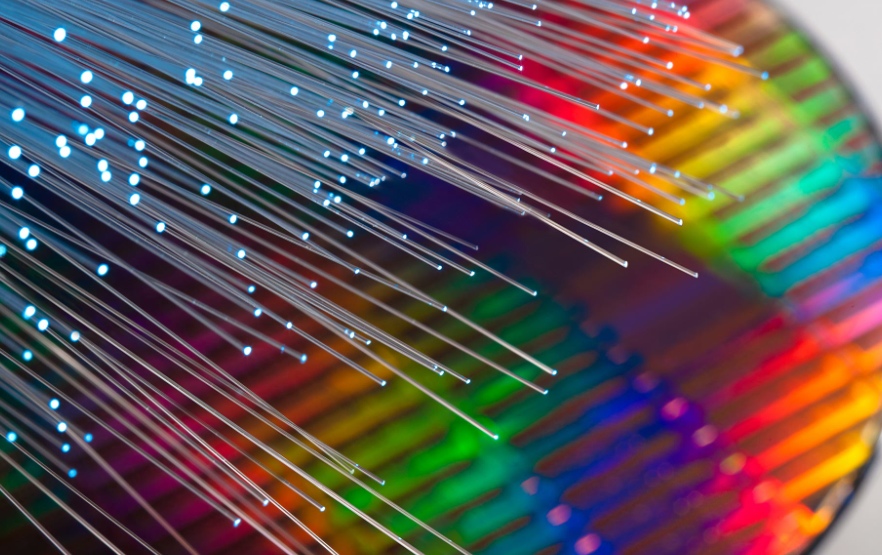 Silicon photonics wafer and the ClearCurve fibres. Source: Intel
The fibre has a 300m reach, triple the reach of existing multi-mode fibre at such speeds, and uses a 1310nm wavelength. Used with the MXC connector that supports 64 fibres, the overall capacity will be 1.6 Terabits-per-second (Tbps).
"Each channel has a send and a receive fibre which are full duplex," says Victor Krutul, director business development and marketing for silicon photonics at Intel. "You can send 0.8Tbps on one direction and 0.8Tbps in the other direction at the same time."
The link supports connections within a rack and between racks; for example, connecting a data centre's top-of-rack Ethernet switch with an end-of-row one.
James Kisner, an analyst at global investment banking firm, Jefferies, views Intel’s efforts as providing important validation for the fledgling silicon photonics market.
However, in a research note, he points out that it is unclear whether large data centre equipment buyers will be eager to adopt the multi-mode fibre solution as it is more expensive than single mode. Equally, large data centres have increasingly longer span requirements - 500m to 2km - further promoting the long term use of single mode fibre.
Rack Scale Architecture
The latest details of the silicon photonics/ ClearCurve cabling were given as part of an Intel update on several data centre technologies including its Atom C2000 processor family for microservers, the FM5224 72-port Ethernet switch chip, and Intel's Rack Scale Architecture (RSA) that uses the new cabling and connector.
Intel is a member of Facebook's Open Compute Project based on a disaggregated system design that separates storage, computing and networking. "When I upgrade the microprocessors on the motherboard, I don't have to throw away the NICs [network interface controllers] and disc drives," says Krutul. The disaggregation can be within a rack or between rows of equipment. Intel's RSA is a disaggregated design example.
The chip company discussed an RSA design for Facebook. The rack has three 100Gbps silicon photonics modules per tray. Each module has four transmit and four receive fibres, or 24 fibres per tray and per cable. “Different versions of RSA will have more or less modules depending on requirements," says Krutul. Intel has also demonstrated a 32-fibre MXC prototype connector.
Corning says the ClearCurve fibre delivers several benefits. The fibre has a smaller bend radius of 7.5mm, enabling fibre routing on a line card. The 50 micron multimode fibre face is also expanded to 180 microns using a beam expander lens. The lenses make connector alignment easier and less sensitive to dust. Corning says the MXC connector comprises seven parts, fewer than other optical connectors.
Fibre and connector standardisation are key to ensure broad use, says Daryl Inniss, vice president and practice leader, components at Ovum.
"Intel is the only 1310nm multimode transmitter and receiver supplier, and expanding this optical link into other applications like enterprise data centres may require a broader supply base," says Inniss in a comment piece. But the fact that Corning is participating in the development signals a big market in the making, he says.
Intel has not said when the silicon photonics transceiver and fibre/ connector will be generally available. "We are not discussing schedules or pricing at this time," says Krutul.
Silicon photonics: Intel's first lab venture
The chip company has been developing silicon photonics technology for a decade.
"As our microprocessors get faster, you need bigger and faster pipes in and around the servers," says Krutul. "That is a our whole goal - feeding our microprocessors."
Intel is setting up what it calls 'lab ventures', with silicon photonics chosen to be the first.
"You have a research organisation that does not do productisation, and business units that just do products," says Krutul. "You need something in between so that technology can move from pure research to product; a lab venture is an organisational structure to allow that movement to happen."
The lab ventures will be discussed more in the coming year.

2020 vision
In a panel discussion at the recent Level123 Terabit Optical and Data Networking conference, Kim Roberts, senior director coherent systems at Ciena, shared his thoughts about the future of optical transmission.
Final part : Optical transmission in 2020
 "Four hundred Gigabit and one Terabit are not going to start in long-haul"
Kim Roberts, Ciena
Kim Roberts starts on a cautionary note, warning of the dangers when predicting the future. "It is always wrong," he says. But in his role as a developer of systems, he must consider what technologies are going to be useful in 2020.
The simple answer is cheap, flexible optical spectrum and coherent modems (DSP-ASICs).
Since DSP-ASICs will become cheaper and consume less power as they are implemented using the latest CMOS processes, they will migrate from their initial use in long-haul/ regional networks to the metro and even the campus. "Four hundred Gigabit and one Terabit are not going to start in long-haul," says Roberts.
Traditionally, the long-haul network has been where new technology is introduced since it is the part of the network where premium prices can first be justified. "It is not going to start there; it won't have that reach," he says. Instead 400 Gigabit-per-second (Gbps) and one Terabit wavelengths will start over medium reaches - 500-700km - once they become more economical.
One consequence is that when going distances beyond medium reach, more spectrum will be required. "You'll have to light up more fibres [for long-haul], whereas in metro-regional you can put more down one fibre," says Roberts.
The current trend of greater functionality and intelligence being encapsulated in an ASIC will continue but Roberts does not rule out a new kind of optical device delivering a useful function. "It can happen quite suddenly - optical amplifiers happened really suddenly." That said, he does not see any such candidate optical technology for now.
The trends Roberts does expect through to 2020 are as follows:
- Optical pulse shaping: Technologies such as optical regeneration and optical demultiplexing have existed in the labs. But such techniques are not spectrally efficiency and are hot, large and expensive, he says. As a result, he does not expect them to become economical for commercial products by 2020.
- Photonic Switching: Optical burst switch, optical label switching, optical packet switching, all will not prove themselves to be economical by 2020. "Optics is not the right answer in the medium term," says Roberts.
- Optical wavelength conversion, optical logic, optical CDMA and optical solitons are other technologies in Roberts' view that will not be economical by 2020.
What Roberts does identify as being useful through 2020 are:
- Low loss, high dispersion, low non-linearities fibre: "New fibres from the likes of Sumitomo and Corning allow the exploitation of coherent modems," says Roberts. "High dispersion is good, it is your friend: it helps minimise non-linearities." This was not an accepted view as recently as 2005, he says, but now it is well accepted.
- Low cost, heat and noise, high-powered optical amplifiers: "This is a fairly simple function, let's just make them better and better," he says.
- Low cost, frequency-selective switching: This refers to taking a wavelength-selective switch (WSS) and getting rid of the ITU grid; making the WSS more flexible while lowering its cost and size.
- Coherent modems: As mentioned, these will improve in efficiency in terms of bits/s/dollar as well as higher performance in terms of decibels (dBs), reach and spectral efficiency. "Polishing these [metrics]," says Roberts.
Roberts admits that his useful items listed are not exciting, radical breakthroughs: "I think we are in an interval of improving on the trends we already have until there is some breakthrough."
Part 1: The capacity limits facing optical networking
Part 2: Optical transmission's era of rapid capacity growth
Further reading on photonic switching:
Packet optical transport: Hollowing the network core
Huawei boosts its optical roadmap with CIP acquisition
Huawei has acquired UK photonic integration specialist, CIP Technologies, from the East of England Development Agency (EEDA) for an undisclosed fee. The acquisition gives the Chinese system vendor a wealth of optical component expertise and access to advanced European Union R&D projects.
"By acquiring CIP and integrating the company’s R&D team into Huawei’s own research team, Huawei’s optic R&D capabilities can be significantly enhanced," says Peter Wharton, CEO at the Centre for Integrated Photonics (CIP). CIP Technologies is the trading name of the Centre for Integrated Photonics.
 Huawei now has six European R&D centres with the acquisition of CIP.
CIP Technologies has indium phosphide as well as planar lightwave circuit (PLC) technology which it uses as the basis for its HyBoard hybrid integration technology. HyBoard allows actives to be added to a silica-on-silicon motherboard to create complex integrated optical systems.
CIP has been using its photonic integration expertise to develop compact, more cost-competitive WDM-PON optical line terminal (OLT) and optical network unit (ONU) designs, including the development of an integrated transmitter array.
The company employs 50 staff, with 70% of its work coming from the telecom and datacom sectors. About a third of its revenues are from advanced products and two thirds from technical services.
The CEO of CIP says all current projects for its customers will be carried out as planned but CIP’s main research and development service will be focused on Huawei’s business priorities. “We expect all contracted projects to be completed and current customers are being assisted to find alternate sources of supply," says Wharton.
CIP is also part of several EU Seventh Framework programme R&D projects. These include BIANCHO, a project to reduce significantly the power consumption of optical components and systems, and 3CPO, which is developing colourless and coolerless optical components for low-power optical networks.
Huawei's acquisition will not affect CIP's continuing participation in such projects. "For EU framework and other collaborative R&D projects, the ultimate share ownership does not matter so long as it is a research organisation based in Europe, which CIP will continue to be," says Wharton.
CIP said it had interest from several potential acquirers but that the company favoured Huawei.
What this means
CIP has a rich heritage. It started as BT's fibre optics group. But during the optical boom of 1999-2000, BT shed its unit, a move also adopted by such system vendors as Nortel and Lucent.
The unit was acquired by Corning in 2000 but the acquisition did not prove a success and in 2002 the group faced closure before being rescued by the East of England Development Agency (EEDA).
CIP has always been an R&D organisation in character rather than a start-up. Now with Huawei's ambition, focus and deep pockets coupled with CIP's R&D prowess, the combination could prove highly successful if the acquisition is managed well.
Huawei's acquisition looks shrewd. Optical integration has been discussed for years but its time is finally arriving. The technologies of 40 Gigabit and 100 Gigabit is based on designs with optical functions in parallel; at 400 Gigabit the number of channels only increases.
Optical access will also benefit from photonic integration - from board optical sub-assemblies for GPON and EPON to WDM-PON to ultra dense WDM-PON. China is also the biggest fibre-to-the-x (FTTx) market by far.
A BT executive talking about the operator's 21CN mentioned how system vendors used to ask him repeatedly about Huawei. Huawei, in contrast, used to ask him about Infinera.
Huawei, like all the other systems vendors, has much to do to match Infinera's photonic integrated circuit expertise and experience. But the Chinese vendor's optical roadmap just got a whole lot stronger with the acquisition of CIP.
Further reading:
Reflecting light to save power, click here