

OIF starts work on a terabit-plus CFP8-ACO module
The Optical Internetworking Forum (OIF) has started a new analogue coherent optics (ACO) specification based on the CFP8 pluggable module.
The CFP8 is the latest is a series of optical modules specified by the CFP Multi-Source Agreement and will support the emerging 400 Gigabit Ethernet standard.
 Karl GassAn ACO module used for optical transport integrates the optics and driver electronics while the accompanying coherent DSP-ASIC residing on the line card.
Systems vendors can thus use their own DSP-ASIC, or a merchant one if they don’t have an in-house design, while choosing the coherent optics from various module makers. The optics and the DSP-ASIC communicate via a high-speed electrical connector on the line card.
ACO design
The OIF completed earlier this year the specification of the CFP2-ACO.
Current CFP2-ACO modules support single-wavelength transmission rates from 100 gigabit to 250 gigabit depending on the baud rate and modulation scheme used. The goal of the CFP8-ACO is to support up to four wavelengths, each capable of up to 400 gigabit-per-second transmissions.
This project is going to drive innovation
“This isn’t something there is a dire need for now but the projection is that this will be needed in two years’ time,” says Karl Gass of Qorvo and the OIF Physical and Link Layer Working Group optical vice chair.
OIF members considered several candidate optical modules for the next-generation ACO before choosing the CFP8. These included the existing CFP2 and the CFP4. There were some proponents for the QSFP but its limited size and power consumption is problematic when considering long-haul applications, says Gass.
 Source: Finisar
One difference between the CFP2 and CFP8 modules is that the electrical connector of the CFP8 supports 16 differential pairs while the CFP2 connector supports 10 pairs.
“Both connectors have similar RF performance and therefore can handle similar baud rates,” says Ian Betty of Ciena and OIF board member and editor of the CFP2-ACO Implementation Agreement. To achieve 400 gigabit on a wavelength for the CFP8-ACO, the electrical connector will need to support 64 gigabaud.
Betty points out that for coherent signalling, four differential pairs per optical carrier are needed. “This is independent of the baud rate and the modulation format,” says Betty.
So while it is not part of the existing Implementation Agreement, the CFP2-ACO could support two optical carriers while the CFP8 will support up to four carriers.
“This is only the electrical connector interface capacity,” says Betty. “It does not imply it is possible to fit this amount of optics and electronics in the size and power budget.” The CFP8 supports a power envelope of 20W compared to 12W of the CFP2.
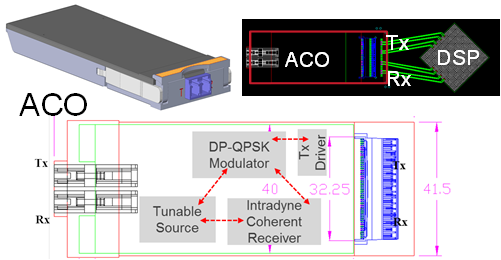 The CFP2-ACO showing the optical building blocks and the electrical connector linking the module to the DSP-ASIC. Source: OIF
The CFP8 occupies approximately the same area as the CFP2 but is not as tall such that the module can be doubled-stacked on a line card for a total of 16 CFP8-ACOs on a line card.
Given that the CFP8 will support up to four carriers per module - each up to 400 gigabit - a future line card could support 25.6 terabits of capacity. This is comparable to the total transport capacity of current leading dense WDM optical transport systems.
Rafik Ward, vice president of marketing at Finisar, says such a belly-to-belly configuration of the modules provides future-proofing for next-generation lineside interfaces. “Having said that, it is not clear when, or how, we will be able to technically support a four-carrier coherent solution in a CFP8 form factor,” says Ward.
Oclaro stresses that such a high total capacity implies that sufficient coherent DSP silicon can fit on the line card. Otherwise, the smaller-height CFP8 module may not enable the fully expected card density if the DSP chips are too large or too power-hungry.
OIF goal
Besides resulting in a higher density module, a key OIF goal of the work is to garner as much industry support as possible to back the CFP8-ACO. “How to create the quantity of scale so that deployment becomes less expensive and therefore quicker to implement,” says Gass.
The OIF expects the work to be similar to the development of the CFP2-ACO Implementation Agreement. But one desired difference is to limit the classes associated with the module. The CFP2-ACO has three class categories based on whether the module has a limited and linear output. “The goal of the CFP8-ACO is to limit the designs to single classes per wavelength count,” says Gass.
Gass is looking forward to the CFP8-ACO specification work. Certain standards efforts largely involve making sure components fit into a box whereas the CFP8-ACO will be more engaging. “This project is going to drive innovation and that will drive some technical work,” says Gass.

Ciena enhances its 6500 packet-optical transport family
"The 6500 T-Series is a big deal as Ciena can offer two different systems depending on what the customer is looking for," says Andrew Schmitt, founder and principal analyst of market research firm, Cignal AI.
 Helen XenosIf customers want straightforward transport and the ability to reach a number of different distances, there is the existing 6500 S-series, says Schmitt. The T-series is a system specifically for metro-regional networks that can accommodate multiple traffic types – OTN or packet.
"It has very high density for a packet-optical system and offers pay-as-you-grow with CFP2-ACO [coherent pluggable] modules," says Schmitt.
Ciena says the T-series has been developed to address new connectivity requirements service providers face. Content is being shifted to the metro to improve the quality of experience for end users and reduce capacity on backbone networks. Such user consumption of content is one factor accounting for the strong annual 40 percent growth in metro traffic.
According to Ciena, service providers have to deploy multiple overlays of network elements to scale capacity, including at the photonic switch layer, because they need more than 8-degree reconfigurable optical add/ drop multiplexers (ROADMs).
Operators are looking for a next-generation platform for these very high-capacity switching locations to efficiently distribute content
But overlays add complexity to the metro network and slow the turn-up times of services, says Helen Xenos, director, product and technology marketing at Ciena: "Operators are looking for a next-generation platform for these very high-capacity switching locations to efficiently distribute content."
U.S. service provider Verizon is the first to announce the adoption of the 6500 T-series to modernise its metro and is now deploying the platform. "Verizon is dealing with a heterogeneous network in the metro with many competing requirements," says Schmitt. "They don’t have the luxury of starting over or specialising like some of the hyper-scale transport architectures."
The T-series, once deployed, will handle the evolving requirements of Verizon's network. "Sure, it comes with additional costs compared with bare-bones transport but my conversation with folks at Verizon would indicate flexibility is worth the price," says Schmitt.
Ciena has over 500 customers in 50 countries for its existing 6500 S-series. Customers include 18 of the top 25 communications service providers and three of the top five content providers.
Xenos says an increasing number of service providers are interested in its latest platform. The T-series is part of six request-for-proposals (RFPs) and is being evaluated in several service providers' labs. The 6500 T-series will be generally available this month.
6500 T-series
The existing 6500 S-series family comprises four platforms, from the 2 rack-unit (RU) 6500-D2 chassis to the 22RU 6500-S32 that supports Ethernet, time-division multiplexed traffic and wavelength division multiplexing, and 3.2 terabit-per-second (Tbps) packet/ Optical Transport Network (OTN) switching.
The two T-series platforms are the half rack 6500-12T and the full rack 6500-24T. The cards have been upgraded from 100-gigabit switching per slot to 500-gigabit per slot.
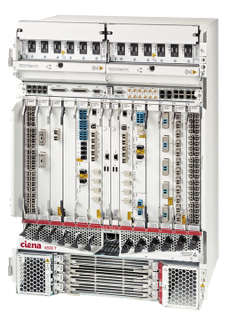 The 6500-T12 has 12 service slots which house either service interfaces or photonic modules. There are also 2 control modules. Shown at the base of the chassis are four 500 Gig switching modules. Source: Ciena
The 500 gigabit switching per slot means the 6500-12T supports 6 terabits of switching capacity while the -24T will support 12 terabits by year end. The platforms have been tested and will support 1 terabit per slot, such that the -24T will deliver the full 24 terabit. Over 100 terabit of switching capacity will be possible in a multiple-chassis configuration, managed as a single switching node.
The latest platforms can use Ciena's existing coherent line cards that support two 100 gigabit wavelengths. The T-Series also supports a 500-gigabit coherent line card with five CFP2-ACOs coupled with Ciena's WaveLogic 3 Nano DSP-ASIC.
"We will support higher-capacity wavelengths in a muxponder configuration using our existing S-series," says Xenos. "But for switching applications, switching lower-speed traffic across the shelf onto a very high-capacity wavelength, this is something that the T-series would be used for."
The T-series also adds a denser, larger-degree ROADM, from an existing 6500 S-series 8-degree to a 16-degree flexible grid, colourless, directionless and contentionless (CDC) design. Xenos says the ROADM design is also more compact such that the line amplifiers fit on the same card.
"The requirements of this platform is that it has full integration of layer 0, layer 1 and layer 2 functions," says Xenos.
The 6500 T-series supports open application programming interfaces (APIs) and is being incorporated as part of Ciena's Emulation Cloud. The Emulation Cloud enabling customers to test software on simulated network configurations without requiring 6500 hardware and is being demonstrated at OFC 2016.
The 6500 is also being integrated as part of Ciena's Blue Planet orchestration and management architecture.
Ciena shops for photonic technology for line-side edge
Part 3: Acquisitions and silicon photonics
Ciena is to acquire the high-speed photonics components division of Teraxion for $32 million. The deal includes 35 employees and Teraxion’s indium phosphide and silicon photonics technologies. The systems vendor is making the acquisition to benefit its coherent-based packet-optical transmission systems in metro and long-haul networks.
 Sterling Perrin
“Historically Ciena has been a step ahead of others in introducing new coherent capabilities to the market,” says Ron Kline, principal analyst, intelligent networks at market research company, Ovum. “The technology is critical to own if they want to maintain their edge.”
“Bringing in-house not everything, just piece parts, are becoming differentiators,” says Sterling Perrin, senior analyst at Heavy Reading.
Ciena designs its own WaveLogic coherent DSP-ASICs but buys its optical components. Having its own photonics design team with expertise in indium-phosphide and silicon photonics will allow Ciena to develop complete line-side systems, optimising the photonics and electronics to benefit system performance.
Owning both the photonics and optics also promises to reduce power consumption and improve line-side port density.
“These assets will give us greater control of a critical roadmap component for the advancement of those coherent solutions,” a Ciena spokesperson told Gazettabyte. “These assets will give us greater control of a critical enabling technology to accelerate the pace of our innovation and speed our time-to-market for key packet-optical solutions.”
Ciena have always been do-it-yourself when it comes to optics, and it is an area where they has a huge heritage. So it is an interesting admission that they need somebody else to help them.
The OME 6500 packet optical platform remains a critical system for Ciena in terms of revenues, according to a recent report from the financial analyst firm, Jefferies.
Ciena have always been do-it-yourself when it comes to optics, and it is an area where they have a huge heritage, says Perrin: “So it is an interesting admission that they need somebody else to help them.” It is the silicon photonics technology not just photonic integration that is of importance to Ciena, he says.
Coherent competition
Infinera, which designs its own photonic integrated circuits (PICs) and coherent DSP-ASIC, recently detailed its next-generation coherent toolkit prior to the launch of its terabit PIC and coherent DSP-ASIC. The toolkit uses sub-carriers, parallel processing soft-decision forward-error correction (SD-FEC) and enhanced modulation techniques. These improvements reflect the tighter integration between photonics and electronics for optical transport.
Cisco Systems is another system vendor that develops its own coherent ASICs and has silicon photonics expertise with its Lightwire acquisition in 2012, as does Coriant which works with strategic partners while using merchant coherent processors. Huawei has photonic integration expertise with its acquisitions of indium phosphide UK specialist CIP Technologies in 2012 and Belgian silicon photonics start-up Caliopa in 2013.
Cisco may have started the ball rolling when they acquired silicon photonics start-up Lightwire, and at the time they were criticised for doing so, says Perrin: “This [Ciena move] seems to be partially a response, at least a validation, to what Cisco did, bringing that in-house.”
Optical module maker Acacia also has silicon photonics and DSP-ASIC expertise. Acacia has launched 100 gigabit and 200-400 gigabit CFP optical modules that use silicon photonics.
Companies like Coriant and lots of mid-tier players can use Acacia and rely on the expertise the start-up is driving in photonic integration on the line side, says Perrin. ”Now Ciena wants to own the whole thing which, to me, means they need to move more rapidly, probably driven by the Acacia development.”
Teraxion
Ciena has been working with Canadian firm Teraxion for a long time and the two have a co-development agreement, says Perrin.
Teraxion was founded in 2000 during the optical boom, specialising in dispersion compensation modules and fibre Bragg gratings. In recent years, it has added indium-phosphide and silicon photonics expertise and in 2013 acquired Cogo Optronics, adding indium-phosphide modulator technology.
Teraxion detailed an indium phosphide modulator suited to 400 gigabit at ECOC 2015. Teraxion said at the time that it had demonstrated a 400-gigabit single-wavelength transmission over 500km using polarisation-multiplexed, 16-QAM (PM-16QAM), operating at a symbol rate of 56 gigabaud.
It also has a coherent receiver technology implemented using silicon photonics.
The remaining business of Teraxion covers fibre-optic communication, fibre lasers and optical-sensing applications which employs 120 staff will continue in Québec City.
Ciena's stackable platform for data centre interconnect
Ciena is the latest system vendor to unveil its optical transport platform for the burgeoning data centre interconnect market. Data centre operators require scalable platforms that can carry significant amounts of traffic to link sites over metro and long-haul distances, and are power efficient.
The Waveserver stackable interconnect system delivers 800 Gig traffic throughput in a 1 rack unit (1RU) form factor. The throughput comprises 400 Gigabit of client-side interfaces and 400 Gigabit coherent dense WDM transport.
For the Waveserver’s client-side interfaces, a mix of 10, 40 and 100 Gigabit interfaces can be used, with the platform supporting the latest 100 Gig QSFP28 optical module form factor. One prominent theme at the recent OFC 2015 show was the number of interface types now supported in a QSFP28.
On the line side, Ciena uses two of its latest WaveLogic 3 Extreme coherent DSP-ASICs. Each DSP-ASIC supports polarisation multiplexing, 16 quadrature amplitude modulation (PM–16-QAM), equating to 200 Gigabit transmission capacity.
The Extreme was chosen rather than Ciena’s more power-efficient WaveLogic 3 Nano DSP-ASIC to maximise capacity over a fibre. “The amount of fibre the internet content providers have tends to be limited so getting high capacity is key,” says Michael Adams, vice president of product and technical marketing at Ciena. The Nano DSP-ASIC does not support 16-QAM.
A rack can accommodate up to 44 Waveserver stackable units to deliver 88 wavelengths, each 50GHz wide, or 17.6 Terabit-per-second (Tbps) of capacity. And up to 96 wavelengths, or 19.2Tbps, is supported on a fibre pair.
"We are going down the path of opening the platform to automation"
“We could add flexible grid and probably get closer to 24 or 25 Tbps,” says Adams. Flexible grid refers to moving off the C-band's set ITU grid by using digital signal processing at the transmitter. By shaping the signal before it is sent, each carrier can be squeezed from a 50GHz channel into a 37.5GHz wide one, boosting overall capacity carried over the fibre.
Adams says that it is not straightforward to compare the power consumption of different vendors’ data centre interconnect platforms but Ciena believes its platform is competitive. He estimates that the Waveserver consumes between 1W and 1.5W per Gigabit line side.
Ciena has stated that between five and 10 percent of its revenues come from web-scale customers, and accounts for a third of its total 100 Gig line-side port shipments.
Web-scale companies include Internet content providers, providers of data centre co-location and interconnect, and enterprises. Web-scale companies also drive the traditional telecom optical networking market as they also use large amounts of the telcos' network capacity to link their sites.
The global data centre interconnect market grew 16 percent in 2014 to reach $US 2.5 billion, according to market research firm, Ovum. Almost half of the spending was by the communications service providers whereas the Internet content providers spending grew 64 percent last year.
Open software
Ciena also announced an open application development environment, dubbed emulation cloud, that allows applications to be developed without needing Waveserver hardware.
One obvious application is the moving server virtual machines between data centres. But more novel applications can be developed by the data centre operators and third-party developers. Ciena cites what it calls an augmented reality application that allows a mobile phone to be pointed at a Waveserver to inform the of user the status of the machine: which ports are active and what type of bandwidth each port is consuming. “It can also show power and specific optical parameters of each line port,” says Adams. “Right there, you have all the data you need to know.”
The Waveserver platform also comes with software that allows data centre managers to engineer, plan, provision and operate links via a browser. More sophisticated users can benefit from Ciena’s OPn architecture and a set of open application programming interfaces (APIs).
“We are going down the path of opening the platform to automation,” says Adams. “We can foresee for the most sophisticated users, plugging into APIs and going to some very specific optical parameters and playing with them.”
Waveserver Status
Ciena is demonstrating its Waveserver platform to over 100 customers, as part of an annual event at the company’s Ottawa site.
“We are well engaged with a variety of Internet content providers,” says Adams. “We will be in trials with many of those folks this summer.” General availability is expected at the end of the third quarter.
In May, Ciena announced it had entered a definitive agreement to acquire Cyan. Cyan announced its own N-Series data centre interconnect platform earlier this year. Ciena says it is premature to comment on the future of the N-Series platform.
Heading off the capacity crunch
Improving optical transmission capacity to keep pace with the growth in IP traffic is getting trickier.
Engineers are being taxed in the design decisions they must make to support a growing list of speeds and data modulation schemes. There is also a fissure emerging in the equipment and components needed to address the diverging needs of long-haul and metro networks. As a result, far greater flexibility is needed, with designers looking to elastic or flexible optical networking where data rates and reach can be adapted as required.
 Figure 1: The green line is the non-linear Shannon limit, above which transmission is not possible. The chart shows how more bits can be sent in a 50 GHz channel as the optical signal to noise ratio (OSNR) is increased. The blue dots closest to the green line represent the performance of the WaveLogic 3, Ciena's latest DSP-ASIC family. Source: Ciena.
But perhaps the biggest challenge is only just looming. Because optical networking engineers have been so successful in squeezing information down a fibre, their scope to send additional data in future is diminishing. Simply put, it is becoming harder to put more information on the fibre as the Shannon limit, as defined by information theory, is approached.
"Our [lab] experiments are within a factor of two of the non-linear Shannon limit, while our products are within a factor of three to six of the Shannon limit," says Peter Winzer, head of the optical transmission systems and networks research department at Bell Laboratories, Alcatel-Lucent. The non-linear Shannon limit dictates how much information can be sent across a wavelength-division multiplexing (WDM) channel as a function of the optical signal-to-noise ratio.
A factor of two may sound a lot, says Winzer, but it is not. "To exhaust that last factor of two, a lot of imperfections need to be compensated and the ASIC needs to become a lot more complex," he says. The ASIC is the digital signal processor (DSP), used for pulse shaping at the transmitter and coherent detection at the receiver.
Our [lab] experiments are within a factor of two of the non-linear Shannon limit, while our products are within a factor of three to six of the Shannon limit - Peter Winzer
At the recent OFC 2015 conference and exhibition, there was plenty of announcements pointing to industry progress. Several companies announced 100 Gigabit coherent optics in the pluggable, compact CFP2 form factor, while Acacia detailed a flexible-rate 5x7 inch MSA capable of 200, 300 and 400 Gigabit rates. And research results were reported on the topics of elastic optical networking and spatial division multiplexing, work designed to ensure that networking capacity continues to scale.
Trade-offs
There are several performance issues that engineers must consider when designing optical transmission systems. Clearly, for submarine systems, maximising reach and the traffic carried by a fibre are key. For metro, more data can be carried on a single carrier to improving overall capacity but at the expense of reach.
Such varied requirements are met using several design levers:
- Baud or symbol rate
- The modulation scheme which determines the number of bits carried by each symbol
- Multiple carriers, if needed, to carry the overall service as a super-channel
The baud rate used is dictated by the performance limits of the electronics. Today that is 32 Gbaud: 25 Gbaud for the data payload and up to 7 Gbaud for forward error correction and other overhead bits.
Doubling the symbol rate from 32 Gbaud used for 100 Gigabit coherent to 64 Gbaud is a significant challenge for the component makers. The speed hike requires a performance overhaul of the electronics and the optics: the analogue-to-digital and digital-to-analogue converters and the drivers through to the modulators and photo-detectors.
"Increasing the baud rate gives more interface speed for the transponder," says Winzer. But the overall fibre capacity stays the same, as the signal spectrum doubles with a doubling in symbol rate.
However, increasing the symbol rate brings cost and size benefits. "You get more bits through, and so you are sharing the cost of the electronics across more bits," says Kim Roberts, senior manager, optical signal processing at Ciena. It also implies a denser platform by doubling the speed per line card slot.
As you try to encode more bits in a constellation, so your noise tolerance goes down - Kim Roberts
Modulation schemes
The modulation used determines the number of bits encoded on each symbol. Optical networking equipment already use binary phase-shift keying (BPSK or 2-quadrature amplitude modulation, 2-QAM) for the most demanding, longest-reach submarine spans; the workhorse quadrature phase-shift keying (QPSK or 4-QAM) for 100 Gigabit-per-second (Gbps) transmission, and the 200 Gbps 16-QAM for distances up to 1,000 km.
Moving to a higher QAM scheme increases WDM capacity but at the expense of reach. That is because as more bits are encoded on a symbol, the separation between them is smaller. "As you try to encode more bits in a constellation, so your noise tolerance goes down," says Roberts.
One recent development among system vendors has been to add more modulation schemes to enrich the transmission options available.
From QPSK to 16-QAM, you get a factor of two increase in capacity but your reach decreases of the order of 80 percent - Steve Grubb
Besides BPSK, QPSK and 16-QAM, vendors are adding 8-QAM, an intermediate scheme between QPSK and 16-QAM. These include Acacia with its AC-400 MSA, Coriant, and Infinera. Infinera has tested 8-QAM as well as 3-QAM, a scheme between BPSK and QPSK, as part of submarine trials with Telstra.
"From QPSK to 16-QAM, you get a factor of two increase in capacity but your reach decreases of the order of 80 percent," says Steve Grubb, an Infinera Fellow. Using 8-QAM boosts capacity by half compared to QPSK, while delivering more signal margin than 16-QAM. Having the option to use the intermediate formats of 3-QAM and 8-QAM enriches the capacity tradeoff options available between two fixed end-points, says Grubb.
Ciena has added two chips to its WaveLogic 3 DSP-ASIC family of devices: the WaveLogic 3 Extreme and the WaveLogic 3 Nano for metro.
WaveLogic3 Extreme uses a proprietary modulation format that Ciena calls 8D-2QAM, a tweak on BPSK that uses longer duration signalling that enhances span distances by up to 20 percent. The 8D-2QAM is aimed at legacy dispersion-compensated fibre that carry 10 Gbps wavelengths and offers up to 40 percent additional upgrade capacity compared to BPSK.
Ciena has also added 4-amplitude-shift-keying (4-ASK) modulation alongside QPSK to its WaveLogic3 Nano chip. The 4-ASK scheme is also designed for use alongside 10 Gbps wavelengths that introduce phase noise, to which 4-ASK has greater tolerance than QPSK. Ciena's 4-ASK design also generates less heat and is less costly than BPSK.
According to Roberts, a designer’s goal is to use the fastest symbol rate possible, and then add the richest constellation as possible "to carry as many bits as you can, given the noise and distance you can go".
After that, the remaining issue is whether a carrier’s service can be fitted on one carrier or whether several carriers are needed, forming a super-channel. Packing a super-channel's carriers tightly benefits overall fibre spectrum usage and reduces the spectrum wasted for guard bands needed when a signal is optically switched.
Can symbol rate be doubled to 64 Gbaud? "It looks impossibly hard but people are going to solve that," says Roberts. It is also possible to use a hybrid approach where symbol rate and modulation schemes are used. The table shows how different baud rate/ modulation schemes can be used to achieve a 400 Gigabit single-carrier signal.

Note how using polarisation for coherent transmission doubles the overall data rate. Source: Gazettabyte
But industry views differ as to how much scope there is to improve overall capacity of a fibre and the optical performance.
Roberts stresses that his job is to develop commercial systems rather than conduct lab 'hero' experiments. Such systems need to be work in networks for 15 years and must be cost competitive. "It is not over yet," says Roberts.
He says we are still some way off from when all that remains are minor design tweaks only. "I don't have fun changing the colour of the paint or reducing the cost of the washers by 10 cents,” he says. “And I am having a lot of fun with the next-generation design [being developed by Ciena].”
"We are nearing the point of diminishing returns in terms of spectrum efficiency, and the same is true with DSP-ASIC development," says Winzer. Work will continue to develop higher speeds per wavelength, to increase capacity per fibre, and to achieve higher densities and lower costs. In parallel, work continues in software and networking architectures. For example, flexible multi-rate transponders used for elastic optical networking, and software-defined networking that will be able to adapt the optical layer.
After that, designers are looking at using more amplification bands, such as the L-band and S-band alongside the current C-band to increase fibre capacity. But it will be a challenge to match the optical performance of the C-band across all bands used.
"I would believe in a doubling or maybe a tripling of bandwidth but absolutely not more than that," says Winzer. "This is a stop-gap solution that allows me to get to the next level without running into desperation."
The designers' 'next level' is spatial division multiplexing. Here, signals are launched down multiple channels, such as multiple fibres, multi-mode fibre and multi-core fibre. "That is what people will have to do on a five-year to 10-year horizon," concludes Winzer.
For Part 2, click here
See also:
- Scaling Optical Fiber Networks: Challenges and Solutions by Peter Winzer
- High Capacity Transport - 100G and Beyond, Journal of Lightwave Technology, Vol 33, No. 3, February 2015.
A version of this article first appeared in an OFC 2015 show preview
Ciena's Tom Mock reflects on a career in telecom
Working for one technology company for so long may be uncommon, says Mock, but not at Ciena: the CTO has clocked 20 years while the CEO boasts 15 years.
 Tom Mock: “I’m about ready to go do something else.”
Mock studied electrical engineering and was at Scientific Atlanta running a product development group before joining Ciena where he crossed over from engineering to marketing. “I’ve been in telecom pretty much my entire career, 35 years worth of telecom,” says Mock. “I’m about ready to go do something else.”
A work colleague says that if there is one word that describes Mock, it is decency: “He has been a key role model of the ‘do the right thing’ culture at Ciena.”
Mock joined Ciena days before the company went public in 1997. He experienced the optical bubble of 1999-2000 and the bust that followed, and just when he thought the company had put that ‘nuclear winter’ behind it, Ciena endured the 2008 global financial crisis.
Now he leaves Ciena as senior vice president of corporate communications. A role, he says, that involves communicating the company's value proposition to the investment community and media, while helping Ciena’s sales staff communicate the company’s brand. The role also involves explaining the significance of the company’s technology: “It is great we can do 16-QAM [quadrature amplitude modulation] on optical, but why is it important?"
When Mock joined Ciena, optical technology in the form of dense wavelength-division multiplexing (DWDM) was starting to be deployed. “You could go to a service provider and say, look, I can increase the capacity of your network by a factor of 16 just by swapping out the bits at the end of your fibre route,” he says.
I remember sitting at my desk looking at stock prices and market capitalisations and realising that a start-up called Corvis ... had a market capitalisation larger than Ford Motor Company
The optical bubble quickly followed. The internet was beginning to change the world, and large enterprises were taking advantage of communication services in new ways. And with it came the inflated expectation that bandwidth demand would grow through the roof. As a result, optical communications became the hottest technology around.
"I remember sitting at my desk looking at stock prices and market capitalisations and realising that a start-up called Corvis, a competitor of ours started by one of the guys that founded Ciena, Dave Huber, had a market capitalisation larger than Ford Motor Company,” says Mock. Ford was the second largest auto manufacturer in the world at the time.
Yet despite all the expected demand for - and speculation in - bandwidth, conversations with Ciena’s customers revealed that their networks were lightly loaded. The inevitable shake-out, once it came, was brutal, particularly among equipment makers. In the end, all that capacity placed in the network was needed, but only from 2006 as the cloud began to emerge and enterprises started making greater use of computing.
“The one positive that came out of the bubble was that a lot of key technologies that enabled things that happened in the late 2000s were developed in that time,” says Mock.
Ciena made several acquisitions during the optical boom, and has done so since; some successful, others less so. Mock says that with most of the good ones, the technology and the market didn't overlap much with Ciena’s.
Speculation didn't work well for the industry in terms of building infrastructure, and it probably doesn't work well in terms of acquisitions.
One acquisition was Cyras Systems for $2.6 billion in 2000, a company developing 10 Gigabit multi-service provisioning platforms and add/ drop multiplexers. But so was Ciena. “That was one example that didn't work so well but if I look at the one that is going the best - Nortel MEN - that was a place where we didn't have as much technology and market overlap,” he says. That makes streamlining products easier and less disruptive for customers.
“The other thing that is important in a good acquisition is a very good understanding of what the end objective is,” he says. “Speculation didn't work well for the industry in terms of building infrastructure, and it probably doesn't work well in terms of acquisitions.”
Making sure the company cultures fit is also key. “In any of these technology acquisitions, it is not just about buying products and markets, it is about buying the capabilities of a workforce,” says Mock. It is important that the new workforce remains productive, and the way that of done is to make sure the staff feel an important part of the company, he says.
Mock highlights two periods that he found most satisfying at Ciena. One was 2006-2008 before the global economic crisis. Ciena was back of a sound financial footing and was making good money. “There was a similar feeling a year to 18 months after the Nortel acquisition” he says. “The integration had been successful, the people were all pointing in the same direction, and employee morale was pretty high.”
You hear about white boxes in the data centre, there are areas in the network where that is going to happen.
What Mock is most proud of in his time at Ciena is the company’s standing. “We do a perception study with our customers every year to 18 months and one of things that comes back is that people really trust the company,” he says. “Our customers feel like we have their best interest at heart, and that is something we have worked very hard to do; it is also the sort of thing you don't get easily.”
Now the industry is going through a period of change, says Mock. If the last 10-15 years can be viewed as a period of incremental change, people are now thinking about how networks are built and used in new ways. It is about shifting to a model that is more in tune with on-demand needs of users, he says: “That kind of shift typically creates a lot of opportunity.” Networks are becoming more important because people are accessing resources in different places and the networks need to be more responsive.
For Ciena it has meant investing in software as more things come under software control. The benefits include network automation and reduced costs for the operators, but it also brings risk. “There are parts of the infrastructure that are likely to become commoditised,” says Mock. “You hear about white boxes in the data centre, there are areas in the network where that is going to happen.”
We both came from small-town, working-class families. Over the years we have probably been more successful that we ever thought we would be, but a lot of that is due to people helping us along the way.
If this is a notable period, why exit now? “It’s a good time for me,” he says. “And there were some things that my wife and I wanted to start looking at.” Mock’s wife retired two years ago and both are keen to give something back.
“We both came from small-town, working-class families,” he says. “Over the years we have probably been more successful that we ever thought we would be, but a lot of that is due to people helping us along the way.”
Mock and his wife were their families’ first generation that got a good professional education. “One of the things that we have taken on board is helping others gain that same sort of opportunity,” he says.
“I’m excited for Tom but will miss having him around,” says his colleague. “Hopefully, in his next phase, he will make the rest of the world a little more decent as well.”
Ciena adds software to enhance network control
Engineers at Ciena have developed software to provide service providers with greater control over their networks. The operators' customers will also benefit from the software control, using a web portal to meet their own networking needs.
 Source: Ciena
"Networks can become more dynamic," says Tom Mock, senior vice president, corporate communications at Ciena. "Operators can now offer more on-demand services." If much work has been done in recent years to make the network's lower layers dynamic, attention is turning to software to make the networks programmable, he says.
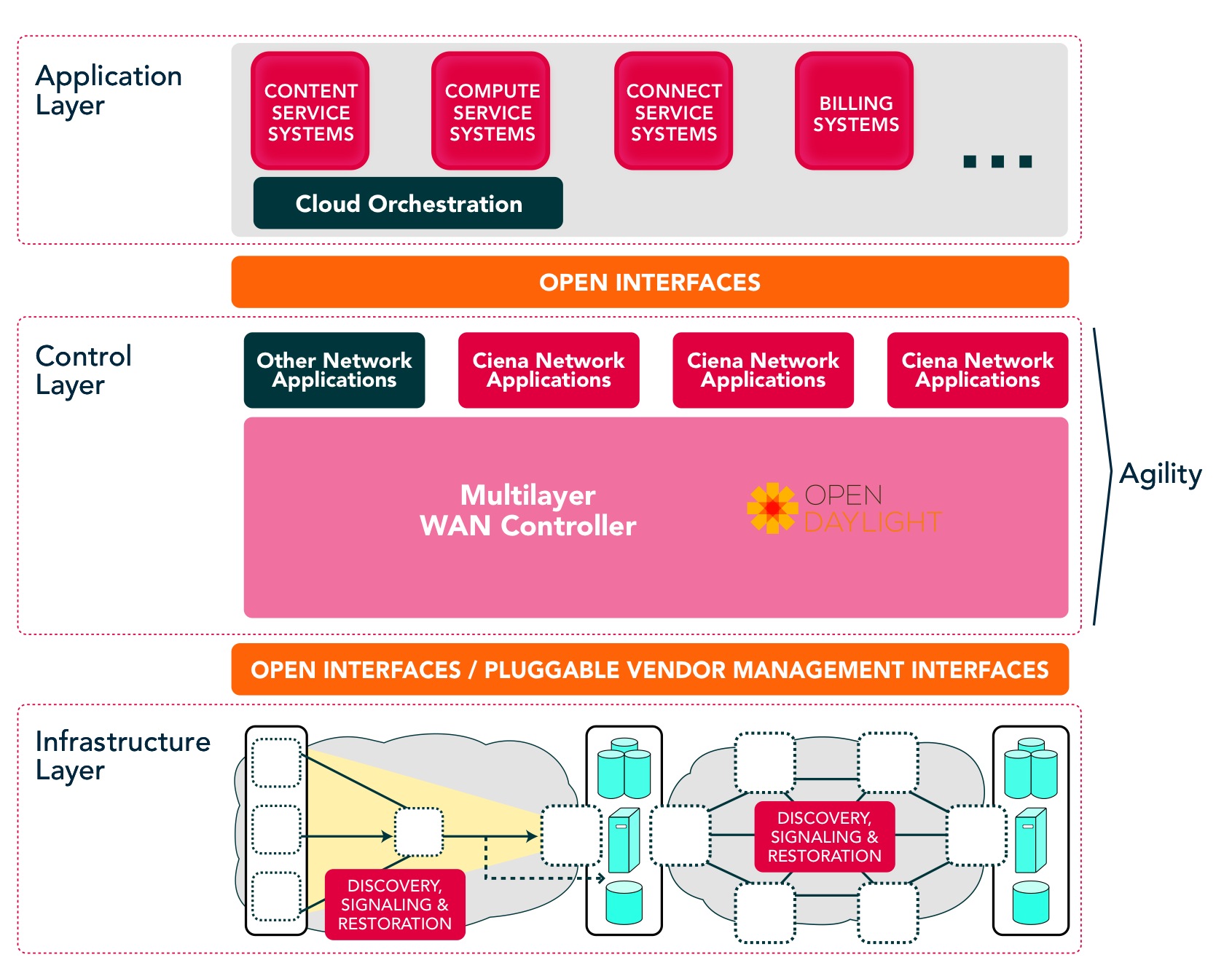
Ciena's announced Agility software portfolio, which resides in the network management centre running on standard computing hardware, includes:
- A multi-layer software-defined networking (SDN) controller
- Three networking applications: Navigate, Protect and Optimize. Navigate is used to determine the ideal route for a connection, Protect is a restoration path calculator used to protect against network failures, while Optimize frees up stranded bandwidth across the network's layers.
- Enhancements to Ciena's existing V-WAN network services module.
Ciena chose to implement the SDN controller using the OpenDaylight framework to ensure it will work with other vendors' equipment, while third-party developers writing software using the open source framework will benefit from Ciena's apps and platforms.
"We think the market is evolving so quickly that there isn't any one company that can deal with all the things end users will require," says Mock. "This idea of openness is not so much a nice thing as a requirement; it is going to require the cooperation of multiple vendors to build the kind of network that service providers are going to require."
At the top of the SDN architecture is the application layer, which resides above the control layer that, in turn, oversees the underlying infrastructure layer where the equipment resides. Agility's three network applications sit above the SDN controller while still being part of the control layer (see diagram).
This idea of openness is not so much a nice thing as a requirement; it is going to require the cooperation of multiple vendors to build the kind of network that service providers are going to require
End users can now control their network requirements using the V-WAN orchestrator. Ciena has added monitoring and control interfaces to enhance V-WAN. End users can now control their networking requirements using a web portal. The operator and the end user also have improved visibility about the network's health due to the performance monitoring. More plug-in adaptors have also been added to interface the platform to more equipment, while service providers can use V-WAN to set up VPNs for multiple users.
"[V-WAN] provides for an outside application to control the network directly," says Mock. "A service provider doesn't have to change the connectivity map, or establish or take down a connection."
V-WAN sits between the SDN's upper two layers, allowing applications in the applications layer to access the SDN controller. Ciena has already detailed work with Brocade that allows the vendor's data centre orchestrator - the Application Resource Broker (ARB) used to set up storage and compute resources - can request cloud resources in a remote data centre when demand can no longer be fulfilled in the existing one. Ciena has provided a plug-in adapter between Brocade's orchestrator and V-WAN to establish a connection between the data centres to allow workload transfers as required.
V-WAN will also be used by Equinix to allow end users to connect its data centres with other cloud computing providers. "If an Equinix end user today wants to run part of their applications on Amazon, they can do that, and if tomorrow they have a different set of applications that they want to run on Microsoft, they can do that as well, without changing a real lot of their physical infrastructure," says Mock.
The Agility software portfolio is Ciena's own work, developed prior to its strategic partnership with Ericsson that was announced earlier this year. However, the two companies are now working to add Ericsson's layer-3 capability to the OpenDaylight SDN controller. Mock says the enhanced SDN controller will be available in 2015.
Meanwhile, the V-WAN product is available now. The SDN controller and the three network applications are being trialled and will be available later this year.
Ciena launches the 8700 metro Ethernet-over-WDM platform
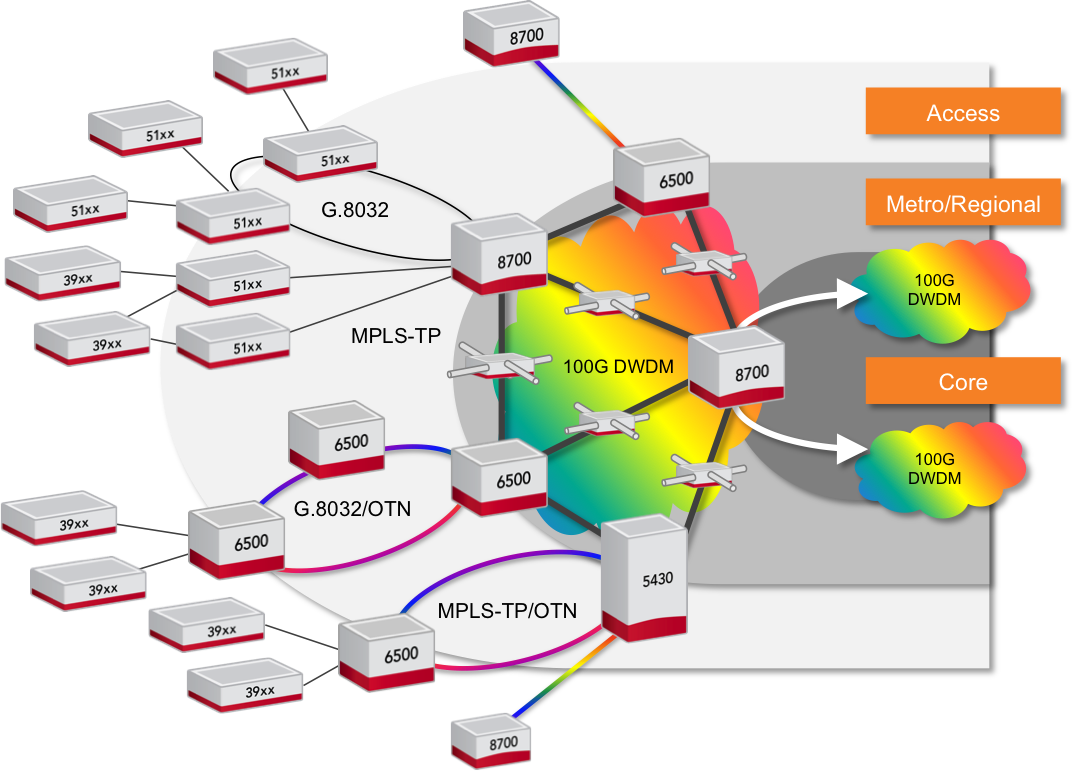
- The 8700 Packetwave is an Ethernet-over-DWDM platform
- The 8700 is claimed to deliver double the Ethernet density while halving the power consumption and space required.
 Source: Ciena
Ciena has launched the 8700 Packetwave platform that combines high-capacity Ethernet switching with 100 Gigabit coherent optical transmission.
The platform is designed to cater for the significant growth in metro traffic, estimated at between 30 and 50 percent each year, and the ongoing shift from legacy to Ethernet services.
 Brian Lavallée
Analysts predict that by 2017, 75 percent of the overall bandwidth in the metro will be Ethernet-based.
"In the major markets we compete in, our customers are telling us that Ethernet has already surpassed 75 percent," says Brian Lavallée, director of technology & solutions marketing at Ciena.
"What you're seeing is a trend towards convergence," says Ray Mota, managing partner at ACG Research. "The economics make sense and it should have happened but organisational issues have caused the delay."
Many service providers have two separate groups, one for packet and another for transport. "Now, many service providers are merging the two groups, feeling the time is right, so you will see more and more converge products get more penetration," says Mota.
The 8700 can be viewed as a slimmed-down packet-optical transport system (P-OTS), tailored for Ethernet. The platform's packet features include Ethernet and MPLS-TP for connection-oriented Ethernet, while optically it has 100 Gigabit coherent WDM.
"This is a more specialised machine hitting this target spot in the aggregation networks," says Michael Howard, co-founder and principal analyst, carrier networks at Infonetics Research. "It doesn't need much MPLS, it doesn’t need OTN switching, and it doesn’t need SDH/TDM."
The main applications for the 8700 include aggregation of telcos' business services, data centre interconnect, wireless backhaul, and the distribution of cable operators' Ethernet traffic. "It [the 8700] is a good product for edge aggregation, where the bandwidth is getting cranked up," says Howard. "I see it as an Ethernet-over-DWDM platform, performing the aggregation on the customer side and the fan-in on the upstream side."
 Ray MotaTwo Packetwave platforms have been announced: an 800 Gigabit full-duplex switching capacity platform and a 2-Terabit one. The platform's line cards support 10, 40 and 100 Gigabit client-side interfaces while a line-side card has two 100 Gigabit coherent interfaces based on Ciena's WaveLogic DSP-ASIC technology.
Ciena says the platform will support double the capacity when it introduces WaveLogic devices that deliver 100 and 200 Gig rates. "It has been tested," says Lavallée. "It is just a matter of changing the cards."
The 8700 is claimed to deliver double the Ethernet density compared to competing platforms, while halving the power consumption and space required. "Given it is a new category of product, we don't have a direct competitor," says Lavallée. "But when we say half the power and space, that is the average across these multiple products from competitors."
Lavallée would not detail the competitor platforms used in the comparison but Mota cites Alcatel-Lucent's 7450 and 7950 platforms, Juniper's MX and PTX platforms and Cisco's ASR 9000 as the ones likely used.
Using merchant silicon for the Ethernet switching has helped achieve greater density, as has using Ciena's own WaveLogic DSP-ASIC. "The further development we have done on our [WaveLogic] coherent optical processor does give us significant savings, not just in power but also real-estate," says Lavallée.
Being a layer-2 platform, the 8700 has none of the packet processing and specialist memory hardware requirements associated with layer-3 IP routers, also benefitting the platform's overall power consumption.
 Michael HowardCiena stresses that P-OTS is not going away and that it will continue to deliver significant value for certain customers. "The biggest concern of customers is complexity," says Lavallée. "There are a lot of ways of reducing complexity in your network and some customers believe that is Ethernet-over-dense WDM."
ACG's Mota sees the launch of the 8700 as an important move by Ciena. "The metro is the hot area that needs transitioning," he says. "Many of the traditional core requirements are moving to the metro so the timing of Ciena playing in this space with a converge platform could be strategic, providing they partner well with companies like Ericsson and the network functions virtualisation software providers."
Lavallée says that with the advent of software-defined networking and the applications that make use of the technology, there is an underlying shift from the hardware towards software. But he dismisses the notion that hardware is becoming less important.
"What is lost in this whole discussion is that if you don't have a programmable piece of hardware below, you can't write these apps," says Lavallée. The 8700 hardware is programmable and there are open interfaces to access it, he says: "We have a lot of knobs and switches that the software can use."
Further reading
Paper: Ciena 8700 Packetwave platform, click here
OFC 2014 industry reflections - Part 2

The high cost of 100 Gigabit Ethernet client modules has been a major disappointment to me as it has slowed adoption
Joe Berthold, Ciena
Joe Berthold, vice president of network architecture at Ciena.
OFC 2014 was another great event, with interesting programmes, demonstrations and papers presented. A few topics that really grabbed my interest were discussions around silicon photonics, software-defined networking (SDN) and 400 Gigabit Ethernet (GbE).
The intense interest we saw at last year’s OFC around silicon photonics grew this year with lots of good papers and standing-room-only sessions. I look forward to future product announcements that deliver on the potential of this technology to significantly reduce cost of interconnecting systems over modest distances. The high cost of 100GbE client modules has been a major disappointment to me as it has slowed adoption.
Another area of interest at this year’s show was the great deal of experimental work around SDN, some more practical than others.
I particularly liked the reviews of the latest work under the DARPA-sponsored CORONET programme, whose Phase 3 focused on SDN control of multi-layer, multi-vendor, multi-data centre cloud networking across wide area networks.
In particular, there were talks from three companies I noted: Anne Von Lehman of Applied Communication Sciences, the prime contractor, provided a good program overview; Bob Doverspike of AT&T described a very extensive testbed using equipment of the type currently deployed in AT&T’s network, as well as two different processing and storage virtualisation platforms; and Doug Freimuth of IBM described its contributions to CORONET including an OpenStack virtualisation environment, as well as other IBM distributed cloud networking research.
All the action on rates above 100 Gig lies with the selection of client signals. 400 Gig seems to have the major mindshare but there are still calls for flexible rate clients and Terabit clients.
One thing I enjoyed about these talks was that they described an approach to SDN for distributed data centre networking that is pragmatic and could be realised soon.
I also really liked a workshop held on the Sunday on the question whether SDN will kill GMPLS. While there was broad consensus that GMPLS has failed in delivering on its original turn-of-the-century vision of IP routers control of multi-layer, multi-domain networks, most speakers recognised the value distributed control planes have in simplifying and speeding the control of single layer, single domain networks.
What I took away was that single layer distributed control planes are here to stay as important network control functions, but instead will work under the direction of an SDN network controller.
As we all know, 400 Gigabit dense wavelength division multiplexing (DWDM) is here from the technology perspective, but awaiting standardisation of the 400 Gig Ethernet signal from the IEEE, and follow-on work by the ITU-T on signal mapping to OTN. In fact, from the perspective of DWDM transmission systems, 1 Terabit-per-second systems can be had for the asking.
All the action on rates above 100 Gig lies with the selection of client signals. 400 Gig seems to have the major mindshare but there are still calls for flexible rate clients and Terabit clients.
One area that received a lot of attention, with many differing points of view, was the question of the 400GbE client. As the 400GbE project begins soon in the IEEE, it is time to take a lesson from the history of the 100 Gig client modules and do better.
Let us all agree that we don’t need 400 Gig clients until they can do better in cost, face plate density, and power dissipation than the best 100 Gig modules that will exist then.
The first 100 Gig DWDM transceivers were introduced in 2009. It is now 2014 and 100 Gig is the transmission rate of choice for virtually all high capacity DWDM network applications, with a strong economic value proposition versus 10 Gig. Yet the industry has not yet managed to achieve cost/bit parity between 100 Gig and 10 Gig clients - far from it!
Last year's OFC, we saw many show floor demonstrations of CFP2 modules. They promise lower costs, but evidence of their presence in shipping products is still lacking. At the exhibit this year we saw 100 Gig QSFP28 modules. While progress is slow, the cost of the 100 Gig client module continues to result in many operators favouring 10 Gig handoffs to their 100 Gig optical networking systems.
Let us all agree that we don’t need 400 Gig clients until they can do better in cost, face plate density, and power dissipation than the best 100 Gig modules that will exist then. At this juncture the 100 Gig benchmark we should be comparing 400 Gig to is a QSFP28 package.
Lastly, last year we heard about the launch of an OIF project to create a pluggable analogue coherent optical module. There were several talks that referenced this project, and discussed its implications for shrinking size and supporting higher transceiver card density.
Broad adoption of this component will help drive down costs of coherent transceivers, so I look forward to its hearing about its progress at OFC 2015.
Daryl Inniss, vice president and practice leader, Ovum.
There was no shortage of client-side announcements at OFC and I’ve spent time since the conference trying to organise them and understand what it all means.
I’m tempted to say that the market is once again developing too many options and not quickly agreeing on a common solution. But I’m reminded that this market works collaboratively and the client-side uncertainty we’re seeing today is a reflection of a lack of market clarity.
Let me describe three forces affecting suppliers:
The IEEE 100GBASE-xxx standards represent the best collective information that suppliers have. Not surprisingly, most vendors brought solutions to OFC supporting these standards. Vendors sharpened their products and focused on delivering solutions with smaller form factors and lower power consumption. Advances in optical components (lasers, TOSAs and ROSAs), integrated circuits (CDRs, TIAs, drivers), transceivers, active optical cables, and optical engines were all presented. A promising and robust supply base is emerging that should serve the market well.
A second driver is that hyperscale service providers want a cost-effective solution today that supports 500m to 2km. This is non-standard and suppliers have not agreed on the best approach. This is where the market becomes fragmented. The same vendors supporting the IEEE standard are also pushing non-standard solutions. There are at least four different approaches to support the hyperscale request:
- Parallel single mode (PSM4) where an MSA was established in January 2014
- Coarse wavelength division multiplexing—using uncooled directly modulated lasers and single mode fibre
- Dense wavelength division multiplexing—this one just emerged on the scene at OFC with Ranovus and Mellanox introducing the OpenOptics MSA
- Complex modulation—PAM-8 for example and carrier multi-tone.
Admittedly, the presence of this demand disrupts the traditional process. But I believe the suppliers’ behavior reflects their unhappiness with the standardisation solution.
The good news is these approaches are using established form factors like the QSFP. And silicon photonic products are starting to emerge. Suppliers will continue to innovate.
Ambiguity will persist but we believe that clarity will ultimately prevail.
The third issue lurking in the background is knowledge that 400 Gig and one Terabit will soon be needed. The best-case scenario is to use 100 Gig as a platform to support the next generation. Some argue for complex modulation as you reduce the number of optical components thereby lowering cost. That’s good but part of the price is higher power consumption, an issue that is to be determined.
Part of today’s uncertainty is whether the standard solution is suitable to support the market to the next generation. Sixteen channels at 25 Gig is doable but feels more like a stopgap measure than a long-term solution.
These forces leave suppliers innovating in search of the best path forward. The approaches and solutions differ for each vendor. Timing is an issue too with hyperscale looking for solutions today while the mass market may be years away.
We believe that servers with 25 Gig and/ or 40 Gig ports will be one of the catalysts to drive the mass market and this will not start until about 2016. Meanwhile, each vendor and the market will battle for the apparent best solution to meet the varying demands. Ambiguity will persist but we believe that clarity will ultimately prevail.
Ciena uses software to dip into the photonic layer
Ciena has enhanced its control plane and line elements to enable software to control the optical networking layer. The additions are part of Ciena's OPn network architecture evolution to enable greater visibility and automation. "It is about putting software into a system to allow you to program the photonic line," says Michael Adams, vice president of product & technology marketing at Ciena.

"For an SDN controller to control a photonic line, we need to present it as a programmable layer. The infrastructure is now there to be programmed."
Michael Adams, Ciena
Dubbed WaveLogic Photonics, the enhancements address the optical line system, made up of Ciena's WaveLogic coherent module, amplifier and reconfigurable optical add/ drop multiplexer (ROADM) elements. Ciena's ROADM is colourless and directionless and supports flexible-grid lightpaths, while the contentionless attribute will be added in the second half of the year.
Making the optical layer programmable is tricky. The OTN, Ethernet and IP networking layers above the line system are digital, lending themselves to software control. The optical layer, however, is not. Its performance is determined by linear and non-linear fibre transmission effects and parameters such as the optical signal-to-noise ratio.
"We believe the photonic line is equally important to be programmed, but the challenge has been that it is an analogue domain," says Adams.
To this aim, Ciena's WaveLogic Photonics introduces three changes:
- The OneConnect Intelligent Control Plane has been extended to include the photonic layer.
- Software-based line monitoring has been added to Raman to simplify amplifier deployment.
- Network analytics has been introduced to identify faults and optical signal loss.
By extending the OneConnect Control Plane to the photonic level, service providers can offer customers more tailored service-level agreements (SLAs). Customers that want protection against double fibre cuts can add automated optical restoration. After the first cut, the 50-millisecond OTN layer restoration kicks in. If a second cut occurs, OneConnect will restore the network in tens of seconds. At present, a truck roll and manual repair is needed after the second cut and that can take hours to repair. "The combination of the two [OTN and optical restoration] gives you a much more flexible system of SLAs that can be offered," says Adams.
The second line system enhancement, dubbed Smart Raman, adds a software-based optical time-domain reflectometer (OTDR) to Ciena's hybrid Raman/ EDFA amplifiers to simplify their deployment. The OTDR enables the amp to monitor and characterise the line.
"The Raman provides simple and controlled turn-up and will not turn on until it has checked that the surrounding fibre does not have any high losses," says Adams. Such automation replaces the careful manual configuration otherwise required when deploying high-powered Raman amps.
Ciena is also using the line data collected by the OTDR to provide network analytics. The line's condition can be plotted over time, helping identify any degradation in line elements. The analytics will also locate faults across fibre spans without requiring a truck roll. "Now from the NOC [network operations centre], that [fault] visibility is within 3m," says Adams.
Comcast has already used Smart Raman and the analytics as part of a Terabit trial conducted with Ciena. The cable operator located signal loss points on the line. "Comcast was able to recover several dBs of margin on that fibre," says Adams. "With 16-QAM used for the Terabit trial, they were able to go much farther; they achieved 1,000km even on marginal fibre." Ciena will also introduce advanced 16-QAM signaling in the second half of the year.
Ciena says WaveLogic Photonics should be viewed as enhancing the OneConnect control plane at the OTN and optical levels, while paving the way for software-defined networking (SDN) and applications-driven automation.
"For an SDN controller to control a photonic line, we need to present it as a programmable layer," says Adams. "The infrastructure is now there to be programmed."
The Smart Raman and analytics software is available and shipping in volume, says Ciena, while the photonic additions to the control plane are being trialled by customers and will be available in several weeks as part of the Release 10.0 software for Ciena's 6500 platform.
See also:
Ovum: Ciena launches WaveLogic Photonics, click here