

OFC highlights a burgeoning coherent pluggable market

A trend evident at the OFC show earlier this month was the growing variety of coherent pluggable modules on display.
Whereas a coherent module maker would offer a product based on a coherent digital signal processor (DSP) and a basic design and then add a few minor tweaks, now the variety of modules offered reflects the growing needs of the network operators.
Acacia, part of Cisco, announced two coherent pluggable to coincide with OFC. The Bright 400ZR+ QSFP-DD pluggable form factor is based on Acacia’s existing 400ZR+ offering. It has a higher transmit power of up to 5dBm and includes a tunable filter to improve the optical signal-to-noise ratio (OSNR) performance.
Acacia’s second coherent module is the fixed wavelength 400-gigabit 400G ER1 module designed for point-to-point applications.
“I can understand it being a little bit confusing,” says Tom Williams, vice president of marketing at Acacia. “We have maybe five or six configurations of modules based on the same underlying DSP and optical technology.”
Bright 400ZR+
The Bright 400ZR+ pluggable addresses a range of network architectures using the high-density QSFP-DD form factor, says Williams.
“Before you had to use the [larger] CFP2-DCO module, now we are bringing some of the functionality into the -DD,” he says. “The Bright 400ZR+ doesn’t replace the CFP2-DCO but it does move us closer to that.” As such, the module also supports OTN framing.
The Bright 400ZR+ has a higher launch power than the optical specification of the OpenZR+ standard but supports the same protocol so it can operate with OpenZR+ compliant pluggables.
The module uses internal optical amplification to achieve the 5dB launch power. The higher launch power is designed for various architectures and ROADM configurations.
“It is not that it allows a certain greater reach so much as the module can address a wider range of applications,” says Williams. “When you talk about colourless, directionless or colourless-directionless-contentionless (CDC-) reconfigurable optical add-drop multiplexing (ROADM) architectures, these are the types of applications this opens up.”
The integrated tunable filter tackles noise. In colourless ROADM-based networks, because the optical multiplexing occurs without filtering, the broadband out-of-band noise can raise the overall noise floor. This then decreases the overall OSNR. Amplification also increases the noise floor.
The tunable filter is used to knock down the overall noise floor, thereby improving the transmit OSNR.
The output power of the Bright 400ZR+ is configurable. The 5dBm launch power is used for ROADMs with array-waveguide gratings while for colourless multiplexing the tunable filter is used, reducing the output power to just above 1dBm.
“You are seeing an anchoring of interoperability that operators can use and then you are seeing people build on top of that with enhancements that add value and expand the use cases,” says Williams.
400 gigabits over 40km
As part of the OIF industry organisation’s work that defined the 400ZR specification, a 40km point-to-point unamplified link was also included. Acacia’s 400G ER1 is such an implementation with the ‘ER’ referring to extended reach, which IEEE defines as 40km.
“At every data rate there has always been an application for these ER reaches in access and enterprise,” says Williams. “The link is just a fibre, it’s like the 10km LR specification, but this goes over 40km.”
The ER1 has been designed to reduce cost and uses a fixed laser. ”We are not doing OSNR testing, it is based on a power-limited 40km link,” says Williams.
The OIF standard uses concatenated forward-error correction (CFEC) while Acacia employs its openFEC (oFEC) that enhances the reach somewhat.
Shipment updates
Acacia also reported a significant ramp in the shipment of its pluggables that use its Greylock coherent DSP.
It has shipped over 50,000 such pluggables, 20,000 alone shipped in Cisco’s last (second) fiscal quarter. “This is being driven by the expected early adopters of 400ZR, as well as a range of other applications,” says Williams.
Acacia says it has also shipped over 100,000 Pico DSP ports. Each AC1200 multi-haul module has two such ports.
The AC1200 sends up to 1.2 terabits over two wavelengths using Acacia’s 7nm CMOS Pico DSP. The multi-haul module is being used in over 100 networks while three of the four largest hyperscalers use the technology.
Acacia also demonstrated at OFC its latest multi-haul module announced last year, a 1.2 terabits single-wavelength design that uses its latest 5nm CMOS Jannu DSP and which operates at a symbol rate of up to 140 gigabaud.
Acacia says samples of its latest multi-haul module that uses its own Coherent Interconnect Module 8 (CIM 8) form factor will be available this year while general availability will be in 2023.
Post-deadline
Williams also presented a post-deadline paper at OFC.
The work outlined was the demonstration of the optical transmission of 400 Gigabit Ethernet flows over a 927km link. The trial comprised transmission through several networks and showed the interoperability of 400-gigabit QSFP-DD and CFP2 modules.
The work involved Orange Labs, Lumentum, Neophotonics, EXFO and Acacia.


Telefónica tackles video growth with IP-MPLS network
- Telefónica’s video growth in one year has matched nine years of IP traffic growth
- Optical mesh network in Barcelona will use CDC-ROADMs and 200-gigabit coherent line cards
Telefónica has started testing an optical mesh network in Barcelona, adding to its existing optical mesh deployment across Madrid. Both mesh networks are based on 200-gigabit optical channels and high-degree reconfigurable add-drop multiplexers (ROADMs) that are part of the optical infrastructure that underpins the operator’s nationwide IP-MPLS network that is now under construction.
 Maria Antonia CrespoThe operator decided to become a video telco company in late 2014 to support video-on-demand and over-the-top streaming video services.
Telefónica realised its existing IP and aggregation networks would not be able to accommodate the video traffic growth and started developing its IP-MPLS network.
“What we are seeing is that the traffic is growing very quickly,” says Maria Antonia Crespo, IP and optical networking director at Telefónica. “In one year we are getting the same
figures as we got from internet traffic in the last nine years.”
The operator is rolling out the IP-MPLS network across Spain. Juniper Networks and Nokia are the suppliers of the IP router equipment, while Huawei and Nokia were chosen to supply the optical networking equipment.
IP-MPLS
Telefónica set about reducing the number of layers and number of hops when designing its IP-MPLS network. “At each hop, we have to invest money if we want to increase capacity,” says Crespo.
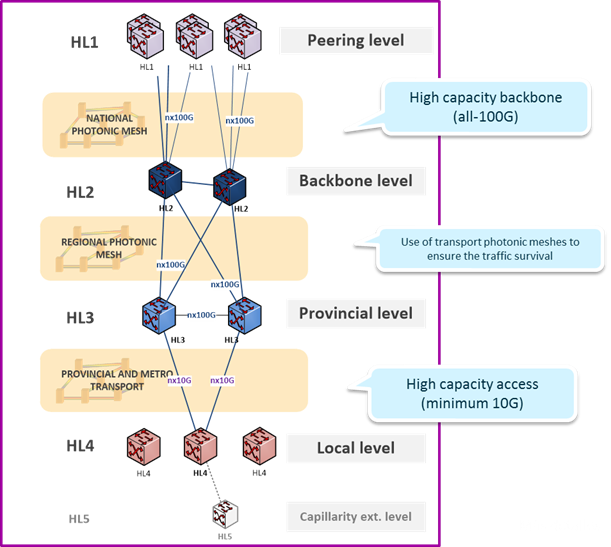
The result is an IP-MPLS network comprising four layers (see diagram). The uppermost Layer 1, dubbed HL1, connects the network to the internet world, while HL2 is a backbone transit layer. The HL3 layer is also a transit layer but at the provincial level. Spain is made up of 52 provinces. HL4 is where the services will reside, where Telefonica will deliver such services as Layer 2 and Layer 3 virtual private networks.
Between HL1 and HL2 is a national GMPLS-based photonic mesh, says Crespo, and between HL3 and HL4 there are the metro mesh networks. “Now we are deploying two GMPLS-based mesh networks, in Madrid and Barcelona,” she says. “Then, in the rest of the country, we are deploying [optical] rings.”
Systems requirements
Telefónica says it had several requirements when choosing the optical transport equipment, requirements common to both its backbone and regional networks.
One is the need to scale capacity at 10 gigabits and 100 gigabits, while network availability and robustness are also key. Telefónica says its network is designed to withstand two or more simultaneous fibre failures. “We have long experience with the GMPLS control plane to support different fibre impairments in the network,” says Alberto Colomer, optical technology manager at Telefónica.
The operator also wants its equipment to support high-speed interfaces and more granular rates to allow it to transition away from legacy traffic such as SDH and 1GbE. Operational improvements are another requirement: Telefónica wants to reduce the manual intervention its network needs. Optical time-domain reflectometers (OTDR) are being integrated into the network to monitor the fibre, as is the ability to automatically equalise the different optical channels.
 Alberto ColomerLastly, Telefónica is looking to reduce its capital expenditure and operational expense. It is deploying flexible rate 200-gigabit transponders in its Barcelona and Madrid networks and the same line cards will support 400-gigabit and even 1 terabit channels in future, as well as flexible grid to support the most efficient use of a fibre’s spectrum.
The 200-gigabit transponders use 16-quadrature amplitude modulation (16-QAM). Such transponders have enough reach to span each of the two cities but Colomer says Telefónica is still studying how many ROADM stages the 16-QAM transponders can cross.
It is like a pilot changing the engines while flying a plane
The ROADMs Telefónica is deploying in Madrid are directionless and are able to support up to 20 degrees. “You need some connectivity inside the mesh but also the mesh has to be connected to rings that cover all the counties around Madrid,” says Colomer.
Barcelona will be the first location where the ROADMs will also be colourless and contentionless (CDC-ROADMs). “We need to understand in a better way what are the advantages that come with that functionality,” says Colomer.
Telefónica has deployed Huawei’s Optix OSN 9800 platform in Madrid while in Barcelona Nokia’s 1830 Photonic Service Switch with the latest PSE-2 Coherent DSP-ASIC technology is being deployed.
Nokia’s PSS-1830 is designed to support the L-band as well as the C-band but Telefonica does not see the need for the L-band in the near future. “We are going in the direction of increasing capacity per channel: 400-gigabit channels and one terabit channels,” says Colomer. By deploying a photonic mesh and high-degree ROADMs, it will also be possible to increase capacity on a specific link by adding a fibre pair.
Status
The mesh in Madrid is already completed while Telefónica is deploying optical rings around Barcelona while it tests the contentionless ROADMs. These deployments are aligned with the IP-MPLS deployment, says Crespo, which is expected to be completed by 2018.
Crespo says the nationwide IP-MPLS rollout is a challenge. The deployment involves learning new technology that needs to be deployed alongside its existing network. "My boss likens it to a pilot changing the engines while flying a plane," says Crespo. "We are testing in the labs, duplicating it [the network], and migrating the traffic without impacting the customer."
Ciena enhances its 6500 packet-optical transport family
"The 6500 T-Series is a big deal as Ciena can offer two different systems depending on what the customer is looking for," says Andrew Schmitt, founder and principal analyst of market research firm, Cignal AI.
 Helen XenosIf customers want straightforward transport and the ability to reach a number of different distances, there is the existing 6500 S-series, says Schmitt. The T-series is a system specifically for metro-regional networks that can accommodate multiple traffic types – OTN or packet.
"It has very high density for a packet-optical system and offers pay-as-you-grow with CFP2-ACO [coherent pluggable] modules," says Schmitt.
Ciena says the T-series has been developed to address new connectivity requirements service providers face. Content is being shifted to the metro to improve the quality of experience for end users and reduce capacity on backbone networks. Such user consumption of content is one factor accounting for the strong annual 40 percent growth in metro traffic.
According to Ciena, service providers have to deploy multiple overlays of network elements to scale capacity, including at the photonic switch layer, because they need more than 8-degree reconfigurable optical add/ drop multiplexers (ROADMs).
Operators are looking for a next-generation platform for these very high-capacity switching locations to efficiently distribute content
But overlays add complexity to the metro network and slow the turn-up times of services, says Helen Xenos, director, product and technology marketing at Ciena: "Operators are looking for a next-generation platform for these very high-capacity switching locations to efficiently distribute content."
U.S. service provider Verizon is the first to announce the adoption of the 6500 T-series to modernise its metro and is now deploying the platform. "Verizon is dealing with a heterogeneous network in the metro with many competing requirements," says Schmitt. "They don’t have the luxury of starting over or specialising like some of the hyper-scale transport architectures."
The T-series, once deployed, will handle the evolving requirements of Verizon's network. "Sure, it comes with additional costs compared with bare-bones transport but my conversation with folks at Verizon would indicate flexibility is worth the price," says Schmitt.
Ciena has over 500 customers in 50 countries for its existing 6500 S-series. Customers include 18 of the top 25 communications service providers and three of the top five content providers.
Xenos says an increasing number of service providers are interested in its latest platform. The T-series is part of six request-for-proposals (RFPs) and is being evaluated in several service providers' labs. The 6500 T-series will be generally available this month.
6500 T-series
The existing 6500 S-series family comprises four platforms, from the 2 rack-unit (RU) 6500-D2 chassis to the 22RU 6500-S32 that supports Ethernet, time-division multiplexed traffic and wavelength division multiplexing, and 3.2 terabit-per-second (Tbps) packet/ Optical Transport Network (OTN) switching.
The two T-series platforms are the half rack 6500-12T and the full rack 6500-24T. The cards have been upgraded from 100-gigabit switching per slot to 500-gigabit per slot.
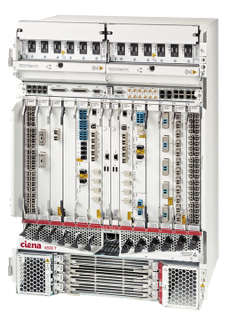 The 6500-T12 has 12 service slots which house either service interfaces or photonic modules. There are also 2 control modules. Shown at the base of the chassis are four 500 Gig switching modules. Source: Ciena
The 500 gigabit switching per slot means the 6500-12T supports 6 terabits of switching capacity while the -24T will support 12 terabits by year end. The platforms have been tested and will support 1 terabit per slot, such that the -24T will deliver the full 24 terabit. Over 100 terabit of switching capacity will be possible in a multiple-chassis configuration, managed as a single switching node.
The latest platforms can use Ciena's existing coherent line cards that support two 100 gigabit wavelengths. The T-Series also supports a 500-gigabit coherent line card with five CFP2-ACOs coupled with Ciena's WaveLogic 3 Nano DSP-ASIC.
"We will support higher-capacity wavelengths in a muxponder configuration using our existing S-series," says Xenos. "But for switching applications, switching lower-speed traffic across the shelf onto a very high-capacity wavelength, this is something that the T-series would be used for."
The T-series also adds a denser, larger-degree ROADM, from an existing 6500 S-series 8-degree to a 16-degree flexible grid, colourless, directionless and contentionless (CDC) design. Xenos says the ROADM design is also more compact such that the line amplifiers fit on the same card.
"The requirements of this platform is that it has full integration of layer 0, layer 1 and layer 2 functions," says Xenos.
The 6500 T-series supports open application programming interfaces (APIs) and is being incorporated as part of Ciena's Emulation Cloud. The Emulation Cloud enabling customers to test software on simulated network configurations without requiring 6500 hardware and is being demonstrated at OFC 2016.
The 6500 is also being integrated as part of Ciena's Blue Planet orchestration and management architecture.
Is the tunable laser market set for an upturn?
Part 2: Tunable laser market
"The tunable laser market requires a lot of patience to research." So claims Vladimir Kozlov, CEO of LightCounting Market Research. Kozlov should know; he has spent the last 15 years tracking and forecasting lasers and optical modules for the telecom and datacom markets.
 Source: LightCounting, Gazettabyte
The tunable laser market is certainly sizeable; over half a million units will be shipped in 2014, says LightCounting. But the market requires care when forecasting. One subtlety is that certain optical component companies - Finisar, JDSU and Oclaro - are vertically integrated and use their own tunable lasers within the optical modules they sell. LightCounting counts these as module sales rather than tunable laser ones.
Another issue is that despite the development of advanced reconfigurable optical add/ drop multiplexers (ROADMs) and tunable lasers, the uptake of agile optical networking has been limited.
"Verizon is bullish on getting the next generation of colourless, directionless and contentionless ROADMS to reconfigure the network on-the-fly," says Kozlov. "But I'm not so sure Verizon is going to be successful in convincing the industry that this is going to be a good market for [ROADM] suppliers to sell into."
Reconfigurability helps engineers at installations when determining which channels to add or drop, but there is little evidence of operators besides Verizon talking about using ROADMS to change bandwidth dynamically, first in one direction and then the other, he says.
Another indicator of the reduced status of tunable lasers is NeoPhotonics's intention to purchase Emcore's tunable external cavity laser as well as its module assets for US $17.5 million. Emcore acquired the laser when it bought Intel's optical platform division for $85 million in 2007, while Intel acquired it from New Focus in 2002 for $50 million. NeoPhotonics has also spent more in the past: it bought Santur's tunable laser for $39 million in 2011.
"There was so much excitement with so many players [during the optical bubble of 1999-2000], the market was way too competitive and eventually it drove vendors to the point where they would prefer to sell the business for pennies rather than keep it running," says Kozlov. "Emcore has been losing money, it is not a highly profitable business." Yet for Kozlov, Emcore's tunable laser is probably the best in the business with its very narrow line-width compared to other devices.
Tunable laser market
Tunable lasers have failed to get into the mainstream of the industry. "If you look at DWDM, I'm guessing that 70 percent of lasers sold are still fixed wavelength or temperature-tunable over a few wavelengths," says Kozlov. System vendors such as Huawei and ZTE advertise their systems with tunable lasers. "But when we asked them how they are using tunable lasers, they admitted that the bulk of their shipments are fixed-wavelength devices because whatever little they can save on cost, they will."
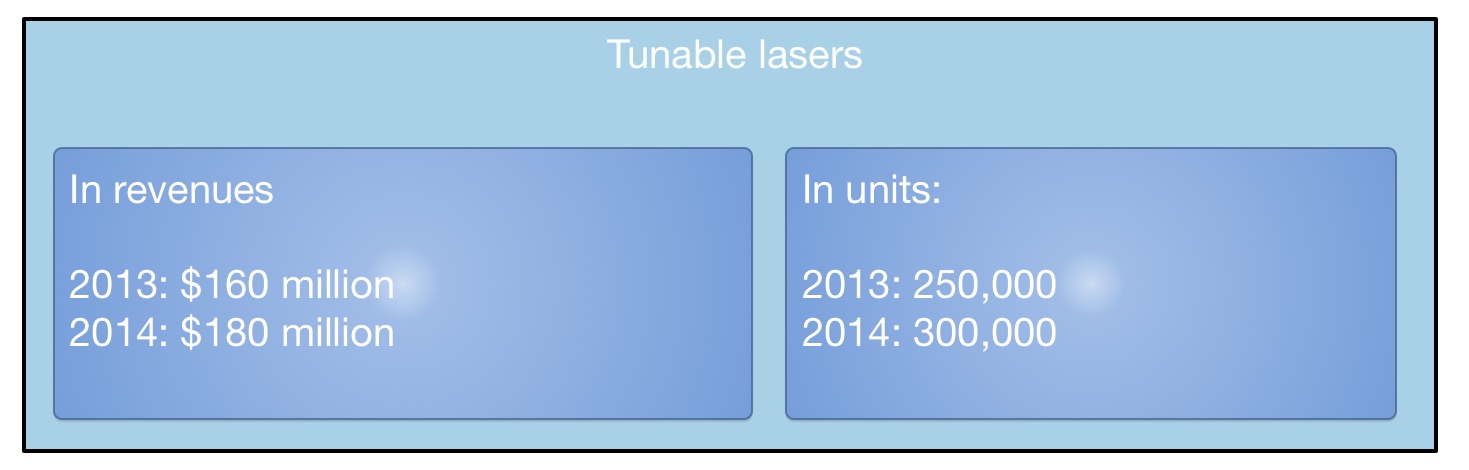
LightCounting valued the 2013 tunable laser market at $160 Million, growing to $180 Million in 2014. This equates to 250,000 units sold in 2013 and 300,000 units this year. "Most of these are for coherent systems," says Kozlov. The number of tunable lasers sold in modules - mainly XFPs but also SFPs and 300-pin modules - is 250,000 million units. "Half a million units a year; if you look at actual shipments, it is quite a lot," says Kozlov.
What next?
"I'm hoping we are reaching the low point in the tunable laser market as vendors are struggling and sales are at a very low valuation," says Kozlov.
The advent of more complex modulation schemes for 400 Gigabit and greater speed optical transmission, and the adoption of silicon photonics-based modulators for long haul will require higher powered lasers. But so much progress has been made by laser designers over the last 15 years, especially during the bubble, that it will last the industry for at least another decade or two, says Kozlov: "Incremental progress will continue and hopefully greater profitability."
For Part 1: NeoPhotonics to expand its tunable laser portfolio, click here