

100 Gigabit for the metro
The firm claims this is an industry first: a direct-detection-based 100 Gigabit-per-second (Gbps) design using four, 28Gbps channels rather than current 10x10Gbps schemes.

"Data centre operators want to make best use of the fibre insfrastructure and get lower overall cost, footprint and power consumption"
Jörg-Peter Elbers, ADVA Optical Networking
The card, designed for the FSP 3000 platform, delivers a 2.5x greater spectral efficiency compared to 10Gbps dense WDM (DWDM) systems. In turn, the 100Gbps metro card has half the cost of a 100 Gigabit coherent design while requiring half the power and space.
ADVA Optical Networking is using a CFP optical module to implement the 100Gbps metro design. This allows the card to use other CFP-based interfaces such at the IEEE 100 Gigabit Ethernet (GbE) standards. The design also benefits from the economies of scale of the CFP as the module of choice for 100GbE, and from future smaller modules such as the CFP2 and CFP4 being developed as the 100GbE market evolves.
The 100Gbps metro CFP's four, 28Gbps signals are modulated using optical duo-binary. By choosing duo-binary, cheaper 10Gbps optics can be used akin to a 4x10Gbps design. Duo-binary is also more resilient to dispersion than standard on-off keying.
The CFP-based card requires 200GHz of spectrum for each 100Gbps light path. This is 2.5x more spectrally efficient than 10x10Gbps based on 50GHz channel spacings. However, while the design is cheaper, denser and less power hungry than 100Gbps coherent, it has only a quarter of the spectral efficiency of coherent (see chart).
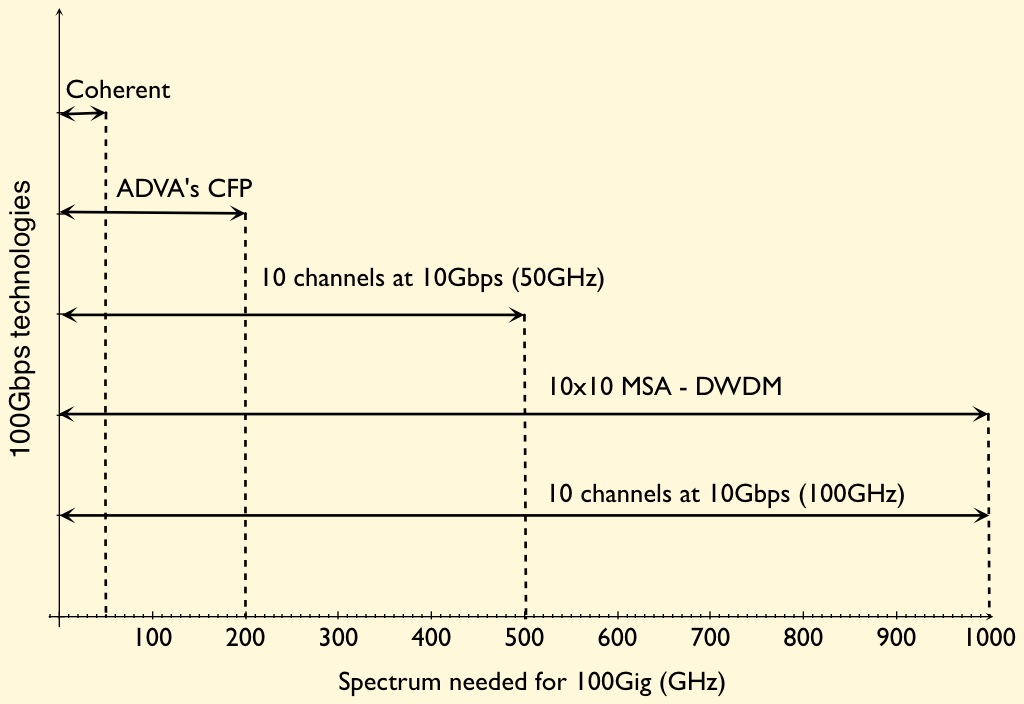
Jörg-Peter Elbers, vice president, advanced technology at ADVA Optical Networking, says duo-binary delivers closer channel spacing such that a doubling in spectral density will be possible in a future design (100Gbps in a 100GHz channel). The 100Gbps metro card supports 500km links using dispersion-compensated fibre.
Non-coherent designs for the metro are starting to appear despite 100Gbps optical transport being in its infancy. Besides ADVA Optical Networking's design, a component vendor is promoting a 100Gbps direct detection DWDM design for the metro. The 10x10 MSA has also announced a DWDM extension that will support four and eight 100Gbps channels.
 The 100G metro card showing the CFP. Source: ADVA Optical Networking
Metro direct-detection also faces competition from system vendors developing coherent designs tailored for the metro.
System vendors, module makers, optical and IC component companies all believe there is a market for lower cost 100Gbps metro transport. This is backed by keen interest from service providers and large content providers that want cheaper 100Gbps interfaces to connect data centres.
Elbers highlights two such applications that will first likely use the 100 Gigabit metro card.
One is connecting the data centres of enterprises that use rented fibre. "They have a multitude of interfaces and services - 10GbE, 8 Gigabit Fibre Channel - and they often rent fibre," says Elbers. "They need to get as much capacity as possible to make the fibre rent worthwhile while being constrained on rack space and power."
The second application is to connect 100GbE-enabled IP routers across the metro. Here service providers may not have heavily loaded DWDM networks and can afford to use a 100Gbps metro link rather than the more spectrally efficient, if more expensive, 100Gbps coherent interface. Equally, such links may be less than 500km while coherent is designed for long-haul links, 1000km or greater.
Elbers says samples of the metro card are available now with volume production beginning at the end of 2011.
Introducing 100G Metro (ADVA Optical video)

100 Gig: Is market expectation in need of a reality check?
 “It could easily be ten to 15 years before we see 100Gbps in a big way on the public network side”
Mark Lutkowitz, Telecom Pragmatics
Infonetics Research, in a published White Paper, says that 100Gbps technology will be adopted at a faster rate than 40Gbps was in its first years, and that the 100Gbps market will begin in earnest from 2013. Indeed this could even be sooner if China, which accounts for half of all 40Gbps ports being shipped, moves to 100Gbps faster than expected.
LightCounting, in its research, describes 100 Gbps optical transmission as a transformational networking technology for carriers, and forecasts that sales of 100Gbps dense wavelength division multiplexing (DWDM) line cards will grow to US $2.3 billion by 2015.
But one research firm, Telecom Pragmatics, is sounding a note of caution. It reports that the 40Gbps market is growing nicely and believes that it could be at least a decade before there is a substantial 100Gbps market.
“100G is not going to kill 40G and, if anything, we are bullish about 40G,” says Mark Lutkowitz, principal at Telecom Pragmatics. “I’m not talking about large volume ramp-up of 40G but there is arguably a ramp-up.”
100G Paradox
One reason, not often mentioned, why 40Gbps is being adopted is that it does not require as many networking changes as when 100Gbps technology is deployed. “There is additional compensation [needed] and it is not clear that all the fibres will work with 100G,” says Lutkowitz.
There is also what he calls the ‘100G Paradox’.
The 100Gbps technology will most likely be considered at pinch-points in the operators’ networks. Yet these are the same network pinch-points that were first upgraded to 10Gbps. As a result they are likely to have legacy DWDM systems such that upgrading to 100Gbps is a considerable undertaking. “It is questionable whether these systems can even work with 100G,” he says.
"We really think that 40G should be getting a lot more respect than it is getting”
”When you look at service providers they are willing to put up with a whole amount of pain before they buy something, and they will certainly not forklift electronics or fibre - they will only do that as a last resort.” Another attraction of 40Gbps for the operators is its growing maturity - it is a technology that has been available for several years.
Costs
Telecom Pragmatics also dismisses the argument made by component vendors that the market will move to 100Gbps especially if the cost-per-bit of 100G technology declines faster than expected.
“The first cost [point] is ten times 10G and really you need to get to something like six or seven times [the cost of] 10G before you consider 100G,” says Lutkowitz. But that is not the sole cost. Network protection is needed which means a second system and there are additional networking and operational costs associated with 100Gbps.
Moreover, to whatever extent 40G is deployed, it will put further pressure on 100Gbps as 40Gbps prices decline. “In the 10G market, prices continued to decline and that precluded 40G, now you have 40G - to whatever extent there is deployment - precluding 100G,” says Lutkowitz.
“It could easily be 10 to 15 years before we see 100G in a big way on the public network side,” says Lutkowitz. But he stresses that in the datacenter and for the enterprise, demand for 100Gbps technology will be a different story.
Meanwhile Telecom Pragmatics expects further operator trials at 100Gbps as well as new system announcements from vendors. “But we really think that 40G should be getting a lot more respect than it is getting,” says Lutkowitz.
OTN hardware gets the 100 Gigabit treatment
 “The real market demand is for simple systems - the transponder and interfaces to the routers"
Lars Pedersen, AppliedMicro
Why is this significant?
The OTN standard, defined by the telecom standards body of the International Telecommunication Union (ITU-T), has existed for a decade but has emerged recently as a key networking technology.
“SONET/SDH is now legacy while packet optical is next-generation work,” says Sterling Perrin, senior analyst at Heavy Reading. “OTN has emerged as an interim step away from SONET/SDH that is able to handle packets.”
With the advent of 100 Gigabit-per-second (Gbps) optical transmission, OTN has been upgraded to handle 100Gbps signals and multiplex existing 10Gbps and 40Gbps OTN within the 100 Gigabit framing format. AppliedMicro claims to be first-to-market with merchant 100Gbps OTN hardware.
AppliedMicro’s 100Gbps OTN designs are implemented using field-programmable gate arrays (FPGAs) and will become available to system vendors this quarter. Using FPGAs allows vendors to start their hardware designs early, adding AppliedMicro’s FPGA software as the OTN design is completed.
What has been done?
The TPOT414 and TPOT424 designs, implemented on a line card, perform mapping - taking a 100 Gigabit client-side signal and turning into a 100Gbps line-side signal for transmission - and regeneration of a 100Gbps signal.
The 100Gbps OTN muxponder uses framing and mapping but adds multiplexing between 10, 40 Gbps and 100Gbps streams. One application is a router taking IP traffic at different rates and framing them before transmission over a 100Gbps dense wavelength division multiplexing (DWDM) network.
The 100Gbps muxponder comprises AppliedMicro’s PQ60 framer/mapper chip and multiplexing FPGA products, referred to by AppliedMicro as soft silicon. “It [soft silicon] is a combination of an FPGA and the programming image delivered as one unified component,” says Lars Pedersen, TPACK’s CTO. “There is still some uncertainty as to the specification and what is needed.”
The benefits of a soft silicon approach compared to an application-specific standard product (ASSP) include the ability to reprogram the design to accommodate standards’ changes, and allowing system vendors to add new elements as they customise their designs.
AppliedMicro also provides an application programming interface (API) which simplifies control and maintenance when several of its designs are combined to implement a more complex function. “From a software perspective it looks like one combined function,” says Pedersen. The 100Gbps muxponder, for example, is controlled via the API. The API also allows software reuse were AppliedMicro to offer the functions as an ASSP chip.
The TPOT OTN architecture
The two functions – the TPOT414 and TPOT424 – are implemented on a common FPGA design.
 The TPOT414: Source: AppliedMicro
The TPOT414 has a 100 Gigabit Ethernet (GbE) CAUI interface (10 x 11.2Gbps) and performs physical coding sub-layer (PCS) monitoring per lane before mapping the signal into OTU4, prior to long-haul transmission. The two signals - the 100GbE and the 100Gbps line side - have separate clocks and the role of the mapper is to place the 100GbE stream into the OTN format.
The TPOT414 could be used to interface two optical modules on a line card: a CFP module that takes in a 100GbE client signal and an MSA-168 long-haul transponder whose electrical input is the OTN OTU4 signal.
 The TPOT424 Source: AppliedMicro
The second design, the TPOT424, takes in an OTU4 signal made up of a payload and overhead components. The overhead part that includes a forward error correction (FEC) is terminated - errors corrected and signal measurements made – before the payload is put into a new OTU4 frame and a fresh overhead including a new FEC scheme is applied.
Both the TPOT414 and TPOT424 use standard FEC from the ITU-T G.709 standard. Separate devices in the optical module are needed if more powerful FECs are used. AppliedMicro says it will support more powerful FECs in future 100Gbps OTN devices.
“These [the TPOT414 and TPOT424] are the bulk of the emerging market and are the most needed components to start with,” says Pedersen.
The 100G OTN muxponder also supports the multiplexing function, including support for 10GbE and 40GbE, OC-192 and OC-768 SONET/SDH, and 8Gbps and 10Gbps Fibre Channel signals
What next?
Pedersen says there is now significant demand for its 100Gbps OTN designs as vendors prepare to launch systems supporting 100Gbps interfaces in 2011 and 2012. These include packet optical transport platforms and 100Gbps IP router line cards.
“The real market demand is for simple systems - the transponder and interfaces to the routers,” says Pedersen. “But at the same time there are many vendors working on packet optical transport platforms.”
The company does not rule out developing ASSP designs that support100Gbps OTN.
MultiPhy eyes 40 and 100 Gigabit direct-detect and coherent schemes
 MultiPhy's Avi Shabtai (left) and Ronen Weinberg
MultiPhy is developing transceiver designs to boost the transmission performance of metro and long-haul 40 and 100 Gigabit-per-second (Gbps) links. The start-up is aiming its advanced digital signal processing (DSP) chips at direct detection and coherent-based modulation schemes.
“We are the only company, as far as we know, who is doing DSP-based semiconductors for the 40G and 100G direct-detect world,” says Avi Shabtai, CEO of Multiphy.
At 40Gbps the main direct-detection schemes are differential phase-shift keying (DPSK) and differential quadrature phase-shift keying (DQPSK), while at 100Gbps several direct-detect modulation schemes are being considered. “The fact that we are doing DSP at 40G and 100G enables us to achieve much better performance than regular hard-detection technology,” says Shabtai.
Established in 2007, the fabless semiconductor start-up raised US$7.2m in its latest funding round in May. MultiPhy is targeting its physical layer chips at module makers and system vendors. “While there is a clear ecosystem involving optical module companies and systems vendors, there is a lot of overlap,” says Shabtai. “You can find module companies that develop components; you can find system companies that skip the module companies, buying components to make their own line cards.”
MultiPhy’s CMOS chips include high-speed analogue-to-digital converters (ADC) and hardware to implement the maximum-likelihood sequence estimation (MLSE) algorithm. The company is operating the MLSE algorithm at “tens of gigasymbols-per-second”, says Shabtai. “We believe we are the only company implementing MLSE at these speeds.”
 MultiPhy's office is alongside Finisar's Israeli headquartersMultiPhy will not disclose the exact sampling rate but says it is sampling at the symbol rate rather than at the Nyquist sampling theorem rate of double the symbol rate. Since commercial ADCs for 100Gbps have been announced that sample at 65Gsample/s, it suggests MultiPhy is sampling at up to half that rate.
MLSE is used to compensate for the non-linear impairments of fibre transmission, to improve overall transmission performance. “We implement an anti-aliasing filter at the input to the ADC and we use the MLSE engine to compensate for impairments due to the low-bandwidth sampling,” says Shabtai.

“There is a good chance that 100Gbps will leapfrog 40Gbps coherent deployments”
Avi Shabtai, MultiPhy
MultiPhy benefits from using one-sample-per-symbol in terms of simplifying the chip design and its power consumption but the MLSE algorithm must counter the resulting distortion. Shabtai claims the result is a significant reduction in power consumption compared to the tradition two-samples-per-symbol approach: “Tens of percent – I won’t say the exact number but it is not 10 percent.”
Other chip companies implementing MLSE designs for optical transmission include CoreOptics, which was acquired by Cisco in May, and Clariphy. (See Oclaro and Clariphy)
Does using MLSE make sense for 40Gbps DPSK and DQPSK?
“If you use DSP for DQPSK at 40Gbps you can significantly improve polarisation mode dispersion tolerance, the limiting factor today of DQPSK transceivers,” says Shabtai. MultiPhy expects the 40 Gigabit direct-detect market to shift towards DQPSK, accounting for the bulk of deployments in two years’ time.
Market applications
MultiPhy is delivering two solutions: for 40 and 100Gbps direct-detect, and 40 and 100Gbps coherent designs. The company has not said when it will deliver products but hinted that first it will address the direct-detect market and that chip samples will be available in 2011.
Not only will the samples enhance the reach of DQPSK-modulation based links but also allow the optical component specifications to be relaxed. For example, cheaper 10Gbps optical components can be used which, says MultiPhy, will reduce total design cost by “tens of percent”.
This is noteworthy, says Shabtai, as the direct-detect markets are increasingly cost-sensitive. “Coherent is being positioned as the high-end solution, and there will be pressure on the direct-detect market to show lower cost solutions,” he says.
 MultiPhy is eyeing two 100Gbps spaces
MultiPhy’s view is that direct-detect modulation schemes will be deployed for quite some time due to their price and power advantage compared to coherent detection.
Another factor against 40Gbps coherent technology will be the price difference between 40Gbps and 100Gbps coherent schemes. “There is a good chance that 100Gbps will leapfrog 40Gbps coherent deployments,” he says. “The 40Gbps coherent modules will need to go a long way to get to the right price.” MultiPhy says it is hearing about the expense of coherent modules from system vendors and module makers, as well as industry analysts.
Metro and long-haul
The company says it has received several requests for 40Gbps and 100Gbps direct-detect schemes for the metro due to its sensitivity to cost and power consumption. “We are getting to the point in optical communications where one solution does not fit all – that the same solution for long-haul will also suit metro,” says Shabtai.
He believes 100Gbps coherent will become a mainstream solution but will take time for the technology to mature and its costs to come down. It will thus take time before 100Gbps coherent expands beyond long-haul and into the metro. He also expects a different 100Gbps coherent solution to be used in the metro. “The requirements are different – in reach, in power constraints” he says. “The metro will increasingly become a segment, not only for direct-detect but also for coherent.”
Coherent: Already a crowded market
There are at least a dozen companies actively developing silicon for coherent transmission, while half-a-dozen leading system vendors developing designs in-house. In addition, no-one really knows when the 100Gbps market will take off. So how does MultiPhy expect to fare given the fierce competition and uncertain time-to-revenues?
“It is very hard to predict the exact ramp up to high volumes,” says Shabtai. “At the end of the day, 100Gbps will come instead of 10Gbps and when people look back in five and six years’ time, they will say: ‘Gee, who would have expected so much capacity would have been needed?’.”
The big question mark is when will coherent technology ramp and this explains why MultiPhy is also targeting next-generation direct-detect schemes with its technology. “We cannot come to market doing the same thing as everyone else,” says Shabtai. “Having a solution that addresses power consumption based on one-sample-per-symbol gives us a significant edge.”
MultiPhy admits it has received greater market interest following Cisco’s acquisition of CoreOptics. “While Cisco said it would fulfill all previous commitments, still it worried some of CoreOptics’ customers,” says Shabtai. The acquisition also says something else to Shabtai: 100Gbps coherent is a strategic technology.
Did Cisco consider MultiPhy as a potential acquisition target? “First, I can’t comment, and I wasn’t at the company at the time,” says Shabtai.
As for design wins, Shabtai says MultiPhy is in “advanced discussion” with several leading module and system vendor companies concerning its 40Gbps and 100Gbps direct-detect and coherent technologies.
Further reading
See Opnext's multiplexer IC plays its part in 100Gbps trial

Q&A with Rafik Ward - Part 1
 "This is probably the strongest growth we have seen since the last bubble of 1999-2000." Rafik Ward, Finisar
Q: How would you summarise the current state of the industry?
A: It’s a pretty fun time to be in the optical component business, and it’s some time since we last said that.
We are at an interesting inflexion point. In the past few years there has been a lot of emphasis on the migration from 1 to 2.5 Gig to 10 Gig. The [pluggable module] form factors for these speeds have been known, and involved executing on SFP, SFP+ and XFPs.
But in the last year there has been a significant breakthrough; now a lot of the discussion with customers are around 40 and 100 Gig, around form factors like QSFP and CFP - new form factors we haven’t discussed before, around new ways to handle data traffic at these data rates, and new schemes like coherent modulation.
It’s a very exciting time. Every new jump is challenging but this jump is particularly challenging in terms of what it takes to develop some of these modules.
From a business perspective, certainly at Finisar, this is probably the strongest growth we have seen since the last bubble of 1999-2000. It’s not equal to what it was then and I don’t think any of us believes it will be. But certainly the last five quarters has been the strongest growth we’ve seen in a decade.
What is this growth due to?
There are several factors.
There was a significant reduction in spending at the end of 2008 and part of 2009 where end users did not keep up with their networking demands. Due to the global financial crisis, they [service providers] significantly cut capex so some catch-up has been occurring. Keep in mind that during the global financial crisis, based on every metric we’ve seen, the rate of bandwidth growth has been unfazed.
From a Finisar perspective, we are well positioned in several markets. The WSS [wavelength-selective switch] ROADM market has been growing at a steady clip while other markets are growing quite significantly – at 10 Gig, 40 Gig and even now 100 Gig. The last point is that, based on all the metrics we’ve seen, we are picking up market share.
Your job title is very clear but can you explain what you do?
I love my job because no two days are the same. I come in and have certain things I expect to happen and get done yet it rarely shapes out how I envisaged it.
There are really three elements to my job. Product management is the significant majority of where I focus my efforts. It’s a broad role – we are very focussed on the products and on the core business to win market share. There is a pretty heavy execution focus in product management but there is also a strategic element as well.
The second element of my job is what we call strategic marketing. We spend time understanding new, potential markets where we as Finisar can use our core competencies, and a lot of the things we’ve built, to go after. This is not in line with existing markets but adjacent ones: Are there opportunities for optical transceivers in things like military and consumer applications?
One of the things I’m convinced of is that, as the price of optical components continues to come down, new markets will emerge. Some of those markets we may not even know today, and that is what we are finding. That’s a pretty interesting part of my job but candidly I spend quite a bit less time on it [strategic marketing] than product management.
The third area is corporate communications: talking to media and analysts, press releases, the website and blog, and trade shows.
"40Gbps DPSK and DQPSK compete with each other, while for 40 Gig coherent its biggest competitor isn’t DPSK and DQPSK but 100 Gig."
Some questions on markets and technology developments.
Is it becoming clearer how the various 40Gbps line side optics – DPSK, DQPSK and coherent – are going to play out?
The situation is becoming clearer but that doesn’t mean it is easier to explain.
The market is composed of customers and end users that will use all of the above modulation formats. When we talk to customers, every one has picked one, two or sometimes all three modulation formats. It is very hard to point to any trend in terms of picks, it is more on a case-by-case basis. Customers are, like us at the component level, very passionate about the modulation format that they have chosen and will have a variety of very good reasons why a particular modulation format makes sense.
Unlike certain markets where you see a level of convergence, I don’t think that there will be true convergence at 40 Gbps. Coherent – DP-QPSK - is a very powerful technology but the biggest challenge 40 Gig has with DP-QPSK is that you have the same modulation format at 100 Gig.
The more I look at the market, 40Gbps DPSK and DQPSK compete with each other, while for 40 Gig coherent its biggest competitor isn’t DPSK and DQPSK but 100 Gig.
Finisar has been quiet about its 100 Gig line side plans, what is its position?
We view these markets - 40 and 100 Gig line side – as potentially very large markets at the optical component level. Despite that fact that there are some customers that are doing vertical integrated solutions, we still see these markets as large ones. It would be foolish for us not to look at these markets very carefully. That is probably all I would say on the topic right now.
"Photonic integration is important and it becomes even more important as data rates increase."
Finisar has come out with an ‘optical engine’, a [240Gbps] parallel optics product. Why now?
This is a very exciting part of our business. We’ve been looking for some time at the future challenges we expect to see in networking equipment. If you look at fibre optics today, they are used on the front panel of equipment. Typically it is pluggable optics, sometimes it is fixed, but the intent is that the optics is the interface that brings data into and out of a chassis.
People have been using parallel optics within chassis – for backplane and other applications – but it has been niche. The reason it’s niche is that the need hasn’t been compelling for intra-chassis applications. We believe that need will change in the next decade. Parallel optics intra-chassis will be needed just to be able to drive the amount of bandwidth required from one printed circuit board to another or even from one chip to another.
The applications driving this right now are the very largest supercomputers and the very largest core routers. So it is a market focussed on the extreme high-end but what is the extreme high-end today will be mainstream a few years from now. You will see these things in mainstream servers, routers and switches etc.
Photonic integration – what’s happening here?
Photonic integration is something that the industry has been working on for several years in different forms; it continues to chug on in the background but that is not to understate its importance.
For vendors like Finisar, photonic integration is important and it becomes even more important as data rates increase. What we are seeing is that a lot of emerging standards are based around multiple lasers within a module. Examples are the 40GBASE-LR4 and the 100GBASE-LR4 (10km reach) standards, where you need four lasers and four photo-detectors and the corresponding mux-demux optics to make that work.
The higher the number of lasers required inside a given module, and the more complexity you see, the more room you have to cost-reduce with photonic integration.
Cisco Systems' coherent power move
Cisco Systems announced its intent to acquire the optical transmission specialist CoreOptics back in May. CoreOptics has digital signal processing expertise used to enhance high-speed long-haul dense wavelength division multiplexing (DWDM) optical transmission. Cisco’s acquisition values the German company at US $99m.
"Let me be clear, we don’t believe 100Gbps serial will dominate the market for a long time, or 40Gbps for that matter"
Mark Lutkowitz, Telecom Pragmatics
“It has become clear that Cisco, with a few exceptions, has cornered the coherent market for 40 Gig and 100 Gig,” says Mark Lutkowitz, principal at market research firm, Telecom Pragmatics, which has published a report on Cisco's move.
Prior to Cisco’s move, several system vendors were working with CoreOptics for coherent transmission technology at 40 and 100 Gigabit-per-second (Gbps). Nokia Siemens Networks (NSN) was one and had invested in the company, another was Fujitsu Network Communications. Telecom Pragmatics believes other firms were also working with CoreOptics including Xtera and Ericsson (CoreOptics had worked with Marconi before it was acquired by Ericsson).
ACG Research in its May report Cisco/ CoreOptics Acquisition: What Does It Mean for the Packet Optical Transport Space? also claimed that the Cisco acquisition would set back NSN and Ericsson and listed other system vendors such as ADVA Optical Networking and Transmode that may have been considering using CoreOptics’ 100Gbps multi-source agreement (MSA) design.
“The mere fact that you have all these companies working with CoreOptics - and we don’t know all of them – says it all,” says Lutkowitz. “This was the company they were initially going to be depending on and Cisco made a power move that was brilliant.”
With Cisco bringing CoreOptics in-house, these system vendors will need to find a new coherent technology partner. “The next chance would be with a company like Opnext coming out with a sub-system,” says Lutkowitz. “There is no doubt about it – this was a major coup for Cisco.”
For Cisco, the deal is important for its router business more than its optical transmission business. “In terms of transceivers that go into routers and switches it was absolutely essential that Cisco comes up with coherent technology,” says Lutkowitz. Cisco views transport as a low-margin business unlike IP core routers. “This [acquisition] is about protecting Cisco’s bread and butter – the router business,” he says.
The acquisition also has consequences among the router vendors. Alcatel-Lucent has its own 100Gbps coherent technology which it could add to its router platforms. In contrast, the other main router player, Juniper Networks, must develop the technology internally or partner. Telecom Pragmatics claims Juniper has an internal coherent technology development programme.
40 and 100 Gig markets
Cisco kick-started the 40Gbps market when it added the high-speed interface on its IP core router and Lutkowitz expects Cisco to do the same at 100Gbps. “But let me be clear, we don’t believe 100Gbps serial will dominate the market for a long time, or 40Gbps for that matter.”
In Telecom Pragmatics’ view, multiple channels of 10Gbps will be the predominant approach. First, 10Gbps DWDM systems are widely deployed and their cost continues to come down. And while Alcatel-Lucent and Ciena already have 100Gbps systems, they remain expensive given the infancy of the technology.
But with business with large US operators to be won, systems vendors must have a 100Gbps optical transport offering. Verizon has an ultra-long haul request for proposal (RFP), AT&T has named Ciena as its first domain supplier for its optical and transport equipment but a second partner is still to be announced. And according to ACG Research, Google also has DWDM business.
What next?
Besides Alcatel-Lucent, Ciena, Infinera, Huawei, and now Cisco developing coherent technology, several optical module players are also developing 100Gbps line-side optics. These include Opnext, Oclaro and JDS Uniphase. There are also players such as Finisar that has yet to detail their plans. Lutkowitz believes that if Finisar is holding off developing 100Gbps coherent modules, it may prove a wise move given the continuing strength of the 10Gbps DWDM market.
Opnext acquired subsystem vendor StrataLight Communications in January 2009 and one benefit was gaining StrataLight’s systems expertise and its direct access to operators. Oclaro made its own subsystem move in July, acquiring Mintera. Oclaro has also partnered with Clariphy, which is developing coherent receiver ASICs.
But Telecom Pragmatics questions the long-term prospects of high-end line-side module/ subsystem vendors. “This [technology] is the guts of systems and where the money is made,” says Lutkowitz. “Ultimately all the system vendors will look to develop their own subsystems.”
Lutkowitz highlights other challenges facing module firms. Since they are foremost optical component makers it is challenging for them to make significant investment in subsystems. He also questions when the market 100Gbps will take off. “Some of our [market research] competitors talk about 2014 but they don’t know,” says Lutkowitz.
But is not the trend that over time, 40Gbps and 100Gbps modules will gain increasing share of the line side systems optics, as has happened at 10Gbps?
That is certainly LightCounting’s view that sees Cisco’s move as good news for component and transceiver vendors developing 40 and 100Gbps products. LightCounting argues that with Cisco’s commitment to the technology, other system vendors will have to follow suit, boosting demand for the higher-margin products.
“There will be all types of module vendors but it is possible that going higher in the food chain will not work out,” says Lutkowitz. “There will be more module and component vendors than we have now but all I question is: where are the examples of companies that have gone into subsystems that have done relatively well?”
Opnext is likely to be the next vendor with 100Gbps product, says Lutkowitz, and Oclaro could easily come out with its own offering. “All I’m saying is that there is a possibility that, in the final analysis, systems vendors take the technology and do it themselves.”
Alcatel-Lucent reveals its 100Gbps-coherent hand
 “It would be irresponsible of any system vendor to overlook a solution that can bring a cost advantage to their customer”
Sam Bucci, Alcatel-Lucent
What is being announced?
- Alcatel-Lucent has a commercially available 100Gbps optical transmission system.
- 40Gbps coherent transmission is also supported.
- Implemented as part of the 1830 Photonic Service Switch (PSS), the platform has a capacity of 500 Gigabit-per-second (Gbps) per rack, or a bay – made up of three racks – capacity of 1.5 Terabit-per-second.
- The system specification includes 88, 100Gbps dense wavelength division multiplexing (DWDM) lightpaths at 50GHz spacing that span the extended C-band; a reach of between 1,500 and 2,000km using coherent-optimised optical amplifiers, and the ability to operate alongside existing 10 and 40Gbps wavelengths without needing a guard-band between them (for more detail, click here).
- Some 20 operators are lined up to trial the 100Gbps technology. These include operators that have deployed the 1830 PSS and new ones.
- Telefònica and Softbank Telecom are two operators known to be trialling the 100Gbps system, Alcatel-Lucent will announce a third next week.
Why is the announcement important?
Alcatel-Lucent is the latest system vendor to announce a commercially available 100Gbps system. Until now Nortel’s Metro Ethernet Networks unit, now owned by Ciena, and Ciena itself had commercially available systems. Indeed Verizon Business deployed Nortel’s 100Gbps system for a route linking Paris and Frankfurt in late 2009.
"What will be a significant differentiator is the control/ management plane interworking across platforms - the integration of IP MPLS with optical networking products."
Ron Kline, Ovum
Alcatel-Lucent claims to be the first vendor to offer a 100Gbps system using a single carrier. Ciena/Nortel’s current offering is an extension of its 40Gbps coherent system and uses two 50Gbps sub-carriers that fit into a 50GHz channel.
But analysts downplay the significance of the advent of a 100Gbps single-carrier system. “Technology leads are short-lived,” says Ron Kline, principal analyst, network infrastructure at Ovum. "I’m not sure if there is a preference between single- versus dual-carrier from service providers either.”
What will be a significant differentiator, says Kline, is the control/ management plane interworking across platforms - the integration of IP MPLS with optical networking products. “Alcatel-Lucent is one of the few vendors which do both well and may have an edge pulling it off,” he says.
Ovum’s Dana Cooperson thinks it is significant that, like Ciena, and unlike some others, Alcatel-Lucent is also doing 40Gbps coherent. “I’ve heard some folks say they think 40 Gig coherent isn’t going anywhere, but the reasoning hasn’t made sense to me,” says Cooperson, Ovum’s vice president, network infrastructure. “If you have bad fibre, which loads of carriers do, and you want a mixed channel capability, which all carriers do, you’ll expect to get both in the same product.”
What’s been done?
Alcatel-Lucent’s 100Gbps system implements polarisation multiplexing quadrature phase-shift keying (PM-QPSK) modulation with coherent detection. The coherent receiver is based on an in-house application specific integrated circuit (ASIC) that includes high-speed analogue-to-digital (a/d) converters and a digital signal processor (DSP).
Alcatel-Lucent would not say if the ASIC uses a 60nm or 45nm CMOS process or what the sampling rate of its a/d converters are but it did say that it has built-in sufficient headroom to operate at a 64Gsamples-per-second rate. The system also uses hard-decision forward error correction (FEC) but, according to Sam Bucci, vice president, terrestrial portfolio management at Alcatel-Lucent, it is looking at a soft decision FEC scheme for a future version “that is not too far away”.
Additional system performance characteristics, according to Bucci, include the ability for the lightpath to travel through as many as 20 reconfigurable optical add/drop multiplexers (ROADMs) before needing optical-electrical-optical (OEO) conversion. The system also has a tolerance of at least 30ps for polarisation mode dispersion and 60,000 ps/nm for chromatic dispersion, says Bucci.
For 40Gbps coherent transmission, Alcatel-Lucent is using polarisation multiplexing binary phase-shift keying (PM-BPSK). Since less information is encoded on the symbol streams, this is a more demanding implementation because the implementation operates at 20Gbaud-per-second rather than the 10Gbaud-per-second of 40Gbps PM-QPSK coherent systems.“We were looking for a solution that was applicable not just for terrestrial but for submarine,” says Bucci. “Therefore the reach we were looking to achieve was greater than perhaps could be accomplished by other modulation formats.”
Alcatel-Lucent says PM-BPSK is also better able to withstand non-linear effects such as cross-phase modulation.
Is Alcatel-Lucent open to adopting an ASIC from a third-party developer for its future 100Gbps systems? “It would be irresponsible of any system vendor to overlook a solution that can bring a cost advantage to their customer,” says Bucci. “If there is a solution that can fit into the scheme we have developed, then yes, we would have to consider it if it produces an economic advantage.” Such an 'economic advantage' would have to be significantly more than just a 10 percent cost-saving, he says.
Volume production of the 100Gbps system will begin at the end of June 2010. Two client-side interface boards are available: a 10x10Gbps and a 100Gbps native port using a pluggable CFP transceiver.

40 and 100Gbps: Growth assured yet uncertainty remains
Part 2: 40 and 100Gbps optical transmission
The market for 40 and 100 Gigabit-per-second optical transmission is set to grow over the next five years at a rate unmatched by any other optical networking segment. Such growth may excite the industry but vendors have tough decisions to make as to how best to pursue the opportunity.
Market research firm Ovum forecasts that the wide area network (WAN) dense wavelength division multiplexing (DWDM) market for 40 and 100 Gigabit-per-second (Gbps) linecards will have a 79% compound annual growth rate (CAGR) till 2014.
In turn, 40 and 100Gbps transponder volumes will grow even faster, at 100% CAGR till 2015, while revenues from 40 and 100Gbps transponder sale will have a 65% CAGR during the same period.
Yet with such rude growth comes uncertainty.

“We upgraded to 40Gbps because we believe – we are certain, in fact – that across the router and backbone it [40Gbps technology] is cheaper.”
Jim King, AT&T Labs
Systems, transponder and component vendors all have to decide what next-generation modulation schemes to pursue for 40Gbps to complement the now established differential phase-shift keying (DPSK). There are also questions regarding the cost of the different modulation options, while vendors must assess what impact 100Gbps will have on the 40Gbps market and when the 100Gbps market will take off.
“What is clear to us is how muddled the picture is,” says Matt Traverso, senior manager, technical marketing at Opnext.
Economics
Despite two weak quarters in the second half of 2009, the 40Gbps market continues to grow.
One explanation for the slowdown was that AT&T, a dominant deployer of 40Gbps, had completed the upgrade of its IP backbone network.
Andreas Umbach, CEO of u2t Photonics, argues that the slowdown is part of an annual cycle that the company also experienced in 2008: strong 40Gbps sales in the first half followed by a weaker second half. “In the first quarter of 2010 it seems to be repeating with the market heating up,” says Umbach.
This is also the view of Simon Warren, Oclaro’s director product line managenent, transmission product line. “We are seeing US metro demand coming,” he says. “And it is very similar with European long-haul.”
BT, still to deploy 40Gbps, sees the economics of higher-speed transmission shifting in the operator’s favour. “The 40Gbps wavelengths on WDM transmission systems have just started to cost in for us and we are likely to start using it in the near future,” says Russell Davey, core transport Layer 1 design manager at BT.
What dictates an operator upgrade from 10Gbps to 40Gbps, and now also to 100Gbps, is economics.
The transition from 2.5Gbps to 10Gbps lightpaths that began in 1999 occurred when 10Gbps approached 2.5x the cost of 2.5Gbps. This rule-of-thumb has always been assumed to apply to 40Gbps yet thousands of wavelengths have been deployed while 40Gbps remains more than 4x the cost of 10Gbps. Now the latest rule-of-thumb for 100Gbps is that operators will make the transition once 100Gbps reaches 2x 40Gbps i.e. gaining 25% extra bandwidth for free.
The economics is further complicated by the continuing price decline of 10Gbps. “Our biggest competitor is 10Gbps,” says Niall Robinson, vice president of product marketing at 40Gbps module maker Mintera.
“The traditional multiplier of 2.5x for the transition to 10Gbps is completely irrelevant for the 10 to 40 Gigabit and 10 to 100 Gigabit transitions,” says Andrew Schmitt, directing analyst of optical at Infonetics Research. “The transition point is at a higher level; even higher than cost-per-bit parity.”
So far two classes of operators adopting 40Gbps have emerged: AT&T, China Telecom and cable operator Comcast which have made, or plan, significant network upgrades to 40Gbps, and those such as Verizon Business and Qwest that have used 40Gbps more strategically for selective routes. For Schmitt there is no difference between the two: “These are economic decisions.”
AT&T is in no doubt about the cost benefits of moving to higher speed transmission. “We upgraded to 40Gbps because we believe – we are certain, in fact – that across the router and backbone it [40Gbps technology] is cheaper,” says Jim King, executive director of new technology product development and engineering, AT&T Labs.
King stresses that 40Gbps is cheaper than 10Gbps in terms of capital expenditure and operational expense. IP efficiencies result and there are fewer larger pipes to manage whereas at lower rates “multiple WDM in parallel” are required, he says.
“We see 100Gbps wavelengths on transmission systems available within a year or so, but we think the cost may be prohibitive for a while yet, especially given we are seeing large reductions in 10Gbps,” says Davey. BT is designing the line-side of new WDM systems to be compatible with 40Gbps – and later 100Gbps - even though it will not always use the faster line-cards immediately.
Even when an operator has ample fibre, the case for adopting 40Gbps on existing routes is compelling. That’s because lighting up new fibre is “enormous costly”, says Joe Berthold, Ciena’s vice president of network architecture. By adding 40Gbps to existing 10Gbps lightpaths at 50GHz channel spacing, capacity on an existing link is boosted and the cost of lighting up a separate fibre is forestalled.
According to Berthold, lighting a new fibre costs about the same as 80 dense DWDM channels at 10Gbps. “The fibre may be free but there is the cost of the amplifiers and all the WDM terminals,” he says. “If you have filled up a line and have plenty of fibre, the 81st channel costs you as much as 80 channels.”
The same consideration applies to metropolitan (metro) networks when a fibre with 40, 10Gbps channels is close to being filled. “The 41st channel also means six ROADMs (reconfigurable optical add/drop multiplexers) and amps which are not cheap compared to [40Gbps] transceivers,” says Berthold.
Alcatel-Lucent segments 40Gbps transmission into two categories: multiplexing of lower speed signals into a higher speed 40Gbps line-side trunk link - ‘muxing to trunk’ - and native 40Gbps transmission where the client-side, signal is at 40Gbps.
“The economics of the two are somewhat different,” says Sam Bucci, vice president, optical portfolio management at Alcatel-Lucent. The economics favour moving to higher capacity trunks. That said, Alcatel-Lucent is seeing native 40Gbps interfaces coming down in price and believes 100GbE interfaces will be ‘quite economical’ compared to 10x10Gbps in the next two years.
Further evidence regarding the relative expense of router interfaces is given by Jörg-Peter Elbers, vice president, advanced technology at ADVA Optical Networking, who cites that in overall numbers currently only 20% go into 40Gbps router interfaces while the remaining 80% go into muxponders.
Modulation Technologies
While economics dictate when the transition to the next-generation transmission speed occurs, what is complicating matters is the wide choice of modulation schemes. Four modulation technologies are now being used at 40Gbps with operators having the additional option of going to 100Gbps.
The 40Gbps market has already experienced one false start back in 2002/03. The market kicked off in 2005, at least that is when the first 40Gbps core router interfaces from Cisco Systems and Juniper Networks were launched.
"There is an inability for guys like us to do what we do best: take an existing interface and shedding cost by driving volumes and driving the economics.”
Rafik Ward, Finisar
Since then four 40Gbps modulation schemes are now shipping: optical duobinary, DPSK, differential quadrature phase-shift keying (DQPSK) and polarisation multiplexing quadrature phase-shift keying (PM-QPSK). PM-QPSK is also referred to as dual-polarisation QPSK or DP-QPSK.
“40Gbps is actually a real mess,” says Rafik Ward, vice president of marketing at Finisar.
The lack of standardisation can be viewed as a positive in that it promotes system vendor differentiation but with so many modulation formats available the lack of consensus has resulted in market confusion, says Ward: “There is an inability for guys like us to do what we do best: take an existing interface and shedding cost by driving volumes and driving the economics.”
DPSK is the dominant modulation scheme deployed on line cards and as transponders. DPSK uses relatively simple transmitter and receiver circuitry although the electronics must operate at 40Gbps. DPSK also has to be modified to cope with tighter 50GHz channel spacing.
“DPSK’s advantage is relatively simple,” says Loi Nguyen, founder, vice president of networking, communications, and multi-markets at Inphi. “For 1200km it works fine, the drawback is it requires good fibre.”
The DQPSK and DP-QPSK modulation formats being pursued at 40Gbps offer greater transmission performance but are less mature.
DQPSK has a greater tolerance to polarisation mode dispersion (PMD) and is more resilient when passing through cascaded 50GHz channels compared to DPSK. However DQPSK uses more complex transmitter and receiver circuitry though it operates at half the symbol rate – at 20Gbaud/s - simplifying the electronics.
DP-QPSK is even more complex than DQPSK requiring twice as much optical circuitry due to the use of polarisation multiplexing. But this halves again the symbol rate to 10Gbaud/s, simplifying the design constraints of the optics. However DP-QPSK also requires a complex application-specific integrated circuit (ASIC) to recover signals in the presence of such fibre-induced signal impairments as chromatic dispersion and PMD.
The ASIC comprises high-speed analogue-to-digital converters (ADCs) that sample the real and imaginary components that are the output of the DP-QPSK optical receiver circuitry, and a digital signal processor (DSP) which performs the algorithms to recovery the original transmitted bit stream in the presence of dispersion.
The chip is costly to develop – up to US $20 million – but its use reduces line costs by allowing fewer optical amplifiers numbers and removing PMD and chromatic dispersion in-line compensators.
“You can build more modular amplifiers and really optimise performance/ cost,” says Bucci. Such benefits only apply when a new optimised route is deployed, not when 40Gbps lightpaths are added to existing fibre carrying 10Gbps lightpaths.
Eliminating dispersion compensation fibre in the network using coherent detection brings another important advantage, says Oliver Jahreis, head of product line management, DWDM at Nokia Siemens Networks. “It reduces [network] latency by 10 to 20 percent,” he says. “This can make a huge difference for financial transactions and for the stock exchange.”
Because of the more complex phase modulation used, 40Gbps DQPSK and DP-QPSK lightpaths when lit alongside 10Gbps suffer from crosstalk interference. “DQPSK is more susceptible to crosstalk but coherent detection is even worse,” says Chris Clarke, vice president strategy and chief engineer at Oclaro.
Wavelength management - using a guard-band channel or two between the 10Gbps and 40Gbps lightpaths – solves the problem. Alcatel-Lucent also claims it has developed a coherent implementation that works alongside existing 10Gbps and 40Gbps DPSK signals without requiring such wavelength management.
100Gbps consensus
Because of the variety of modulation schemes at 40Gbps the industry has sought to achieve a consensus at 100Gbps resulting in coherent becoming the defacto standard.
Early-adopter operators of 40Gbps technology such as AT&T and Verizon Business have been particularly vocal in getting the industry to back DP-QPSK for 100Gbps. The Optical Internetworking Forum (OIF) industry body has also done much work to provide guidelines for the industry as part of its 100Gbps Framework Document.
Yet despite the industry consensus, DP-QPSK will not be the sole modulation scheme targeted at 100Gbps.
ADVA Optical Networking is pursuing 100Gbps technology for the metro and enterprise using a proprietary modulation scheme. “If you look at 100Gbps, we believe there is room for different solutions,” says Elbers.
For metro and enterprise systems, the need is for more compact, less power-consuming, cheaper solutions. ADVA Optical Networking is following a proprietary approach. At ECOC 2008 the company published a paper that combined DPSK with amplitude-shift keying.
“If you look at 100Gbps, we believe there is room for different solutions.”
Jörg-Peter Elbers, ADVA Optical Networking
“Coherent DP-QPSK offers the highest performance but it is not required for certain situations as it brings power and cost burdens,” says Elbers. The company plans to release a dedicated product for the metro and enterprise markets and Elbers says the price point will be very close to 10x10Gbps.
Another approach is that of Australian start-up Ofidium. It is using a multi-carrier modulation scheme based on orthogonal frequency-division multiplexing. Ofidium claims that while OFDM is an alternative modulation scheme to DP-QPSK, it uses the same optical building blocks as recommended by the OIF.
Decisions, decisions
Simply looking at the decisions of a small sample of operators highlights the complex considerations involved when deciding a high-speed optical transmission strategy.
Cost is clearly key but is complicated by the various 40Gbps schemes being at different stages of maturity. 40Gbps DPSK is deployed in volume and is now being joined by DQPSK. Coherent technology was, until recently, provided solely by Nortel, now owned by Ciena. However, Nokia Siemens Networks working with CoreOptics, and Fujitsu have recently announced 40Gbps coherent offerings upping the competition.
Ciena also has a first-generation 100Gbps technology and will soon be joined by system vendors either developing their own 100Gbps interfaces or are planning to offer 100Gbps once DP-QPSK transponders become available in 2011.
The particular performance requirements also influence the operators’ choices.
Verizon Business has limited its deployment of DPSK due to the modulation scheme’s tolerance to PMD. “It is quite low, in the 2 to 4 picosecond range,” says Glenn Wellbrock, director of backbone network design at Verizon Business. “We have avoided deploying DPSK even if we have measured the [fibre] route [for PMD].”
Because PMD can degrade over time, even if a route is measured and is within the PMD tolerance there is no guarantee the performance will last. Verizon will deploy DQPSK this year for certain routes due to its higher 8ps tolerance to PMD.
China Telecom is a key proponent of DQPSK for its network rollout of 40Gbps. “It has doubled demand for its 40Gbps build-out and the whole industry is scrambling to keep up,” says Oclaro’s Clarke.
AT&T has deployed DPSK to upgrade its network backbone and will continue as it upgrades its metro and regional networks. “Our stuff [DPSK transponders] is going into [these networks],” says Mintera’s Robinson. But AT&T will use other technologies too.
In general modulation formats are a vendor decision, “something internal to the box”, says King. What is important is their characteristics and how the physics and economics match AT&T’s networks. “As coherent becomes available at 40Gbps, we will be able to offer it where the fibre characteristics require it,” says King.
“AT&T is really hot on DP-QPSK,” says Ron Kline, principal analyst of network infrastructure at Ovum. “They have a whole lot of fibre - stuff before 1998 - that is only good for 2.5Gbps and maybe 10Gbps. They have to be able to use it as it is hard to replace.”
BT points out how having DP-QPSK as the de facto standard for 100Gbps will help make it cost-effective compared to 10Gbps and will also benefit 40Gbps coherent designs. “This offers high performance 40Gbps which will probably work over all of our network,” says Davey.
But this raises another issue regarding coherent: it offers superior performance over long distances yet not all networks need such performance. “For the UK it may be that we simply don’t have sufficient long distance links [to merit DP-QPSK] and so we may as well stick with non-coherent,” says Davey. “In the end pricing and optical reach will determine what is used and where.”
One class of network where reach is supremely important is submarine.
For submarine transmission, reaches between 5,000 and 7,000km can be required and as such 10Gbps links dominate. “In the last six months even if most RFQs (Request for Quotation from operators) are about 10Gbps, all are asking about the possibility of 40Gbps,” says Jose Chesnoy, technical director, submarine network activity at Alcatel-Lucent.
Until now there has also been no capacity improvement in submarine adopting 40Gbps: 10Gbps lightpaths use 25GHz-spaced channels while 40Gbps uses 100GHz. “Now with technology giving 40Gbps performance at 50GHz, fibre capacity is doubled,” says Chesnoy.
To meet trans-ocean distances for 40Gbps submarine, Alcatel-Lucent is backing coherent technology, as it is for terrestrial networks. “Our technology direction is definitely coherent, at 40 and 100Gbps,” says Bucci.
Ciena, with its acquisition of Nortel’s Metro Ethernet Networks division, now offers 40 and 100Gbps coherent technology.
 “It’s like asking what the horsepower per cylinder is rather than the horsepower of the engine.”
Drew Perkins, Infinera
ADVA Optical Networking, unlike Ciena and Alcatel-Lucent, is not developing 40Gbps technology in-house. “When looking at second generation 40Gbps, DQPSK and DP-QPSK are both viable options from a performance point of view,” says Elbers.
He points out that what will determine what ADVA Optical Networking adopts is cost. DQPSK has a higher nonlinear tolerance and can offer lower cost compared to DP-QPSK but there are additional costs besides just the transponder for DQPSK, he says, namely the need for an optical pre-amplifier and an optical tunable dispersion compensator per wavelength.
DP-QPSK, for Elbers, eliminates the need for any optical dispersion compensation and complements 100Gbps DP-QPSK, but is currently a premium technology. “If 40Gbps DP-QPSK is close to the cost of 4x10Gbps tunable XFP [transceivers], it will definitely be used,” he says. “We are not seeing that yet.”
Infinera, with its photonic integrated circuit (PIC) technology, questions the whole premise of debating 40Gbps and 100Gbps technologies. Infinera believes what ultimately matters is how much capacity can be transmitted over a fibre.
“Most people want pure capacity,” says Drew Perkins, Infinera’s CTO, who highlights the limitations of the industry’s focus on line speed rather than overall capacity using the analogy of buying a car. “It’s like asking what the horsepower per cylinder is rather than the horsepower of the engine,” he says.
Infinera offers a 10x10Gbps PIC though it has still not launched its 10x40Gbps DP-DQPSK PIC. “The components have been delivered to the [Infinera] systems group,” says Perkins. The former CEO of Infinera, Jagdeep Singh, has said that while the company is not first to market with 40Gbps it intends to lead the market with the most economical offering.
Moreover, Infinera is planning to develop its own coherent based PIC. “The coherent approach - DP-QPSK ‘Version 1.0’ with a DSP - is very powerful with its high capacity and long reach but it has a significant power density cost,” says Perkins. “We envisage the day when there will be a 10-channel PIC with a 100Gbps coherent-type technology in 50GHz spectrum at very low power.” Such PIC technology would deliver 8 Terabits over a fibre.
Further evidence of the importance of 100Gbps is given by Verizon Business which has announced that it will deploy 100Gbps coherent-optimized fibre links starting next year that will do away with dispersion compensation fibre. AT&T’s King says it will also deploy coherent-optimised links.
Not surprisingly, views also differ among module makers regarding the best 40Gbps modulation schemes to pursue.
“We had a very good look at DQPSK,” says Mintera’s Robinson. “What’s best to invest? The price comparison [DQPSK versus coherent] is very similar yet DP-QPSK is vastly superior [in performance]. Put in a module it will kill off DP-QPSK.”
Finisar has yet to detail its plans but Ward says that the view inside the company is that the lowest cost interface is offered by DPSK while DP-QPSK delivers high performance. “DQPSK is in this challenging position, it can’t meet the cost point of DPSK nor the performance of DP-QPSK,” he says.
Opnext begs to differ.
The firm offers the full spectrum of 40Gbps modulation schemes - optical duobinary, DPSK and DQPSK. “The next phase we are focussed on is 100Gbps coherent,” says Traverso. “We are not as convinced that 40Gbps is a sweet spot.”
In contrast Opnext does believe DQPSK will be popular, although Traverso highlights that it depends on the particular markets being addressed, with DQPSK being particularly suited to regional networks. “One huge advantage of DQPSK is thermal – the coherent IC burns a lot of power”.
Oclaro is also backing DQPSK as the format for metro and regional networks: fibre is typically older and the number of ROADM stages a signal encounters is higher.
Challenges
The maturity of the high–speed transmission supply chain is one challenge facing the industry.
“Many of the critical components are not mature,” says Finisar’s Ward. “There are a lot of small companies - almost start-ups - that are pioneers and are doing amazing things but they are not mature companies.”
JDS Uniphase believes that with the expected growth for 40Gbps and 100Gbps there is an opportunity for the larger optical vendors to play a role. “The economic and technical challenges are still a challenge,” says Tom Fawcett, JDS Uniphase’s director of product line management.
Driving down cost at 40Gbps remains a continuing challenge, agrees Nguyen: “Cost is still an important factor; operators really want lower cost”. To address this the industry is moving along the normal technology evolution path, he says, reducing costs, making designs more compact and enabling the use of techniques such as surface-mount technology.
 Mintera has developed a smaller 300-pin MSA DPSK transponder that enable two 40Gbps interfaces on one card: the line side and client side ones. Shown on the right is a traditional 5"x7" 300-pin MSA.
JDS Uniphase’s strategy is to bring the benefits of vertical integration to 40 and 100Gbps; using its own internal components such as its integrated tunable laser assembly, lithium niobate modulator, and know-how to produce an integrated optical receiver to reduce costs and overall power consumption.
Vertical integration is also Oclaro’s strategy with is 40Gbps DQPSK transponder that uses its own tunable laser and integrated indium-phosphide-based transmitter and receiver circuitry.
“[Greater] vertical integration will make our lives more difficult,” says u2t’s Umbach. “But any module maker that has in-house components will only use them if they have the right optical performance.”
Jens Fiedler, vice president sales and marketing at u2t Photonics,stresses that while DQPSK and DP-QPSK may reduce the speed of the photodetectors and hence appear to simplify design requirements, producing integrated balanced receivers is far from trivial. And by supplying multiple customers such as non-vertically integrated module makers and system vendors, merchant firms also have a volume manufacturing advantage.
Opnext has already gone down the vertically integrated path with its portfolio of 40Gbps offerings and is now developing an ASIC for use in its 100Gbps transponders.
Estimates vary that there are between eight and ten companies or partnerships developing their own coherent ASIC. That equates to a total industry spend of some $160 million, leading some to question whether the industry as a whole is being shrewd with its money. “Is that wise use of people’s money?” says Oclaro’s Clarke. “People have got to partner.”
The ASICs are also currently a bottleneck. “For 100Gbps the ASIC is holding everything up,” says Jimmy Yu, a director at the Dell'Oro Group
According to Stefan Rochus, vice president of marketing and business development at CyOptics, another supply challenge is the optical transmitter circuitry at 100Gbps while for 40Gbps DP-QPSK, the main current supplier is Oclaro.
“The [40Gbps] receiver side is well covered,” says Rochus.
CyOptics itself is developing an integrated 40Gbps DPSK balanced receiver that includes a delay-line inteferometer and a balanced receiver. The firm is also developing a 40 and a 100G PM-QPSK receiver, compliant with the OIF Framework Document. This is also a planar lightwave circuit-based design but what is different between 40 and 100Gbps designs is the phodetectors - 10 and 28GHz respectively - and the trans-impedence amplifiers (TIAs).
NeoPhotonics is another optical component company that has announced such integrated DM-QPSK receivers.
And u²t Photonics recently announced a 40G DQPSK dual balanced receiver that it claims reduces board space by 70%, and it has also announced with Picometrix a 100Gbps coherent receiver multi-source agreement.
40 and 100Gbps: next market steps
Verizon Business in late 2009 became the first operator to deploy a 100Gbps route linking Frankfurt and Paris. And the expectation is that only a few more 100Gbps lightpaths will be deployed this year.
The next significant development is the ratification of the 40 and 100 Gigabit Ethernet standards that will happen this year. The advent of such interfaces will spur 40Gbps and 100Gbps line side. After that 100Gbps transponders are expected in mid-2011.
Such transponders will have a two-fold effect: they will enable more system vendors to come to market and reduce the cost of 100Gbps line-side interfaces.
However industry analysts expect the 100Gbps volumes to ramp from 2013 onwards only.
Dell'Oro’s Yu expects the 40Gbps market to grow fiercely all the while 100Gbps technology matures. At 40Gbps he expects DPSK to continue to ship. DP-QPSK will be used for long haul links - greater than 1200km –while DQPSK will find use in the metro. “There is room for all three modulations,” says Yu.
|
40 100G market |
Compound annual growth rate CAGR |
|
Line card volumes |
79% till 2014 |
|
Transponder volumes |
100% till 2015 |
|
Transponder revenues |
65% till 2015 |
Source: Ovum
Ovum and Infonetics have different views regarding the 40Gbps market.
“Coherent is the story; the opportunity for DQPSK being limited,” says Ovum’s Kline. Infonetics’ Schmitt disagrees: “If you were to look back in 2015 over the last five years, the bulk of the deployments [at 40Gbps] will be DQPSK.
Schmitt does agree that 2013 will be a big year for 100Gbps: “100Gbps will ramp faster than 40Gbps but it will not kill it.”
Schmitt foresees operators bundling 10Gbps wavelengths into both 40Gbps and 100Gbps lightpaths (and 10Gbps and 40Gbps lightpaths into 100Gbps ones) using Optical Transport Networking (OTN) encapsulation technology.
Given the timescales, vendors still to make their 40Gbps modulation bets run the risk of being late to market. They are also guaranteed a steep learning curve. Yet those that have made their decisions at 40Gbps will likely remain uncomfortable for a while yet until they can better judge the wisdom of their choices.
For the first part of this feature, click here
For Part 3, click here
Ofidium to enter 100Gbps module market using OFDM
Part 1: The start-up
Ofidium is a 100 Gigabit start-up that refuses to follow the herd.
While the optical industry has chosen polarisation-multiplexing quadrature phase-shift keying (PM-QPSK) for 100 Gigabit-per-second (Gbps) transmission, the Australian start-up is developing a module based on orthogonal frequency division multiplexing (OFDM) modulation.

"For data rates higher than 100Gbps, it [OFDM] is the only way to go"
Jonathan Lacey, CEO
Orthogonality refers to how more than one signal, each carrying a data stream, can be sent over a fibre before being recovered at the receiver.
Polarisation multiplexing, as used by PM-QPSK and Ofidium’s OFDM, makes use of two independent signals, exploiting the fibre’s orthogonal polarisations. But OFDM also uses orthogonality in the form of multiple independent carriers.
PM-QPSK is referred to as a single-carrier scheme. Ofidium’s OFDM approach, in contrast, uses digital processing at the transmitter to generate a signal that has many hundreds of very closely-spaced, independent sub-carriers, each tolerant to optical impairments. At the receiver, digital processing transforms this comb-like signal back into a single data stream.
Ofidium claims OFDM line-side transmission delivers several advantages when compared with PM-QPSK.
OFDM lends itself to very high spectral efficiency, claims Jonathan Lacey, Ofidium's CEO: “For 100Gbps at 25GHz channel spacing – and for data rates higher than 100Gbps – it [OFDM] is the only way to go.” The spectrally efficiency gives OFDM higher tolerance to optical filtering and to polarisation-dependent loss encountered at 100Gbps. “It is very tolerant to optical filtering and to polarisation-dependent loss,” says Lacey.
OFDM also has implementation benefits.
Despite adopting an alternative modulation scheme to the rest of the industry, Ofidium benefits from the same optical components being developed for PM-QPSK as stipulated by the Optical Internetworking Forum (OIF) in its Framework Document.
And one costly aspect of a single-carrier PM-QPSK design is the fast analogue-to-digital converters (ADCs) used. Sampling rates of up to 64 Gsamples/s are required. According to Ofidium, its OFDM design uses a sampling rate 40% lower than single-carrier PM-QPSK. Ofidium is working with German mixed signal specialist Micram for its ADCs.
OFDM also uses the fast Fourier transform, a commonly available digital signal processor (DSP) design block. “The wireless world has been optimising DSPs for OFDM for decades,” says Lacey. “We borrow from the wireless guys.”
Lacey says the start-up never considered using its OFDM expertise to become an equipment maker. “If I look at the expertise of the company, that isn’t where we add value,” he says. In turn the level of investment needed for a system vendor start-up is 10x that of a module maker. “With Australian venture capital $10 to $100m is possible, not hundreds of millions.”
Lacey says its module design is already being tested by a leading equipment maker and that more details will be announced in coming months.
The start-up can also take encouragement from the views of Verizon, the first operator to deploy 100Gbps.
Verizon and AT&T have both been vocal in backing PM-QPSK as the 100Gbps modulation scheme, partly to encourage the industry to focus their R&D spending on developing one common technology.
Yet Glenn Wellbrock, director of backbone network design at Verizon Business, accepts that Ofidium is ‘most likely” OIF Framework Document compliant, and admits that the operator could use OFDM technology. However two requirements must first be met.
When a system vendor says it meets Verizon’s system link performance requirements, all the 300-pin optical module suppliers’ designs used by the system vendor meet the specification. Any OFDM-based module must also meet Verizon’s specifications to be considered.
The OFDM module also needs to be as cheap as - ideally cheaper than - the 300-pin PM-QPSK transponders.
If both these conditions are met then OFDM-based transponders “can be successful”, says Wellbrock.
References:
[1] “Modulation and multiplexing in optical communication systems,” by Peter Winzer, IEEE LEOS newsletter, February 2009
[2] Ofidium’s technology resources