

ECOC 2025 industry reflections - Part 2

Part 2: More industry figures share their thoughts after attending ECOC 2025 in Copenhagen: Lumentum’s Rafik Ward, Scintil Photonics’ CEO, Matt Crowley, Rob Shore of Nokia, and Jeff Hutchins of the OIF and Ranovus.
Rafik Ward, Senior Vice President, Chief Strategy Officer and Chief Marketing Officer at Lumentum
At ECOC 2025, I saw a nice uptick in the discussion about co-packaged optics with a clearer view to commercialisation.
While co-packaged optics has been discussed for nearly a decade, we are moving from a world of pretty slides and architecture diagrams to one where increasingly large statistical data sets are shown. Meta showed co-packaged optics data over 15 million port hours with significant improvements with regard link failures. Similarly, Broadcom has been showing statistical performance across increasingly large datasets in the last year.
At Lumentum, we are doing our part to be ready for co-packaged optics with the announcement of our External Laser Small Form-Factor Pluggable (ELSFP) module, which supports eight lasers, each with 400mW class UHP (Ultra High Power) pump lasers. These 1310nm lasers stem from our heritage as a pump laser supplier to the telecommunications industry, where we have supported long-haul and submarine networks for decades. Thus, they are inherently reliable as they have been deployed into the more stringent part of the network, each carrying many channels.
There was a nice buzz at the show, which I have not felt in a while. Companies focused on optics outside the data centre are seeing a very healthy lift in their business and are proposing new ways of doing things, driven by trends like hollow-core fibre, next-generation in-line amplifiers and high-speed coherent optics.
Inside the datacentre, new architectures that have been discussed for many years, including elements like optical circuit switches (OCSes) and co-packaged optics, are gaining momentum. It is an exciting time to be in the optics industry.
Matt Crowley, CEO, Scintil Photonics
ECOC 2025 shifted two pieces of ‘conventional wisdom.’ First, regarding co-packaged optics reliability: datasets shared by Meta and Broadcom indicate that, for reliability, co-packaged optics is surpassing pluggable optics. Assuming those results hold across large-scale deployments, reliability concerns around the risks of deploying co-packaged optics should decline. Indeed, given the power and latency advantages, this should advance co-packaged optics adoption. After all, who doesn’t want a more reliable, lower-power network?
Second, dense wavelength-division multiplexing (DWDM) laser precision: multiple discussions made clear that fundamental process capabilities are the gating factor for DWDM deployments at scale. Traditional distributed feedback laser (DFB) arrays clustered around ±50GHz spacing tolerance are misaligned with ~±10 GHz DWDM requirements. You can work around these shortcomings in a small-scale demo by binning parts; you can’t bin your way into high-yield volume with tight channel uniformity and lifetime stability. New solutions for DWDM co-packaged optics must have the manufacturing precision to achieve high yields off the wafer if they are to scale in volume.
My overall ECOC takeaway? The winners in the next optical cycle will pair high reliability (including co-packaged optics where it fits) with precision manufacturing to deliver precise wavelength control of ±10 GHz at high yield. That combination is an absolute requirement for next-generation DWDM co-packaged optics network architectures.
What caught my attention at the show was the maturation signal: reliability curves trending the right way for co-packaged optics, and an industry-wide recognition that precision laser source manufacturing is now the central lever for scaling optics for AI.
Rob Shore, Head of Portfolio Marketing, Optical Networks, Nokia
One trend I’d note is the rise of 800-gigabit coherent pluggables. Eight hundred gigabit is the primary solution to address data centre interconnect applications. There is now also a massive demand for 800-gigabit coherent pluggables to address the new and rapidly growing ‘scale-across’ application, where workloads are shared across data centres.
Much of the discussion on next-generation optics is on higher modulation rates and smaller digital signal processor (DSP) node processes (2nm CMOS). New types of modulator technology were discussed at the conference and show as challenges with silicon photonics mount for higher baud rates. These modulator technologies include indium phosphide, thin-film lithium niobate, and thin-film lithium tantalate.
These is also increasing interest in optical fibre: hollow-core and multi-core fibre to reduce latency and fibre-count in campus data centre interconnect and intra-data centre applications.
Another area is multi-rail optical line systems to meet the power and space limitations of optical line station amplifier (OLA) huts. The target has shifted from some 100 fibres per OLA rack to 1,000 fibres per OLA rack.
Putting my marketing hat on, Nokia demonstrated two key solutions. We were part of the OIF multi-vendor interoperable, multi-haul 800 gigabit coherent pluggable demonstration. And we showed the ICE-D-based LPO intra-DC connectivity solution. ICE-D will help bring a deployable LPO solution to market, enabling power savings of up to 80 per cent.
ECOC 2025 focused on ideas to bring us into the next generation of optics for both inter-data centre and intra-data centre connectivity. And while there was a broad collection of innovative topics, the key takeaway is that the next generation of optics is at least 18 months to two years away.
Jeff Hutchins, the OIF’s PLL Work Group, Energy Efficient Interfaces (EEI) vice chair, and Ranovus
I spent most of the time at the OIF booth and so did not have much time to see other events.
I did note 400-gigabit/lane demonstrations such as the one by Keysight. More companies were promoting silicon photonics offerings for optical modules. And there were lots of thin-film lithium niobate foundries and other technologies for high-speed modulators that could be used for 400-gigabit optical lanes.
Meta’s presentation about the failure rate and link flaps was interesting with respect to co-packaged optics, suggesting that co-packaged optics would offer much better performance, especially for scale-up, where retries are expensive. Meta also gave a similar presentation at the more recently held OCP Global Summit event and suggested that they suspect the reason for the improvement was the reduction in human touch.
I also learned from Broadcom and Corning’s joint presentation regarding fibre connectivity and associated failure rates. Corning showed failure rates for fibre array units that were very good. Also, Terahop showed at the OCP Global Summit very good FIT (failures in time) rates for silicon photonics-based modules. This topic is key as the hyperscalers want excellent link and hardware reliability for scale-up networks.


ECOC 2025: industry reflections

Gazettabyte is asking industry figures for their thoughts after attending ECOC 2025 in Copenhagen. Here are the first contributions from LightWave Logic’s Yves LeMaitre, Maxim Kuschnerov of Huawei, and LightCounting’s Daryl Inniss.
The optical centre of gravity has shifted towards AI networking; everything else is becoming an afterthought.
Yves LeMaitre, CEO of LightWave Logic
The optical centre of gravity has shifted towards AI networking; everything else is becoming an afterthought. Even data centre interconnect/ ZR coherent optics, a major topic at OFC2025, is relegated to a secondary topic.
The achievement of 400G/lane is happening faster than everyone thought. The race to chiplets, co-packaged optics, integration and the co-packaging of Electronic and photonic ICs (EICs/PICs) is what will define the winners of tomorrow. Winning in the transceiver world might feed you today, but you’d better adjust quickly to the new AI world order.
As for what I learned, our little and comfortable world of photonics is being rocked by the semiconductor giants stepping in with their oversized wallets and investments. Silicon foundries and major semi-players are not just influencing; they are now driving the photonics roadmap. The shock of culture and mutual discovery between somewhat segregated semi and optical players was on full display at ECOC.
I know the optical royalty was attending ECOC at the Bella Center, but did we need that much presence from the Danish police? Or was something else happening? Regardless, we had a blast in our tiny Lightwave Logic electro-optics polymer bubble and away from the drones. What a great show!
Maxim Kuschnerov, Senior Director R&D, Optical Technology Laboratory at Huawei
ECOC 2025 was not the stage for major announcements — those now tend to happen at larger AI infrastructure conferences. On the surface, walking around the exhibition, it was hard to tell that we’re in the midst of one of the greatest technological breakthroughs of our time. Everything looked the same, and all the familiar faces were still there — just one year older. But looking deeper, fascinating technical discussions unfolded. The conference sessions featured several notable highlights, such as Linfiber’s 0.052dB/km hollow-core fibre, imec’s 110GHz GeSi EAM, Microsoft’s 11,154km hollow-core fibre experiment, and the use of submarine optical fibres for earthquake precursor monitoring.
One particularly hot topic was GPU scale-up networking. After 18 months of debate around cabled GPU racks, the industry now agrees that we need cheap, dense optics in the scale-up domain — and we need them soon.
The silicon photonics versus VCSEL debate was prominent in the workshops, with both technologies appearing ready for near-packaged optics and co-packaged optics (NPO/CPO) and even optical input-output applications. Vendors demonstrated impressive high-temperature tolerance and reliability of VCSELs for silicon interposer use cases. In the classical Ethernet scale-out domain, discussions continued around thin-film lithium niobate and indium-phosphide, both of which seem likely to be ready for 448G/lane optical deployment.
The seemingly eternal coherent versus PAM4 battle is now stabilising around the 2km reach for the 1600CL (coherent-lite) interface, with some optimists claiming that this time it will be different. Unlike the limited appeal of 800LR coherent for 10km applications, it will be different this time. The incursion of optical circuit switches into the data centre, along with the fundamental difficulties of intensity-modulation direct-detect in achieving a 2km reach, will carve out a large enough application space for coherent-lite 400G/lane optics. An interesting question here is how to reduce the ‘coherent tax’ relative to intensity-modulation direct-detect. Marvell, for example, proposed lowering the digital-to-analogue converter and analogue-to-digital converter (DAC/ADC) baud rate to PAM4 levels — a move that could help converge toward a largely homogeneous ecosystem of electronic and optical building blocks.
Lastly, we should remember that today’s massive AI boom is built on optical technologies that were designed and standardised before large-scale large-language models were a thing. The next generation of photonics will be heavily shaped by the demands of today’s extreme compute scaling. Adoption cycles and hesitation around so-called “unconventional” technologies — such as co-packaged optics, Optical I/O, or panel-sized optical interposers — will likely vanish like morning mist once optics becomes the sole enabler for highly dense GPU compute networks.
Daryl Inniss, Principal Market Analyst, LightCounting Market Research
Reflecting on ECOC 2025, two things stand out that make a profound commercial impact on the industry. These represent both technology advancements and market shifts.
Dr Nakajima’s ECOC plenary talk, Next generation optical fibre technology: Expectations and applications, set the stage by proposing hollow-core fibre (HCF) and multi-core fibre (MCF) as the fifth optical fibre generation. Dr Nakajima views the fifth generation as having a positive environmental impact and outlines the attributes of each fibre type.
However, widespread adoption of these fibres will require a significant change in the optical communications infrastructure ecosystem, and operating procedures for the fibres to become cost-effective. Importantly, the environmental contribution must be a part of the business case analysis for accurate evaluation.
History must be taken into consideration when thinking about hollow-core fibre and multi-core fibre. There are examples of new fibres that promise better performance than silica-based ones, but never hit mainstream status due to the inability to scale manufacturing. Fluoride-based fibre is one such example. Linfiber presented encouraging progress of hollow-core fibre manufacturing with a design that has the potential to produce higher volumes.
Its Interstitial-Tube Assisted Double-Nested Anti-Resonant Nodeless Fibre presented in the post-deadline paper session is designed to overcome the fibre-draw scaling problem. Interstitial tubes are inserted to control the gap between the main capillaries, counteracting the natural contraction that occurs during draw. Moreover, Linfiber demonstrated two firsts: the longest fibre on a continuous draw and the lowest loss.
The second aspect of ECOC’s significant commercial impact is the number of vendors, their status, and the fibre attachment to the chip solutions they’re developing. These include Corning, Teramount, Senko, and GlobalFoundries, among others. Co-package optics is a new market opportunity, and its reliability, high level of performance, and diverse ecosystem are essential for success.
What surprised me was the prevalence of vendors using pluggable coherent transceivers in routers. This is booming due to the adoption of geographically dispersed AI training sites. And 800-gigabit is emerging as the data rate of choice.
What did not surprise is the number of suppliers and technologies competing to become the next-generation high-speed modulator.

Silicon Photonics: Fueling the AI Revolution - Book 2.0
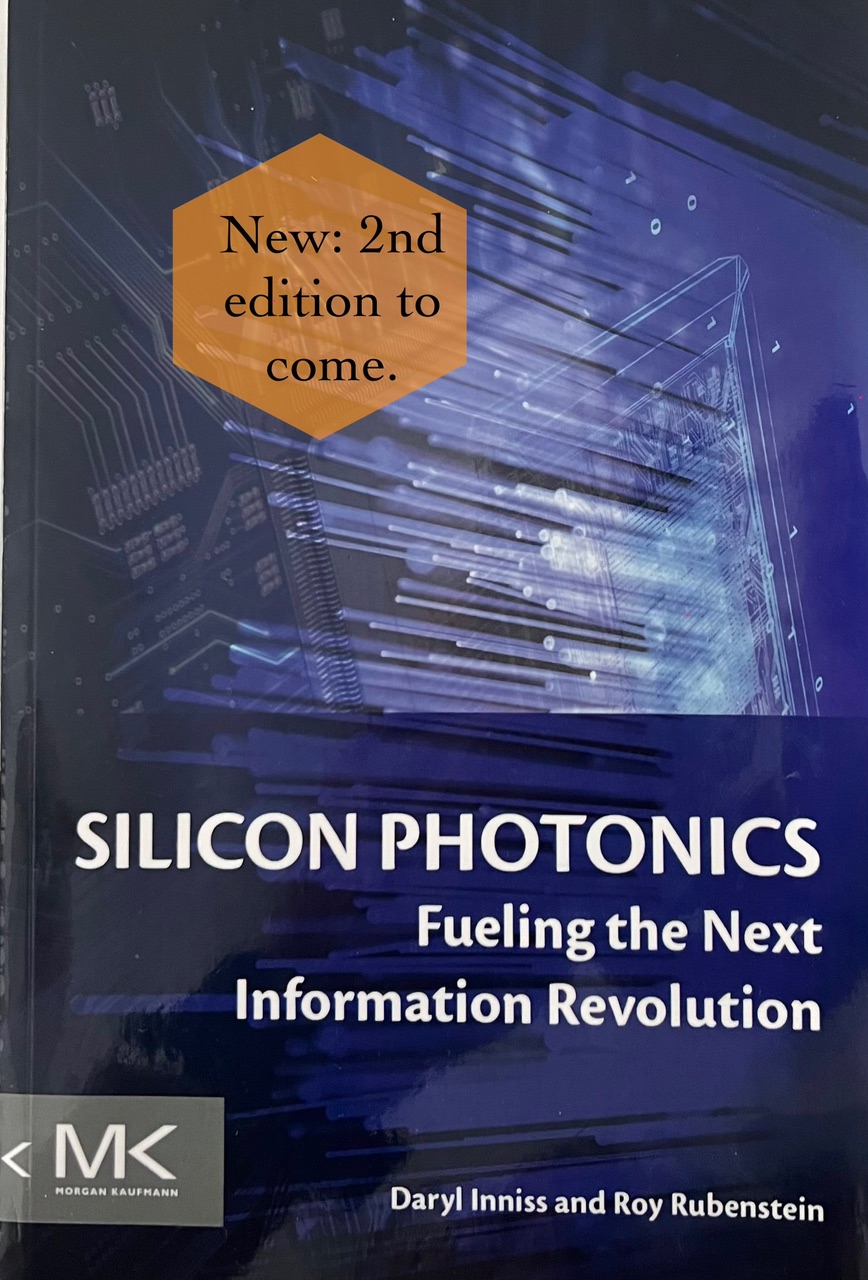
How is silicon photonics powering the AI revolution and benefitting industries from autonomous vehicles to healthcare? A new edition of the book, Silicon Photonics: Fueling the Information Revolution will reveal the answers.
A decade ago, the editor of Gazettabyte and Daryl Inniss, now Principal Market Analyst at LightCounting Market Research, wrote the book: Silicon Photonics: Fueling the Information Revolution, published by Morgan Kaufmann, part of Elsevier.
We are delighted to report that we have agreed with the publisher to proceed with a second edition.
Many of the arguments about how silicon photonics would develop, as made in the first book, have come to pass. But much has also changed, AI’s phenomenal rise and the emergence of massive AI computing clusters that work only because of photonics enabling their vast networking needs.
While AI will be the primary driver of silicon photonics in the coming years, the book will touch on emerging non-datacom/telecoms applications for silicon photonics such as Lidar and biosensors.
We look forward to our writing journey and conducting interviews with incumbents, start-ups, and academics to deepen our understanding of the technology and the market. The book will explain the technology, the emerging ecosystem, the evolving challenges in bringing silicon photonics to market, and the end applications.
One aim of the first edition was to highlight how silicon photonics would converge with the semiconductor world. Now with the advent of AI, silicon photonics is butting up to AI chips, the most complex of all compute silicon. Yet the integration of photonics and electronics is still to come. The book will discuss the chip world as well as optics.
The second edition is targeted to be published in 2027. We will provide book updates and relevant articles as we advance with our research and writing.
Daryl Inniss and Roy Rubenstein
Please feel free to leave a comment with your thoughts and suggestions regarding the second edition.

Ciena becomes a computer weaver
- Ciena is to buy optical interconnect start-up Nubis Communications for $270 million.
- The deal covers optical and copper interconnect technology for data centres
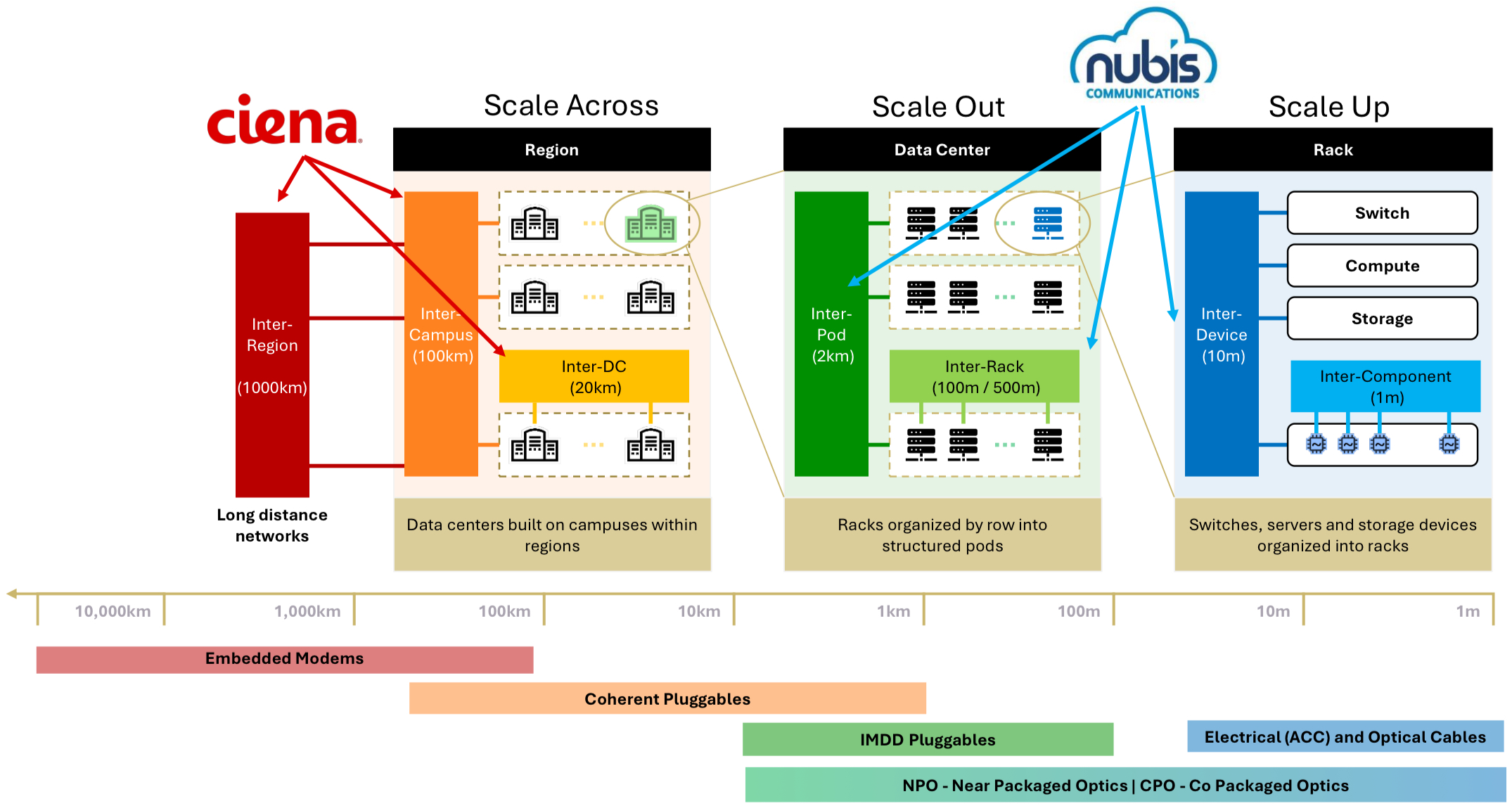
Ciena has announced its intention to buy optical engine specialist Nubis Communications for $270 million. If the network is the computer, Nubis’ optical engine and copper integrated circuit (IC) expertise will help Ciena better stitch together AI’s massive compute fabric.
Ciena signalled its intention to target the data centre earlier this year at the OFC show when it showcased its high-speed 448-gigabit serialiser-deserialiser IC technology and coherent lite modem. Now, Ciena has made a move for start-up Nubis, which plays at the core of AI data centres.
“Ciena’s expertise in high-speed components is relevant to 400G per lane Ethernet transceivers, but they never sold any products to this market,” says Vladimir Kozlov, CEO of LightCounting. “Nubis offers them an entry point with several designs and customer engagements.”
With the deal, Ciena is extending its traditional markets of wide area networks (WAN), metro, and short-reach dense wavelength division multiplexing (DWDM) to include AI networking opportunities. These opportunities include scale-across networks, where AI workloads are shared across multiple data centres, something Ciena can address, to now scale-out and scale-up networks for AI clusters in the data centre.
Puma optical engine
Nubis has developed two generations of compact optical engines for near-package optics (NPO) and co-package optics (CPO) applications. Its first-generation engine operates at 100 gigabits per second (Gbps), while its second, dubbed Puma, operates at 200 Gbps.
Nubis’s optical engine philosophy is based on escaping the optical channels from the surface of the optical engine, not its edge. The start-up also matches the number of optical channels to the electrical ones. The optical engine can be viewed as a sieve: data from the input channels flow through the chip and emerge in the same number of channels at the output. The engine acts as a two-way gateway, with one side handling electrical signals and the other, optical ones.
The Puma optical engine uses 16 channels in each direction, 16 by 200Gbps electrical signals for a total of 3.2 terabits per second (Tbps), and 16 fibres, each fibre carrying 200Gbps of data in the form of a wavelength. Puma’s total capacity is thus 6.4 terabits per second (Tbps). The engine also needs four external lasers to drive the optics, each laser feeding four channels or four fibres. The total fibre bundle of the device consists of 36 fibres: 32 for data (16 for receive and 16 for transmit), and four for the laser light sources.
Nubis is also a proponent of linear drive technology. Here, the advanced serdes on the adjacent semiconductor chip drives the optical engine, thereby avoiding the need for an on-engine digital signal processor (DSP) that requires power. The start-up has also developed a system-based simulator software tool that it uses to model the channel, from the transmitter to the receiver. The tool models not only the electrical and optical components within the channel but also the endpoints, such as the serdes.
Nitro
Nubis has an analogue IC team that designs its trans-impedance amplifiers (TIAs) and drivers used for the optical engine. The hardware compensates for channel impairments with low noise, high linearity, and at high speed. It is this channel simulator tool that Nubis used to optimise its optical engine, and to develop its second key technology, which Nubis calls Nitro —a chip that extends the reach of copper cabling.
“We use our linear optics learning and apply it to copper straight out of the gate, “said Peter Winzer, founder & CTO at Nubis, earlier this year. By using its end-to-end simulator tool, Nubis developed the Nitro IC, which extends the 1m reach of direct-attached copper to 4m using an active copper cable design. “We don’t optimise the driver chip, we optimise the end-to-end system,” says Winzer.
Nubis was also part of a novel design based on a vertical line card to shorten the trace length between an ASIC and pluggable modules.
Ciena’s gain
The acquisition of Nubis places Ciena at the heart of the electrical-optical transition inside the data centre. Ciena will cover both options: copper and optical interconnect. Ciena will gain direct-drive technology expertise for electrical and optical interfaces, enabling scale-up, as well as optical engine technology for scale-out, adding to its coherent technology expertise.

Ciena’s technologies will span coherent ultra-long-haul links all the way to AI accelerators, the heart of AI clusters. By combining Ciena’s 448-gigabit serdes with Nubis’s optical engine expertise, Ciena has a roadmap to develop 12.8Tbps and faster optical engines.
The acquisition places Ciena among new competitors that have chip and optical expertise and deliver co-packaged optics solutions alongside complex ICs such as Broadcom and Marvell.
The deal adds differentiation from Ciena’s traditional system vendor competitors, such as Cisco/ Acacia and Nokia. Huawei is active in long-haul optical and makes AI clusters. Ciena will also compete with existing high-speed optical players, including co-packaged optics specialists Ayar Labs and Ranovus, microLED player Avicena, and optical/IC fabric companies such as LightMatter and Celestial AI.
“Ciena will be a unique supplier in the co-packaged optics/near-packaged optics/active copper cabling data centre interconnect market,” says Daryl Inniss, Omdia’s thought lead of optical components and advanced fibre. “The other suppliers either have multiple products in the intra data centre market, like Broadcom and Nvidia, or they are interconnect-focused start-ups. These suppliers should all wonder what Ciena will do next inside the data centre.”
Ciena will enhance its overall expertise in chips, optics, and signal processing with the Nubis acquisition. It will also put Ciena in front of key processor players and different hyperscaler engineering teams, which drive next-generation AI systems.
Ciena will also have all the necessary parts for the various technologies, regardless of the evolving timescales associated with the copper-to-optical transition within AI systems. Ciena will add direct-detect technology and copper interconnect. On the optical side, it has coherent optical expertise, now coupled with near-package optics and co-packaged optics.
Nubis’ gain
Nubis’ 50-plus staff get a successful exit. The start-up was founded in 2020. Nubis will become a subsidiary of Ciena.
Nubis will be joining a much bigger corporate entity with deep expertise and pockets. Ciena has a good track record with its mergers. Think Nortel at the system level and Blue Planet, a software acquisition. Now the Nubis deal will bring Ciena firmly inside the data centre.
“This is a great deal for Nubis,” says Kozlov. “Congratulations to their team.”
What next?
The deal is expected to close in the fourth quarter of this year. Ciena expects the deal to start adding to its revenues from 2028, requiring Ciena and Nubis to develop products and deliver design wins in the data centre.
“Given the breadth of Ciena’s capabilities, its deep pockets, and products like its data centre out-of-band (DCOM) measurement product, router, and coherent transceivers, one can imagine that Ciena would offer more than co-packaged optics/ near-packaged optics/ active copper cabling inside the data centre,” says Inniss.

From spin-out to scale-up: OpenLight’s $34M funding
Part 1: Start-up funding
OpenLight Photonics, a Santa Barbara-based start-up specialising in silicon photonics, has raised $34 million in an oversubscribed Series A funding round.
The start-up will use the funding to expand production and its photonic integrated circuit (PIC) design staff.
OpenLight Photonics raises $34M in an oversubscribed Series A.
“We’re starting to get customers taking in production mask sets, so it’s about scaling operations and how we handle production,” says OpenLight CEO, Adam Carter (pictured). The start-up needs more PIC designers to work with customers.
Technology
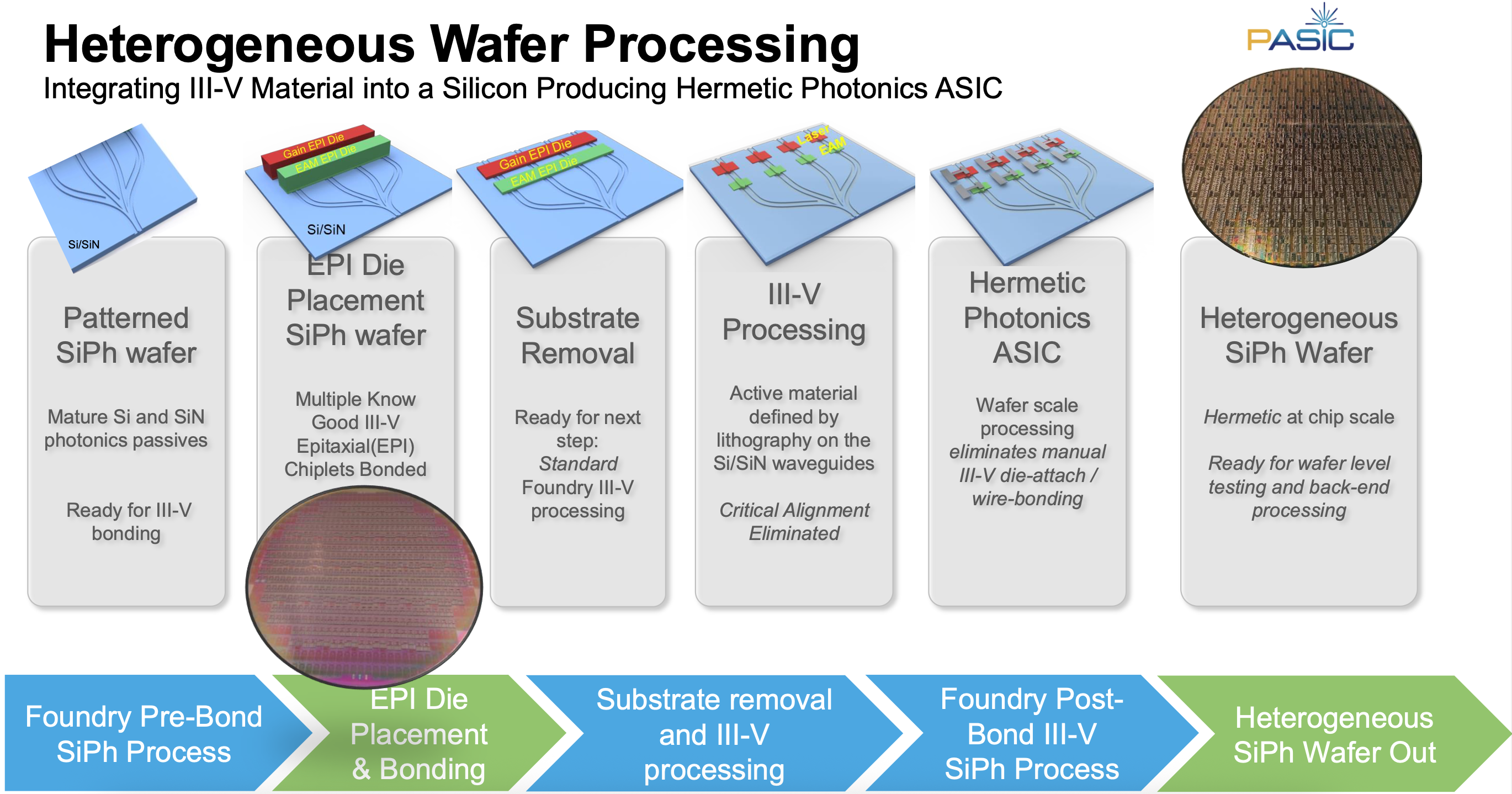
OpenLight’s technology originated at Aurrion, a fabless silicon photonics start-up from the University of California, Santa Barbara.
Aurrion’s heterogeneous integration silicon photonics technology supports III-V materials, enabling components such as lasers, modulators, and optical amplification to be part of a photonic integrated circuit (PIC). Intel has its own heterogeneous integration silicon photonics process, which it has used to make millions of pluggable optical transceivers. OpenLight is offering the technology to customers effectively as a photonic ASIC design house.
Juniper Networks bought Aurrion in 2016 and, in 2022, spun out the unit that became OpenLight. Electronic design tool specialist Synopsys joined Juniper in backing the venture. Synopsys announced it was acquiring simulation company Ansys, a $35 billion deal it completed in July. Given that Synopsys would be focused on integrating Ansys, it suggested to OpenLight in January that they should part ways.
Funding
“We were only looking for $25 million to start with, and we finished at $34 million,” says Carter. Capricorn Investment Group was a late entrant and wanted to co-lead the funding round. Given initial commitments from other funders, Mayfield and Xora Innovation, set specific ownership percentages, it required an increase to accommodate Capricorn.
Xora’s first contact with OpenLight was after it approached the start-up’s stand at the OFC 2025 event held in March.
Juniper—now under HPE—is also an investor. The company played a key role in helping OpenLight while it sought funding. “Juniper could see that we were very close to an intercept point regarding our business model and our customers, so that’s why Juniper invested,” says Carter.
HPE continually looks at technologies it will require; silicon photonics with heterogeneous integration is one such technology, says Carter. However, HPE has no deal with OpenLight at this time.
Design roadmap
OpenLight is developing a 1.6-terabit PIC, now at an advanced prototype (beta) stage. The design uses eight channels for a 1.6T-DR8 OSFP pluggable design, implemented using four lasers and eight modulators, each operating at 200 gigabit-per-second (Gbps).
Carter says the first wafers will come from foundry Tower Semiconductor around October. This will be OpenLight’s largest production run — 100 wafers in four batches of 25. Some ten customers will evaluate the PICs, potentially leading to qualification.
A coarse wavelength division multiplexing (CWDM) 1.6-terabit design will follow in 2026. The CWDM uses 4 wavelengths, each at 200Gbps, on a fibre, with two such paths used for the 1.6T OSFP-XD 2xFR4 optical module.
The company is also pushing to develop 400Gbps channels, increasing the frequency response and improving the extinction ratio through process changes.
“We’ve got a whole series of experiments coming out over the next few months,“ says Carter. The frequency response of the indium phosphide modulator has already been improved by 10 gigahertz (GHz) to 90-95GHz. The process changes will be adopted for some alpha sample wafers in production that may enable modulation at 400Gbps, hence a 3.2-terabit PIC design.
“If we can show some good 3.2-terabit eyes, just as a demo, it shows that there’s a technology route to get there whenever 3.2-terabit modules are needed,” he says.
Customer growth
OpenLight’s customers have grown from three in 2023 to 17 last year to 20 actively designing. “We are growing the pipeline,” says Carter.
Early adopters were start-ups, but now larger firms are engaging Openlight. “Investors noted start-ups take more risk, but now bigger companies are coming in to drive volume,” says Carter.
Optical interconnect will drive initial volumes, but automotive and industrial sensing will follow. “The mix will change, but for the next couple of years, the revenues will be from optical interconnect,” says Carter.
Co-packaged optics is another interconnect opportunity. Here, OpenLight’s integrated laser technology would not be needed, given the co-packaged optics designs favour external laser sources. Instead, the company can offer integrated indium phosphide modulator banks or modulator banks with semiconductor optical amplifiers (SOAs), their compact size—“microns, not millimetres”—aiding packaging.
In addition to the foundry Tower Semiconductor for its wafers, OpenLight partners with Jabil, Sanmina, and TFC for the packaging and does its testing via ISC, an ASE subsidiary.
“They know test and certain customers with ISC, and ASE could do a complete turnkey solution,” says Carter. “But our priority is to get the test area set up to deal with the production; we’ve not had 100 wafers in a year being delivered for test.”
Silicon photonics
Carter, who was at Cisco when it acquired Lightwire in 2012, says silicon photonics’ potential to shrink optical designs was already recognised then. Since then, a lot of progress has been made, but now the focus is on building the supporting ecosystem. This includes a choice of foundries offering optical process design kits (PDKs) and outsourced assembly and test houses (OSATs) that can handle volumes.
Until now, silicon photonics has been all passive circuits. Now OpenLight, working with Tower and its PDK, is offering customers the ability to design and make heterogeneous integrated silicon photonics circuits. “Every customer gets the same PDK,” says Carter.
And it need not just be indium phosphide. The idea is to expand the PDK to support modulation materials such as polymer and thin-film lithium niobate. “If it is a better material, we’ll integrate it,” he says.
Having secured the funding, Carter is clear about the company’s priority: “It’s all about execution now.”

Paying homage to Harald Bock

Harald Bock, described by an optical networking executive as one of the great people of our industry, has died. Former colleagues describe the man and their sense of loss
Those who knew and worked with Harald Bock have been stunned by his sudden passing at 55. For them, Harald was a valued and much-admired friend, a deep thinker who made his views heard, quietly yet powerfully.
Last February, Harald changed jobs, becoming chief product officer at Ekinops after six years at Infinera. He was excited by the role and enjoyed his introductory period travelling to Ekinops’ sites, meeting colleagues and customers, and working on the company’s strategy.
Sylvain Quartier, Ekinops’ chief marketing & strategy officer, says it took the company a year to find the right candidate. Ekinops knew of Harald’s optical networking expertise but was impressed with his keenness to expand into what, for him, were new product areas such as routeing and cybersecurity.
“We needed someone expert in one domain and with good experience in product strategy,” says Quartier. “He was full of joy and happy to work.”
During Harald’s short spell at the company, he sharpened Ekinops’s product plans. “We’re executing his roadmap and strategy today,” says Quartier. “In six months, he had a great impact.”
Career
Harald earned his PhD in physics, specialising in polymer materials.
“Polymers may become an important material system for future high-speed [optical] modulators,” says Uwe Fischer, who was chief technology officer (CTO) at former optical networking firm, Coriant. “He was ahead of his time by doing something in his PhD thesis which is about to become important in business and technology.”
Harald’s career spanned some notable optical networking firms: Marconi, Nokia Siemens Networks, Coriant, and Infinera. He was part of Uwe Fischer’s team at Nokia Siemens Networks and Coriant. Harald’s strength was as a technologist, and had roles in several CTO offices.
Stefan Voll, then a lead product line manager and now senior director of business development at Adtran, worked with Harald at Nokia Siemens Networks in 2012.
The two were tasked with carving out the optical business of Nokia Siemens Networks in what was to become Coriant. “The carve-out was a big achievement,” says Voll. Harald represented the CTO office and Voll led the product line manager team and the two were tasked with making the product portfolio not only viable but profitable. This required aligning technical aspects with business needs, setting the foundation for Coriant’s operations.
At Coriant, Harald contributed to the development of Groove, one of the first compact modular platform for metro wavelength division multiplexing (WDM) and long-haul networks. Harald continued in the CTO office at Infinera after it acquired Coriant in 2019.
More recently, Harald served as editor of the Optical Internetworking Forum’s (OIF) 1600ZR project, taking over the role after an OIF member stepped down. The work involves standardising 1600-gigabit coherent optics for high-capacity networks. “He stepped in as smooth as possible,” says Karl Gass, optical vice chair of the OIF’s physical link layer (PLL) working group. “He knew how to manage personalities and get things done.”
Work ethic
Christian Uremovic, senior director of solution marketing at Nokia Optical Networks, worked with Harald at Coriant and Infinera. “He was a respected and valued technology guide for product line management and sales and for us in marketing,” says Uremovic. It wasn’t always an easy role; groups in the company would pull in different directions, and bringing it all together was a challenge. “Sometimes you had to make difficult decisions,” says Uremovic.
“He would like to understand basic technologies, and when, at executive meetings, he wanted to bring his opinion and convince others, he would talk quietly,” says Ekinop’s Quartier. “Everybody would be quiet because you wanted to hear him, and he made a strong impression.” With this quiet manner, Harald would progress the discussion and bring everybody in the right direction, says Quartier.
It is something Robert Richter, managing director and senior vice president, customer executive, product marketing office, at Nokia, highlights: “Harald would reiterate his view calmly, even if it annoyed some leaders, but it was always positive,” he says, adding that Harald was not the kind of guy who did what management told him. But he was always trying to change opinions constructively.
Voll reinforces this, saying Harald would not let shortcuts slide, ensuring all critical aspects were covered. “He was not afraid of conflict.” Harald would broaden discussions to bring in new angles to the point where it could be annoying. “But it was always valuable,” says Voll. “He was not fast, and that’s because he was a deep thinker. He reacted in meetings, but not immediately; he needed some time putting his thoughts together.”
Voll says Harald was focused on long-term technology trends, five to six years out, compared to product line managers’ shorter-term view. “He taught me to assess competitiveness through metrics like capacity per power consumption,” says Voll. Harald would say: “Convert it into capacity per volume or per power consumption.” Ten years ago, these were not usual metrics, but Harald used them to measure product plans. Harald would also also look product optimisations, such as whether a platform’s chips had features that were not used.
Maxim Kuschnerov, Director of R&D, at Huawei, worked with Harald at Coriant. He recalls a meeting he had with Deutsche Telekom presenting Huawei’s research topics. Afterwards, a Deutsche Telekom executive remarked that although it was framed as a research discussion, Kuschnerov kept steering the conversation toward commercial applications and customer value: “It reminds me of a guy at Coriant who talks about use cases a lot — Harald Bock”. Smiling, Kuschnerov replied: “Where do you think I was taught to think like that? I worked with Harald!”
Traits
Ekinops’ Quartier highlights Harald’s general cheerfulness: “He was always smiling, which was much appreciated.”
Richter, who worked with Harald for 18 years at Nokia Siemens Networks and Coriant, describes him as the most empathetic person he has met. “He was always listening to people and was very patient,” he says. Harald would bring cakes to the office from vacations and would never speak ill of others. He’d keep positive even during challenging times and in that sense, he was a role model, says Richter: “It was always a pleasure to talk to him over a coffee. He was open to a dialogue.”
Harald had an impressive fitness routine. “He’d bike 20km, swim for an hour, then come to the office relaxed,” says Voll. Until recently, Fischer and Harald would go biking on 40-kilometre rides. “Sometimes he was behind in my slipstream, then we change positions,” says Fischer. “We were proud of the competitive speed and times we could achieve together.” He was a keen water polo player in his youth.

Fluent in English, French, and his native German, Harald read books in all three languages. He adored France – his wife is French – with its pastries and Brittany with its Hydrangeas. He said how the Hydrangeas in his garden struggled, yet on seeing the flourishing bands of colour in Brittany (pictured), he was determined to try again.
Legacy
When colleagues talk about Harald, they recount his warmth and character.
Uremovic recollects sharing an office and hearing Harald’s diplomatic charm on calls. These experiences have shaped his ability to connect better with others. He will also miss their talks: “To me, he was like a big brother.”
Harald made a deep impression during his short time at Ekinops. “We miss him,” says Quartier. “We will always have his memory at Ekinops.”
Fischer highlights their shared interests in life – sport and a love of France.”There was a lot of mutual understanding which we didn’t need to put into words,” says Fischer. “Sometimes, when you feel close to somebody, you don’t even need to talk.”
Fischer, who has watched Harald’s career over the years, laments a life cut short. “He was at the peak of his career,” he says. ”He brought to Ekinops all his experience of the last 20 to 30 years so this period was maybe the most impactful time of his life.”
Richter’s grief over his lost colleague is evident in his sombre tone and demeanour, perhaps the deepest tribute one can pay to someone held so dear.

IOWN’s all-photonic network vision

What is the best way to send large amounts of data between locations? Its a question made all the more relevant with the advent of AI, and one that has been preoccupying the Innovative Optical and Wireless Network (IOWN) Global Forum that now has over 160 member companies and organisations
Optical networking has long established itself as the high-speed communications technology of choice for linking data centres or large enterprises’ sites.
The IOWN Global Forum aims to take optical networking a step further by enabling an all-optical network, to reduce the energy consumption and latency of communication links. Latency refers to the time it takes transmitted data to start arriving at the receiver site.
“The IOWN all-photonic network is the infrastructure for future enterprise networking,” says Masahisa Kawashima, IOWN technology director, IOWN development office, NTT Technology working group chair, IOWN Global Forum.

“The main significance of IOWN is setting a roadmap,” says Jimmy Yu, vice president and optical transport senior analyst at Dell’Oro. “It helps component and systems companies understand what technology and architectures that companies, such as NTT, are interested in for a next-generation optical and wireless network. It also fosters industry collaboration.”
IOWN architecture
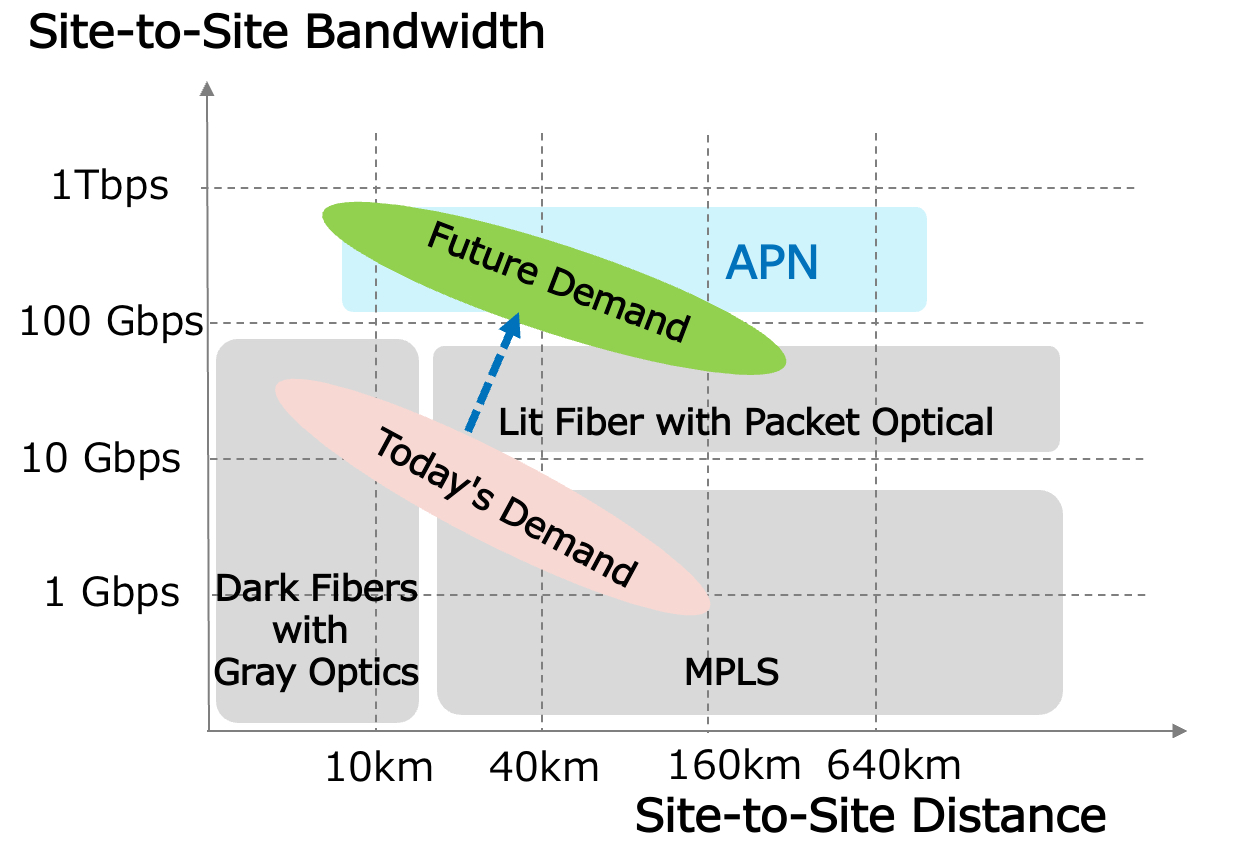
The IOWN Global Forum’s all-optical network (APN) is to enable optical connectivity from edge devices to data centres at speeds exceeding 100 gigabits-per-second (Gbps).
The Forum envisions energy and latency performance improvements by driving optics to the endpoints. Linking endpoints will require a staged adoption of photonic technology as it continues to mature.
Professor Ioannis Tomkos, a member of the Optical Communications Systems & Networks (OCSN) Research Lab/Group at the Electrical and Computer Engineering Department at the University of Patras, says the aim of the IOWN Global Forum is to gradually replace electronics-based transmission, switching, and even signal processing functions with photonics. The OCSN Group recently joined the IOWN Global Forum.
The Forum has defined a disaggregated design for the all-photonic network. The following stages will include using optics to replace copper interconnect within platforms, interfacing photonics to chips, and, ultimately, photonic communications within a chip.
“If information-carrying light signals can remain in the optical domain and avoid opto-electronic and electro-optical conversions, that will ensure enhanced bandwidth and much reduced power consumption per bit,” says Tomkos.
The IOWN Global Forum was created in 2019 by Japanese service provider, NTT, Sony, and Intel. Since then, it has grown to over 160 members, including cloud players Google, Microsoft, and Oracle, telecom service providers British Telecom, Orange, KDDI, Telefónica, and companies such as Nvidia.
The Forum has developed an IOWN framework that includes the all-photonic network, digital twin computing (DTC), and a ‘cognitive foundation’ (CF). Digital twin computing enables the creation of virtual representations of physical systems, while the cognitive foundation is the architecture’s brain, allocating networking and computing resources as required.
“We expect future societies will be more data-driven and there will be many applications that collect huge real-time sensor data and analyse them,” says Kawashima. “The IOWN all-photonic network and disaggregated computing platforms will enable us to deploy digital twin application systems in an energy-efficient way.”
Optical infrastructure
The IOWN Global Forum’s all-photonic network uses open standards, such as the OpenROADM (Open reconfigurable optical add-drop multiplexing) Multi-Source Agreement (MSA), the OIF and the OpenZR+ MSA pluggable coherent optics, and the OpenXR Optics Forum standards. The IOWN Global Forum also adheres to the ‘white box’ platform designs defined by the Telecom Infra Project (TIP).
“There is a lot of similarity with the approach and objectives of TIP,” says an unnamed industry veteran who has observed the IOWN Global Forum’s organisation since its start but whose current employer is not a member. “Although the scope is not the same, I cannot help but wonder why we don’t combine the two as an industry.”
Kawashima says that optical hardware, such as ROADMs, pluggable optics, and transponder boards, is located at one site and operated by one organisation. Now, the Forum has disaggregated the design to enable the ROADM and transponders to be in different locations: the transponder can be deployed at a customer’s premises, remote from the ROADM’s location.
“We allow the operator of the switch node to be different from the operator of the aggregator node, and we allow the operator of the transponder node to be different from the operator of the ROADM nodes,” says Kawashima.
The disaggregation goal is to encourage the growth of a multi-operator ecosystem, unlike how optical transport is currently implemented. It is also the first stage in making the infrastructure nodes all-optical. Separating the transponder and the ROADMs promises to reduce capital expenditure, as the transceiver nodes can be upgraded separately from the ROADMs that can be left unchanged for longer.
Kawashima says that reducing infrastructure capital expenditure promises reduced connectivity prices: “Bandwidth costs will be cheaper.”
Service providers can manage the remote transponders at the customers’ sites, creating a new business model for them.
Early use cases
IOWN has developed several use cases as it develops the technology.
One is a data centre interconnect for financial service institutions that conduct high-frequency trading across geographically dispersed sites.
Another is remote video production for the broadcast industry. Here, the broadcast industry would use an all-photonic network to connect the site where the video feed originates to the cloud, where the video production work is undertaken.
A third use case is for AI infrastructure. An enterprise would use the all-photonic network to link its AI product development engineers to GPU resources hosted in the cloud.
If the network is fast enough and has sufficiently low latency, the GPUs can source data from the site, store it in their memory, process it, and return the answer. The aim is for enterprises not to need to upload and store their data in the cloud. “So that customers do not have to be worried about data leakages,” says Kawashima.
The Forum also publishes documents. “Once the proof-of-concept is completed, that means that our solution is technically proven and is ready for delivery,” says Kawashima.
Goals
At OFC 2025, held earlier this year, NTT, NTTCom, Orange, and Telefónica showcased a one terabit-per-second optical wavelength circuit using the IOWN all-photonics network.

The demonstration featured a digital twin of the optical network, enabling automated configuration of high-speed optical wavelength circuits. The trial showcased the remote control of data centre communication devices using an optical supervisory channel.
The Forum wants to prove the technical feasibility of the infrastructure architecture by year-end. It looks to approve the remote GPUs and financial services use cases.
“What we are trying to achieve this year is that the all-photonic network is commercially operable, as are several use cases in the enterprise networking domain,” says Kawashima.
IOWN’s ultimate success will hinge on the all-photonic network’s adoption and economic viability. For Kawashima, the key to the system architecture is to bring significant optical performance advantages.
Tomkos cautions that this transformation will not happen overnight and not without the support of the global industry and academic community. But the promise is growth in the global network’s throughput and reduced latency in a cost and power-efficient way.

Glenn Wellbrock’s engineering roots
After four decades shaping optical networking, Glenn Wellbrock has retired. He shares his career highlights, industry insights, and his plans to embrace a quieter life of farming and hands-on projects in rural Kansas.
Glenn Wellbrock’s (pictured) fascination with telecommunications began at an early age. “I didn’t understand how it worked, and I wanted to know,” he recalls.
Wellbrock’s uncle had a small, rural telephone company where he worked while studying, setting the stage for his first full-time job at telecom operator, MCI. Wellbrock entered a world of microwave and satellite systems; MCI was originally named Microwave Communications Incorporated. “They were all ex-military guys, and I’m the rookie coming out of school trying to do my best and learn,” says Wellbrock.
The challenge that dominated the first decade of this century.
The arrival of fibre optics in the late 1980s marked a pivotal shift. As colleagues hesitated to embrace the new “glass” technology, Wellbrock seized the opportunity. “I became the fibre guy,” he says. “My boss said, ‘Anything breaks over there, it’s your problem. You go fix it.’”
This hands-on role propelled him into the early days of optical networking, where he worked on asynchronous systems with bit rates ranging from hundreds of kilobits to over a megabit, before SONET/SDH standards took over.
By the 1990s, with a young family, Wellbrock moved to Texas, contributing to MCI’s development of OC-48 (2.5 gigabit-per-second or Gbps) systems, a precursor to the high-capacity networks that would define his career.
Hitting a speed wall
One of Wellbrock’s proudest achievements was overcoming the barrier to get to speeds faster than 10Gbps, a challenge that dominated the first decade of this century.
Polarisation mode dispersion (PMD) in an optical fibre was a significant hurdle, limiting the distance and reliability of high-speed links. By then, he was working at a start-up and did not doubt that using phase modulation was the answer.
Wellbrock recalls conversations he had with venture capitalists at the time: “I said: ‘Okay, I get we are a company of 40 guys and I don’t even know if they can build it, but somebody’s going to do it, and they’re going to own this place.’”
Wellbrock admits he didn’t know the answer would be coherent optics, but he knew intensity modulation direct detection had reached its limits.
For a short period, Wellbrock was part of Marconi before joining Verizon in 2006. In 2007, he was involved in a Verizon field trial between Miami and Tampa, 300 miles apart, which demonstrated a 100Gbps direct-detection system. “It was so manual,” he admits. “It took three of us working through the night to keep it working so we could show it to the executives in the morning.”
While the trial passed video, it was clear that direct detection wouldn’t scale. The solution lay in coherent detection, which Wellbrock’s team, working with Nortel (acquired by Ciena), finally brought to market by 2009.
“Coherent was like seeing a door,” he says. “PMD was killing you, but you open the door, and it’s a vast room. We had breathing room for almost two decades.”
Verizon’s lab in Texas had multiple strands of production fibre that looped back to the lab every 80km. “We could use real-world glass with all the impairments, but keep equipment in one location,” says Wellbrock.
This setup enabled rigorous testing and led to numerous post-deadline papers at OFC, cementing Verizon’s reputation for optical networking innovation.
Rise of the hyperscalers
Wellbrock’s career spanned a transformative era in telecom, from telco-driven innovation to the rise of hyperscalers like Google and Microsoft.
He acknowledges the hyperscalers’ influence as inevitable due to their scale. “If you buy a million devices, you’re going to get attention,” he says. “We’re buying 100 of the same thing.”
Hyperscalers’ massive orders for pluggable modules and tunable lasers—technologies telcos like Verizon helped pioneer—have driven costs down, benefiting the industry.
However, Wellbrock notes that telcos remain vital for universal connectivity. “Every person, every device is connected,” he says. “Telcos aren’t going anywhere.”
Reliability remains a core challenge, particularly as networks grow. Wellbrock emphasises dual homing—redundant network paths—as telecom’s time-tested solution. “You can’t have zero failures,” he says. “Everything’s got a failure rate associated with it.”
He sees hyperscalers grappling with similar issues, as evidenced by a Google keynote at the Executive Forum at OFC 2025, which sought solutions for network failures linking thousands of AI accelerators in a data centre.
Wellbrock’s approach to such challenges is rooted in collaboration. “You’ve got to work with the ecosystem,” he insists. “Nobody solves every problem alone.”
Hollow-core fibre
Looking forward, what excites Wellbrock is hollow-core fibre, which he believes could be as transformative as SONET, optical amplifiers, and coherent detection.
Unlike traditional fibre, hollow-core fibre uses air-filled waveguides, offering near-zero loss, low latency, and vast bandwidth potential. “If we could get hollow-core fibre with near-zero loss and as much bandwidth as you needed, it would give us another ride at 20 years’ worth of growth,” he says. “It’s like opening another door.”
While companies like Microsoft are experimenting with hollow-core fibre, Wellbrock cautions that widespread adoption is years away. “They’re probably putting in [a high fibre glass] 864 [strand]-count standard glass and a few hollow core [strands],” he notes.
For long-haul routes, the technology promises lower latency and freedom from nonlinear effects, but challenges remain in developing compatible transmitters, receivers, and amplifiers. “All we’ve got to do is build those,” he says, laughing, acknowledging the complexity.
Wellbrock also highlights fibre sensing as a practical innovation, enabling real-time detection of cable damage. “If we can detect an excavator getting closer, we can stop it before it breaks a fibre link,” he explains. This technology, developed in collaboration with partners like NEC and Ciena, integrates optical time-domain reflectometry (OTDR) into transmission systems, thereby enhancing network reliability.
Learnings
Wellbrock’s approach to innovation centres on clearly defining problems to engage the broader ecosystem. “Defining the problem is two-thirds of solving it,” he says, crediting a Verizon colleague, Tiejun J. Xia, for the insight. “If you articulate it well, lots of smart people can help you fix it.”
This philosophy drove his success at OFC, where he used the conference to share challenges, such as fibre sensing, and rally vendor support. “You’ve got to explain the value of solving it,” he adds. “Then you’ll get 10 companies and 1,000 engineers working on it.”
He advises against preconceived solutions or excluding potential partners. “Never say never,” he says. “Be open to ideas and work with anybody willing to address the problem.”
This collaborative mindset, paired with a willingness to explore multiple solutions, defined his work with Xia, a PhD associate fellow at Verizon. “Our favourite Friday afternoon was picking the next thing to explore,” he recalls. “We’d write down 10 possible things and pull on the string that had legs.”

Fibre to Farming
As Wellbrock steps into retirement, he is teaming up with his brother.
The two own 400 acres in Kansas, where wheat farming, hunting, and fishing will define their days. “I won’t miss 100 emails a day or meetings all day long,” he admits. “But I’ll miss the interaction and building stuff.”
Farming offers a chance to work with one’s hands, doing welding and creating things from metal. “I love to build things,” he says. “It’s fun to go, ‘Why hasn’t somebody built this before?’
Farming projects can be completed in a day or over a weekend. “Networks take a long time to build,” he notes. “I’m looking forward to starting a project and finishing it quickly.”
He plans to cultivate half their land to fund their hobbies, using “old equipment” that requires hands-on maintenance—a nod to his engineering roots.
OFC farewell
Wellbrock retired just before the OFC show in March 2025. His attendance was less about work and more about transition, where he spent the conference introducing his successor to vendors and industry peers, ensuring a smooth handoff.
“I didn’t work as hard as I normally do at OFC,” he says. “It’s about meeting with vendors, doing a proper handoff, and saying goodbye to folks, especially international ones.” He also took part in this year’s OFC Rump Session.
Wellbrock admits to some sadness. Yet, he remains optimistic about his future, with plans to possibly return to OFC as a visitor. “Maybe I’ll come just to visit with people,” he muses.
Timeline
- 1984: MCI
- 1987: Started working on fibre
- 2000: Joined start-ups and, for a short period, was part of Marconi
- 2004: Joined Worldcom, which had bought MCI
- 2006: Joined Verizon
- 2025: Retired from Verizon
A tribute
Prof. Andrew Lord, Senior Manager, optical and quantum research, BT
I have had the privilege of knowing Glenn since the 1990s, when BT had a temporary alliance with MCI. We shared a vendor trip to Japan, where I first learnt of his appetite for breakfasting at McDonald’s!
Glenn has been a pivotal figure in our industry since then. A highlight would be the series of ambitious Requests For Information (RFIs) issued by Verizon, which would send vendor account managers scurrying to their R&D departments for cover.
Another highlight would be the annual world-breaking Post-Deadline Paper results at OFC: those thrilling sessions won’t be the same without a Wellbrock paper and neither will the OFC rump sessions, which have benefited from his often brutal pragmatism, always delivered with grace (which somehow made it even worse when defeating me in an argument!).
But it’s grace that defines the man who always has time for people and is always generous enough to share his views and experiences. Glenn will be sorely missed, but he deserves a fulfilling and happy retirement.
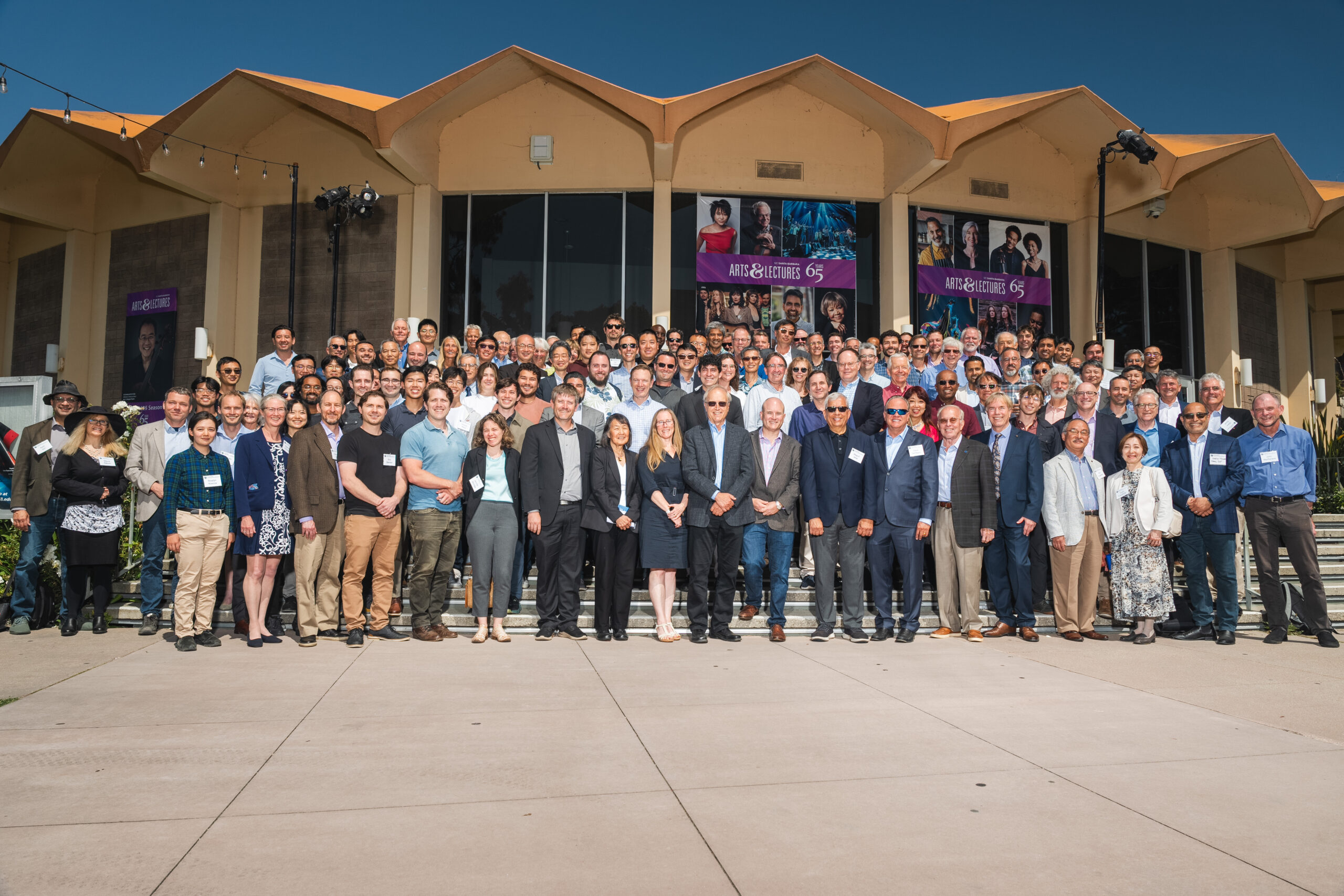
John Bowers: We are still at the dawn of photonics

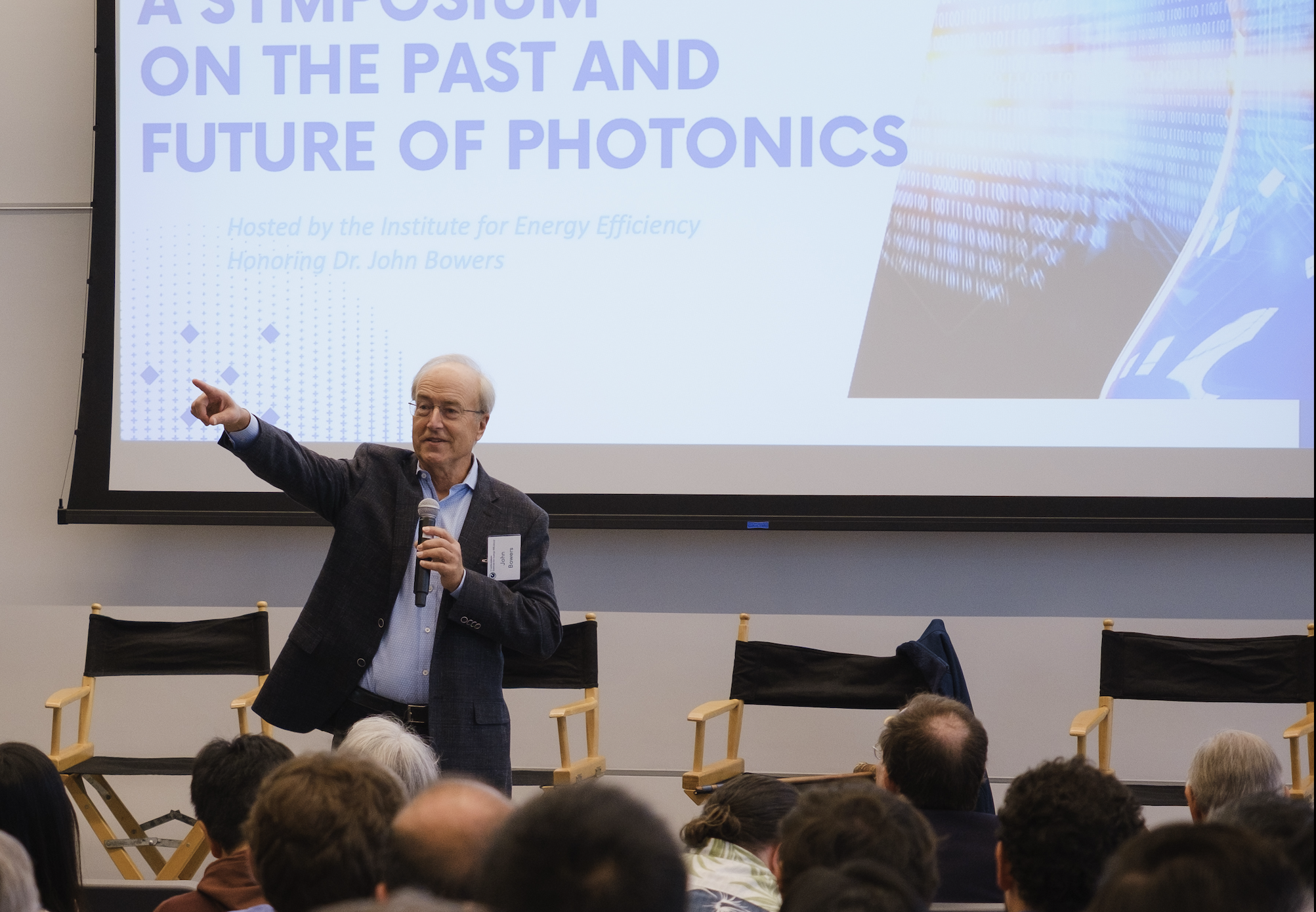
After 38 years at the University of California, Santa Barbara (UCSB), Professor John Bowers (pictured) is stepping away from teaching and administrative roles to focus on research.
He welcomes the time it will free for biking and golf. He will also be able to linger, not rush, when travelling. On a recent trip to Saudi Arabia, what would have centered around a day-event became a week-long visit.
Bowers’ career includes significant contributions to laser integration and silicon photonics, mentoring some 85 PhD students, and helping found six start-ups, two of which he was the CEO.
Early Influences
Bowers’ interest in science took root while at high school. He built oscilloscopes and power supplies using Heathkits, then popular educational assemblies for electronics enthusiasts. He was also inspired by his physics and chemistry teachers, subjects he majored in at the University of Minnesota.
A challenging experience led him to focus solely on physics: “I took organic chemistry and hated it,” says Bowers. “I went, ‘Okay, let’s stick to inorganic materials.’”
Bowers became drawn to high-energy physics and worked in a group conducting experiments at Fermilab and Argonne National Laboratories. Late-night shifts – 10 PM to 6 AM – offered hands-on learning, but a turning point came when his mentor was denied tenure. “My white knight fell off his horse,” he says.
He switched to applied physics at Stanford, where he explored gallium arsenide and silicon acoustic devices, working under the supervision of the late Gordon Kino, a leading figure in applied physics and electrical engineering.
Bowers then switched to fibre optics, working in a group that was an early leader in single-mode optical fibre. “It was a period when fibre optics was just taking off,” says Bowers. “In 1978, they did the first 50-megabit transmission system, and OFC [the premier optical fibre conference] was just starting.”
Bell Labs and fibre optics
After gaining his doctorate, Bowers joined Bell Labs, where his work focused on the devices—high-speed lasers and photodetectors—used for fibre transmission. He was part of a team that scaled fibre-optic systems from 2 to 16 gigabits per second. However, the 1984 AT&T breakup signalled funding challenges, with Bell Labs losing two-thirds of its financial support.
Seeking a more stable environment, Bowers joined UCSB in 1987. He was attracted by its expertise in semiconductors and lasers, including the presence of the late Herbert Kroemer, who went on to win the 2000 Nobel Prize in Physics. Kroemer developed the double heterostructure laser and played a big part in enticing Bowers to join. Bowers was tasked with continuing the laser work, something he has done for the last 40 years.
“Coming to Santa Barbara was brilliant, in retrospect,” says Bowers, citing its strong collaborative culture and a then newly formed materials department.
Integrated lasers
At UCSB, Bowers worked on integrated circuits using indium phosphide, including tunable lasers and 3D stacking of photonic devices.
At the same time, the field of silicon photonics was starting after Richard Soref wrote a seminal paper proposing silicon as an optical material for photonic integrated circuits (PIC).
“We all knew that silicon was a terrible light emitter because it is an indirect band-gap material,” says Bowers. “So when people started talking about silicon photonics, I kept thinking: ‘Well, that is fine, but you need a light source, and if you don’t have a light source, it’ll never become important.’”
Bowers tackled integrating lasers onto silicon to address the critical need for an on-chip light source. He partnered with Intel’s Mario Paniccia and his team, which had made tremendous progress developing a silicon Raman lasers with higher powers and narrower linewidths.
“It was very exciting, but you still needed a pump laser; a Raman laser is just a wavelength converter from one wavelength to another,” says Bowers. “So I focused on the pump laser end, and the collaboration benefitted us both.”
Intel commercialised the resulting integrated laser design and sold millions of silicon-photonics-based pluggable transceivers.
“Our original vision was verified: the idea that if you have CMOS processing, the yields will be better, the performance will be better, the cost will be lower, and it scales a lot better,” says Bowers. “All that has proven to be true.
Is Bowers surprised that integrated laser designs are not more widespread?
All the big silicon photonics companies, including foundry TSMC, will incorporate lasers into their products, he says, just as Intel has done and Infinera before that.
Infinera, an indium phosphide photonic integrated circuit (PIC) company now acquired by Nokia, claimed that integration would improve the reliability and lower the cost, says Bowers: “Infinera did prove that with indium phosphide and Intel did the same thing for silicon.”
The indium phosphide transceiver has a typical failure rate of 10 FIT (failures per ten billion hours), and if there are 10 laser devices, the FIT rises to 100, he says. By contrast, Intel’s design has a FIT of 0.1, and so with 10, the FIT becomes on the order of 1.
Silicon lasers are more reliable because there’s no III-V material exposed anywhere. Silicon or silicon dioxide facets eliminate the standard degradation mechanisms in III-V materials. This enables non-hermetic packaging, reducing costs and enabling rapid scaling.
According to Bowers, Intel scaled to a million transceivers in one year. Such rapid scaling to high volumes is important for many applications, and that is where silicon photonics has an advantage.
“Different things motivate different people. For me, it’s not about money, it’s more about your impact, particularly on students and research fields. To the extent that I’ve contributed to silicon photonics becoming important and dynamic, that is something I’m proud of.”
-Professor John Bowers
Optical device trends
Bowers notes how the rise of AI has surprised everyone, not just in terms of the number of accelerator chips needed but their input-output (I/O) requirements.
Copper has been the main transmission medium since the beginning of semiconductor chips, but that is now being displaced by optics – silicon photonics in particular – for the communications needs of very high bandwidth chips. He also cites companies like Broadcom and Nvidia shipping co-packaged optics (CPO) for their switching chips and platforms.
“Optics is the only economic way to proceed, you have to work on 3D stacking of chips coupled with modern packaging techniques,” he says, adding that the need for high yield and high reliability has been driving the work on III-V lasers on silicon.
One current research focus for Bowers is quantum dot lasers, which reduce the line width and minimise reflection sensitivity by 40dB. This eliminates the need for costly isolators in datacom transceivers.
Quantum dot devices also show exceptional durability, with lifetimes for epitaxial lasers on silicon a million times longer than quantum well devices on silicon and 10 times less sensitivity to radiation damage, as shown in a recent Sandia National Labs study for space applications.
Another area of interest is modulators for silicon photonics. Bowers says his group is working on sending data at 400 gigabits-per-wavelength using ‘slow light’ modulators. These optical devices modulate the intensity or phase, of light. Slowing down the light improves its interaction in the material, improving efficiency and reducing device size and capacitance. He sees such modulators is an important innovation.
“Those innovations will keep happening; we’re not limited in terms of speed by the modulator,” says Bowers, who also notes the progress in thin-film lithium niobate modulators, which he sees as benefiting silicon photonics, “We have written papers suggesting most of the devices may be III-V,” says Bowers, and the same applies to materials such as thin-film lithium niobate.
“I believe that as photonic systems become more complex, with more lasers and amplifiers, then everyone will be forced to integrate,” says Bowers.
Other applications
Beyond datacom, Bowers sees silicon photonics enabling LIDAR, medical sensors, and optical clocks. His work on low-noise lasers, coupled to silicon nitride waveguides, reduces phase noise by 60dB, enhancing sensor sensitivity. “If you can reduce the frequency noise by 60dB, then that makes it either 60dB more efficient, or you need 60dB less power,” he says.
Applications include frequency-based sensors for gas detection, rotation sensing, and navigation, where resonance frequency shifts detect environmental changes.
Other emerging applications include optical clocks for precise timing in navigation, replacing quartz oscillators. “You can now make very quiet clocks, and at some point we can integrate all the elements,” Bowers says, envisioning chip-scale solutions.
Mentorship and entrepreneurial contributions
Bowers’ impact extends to mentorship, guiding so many PhD students who have gone on to achieve great success.
“It’s very gratifying to see that progression from an incoming student who doesn’t know what an oscilloscope is to someone who’s running a group of 500 people,” he says.
Alan Liu, former student and now CEO of the quantum dot photonics start-up Quintessent, talks about how Bowers calls on his students to ‘change the world’.
Liu says it is not just about pushing the frontiers of science but also about having a tangible impact on society through technology and entrepreneurship.”
Bowers co-founded UCSB’s Technology Management Department and taught entrepreneurship for 30 years. Drawing on mentors like Milton Chang, he focused on common start-up pitfalls: “Most companies fail for the same set of reasons.”
His own CEO start-up experience informed his teaching, highlighting interdisciplinary skills and team dynamics.
Mario Paniccia, CEO of Anello Photonics, who collaborated with Bowers as part of the Intel integrated laser work, highlights Bowers’ entrepreneurial skills.
“John is one of the few professors who are not only brilliant and technically a world expert – in John’s case, in III-V materials – but also business savvy and entrepreneurial,” says Paniccia. “He is not afraid to take risks and can pick and hire the best.”
Photonics’ future roadmap
Bowers compares photonics’ trajectory to electronics in the 1970s, when competing CMOS technologies standardised, shifting designers’ focus from device development to complex circuits. “Just like in the 1970s, there were 10 competing transistor technologies; the same consolidation will happen in photonics,” he says.
Standardised photonic components will be integrated into process design kits (PDKs), redirecting research toward systems like sensors and optical clocks.
“We’re not at the end, we’re at the beginning of photonics,” emphasises Bowers.
Reflections
Looking back, would he have done anything differently?
A prolonged pause follows: “I’ve been very happy with the choices I have made,” says Bowers, grateful for his time at UCSB and his role in advancing silicon photonics.
Meanwhile, Bowers’ appetite for photonics remains unwavering: “The need for photonic communication, getting down to the chip level, is just going to keep exploding,” he says.


Lumentum's optical circuit switch for AI data centres
Part 3: Data Centre Switching
The resurgence of optical circuit switches for use in data centres is gaining momentum, driven by artificial intelligence (AI) workloads that require scalable connectivity.
Lumentum is one of several companies that showcased an optical circuit switch at the OFC event in San Francisco in March. Lumentum’s R300 switch connects optically the 300 input ports to any of the 300 output ports. The optical circuit switch uses micro-electro-mechanical systems (MEMS), tiny mirrors that move electrostatically, to direct light from an input port to one of the 300 output ports.
The R300 addresses the network needs of AI data centres, helping link large numbers of AI accelerator chips such as graphics processor units (GPUs).
“We’ve been talking to all the hyperscalers in North America and China,” says Peter Roorda, general manager of the switching business unit at Lumentum. “The interest is pretty broad for the applications of interconnecting GPUs and AI clusters; that’s the exciting one.”
Optical circuit switches
In a large-scale data centre, two or three tiers of electrical switch platforms link the many servers’ processors. The number of tiers needed depends on the overall processor count. The same applies to the back-end network used for AI workloads. These tiers of electrical switches are arranged in what is referred to as a Clos or “Fat Tree” architecture.
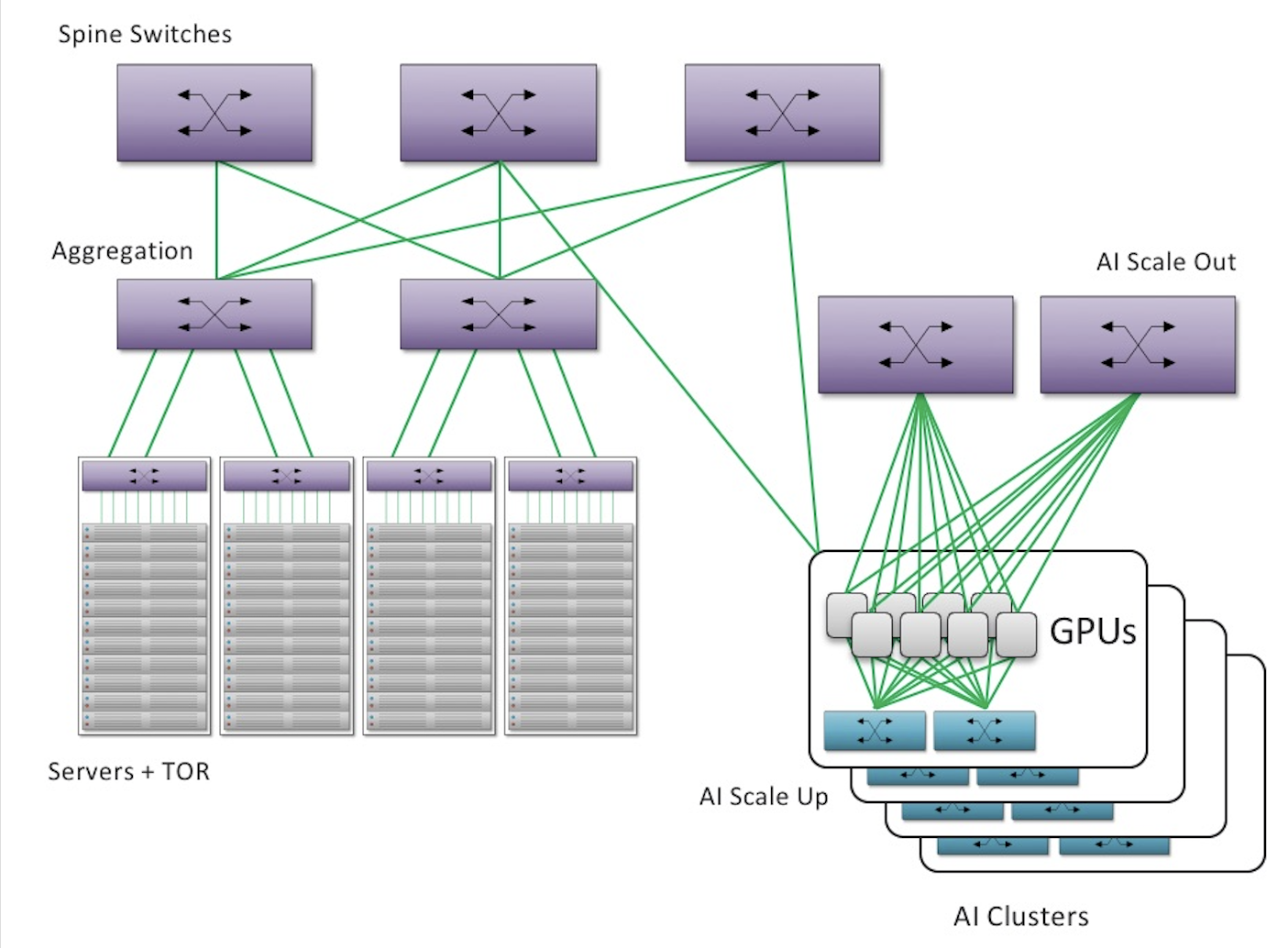
Google presented a paper in 2022 revealing that it had been using an internally developed MEMS-based optical circuit switch for several years. Google used its optical circuit switches to replace all the top-tier ‘spine’ layer electrical switches across its data centres, resulting in significant cost and power savings.
Google subsequently revealed a second use for its switches to directly connect between racks of its tensor processor unit (TPU) accelerator chips. Google can move workloads across thousands of TPUs in a cluster, efficiently using its hardware and bypassing a rack when a fault arises.
Google’s revelation rejuvenated interest in optical switch technology, and at OFC, Lumentum showed its first R300 optical switch product in operation.
Unlike packet switches, which use silicon to process data at the packet level, an optical circuit switch sets up a fixed, point-to-point optical connection, akin to a telephone switchboard, for the duration of a session.
The optical switch is ideal for scenarios where large, sustained data flows are required, such as in AI training clusters.

Merits
The optical circuit switch’s benefits include cost and power savings and improved latency. Optical-based switch ports are data-rate independent. They can support 400 gigabit, 800 gigabit, and soon 1.6-terabit links without requiring an upgrade.
“Now, it’s not apples to apples; the optical circuit switch is not a packet switch,” says Roorda. “It’s just a dumb circuit switch, so there must be control plane software to manage it.” However, the cost, power, space savings, and port transparency incentives suffice for the hyperscalers to invest in the technology.
The MEMS-based R300
Lumentum has a 20-year history using MEMS. It first used the technology in its wavelength-selective switches used in telecom networks before the company adopted liquid crystal on silicon (LCOS) technology.
“We have 150,000 MEMS-based wavelength selective switches in the field,” says Roorda. “This gives us a lot of confidence about their reliability.”
MEMS-based switches are renowned for their manufacturing complexity, and Lumentum has experience in MEMS.
“This is a key claim as users are worried about the mechanical aspect of MEMS’ reliability,” says Michael Frankel, an analyst at LightCounting Market Research, which published an April report covering Ethernet, Infiniband and optical switches in cloud data centres. “Having a reliable volume manufacturer is critical.”
In its system implementation, Google revealed that it uses bi-directional transceivers in conjunction with the OCS.
“Using bi-directional ports is clever because you get to double the ports out of your optical circuit switch for the same money, “says Mike DeMerchant, Lumentum’s senior director of product line management, optical circuit switch. “But then you need customised, non-standard transceivers.”
A bi-directional design complicates the control plane management software because bi-directional transponders effectively create two sets of connections. “The two sets of transceivers can only talk in a limited fashion between each other, so you have to manage that additional control plane complexity,” says DeMerchant.
Lumentum enters the market with a 300×300 radix switch. Some customers have asked about a 1,000×1,000 port switch. From a connectivity perspective, bigger is better, says Roorda. “But bigger is also harder; if there is a problem with that switch, the consequences of a failure—the blast radius—are larger too,” he says.

Lumentum says there are requests for smaller optical circuit switches and expects to offer a portfolio of different-sized products in the next two years.
The R300 switch is cited as having a 3dB insertion loss, but Roorda says the typical performance is close to 1.5dB at the start of life. “And 3dB is good enough for using a standard off-the-shelf -FR4 or a -DR4 or -DR8 optical module [with the switch],” says Roorda.
A 400G QSFP-DD FR4 module uses four wavelengths on a single-mode fibre and has a reach of 2km, whereas a DR4 or DR8 uses a single wavelength on each fibre and has 4 or 8 single-mode fibre outputs, respectively, with a reach of 500m.
An FR4 interface is ideal with an optical circuit switch since multiple wavelengths are on a single fibre and can be routed through one port. However, many operators use DR4 and DR8 interfaces and are exploring using such transceivers.
“More ports would be consumed, diluting the cost-benefit, but the power savings would still be significant,” says Roorda.Additionally, in some applications, individually routing and recombining the separate ‘rails’ of DR4 or DR8 offer greater networking granularity. Here, the optical circuit switch still provides value, he says.
One issue with an optical circuit switch compared to an electrical-based one is that the optics go through both optical ports before reaching the destination transceiver, adding an extra 3dB loss. By contrast, for an electrical switch, the signal is regenerated optically by the pluggable transceiver at the output port.
LightCounting’s Frankel also highlights the switch’s loss numbers. “Lumentum’s claim of a low loss – under 2dB – and a low back reflection (some 60dB) are potential differentiators,” he says. “It is also a broadband design – capable of operating across the O-, C- and L-bands: O-band for data centre and C+L for telecom.”
Software and Hyperscaler Control
Lumentum is controlling the switch using the open-source SONiC [Software for Open Networking in the Cloud] network operating system (NOS), based on Linux. The hyperscalers will add the higher-level control plane management software using their proprietary software.
“It’s the basic control features for the optics, so we’re not looking to get into the higher control plane,” says DeMerchant.
Challenges and Scalability
Designing a 300×300 optical circuit switch is complicated. “It’s a lot of mirrors,” says Roorda. “You’ve got to align them, so it is a complicated, free-space, optical design.”
Reliability and scalable manufacturing are hurdles. “The ability to build these things at scale is the big challenge,” says Roorda. Lumentum argues that its stable MEMS design results in a reliable, simpler, and less costly switch.Lumentum envisions data centres evolving to use a hybrid switching architecture, blending optical circuit switches with Ethernet switches.
Roorda compares it to how telecom networks transitioned to using reconfigurable optical add-drop multiplexers (ROADMs).”It’ll be hybridised with packet switches because you need to sort the packets sometimes,” says Roorda.
Future developments may include multi-wavelength switching and telecom applications for optical circuit switches. “For sure, it is something that people are talking about,” he adds.
Lumentum says its R300 will be generally available in the second half of this year.