

Books of the year 2016 - Part 2
Simon Poole, director, new business ventures, Finisar Australia
The highlight of the year in fiction was reading The Shepherds’ Crown, the last of the Discworld novels from the wonderful Terry Pratchett. He, along with his cast of extraordinary characters, including the marvellous Tiffany Aching – a fabulous role model for teenage girls, held up a mirror to the foibles and strengths of our humanity, and will be sorely missed.
Farewell also to the fearless Christoph Hitchens; re-reading God is not Great reminded me of the strengths of his analysis and the importance of ethics and morals in our dealings with each other.
From a work perspective, The Other Side of Innovation: Solving the Execution Challenge by Vijay Govindarajan and Chris Trimble is one of the few books about innovation that tries to address the real issues which are, to my mind, around the implementation of the ideas rather than their generation. Recommended for anyone who has to manage innovation within an existing organisation with all its strengths and weaknesses.
Loudon Blair, senior director, corporate strategy office, Ciena
Three books read this year caused me to innocently stumble upon a recurring theme of how we are responding to rapid advances in communications technology.
As an adult, reading the 19th century classic, Alice’s Adventures in Wonderland by Lewis Carroll, provided a fascinating insight into Carroll’s creative mind. I was especially intrigued by how he plays with the reader’s interpretation of the English language - how we can say one thing and be understood to have said something else. It is a reminder in these days of email misinterpretation and text shorthand to be clear about what we intend to communicate.
The Alchemist by Paulo Coelho is a story of a shepherd boy seeking his personal legend and has multiple layers of interpretation. Coelho talks about how your personal legend is something that you have always wanted to accomplish. You know what it is when you are young because, at that age, everything is possible. But as you get older, you can lose track of your goal as some “mysterious force” convinces you that it is impossible to realize. However, Coelho says that when you really want something, “the universe conspires in helping you achieve it”.
I think there is a lot to be said for this idea that there is a universe of help out there to steer us towards our goals. As a society, we have never been more connected. Through the Internet and social networks, we have created a highly interactive and diverse networking universe which helps us attain our goals on a daily basis.
Drive: The Surprising Truth About What Motivates Us by Daniel H. Pink explores the issue of motivation in the workplace. Pink discusses how, as society evolves, traditional motivational techniques that may have been useful in the past, can be counter-productive in the future.
His discussion on how our workplace is evolving from routine rule-based tasks to non-routine conceptual tasks sidetracked me on to a commonly explored concern today about how artificial intelligence and robotics may replace many of today’s jobs.
As an engineer working to develop the next generation of the Internet, this caused me to reflect on the responsibility and implications of the future we will create as technical innovators.

Books of the year 2016 - Part 1
Each year Gazettabyte asks industry figures to comment on books that they recommend. Here are BT's Andrew Lord's and Cignal's Andrew Schmitt's recommendations to kick off this year's reviews.
Andrew Lord, Head of Optical Research at BT.
Quantum technologies are flavour of the month, with huge government investments from around the world. The title and cover of Bananaworld: Quantum Mechanics for Primates by Jeffrey Bub, suggest a book that will ‘unpeel’ a tough but increasingly important subject for general readers.
The book itself is, however, far deeper than its cover suggests, going way beyond the basics, and attempting to forge a link between quantum mechanics and the structure of information.
Imagining a strange world in which bananas exhibit quantum effects might just confuse rather than aid the general reader, but those wishing to probe the deeper information theory questions will find much here to ‘chew on’.
Andrew Schmitt, founder of Cignal AI
Starting a company with a wide customer base requires a lot of ‘infrastructure’ that I didn’t realise would consume so much time. I like to build things so it has been a real thrill but also a lot of work. I think I gravitated towards fun things to read as a result of having my hands full. All of them were outstanding.
A Fire Upon The Deep by Vernor Vinge, and Seveneves by Neal Stephenson require a great deal of mental fortitude but unfold on such a grand scale that they are very appealing. Stephenson is a favourite of mine, ever since reading Snow Crash in college. He’s like William Gibson except with a sense of humour.
I also reread Fahrenheit 451 by Ray Bradbury. Let’s just say it felt a lot less sci-fi the second time around. If you look at the monoculture of ideas in politics, education, even business – it’s a dangerous situation. A big reason populism is emerging in the West is because people are sick of getting told what to think by “smart” people, and the perceived loss of control. It is a healthy rebellion despite a lot of the downside because the alternative – everyone thinking in lockstep – is far more dangerous.
I had greater ambitions for non-fiction and have several unread Kindle books on my iPhone. I wanted to read The Hard Thing about Hard Things from Ben Horowitz but have not. Other titles include The Comeback: How Larry Ellison's Team Won the America's Cup by G. Bruce Knecht and American Sniper: The Autobiography of the Most Lethal Sniper in U.S. Military History by Chris Kyle.
The book Elon Musk: Tesla, SpaceX, and the Quest for a Fantastic Future by Ashlee Vance is a great read. There are a lot of haters out there who don’t like Tesla for various reasons – his government funding, climate-change skeptics who don’t like his views, and who knows what else? Fine by me. But after reading this book you have to acknowledge the massive, ridiculous undertaking of starting both a rocket company and an electric car company. It is insane. Yet this guy has managed to keep the wheels from coming off so far. He has burned through people, capital, and relationships but the results are impressive.
He may not be everyone's idea of a nice guy – whatever - but he is a walking, breathing, living image of the American ethos of invention and capitalism. Whatever money it costs the US government is more than offset by the example he sets for others that anything is possible provided you have enough time, money, and guts.
Books in 2015 - Final Part
Sterling Perring, senior analyst, Heavy Reading
My ambitions to read far exceed my actual reading output, and because I have such a backlog of books on my reading list, I generally don’t read the latest.
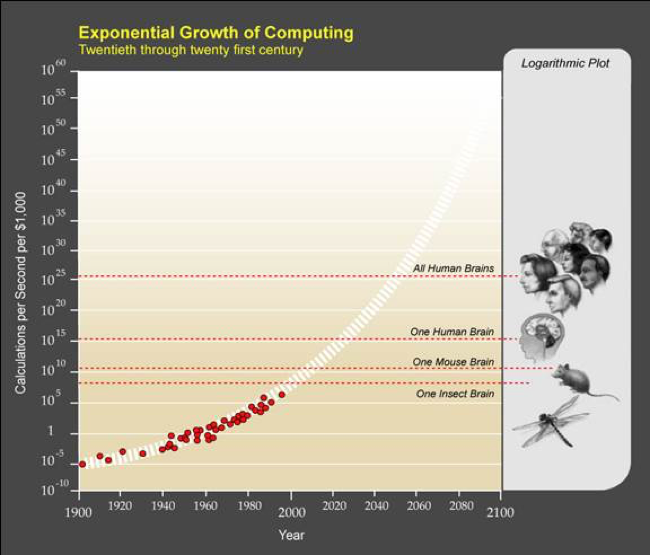 Source: The Age of Spiritual Machines
I have long been fascinated by a graphic from futurist Ray Kurweil which depicts the exponential growth of computing and plots it against living intelligence. The graphic is from Kurzweil’s 1999 book on artificial intelligence The Age of Spiritual Machines: When Computers Exceed Human Intelligence, which I read in 2015.
The book contains several predictions, but this one about computer intelligence vastly exceeding collective human intelligence in our own lifetimes interested me most. Kurzweil translates the brain power of living things into computational speeds and storage capacity and plots them against exponentially growing computing power, based on Moore’s law and its expected successors.
He writes that by 2020, a $1,000 personal computer will have enough speed and memory to match the human brain. But science fiction (and beyond) becomes reality quickly because computational power continues to grow exponentially while collective human intelligence continues on its plodding linear progression. The inevitable future, in Kurzweil’s scenario, blends human intelligence and AI to the point where by the end of this century, it’s no longer possible or relevant to distinguish between the two.
There have been many criticisms of Kurzweil’s theory and methodologies on AI evolution, but reading a futures book 15 years after publication gives you the ability to validate its predictions. On this, Kurzweil has been quite amazing, including self-driving cars, headset-based virtual reality gaming (which I experienced this year at the mall), tablet computing coming of age in 2009, and the coming end of Moore’s law, to name a few in this book that struck me as astoundingly accurate.
Of newer books, I read Yuval Noah Harari’s Sapiens: A Brief History of Humankind (originally published in Hebrew in 2011 but first published in English in 2014). I was attracted to this book because it provides a succinct summary of millions of years of human history and, from its high level vantage point, is able to draw fascinating conclusions about why our human species of sapiens has been so successful.
Harari’s thesis is that it’s not our thumbs, or the invention of fire, or even our languages that led to our dominance over all animals and other humans but rather the creation of fictional constructs – enabled by our languages – that unified sapiens in collective groups vastly larger than otherwise achievable.
Here, the book can strike some nerves because all religions qualify as fictional constructs, but he’s really talking about all intangible constructs under which humans can massively align themselves, including nations, empires, corporations, money and even capitalism. Without fictional constructs, he writes, it’s hard for humans to form meaningful social organizations beyond 150 people – a number also famously cited by Malcolm Gladwell in The Tipping Point.
In fiction, I completed the fifth and final published installment of George RR Martin’s Song of Ice and Fire Series, A Dance with Dragons. I’ve been drawn to this series in large part, I think, because the simpler medieval setting is such a stark contrast to the ultra-high-tech world in which we live and work.
I thought I had timed the reading to coincide with the release of the 6th book, The Winds of Winter, but I’ve heard that the book is delayed again. Fortunately, I’m still two seasons behind on the HBO series.
Aaron Zilkie, vice president of engineering at Rockley Photonics
I recommend the risk assessment principles in the book, Projects at Warp - Speed with QRPD: The Definitive Guidebook to Quality Rapid Product Development by Adam Josephs, Cinda Voegtli, and Orion Moshe Kopelman.
These principles provide valuable one-stop teaching of fundamental principles for the often under-utilised and taken-for-granted engineering practice of technology risk management and prioritisation. This is an important subject for technology and R&D managers in small-to-medium size technology companies to include in their thinking as they perform the challenging task of selecting new technologies to make next-generation products and product improvements.
The book Who: The A Method for Hiring by Geoff Smart and Randy Street teaches good practices for focused hiring, to build A-teams in technology companies, a topic of critical importance for the rapid success of start-up companies that is not taught in schools.
Tom Foremski, SiliconValleyWatcher
Return of a King: The Battle for Afghanistan, 1839-42 by William Dalrymple. This is one of the best reads, an amazing story! Only one survivor on an old donkey.
Books in 2015 - Part 2
Yuriy Babenko, senior network architect, Deutsche Telekom
The books I particularly enjoyed in 2015 dealt with creativity, strategy, and social and organisational development.
People working in IT are often right-brained people; we try to make our decisions rationally, verifying hypotheses and build scenarios and strategies. An alternative that challenges this status quo and looks at issues from a different perspective is Thinkertoys by Michael Michalko.
Thinkertoys develops creativity using helpful tools and techniques that show problems in a different light that can help a person stumble unexpectedly on a better solution.
Some of the methods are well known such as mind-mapping and "what if" techniques but there is a bunch of intriguing new approaches. One of my favourites this year, dubbed Clever Trevor, is that specialisation limits our options, whereas many breakthrough ideas come from non-experts in a particular field. It is thus essential to talk to people outside your field and bounce ideas with them. It leads to the surprising realisation that many problems are common across fields.
The book offers a range of practical exercises, so grab them and apply.
I found From Third World to First: The Singapore Story - 1965-2000 by by Lee Kuan Yew, the founder of modern Singapore, inspiring.
Over 700 pages, Mr. Lee describes the country’s journey to ‘create a First World oasis in a Third World region". He never tired to learn, benchmark and optimise. The book offers perspectives on how to stay confident no matter what happens, focus and execute the set strategy; the importance of reputation and established ties, and fact-based reasoning and argumentation.
Lessons can be drawn here for either organisational development or business development in general. You need to know your strengths, focus on them, not rush and become world class in them. To me, there is a direct link to a resource-based approach, or strategic capability analysis here.
The massive Strategy: A History by Lawrence Freeman promises to be the reference book on strategy, strategic history and strategic thinking.
Starting with the origins of strategy including sources such as The Bible, the Greeks and Sun Tzu, the author covers systematically, and with a distinct English touch, the development of strategic thinking. There are no mathematics or decision matrices here, but one is offered comprehensive coverage of relevant authors, thinkers and methods in a historical context.
Thus, for instance, Chapter 30 (yes, there are a lot of chapters) offers an account of the main thinkers of strategic management of the 20th century including Peter Drucker, Kenneth Andrews, Igor Ansoff and Henry Mintzberg.
The book offers a reference for any strategy-related questions, in both personal or business life, with at least 100 pages of annotated, detailed footnotes. I will keep this book alive on my table for months to come.
The last book to highlight is Continuous Delivery by Jez Humble and David Farley.
The book is a complete resource for software delivery in a continuous fashion. Describing the whole lifecycle from initial development, prototyping, testing and finally releasing and operations, the book is a helpful reference in understanding how companies as diverse as Facebook, Google, Netflix, Tesla or Etsy develop and deliver software.
With roots in the Toyota Production System, continuous delivery emphasises empowerment of small teams, the creation of feedback processes, continuous practise, the highest level of automation and repeatability.
Perhaps the most important recommendation is that for a product to be successful, ‘the team succeeds or fails’. Given the levels of ever-rising complexity and specialisation, the recommendation should be taken seriously.
Roy Rubenstein, Gazettabyte
I asked an academic friend to suggest a textbook that he recommends to his students on a subject of interest. Students don’t really read textbooks anymore, he said, they get most of their information from the Internet.
How can this be? Textbooks are the go-to resource to uncover a new topic. But then I was at university before the age of the Internet. His comment also made me wonder if I could do better finding information online.
Two textbooks I got in 2015 concerned silicon photonics. The first, entitled Handbook of Silicon Photonics provides a comprehensive survey of the subject from noted academics involved in this emerging technology. At 800-pages-plus, the volume packs a huge amount of detail. My one complaint with such compilation books is that they tend to promote the work and viewpoints of the contributors. That said, the editors Laurent Vivien and Lorenzo Pavesi have done a good job and while the chapters are specialist, effort is made to retain the reader.
The second silicon photonics book I’d recommend, especially from someone interested in circuit design, is Silicon Photonics Design: From Devices to Systems by Lukas Chrostowski and Michael Hochberg. The book looks at the design and modelling of the key silicon photonics building blocks and assumes the reader is familiar with Matlab and EDA tools. More emphasis is given to the building blocks than systems but the book is important for two reasons: it is neither a textbook nor a compendium of the latest research, and is written for engineers to get them designing. [1]
I also got round to reading a reflective essay by Robert W. Lucky included in a special 100th anniversary edition of the Proceedings of the IEEE magazine, published in 2012. Lucky started his career as an electrical engineer at Bell Labs in 1961. In his piece he talks about the idea of exponential progress and cites Moore’s law. “When I look back on my frame of reference in 1962, I realise that I had no concept of the inevitability of constant change,” he says.
1962 was fertile with potential. Can we say the same about technology today? Lucky doesn’t think so but accepts that maybe such fertility is only evident in retrospect: “We took the low-hanging fruit. I have no idea what is growing further up the tree.”
A common theme of some of the books I read in the last year is storytelling.
I read journalist Barry Newman’s book News to Me: Finding and Writing Colorful Feature Stories that gives advice on writing. Newman has been writing colour pieces for the Wall Street Journal for over four decades: “I’m a machine operator. I bang keys to make words.”
I also recommend Storytelling with Data: A Data Visualization Guide for Business Professionals by Cole Nussbaumer Knaflic about how best to present one’s data.
I discovered Abigail Thomas’s memoirs A Three Dog Life: A Memoir and What Comes Next and How to Like It. She writes beautifully and a chapter of hers may only be a paragraph. Storytelling need not be long.
Three other books I hugely enjoyed were Atul Gawande's Being Mortal: Medicine and What Matters in the End, Roger Cohen’s The Girl from Human Street: A Jewish Family Odyssey and the late Oliver Sacks’ autobiography On the Move: A Life. Sacks was a compulsive writer and made sure he was never far away from a notebook and pen, even when going swimming. A great habit to embrace.
Lastly, if I had to choose one book - a profound work and a book of our age - it is One of Us: The Story of Anders Breivik and the Massacre in Norway by Asne Seierstad.
For Books in 2015 - Part 1, click here
Further Information
[1] There is an online course that includes silicon photonics design, fabrication and data analysis and which uses the book. For details, click here
Books in 2015 - Part 1
Andrew Schmitt, founder and CEO at Cignal AI
I didn’t read that much this year but I did read The Wright Brothers by David McCullough. That was outstanding. McCullough is a great historical author and wrote a book that was both a biography of the Wrights as well as a narrative of their efforts to build the first powered airplane.
I didn't know of all of the other simultaneous, better-financed efforts that fell far short of the efforts of two brothers from Dayton, Ohio. I also was unaware of how the effort transfixed the world when they did complete it.
There is so much chattering today about Lean Development and Devops (how many people use that word and really know what it means?) as if these are new developments. But the Wrights are a case study in lean development and simultaneous development and deployment. Read this and see Devops in action over 100 years ago and I'm sure there are lots more examples.
Rupert Baines, CEO at UltraSoC
This year has been rather frantic: starting a new role and being very full on has meant I've read less than I usually do. Perhaps that's wrong: a friend and mentor advises this precisely is the time to read more, for sanity and perspective. But she is wiser than I, or perhaps more self-disciplined.
Inevitably, reading less does not mean buying less! The Japanese have a term which is not yet a loanword but ought to be: Tsundoku.
Many of the books I have read have been non-taxing but fun (Trigger Mortis: the new James Bond; The Martian; Robert Harris' Cicero trilogy etc.) but I have read a few brilliant books worth recommending.
The Narrow Road To The Deep North by Richard Flanagan deservedly won the Booker prize last year and is a lovely, haunting, tragic novel. It describes an Australian surgeon who is captured and becomes a war hero as commander of a Japanese PoW camp - and the consequences for him and others after the war. It is not an easy read, harrowing and sad. But brilliant scenes, astonishingly vivid characters and insights on what it means to be "a good man" and the effect of war make the hard work worthwhile. A brilliant book.
A Place of Greater Safety by Hilary Mantel. I loved Wolf Hall (if you haven't read it, then do so) so read her earlier historic novel. Thank God for e-books because this is huge - and if I had realised how hefty it was I might not have read it. Set in the French Revolution, this describes in feverish intensity and hyper-real vividness the run-up to revolution, the Bastille and then the Terror. Robespierre, St. Just, Danton, and many, many more feature in utterly fascinating, compelling detail. There is a lot of information, and a LOT of pages but fascinating and enjoyable.
I really enjoy David Mitchell's novels. A clever, complex, interwoven set of stories (within the books and between them). The Bone Clocks was a fun novel: flitting through characters and decades (1984-2043) in a gripping science fiction/ adventure romp. Slade House is a shorter Halloween horror-ride of a creepy page-turner.
In non-fiction, it is interesting I haven't read much this year.
I finally read Thinking, Fast and Slow by Daniel Kahneman. To be honest, it is a fascinating insight but suffers the fault of so many business books: it has one great idea, but that isn't enough to support a whole book. Reading it late and being aware of that idea I found myself turning pages rather fast as a familiar concept was explained and repeated. That is perhaps ironic in a book about modes of thinking and contrasting quick impressions with deeper reflection.
A slight cheat as I haven't read them yet (remember what I said about book piles?), are SuperForecasting: The Art and Science of Forecasting by Philip Tetlock and Dan Gardner and Act Like a Leader, Think Like a Leader by Herminia Ibarra.
Both were highly recommended by several people independently. Both have travelled the world on my Kindle without being started yet. Maybe over the holidays.
For Part 2, click here
The quiet period of silicon photonics
Michael Hochberg discusses his book on silicon photonics and the status of the technology. Hochberg is director of R&D at Coriant's Advanced Technology Group. Previously he has been an Associate Professor at the University of Delaware and at the National University of Singapore. He was also a director at the Optoelectronic Systems Integration in Silicon (OpSIS) foundry, and was a co-founder of silicon photonics start-up, Luxtera.
Part 2: An R&D perspective
If you are going to write a book on silicon photonics, you might as well make it different. That is the goal of Michael Hochberg and co-author Lukas Chrostowski, who have published a book on the topic.
 Michael HochbergHochberg says there is no shortage of excellent theoretical textbooks and titles that survey the latest silicon photonics research. Instead, the authors set themselves the goal of creating a design manual to help spur a new generation of designers.
The book aims to provide designers with all the necessary tools and know-how to develop silicon photonics circuits without needing to be specialists in optics.
“One of the limiting factors in terms of the growth and success of the field is how quickly can we breed up more and more designers,” says Hochberg.
The book - Silicon Photonics Design: From Devices to Systems - starts by exploring the main silicon photonics building blocks, from optical waveguides and grating couplers to modulators, photo-detectors and lasers. The book then addresses putting the parts together, with chapters on tools, fabrication, testing and packaging before finishing with system design examples.
The numerical tools used in the book are mostly based on the finite-difference time-domain method, what the authors describe as the typical workhorse in silicon photonics design. Hochberg admits that the systems software tools, in contrast, are less mature: “It is a moving target that will change year to year.”
Myths
Hochberg is also a co-author of a Nature Photonics’ paper, published in 2012, that debunks some of the myths regarding silicon photonics. “We wrote the myths paper after seeing an upswing in the ratio of hype-to-results going on,” says Hochberg.
He says part of the problem was that people were claiming silicon photonics was going to solve problems that it was plainly unsuited to address, for example integrating photonics with cutting-edge ultra-scale sub-micron electronics, for instance at 16 nm and 28 nm nodes. “That is not a practical solution for any near term problem,” says Hochberg.
More recent events, such as Intel’s announcement in February that it is delaying the commercial introduction of its silicon photonics products, highlights how bringing the technology to market is a significant engineering challenge. Instead, we are in a quiet period for silicon photonics, he says. Companies are getting into serious product mode, where they stop publishing and start focussing on building a product.
Moreover, these products - what he refers to as second-generation silicon photonics designs - are increasingly sophisticated with more functions or channels placed on the chip. “It is the standard story of almost any technology in silicon,” he says. “Silicon wins when you can do more stuff on a single chip.”
Silicon photonics and III-V
Hochberg stresses that while it is an understandable desire, it is very hard to compare the performance of silicon photonics as a whole with traditional optical components using III-V compounds. The issue being that silicon photonics comprises many different platforms where designers have made tradeoffs. The same applies to III-V compounds where there are hundreds of processes aimed at thousands of different products. “It is very hard to compare them in a generic way,” he says.
“The great advantage silicon photonics gives you is access to first-rate fabrication infrastructure,” says Hochberg. Silicon photonics offers 8- and 12-inch wafers, high volume foundries, high process control, the ability to ramp to high volumes and achieve high yields of complex-structure designs with hundreds, even thousands of components on-chip.
In contrast, III-V materials such as indium phosphide and gallium arsenide offer higher mobilities - electrons and holes move faster - and, unlike silicon, can straightforwardly emit light.
“The downside is that III-V foundries use technology processes that silicon stopped using 20 to 30 years ago,” says Hochberg. Wafers that are 2-, 3- or 4-inch in diameter, lithography that is ten times coarser than is used for silicon, process controls that are less advanced, and less automation.
If you are going to design a complex chip with lots of different components that require a predictable relationship with each other, this is where silicon tends to beat III-Vs, he says.
But the claim of large silicon wafers and huge volumes is what silicon photonics proponents have been promoting for years, and which has fed some of the false expectation associated with the emerging technology, says one industry analyst.
Hochberg counters by highlighting two trends that play in silicon photonics’ favour.
One is the well-known one of optics slowly replacing copper. This has been going on for 40 to 50 years, he says, in long haul, then in metro and now linking equipment in the data centre. “This will continue for shorter and shorter distances and then, at some point, stop,” he says. That said, Hochberg stresses that there are other applications for silicon photonics besides data communications.
“Just because you run out of opportunities at shorter and shorter reach at some point in the distant future, doesn't mean that the field collapses,” he says. “There's a lot of other cool stuff being done in silicon photonics these days with serious commercial potential.” Example applications include medical and remote sensing.
Once you can do something in silicon and do it adequately well, it tends to displace everything else from the majority of the market
The second trend he highlights is that silicon ends up dominating fields, not necessarily because it is the best choice in terms of performance but because it ends up being so cheap in scale. “Once you can do something in silicon and do it adequately well, it tends to displace everything else from the majority of the market.”
There are up-front costs of getting silicon photonics into a CMOS fab so companies have to be judicious in choosing the applications they tackle. “But once the infrastructure gets going to make a new application, the speed with which the industry can scale is just mind-blowing,” he said.
At Coriant, Hochberg leads a team that is doing advanced R&D. “We are doing advanced research with the goal to develop new technology that may eventually make its way into product.”
Does that include silicon photonics? “There is certainly an interest in silicon photonics; it is one of the things we are exploring,” says Hochberg.
Further reading:
Book: Michael Hochberg and Lukas Chrostowski, Silicon Photonics Design: From Devices to Systems, Cambridge University Press, 2015
Paper: Myths and rumours of silicon photonics, Nature Photonics, Vol 6, April 2012.
Books in 2014 - Part 2
More book recommendations, from Infonetics Research's Andrew Schmitt and ADVA Optical Networking's Ulrich Kohn.
Andrew Schmitt, principal analyst for carrier transport networking at Infonetics Research
It has been a bit of a thin year for me. And what I’ve read is a little outside the job. It seems like with all of the new media at hand I make less time for long-form consumption.
My wife is a big rower and I bought The Boys in the Boat: Nine Americans and their epic quest for gold at the 1936 Berlin Olympics by Daniel James Brown for her. But then someone recommended it to me and I started reading it before she could. It is a fantastic underdog story about the University of Washington crew team and their road to the Berlin Olympics. It has lots of colour of what 1920's and 1930's America was like and it does a good job of conveying the subtleties of the sport. The central character has everything in life stacked against him but relies on a bottomless ability to suffer both in and out of the boat to grind his way towards a goal. There is so much vivid detail about the personalities and the races that I am slightly skeptical about whether it was all accurate but a fantastic read nonetheless.
Probably my favourite book of 2014 was Zero to One: Notes on startups, or how to build the future by Peter Thiel and Blake Masters, and I’m sure I won’t be the only one to mention it. It is like the anti-business book, blowing up all of the conventional thoughts surrounding start-ups and makes for a refreshing read. Excellent signal-to-noise ratio. Blake Masters deserves more credit than he has received for canning the thoughts of Peter Thiel in a very readable way.
I re-read Fahrenheit 451 by Ray Bradbury after 20-plus years. I decided to read this again with more life experience under my belt. Sci-fi when first written 60 years ago, it now outlines a frightening and plausible adjacent reality to ours. I don’t watch much TV but I see others consumed by popular culture media; it isn’t really that different than what happens in this book – only the outcome is. Like Brave New World, it was a remarkable window to the future when written.
In the last 20 years the media’s reach and power has soared with the Internet and mobile. Media is a weapon whose power has vastly expanded from 1950's America, not unlike the exponential increase in weaponry after World War II. This creation of so many new media sources was supposed to bring many more voices and result in a more balanced media. I am no longer confident this is happening as folks can now pick and choose the media sources that re-enforce their own biases – just as the characters in 451 do. So far this has been harmless in the USA but I’m afraid of what might happen here or in other parts of the world. I suppose one benefit to the current media structure is it is still 'Antifragile', as it is free, but that is not the case in places like China.
Michael Lewis is one of those authors that can take any subject and make it interesting but Wall St. certainly grants him a home field advantage. But Flash Boys is not one of my favourite books of his. But he does a great job outlining how high-frequency trading is conducted, and allows one to understand how it happens. It is shameful that the existing market structure knowingly allows buy/ sell orders to be front-run; it was like owners of a large bazaar allowing pickpockets to roam freely. There is some colourful mention of the use of optics and the physical means of getting ahead of legitimate orders at exchange points throughout the country.
Tyler Hamilton’s story The Secret Race: Inside the hidden world of the Tour de France closed the book on the Lance Armstrong scandal, and removed the mystery and shadows of doubt about what happened during the Tour de France during those years. The book walks the reader through what happened during Lance’s big victories, and Tyler’s solo career and subsequent downfall. You realise that everyone was doping, and that competing was not possible otherwise.
I had the chance to meet Tyler, ride with him and talk about his career at length. His brother is my son’s ski coach. He told me that the big lesson here applies to everyone – at many points in your career someone is going to make you do something wrong or illegal in order to get ahead, and they will tell you that it is OK because everyone else does it. That is where you have to be prepared to find another path, even at the expense of your dreams.
Once you lose trust, which he has, you can never go back. It is an extremely important lesson for my work too.
Ulrich Kohn, director of technical marketing at ADVA Optical Networking
The book that springs to mind is Economics of Good and Evil: The Quest for Economic Meaning from Gilgamesh to Wall Street by Tomáš Sedláček. It is one of those books you buy in passing, put aside, happen to start reading months later and become completely absorbed. It combines a broad outline of the history of economics with views on social, cultural and ethical development.
What’s clear is that much thought and research went into the writing. However, there is also plenty of speculation. So much so, that it is impossible to read without a great deal of personal reflection. This is especially true with Adam Smith’s concept of the ‘Invisible Hand,’ which assumes that stronger players who strive to further their own gains act in a way that also serves society.
As a communications engineer, this intrigues me.
The Internet has changed almost every aspect of our social and business lives. It enables us to continually stay in contact with our friends, family and colleagues. We have access to almost any desired information in real-time. We’re living in an era of shared wisdom and opinions. What or who controls this? Is there an Invisible Hand that makes sure we as a society make best use of innovative communication services similar to the model described by Adam Smith in the 18th century?
The book discusses Smith’s model and outlines the criticism and limitations as the Invisible Hand that could not solve all economic problems, such as the high unemployment rates in Europe in the early 20th century. John Maynard Keynes' suggestions for governmental control as self-regulation did not lead to a fair balance among all participants in the economic system. Today, it is widely accepted that fiscal and legal measures need to act as a safeguard.
The Internet is mainly a self-controlled environment. This approach so far has served us well. An Invisible Hand made sure that all participants benefitted. However, there is increasing concern that strong players can gain value in a way that impacts that balance. Various organisations are initiating action such as the EU’s intention to strengthen the right of users on ownership of their data and their network identities. It is fascinating to see those analogies between the historic development of economic systems and the present discussion about the Internet.
Tomáš Sedláček combines economic history with social, cultural and ethical development that inspires and triggers further thought. In his book, he outlines how ethical principles shape economic systems. I would love to see a similar book on the impact of communication on our society and culture.
The development of the Internet is driven by technical capabilities and innovative applications. A reflection on the social and cultural impact of such innovation is limited to expert discussion; a wider discussion could be fruitful, and some would argue, urgently required.
For Part 1, click here
Books in 2014 - Part 1
Gazettabyte is asking various industry figures to recommend key books they have read this year.
Joe Berthold, vice president, network architecture at Ciena
Antifragile: Things that Gain from Disorder by Nassim Nicholas Taleb
I really enjoyed The Black Swan: The Impact of the Highly Improbable when I read it several years ago, so when I learned about Antifragile from a friend during a chat at an NSF workshop at the end of 2013 I decided to read it. He warned me that it was tough going at times. I enjoyed it so much I decided to reread The Black Swan and then also read Fooled by Randomness: The Hidden Role of Chance in Life and in the Markets which I had not read. Then I went back and read Antifragile again. Yes, it was tough going at times, but I found it very worthwhile book to read and ponder.
Antifragile and Taleb’s other books are relevant to life in general, but have a special relevance to the broad networking and information technology industries as they undergo sweeping change.
Revolutionary change creates great risks and great opportunities, and plenty of disorder. We all have to be aware of what Taleb calls the 'Turkey problem'. The turkey enjoys his life, convinced that the farmer who feeds him every day will do so forever. Then early in November he looses his head, and becomes the guest of honour at a Thanksgiving Dinner.
To avoid the fate of the turkey we have to avoid the misconception that we are in total control of the future, and that the narrative of the future we have created in our minds is pretty certain. Recognising the uncertainty the future holds, both in actions of customers and competitors, and avoiding paths that have limited upside potential and large downside impacts is, I believe, one of his main insights.
Thinking, Fast and Slow by Daniel Kahneman
I read this book a couple of years ago and was reminded of it again while binging on Taleb’s books, as he refers to Kahneman’s research many times. You can see a recording of them both during an interview about Antifragile at the New York Public Library on YouTube (click here)
Kahneman won a Nobel Prize for his research on how our brains work, and identified two systems in operation, the fast and slow systems. The fast system is intuitive and emotional, while the slow system is deliberate and logical. The fast system is easy, and the slow system is hard, so we often default to the fast and draw erroneous conclusions. It is a fascinating book, as it describes, in terms accessible to a layman, that we are all quite imperfect in our thinking. The real value of this book for our professional lives is he makes us aware of these systems so that we can try to avoid mental glitches that can get us into trouble.
This is a very interesting explanation of the workings of the capital markets that is worth reading from that perspective, but anecdotes at the beginning and end were particularly interesting because the subject matter was optical communications. At the beginning Michael describes the construction of a new fibre optic cable from Carteret NJ, primary data center of the NASDAQ, to Chicago. The cable, built by Spread Networks, aimed to shave a few milliseconds off the latency between the two markets in order for computer-driven traders to profit from price differences. Extreme care was taken to make the path as straight as possible, and they did shave a few milliseconds off the transit time delivered by current commercial cables.
Fast-forward through all the good stuff in the book about high frequency trading to the end. The last description is of a visit back to the vicinity of the Spread Networks cable route, and a climb up a hill to the base of a microwave tower. Others had the bright idea of using a vastly inferior technology, in this case microwave transmission, to create communications links for the same purpose between the two markets. Microwave transmission is much inferior to optical fiber in channel speed and total link capacity. But since light in glass travels about 1/3 slower than microwaves do in free space, the microwave system delivered much lower latency. It turned out the capacity of the microwave system was adequate for many purposes.
Again, the message to us in technology is not to be complacent, and not to dismiss technologies we deem to be inferior based on our current presumptions and biases. Stay vigilant and open to new ideas!
Peter Jarich, vice president for the consumer and infrastructure services, Current Analysis
Undaunted Courage: Meriwether Lewis, Thomas Jefferson, and the Opening of the American West
I wish I could say I had to think about this, but I just don’t read many books. It’s always a new year’s resolution but rarely fulfilled.
But, here's one recommendation published in 1997. I decided to get deeper into the story of Lewis and Clark after a presentation that used their story as an introduction to changes taking place in the higher education system. I realised that the theme of exploring uncharted territories applied to much of what we’re going through in telecom right now, particularly with topics like 5G and SDN/NFV. In each case, you need the right combination of vision and execution to pull off a success. You saw that same dynamic embodied in Lewis and Clark.
I’d like to say there’s a way to link Ayn Rand’s 1937 novella Anthem to telecom, but I can’t. In reality, I’m still not quite sure what to make of it.
Brandon Collings, CTO for communications and commercial optical products at JDSU
As a father of younger children, I find I read a lot of children’s books. Quite a quantity and variety come through our hands and the good ones are always considerably more enjoyable for parent and kid. Assuming that many of the readers of this review are in a similar life situation (rather than they are kindergarten-reading level), here are some favourites of my family.
- The Ugly Pumpkin, by Dave Horowitz: A charming story about self-discovery and fitting in
-
Room on the Broom, by Julia Donaldson: The cadence, rhythm and rhyme make this story possibly more fun to read than to listen to. This book has it all: adventure, witches, dragons, magic, animals, good, evil, and even a broom with first-class seats.
-
ish by Peter Reynolds: A cute story about viewing the one’s self and the world through one’s own eyes rather than through others.
Eric Hall, vice resident of business development at Aurrion
It was tough to find time in 2014 for reading outside of work, but one memorable book was The Perfect Theory: A Century of Geniuses and the Battle over General Relativity by Pedro Ferreira, a professor of Astrophysics at Oxford who traced the thinking on Einstein’s theory for several decades. The scientific narrative, in itself, provided a fascinating review of the physics, covering early theories to more complex modern views of Black Holes and featuring cameos by notable names like Steven Hawking.
Perhaps the more interesting takeaway, however, was the very circuitous route that the evolution followed. I think it is very easy to forget that scientific progress doesn’t follow a linear path driven exclusively by the 'correct solution' but is often more driven by the personalities involved. As a result, what might eventually become the more generally-accepted solution can be derailed and held up for years by the nay-saying of single strong voices (such as Einstein himself).
Such inefficiency is maybe more obvious in the product marketplace but also translates to the marketplace of ideas.
For Part 2, click here
Books in 2013 - Part 2
Steve Alexander, CTO of Ciena
David and Goliath: Underdogs, Misfits, and the Art of Battling Giants by Malcolm Gladwell.
I’ve enjoyed some of Gladwell’s earlier works such as The Tipping Point and Outliers: The Story of Success. You often have to read his material with a bit of a skeptic's eye since he usually deals with people and events that are at least a standard deviation or two away from whatever is usually termed “normal.” In this case he makes the point that overcoming an adversity (and it can be in many forms) is helpful in achieving extraordinary results. It also reminded me of the many people who were skeptical about Ciena’s initial prospects back in the middle '90s when we first came to market as a “David” in a land of giant competitors. We clearly managed to prosper and have now outlived some of the giants of the day.
Overconnected: The Promise and Threat of the Internet by William Davidow.
I downloaded this to my iPad a while back and finally got to read it on a flight back from South America. On my trip what had I been discussing with customers? Improving network connections of course. I enjoyed it quite a bit because I see some of his observations within my own family. The desire to “connect” whenever something happens and the “positive feedback” that can result from an over-rich set of connections can be both quite amusing as well as a little scary! I don’t believe that all of the events that the author attributes to being overconnected are really as cause-and-effect driven as he may portray, but I found the possibilities for fads, market bubbles, and market collapses entertaining.
For another insight into such extremes see Extraordinary Popular Delusions and the Madness of Crowds by Charles Mackay, first published in the 1840s. We, as a species, have been a bit wacky for a long time.
Shadow Divers: The True Adventure of Two Americans Who Risked Everything to Solve One of the Last Mysteries of World War II by Robert Kurson.
Having grown up in the New York / New Jersey area and having listened to stories from my parents about the fear of sabotage in World War II (Google Operation Pastorius for some background) and grandparents, who had experienced the Black Tom Explosion during WW1, this book was a “don’t put it down till done” for me. I found it by accident when browsing a used book store. It’s available on Kindle and is apparently somewhat controversial because another diver has written a rebuttal to at least some of what was described. It is a great example of what it takes to both dive deep and solve a mystery.
David Welch, President, Infinera
Here is my cut. The first three books offer a perspective on how people think and I apply it to business.
- The Talent Code: Greatness Isn't Born. It's Grown. Here's How by Daniel Coyle.
- Mindset: The New Psychology of Success by Carol Dweck
- Moneyball: The Art of Winning an Unfair Game by Michael Lewis.
My non-work related book is Unbroken: A World War II Story of Survival, Resilience, and Redemption by Laura Hillenbrand.
Unfortunately, I rarely get time to read books, so the picking can be thin at times.
Marcus Weldon, President of Bell Labs and CTO, Alcatel-Lucent
I am currently re-reading Jon Gertner's history of Bell labs, called The Idea Factory: Bell Labs and the Great Age of American Innovation which should be no surprise as I have just inherited the leadership of this phenomenal place, and much of what he observes is still highly relevant today and will inform the future that I am planning.
I joined Bell Labs in 1995 as a post-doctoral researcher in the famous, Nobel-prize winning Physics Division (Div111, as it was known) and so experienced much of this first hand. In particular, I recall being surrounded by the most brilliant, opinionated, odd, inspired, collaborative, competitive, driven, relaxed, set of people I had ever met. And with the shared goal of solving the biggest problems in information and telecommunications.
Having recently returned back to the 'bosom of bell', I find that, remarkably, much of that environment and pool of talent still remains. And that is hugely exciting as it means that we still have the raw ingredients for the next great era of Bell Labs. My hope is that 10 years from now Gertner will write a second edition or updated version of the tale that includes the renewed success of Bell Labs, and not just the historical successes.
On the personal front, I am reading whatever my kids ask me to read them. Two of the current favourites are: Turkey Claus, about a turkey trying to avoid becoming the centrepiece of a Christmas feast by adapting and trying various guises, and Pete the Cat Saves Christmas, about a world of an ailing feline Claus, requiring average cat, Pete, to save the big day.
I am not sure there is a big message here, but perhaps it is that 'any one of us can be called to perform great acts, and can achieve them, and that adaptability is key to success'. And of course, there is some connection in this to the Bell Labs story above, so I will leave it there!
Books in 2013: Part 1, click here
Books in 2013 - Part 1
Gazettabyte is asking various industry figures to highlight books they have read this year and recommend, both work-related and more general titles.
Part 1:
Tiejun J. Xia (TJ), Distinguished Member of Technical Staff, Verizon
The work-related title is Optical Fiber Telecommunications, Sixth Edition, by Ivan Kaminow, Tingye Li and Alan E. Willner. This edition, published in 2013, includes almost all the latest development results of optical fibre communications.
My non-work-related book is Fortune: Secrets of Greatness by the editors of Fortune Magazine. While published in 2006, the book still sheds light on the 'secrets' of people with significant accomplishments.
Christopher N. (Nick) Del Regno, Fellow Verizon
OpenStack Cloud Computing Cookbook, by Kevin Jackson is my work-related title. While we were in the throes of interviewing candidates for our open Cloud product development positions, I figured I had better bone up on some of the technologies.
One of those was OpenStack’s Cloud Computing software. I had seen recommendations for this book and after reading it and using it, I agree. It is a good 'OpenStack for Dummies' book which walks one through quickly setting up an OpenStack-based cloud computing environment. Further, since this is more of a tutorial book, it rightly assumes that the reader would be using some lower-level virtualisation environment (e.g., VirtualBox, etc) in which to run the OpenStack Hypervisor and virtual machines, which makes single-system simulation of a data centre environment even easier.
Lastly, the fact that it is available as a Kindle edition means it can be referenced in a variety of ways in various physical locales. While this book would work for those interested in learning more about OpenStack and virtualisation, it is better suited to those of us who like to get our hands dirty.
My somewhat work-related suggestions include Brilliant Blunders: From Darwin to Einstein – Colossal Mistakes by Great Scientists That Changed Our Understanding of Life and the Universe, by Mario Livio.
I discovered this book while watching Livio’s interview on The Daily Show. I was intrigued by the subject matter, since many of the major discoveries over the past few centuries were accidental (e.g. penicillin, radioactivity, semiconductors, etc). However, this book's focus is on the major mistakes made by some of the greatest minds in history: Darwin, Lord Kelvin, Pauling, Hoyle and Einstein.
It is interesting to consider how often pride unnecessarily blinded some of these scientists to contradictions to their own work. Further, this book reinforces my belief of the importance of collaboration and friendly competition. So many key discoveries have been made throughout history when two seemingly unrelated disciplines compare notes.
Another is Beyond the Black Box: The Forensics of Airplane Crashes, by George Bibel. As a frequent flyer and an aviation buff since childhood, I have always been intrigued by the process of accident investigation. This book offers a good exploration of the crash investigation process, with many case studies of various causes. The book explores the science of the causes and the improvements resulting from various accidents and related investigations. From the use of rounded openings in the skin (as opposed to square windows) to high-temperature alloys in the engines to ways to mitigate the impact of crash forces on the human body, the book is a fascinating journey through the lessons learned and the steps to avoid future lessons.
While enumerating the ways a plane could fail might dissuade some from flying, I found the book reassuring. The application of the scientific method to identifying the cause of, and solution to, airplane crashes has made air travel incredibly safe. In exploring the advances, I’m amazed at the bravery and temerity of early air travelers.
Outside work, my reading includes Doctor Sleep, by Stephen King. The sequel to “The Shining” following the little boy (Dan Torrence) as an adult and Dan’s role-reversal now as the protective mentor of a young child with powerful shining.
I also recommend Joyland (Hard Case Crime), by Stephen King. King tries his hand at writing a hard-case crime novel with great results. Not your typical King…think Stand by Me, Hearts in Atlantis, Shawshank Redemption.
Andrew Schmitt, Principal Analyst, Optical at Infonetics Research
My work-related reading is Research at Google.
Very little signal comes out of Google on what they are doing and what they are buying. But this web page summarises public technical disclosures and has good detail on what they have done.
There are a lot of pretenders in the analyst community who think they know the size and scale of Google's data center business but the reality is this company is sealed up tight in terms of disclosure. I put something together back in 2007 that tried to size 10GbE consumption (5,000 10GbE ports a month ) but am the first to admit that getting a handle on the magnitude of their optical networking and enterprise networking business today is a challenge.
Another offending area is software-defined networking (SDN). Pundits like to talk about SDN and how Google implemented the technology in their wide area network but I would wager few have read the documents detailing how it was done. As a result, many people mistakenly assume that because Google did it in their network, other carriers can do the same thing - which is totally false. The paper on their B4 network shows the degree of control and customisation (that few others have) required for its implementation.
I also have to plug a Transmode book on packet-optical networks. It does a really good job of defining what is a widely abused marketing term, but I’m a little biased as I wrote the forward. It should be released soon.
The non-work-related reading include Nate Silver’s book: The Signal and the Noise: Why So Many Predictions Fail — but Some Don't . I am enjoying it. I think he approaches the work of analysis the right way. I’m only halfway through but it is a good read so far. The description on Amazon summarises it well.
But some very important books that shaped my thinking are from Nassim Taleb . Fooled by Randomness is by far the best read and most approachable. If you like that then go for The Black Swan. Both are excellent and do a fantastic job of outlining the cognitive biases that can result in poor outcomes. It is philosophy for engineers and you should stop taking market advice from anyone who hasn’t read at least one.
The Steve Jobs biography by Walter Isaacson was widely popular and rightfully so.
A Thread Across the Ocean is a great book about the first trans-Atlantic cable, but that is a great book only for inside folks – don’t talk about it with people outside the industry or you’ll be marked as a nerd.
If you are into crazy infrastructure projects try Colossus about the Hoover Dam and The Path Between the Seas about the Panama Canal. The latter discloses interesting facts like how an entire graduating class of French engineers died trying to build it – no joke.
Lastly, I have to disclose an affinity for some favourite fiction: Brave New World, by Aldous Huxley and The Fountainhead by Ayn Rand.
I could go on.
If anyone reading this likes these books and has more ideas please let me know!
Books in 2013 - Part 2, click here