
Books 2020: Part III
Gazettabyte asked industry figures to pick their reads during last year. In the final post - Part III - Alexis Bjorlin and Don Clarke choose theirs.
Alexis Bjorlin, Senior Vice President and General Manager, Optical Systems Division, Broadcom
In 1996, during my first semester as a graduate student in Santa Barbara, I both lost myself and found companionship in Gabriel Garcia Marquez’s epic saga, One Hundred Years of Solitude. This work of magical realism has become my comparand against which all other works of fiction are measured.
In 2020, I revisited the town of Macondo and the Buendia family, and discovered a whole new world, offering striking comparisons to our current history, replete with juxtaposed conservative and progressive narratives, luring me into a suspension of disbelief to enjoy the richness of the family and their century-long story unfolding.
I was similarly swept away by Isabel Allende’s recent work, A Long Petal of the Sea. It is essentially a love story – between man and woman, between oneself and one’s cultural identity -- that spans the Spanish Civil War through the rise and fall of Pinochet’s regime in Chile.
There is a prevailing sense of displacement that permeates the book that is accessible to all through the global pandemic experience. While a work of fiction, it is threaded with historical facts - from Pablo Neruda chartering ships to bring Spanish refugees to Chile, to the coup d’etat that overthrew Chile’s first democratically elected President, Salvador Allende - that gave me opportunities to reflect on the fragility of our own democracy.
The most beautiful piece of fiction I read was On Earth We’re Briefly Gorgeous, by Ocean Vuong. Set in modern-day Connecticut (close to my childhood home), it is the story of a Vietnamese immigrant family, written as a letter from son “little dog” to his illiterate mother. In it, some sentences vibrate with raw humanity - not for the faint of heart.
The non-fiction I read in 2020 included Good Economics for Hard Times: Better Answers to Our Biggest Problems, by Abhijit Banerjee and Esther Duflo. This team from MIT brings a thoughtful perspective to pressing macro-economic issues such as inequality, immigration, technology disruption, universal basic income, and the environment.
Immensely readable, Good Economics for Hard Times examines economic theory and provides empirical evidence in the developing and developed worlds, debunking some commonly held beliefs. They call for active dialogue and intelligent intervention in an increasingly polarised world. “Economics,” they maintain, “is too important to be left to economists.”
Finally, I recommend Sapiens, A Brief History of Humankind, by Yuval Noah Harari. This book had been collecting dust on my shelf; it took the global pandemic and threat to our comfortable existence for me to crack it open. It is thoroughly enjoyable - a sweeping history of homo sapiens, how we’ve evolved, all the way to the future of genetic engineering and the potential end of the human race itself.
What made this book good, as with any I’ve read and recommended, was its ability to pique my curiosity and spark lively conversation and debate at the dinner table.
Whereas many have opined that Harari is overly pessimistic about the future, Sapiens gives ample thought-provoking opportunities to consider the accelerating pace of change and our ability as individuals and collectively to impact the future.
Don Clarke, consultant, formerly at BT and CableLabs
I haven’t been a prolific reader since childhood when I would bury myself in science fiction and history books to get away from the daily insecurities of a chaotic childhood.
I grew up in England, which has engendered a moderate political outlook and a keen sense of fair play. I am now living in the United States, bewildered by the tumult of the past year and trying to make sense of the xenophobia and disintegration of societal and political norms here.
It is profoundly depressing to observe what appears to be the re-emergence of fascism around the globe and, over the past year, I have read more books than in the previous forty in an attempt to make sense of it all. Of all of the books listed below, the one that made the strongest impression was The Choice: Escaping the Past and Embracing the Possible, by Dr Edith Eva Eger.
The Choice is a powerful first-hand account of the Holocaust. It begins with a vivid description of the author’s happy family life as a Jewish girl growing up in Hungary. She describes her love of dancing, her oldest sister’s exceptional talent as a musician, the sometimes fraught relationship between her hard-working parents, and her first teenage love - a tragically poignant aspect that propagates through the book.
Her style of writing puts you right there in the room with her as the brutal events unfold which will change the trajectory of her life forever.
The description of the eviction of the family from their home when she was 16 is heartbreaking, and everything that follows is an unspeakable tragedy to which no words I would write could do justice. Her descriptive narrative is vivid and at times very hard to take. Upon arrival at Auschwitz, she describes the moment, in Josef Mengele’s selection line, when her mother was sent to the gas chamber. I was reading a chapter from the book aloud to my wife each evening and I would often break down in tears.
We have all asked at various times during our lives, how could human beings inflict such suffering on others, and not feel any empathy or remorse? But throughout the book, Dr Eger emphasises the importance of hope, and that it is a choice to hold onto hope, or to allow what is happening to you to consume and destroy you. She saw, first-hand, that all who gave up, died.
Eva and her sister Magda survived Auschwitz and the death march that followed - which she describes in horrifying detail, and were ultimately pulled barely alive from a pile of bodies by American soldiers.
In the book, Dr Eger describes her journey after World War II to realise her dream to become a clinical psychologist in the United States, helping others suffering from the effects of trauma.
In the latter pages of the book, she describes several interesting case studies. Now, well into her 90s, she is still practising and giving talks, which she always concludes with a high kick to remind herself of her thwarted career as a ballerina, and to prove to her audience that hope is alive and kicking.
The book does not answer the question of why human beings do what they do, but it is a powerful reminder that we must all play our part to prevent it from happening again.
Some of the other books I recommend from my literary journey over the past year:
Disloyal: A Memoir: The True Story of the Former Personal Attorney To President Donald Trump by Michael Cohen, which provides insight on how Trump ran his businesses before being elected, and how Trump learned how to get what he wanted by observing the techniques used by the mob bosses in his New York circle.
Rage, by acclaimed journalist Bob Woodward, which, through numerous recorded interviews with Trump and other key figures in the administration, provides practical insight on Trump’s approach to the US Presidency, including the mismanagement of the pandemic.
Too Much and Never Enough: How My Family Created the World’s Most Dangerous Man, by Donald Trump’s niece, Mary Trump, a clinical psychologist, provides deep insight on Trump’s family and the toxic relationship dynamics that shaped his personality.
Lastly, My Friend the Enemy: An English Boy in Nazi Germany, by Paul Briscoe, the British born father of a former colleague of mine who, by a curious quirk of fate, was brought up in Hitler’s Germany.
His description as a small boy and proud member of the Hitler Youth of his participation in the destruction of a synagogue and witnessing attacks on Jews by people who were previously their friends and neighbours is profoundly disturbing.

Books 2020: Part II
Gazettabyte asks industry figures to pick their reads of the year. In Part II, Maxim Kuschnerov, Professor Roel Baets and Yves LeMaître share their favourites.
Maxim Kuschnerov, Director of the Optical & Quantum Communications Laboratory, Huawei
Beyond Weird: Why Everything You Thought You Knew about Physic is Different by Philip Ball is one of my favourite books about physics. It offers an intuitive and math-free view on the beauty of quantum mechanics, which, in its approach, is almost philosophical.
As the author states, one of the problems that people have with the inherent unpredictability of quantum effects is the lack of analogies from real life that would make quantum phenomena relatable.
Although I didn’t last four weeks on my quantum course at university due to the mathematics, I find my world full of quantum analogies. As planners, we always need to think about a running project in terms of the possible outcomes mitigating future risks until the deliverables materialise. Also, it’s clear to every marketing person that a product’s success is partly due to its features and in part (and maybe even more so) due to customer perception. So, in that sense, one should be puzzled that observation changes the state of a quantum system .. or the next smartphone’s success.
John Bolton’s The Room Where It Happened: A White House Memoir provides an open view into the daily work of President Donald Trump and his security advisors. It’s surprising that seemingly solid and experienced advisors like Bolton still act like it’s the 1980s and, en passant, suggest to bomb North Korea. While Bolton dedicates himself to criticising a still-sitting president, he is a relic and one should be glad that he is no longer in politics.
After binge-watching The Last Dance, the 10-part Michael Jordon documentary during the first lockdown, I ordered the legendary book from the 1990s, Jordan Rules, which described the tough, win-at-all-costs persona of a then young Michael Jordan.
Having discovered that the only copy of this book that I found and ordered on Amazon was in Polish (yikes!), I settled for the next best historical basketball account of how Larry and Earvin “Magic” Johnson made basketball into primetime television in the 1980s.
Larry Bird and Magic Johnson’s book When the Game Was Ours is a joint biography by two formerly bitter rivals. It provide a compassionate view of their relationship, which saw Magic call Larry to inform him about being HIV positive before telling the press, a reflection of the respect the two competitors held for each other.
Chris Voss’s Never Split the Difference: Negotiating As if Your Life Depended On It is a true highlight for all the occasions in life where you need to make a deal. This is a highly psychological book, what is required is to develop a deep sense of empathy for the other party as a foundation for any agreement. And if the author can negotiate with terrorists and bring the ransom down by two orders of magnitude, this book should prepare you well for your next salary review.
Professor Roel Baets, director of the multidisciplinary Centre for Nano- and Biophotonics at Ghent University, Belgium.
Two books, both non-fiction, impressed me a lot in 2020. The first is Humankind: A Hopeful History by Rutger Bregman. I read both in Dutch but one English translation exists and the other is coming next year. Bregman’s book is thought-provoking. The second book, Bart Van Loo’s The Burgundians: The Vanished Empire is history narrated in a sublime way.
Yves LeMaître, president of Rio Lasers, an Optasense business.
Well, I guess there is always a silver lining. The new working-from-home COVID world allowed me to discover more books than I had in ages, turning the daily mindless and soul-destroying commute on Highway 101 into an opportunity to learn about California and US history.
Let me start with Junipero Serra: California’s Founding Father by Steven W. Hackell. From his statue pointing an accusing finger at me on my drive to San Francisco to his name present all across California missions, streets, cities and schools, Father Serra is hard to ignore. I had heard about his critical role in the first Spanish expedition into Alta California in 1769 and establishing the Mission system but knew little beyond that.
Serra became a highly controversial figure due to his role in creating a system that fostered harsh repression of Native American cultures. Serra was canonized in 2015 and is one of the two Californians selected to represent the State in the US Capitol Statuary Hall, the other being Ronald Reagan. As part of the 2020 cultural and social debate surrounding historical figures and their roles shaping race relations, the biography by Steven Hackell could hardly be more relevant and is a must-read to get a deeper understanding of the colonisation of California by the Spanish empire and the role of Serra and his Franciscan religious order in establishing modern California.
Imperfect Union: How Jessie and John Frémont Mapped the West, Invented Celebrity, and Helped Cause the Civil War by Steve Inskeep is my next recommendation. The book is about one of the most famous men of his time; so famous that he was compared to Jesus, Christopher Columbus and George Washington. His name was John Charles Fremont and his wife, the daughter of a US senator, became major celebrities in the 1850s. Think of them as the Kardashians of the times, albeit with accomplishments like mapping the road to the Pacific and leading the US army in its conquest of California during the Mexican-American war. The book covers the fascinating life stories of Fremont and his wife that led him to be the first Republican Presidential candidate, four years before Lincoln was elected.
Another book read is Andrew Jackson: His Life and Times by H.W. Brands. What could be more relevant these days than learning about Andrew Jackson, another controversial US figure, the President pictured on the $20 bill and who made a recent comeback in the public interest as part of the 2020 US presidential election. Much has been written about Jackson but this book by H.W. Brands is an easy-to-read, one-volume biography of a man widely considered to have been the most popular US president and who remains a polarizing figure almost two hundred years later.
Lastly, there is Blood Meridian: Or the Evening Redness in the Sky by Cormac McCarthy. This is a bonus for readers who prefer fiction and want to get a sense of life in the West in the 19th century. A masterpiece by Cormac McCarthy although not one for the faint-hearted.

Silicon photonics webinar
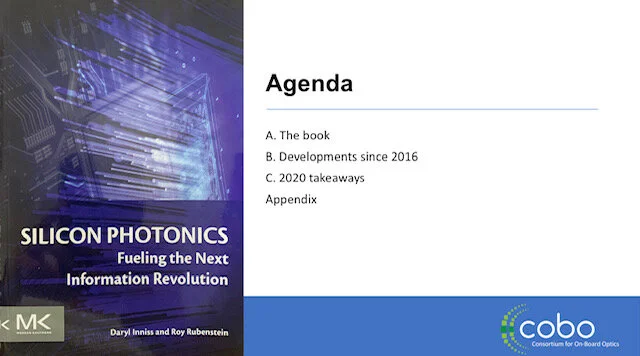
Daryl Inniss and I assess how the technology and marketplace has changed since we published our silicon photonics book at the end of 2016. Click here to view the webinar. Ours is the first of a series of webinars that COBO, the Consortium of On-Board Optics, is hosting.

OFC interview regarding silicon photonics and our book
ADVA Optical Networking's Gareth Spence interviewed Daryl Inniss, director, new business development at OFS, and me at the OFC conference and exhibition held earlier this month in San Diego, California. We were interviewed regarding the status of silicon photonics and our book on the topic.

Click here for the interview.

Books in 2018 - Part 3
More books read in 2018, as recommended by Steve Alexander and Yves LeMaitre.
Steve Alexander, senior vice president and CTO, Ciena
I was standing in line at a Starbucks and was chatting with another person who asked what all these engineers were doing talking about networks of submarines. In fact, it was a nearby conference on submarine cables. The person said: “I thought that’s what satellites were for”.
I wanted to find a book I could point people to who think that satellites carry most of the international traffic when, in fact, it is the fibre-optic submarine cables that carry the vast majority of the world’s communications. I came up with The Undersea Network by Nicole Starosielski.
Our industry does such a good job at this that most people don’t even know such networks exist. It is like air; it is there and it works.
My youngest son read The Martian by Andy Weir after seeing the movie and he thought it was pretty good. I’ve always been a Sci-Fi fan but haven’t read much lately so it was nice to get back into it.
Yves LeMaitre, chief strategy officer at Lumentum
I am afraid I am guilty of spending far too much time streaming shows and sports to my laptop. The good thing is my TV stays off. However, I did manage to read several books this year. The three I would highlight - all non-fiction - have a focus on US history.
The first, Destiny of the Republic: A Tale of Madness, Medicine and the Murder of a President by Candice Millard, is about the presidency and assassination of James Garfield intertwined with several of the scientific inventions of the times.
Another title by Candice Millard that I recommend is The River of Doubt: Theodore Roosevelt’s Darkest Journey that details his exploration of the Amazon.
My third recommendation, The Devil in the White City: A Saga of Magic and Murder at the Fair that Changed America by Erik Larson, tells the story of the Chicago’s World Fair of 1893 combined with a serial killer story.
Reading about what are still relatively recent events highlights how much the world has changed in the last century while people’s aspirations and desires have not.
The life stories and achievements of Theodore Roosevelt, James Garfield and Daniel Burnham, the architect of the Chicago World’s Fair, should challenge us to expect more from our leadership, whether in the political, business or social arenas. We have become complacent in accepting mediocrity and lowering our standards.
Reading these stories should remind us that true leadership exists and is a rare quality that should be appreciated and recognised.

Books in 2018 - Part 2
Some more books consumed in 2018, as recommended by Maxim Kuschnerov and Andrew Schmitt.
Maxim Kuschnerov, senior R&D manager at Huawei.
It is hard to believe the book Fire and Fury: Inside the Trump White House by Michael Wolff was published in 2018. Judging by what has happened since Trump’s inauguration, this recollection of his first days in the White House seems outdated. But it was fun to read while the memory of the election was still fresh. It is hard to judge whether all the book’s sources are truthful but the main message is certainly not too far off.
John Carreyrou’s Bad Blood: Secrets and Lies in a Silicon Valley Startup deals with the rise and fall of Elizabeth Holmes and her infamous blood testing start-up, Theranos. If it wasn’t for the fact that Holmes endangered the lives of thousands of people with her erroneous tests, one could be almost amazed on how she secured $1 billion from investors based on absolutely no technology whatsoever. It is also hard to believe how big chains could go along deploying Theranos tests without qualification of the products or the necessary Food and Drug Administration (FDA) approval.
As a westerner working for Huawei, Henry Kissinger’s On China was an important read to understand better how China sees itself and the world. There is no other nation capable of looking decades ahead like it is the fourth quarter of the next financial year. This is a worthwhile book for anyone wanting to make sense of the world.
Being a huge poker fan, buying the book Poker Brat: Phil Hellmuth’s Autobiography was a no-brainer. Hellmuth has his place in poker history, being one of the youngest World Series of Poker (WSOP) main event winners and the record holder with 15 bracelets. However, the book offers little insight on poker strategy. Or maybe it is the lack of strategy which makes Hellmuth who he is. If someone is really interested in learning from a great poker player, I’d recommend Every Hand Revealed by Gus Hansen. Hansen may have lost more than $20 million in online playing, but his book offers a better view on poker strategy back in the day of the big poker boom, before German maths wizards and game theory optimal strategy rewrote poker rules once again.
If a book has already been turned into a movie starring Brad Pitt, it means I am very late to the party with Michael Lewis’s Moneyball: The Art of Winning an Unfair Game. But being an artificial intelligence and machine-learning aficionado, everything is about recognising the underlying patterns, whether it is in images, optical signals or in such a beautiful and simple game like baseball. Most likely baseball strategists already apply machine learning to further optimise their strategy.
Andrew Schmitt, Founder and directing analyst at Cignal AI
The Winter Fortress: The Epic Mission to Sabotage Hitler's Atomic Bomb by Neal Bascomb is my pick of the year. I can’t believe this story isn't already a movie. It is about the Allies’ attempt to destroy the heavy-water plant in German-occupied Norway that was critical to the development of a German Atomic Weapon. Norwegians in exile in the UK, working with locals, pulled off a stunning attack that crippled the plant and set back the German effort. But the book is mostly about the events leading up to the mission, as well as the escape afterwards. The men who pulled it off were as hardcore as they come, and the sacrifices and impossible decisions they faced need to be shared. It is a story I imagine most Norwegians know, and it is a story that should be told to the world.
Hillbilly Elegy: A Memoir of a Family and Culture in Crisis by J.D. Vance is a good autobiography of someone who managed to escape people and situations that could easily have misdirected him. I am not going to join the chorus of folks who point to this book as reasoning for Trump getting elected; I avoid political discussions at all costs in a work environment. But reading this makes you appreciate the positive advantages you may have had growing up. The author, on the surface, had none but he highlights the people and situations that were formative for him and how they guided him on the right path. The best part about the book is that it isn’t preachy and Vance goes out of his way to explain that the problems he avoided have no easy or clear solutions.
Ray Dalio’s whitepapers, essays and explainer videos have always impressed me with concise formats and clear ideas. However, his book, Principles: Life and Work, is a big meal that I didn’t finish. I would recommend his YouTube videos and whitepapers and unless you are a hardcore self-help reader, which I’m not, then skip this.
My son had to read War by Sebastian Junger over the summer for High School. We read it together; a highly recommended thing to do with your teenagers. Junger was embedded in the Korengal Valley in Afghanistan with the US Army and was in the thick of some of the worst fighting. He also wrote The Perfect Storm which was a great book (and a terrible movie). In this book, he brings you right in the midst of events. If you want to know what being at the sharp end in Afghanistan is like, and the physical and mental sacrifices soldiers are making, then read this.
Michael Lewis is one of my favourite authors so I had to read his latest book, The Fifth Risk. It is well-written but it is about politics. I’m tired of politics. I don't think we need more of it so I won't recommend it.
I ripped through two volumes of Martha Wells’s The Murderbot Diaries on the way back from China. It’s about a security robot that figures out how to disable its governor software and become self-aware. A killing machine with a conscience, struggling with the details of being human. Some of the best Sci-Fi I’ve read in a long time. Netflix or Amazon need to give their money to this author right now and turn it into a series.

Books in 2018
Gazettabyte has asked various industry executives to discuss the books they have read in 2018. Here, Valery Tolstikhin and Alexandra Wright-Gladstein give their recommendations.
Valery Tolstikhin, president and CEO of Intengent, a consultancy
I read too many technical and business texts during the day so I leave my bedtime for more human reading.

Valery Tolstikhin
This year I wasn’t too lucky with fiction books but I did read some great non-fiction ones: Homo Deus: A Brief History of Tomorrow by Yuval Noah Harari, Jordan Peterson’s 12 Rules for Life: An Antidote to Chaos and Leonardo Da Vinci by Walter Isaacson.
All three titles are bestsellers and do not need an introduction, but still.
Harari’s book - the second in the series, and there is a third already published - encourages you to think of the big issues by detaching yourself from everyday routines and trivia.
Peterson’s book is about how to make yourself comfortable with these very routines and trivia while remaining at peace with the big issues. The book is also music to the ears of conservatives.
Isaacson’s book is as much about Leonardo da Vinci as it is about human’s aspiration for harmony, which extends from the arts to physics theories to iPhone design.
I highly recommend all three.
Alexandra Wright-Gladstein, co-founder of Ayar Labs
I'd recommend Measure What Matters: How Google, Bono and the Gates Foundation Rock the World with OKRs, by John Doerr, and Daring to Drive: A Saudi Woman's Awakening by Manal al-Sharif.
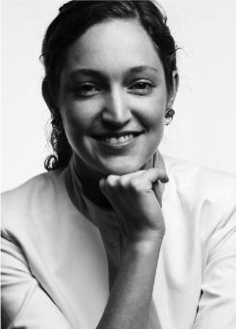
Alexandra Wright-Gladstein
Measure what Matters is a great overview of how several of the top companies of our time use the management method known as OKRs (objectives and key results), first developed by Andy Grove of Intel, to motivate large teams to accomplish impressive goals.
John Doerr learned the method early in his career while at Intel. Then, when he became a VC investor, he started teaching the method to the companies he invested in, including Google.
It is great that the method is now available for the rest of us.
Daring to Drive is just a wonderful story, a page-turner I could not put down. It is the autobiography of a woman who was raised in a conservative part of Saudi Arabia, who eventually revolted by driving a car (an illegal act for women in Saudi Arabia) and putting a video of her doing so on YouTube.
The book came out last year. This year we felt the impact of her life's work and the book when the Saudi government legalised driving for women - an incredible win for Manal and her community.

Books in 2017: Part 2
Dave Welch, founder and chief strategy and technology officer at Infinera
One favourite book I read this year was Alexander Hamilton by Ron Chernow. Great history about the makings of the US government and financial systems as well as a great biography. Another is The Gene: An Intimate History by Siddhartha Mukherjee, a wonderful discussion about the science and history of genetics.
Yuriy Babenko, senior expert NGN, Deutsche Telekom
As part of my reading in 2017 I selected two technical books, one general life-philosophy title and one strategy book.
Today’s internet infrastructure design is hardly possible without what we refer to as the cloud. Cloud is a very general term but I really like the definition of NIST: Cloud computing is a model for enabling ubiquitous, convenient, on-demand network access to a shared pool of configurable computing resources that can be rapidly provisioned and released with minimal management effort or service provider interaction.
Cloud Native Infrastructure: Patterns for scalable infrastructure and applications in a dynamic environment by Kris Nova and Justin Garrison helps you understand the necessary characteristics of such cloud infrastructure and defines the capabilities of the service architecture that fits this model. The Cloud Native architecture is not just about ‘lift and shift’ into the cloud, it is the redesign of your services focusing on cloud elasticity, scalability, and security as well as operational models including but not limited to infrastructure as code. If you already heard about Kubernetes, Terraform and Cloud Native Foundation but want to understand how various technologies and frameworks fit together, this is a great and easy read.
High Performnce Browser Networking: What Every Web Developer Should Know About Networking and Web Performance by Ilya Grigorik provides a thorough look into the peculiarities of modern browser networking protocols, their foundation, methods and tools that help to optimise and increase the performance of internet sites.
Every serious business today has a web presence. Many services and processes are consumed through the browser, so a look behind the curtains of these infrastructure is informative and useful.
Probably one of the more interesting conclusions is that is not always the bandwidth which is necessary for a site’s successful operation but rather the end-to-end latency. The book discusses HTTP, HTTP2 and SPDY and will be of great interest to anyone who wants to refresh their knowledge of the history of the internet as well as to understand the peculiarities of performance optimisation of (big) internet sites.
Principles: Life and Work by Ray Dalio is probably one of the most discussed books of 2017. Mr Dalio is one of the most successful hedge-fund investors of our generation. In this book, he decided to share the main life and business principles that have guided his decisions during the course of his life. The main message which Dalio shares is not to copy or use his particular principles, although you are likely to adopt several of them, but to have your own.
One of Dalio’s key ideas is that everything works as a machine so if you define the general rules of how the machine (i.e. life in general) works, it will be significantly easier to follow the ups and downs and apply clear thinking in case of difficulties and challenges. He sums it up in an easy-to-comprehend approach which goes like the following: you try things out, reflect on them if something goes well or wrong, log all problems you face along the way, reflect on them and formulate and write down the principles. In due course, you will end up with your own version of Principles. Sounds easy but doing it is the key.
Edge Strategy: A New Mindset for Profitable Growth by Dan McKone and Alan Lewis is about the edges of a business, opportunities sitting comfortably in front of you and your business and which can be 'easily’ tackled and addressed.
Why would you go for a crazy new and risky business idea when there is a bunch of market opportunities just outside of the main door of your core business?
This sounds like “focus and expand” to me and makes a lot of sense. The authors identify three main “edges” which a business can address: product edge, journey edge and enterprise edge.
The book goes into detail about how product edge can be expanded (remember your shiny new iPhone leather case?); a firm can focus more on the complete customer journey (What are the jobs to be done? What problem is the customer really trying to solve? Airbnb service can be a great example); and finally leveraging the enterprise edge (like Amazon renting and selling unused server capacity via its AWS services).
Edge strategies are not new per se, but this book helps to formulate and structure the discussion in an understandable and comprehensive framework.
Books in 2017
Andrew Schmitt, founder and lead analyst of Cignal AI
I didn’t have a good year with books. I bought more than these and either didn’t read them or I lost interest. Hopefully, 2018 will be better.
A Mind at Play: How Claude Shannon Invented the Information Age by Jimmy Soni and Rob Goodman was a big disappointment. It is a well-researched book and has tons of great history on Claude Shannon but there was something about the writing style that made it turgid. I struggled to finish it but learned a lot about Claude Shannon, including that his home in Boston wasn’t far from mine.
The Hard Thing about Hard Things: Building a Business When There are No Easy Answers by Ben Horowitz was the year’s winner. Ben Horowitz started the VC firm A16Z with Marc Andreessen, and both worked at Netscape and later founded Loudcloud. This is easily one of my favourite management books. Each chapter of the book covers an operational topic via a narrative of experiences from the author. Examples include how to build culture and how to scale a sales organisation. The book is highly readable and enjoyable, rare for a title about management advice. Horowitz talks about another book, High Output Management by Andy Grove, which I am reading now.
I reread Cryptonomicon by Neal Stephenson this year for fun. Entertaining book, particularly in light of all the crypto-currency mania. It was written 18 years ago and was way ahead of its time. As William Gibson said, the future is already here, it’s just not evenly distributed. Seveneves was good too (from 2015), but I sure hope that isn’t our future.
The King and Queen of Malibu: The True Story of the Battle for Paradise by David Randall is a history of the large parcel of land now known as Malibu in Southern California. One person owned it after the Spanish American war, and the book is the story of how a rapidly encroaching Los Angeles, spurred on by the automobile, led to its eventual taking by eminent domain. If you know the area and are interested in the history, it is a great book. Otherwise, it is probably of little interest.
I also read a few other sci-fi fiction books while on the road that came highly recommended (Ready Player One, Fortress at the End of Time, Blindsight) but I thought they were not that great.
Vladimir Kozlov, founder and CEO of LightCounting Market Research
I read two books in 2017 that I would highlight.
The first is War and Peace by Leo Tolstoy.
The second is Makers and Takers: The Rise of Finance and the Fall of American Business by Rana Foroohar. The book offers a sobering outlook on modern economic developments and questions the sustainability of growth.
IoT will drive chip design and new styles of computing
Looking back 20 years hence, how will this period be viewed? The question was posed by the CEO of imec, Luc Van de hove, during his opening talk at a day event imec organised in Tel-Aviv.
For Van den hove, this period will be seen as one of turbulent technological change. “The world is changing at an incredible rate,” he says. “The era of digital disruption is changing our industry and this disruption is not going to stop.”
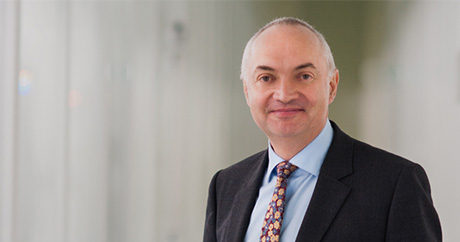 Luc Van den hove
It was the Belgium nonoelectronics R&D centre’s second visit to Israel to promote its chip and systems expertise as it seeks to expand its links with Israel’s high-tech industry. And what most excites imec is the Internet of Things (IoT), the advent of connected smart devices that turn data into information and adapt the environment to our needs.
The world is changing at an incredible rate. The era of digital disruption is changing our industry and this disruption is not going to stop
Internet of Things
Imec is focussing on five IoT areas: Smart Health - wearable and diagnostic devices, Smart Mobility which includes technologies for autonomous cars, drones and robots, Smart Cities, Smart Industry and Smart Energy. “In all these areas we look at how we can leverage our semiconductor know-how,” says Van den hove. “How we can bring innovative solutions by using our microchip technology.”
The broad nature of the IoT means imec must form partnerships across industries while strengthening its systems expertise. In healthcare, for example, imec is working with John Hopkins University, while last October, imec completed the acquisition of iMinds, a Belgium research centre specialising in systems software and security.
“One of the challenges of IoT is that there is not one big killer application,” says Van den hove. “How to bring these technologies to market is a challenge.” And this is where start-ups can play a role and explains why imec is visiting Israel, to build its partnerships with local high-tech firms.
Imec also wants to bring its own technologies to market through start-ups and has established a €100 million investment fund to incubate new ideas and spin-offs.
Technologies
Imec’s expertise ranges from fundamental semiconductor research to complex systems-on-chip. It is focussing on advanced sensor designs for IoT as this is where it feels it can bring an advantage. Imec detailed a radar chip design for cars that operates at 79GHz yet is implemented in CMOS. It is also developing a Light Detection and Ranging (LIDAR) chip for cars based on integrated photonics. Future cars will have between 50 to 100 sensors including cameras, LIDAR, radar and ultrasound.
 Imec's multi-project wafers. Source: imec
The data generated from these sensors must be processed, fused and acted upon. Imec is doing work in the areas of artificial intelligence and machine learning. In particular, it is developing neuromorphic computing devices that use analogue circuits to mimic the biological circuitry of the brain. Quantum computing is another area imec has begun to explore.
One of the challenges of IoT is that there is not one big killer application
“There is going to be so much data generated,” says Van den Hove. “And it is better to do it [processing] locally because computation is cheaper than bandwidth.”
Imec envisages a network with layers of intelligence, from the sensors all the way to the cloud core. As much of the data as possible will be processed by the sensor so that it can pass on more intelligent information to the network edge, also known as fog computing. Meanwhile, the cloud will be used for long-term data storage, for historical trending and for prediction using neuromorphic algorithms, says Van den Hove.
But to perform intensive processing on-chip and send the results off-chip in a power-efficient manner will require advances in semiconductor technology and the continuation of Moore’s law.
Moore's law
Imec remains confident that Moore’s law will continue to advance for some years yet but notes it is getting harder. In the past, semiconductor technology had a predictable roadmap such that chip designers could plan ahead and know their design goals would be met. Now chip technologists and designers must work together, a process dubbed technology-design co-optimisation.
Van den hove cites the example of imec’s work with ARM Holdings to develop a 7nm CMOS process node. “You can create some circuit density improvement just by optimising the design, but you need some specific technology features to do that,” he says. For example, by using a self-alignment technique, fewer metal tracks can be used when designing a chip's standard cell circuitry. "Using the same pitch you get an enormous shrink," he says. But even that is not going to be enough and techniques such as system-technology co-optimisation will be needed.
Imec is working on FinFETs, a style of transistor, to extend CMOS processes down to 5nm and then sees the use of silicon nanowire technology - first horizontal and then vertical designs - to extend the roadmap to 3nm, 2.5nm and even 1.8nm feature sizes.
Imec is also working on 3D chip stacking techniques that will enable multi-layer circuits to be built. “You can use specific technologies for the SRAM, processing cores and the input-output.” Imec is an active silicon photonics player, seeing the technology playing an important role for optical interconnect.
Imec awarded Gordon Moore a lifetime of innovation award last year, and Van den hove spent an afternoon at Moore’s home in Hawaii. Van den hove was struck with Moore’s humility and sharpness: “He was still so interested in the technology and how things were going.”