

40 Gigabit Ethernet QSFPs boost port density and reach
 "For the larger data centres being built today, reach is becoming more and more important"
I Hsing Tan, Avago
Avago’s eSR4 QSFP+ transceiver extends the reach of 40GbE over multimode fibre beyond the IEEE 40GBASE-SR4 specification, to 300m over OM3 and 400m over OM4 multimode fibre.
Reflex Photonics’ 40GbE QSFP also achieves 300m over OM3 fibre and while it has not tested the transceiver over OM4 fibre, the company is using the same optics that it uses for its CFP which meets 450m over OM4.
“This [QSFP] is aimed at large data centres operated by the likes of a Google or a Facebook,” says Robert Coenen, vice president, sales and marketing at Reflex Photonics. Such data centres can have link requirements of 1000m. “The more reach you can give over multimode fibre, the more money they [data centre operators] can save.”
The eSR4, like Avago's already announced iSR4 (interoperable SR4) 40GbE QSFP+ transceiver, supports either 40GbE or four independent 10GbE channels. When used as a multichannel 10GbE interface, the QSFP+ can interface to various 10GbE form factors such as X2, XFP and SFP+, says Avago.
The iSR4 also increases the faceplate port density of equipment from 48, 10 Gigabit Ethernet (GbE) SFP+ ports to up to 44 QSFP+ 40GbE ports. Avago says that one equipment vendor has already announced a card with 36 QSFP+ ports. The iSR4 QSFP+ also reduces the overall Gigabit/Watt power consumption to 37.5mW/Gbps compared to 100mW /Gbps for the SFP+. The eSR4 has half the power consumption, which puts it around 50mW/Gbps.
But the iSR4 matches the reach of the IEEE 40GBASE-SR4 40GbE standard: 100m for OM3 and 150m for OM4-based fibre. "This [reduced reach at 40GbE] creates an issue for data centre operations," says I Hsing Tan, Ethernet segment marketing manager in the fiber optics product division at Avago. "They require additional investment to redo all the wiring in current 10GbE infrastructure to support a shorter reach."
With the extended reach 40GbE QSFPs the reach associated with 10GbE interfaces on OM3 and OM4 multimode fibre is now restored.
The iSR4 module is available now, says Avago, while the eSR4 will be available from mid-2012. Reflex’s Coenen says it will have samples of its 40GbE QSFP, which also supports 40GbE and 4x10GbE, by May 2012.
What has been done
For Avago's iSR4 QSFP+ to operate as four, 10GbE channels, it has to comply with the 10GBASE-SR optical standard. That is because 10GBASE-SR supports a maximum receive power of -1dBm whereas the 40GBASE-SR4 has a maximum output power of 2.4dBm. The transmitter power of the iSR4 has thus been reduced. "We force the output of the transmitter down to -1dBm," says Tan.
To achieve the greater reach, the eSR4 uses a VCSEL design with a tighter spectral width. Other parameters include the optical modulation amplitude power and the wavelength. These affect the resulting fibre dispersion. “Once you control the spectral width, you can design the other two to meet the specs," says Tan.
The Avago 40GbE QSFP+ modules use an integrated 4- channel VCSEL array and a 4-channel photo-detector array.
Significance
The 40GbE short reach interfaces play an important role in the data centre. As servers move from using 1GbE to 10GbE interfaces, the uplink from aggregation 'top-of-rack' switches must also scale from 10GbE to higher speeds of 40GbE or 100GbE.
However existing 100GbE interfaces make use of the CFP module which is relatively large and expensive. And although the 100GbE standard has a clear roadmap leading to CFP2 and CFP4 modules, half and a quarter of the size of the CFP, respectively, these are not yet available.
40GbE QSFP+ transceivers do exist and offer the equipment faceplate density improvement vendors want.
The QSFP+ also benefits existing 10GbE designs by supporting nearly 4x the number of 10GbE on a card. Thus a new blade supporting up to 44, 40GbE QSFP+ transceivers can interface to up to 176 10GbE transceivers, a near fourfold capacity increase.
According to Avago, between 10% and 20% of interface requirements in the data centre are beyond 150m. Without the advent of extended reach 40GbE modules, data centre operators would need to deploy single mode fibre and a 40GBASE-LR4 module, it says. And while that can be fitted inside a QSFP, its power consumption is up to 3.5W, compared to the 1.5W of the QSFP+ eSR4. "The cost of the LR4 is also increased by at least a factor of three," says Tan.
Avago says that some 95% of all fibre in the data centre is multimode fibre. As for OM3 and OM4 deployments the ratio is 80% to 20%, respectively.

Will LTE lead to new revenues for the operators?

The opportunities and challenges the Long Term Evolution (LTE) standard poses for mobile operators. An article for the Mobile World Congress show for the magazine Informilo, click here.
The evolution of optical networking
An upcoming issue of the Proceeedings of the IEEE will be dedicated solely to the topic of optical networking. This, says the lead editor, Professor Ioannis Tomkos at the Athens Information Technology Center, is a first in the journal's 100-year history. The issue, entitled The Evolution of Optical Networking, will be published in either April or May and will have a dozen invited papers.
One topic that will change the way we think about optical networks is flexible or elastic optical networks.
Professor Ioannis Tomkos
"If I have to pick one topic that will change the way we think about optical networks, it is flexible or elastic optical networks, and the associated technologies," says Tomkos.
A conventional dense wavelength division multiplexing (DWDM) network has fixed wavelengths. For long-haul optical transmission each wavelength has a fixed bit rate - 10, 40 or 100 Gigabit-per-second (Gbps), a fixed modulation format, and typically occupies a 50GHz channel. "Such a network is very rigid," says Tomkos. "It cannot respond easily to changes in the network's traffic patterns."
This arrangement has come about, says Tomkos, because the assumption has always been that fibre bandwidth is abundant. "But at the moment we are only a factor of two away from reaching the Shannon limit [in terms of spectral efficiency bits/s/Hz) so we are going to hit the fibre capacity wall by 2018-2020," he warns.
The maximum theoretically predicted spectral efficiency for an optical communication system based on standard single-mode fibres is about 9bits/s/Hz per polarisation for typical long-haul system reaches of 500km without regeneration, says Tomkos. "At the moment the most advanced hero experiments demonstrated in labs have achieved a spectral efficiency of about 4-6bits/s/Hz," he says. This equates to a total transmission capacity close to 100 Terabits-per-second (Tbps). After that, deploying more fibre will be the only way to further scale networks.
Accordingly, new thinking is required.
Two approaches are being proposed. One is to treat the optical network in the same way as the air interface in cellular networks: spectrum is scarce and must be used effectively.
"We are running close to fundamental limits, that's why the optical spectrum of available deployed standard single mode fibers should be utilized more efficiently from now on as is the case with wireless spectrum," says Tomkos.
 How optical communication is following in the footsteps of wireless.
The second technique - spatial multiplexing - looks to extend fibre capacity well beyond what can be achieved using the first approach alone. Such an option would need to deploy new fibre types that support multiple cores or multi-mode transmission.
Flexible spectrum
"We have to start thinking about techniques used in wireless networks to be adopted in optical networks," says Tomkos (See text box). With a flexible network, the thinking is to move from the 50GHz fixed grid, down to 12.50GHz, then 6.25GHz or 1.50GHz or even eliminate the ITU grid entirely, he says. Such an approach is dubbed flexible spectrum or a gridless network.
With such an approach, the optical transponders can tune the bit rate and the modulation format according to the reach and capacity requirements. The ROADMs or, more aptly, the wavelength-selective switches (WSSes) on which they are based, also have to support such gridless operation.
WSS vendors Finisar and Nistica already support such a flexible spectrum approach, while JDS Uniphase has just announced it is readying its first products. Meanwhile US operator Verizon is cheerleading the industry to support gridless. "I'm sure Verizon is going to make this happen, as it did at 100 Gigabit," says Tomkos.
Spatial multiplexing
The simplest way to implement spatial multiplexing is to use several fibres in parallel. However, this is not cost-effective. Instead, what is being proposed is to create multi-core fibres - fibres that have more than one core - seven, 19 or more cores in an hexagonal arrangement, down which light can be transmitted. "That will increase the fibre's capacity by a factor of ten of 20," says Tomkos.
Another consideration is to move from single-mode to multi-mode fibre that will support the transmission of multiple modes, as many as several hundred.
The issue with multi-mode fibre is its very high modal dispersion which limits its bandwidth-distance product. "Now with improved techniques from signal processing like MIMO [multiple-input, multiple out] processing, OFDM [orthogonal frequency division multiplexing] to more advanced optical technologies, you can think that all these multiple modes in the fibre can be used potentially as independent channels," says Tomkos. "Therefore you can potentially multiply your fibre capacity by 100x or 200x."
The Proceedings of the IEEE issue will have a paper on flexible networking by NEC Labs, USA, and a second, on the ultimate capacity limits in optical communications, authored by Bell Labs.
Further reading:
MODE-GAP EU Seventh Framework project, click here.
OFC/NFOEC 2012: Technical paper highlights
 Source: The Optical Society
Novel technologies, operators' experiences with state-of-the-art optical deployments and technical papers on topics such as next-generation PON and 400 Gigabit and 1 Terabit optical transmission are some of the highlights of the upcoming OFC/NFOEC conference and exhibition, to be held in Los Angeles from March 4-8, 2012. Here is a taste of some of the technical paper highlights.
Optical networking
In Spectrum, Cost and Energy Efficiency in Fixed-Grid and Flew-Grid Networks (Paper number 1248601) an evaluation of single and multi-carrier networks at rates up to 400 Gigabit-per-second (Gbps) is made by the Athens Information Technology Center. One finding is that efficient spectrum utilisation and fine bit-rate granularity are essential if cost and energy efficiencies are to be realised.
In several invited papers, operators report their experiences with the latest networking technologies. AT&T Labs discusses advanced ROADM networks; NTT details the digital signal processing (DSP) aspects of 100Gbps DWDM systems and, in a separate paper, the challenge for Optical Transport Network (OTN) at 400Gbps and beyond, while Verizon gives an update on the status of MPLS-TP. As part of the invited papers, Finisar's Chris Cole outlines the next-generation CFP modules.
Optical access
Fabrice Bourgart of FT-Orange Labs details where the next generation PON standards - NGPON2 - are going while NeoPhotonics's David Piehler outlines the state of photonic integrated circuit (PIC) technologies for PONS. This is also a topic tackled by Oclaro's Michael Wale: PICs for next-generation optical access systems. Meanwhile Ao Zhang of Fiberhome Telecommunication Technologies discusses the state of FTTH deployments in the world's biggest market, China.
Switching, filtering and interconnect optical devices
NTT has a paper that details a flexible format modulator using a hybrid design based on a planar lightwave circuit (PLC) and lithium niobate. In a separate paper, NTT discusses silica-based PLC transponder aggregators for a colourless, directionless and contentionless ROADM, while Nistica's Tom Strasser discusses gridless ROADMs. Compact thin-film polymer modulators for telecoms is a subject tackled by GigOptix's Raluca Dinu.
One novel paper is on graphene-based optical modulators by Ming Liu, Xiang at the UC Berkeley (Paper Number: 1249064). The optical loss of graphene can be tuned by shifting its Fermi level, he says. The paper shows that such tuning can be used for a high-speed optical modulator at telecom wavelengths.
Optoelectronic Devices
CMOS photonic integrated circuits is the topic discussed by MIT's Rajeev Ram, who outlines a system-on-chip with photonic input and output. Applications range from multiprocessor interconnects to coherent communications (Paper Number: 1249068).
A polarisation-diversity coherent receiver on polymer PLC for QPSK and QAM signals is presented by Thomas Richter of the Fraunhofer Institute for Telecommunications (Paper Number: 1249427). The device has been tested in systems using 16-QAM and QPSK modulation up to 112 Gbps.
Core network
Ciena's Maurice O'Sullivan outlines 400Gbps/ 1Tbps high-spectral efficiency technology and some of the enabling subsystems. Alcatel-Lucent's Steven Korotky discusses traffic trends: drivers and measures of cost-effective and energy-efficient technologies and architectures for the optical backbone networks, while transport requirements for next-generation heterogeneous networks is the subject tackled by Bruce Nelson of Juniper Networks.
Data centre
IBM's Casimir DeCusatis presents a future - 2015-and-beyond - view of data centre optical networking. The data centre is also tackled by HP's Moray McLaren, in his paper on future computing architectures enabled by optical and nanophotonic interconnects. Optically-interconnected data centres are also discussed by Lei Xu of NEC Labs America.
Expanding usable capacity of fibre syposium
There is a special symposium at OFC/ NFOEC entitled Enabling Technologies for Fiber Capacities Beyond 100 Terabits/second. The papers in the symposium discuss MIMO and OFDM, technologies more commonly encountered in the wireless world.
Huawei boosts its optical roadmap with CIP acquisition
Huawei has acquired UK photonic integration specialist, CIP Technologies, from the East of England Development Agency (EEDA) for an undisclosed fee. The acquisition gives the Chinese system vendor a wealth of optical component expertise and access to advanced European Union R&D projects.
"By acquiring CIP and integrating the company’s R&D team into Huawei’s own research team, Huawei’s optic R&D capabilities can be significantly enhanced," says Peter Wharton, CEO at the Centre for Integrated Photonics (CIP). CIP Technologies is the trading name of the Centre for Integrated Photonics.
 Huawei now has six European R&D centres with the acquisition of CIP.
CIP Technologies has indium phosphide as well as planar lightwave circuit (PLC) technology which it uses as the basis for its HyBoard hybrid integration technology. HyBoard allows actives to be added to a silica-on-silicon motherboard to create complex integrated optical systems.
CIP has been using its photonic integration expertise to develop compact, more cost-competitive WDM-PON optical line terminal (OLT) and optical network unit (ONU) designs, including the development of an integrated transmitter array.
The company employs 50 staff, with 70% of its work coming from the telecom and datacom sectors. About a third of its revenues are from advanced products and two thirds from technical services.
The CEO of CIP says all current projects for its customers will be carried out as planned but CIP’s main research and development service will be focused on Huawei’s business priorities. “We expect all contracted projects to be completed and current customers are being assisted to find alternate sources of supply," says Wharton.
CIP is also part of several EU Seventh Framework programme R&D projects. These include BIANCHO, a project to reduce significantly the power consumption of optical components and systems, and 3CPO, which is developing colourless and coolerless optical components for low-power optical networks.
Huawei's acquisition will not affect CIP's continuing participation in such projects. "For EU framework and other collaborative R&D projects, the ultimate share ownership does not matter so long as it is a research organisation based in Europe, which CIP will continue to be," says Wharton.
CIP said it had interest from several potential acquirers but that the company favoured Huawei.
What this means
CIP has a rich heritage. It started as BT's fibre optics group. But during the optical boom of 1999-2000, BT shed its unit, a move also adopted by such system vendors as Nortel and Lucent.
The unit was acquired by Corning in 2000 but the acquisition did not prove a success and in 2002 the group faced closure before being rescued by the East of England Development Agency (EEDA).
CIP has always been an R&D organisation in character rather than a start-up. Now with Huawei's ambition, focus and deep pockets coupled with CIP's R&D prowess, the combination could prove highly successful if the acquisition is managed well.
Huawei's acquisition looks shrewd. Optical integration has been discussed for years but its time is finally arriving. The technologies of 40 Gigabit and 100 Gigabit is based on designs with optical functions in parallel; at 400 Gigabit the number of channels only increases.
Optical access will also benefit from photonic integration - from board optical sub-assemblies for GPON and EPON to WDM-PON to ultra dense WDM-PON. China is also the biggest fibre-to-the-x (FTTx) market by far.
A BT executive talking about the operator's 21CN mentioned how system vendors used to ask him repeatedly about Huawei. Huawei, in contrast, used to ask him about Infinera.
Huawei, like all the other systems vendors, has much to do to match Infinera's photonic integrated circuit expertise and experience. But the Chinese vendor's optical roadmap just got a whole lot stronger with the acquisition of CIP.
Further reading:
Reflecting light to save power, click here
Transport processors now at 100 Gigabit
Cortina Systems has detailed its CS605x family of transport processors that support 100 Gigabit Ethernet and Optical Transport Network (OTN).
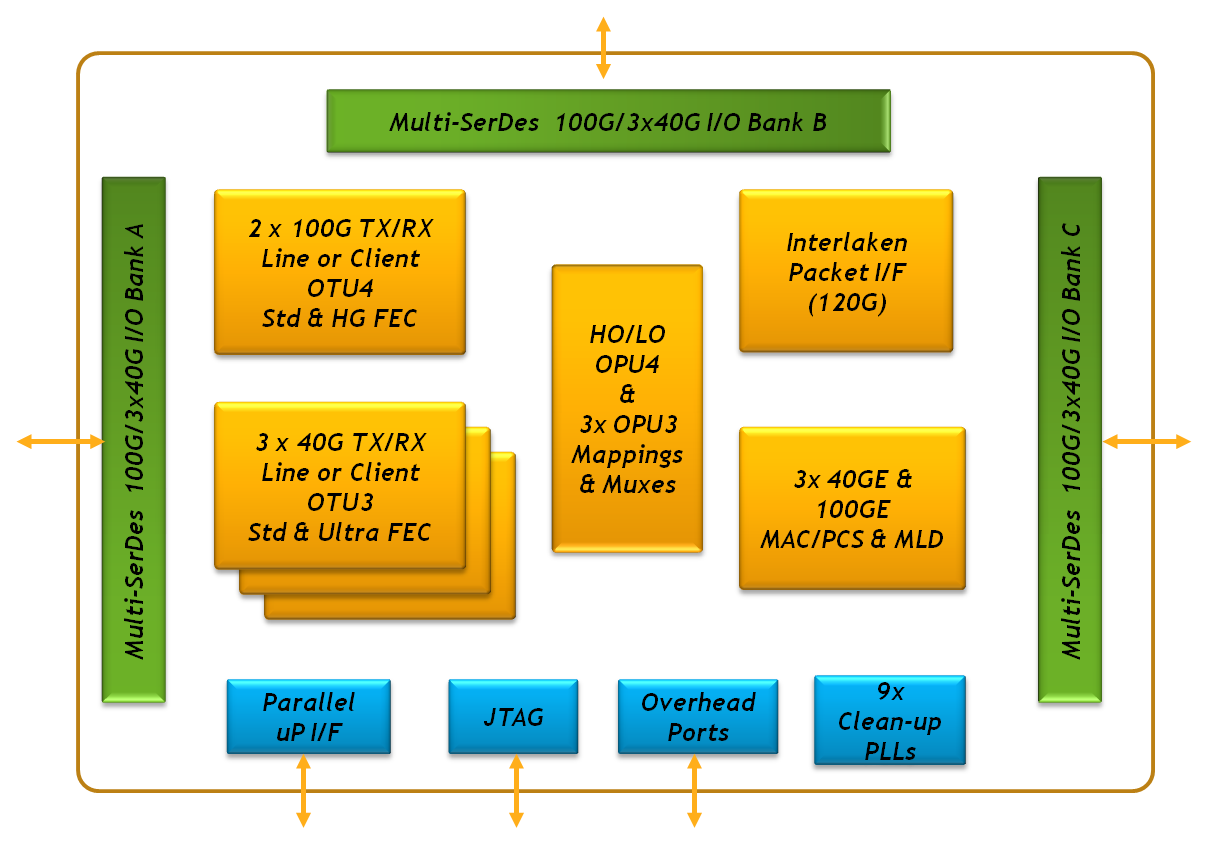 The CS6051 transport processor architecture. Source: Cortina Systems
The application-specific standard product (ASSP) family from Cortina Systems is aimed at dense wavelength division multiplexing (DWDM) platforms, packet optical transport systems, carrier Ethernet switch routers and Internet Protocol edge and core routers. The chip family can also be used in data centre top-of-rack Ethernet aggregation switches.
"Our traditional business in OTN has been in the WDM market," says Alex Afshar, product line manager, transport products at Cortina Systems. "What we see now is demand across all those platforms."
ASSP versus FPGA
Until now, equipment makers have used field programmable gate arrays (FPGAs) to implement 100 Gigabit-per-second (Gbps) designs. This is an important sector for FPGA vendors, with Altera and Xilinx making several company acquisitions to bolster their IP offerings to address the high end sector. System vendors have also used FPGA board-based designs from specialist firm TPACK, acquired by Applied Micro in 2010.
The advantage of an FPGA design is that it allows faster entry to market, while supporting relevant standards as they mature. FPGAs also enable equipment makers to use their proprietary intellectual property (IP); for example, advanced forward error correction (FEC) codes, to distinguish their designs.
However, once a market reaches a certain maturity, ASSPs become available. "ASSPs are more efficient in terms of cost, power and integration," says Afshar.
But industry analysts point out that ASSP vendors have a battle on their hands. "In this class of product, there is a lot of customisation and proprietary design and FPGAs are well suited for that," says Jag Bolaria, senior analyst at The Linley Group.
CS605x family
The CS605x extends Cortina's existing CS604x 40Gbps OTN transport processors launched in April 2011. The CS605x devices aggregate 40 Gigabit Ethernet or OTN streams into 100Gbps or map between 100 Gigabit Ethernet and OTN frames. Combining devices from the two families enables 10 and 40 Gigabit OTN/ Ethernet traffic to be aggregated into 100 Gigabit streams.
The CS6051 is the 100 Gigabit family's flagship device. The CS6051 can interface directly to three 40Gbps optical modules, a 100 Gigabit CFP or a 12x10Gbit/s CXP module. The device also supports the Interlaken interface to 120 Gigabit (10x12.5Gbps) to interface to devices such as network processors, traffic managers and FPGAs.
The CS6051 supports several forward error correction (FEC) codes including the standard G.709, a 9.4dB coding gain FEC with only a 7% overhead, and an 'ultra-FEC' whose strength can be varied with overhead, from 7% to 20%.
The CS6053 is similar to the CS6051 but uses a standard G.709 FEC only, aimed at system vendors with their own powerful FECs such as the latest soft-decision FEC. The CS6052 supports Ethernet and OTN mapping but not aggregation while the CS6054 supports Ethernet only. It is the C6054 which is used for top-of-rack switches in the data centre.
The devices consume between 10-12W. Samples of the CS605x family have been available since October 2011 and will be in volume production in the first half of this year.
Further reading:
For a more detailed discussion of the C605x family, click on the article featured in New Electronics
Melding networks to boost mobile broadband
In a Q&A, Bryan Kim, manager at SK Telecom's Core Network Lab, discusses the mobile operator's heterogeneous network implementation and the service benefits.
SK Telecom has developed an enhanced mobile broadband service that combines two networks: 3G and Wi-Fi or Long Term Evolution (LTE) and Wi-Fi. The mobile operator will launch the 3G/ Wi-Fi heterogeneous network service in the second quarter of 2012 to achieve a maximum data rate of 60 Megabits-per-second (Mbps), while the LTE and Wi-Fi integrated service will be offered in 2013, enabling up to a 100Mbps wireless Internet service.
Q. What exactly has SK Telecom developed?
A. SK Telecom has developed a technology that provides subscribers with a faster data service by using two different wireless networks simultaneously. For instance, customers can enjoy a much faster video streaming service supported by either 3G and Wi-Fi, or LTE and Wi-Fi networks.
To benefit, a handset must use two radio frequencies at the same time. We have also built a system that is installed in the core network for simultaneous transmission.
"If it takes 10s to download a 10MB file using a 3G network and 5s to download the same file using the heterogeneous solution, the impact on the battery life is the same."
Bryan Kim, SK Telecom
Q. LTE-Advanced is standardising heterogeneous networking. This suggests that what SK Telecom has done is pre-standard and proprietary. What have you done that is different to the emerging standard?
A. SK Telecom is not talking about LTE-Advanced technology. This is a technology that enables simultaneous use of heterogeneous wireless networks we’ve deployed.
Q. What are the technical challenges involved in implementing a heterogeneous network?
A. It is technically difficult to realise the technology as it involves using networks with different characteristics in terms of speed and latency. At the same time, the technology is designed to minimise the changes required to the existing networks.
There has not really been challenges when linking the two separate networks but it is always a challenge to analyse the real-time network status to provide fast data services.
Q. What impact will simultaneous heterogeneous network operation have on a smartphone's battery life?
A. Using the heterogeneous network integration solution does increase the battery consumption: the device is using two radio frequencies. However, from a customer's perspective, if it takes 10s to download a 10MB file using a 3G network and 5s to download the same file using the heterogeneous solution, the impact on the battery life is the same.
SK Telecom also plans to apply a scanning algorithm for selecting qualified Wi-Fi networks.
Q. What services can SK Telecom see benefiting from having a 3G/ LTE network combined with a Wi-Fi network?
A. Customers will experience greater convenience when using multimedia services and network games, for example, with increased available bandwidth.
 Source: SK Telecom
Heavy users tend to consume a lot of video services through mobile broadband. With this solution, SK Telecom will be providing faster data services to customers compared to when using only one network. This will enhance data service markets. The company has no plans for now to provide services directly.
Q. What mobile services come close to using 60Mbps or 100Mbps?
A. The 60Mbps and 100Mbps are theoretical maximum speeds. People who sign up for a 100Mbps fixed-line network service rarely experience the 100Mbps speed. With this technology, SK Telecom aims to increase the amount of wireless network resources for subscribers by using two different types of networks in a simultaneous manner, which in turn will boost the services that require wider bandwidth including video streaming service and network games.
Q. With a combination of Wi-Fi and cellular, most operators want to get traffic off the cellular network onto the ‘hot spot’. Does SK Telecom really want to fill their cellular network by providing higher speeds?
A. From the customer’s perspective, a Wi-Fi network offers narrow coverage and small capacity and since it is not a managed network, wireless data access is made upon request from customers. Thus, data offloading often does not work as intended by the mobile carriers.
In contrast, cellular networks provide national coverage so if there is an available Wi-Fi network to add to the cellular network, we can simultaneously use the cellular and Wi-Fi networks to offer a data service. By doing so customers will enjoy greater speed data services and mobile operators will be able to naturally offload data.
Gazettabyte sponsorship for 2012
ADVA Optical Networking, Ciena, ECI Telecom, Finisar, Infinera, LightCounting, Opnext and u2t Photonics.
That nearly all of the founding sponsors have agreed to renew is great confirmation about the site and the stories and features it publishes.
Gazettabyte is also delighted to welcome three new sponsors:
Cisco Systems, business information and networking service provider, Layer123, and Transmode.
Gazettabyte strives for editorial independence yet its existence is only possible due to the backing of its sponsors. For those interested in understanding the way the sponsorship works and how it impacts what is published, please click on this link.
Meanwhile, Gazettabyte wishes to thank again all of its sponsors, those that have agreed to renew and its new sponsors.
100 Gigabit 'unstoppable'
A Q&A with Andrew Schmitt (@aschmitt), directing analyst for optical at Infonetics Research.

"40Gbps has even less value in the metro than in the core"
Andrew Schmitt, Infonetics Research
A study from market research firm, Infonetics Research, has found that operators have a strong preference for deploying 100 Gigabit-per-second (Gbps) technology as they upgrade their networks.
Infonetics interviewed 21 incumbent service providers, competitive operators and mobile operators that have either 40Gbps, 100Gbps or both wavelength types installed in their networks, or that plan to install by next year (2013).
The operators surveyed, from all the major regions, account for over a quarter (28%) of worldwide telecom carrier revenue and capital expenditure.
The study's findings include:
- A strong preference by the carriers for 100Gbps transport in both Brownfield and Greenfield installations. Carriers will use 40 and 100Gbps to the same degree in existing Brownfield networks while favouring 100Gbps for new, Greenfield builds.
- The reasons to deploy 40Gbps and 100Gbps optical transport equipment include lowering the cost per bit, taking advantage of the superior dispersion performance of coherent optics, and lowering incremental common equipment costs due to the increased spectral efficiency.
- Most respondents indicate 40Gbps is only a short-term solution and will move the majority of installations to 100Gbps once those products become widely available.
- Non-coherent 100Gbps is not yet viewed as an important technology.
- Colourless and directionless ROADMs and Optical Transport Network (OTN) switching are important components of Greenfield builds; gridless and contentionless ROADMs are much less so.
Q&A with Andrew Schmitt
Q. A key finding is that 40Gbps and 100Gbps are equally favoured for Brownfield routes. And is it correct that Brownfield refers to existing routes carrying 10Gbps and maybe 40Gbps wavelengths while Greenfield involves new 100Gbps wavelengths? What is it about Brownfield that 40Gbps and 100Gbps have equal footing? Equally, for Greenfield, is the thinking: "If we are deploying a new lit fibre, we might as well start with the newest and fastest"?
A: The assumptions on Brownfield versus Greenfield are correct, the definitions in the survey and the report are more detailed but that is right.
It is more an issue that they [carriers] are building with 40Gbps now but will transition to 100Gbps where it can be used. Where it can't be used they stick with 40Gbps. There are many reasons why 100Gbps may not work in existing networks.
Q: Another finding is that 40Gbps is seen as a short-term solution. What is short term? And will that also be true for the metro or does metro have its own dynamic?
A: We didn't test timing explicitly for Greenfield versus Brownfield networks. It [40Gbps] doesn't necessarily peak, it is just not growing at the same rate as 100Gbps. And 40Gbps has even less value in the metro than in the core, particularly in Greenfield builds. With Greenfield 100Gbps combined with soft-decision forward error correction (SD-FEC), it is almost as good as 40Gbps.
Q: The study found that non-coherent 100Gbps isn't yet viewed as an important technology. Why do you think that is so? And what is your take on the non-coherent 100Gbps opportunity?
A: The jury is still out.
The large customers I spoke with haven't looked at it and therefore can't form an opinion. A lot of promises and marketing at this point but that doesn't mean it won't work. Module vendors are pretty excited about it and they aren't stupid.
Q: You say colourless and directionless is seen as important ROADM attributes, gridless and contentionless much less so. If operators are building 100Gbps Greenfield overlays, is not gridless a must to future-proof the network investment?
A: The gridless requirement is completely overblown and folks positioning it as a requirement today haven't done the work to understand the issues trying to use it today. This survey was even more negative than I expected.
FPGA transceiver speed hikes bring optics to the fore

Despite rapid increases in the transceiver speeds of field-programmable gate arrays (FPGA), the transition to optical has begun.
FPGA vendors Xilinx and Altera have increased their on-chip transceiver speeds fourfold since 2005, from 6.5Gbps to 28Gbps. But signal integrity issues and the rapid decline in reach associated with higher speed means optics is becoming a relevant option.
Altera has unveiled a prototype with two 12x10Gbps optical engines but has yet to reveal its product plans. Xilinx believes that FPGA optical interfaces are still several years off with requirements being met with electrical interfaces for now.