

BT's IP-over-DWDM move
- BT will roll out next year IP-over-DWDM using pluggable coherent optics in its network
- At ECOC 2022, BT detailed network trials that involved the use of ZR+ and XR optics coherent pluggable modules
Telecom operators have been reassessing IP-over-DWDM with the advent of 400-gigabit coherent optics that plug directly into IP routers.
According to BT, using pluggables for IP-over-DWDM means a separate transponder box and associated ‘grey’ (short-reach) optics are no longer needed.
Until now, the transponder has linked the IP router to the dense wavelength-division multiplexing (DWDM) optical line system.
“Here is an opportunity to eliminate unnecessary equipment by putting coloured optics straight onto the router,” says Professor Andrew Lord, BT’s head of optical networking.
Removing equipment saves power and floor space too.
DWDM trends
Operators need to reduce the cost of sending traffic, the cost-per-bit, given the continual growth of IP traffic in their networks.
BT says its network traffic is growing at 30 per cent a year. As a result, the operator is starting to see the limits of its 100-gigabit deployments and says 400-gigabit wavelengths will be the next capacity hike.
Spectral efficiency is another DWDM issue. In the last 20 years, BT has increased capacity by lighting a new fibre pair using upgraded optical transport equipment.
Wavelength speeds have gone from 2.5 to 10, then to 40, 100, and soon 400 gigabits, each time increasing the total traffic sent over a fibre pair. But that is coming to an end, says BT.
“If you go to 1.2 terabits, it won’t go as far, so something has to give,” says Lord. ”So that is a new question we haven’t had to answer before, and we are looking into it.”
Fibre capacity is no longer increasing because coherent optical systems are already approaching the Shannon limit; send more data on a wavelength and it occupies a wider channel bandwidth.
Optical engineers have improved transmission speeds by using higher symbol rates. Effectively, this enables more data to be sent using the same modulation scheme. And keeping the same modulation scheme means existing reaches can still be met. However, upping the symbol rate is increasingly challenging.
Other ways of boosting capacity include making use of more spectral bands of a fibre: the C-band and the L-band, for example. BT is also researching spatial division multiplexing (SDM) schemes.
IP-over-DWDM
IP-over-DWDM is not a new topic, says BT. To date, IP-over-DWDM has required bespoke router coherent cards that take an entire chassis slot, or the use of coherent pluggable modules that are larger than standard QSFP-DD client-side optics ports.
“That would affect the port density of the router to the point where it’s not making the best use of your router chassis,“ says Paul Wright, optical research manager at BT Labs.
The advent of OIF-defined 400ZR optics has catalysed operators to reassess IP-over-DWDM.
The 400ZR standard was developed to link equipment housed in separate data centres up to 120km apart. The 120km reach is limiting for operators but BT’s interest in ZR optics stems from the promise of low-cost, high-volume 400-gigabit coherent optics.
“It [400ZR optics] doesn’t go very far, so it completely changes our architecture,” says Lord. “But then there’s a balance between the numbers of [router] hops and the cost reduction of these components.”
BT modelled different network architectures to understand the cost savings using coherent ZR and ZR+ optics; ZR+ pluggables have superior optical performance compared to 400ZR.
The networks modelled included IP routers in a hop-by-hop architecture where the optical layer is used for point-to-point links between the routers.
This worked well for traffic coming into a hub site but wasn’t effective when traffic growth occurred across the network, says Wright, since traffic cascaded through every hop.
BT also modelled ZR+ optics in a reconfigurable optical add-drop multiplexer (ROADM) network architecture, as well as a hybrid arrangement using both ZR+ and traditional coherent optics. Traditional coherent optics, with its superior optical performance, can pass through a string of ROADM stages where ZR+ optics falls short.
BT compared the cost of the architectures assuming certain reaches for the various coherent optics and published the results in a paper presented at ECOC 2020. The study concluded that ZR and ZR+ optics offer significant cost savings compared to coherent transponders.
ZR+ pluggables have since improved, using higher output powers to better traverse a network’s ROADM stages. “The [latest] ZR+ optics should be able to go further than we predicted,” says Wright.
It means BT is now bought into IP-over-DWDM using pluggable optics.
BT is doing integration tests and plans to roll out the technology sometime next year, says Lord.
XR optics
BT is a member of the Open XR Forum, promoting coherent optics technology that uses optical sub-carriers.
Dubbed XR optics, if all the subs-carriers originate at the same point and are sent to a common destination, the technology implements a point-to-point communication scheme.
Sub-carrier technology also enables traffic aggregation. Each sub-carrier, or a group of sub-carriers, can be sent from separate edge-network locations to a hub where they are aggregated. For example, 16 endpoints, each using a 25-gigabit sub-carrier, can be aggregated at a hub using a 400-gigabit XR optics pluggable module. Here, XR optics is implementing point-to-multipoint communication.
Lord views XR optics as innovative. “If only we could find a way to use it, it could be very powerful,” he says. “But that is not a given; for some applications, XR optics might be too big and for others it may be slightly too small.”
ECOC 2022
BT’s Wright shared the results of recent trial work using ZR+ and XR optics at the recent ECOC 2022 conference, held in Basel in September.
The 400ZR+ were plugged into Nokia 7750 SR-s routers for an IP-over-DWDM trial that included the traffic being carried over a third-party ROADM system in BT’s network. BT showed the -10dBm launch-power ZR+ optics working over the ROADM link.
For Wright, the work confirms that 0dBm launch-power ZR+ optics will be important for network operators when used with ROADM infrastructures.
BT also trialled XR optics where traffic flows were aggregated.
“These emerging technologies [ZR+ and XR optics] open up for the first time the ability to deploy a full IP-over-DWDM solution,” concluded Wright.

Infinera's XR optics pluggable plans

Infinera’s coherent pluggables for XR optics will also address the company’s metro needs.
Coherent pluggables now dominate the metro market where embedded designs account for just a fifth of all ports, says Infinera.
“As we grow our metro business, we need our own pluggables if we want to be cost-competitive,” says Robert Shore, senior vice president of marketing at Infinera.
Infinera’s family of pluggables implementing the XR optics concept is dubbed ICE-XR.
XR optics splits a coherent optical signal into Nyquist sub-carriers, each carrying a data payload. Twenty-five gigabits will likely be the sub-carrier capacity chosen.
XR optics can be used for point-to-point links where all the sub-carriers go to the same destination. But the sub-carriers can also be steered to different destinations, similar to how breakout cables are used in the data centre.
With XR optics, a module can talk to several lower-speed ones in a point-to-multipoint arrangement. This enables optical feeds to be summed, ideal for traffic aggregation applications such as access and 5G.
Open XR Forum
Infinera detailed its ICE-XR pluggables during the OFC virtual conference and exhibition.
The event coincided with the launch of the Open XR Forum whose members include network operators, Verizon, Lumen Technologies (formerly CenturyLink), Windstream and Liberty Global.
Members of the Open XR Forum span sub-component makers, systems vendors like Infinera, and network operators. The day the Open XR Forum website was launched, Infinera received a dozen enquiries from interested parties.
The Open XR Forum will define standards for XR optics such as how the networks are managed, the form factors used, their speeds and power requirements.
“There are a lot of underlying operational aspects that need to be worked out,” says Shore.
XR optics will use a similar model to ZR+ coherent optics. ZR+ delivers enhanced transmission performance compared to the OIF’s 400ZR coherent standard. “ZR+ is not a standard but rather a set of open specifications that can be used by anyone to create a product, and that is exactly the approach we are taking with XR optics,” says Shore.
Over the last 18 months, Infinera has met with 150 network operators regarding XR optics. “We wanted to validate this is a worthwhile technology and that people wanted it,” says Shore.
There have also been 40 network operator trials of the technology by the end of July. BT has used the technology as part of a metro aggregation trial while Virgin Media and American Tower each tested XR optics over PON.
More members have joined the Open XR Forum and will be announced in the autumn.
ICE-XR
ICE-XR’s name combines two concepts.
The first, ICE, refers to the Infinite Capacity Engine, the optics and coherent digital signal processor (DSP) that is the basis for Infinera’s ICE4 and newer ICE6 coherent transmission designs. ICE4 was Infinera’s first product to use Nyquist sub-carriers.
“XR”, meanwhile, borrows from 400ZR. Here, the ‘X’ highlights that XR supports point-to-point coherent communications, like 400ZR, and point-to-multipoint.
“ICE-XR’s release will be timed in conjunction with the official ratification of the specifications from the Open XR Forum,” says Shore.
Infinera’s ICE-XR portfolio will include 100, 400, and 800-gigabit optical modules.
The 100-gigabit ICE-XR, based on four 25-gigabit sub-carriers, will be offered as QSFP-28, QSDP-DD and CFP2 form factors. The 400-gigabit and 800-gigabit variants, using 16 and 32 sub-carriers respectively, will be available as QSFP-DD and CFP2 modules.
The 100-gigabit and 400-gigabit ICE-XR modules will be released first in 2022.
The 400-gigabit ICE-XR will also double as Infinera’s ZR+ offering when used point-to-point.
Shore says its first ZR+ module will not support the oFEC forward-error correction (FEC) used by the OpenZR+ multi-source agreement (MSA).
“The performance hit you take to ensure multi-vendor interoperability is vastly outweighed by the benefits of the improved [optical] performance [using a proprietary FEC],” says Shore.
Merchant DSP suppliers and the systems vendors with in-house DSP designs all support proprietary FEC schemes that deliver far better performance than oFEC, says Shore.
Infinera is developing a monolithic photonic integrated circuit (PIC) for ICE-XR manufactured at its indium phosphide facility.“ICE-XR will increase the utilisation of our fabrication centre, especially when pluggables produce higher volumes compared to embedded [coherent designs],” says Shore.
Infinera says more than one coherent DSP will be needed for the ICE-XR product portfolio. The modules used have a range of power profiles. The QSFP-28 module will need to operate within 4-5W, for example, while the QSFP-DD implementing ZR+ will need to be below 20W. Developing one DSP to span such a power range is not possible.
Business model
The Open XR Forum’s specifications will enable vendors to develop their own XR optics implementations.
Infinera will also license aspects of its design including its coherent DSPs. The aim, says Shore, is to develop as broad an ecosystem as possible: “We want to make XR optics an industry movement.”
Shore stresses ZR+ interoperability is not a must for most applications. Typically, a vendor’s module will be used at both ends of a link to benefit from the ZR+’s custom features. But interoperability is a must for XR optics given its multi-rate nature. The different speed modules from different vendors must talk to each other.
“Because you have multi-generational and multi-rate designs, it becomes even more important to support multi-vendor interoperability,” says Shore. “It gives the network operators more choice, freedom and flexibility.”
XR optics for the data centre
Infinera says there are developments to use XR optics within the data centre.
As data rates between equipment rise, direct-detect optics will struggle to cope, says Shore. The hierarchical architectures used in data centres also lend themselves to a hub-and-spoke architecture of XR optics.
“This type of technology could fit very nicely into that environment once the capacity requirements get high enough,” says Shore.
For this to happen, power-efficient coherent designs are required. But first, XR optics will need to become established and demonstrate a compelling advantage in a point-to-multipoint configuration.
XR optics will also need to replace traditional direct-detect pluggables that continue to progress; 800-gigabit designs are appearing and 1.6-terabit designs were discussed at OFC. Co-packaged optics is another competing technology.
“You are not looking at the 2022-23 timeframe, but maybe 2025-26,” says Shore.
Covid-era shows
Infinera postponed its customer meetings that pre-covid would take place at OFC till after the show to avoid clashing with the online sessions. Once the meetings occurred, customers were given a tour of Infinera’s virtual OFC booth.
Infinera’s solutions marketing team also divided between them the OFC sessions of interest to attend. The team then ‘met’ daily to share their learnings.
“I do think that the world of in-person events has changed forever,” says Shore. Infinera attended 40 events in 2019. “We will probably do fewer than 20 [a year] going forward,” says Shore.

Nokia adds 400G coherent modules across its platforms

Nokia is now shipping its 400-gigabit coherent multi-haul CFP2-DCO. The module exceeds the optical performance of 400ZR and ZR+ coherent pluggables.
Nokia’s CFP2-DCO product follows its acquisition of silicon photonics specialist, Elenion Technologies, in 2020.
Nokia has combined Elenion’s coherent optical modulator and receiver with its low-power 64-gigabaud (GBd) PSE-Vc coherent digital signal processor (DSP).
Nokia is also adding coherent pluggables across its platform portfolio.
“Not just optical transport and transponder platforms but also our IP routing portfolio as well,” says Serge Melle, director of product marketing, IP-optical networking at Nokia.
“This [amplifier and filter] allows for much better optical performance,”
“This [amplifier and filter] allows for much better optical performance,”
Melle is an optical networking industry veteran. He joined Nokia two years ago after a 15-year career at Infinera. Melle started at Pirelli in 1995 when it was developing a 4×2.5-gigabit wavelength-division multiplexing (WDM) system. In between Pirelli and Infinera, Melle was at Nortel Networks during the optical boom.
400ZR, ZR+ and the multi-haul CFP2-DCO
The CFP2-DCO’s optical performance exceeds that of the QSFP-DD and OSFP form factors implementing 400ZR and ZR+ but is inferior to line-card coherent transponders used for the most demanding optical transport applications.
The 400ZR coherent OIF standard transmits a 400-gigabit wavelength up to 120km linking equipment across data centres. Being a standard, 400ZR modules are interoperable.
The ZR+ adds additional transmission speeds – 100, 200 and 300-gigabits – and has a greater reach than ZR. ZR+ is not a standard but there is the OpenZR+ multi-source agreement (MSA).
Implementing 400ZR and ZR+ coherent modules in a QSFP-DD or OSFP module means they can be inserted in client-side optics’ ports on switches and routers.
The OIF did not specify a form factor as part of the 400ZR standard, says Melle, with the industry choosing the QSFP-DD and OSFP. But with the modules’ limited power dissipation, certain modes of the coherent DSP are turned off, curtailing the feature set and the reach compared to a CFP2-DCO module.
The modules also have physical size restrictions.
“You don’t have enough thermal budget to put an optical amplifier inside the QSFP-DD package,” says Melle. “So you are left with whatever power the DWDM laser outputs through the modulator.” This is -7dBm to -10dBm for 400ZR and ZR+ optics, he says.
The CFP2-DCO is larger such that the DSP modes of encryption, OTN client encapsulation, LLDP snooping (used to gather data about attached equipment), and remote network monitoring (RMON) can be enabled.
The CFP2-DCO can also house an optical amplifier and tunable filter. The filter reduces the out-of-band optical signal-to-noise ratio (OSNR) thereby increasing the module’s sensitivity. “This [amplifier and filter] allows for much better optical performance,” says Melle. A 400-gigabit multi-haul module has a 0dBm optical output power, typically.
The different transceiver types are shown in the table.
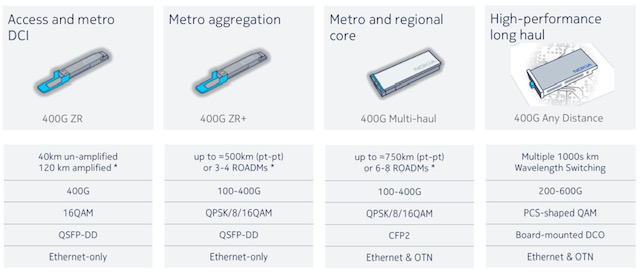
Nokia’s paper at the recent OFC virtual conference and exhibition detailed how its 400-gigabit multi-haul CFP2-DCO achieved a reach of 1,200km.
The paper details the transmission of 52, 400-gigabit signals, each occupying a 75GHz channel, for a total capacity of 20.8 terabits-per-second (Tbps).
Melle stresses that the demonstration was more a lab set-up than a live network where a signal goes through multiple reconfigurable optical add-drop multiplexers (ROADMs) and where amplifier stages may not be equally spaced.
That said, the CFP2-DCO’s reach in such networks is 750km, says Nokia.
IP-optical integration
Having coherent pluggables enables 400 Gigabit Ethernet (400GbE) payloads to be sent between routers over a wide area network, says Nokia.
“Given this convergence in form factor, with the QSFP-DD and ZR/ ZR+, you can now do IP-optical integration, putting coherent optics on the router without sacrificing port density or having locked-in ports,” says Melle.
Nokia is upgrading its IP and optical portfolio with coherent pluggables.
“In the routers, ZR/ ZR+, and in transponders not only the high-performance coherent optics – the [Nokia] PSE-Vs [DSP] – but also the CFP2-DCO multi-haul,” says Melle. “The 400-gigabit multi-haul is also going to be supported in our routers.”
Accordingly, Nokia has developed two sets of input-output (I/O) router cards: one supporting QSFP-DDs suited for metro-access applications, and the second using CFP2-DCO ports for metro and regional networks.
The choice of cards adds flexibility for network operators; they no longer need to have fixed CFP2-DCO slots on their router faceplates, whether they are used or not. But being physically larger, there are fewer CFP2-DCO ports than QSFP-DD ports on the I/O cards.
While the QSFP-DD MSA initially defined the module with a maximum power dissipation of 14.5W, a coherent QSFP-DD module consumes 18-20W. Dissipating the heat generated by the modules is a challenge.
Nokia’s airflow cooling is simplified by placing a module on both sides of the line card rather than stacking two CFP2-DCOs, one on top of the other.
Nokia is adding its CFP2-DCO to its 1830 optical transport portfolio. These include its PSI-M compact modular systems, the PSS transponder systems and also its PSS-x OTN switching systems.
The 400ZR/ZR+ module will be introduced with all its routing platforms this summer – the 7250 IXR, 7750 SR, 7750 SR-s, and the 7950 XRS, whereas the CFP2-DCO will be added to its 7750 and 7950 series later this year.
Nokia will source the 400ZR/ZR+ from third parties as well as from its optical networks division.
Its routers use QSFP-DD form-factor for all 400GbE ports and this is consistent for most router vendors in the industry. “Thus, our use and supply of 400ZR/ZR+ pluggable DCOs will focus on the QSFP-DD form-factor,” says Melle. However, the company says it can offer the OSFP form-factor depending on demand.
Network planning study
Nokia published a paper at OFC on the ideal coherent solution for different applications.
For metro aggregation rings with 4-5 nodes and several ROADM pass-throughs, using ZR+ modules is sufficient. Moreover, using the ZR+ avoids any loss in router port density.
For metro-regional core applications, the ZR+’s optical performance is mostly insufficient. Here, the full 400-gigabit rate can not be used but rather 300 gigabit-per-second (Gbps) or even 200Gbps to meet the reach requirements.
Using a 400-gigabit multi-haul pluggable on a router might not match the density of the QSFP-DD but it enables a full 400-gigabit line rate.
For long-haul, the CFP2-DCO’s performance is “reasonable”, says Nokia, and this is where high-performance transponders are used.
What the OFC paper argues is that there is no one-size-fits-all solution, says Melle.
800-Gigabit coherent pluggables
Traditionally, the IEEE has defined short-reach client-side optics while the OIF defines coherent standards.
“If we want this IP-optical convergence continuing in the next generation of optics, those two worlds are going to have to collaborate more closely,” says Melle.
That’s because when a form-factor MSA will be defined, it will need to accommodate the short-reach requirements and the coherent optics. If this doesn’t happen, says Melle, there is a risk of a new split occuring around the IP and optical worlds.
The next generation of coherent pluggables will also be challenging.
All the vendors got together in 2019 and said that 400ZR was just around the corner yet the modules are only appearing now, says Melle.
The next jump in pluggable coherent optics will use a symbol rate of 90-130GBd.
“That is very much the cutting-edge so it brings back the optics as a critical enabling technology, and not just optics but the packaging,” concludes Melle.

NeoPhotonics’ growing 400G coherent pluggable portfolio
NeoPhotonics has unveiled its first two 400-gigabit coherent pluggable modules that support the OIF’s 400ZR coherent standard and extended ZR+ modes.
The company has delivered samples of its ClearLight CFP2-DCO module for trials. The CFP2-DCO supports 400ZR, metro, and long-haul optional transmissions.
NeoPhotonics has also delivered to a hyperscaler the first samples of a 400-gigabit OSFP pluggable that supports 400ZR and 400ZR+.
Both modules use Inphi’s latest Canopus 7nm CMOS coherent digital signal processor (DSP) chip.
Module types
The OIF has developed the 400ZR standard to enable 400-gigabit signals to be sent between switches or routers in data centres up to 120km apart.
The main three pluggable modules earmarked for 400ZR are the QSFP-DD, OSFP and CFP2-DCO.
These modules differ in size and power envelope, ranging from the QSFP-DD, which is the most compact and has the smallest power envelope, to the CFP2-DCO module which supports the highest power and size.
It is the two client-side module form factors – the QSFP-DD and the OSFP – that will be mainly used for 400ZR.
“The CFP2 has more of a power envelope available so it tends to be used for longer reach applications,” says Ferris Lipscomb, vice president of marketing at NeoPhotonics.
These applications include specialist data-centre-interconnect applications and the metro and long-haul needs of the telecom operators.
400G CFP2-DCO
NeoPhotonics’ ClearLight CFP2-DCO uses an extension of a fibre’s C-band spectrum, what Huawei calls the Super C-band while NeoPhotonics refers to its implementation as C++.
The Super C-band covers 6THz of the spectrum compared to the standard C-band’s 4THz. The extended band can fit 120, 50GHz-wide channels or 80, 75GHz-wide channels.
NeoPhotonics can send 64-gigabaud (GBd), 400-gigabit signals over a 75GHz channel such that using ClearLight CFP2-DCO modules, 32 terabits can be sent overall.
The CFP2-DCO module uses NeoPhotonics’s ultra narrow-band line-width tunable laser that has had its tuning range extended to span the Super C-band. NeoPhotonics also uses its 64GBd intradyne coherent receiver (ICR) and coherent driver modulator.
The ClearLight CFP2-DCO can also send 400-gigabit signals over distances greater than 400ZR’s 120km. In addition, the module supports 200-gigabit transmissions over greater distances.
Sending a 200-gigabit at 64GBd using a 75GHz channel and quadrature phase-shift keying (QPSK) modulation, an optical signal-to-noise ratio (OSNR) of under 14dB is needed. Alternatively, using a 50GHz channel at 32GBd and 16-ary quadrature amplitude modulation (16-QAM), the OSNR is 16dB.
“With these [decibel] numbers, lower is better,” says Lipscomb. “You can go further with 64 gigabaud and QPSK; it’s 2dB better.”
Lipscomb says one use case for the 400-gigabit CFP2-DCO promises significant volumes: “The Super C-band has been used for deployments particularly by the Chinese carriers where they want to get more channels down a fibre.”
OSFP
NeoPhotonics has also unveiled its ClearLight OSFP module that enables the 400ZR standard and 400-gigabit transmissions for metro.
The module incorporates NeoPhotonics’s nano integrated tunable laser assembly (Nano-ITLA) and its silicon photonics-based coherent optical sub-assembly (COSA) that integrates the coherent receiver and modulator driver functions.
The OSFP tunes over 75GHz- or 100GHz-spaced channels, enabling 85 and 64 channels, respectively, as specified by the OIF. The OSFP also supports longer metro reaches at 400 gigabits.
NeoPhotonics also makes arrayed waveguide gratings (AWG) suited for 64GBd and 75GHz channel spacings that both modules support. “You need broader passbands and different channel spacings for 64 gigabaud,” says Lipscomb.
ZR+ interop?
Lipscomb is not a proponent of enforcing standardisation for the ZR+ extended modes, as has been done with 400ZR, despite the resulting lack of interoperability between optical modules from different vendors.
“There will always be the temptation in cases where you need it, to give up interoperability for increased [optical] performance,” he says.
The era of 400G coherent pluggables finally emerges

Part 1: 7nm coherent DSPs, ZR and ZR+
The era of 400-gigabit coherent pluggable modules has moved a step closer with Inphi’s announcement of its Canopus coherent digital signal processor (DSP) and its QSFP-DD ColorZ II optical module.
NeoPhotonics has also entered the fray, delivering first samples of its 400-gigabit ClearLight CFP2-DCO module that uses the Canopus DSP.
The ColorZ II and ClearLight modules support the 400ZR OIF standard used to link data centres up to 120km apart. They also support extended modes, known as ZR+, that is not standardised.
ZR+’s modes include 400 Gigabit-per-second (Gbps) over distances greater than 400ZR’s 120km and lower data rates over metro-regional and long-haul distances.
The announcements of the Canopus DSP and 400-gigabit pluggable coherent modules highlight the approaches being taken for ZR+. Optical module vendors are aligning around particular merchant DSPs such that interoperability exists but only within each camp.
The first camp involves Inphi and three other module vendors, one being NeoPhotonics. The second camp is based on the OpenZR+ specification that offers interoperability between the DSPs of the merchant players, Acacia Communications and NTT Electronics (NEL). Cisco is in the process of acquiring Acacia.
Market analysts, however, warn that such partial interoperability for ZR+ harms the overall market opportunity for coherent pluggables.
“ZR+ should be interoperable like ZR, and come along with the hard decisions the ZR standard required,” says Andrew Schmitt, founder and directing analyst at research form, Cignal AI.

The optical module vendors counter that only with specialist designs – designs that are multi-sourced – can the potential of a coherent DSP be exploited.
Applications
The advent of 400-gigabit coherent optics within compact client-side form factors is a notable development, says Inphi. “The industry has been waiting for this inflextion point of having, for the first time, 400-gigabit coherent pluggables that go on router and switch interfaces,” says Pranay Aiya, vice president of product marketing and applications engineering at Inphi.
“IP over DWDM has never happened; we have all heard about it till the cows come home,” says Aiya.
IP-over-DWDM failed to take off because of the power and space demands of coherent optics, especially when router and switch card slots come at a premium. Using coherent optics on such platforms meant trading off client-side faceplate capacity to fit bulkier coherent optics. This is no longer the case with the advent of QSFP-DD and OSFP coherent modules.
“If you look at the reasons why IP-over-DWDM – coloured optics directly on routers – failed, all of those reasons have changed,” says Schmitt. The industry is moving to open line systems, open network management, and more modular network design.
“All of the traffic is IP and layer-1 switching and grooming isn’t just unnecessary, it is more expensive than low-feature layer-2 switching,” says Schmitt, adding that operators will use pluggables wherever the lower performance is acceptable. Moreover, this performance gap will narrow with time.
The Canopus DSP also supports ZR+ optical performance and, when used within a CFP2-DCO module with its greater power enveloped than OSFP and QSFP-DD, enables metro and long-haul distances, as required by the telecom operators. This is what Neophotonics has announced with its ClearLight CFP2-DCO module.

Canopus
Inphi announced the Canopus DSP last November and revealed a month later that it was sampling its first optical module, the ColorZ II, that uses the Canopus DSP. The ColorZ II is a QSFP-DD pluggable module that supports 400ZR as well as the ZR+ extended modes.
Inphi says that, given the investment required to develop the 7nm CMOS Canopus, it had to address the bulk of the coherent market.
“We were not going after the ultra-long-haul and submarine markets but we wanted pluggables to address 80-90 per cent of the market,” says Aiya.
This meant developing a chip that would support the OIF’s 400ZR, 200-gigabit using quadrature phased-shift keying (QPSK) modulation for long haul, and deliver 400-gigabit over 500-600km.
The Canopus DSP also supports probabilistic constellation shaping (PCS), a technology that until now has been confined to the high-end coherent DSPs developed by the leading optical systems vendors.
With probabilistic shaping, not all the constellation points are used. Instead, those with lower energy are favoured; points closer to the origin on a constellation graph. The only time all the constellation points are used is when sending the maximum data rate for a given modulation scheme.
Choosing the inner, lower-energy constellation points more frequently than the outer points to send data reduces the average energy and improves the signal-to-noise ratio. To understand why, the symbol error rate at the receiver is dominated by the distance between neighbouring points on the constellation. Reducing the average energy keeps the distance between the points the same, but since a constant signal power level is used for DWDM transmission, applying gain increases the distance between the constellation points. The result is improved optical performance.
Probabilistic shaping also allows an exact number of bits-per-symbol to be sent, even non-integer values.

For example, using standard modulation schemes such as 64-QAM with no constellation shaping, 6 bits-per-symbol are sent. Using shaping and being selective as to which constellation points are used, 5.7 bits-per-symbol could be sent, for example. This enables finer control of the sent data, enabling operators to squeeze the maximum data rate to suit the margins on a given fibre link.
“This is the first time a DSP with probabilistic shaping has been available in a size and power that enables pluggables,” says Aiya.
The resulting optical performance using the Canopus is up to 1,500km at 300Gbps signals and up to 2,000km for 200Gbps transmissions (see Table above). As for baud rates, the DSP ranges from 30+ to the mid-60s Gigabaud.
Inphi also claims a 75 per cent reduction in power consumption of the Canopus compared to 16nm CMOS DSPs found in larger, 4×5-inch modules.
Several factors account for the sharp power reduction: the design of the chip’s architecture and physical layout, and the use of 7nm CMOS. The Canopus uses functional blocks that extend the reach, and these can be turned off to reduce the power consumption when lower optical performance is acceptable.
The architectural improvements and the physical layout account for half of the overall power savings, says Aiya, with the rest coming from using a 7nm CMOS.
The result is a DSP a third the size of 16nm DSPs. “It [pluggables] requires the DSP to be very small; it’s not a paperweight anymore,” says Aiya.
400ZR and ZR+
The main challenge for the merchant coherent DSP camps is the several, much larger 400ZR eco-systems from Ciena, Cisco and Huawei.
“Each one of these eco-systems will be larger than the total merchant market of 400ZR,” says Vladimir Kozlov, CEO and founder of LightCounting. The system vendors will make sure that their products offer something extra if plugged into their equipment while maintaining interoperability. “This could be some simple AI-like features monitoring the link performance and warning customers of poor operation of devices on the other side of the link if these are made by another supplier,” says Kozlov.
LightCounting says that ZR+ units will be half to a third of the the number of 400ZR units shipped. However, each ZR+ module will command a higher selling price.
Regarding the ZR+ camps, one standardisation effort is OpenZR+ that adopts the forward-error correction (oFEC) scheme of the OpenROADM MSA, supports multiplexing of 100 Gigabit Ethernet (GbE) and 200GbE client signals, and different line rates – 100-400Gbps – to achieve greater reaches.
The backers of OpenZR+ include the two merchant DSP vendors, Acacia and NEL, as well as Fujitsu Optical Components, Lumentum, and Juniper Networks.
The second ZR+ camp includes four module-makers that are adopting the Canopus: Inphi, Molex Optoelectronics, NeoPhotonics and an unnamed fourth company. According to Schmitt, the unnamed module maker is II-VI. II-VI declined to comment when asked to confirm.
Schmitt argues that ZR+ should be interoperable, just like 400ZR. “I think NEL, Acacia, and Inphi should have an offsite and figure this out,” he says. “These three companies are in a position to nail down the specs and create a large, disruptive coherent pluggable market.”

Simon Stanley, founder and principal consultant at Earlswood Marketing Limited, expects several ZR+ solutions to emerge but that the industry will settle on a common approach. “You will initially see both ZR+ and OpenZR+,” says Stanley. “ZR+ will be specific to each operator but over time I expect OpenZR+ or something similar to become the standard solution.”
But the optical vendors stress the importance of offering differentiated designs to exploit the coherent DSP’s full potential. And maximising a module’s optical performance is something operators want.
“We are all for standards where it makes sense and where customers want it,” says Inphi’s Aiya. “But for customers that require the best performance, we are going to offer them an ecosystem around this DSP.”
“It is always a trade-off,” adds Ferris Lipscomb, vice president of marketing at NeoPhotonics. “More specialised designs that aren’t interoperable can squeeze more performance out; interoperable has to be the lowest common denominator.”
Next-generation merchant DSPs
The next stage in coherent merchant DSP development is to use a 5nm CMOS process, says Inphi. Such a state-of-the-art [CMOS] process will be needed to double capacity again while keeping the power consumption constant.
The optical performance of a 5nm coherent DSP in a pluggable will approach the high-end coherent designs. “It [the optical performance of the two categories] is converging,” says Aiya.
However, demand for such a device supporting 800 gigabits will take time to develop. Several years have passed for demand for 400-gigabit client-side optics to ramp and there will be a delay before telecom operators need 400-gigabit wavelengths in volume, says Inphi.
LightCounting points out that it will take Inphi and its ecosystem of suppliers at least a year to debug their products and demonstrate interoperability.
“And keep in mind that we are talking about the industry that is changing very slowly,” concludes Kozlov.