

Edgecore exploits telecom’s open-networking opportunity
Edgecore Networks is expanding its open networking portfolio with cell-site gateways and passive optical networking (PON) platforms.
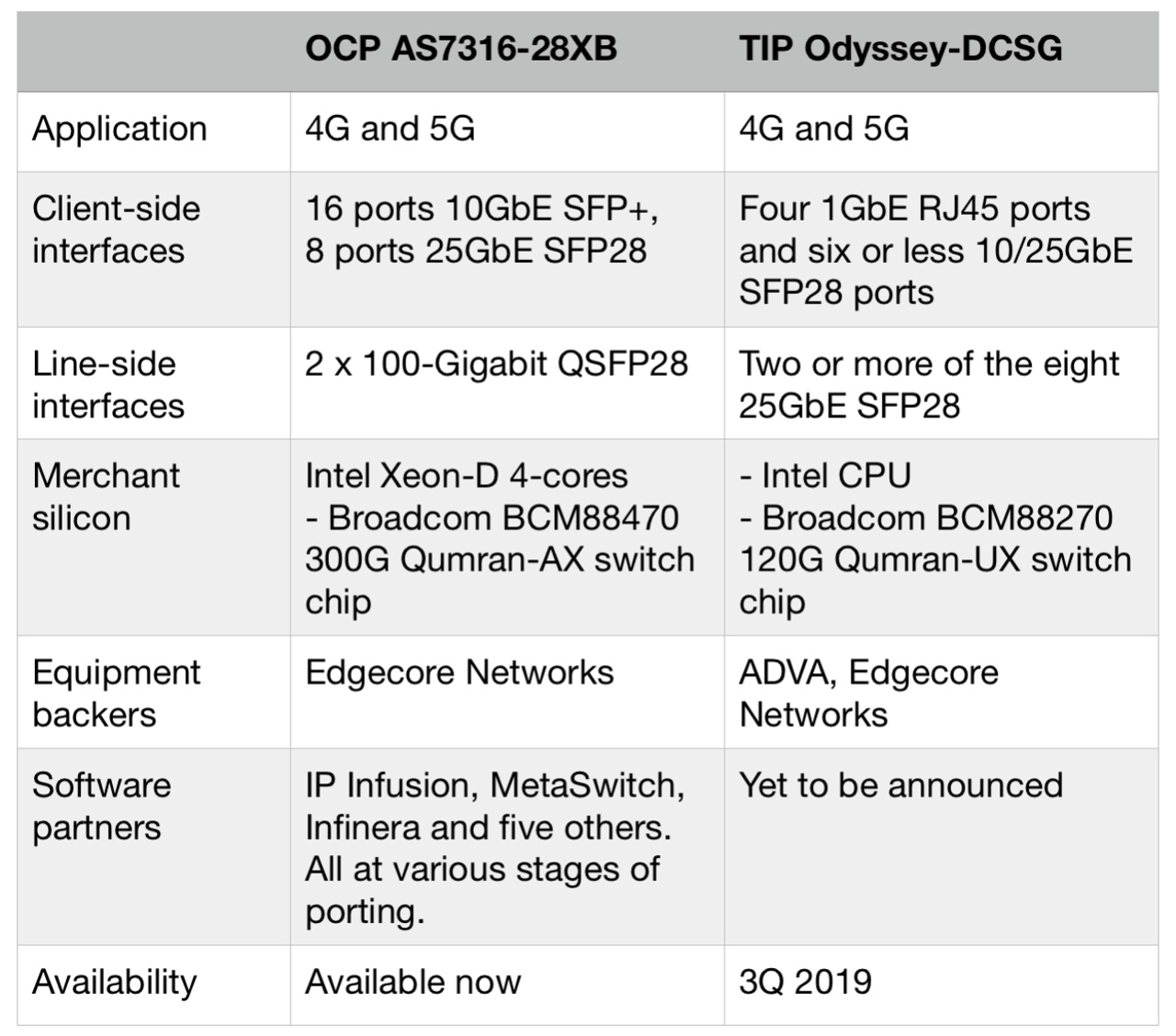
The company is backing two cell-site gateway designs that aggregate traffic from baseband units for 4G and 5G mobile networks. One design is from the Open Compute Project (OCP) that is available now and the second is from the Telecom Infra Project (TIP) that is planned for 2019 (see table).
Edgecore has also announced PON optical line terminal (OLT) platforms addressing 10-gigabit XGS-PON and GPON.
 Source: ADVA, Edgecore Networks
Edgecore is a wholly-ownedsubsidiary of Accton Technology, a Taiwanese original design manufacturer (ODM) employing over 700 networking engineers that reported revenues exceeding $1.2 billion in 2017.
Open networking
Edgecore is a leading proponent of open networking that first data centre operators and now telecom operators are adopting.
Open networking refers to disaggregated designs where the hardware and software comes from separate companies. The hardware is a standardised white box developed in an open framework, while the accompanying software can be commercial code from a company or open-sourced.
Our focus is on all those attributes of open networking: disaggregation, the hardware and software design of standard platforms, and making those designs open
Telecom networks have traditionally been built using proprietary equipment from systems vendors that includes the complete software stack. But the leading telcos have moved away from this approach to avoid being locked into a systems vendor's roadmap. Instead, they are active in open frameworks and are embracing disaggregated open designs, having seen the benefits achieved by the internet content providers that pioneered the approach.
“The IT industry for years have been buying servers and purposing them for whatever application they are designated for, adding an operating system and application software on top,” says Mark Basham, vice president business development and marketing, EMEA at Edgecore. “Now we are seeing the telecom industry shift to that model; they see where the value should be.”
White-box platforms built using merchant silicon promise to reduce the number of specialised platforms in an operator’s network, reducing costs by simplifying platform qualification and support.
“Our focus is on all those attributes of open networking: disaggregation, the hardware and software design of standard platforms, and making those designs open,” says Bill Burger, vice president, business development and marketing for North America at Edgecore.
OCP, TIP and ONF
Edgecore is active in three leading open framework initiatives whose memberships include large-scale data centre operators, telcos, equipment makers, systems integrators, software partners and chip players.
Edgecore is a member of OCP that was founded to address the data centre but now plays an important role in telecoms. The company is also part of TIP that was established in 2016 and includes internet giants Facebook and Microsoft as well as leading telecom operators, systems vendors, components players and others. Edgecore is also a key white-box partner as part of the Open Networking Foundation’s (ONF) reference-design initiative.
 Edgecore Networks' involvement in the ONF's reference design projects. Diagram first published in July 2018. Source: ONF.
Cell-site gateways
Edgecore has announced the availability of its AS7316-26XB, the industry’s first open cell-site gateway white-box design from the OCP that originated as an AT&T specification.
The company is also active in TIP’s cell-site gateway initiative. Edgecore will make and market the Odyssey Disaggregated Cell Site Gateway (Odyssey-DCSG) design that is backed by TIP’s operator members Telefonica, Orange, TIM Brazil and Vodafone. BT is also believed to be backing the TIP gateway.
The gateway aggregates the radio baseband unit (BBU) at a cell site back into the transport network.
The OCP cell-site gateway has a more advanced specification compared to the Odyssey. The AS7316-26XB uses a more powerful Intel processor and employs a 300-gigabit Broadcom Qumran-AX switch chip that aggregates the baseband traffic for transmission into the network.
The platform’s client-side interfaces include 16 SFP+ ports that supports either 1 Gigabit Ethernet (GbE) SFP or 10GbE SFP+ pluggable modules, eight 25GbE ports that accommodate either 10GbE SFP+ or 25GbE SFP28 modules, and two 100GbE QSFP28 uplinks. Some of the 25GbE ports could be used to expand the uplink capacity, if needed.
In contrast, the TIP Odyssey-DCSG platform uses a 120-gigabit Qumran switch chip while its interfaces include provide four 1GbE RJ45 ports and eight 10GbE or 25GbE SFP28 ports. Accordingly, the platform’s uplinks are at 25GbE.
“They [the OCP and TIP gateways] are very different boxes in terms of their performance,” says Basham.
Current deployed mobile platforms don't have sufficient capacity to support LTE Advanced Pro, never mind 5G, says Basham: “All the operators are looking at what is the right time to insert these boxes in the network.”
Telcos need to decide how much they are willing to spend up front. They could deploy a larger capacity but costlier cell-site gateway to future-proof their mobile backhaul for up to a decade. Or they could install the smaller-capacity Odyssey-DCSG that will suffice for five years before requiring an upgrade.
Given that the largest operators will deploy the gateways in units of hundreds of thousands, the capital expenditure outlay will be significant.
Basham says there will be a family of cell-site gateways and points out that the TIP specification originally had three ‘service configurations’. The latest TIP specification document now has a fourth service configuration that differs significantly from the other three in its port count and capabilities. “It shows that there is no one-size-fits-all,” says Basham.
The company also has announced two open disaggregated PON products, part of the OCP.
The ASXvOLT16 is a 10-gigabit OLT platform that supports XGS-PON and NG-PON2. The open OLT platform uses Broadcom’s 800-gigabit Qumran-MX switch chip and its BCM68620 Maple OLT device.
The platform’s interfaces includes 16 XFP ports supporting 10-gigabit optics while for the uplink traffic, four 100GbE ports are used. Each 10-gigabit interface will support 32 or 64 PON optical network units (ONU) typically.
“To support NG-PON2 will require the virtual OLT hardware abstraction layer to be adapted slightly, and also firmware to be put on the Broadcom chips,” says Basham. “The big difference between XGS-PON and NG-PON2 is in the plug-in optics.” More costly tunable optics will be required for NG-PON2. The 1 rack unit (1RU) PON OLT design is available now.
Edgecore has also contributed GPON OLT designs that conform with Deutsche Telecom’s Open GPON OLT design. The Edgecore ASGvOLT32 and ASGvOLT64 GPON OLTs support 32- and 64-GPON ports, respectively, while there are two 100GbE and eight 25GbE uplink ports.
The two GPON OLTs will sample in the first quarter of 2019, moving to volume production one quarter later.
We are at the cusp of bringing together all the parts to make Cassini a deployable solution
Cassini
Edgecore is also bringing its Cassini packet-optical transport white-box platform to market.
Like TIP’s Voyager box, Cassini uses the Broadcom StrataXGS Tomahawk 3.2-terabit switch chip. But while the Voyager comes with built-in coherent interfaces based on Acacia’s AC-400 module, Cassini is a modular design that has eight card slots. Each slot can accommodate one of three module options: a coherent CFP2-ACO, a coherent CFP2-DCO or two QSFP28 100-gigabit pluggables. The Cassini platform also has 16 fixed QSFP28 ports.
Accordingly, the 1.5RU Cassini box can be configured using only the coherent interfaces required. The box could be set up as a 3.2-terabit switch using QSFP28 modules only or as a transport box with up to 1.6 terabits of client-side interfaces and 1.6 terabits of line-side coherent interfaces. This contrasts with the 1RU Voyager that offers 2 terabits of switch capacity with its dozen 100-gigabit client-side interfaces and 800 gigabits of coherent line-side capacity.
“We are at the cusp of bringing together all the parts to make Cassini a deployable solution,” says Basham. “The focus is to get it deployed in the market.”
Edgecore sees Cassini as a baseline for future products. One obvious direction is to increase the platform’s capacity using Broadcom’s 12.8-terabit Tomahawk 3 switch chip. Edgecore already offers a Tomahawk 3-based switch for the data centre.
Such a higher-capacity Cassini platform would support 400GbE client-side interfaces and 400- or 800-gigabit coherent line-side interfaces. “We think that there is a future need for such a platform but we are not actively developing it right now,” says Burger.
A second direction for Cassini’s development is as a platform suited to routeing using larger look-up tables and deep buffering. Such a platform would use merchant silicon such as Broadcom’s Jericho chip. “We think there is a need for that as service providers deploy packet transport platforms in their networks,” says Burger.
Business model
The Cassini platform arose as part of Edgecore’s detailed technology planning discussions with its leading internet content provider customers.
“We recognised a need for more modularity in an open-packet transponder, the ability to mix-and-match the number of packet switching interfaces with the coherent optical interfaces,” says Burger.
Edgecore then approached TIP before contributing the Cassini platform to the organisation’s Open Optical and Packet Transport group.
When Edgecore contributes a design to an open framework such as the OCP or TIP, the design undergoes a review resulting in valuable feedback from member companies.
“We end up making modifications to improve the design in some cases and it then goes through an approval process,” says Burger. “After that, we contribute the design package and its available to anyone without any royalty obligation.”
At first glance, it is not obvious how contributing a platform design that other firms can build benefits Edgecore. But Burger says Edgecore benefits is several ways.
The organisation members’ feedback improves the product’s design. Edgecore also raises industry awareness of its platforms including among the OCP’s and TIP’s large service provider members.
Making the design available to members also offers the operators a potential second source for Edcore’s white box designs, strengthening confidence and their appeal.
And once a design is open sourced, software partners including start-ups will investigate the design as a platform for their code which can result in partnerships. “This benefits us and benefits the software companies,” says Burger.
Edgecore stresses that open-networking platforms are going to take time before they become widely adopted across service providers’ networks.
“It is going to be an evolution, starting with high-volume, more standardised use cases,” concludes Burger.
Part 1: TIP white-box designs, click here

FSAN unveils roadmap plans
Part 2: Next-generation passive optical networks
The Full Service Access Network (FSAN) has outlined its vision for fibre access networks for the coming decade.
FSAN is an industry forum that includes over 20 operators and 70 members overall. The group identifies service requirements and develops optical access technologies that are passed to the International Telecommunication Union (ITU) for standardisation.
 Source: FSAN
“One of the messages of the roadmap is that, in the immediate future, what FSAN wants to do is evolve the existing standards,” says Peter Dawes, FSAN NGPON co-chair.
The latest FSAN technologies to become standards are XGS-PON (10 gigabits symmetrical passive optical network) and the multiple wavelength TWDM-PON (time wavelength-division multiplexing passive optical network), also known as NG-PON2 (see chart).
PON status
XGS-PON is a single-wavelength PON standard that supports two rates: a 10-gigabit symmetrical rate and the asymmetrical 10 gigabits downstream (to the user) and 2.5 gigabits upstream originally introduced by XG-PON.
 Peter Dawes
TWDM-PON uses four wavelengths to deliver up to 40 gigabits of symmetrical bandwidth and has an option for eight wavelengths overall. TWDM-PON also uses tuneable lasers enabling operators to move subscribers between wavelengths.
“FSAN operators see continued growth in PON deployment,” says Dawes. “There is still strong deployment of GPON and we are on the verge of needing 10-gigabit symmetrical services.” Other operators may delay and go straight to TWDM-PON, he says.
According to Dawes, operators are seeing a variety of applications that are driving the need for 10-gigabit access rates. One is the growing use of video and video conferencing. Another bandwidth driver for access networks is mobile applications such as connecting mobile antennas and mobile backhaul. In addition, there are digital home trends such as social networking and the moving of content to the cloud.
Mobile fronthaul can eat as much bandwidth as you can supply once you start to aggregate [radio] antennas
Operators are also keen to attach the labels ‘gigabit’ and ‘gigabit services’ to their broadband offerings as a marketing differentiator.
Other drivers for the move to the newer PON technologies include peer-to-peer services and business IP services, says Dawes.
Roadmap
FSAN’s plan to evolve the existing standards in the near term will take the group to 2021.
One obvious way the existing PONs can be evolved is to adopt 25-gigabit wavelengths. This would enable a 25-gigabit symmetrical extension to XGS-PON and a future TWDM-PON variant with up to 200 gigabits of capacity if the full eight wavelengths are used. “It is a case of looking for logical evolutions of these technologies,” says Dawes.
One application that could use such high capacities is mobile fronthaul, says Dawes: “It can eat as much bandwidth as you can supply once you start to aggregate [radio] antennas.”
After 2020, FSAN will investigate disruptive technologies as it defines future optical access schemes. R&D work, new modulation schemes and component developments including silicon photonics will all be assessed as to their suitability for future optical access schemes.
Meanwhile, FSAN says it will review its roadmap on a yearly basis and amend it as required.
See Part 1: XGS and TWDM passive optical networks, click here
Telefonica tests XGS-PON
Part 1: XGS and TWDM passive optical networks
Telefonica is the latest operator to test XGS-PON, the 10-gigabit passive optical networking standard.
“Operators want to show they are taking the maximum from their fibre investment,” says Ana Pesovic, marketing manager for fibre at Nokia, the supplier of the XGS-PON equipment used for the operator’s lab tests. “Telefonica has been really aggressive in their fibre deployments in the last couple of years.”
 Ana Pesovic
XGS-PON
Approved by the ITU-T in 2016, XGS-PON supports two rates: 10-gigabit symmetrical and the asymmetrical rate of 10 gigabits downstream (to the user) and 2.5 gigabits upstream.
XGS-PON has largely superseded the earlier XG-PON standard which supports the 10-gigabit asymmetrical rate only. “It is fair to say there is no traction for XG-PON,” says Pesovic. “Even in China [an early adopter of XG-PON], we see the interest slowly moving to XGS-PON.”
Nokia says it has now been involved in 40 XGS-PON trials and nine customers have deployed the technology. “These have just started and they are not massive deployments,” says Pesovic.
Nokia’s XGS-PON customers include China Telecom and SK Broadband. SK Broadband has deployed XGS-PON alongside the more advanced TWDM-PON (time wavelength division multiplexing, passive optical network), the ITU-T NG-PON2 standard.
XGS-PON uses a fixed wavelength to deliver either the 10-gigabit symmetrical or asymmetrical service. The standard supports a distance of 20km and a split ratio of up to 1:128 - one XGS-PON optical line terminal (OLT) serving up to 128 optical network units (ONUs). In contrast, TWDM-PON supports four wavelengths enabling up to 40-gigabit symmetrical rates. And unlike XGS-PON, TWDM-PON supports flexible wavelengths using tuneable lasers.
The wavelengths used by XGS-PON and TWDM-PON have been specified such that the two standards can operate alongside GPON on the same fibre. Accordingly, with SK Broadband’s deployment, the two PON standards along with GPON support an aggregate capacity of 52.5 gigabits-per-second.
As well as testing XGS-PON's performance, Telefonica has tested that XGS-PON works without disturbing existing broadband services over its GPON networks, says Pesovic.
For the test, Telefonica used an 8-port line card where each port can be configured for XGS-PON or as a wavelength of a TWDM-PON. The line card fits within Nokia’s 7360 Intelligent Services Access Manager (ISAM) FX platform.
5G will require the deployment of many more small cells. With XGS-PON, multiple small cells can be served using a single PON
Applications
XGS-PON with its symmetrical 10-gigabit rate is suited to business services. "Operators can use one network to converge business and residential; today they are two overlay networks,” says Pesovic. Many businesses require 1-gigabit connectivity or less but by having a 10-gigabit link, multiple enterprises can be aggregated on one PON.
Nokia says that in countries such as South Korea as well as in Europe and North America there is also interest in a 10-gigabit PON for residential services. “People are taking the downstream bandwidth for granted and now the upstream is becoming a differentiator, making the quality of experience much better,” says Pesovic.
The bulk of traffic is still predominately downstream but increasingly users want to upload large files and video. Even if these uploads are of shorter duration, the network must deliver, says Pesovic.
Operators are also eyeing XGS-PON for the emerging 5G cellular standard. Nokia points out that 5G will require the deployment of many more small cells. With XGS-PON, multiple small cells can be served using a single PON.
Nokia expects XGS-PON will be deployed for years to come. Broadband is advancing by adding more wavelengths. To GPON, which uses one wavelength, can be added a second wavelength supporting 10-gigabit XGS-PON. Using TWDM-PON adds four and potentially eight more wavelengths - 40 gigabits and 80 gigabits of bandwidth, respectively. “It really doesn’t matter what the technology is called,” says Pesovic.
One North American operator is looking at TWDM-PON as a way to save power. During the night when there is less broadband usage, the operator wants to use wavelength mobility to migrate users onto a single wavelength.
TWDM-PON
Besides wavelength count, TWDM-PON differs from XGS-PON in its use of tuneable lasers.
Having tuneable wavelengths delivers several benefits to the operators. One is load balancing. If users on one wavelength start to exhaust its capacity, several users can be moved to a second wavelength that is less heavily loaded.
TWDM-PON also benefits network sharing and wavelength unbundling. A third-party operator can offer its fibre to interested operators. “Each operator could then operate on a single wavelength,” says Pesovic. If a user changes operator, they can simply be moved from one wavelength to another.
There are also operational benefits. If a fault develops on a board, users can be migrated to a second card without service interruption and the faulty board replaced.
One North American operator is looking at TWDM-PON as a way to save power, says Pesovic. During the night when there is less broadband usage, the operator wants to use wavelength mobility to migrate users onto a single wavelength. This would deliver sufficient bandwidth to those users that are active while allowing the remaining wavelengths to be powered down, saving power.
The issue impeding the uptake of TWDM-PON remains the high cost of tuneable lasers. Nokia expects it to be at least another year before the cost of tuneable lasers becomes more economical for PON. That said, service providers delivering businesses services may still be tempted to adopt TWDM-PON despite the higher cost of tuneable lasers given that the average revenue per user (ARPU) of business users is 5x that of residential users, says Pesovic.
See Part 2: FSAN unveils roadmap plans, click here