

China Mobile plots 400 Gigabit trials in 2017
China Mobile is preparing to trial 400-gigabit transmission in the backbone of its optical network in 2017. The planned trials were detailed during a keynote talk given by Jiajin Gao, deputy general manager at China Mobile Technology, at the OIDA Executive Forum, an OSA event hosted at OFC, held in Los Angeles last week.
The world's largest operator will trial two 400-gigabit variants: polarisation-multiplexed, quadrature phase-shift keying (PM-QPSK) and 16-ary quadrature amplitude modulation (PM-16QAM).
The 400-gigabit 16-QAM will achieve a total transmission capacity of 22 terabits and a reach of 1,500km using ultra-low-loss fibre and Raman amplification, while with Nyquist PM-QPSK, the capacity will be 13.6 terabits and a 2000km reach. China Mobile started to deploy 100 gigabits in its backbone in 2013. It expects to deploy 400 gigabits in its metro and provisional networks from 2018.
Gao also detailed the growth in the different parts of China Mobile's network. Packet transport networking ports grew by 200,000 in 2016 to 1.2 million. The operator also grew its fixed broadband market share, adding over 20 million GPON subscribers to reach 80 million in 2016 while its optical line terminals (OLTs) grew from 89,000 in 2015 to 113,000 in 2016. Indeed, China Mobile has now overtaken China Unicom as China's second largest fixed broadband provider. Meanwhile, the fibre in its metro networks grew from 1.26 million kilometres in 2015 to 1.41 million in 2016.
The Chinese operator is also planning to adopt a hybrid OTN-reconfigurable optical add-drop multiplexer (OTN-ROADM) architecture which it trialled in the second half of 2016, linking several cities. The operator currently uses electrical cross-connect switches which were first deployed in 2011.
The ROADM is a colourless, directionless and contentionless design that also supports a flexible grid, and the operator is interested in using the hybrid OTN-ROADM in its provisional backbone and metro networks. Using the OTN-ROADM architecture is expected to deliver a power savings of between 13% and 50%, says Gao.
XG-PON was also first deployed in 2016. China Mobile says 95% of its GPON optical network units deployed connect single families. The operator detailed an advanced home gateway that it has designed which six vendors are now developing. The home gateway features application programming interfaces to enable applications to be run on the platform.
For the XG-PON OLTs, China Mobile is using four vendors - Fiberhome, Huawei, ZTE and Nokia Shanghai Bell. The OLTs support 8 ports per card with three of the designs using an ASIC and one an FPGA. "Our conclusion is that 10-gigabit PON is mature for commercialisation," says Gao.
Gao also talked about China Mobile's NovoNet 2020, the vision for its network which was first outlined in a White Paper in 2015. NovaNet will be based on such cloud technologies as software-defined networking (SDN) and network function virtualisation (NFV) and is a hierarchical arrangement of Telecom Integrated Clouds (TICs) that span the core through to access. He outlined how for private cloud services, a data centre will have 3,000 servers typically while for public cloud 4,000 servers per node will be used.
China Mobile has said the first applications on NovoNet will be for residential services, with LTE, 5G enhanced packet core and multi-access edge computing also added to the TICs.
The operator said that it will trial SDN and NFV in its network this year and also mentioned how it had developed its own main SDN controller that oversees the network.
China Mobile reported 854 million mobile subscribers at the end of February, of which 559 million are LTE users, while its wireline broadband users now exceed 83 million.

FSAN unveils roadmap plans
Part 2: Next-generation passive optical networks
The Full Service Access Network (FSAN) has outlined its vision for fibre access networks for the coming decade.
FSAN is an industry forum that includes over 20 operators and 70 members overall. The group identifies service requirements and develops optical access technologies that are passed to the International Telecommunication Union (ITU) for standardisation.
 Source: FSAN
“One of the messages of the roadmap is that, in the immediate future, what FSAN wants to do is evolve the existing standards,” says Peter Dawes, FSAN NGPON co-chair.
The latest FSAN technologies to become standards are XGS-PON (10 gigabits symmetrical passive optical network) and the multiple wavelength TWDM-PON (time wavelength-division multiplexing passive optical network), also known as NG-PON2 (see chart).
PON status
XGS-PON is a single-wavelength PON standard that supports two rates: a 10-gigabit symmetrical rate and the asymmetrical 10 gigabits downstream (to the user) and 2.5 gigabits upstream originally introduced by XG-PON.
 Peter Dawes
TWDM-PON uses four wavelengths to deliver up to 40 gigabits of symmetrical bandwidth and has an option for eight wavelengths overall. TWDM-PON also uses tuneable lasers enabling operators to move subscribers between wavelengths.
“FSAN operators see continued growth in PON deployment,” says Dawes. “There is still strong deployment of GPON and we are on the verge of needing 10-gigabit symmetrical services.” Other operators may delay and go straight to TWDM-PON, he says.
According to Dawes, operators are seeing a variety of applications that are driving the need for 10-gigabit access rates. One is the growing use of video and video conferencing. Another bandwidth driver for access networks is mobile applications such as connecting mobile antennas and mobile backhaul. In addition, there are digital home trends such as social networking and the moving of content to the cloud.
Mobile fronthaul can eat as much bandwidth as you can supply once you start to aggregate [radio] antennas
Operators are also keen to attach the labels ‘gigabit’ and ‘gigabit services’ to their broadband offerings as a marketing differentiator.
Other drivers for the move to the newer PON technologies include peer-to-peer services and business IP services, says Dawes.
Roadmap
FSAN’s plan to evolve the existing standards in the near term will take the group to 2021.
One obvious way the existing PONs can be evolved is to adopt 25-gigabit wavelengths. This would enable a 25-gigabit symmetrical extension to XGS-PON and a future TWDM-PON variant with up to 200 gigabits of capacity if the full eight wavelengths are used. “It is a case of looking for logical evolutions of these technologies,” says Dawes.
One application that could use such high capacities is mobile fronthaul, says Dawes: “It can eat as much bandwidth as you can supply once you start to aggregate [radio] antennas.”
After 2020, FSAN will investigate disruptive technologies as it defines future optical access schemes. R&D work, new modulation schemes and component developments including silicon photonics will all be assessed as to their suitability for future optical access schemes.
Meanwhile, FSAN says it will review its roadmap on a yearly basis and amend it as required.
See Part 1: XGS and TWDM passive optical networks, click here
ICT could reduce global carbon emissions by 15%
Part 1: Standards and best practices
Keith Dickerson is chair of the International Telecommunication Union's (ITU) working party on information and communications technology (ICT) and climate change.
In a Q&A with Gazettabyte, he discusses how ICT can help reduce emissions in other industries, where the power hot spots are in the network and what the ITU is doing.

"If you benchmark base stations across different countries and different operators, there is a 5:1 difference in their energy consumption"
Keith Dickerson
Q. Why is the ITU addressing power consumption reduction and will its involvement lead to standards?
KD: We are producing standards and best practices. The reason we are involved is simple: ICT – all IT and telecoms equipment - is generating 2% of [carbon] emissions worldwide. But traffic is doubling every two years and the energy consumption of data centres is doubling every five years. If we don’t watch out we will be part of the problem. We want to reduce emissions in the ICT sector and in other sectors. We can reduce emissions in other sectors by 5x or 6x what we emit in our own sector.
Just to understand that figure, you believe ICT can cut emissions in other industries by a factor of six?
KD: We could reduce emissions overall by 15% worldwide. Reducing things like travel and storage of goods and by increasing recycling. All these measures in conjunction, enabled by ICT, could reduce overall emissions by 15%. These sectors include travel, the forestry sector and waste management. The energy sector is huge and we can reduce emissions here by up to 30% using smarter grids.
What are the trends regarding ICT?
KD: ICT accounts for 2% at the moment, maybe 2.5% if you include TV, but it is growing very fast. By 2020 it could be 6% of worldwide emissions if we don’t do something. And you can see why: Broadband access rates are doubling every two years, and although the power-per-bit is coming down, overall power [consumed] is rising.
Where are the hot spots in the network?
The areas where energy consumption is going up most greatly are at the ends of the network. They are in the home equipment and in data centres. Within the network it is still going up, but it is under control and there are clear ways of reducing it.
For example all operators are moving to a next-generation network (NGN) – BT is doing this with its 21CN - and this alone leads to a power reduction. It leads to a significant reduction in switching centres, by a factor of ten. And you can collapse different networks into a single IP network, reducing the energy consumption [associated with running multiple networks]. The equipment in the NGN doesn’t need as much cooling or air conditioning. The use of more advanced access technology such as VDSL2 and PON will by itself lead to a reduction in power-per-bit.
The EU has a broadband code of conduct which sets targets in reducing energy consumption in the access network and that leads to technologies such as standby modes. My home hub, if I don’t use it for awhile, switches to a low-power mode.
The ITU is looking at how to apply these low–power modes to VDSL2. There has also been a very recent proposal to reduce the power levels in PONs. There has been a contribution from the Chinese for a deep-sleep mode for XG-PON. The ITU-T Study Group 13 on future networks is also looking at such techniques, shutting down part of the core network when traffic levels are low such as at night.
What about mobile networks?
If you benchmark them across different countries and different operators there is a 5:1 difference in the energy consumption of base stations. They are running the same standard but their energy efficiency is somewhat different; they have been made at different times and by different vendors.
In a base station, some half of the power is lost in the [signal] coupling to the antenna. If you can make amplifiers more efficient and reduce the amount of cooling and air-condition required by the base station, you can reduce energy consumption by 70 or 80%. If all operators and all counties used best practices here, energy consumption in the mobile network could be reduced by 50% to 70%.
If you could get overall power consumption of a base station down to 100W, you could power it from renewable energy. That would make a huge difference; it could work without having to worry about the reliability of the electricity grid which in India and Africa is a tricky problem. And at the moment the price of diesel fuel [to power standby generators] is going through the roof.
I visited Huawei recently and they have examples of 100W base stations powered by renewable energy, making them independent of the electricity network. At the moment a base station consume more like 1000W and overall they consume over half the overall power used by a mobile operator. At 100W, that wouldn’t be the case.
Other power saving activities in mobile include sharing networks among operators such as Orange and T-Mobile in the UK. And BT has signed a contract with four out of the five UK mobile operators to provide their backhaul and core networks in the future.
What is the ITU doing with regard energy saving schemes?
The ITU set up the working party on ICT and climate change less than two years ago. We have work in three different areas.
One is increasing energy efficiencies in ICT which we are doing through the widespread introduction of best practices. We are relying on the EC to set targets. The ITU, because it has 193 countries involved, finds it very difficult to agree targets. So we issue best practices which show how targets can be met. This covers data centres, broadband and core networks.
Another of our areas is agreeing a common methodology for how to measure the impact of ICT on carbon emissions. We have been working on this for 18 months and the first recommendations should be consented this summer. Overall this work will be completed in the next two years. This will enable you to measure the emissions of ICT by country, or sector, or an individual product or service, or within a company. If companies don’t meet their targets in future they will be fined so it is very important companies are measured in the same way.
A third area of our activities are things like recycling. We have produced a standard for a universal charger for mobile phones. You won’t have to buy a new charger each time you buy a new phone. At the moment thousands of tonnes of chargers go to landfill [waste sites] every year. The standard introduced by the ITU last year only covers 25% of handsets. The revised standard will raise that to 80%.
At the last meeting the Chinese also proposed a universal battery – or a range of batteries. This would means you don’t have to throw away your old battery each time you buy a new mobile. It is all about reducing the amount of equipment that goes into landfill.
We are also doing some other activities. Most telecom equipment use a 50V power supply. We are taking that up to 400V. So a standard power supply for a data centre or a switch would be at 400V. This would mean you would lose a lot less power in the wiring as you would be operating at a lower current - power losses vary according to the square of the current.
These ITU activities coupled with operators moving to new architectures and adopting new technologies will all help yet traffic is doubling every two years. What will be the overall effect?
It all depends on the targets that are set. The EU is putting in more and more severe targets. If companies have to pay a fine if they don’t meet them, they will introduce new technologies more quickly. Companies won’t pay the extra investment unless they have to, I’m afraid, especially during this difficult economic period.
Every year the EC revises the code of conduct on broadband and sets stiffer targets. They are driving the introduction of new technology into the industry, and everyone wants to sign up to show that they are using best practices.
What the ITU is doing is providing the best practices and the standards to help them do that. The rate at which they act will depend on how fast those targets are reduced.
Keith Dickerson is a director at Climate Associates.
Part 2 Operators' power efficiency strategies
Bringing WDM-PON to market

"We see just one way to bring down the cost, form-factor and energy consumption of the OLT’s multiple transceivers: high integration of transceiver arrays"
Klaus Grobe, ADVA Optical Networking
Considerable engineering effort will be needed to make next-generation optical access schemes using multiple wavelengths competitive with existing passive optical networks (PONs).
Such a multi-wavelength access scheme, known as a wavelength division multiplexing-passive optical network (WDM-PON), will need to embrace new architectures based on laser arrays and reflective optics, and use advanced photonic integration to meet the required size, power consumption and cost targets.
Current PON technology uses a single wavelength to deliver downstream traffic to end users. A separate wavelength is used for upstream data, with each user having an assigned time slot to transmit.
Gigabit PON (GPON) delivers 2.5 Gigabit-per-second (Gbps) to between 32 or 64 users, while the next development, XG-PON, will extend GPON’s downstream data rate to 10 Gbps. The alternative PON scheme, Ethernet PON (EPON), already has a 10 Gbps variant. Vendors are also extending PON’s reach from 20km to 80km or more using signal amplification.
But the industry view is that after 10 Gigabit PON, the next step will be to introduce multiple wavelengths to extend the capacity beyond what a time-sharing approach can support. Extending the access network's reach to 100km will also be straightforward using WDM transport technology.
The advent of WDM-PON is also an opportunity for new entrants, traditional WDM optical transport vendors, to enter the access market. ADVA Optical Networking is one firm that has been vocal about its plans to develop next-generation access systems.
“We are seriously investigating and developing a next-generation access system and it is very likely that it will be a flavour of WDM-PON,” says Klaus Grobe, senior principal engineer at ADVA Optical Networking. “It [next-generation access] must be based on WDM simply because of bandwidth requirements.”
The system vendor views WDM-PON as addressing three main applications: wireless backhaul, enterprise connectivity and residential broadband. But despite WDM-PON’s potential to reduce operating costs significantly, the challenge facing vendors is reducing the cost of WDM-PON hardware. Indeed it is the expense of WDM-PON systems that so far has assigned the technology to specialist applications only.
 A non-reflective tunable laser-based WDM-PON ONU. Source: ADVA Optical NetworkingAccording to Grobe, cost reduction is needed at both ends of the WDM-PON: the client receiver equipment known as the optical networking unit (ONU) and the optical line terminal (OLT) housed within an operator’s central office.
ADVA Optical Networking plans to use low-cost tunable lasers rather than a broadband light source and reflective optics for the ONU transceivers. “For the OLT, we see just one way to bring down the cost, form-factor and energy consumption of the OLT’s multiple transceivers: high integration of transceiver arrays,” says Grobe.
This is a considerable photonic integration challenge: a 40- or 80-wavelength WDM-PON uses 40 or 80 transceiver bi-directional clients, equating to 80 and 160 wavelengths. If 80 SFPs optical modules were used at the OLT, the resulting cost, size and power consumption would be prohibitive, says Grobe.
ADVA Optical Networking is working with several firms, one being CIP Technologies, to develop integrated transceiver arrays. ADVA Optical Networking and CIP Technologies are part of the EU-funded project, C-3PO, that includes the development of integrated transceiver arrays for WDM-PON.
Splitters versus filters
One issue with WDM-PON is that there is no industry-accepted definition. ADVA Optical Networking views WDM-PON as an architecture based on optical filters rather than splitters. Two consequences result once that choice is made, says Grobe.
One is insertion loss. Choosing filters implies arrayed waveguide gratings (AWGs), says Grobe. “No other filter technology is seriously considered for WDM-PON if filters are used,” he says.
With an AWG, the insertion loss is independent of the number of wavelengths supported. This differs from using a splitter-based architecture where every 1x2 device introduces a 3dB loss - “closer to 3.5dB”, he says. Using a 1x64 splitter, the insertion loss is 14 or 15dB whereas for a 40-channel AWG the loss can be as low as 4dB. “I just saw specs of a first 96-channel AWG, even that one isn’t much higher [than 4dB],” says Grobe. Thus using filters rather than splitters, the insertion loss is much lower for a comparable number of client ONUs.
There is also a cost benefit associated with a low insertion loss. To limit the cost of next-generation PON, the transceiver design must be constrained to a 25dB power budget associated with existing PON transceivers. “This is necessary to keep these things cheap, possibly dirt cheap,” says Grobe.
The alternative, using XG-PON’s sophisticated 10 Gbps burst-mode transceiver with its associated 35dB power budget, achieving low cost is simply not possible, he says. To live with transceivers with a 25dB power budget, the insertion loss of the passive distribution network must be minimised, explaining why filters are favoured.
The other main benefit of using filters is security. With a filter-based PON, wavelength point-to-point connections result. “You are not doing broadcast,” says Grobe. “You immediately get rid of almost all security aspects.” This is an issue with PON where traffic is shared.
Low power
Achieving a low-power WDM-PON system is another key design consideration. “In next-gen access, it is absolutely vital,” says Grobe. “If the technology is deployed on a broad scale - that is millions of user lines – every single watt counts, otherwise you end up with differences in the approaches that go into the megawatts and even gigawatts.”
There is also a benchmarking issue, says Grobe: the WDM-PON OLT will be compared to XG-PON’s even if the two schemes differ. Since XG-PON uses time-division multiplexing, there will be only one transceiver at the OLT. But this is what a 40- or 80-channel WDM-PON OLT will be compared with, even if the comparison is apples to pears, says Grobe.
WDM-PON workings
There are two approaches to WDM-PON.
In a fully reflective architecture, the OLT array and the ONUs are seeded using multi-wavelength laser arrays; both ends use the lasers arrays in combination with reflective optics for optical transmission.
ADVA Optical Networking is interested in using a reflective approach at the OLT but for the ONU it will use tunable lasers due to technical advantages. For example, using the same wavelength for the incoming and modulated streams in a reflective approach, Rayleigh crosstalk is an issue when the ONUs are 100km from the OLT. In contrast, Rayleigh crosstalk at the OLT is avoided because the multi-wavelength laser array is located only a few metres from the reflective electro-absorption modulators (REAMs).
REAMs are used rather than semiconductor optical amplifiers (SOAs) to modulate data at the OLT because they support higher bandwidth 10 Gbps wavelengths. Indeed the C-3PO project is likely to use a monolithically integrated SOA-REAM for this task. “The reflective SOA is narrower in bandwidth but has inherent gain while the REAM has loss rather than gain – it is just a modulator,” says Grobe. “The combination of the two is the ideal: giving high modulation bandwidth and high transmit power.”
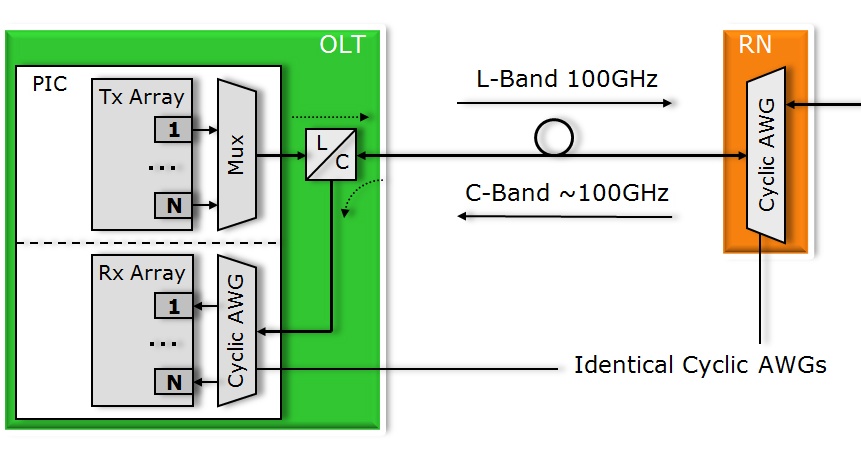 The integrated WDM-PON OLT. In practice the transmit array uses a reflective architecture based on SOA-REAMs and is fed with a multi-wavelength laser source. Source: ADVA Optical Networking
For the OLT, a multi-wavelength laser is fed via an AWG into an array of SOA-REAMs which modulate the wavelengths and return them through the AWG where they are multiplexed and transmitted to the ONUs via a demultiplexing AWG. An added benefit of this approach, says Grobe, is that the same multi-wavelength laser source can be use to feed several WDM-PON OLTs, further decreasing system cost.
For the upstream path, each ONU’s wavelength is separated by the OLT’s AWG and fed to the receiver array. In a WDM-PON system, the OLT transmit wavelengths and receive wavelengths (from the ONUs) operate in separate optical bands.
Grobe expects its resulting WDM-PON system to use 40 or 80 channels. And to best meet size, power and cost constraints, the OLT design will likely implemented as a photonic integrated circuit. “We are after a single PIC solution,” he says. “It is clear that with the OLT, integration is the only way to meet requirements.” A photonically-integrated OLT design is one of the products expected from the C-3PO project, using CIP Technologies' hybrid integration technology.
ADVA Optical Networking has already said that its WDM-PON OLT will be implemented using its FSP 3000 platform.
- To see some WDM-PON architecture slides, click here.
Reflecting light to save power
System vendors will be held increasingly responsible for the power consumption of their telecom and datacom platforms. That’s because for each watt the equipment generates, up to six watts is required for cooling. It is a burden that will only get heavier given the relentless growth in network traffic.
 "Enterprises are looking for huge capacity at low cost and are increasingly concerned about the overall impact on power consumption"
David Smith, CIP Technologies
No surprise, then, that the European 7th Framework Programme has kicked-off a research project to tackle power consumption. The Colorless and Coolerless Components for Low-Power Optical Networks (C-3PO) project involves six partners that include component specialist CIP Technologies and system vendors ADVA Optical Networking.

CIP is the project’s sole opto-electronics provider while ADVA Optical Networking's role is as system integrator.
“It’s not the power consumption of the optics alone,” says David Smith, CTO of CIP Technologies. “The project is looking at component technology and architectural issues which can reduce overall power consumption.”
The data centre is an obvious culprit, requiring up to 5 megawatts. Power is consumed by IT and networking equipment within the data centre – not a C-3PO project focus – and by optical networking equipment that links the data centre to other sites. “Large enterprises have to transport huge amounts of capacity between data centres, and requirements are growing exponentially,” says Smith. “They [enterprises] are looking for huge capacity at low cost and are increasingly concerned about the overall impact on power consumption.”
One C-3PO goal is to explore how to scale traffic without impacting the data centre’s overall power consumption. Conventional dense wavelength division multiplexing (DWDM) equipment isn’t necessarily the most power-efficient given that DWDM tunable lasers requires their own cooling. “There is the power that goes into cooling the transponder, and to get the heat away you need to multiply again by the power needed for air conditioning,” says Smith.
Another idea gaining attention is operating data centres at higher ambient temperatures to reduce the air conditioning needed. This idea works with chips that have a wide operating temperature but the performance of optics - indium phosphide-based actives - degrade with temperature such that extra cooling is required. As such, power consumption could even be worse, says Smith
A more controversial optical transport idea is changing how line-side transport is done. Adding transceivers directly to IP core routers saves on the overall DWDM equipment deployed. This is not a new idea, says Smith, and an argument against this is it places tunable lasers and their cooling on an IP router which operates at a relatively high ambient temperature. The power reduction sought may not be achieved.
But by adopting a new transceiver design, using coolerless and colourless (reflective) components, operating at a wider temperature range without needing significant cooling is possible. “It is speculative but there is a good commercial argument that this could be effective,” says Smith.
C-3PO will also exploit material systems to extend devices’ temperature range - 75oC to 85oC - to eliminate as much cooling as possible. Such material systems expertise is the result of CIP’s involvement in other collaborative projects.
"If the [WDM-PON] technology is deployed on a broad scale - that is millions of user lines – every single watt counts"
Klaus Grobe, ADVA Optical Networking
Indeed a companion project, to be announced soon, will run alongside C-3PO based on what Smith describes as ‘revolutionary new material systems’. These systems will greatly improve the temperature performance of opto-electronics. “C-3PO is not dependent on this [project] but may benefit from it,” he says.
Colourless and coolerless
CIP’s role in the project will be to integrate modulators and arrays of lasers and detectors to make coolerless and colourless optical transmission technology. CIP has its own hybrid optical integration technology called HyBoard.
“Coolerless is something that will always be aspirational,” says Smith. C-3PO will develop technology to reduce and even eliminate cooling where possible to reduce overall power consumption. “Whether you can get all parts coolerless, that is something to be strived for,” he says.
Colourless implies wavelength independence. For light sources, one way to achieve colourless operation is by using tunable lasers, another is to use reflective optics.
CIP Technologies has been working on reflective optics as part of its work on wavelength division multiplexing, passive optical networks (WDM-PON). Given such reflective optics work for distances up to 100km for optical access, CIP has considered using the technology for metro and enterprise networking applications.
Smith expects the technology to work over 200-300km, at data rates from 10 to 28 Gigabit-per-second (Gbps) per channel. Four 28Gbps channels would enable low-cost 100Gbps DWDM interfaces.
Reflective transmission
CIP’s building-block components used for colourless transmission include a multi-wavelength laser, an arrayed waveguide grating (AWG), reflective modulators and receivers (see diagram).
 Reflective DWDM architecture. Source: CIP Technologies
Smith describes the multi-wavelength laser as an integrated component, effectively an array of sources. This is more efficient for longer distances than using a broadband source that is sliced to create particular wavelengths. “Each line is very narrow, pure and controlled,” says Smith.
The laser source is passed through the AWG which feds individual wavelengths to the reflective modulators where they are modulated and passed back through the AWG. The benefit of using a reflective modulator rather than a pass-through one is a simpler system. If the light source is passed through the modulator, a second AWG is needed to combine all the sources, as well as a second fibre. Single-ended fibre is also simpler to package.
For data rates of 1 or 2Gbps, the reflective modulator used can be a reflective semiconductor optical amplifier (RSOA). At speeds of 10Gbps and above, the complementary SOA-REAM (reflective electro-absorption modulator) is used; the REAM offers a broader bandwidth while the SOA offers gain.
The benefit of a reflective scheme is that the laser source, made athermal and coolerless, consumes far less power than tunable lasers. “It has to be at least half the cost and we think that is achievable,” says Smith.
Using the example of the IP router, the colourless SFP transceiver – made up of a modulator and detector - would be placed on each line card. And the multi-wavelength laser source would be fed to each card’s module.
Another part of the project is looking at using arrays of REAMs for WDM-PON. Such an modulator array would be used at the central office optical line terminal (OLT). “Here there are real space and cost savings using arrays of reflective electro-absorption modulators given their low power requirements,” says Smith. “If we can do this with little or no cooling required there will be significant savings compared to a tunable laser solution.”
ADVA Optical Networking points out that with an 80-channel WDM-PON system, there will be a total of 160 wavelengths (see the business case for WDM-PON). “If you consider 80 clients at the OLT being terminated with 80 SFPs, there will be a cost, energy consumption and form-factor overkill,” says Klaus Grobe, senior principal engineer at ADVA Optical Networking. “The only known solution for this is high integration of the transceiver arrays and that is exactly what C-3PO is about.”
The low-power aspect of C-3PO for WDM-PON is also key. “In next-gen access, it is absolutely vital,” says Grobe. “If the technology is deployed on a broad scale - that is millions of user lines – every single watt counts, otherwise you end up with differences in the approaches that go into the megawatts and even gigawatts.”
 There is also a benchmarking issue: the WDM-PON OLT will be compared to the XG-PON standard, the next-generation 10Gbps Gigabit passive optical network (GPON) scheme. Since XG-PON will use time-division multiplexing, there will be only one transceiver at the OLT. But this is what a 40- or 80-channel WDM-PON OLT will be compared with.
CIP will also be working closely with 3-CPO partner, IMEC, as part of the design of the low-power ICs to drive the modulators.
Project timescales
The C-3PO project started in June 2010 and will last three years. The total funding of the project is €2.6 million with the European Union contributing €1.99 million.
The project will start by defining system requirements for the WDM-PON and optical transmission designs.
At CIP the project will employ the equivalent of two full-time staff for the project’s duration though Smith estimates that 15 CIP staff will be involved overall.
ADVA Optical Networking plans to use the results of the project – the WDM-PON and possibly the high-speed transmission interfaces - as part of its FSP 3000 WDM platform.
CIP expects that the technology developed as part of 3-CPO will be part of its advanced product offerings.
BroadLight’s GPON ICs: from packets to apps
BroadLight has announced its Lilac family of customer premise equipment (CPE) chips that support the Gigabit Passive Optical Network (GPON) standard.
The company claims its GPON devices with be the first to be implemented using a 40nm CMOS process. The advanced CMOS process, coupled with architectural enhancements, will double the devices' processing performance while improving by five-fold the packet-processing capability. The devices also come with a hardware abstraction layer that will help system vendors tailor their equipment.

"Traffic models and service models are not stable, and there are a lot of differences from carrier to carrier"
Didi Ivancovsky, BroadLight
Lilac will also act as a testbed for technologies needed for XG-PON, the emerging next generation GPON standard. XG-PON will support a 10 Gigabit-per-second (Gbps) downstream and 2.5Gbps upstream rate, and is set for approval by the International Telecommunication Union (ITU) in September.
Why is this important?
GPON networks are finally being rolled out by carriers after a slow start. Yet the GPON chip market is already mature; Lilac is BroadLight’s third-generation CPE family.
Major chip vendors such as Broadcom and Marvell are also now competing with the established GPON chip suppliers such as BroadLight and PMC-Sierra. “The [big] gorillas are entering [the market],” says Didi Ivancovsky, vice president of marketing at BroadLight.
BroadLight claims it has 60% share of the GPON CPE chip market. For the central office, where the optical line terminal (OLT) GPON integrated circuits (ICs) reside, the market is split between 40% merchant ICs and 60% FPGA-based designs. BroadLight claims it has over 90% of the OLT merchant IC market.
The Lilac family is Broadlight’s response to increasing competition and its attempt to retain market share as deployments grow.
GPON market
US operator Verizon with its FiOS service remains the largest single market in terms of day-to-day GPON deployments. But now significant deployments are taking place in Asia.
“Verizon might still be the largest individual deployer, but China Telecom and China Mobile are catching up fast,” says Jeff Heynen, directing analyst, broadband and video at Infonetics Research. “In fact, the aggregate GPON market in China is now larger than what Verizon has been deploying, given that Verizon’s OLT numbers have really slowed while its optical network terminal (ONT) shipments remain high at some 200,000 per quarter.”

“Verizon might still be the largest individual deployer, but China Telecom and China Mobile are catching up fast”
Jeff Heynen, Infonetics Research
Chinese operators are deploying both GPON and Ethernet PON (EPON) technologies. According to BroadLight, Chinese carriers are moving from deploying multi-dwelling unit (MDU) systems to single family unit (SFU) ONTs.
An MDU deployment involves bringing PON to the basement of a building and using copper to distribute the service to individual apartments. However such deployments have proved less popular that expected such that operators are favouring an ONT-per-apartment.
“Through this transition, China Telecom and China Unicom are also making the transition to GPON,” says Ivancovsky. “End–to-end prices of EPON and GPON are practically the same,” GPON has a download speed of 2.5Gbps and an upload speed of 1.25Gbps (Gbps) while for EPON it is 1.25Gbps symmetrical.
China Telecom and China Unicom are deploying GPON is several provinces whereas in major population centres the PON technology is being left unspecified; vendors can propose either the use of EPON or GPON. “This is a big change, really a big change,” says Ivancovsky.
In India, BSNL and a handful of private developers have been the primary GPON deployers, though the Indian market is still in its infancy, says Heynen. Ericsson has also announced a GPON deployment with infrastructure provider Radius Infratel that will involve 600,000 homes and businesses.
“I expect there to be a follow-on tender for BSNL later this year or early next year that will be twice the size of the first tender of 700,000 total GPON lines,” says Heynen. He also expects MTNL to begin deploying GPON early next year.
In other markets, Taiwan’s Chunghwa Telecom has issued its first tender for GPON. Telekom Malaysia is deploying GPON as is Hong Kong Broadband Network (HKBN), while in Australia the National Broadband Network Company will roll-out a 100Mbps fibre-to-the-home network to 90% of Australian premises over eight years working with Alcatel-Lucent.
“Let’s not forget about Europe, which has been basically dormant from a GPON perspective,” adds Heynen. “We now have commitments from France Telecom, Deutsche Telekom, and British Telecom to roll out more FTTH using GPON, which should help increase the overall market, which really was being driven by Telefonica, Portugal Telecom, and Eitsalat.”
Infonetics expects 2010 to be the first year that GPON revenue will exceed EPON revenue: US $1.4 billion worldwide compared to $1.02 billion. By 2014, the market research firm expects GPON revenue to reach $2.5 billion with EPON revenue - 1.25Gbps and 10Gbps EPON - to be US $1.5 billion. “At this point, China, Japan, and South Korea will be the only major EPON markets with many MSOs also using EPON for FTTH and business services,” says Heynen.
What’s been done?
BroadLight offers a range of devices in the Lilac family. It has enhanced the control processing performance of the CPE devices using 40nm CMOS, and has also added more network processor unit (NPU) cores to enhance the ICs’ data plane processing performance.
“It’s been the same story for some time now,” says Heynen. “System-on-chip vendors differentiate themselves on four key aspects: footprint, power consumption, speed and, most importantly, cost”
A key driver for upping the Lilac family’s control processor’s performance is to support the Java programming language and the OSGi Framework, says Ivancovsky. The OSGi Framework used with embedded systems has yet to be deployed on gateways but is becoming mandatory. This will enable the CPE gateway to run downloaded applications much as applications stores now complement mobile handsets.
BroadLight has also doubled to four the on-chip RunnerGrid NPU cores. “Traffic models and service models are not stable, and there are a lot of differences from carrier to carrier” says Ivancovsky. “This [on-chip] flexibility helps us to have a single device that can support many different requirements.”
As an example, Broadlights cites South Korean operator, SK Broadband, which is deploying an ONT supporting two gigabit Ethernet (GbE) ports – one for laptops and the other for the home’s set-top box. Thus a single GPON 2.5Gbps stream is delivered down the fibre and shared between the PON’s 32 or 64 ONTs, with each ONT having two 1GbE links.“The carrier wants to limit the IPTV downstream rate according to the service level agreement,” says Ivancovsky. Having the network processor as part of the CPE, the carrier can avoid deploying more more expensive NPUs at the central office.
The overall result is a Lilac family rated at 2,000 Dhrystone MIPS (DMIPS) and a packet processing capability of 15 million packets per second (Mpps) compared to BroadLight’s current-generation CPE family of 650-900 DMIPs and 3Mpps.
“Broadlight understands that you have to have a range of chips that provide flexibility across a wide range of CPE and infrastructure types,” says Heynen. The CPE demands of a Verizon differ markedly from those of China Telecom, for example, primarily because average-revenue-per-user expectations are so different. Verizon wants to provide the most advanced integrated CPE, with the ability to do TR-069 remote provisioning and both broadcast and on-demand TV, while China Telecom is concerned with achieving sustained downstream bandwidth, with IPTV being a secondary concern, he says.
Heynen also highlights the devices’ software stack with its open application programming interfaces (APIs) that allow third-party developers to develop applications on top of features already provided in BroadLight’s software stack.
“Residential gateway software stacks used to be dominated by Jungo (NDS). But now chipset companies are developing their own, which helps to reduce licensing costs on a per CPE basis,” says Heynen. “If a silicon vendor can provide a hardware abstraction layer like this, it makes it very attractive to system vendors who need an easy way to customise feature sets for a wide range of customers.”
Is the Lilac GPON family fast enough to support XG-PON?
“We are deep in the design of XG-PON end-to-end: one team is working on the OLT and one on the ONT,” says Ivancovsky. “We expect an FPGA prototype very early in 2011.”
The first XG-PON product will be an OLT ASIC rated at 40Gbps: supporting four XG-PON or 16 GPON ports. One XG-PON challenge is developing a 10Gbps SERDES (serialiser/ deserialiser), says Ivancovsky: “The SERDES in Lilac is a 10Gbps one, a preparation for XG-PON devices.”
Meanwhile, the first XG-PON CPE design will be implemented using an FPGA but the control processor used will be the one used for Lilac. As for data plane processing, NPUs will be added to the OLT design while more NPUs cores will be needed within the CPE device. “The number of cores in the Lilac will not be enough; we are talking about 40Gbps,” says Ivancovsky.
Lilac device members
Ivancovsky highlights three particular devices in the Lilac family that will start appearing from the fourth quarter of this year:
- The BL23530 aimed at GPON single family units with VoIP support. To reduce its cost, a low-cost packaging will be used.
- The BL23570 which is aimed at the integrated GPON gateway market.
- The BL23510, a compact 10x10mm IC to be launched after the first two. The chip’s small size will enable it to fit within an SFP form-factor transceiver. The resulting SFP transceiver can be added to connect a DSLAM platform, or upgrade an enterprise platform, to GPON.
“This new system-on-chip is a technology improvement, especially with respect to the residential gateway software layer, which is a requirement among most operators,” concludes Heynen. “But it should be noted this is an addition to, not a replacement for, existing BroadLight chips that solve different infrastructure requirements.”
Next-Gen PON: An interview with BT
 Peter Bell, Access Platform Director, BT Innovate & Design
Q: The status of 10 Gigabit PON – 10G EPON and 10G GPON (XG-PON): Applications, where it will be likely be used, and why is it needed?
PB: IEEE 10G EPON: BT not directly involved but we have been tracking it and believe the standard is close to completion (gazettabyte: The standard was ratified in September 2009.)
ITU-T 10Gbps PON: This has been worked on in the Full Service Access Network group (FSAN) where it became known as XG-PON. The first version XG-PON1 is 10Gbps downstream and 2.5Gbps upstream and work has started on this in ITU-T with a view to completion in the 2010 timeframe. The second version XG-PON2 is 10Gbps symmetrical and would follow later.
Not specific to BT’s plans but an operator may use 10Gbps PON where its higher capacity justified the extra cost. For example: business customers, feeding multi-dwelling units (MDUs) or VDSL street cabinets
Q: BT's interest in WDM-PON and how would it use it?
PB: BT is actively researching WDM-PON. In a paper presented at ECOC '09 conference in Vienna (24th September 2009) we reported the operation of a compact DWDM comb source on an integrated platform in a 32-channel, 50km WDM-PON system using 1.25Gbps reflective modulation.
We see WDM-PON as a longer term solution providing significantly higher capacity than GPON. As such we are interested in the 1Gbps per wavelength variants of WDM-PON and not the 100Mbps per wavelength variants.
Q: FSAN has two areas of research regarding NG PON: What is the status of this work?
PB: NG-PON1 work is focussed on 10 Gbps PON (known as XG-PON) and has advanced quite quickly into standardisation in ITU-T.
NG-PON2 work is longer term and progressing in parallel to NG-PON1
Q: BT's activities in next gen PON – 10G PON and WDM-PON?
PB: It is fair to say BT has led research on 10Gbps PONs. For example an early 10Gbps PON paper by Nesset et al from ECOC 2005 we documented the first, error-free physical layer transmission at 10Gbps, over a 100km reach PON architecture for up and downstream.
We then partnered with vendors to achieve early proof-of-concepts via two EU funded collaborations.
Firstly in MUSE we collaborated with NSN et al to essentially do first proof-of-concept of what has become known as XG-PON1 (see attached long reach PON paper).
Secondly, our work with NSN, Alcatel-Lucent et al on 10Gbps symmetrical hybrid WDM/TDMA PONs in EU project PIEMAN has very recently been completed.
Q: What are the technical challenges associated with 10G PON and especially WDM-PON?
For 10Gbps PONs in general the technical challenges are:
- Achieving the same loss budgets - reach - as GPON despite operating at higher bitrate and without pushing up the cost.
- Coexistence on same fibres as GPON to aid migration.
- For the specific case of 10Gbps symmetrical (XG-PON2) the 10 Gbps burst mode receiver to use in the headend is especially challenging. This has been a major achievement of our work in PIEMAN.
For WDM-PONs the technical challenges are:
- Reducing the cost and footprint of the headend equipment (requires optical component innovation)
- Standardisation to increase volumes of WDM-PON specific optical components thereby reducing costs.
- Upgrade from live GPON/EPON network to WDM-PON (e.g. changing splitter technology)
Q: There are several ways in which WDM-PON can be implemented, does BT favour one and why, or is it less fussed about the implementation and more meeting its cost points?
PB: We are only interested in WDM-PONs giving 1Gbps per wavelength or more and not the 100Mbps per wavelength variants. In terms of detailed implementation we would support the variant giving lowest cost, footprint and power consumption.
Q: What has been happening with BT's Long Reach PON work
PB: We have done lots of work on the long reach PON concept which is summarised in a review published paper from IEEE JLT and includes details of our work to prototype a next-generation PON capable of 10Gbps, 100km reach and 512-way split. This includes EU collaborations MUSE and PIEMAN
From a technical perspective, Class B+ and C+ GPON (G.984.2) could reach a high percentage of UK customers from a significantly reduced number of BT exchanges. Longer reach PONs would then increase the coverage further.
Following our widely published work in amplified GPON, extended reach GPON has now been standardised (G.984.6) to have 60 km reach and 128-way split, and some vendors have early products. And 10Gbps PON standards are expected to have same reach as GPON.