

Ciena becomes a computer weaver
- Ciena is to buy optical interconnect start-up Nubis Communications for $270 million.
- The deal covers optical and copper interconnect technology for data centres
Ciena has announced its intention to buy optical engine specialist Nubis Communications for $270 million. If the network is the computer, Nubis’ optical engine and copper integrated circuit (IC) expertise will help Ciena better stitch together AI’s massive compute fabric.
Ciena signalled its intention to target the data centre earlier this year at the OFC show when it showcased its high-speed 448-gigabit serialiser-deserialiser IC technology and coherent lite modem. Now, Ciena has made a move for start-up Nubis, which plays at the core of AI data centres.
“Ciena’s expertise in high-speed components is relevant to 400G per lane Ethernet transceivers, but they never sold any products to this market,” says Vladimir Kozlov, CEO of LightCounting. “Nubis offers them an entry point with several designs and customer engagements.”
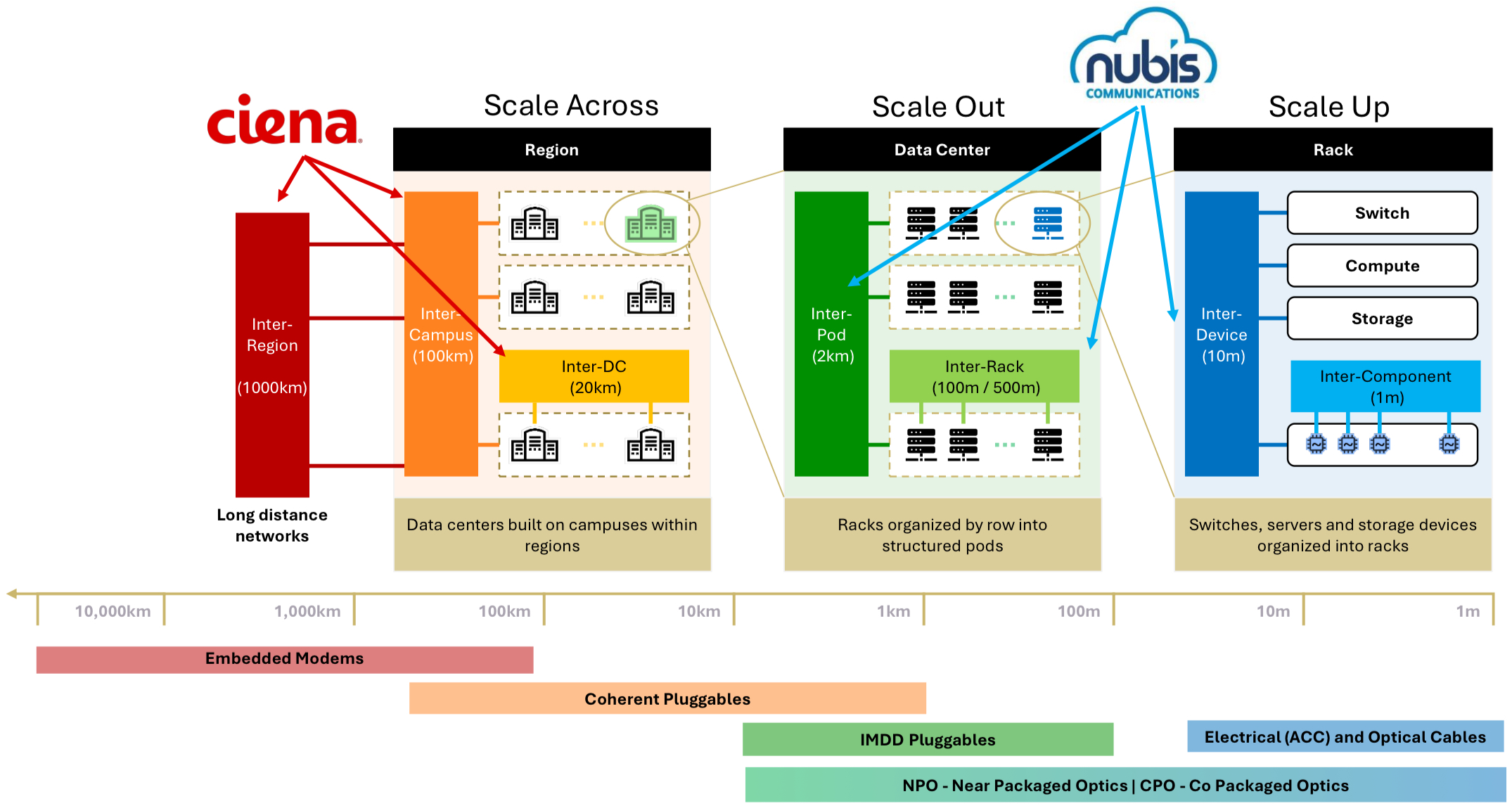
With the deal, Ciena is extending its traditional markets of wide area networks (WAN), metro, and short-reach dense wavelength division multiplexing (DWDM) to include AI networking opportunities. These opportunities include scale-across networks, where AI workloads are shared across multiple data centres, something Ciena can address, to now scale-out and scale-up networks for AI clusters in the data centre.
Puma optical engine
Nubis has developed two generations of compact optical engines for near-package optics (NPO) and co-package optics (CPO) applications. Its first-generation engine operates at 100 gigabits per second (Gbps), while its second, dubbed Puma, operates at 200 Gbps.
Nubis’s optical engine philosophy is based on escaping the optical channels from the surface of the optical engine, not its edge. The start-up also matches the number of optical channels to the electrical ones. The optical engine can be viewed as a sieve: data from the input channels flow through the chip and emerge in the same number of channels at the output. The engine acts as a two-way gateway, with one side handling electrical signals and the other, optical ones.
The Puma optical engine uses 16 channels in each direction, 16 by 200Gbps electrical signals for a total of 3.2 terabits per second (Tbps), and 16 fibres, each fibre carrying 200Gbps of data in the form of a wavelength. Puma’s total capacity is thus 6.4 terabits per second (Tbps). The engine also needs four external lasers to drive the optics, each laser feeding four channels or four fibres. The total fibre bundle of the device consists of 36 fibres: 32 for data (16 for receive and 16 for transmit), and four for the laser light sources.
Nubis is also a proponent of linear drive technology. Here, the advanced serdes on the adjacent semiconductor chip drives the optical engine, thereby avoiding the need for an on-engine digital signal processor (DSP) that requires power. The start-up has also developed a system-based simulator software tool that it uses to model the channel, from the transmitter to the receiver. The tool models not only the electrical and optical components within the channel but also the endpoints, such as the serdes.
Nitro
Nubis has an analogue IC team that designs its trans-impedance amplifiers (TIAs) and drivers used for the optical engine. The hardware compensates for channel impairments with low noise, high linearity, and at high speed. It is this channel simulator tool that Nubis used to optimise its optical engine, and to develop its second key technology, which Nubis calls Nitro —a chip that extends the reach of copper cabling.
“We use our linear optics learning and apply it to copper straight out of the gate, “said Peter Winzer, founder & CTO at Nubis, earlier this year. By using its end-to-end simulator tool, Nubis developed the Nitro IC, which extends the 1m reach of direct-attached copper to 4m using an active copper cable design. “We don’t optimise the driver chip, we optimise the end-to-end system,” says Winzer.
Nubis was also part of a novel design based on a vertical line card to shorten the trace length between an ASIC and pluggable modules.
Ciena’s gain
The acquisition of Nubis places Ciena at the heart of the electrical-optical transition inside the data centre. Ciena will cover both options: copper and optical interconnect. Ciena will gain direct-drive technology expertise for electrical and optical interfaces, enabling scale-up, as well as optical engine technology for scale-out, adding to its coherent technology expertise.

Ciena’s technologies will span coherent ultra-long-haul links all the way to AI accelerators, the heart of AI clusters. By combining Ciena’s 448-gigabit serdes with Nubis’s optical engine expertise, Ciena has a roadmap to develop 12.8Tbps and faster optical engines.
The acquisition places Ciena among new competitors that have chip and optical expertise and deliver co-packaged optics solutions alongside complex ICs such as Broadcom and Marvell.
The deal adds differentiation from Ciena’s traditional system vendor competitors, such as Cisco/ Acacia and Nokia. Huawei is active in long-haul optical and makes AI clusters. Ciena will also compete with existing high-speed optical players, including co-packaged optics specialists Ayar Labs and Ranovus, microLED player Avicena, and optical/IC fabric companies such as LightMatter and Celestial AI.
“Ciena will be a unique supplier in the co-packaged optics/near-packaged optics/active copper cabling data centre interconnect market,” says Daryl Inniss, Omdia’s thought lead of optical components and advanced fibre. “The other suppliers either have multiple products in the intra data centre market, like Broadcom and Nvidia, or they are interconnect-focused start-ups. These suppliers should all wonder what Ciena will do next inside the data centre.”
Ciena will enhance its overall expertise in chips, optics, and signal processing with the Nubis acquisition. It will also put Ciena in front of key processor players and different hyperscaler engineering teams, which drive next-generation AI systems.
Ciena will also have all the necessary parts for the various technologies, regardless of the evolving timescales associated with the copper-to-optical transition within AI systems. Ciena will add direct-detect technology and copper interconnect. On the optical side, it has coherent optical expertise, now coupled with near-package optics and co-packaged optics.
Nubis’ gain
Nubis’ 50-plus staff get a successful exit. The start-up was founded in 2020. Nubis will become a subsidiary of Ciena.
Nubis will be joining a much bigger corporate entity with deep expertise and pockets. Ciena has a good track record with its mergers. Think Nortel at the system level and Blue Planet, a software acquisition. Now the Nubis deal will bring Ciena firmly inside the data centre.
“This is a great deal for Nubis,” says Kozlov. “Congratulations to their team.”
What next?
The deal is expected to close in the fourth quarter of this year. Ciena expects the deal to start adding to its revenues from 2028, requiring Ciena and Nubis to develop products and deliver design wins in the data centre.
“Given the breadth of Ciena’s capabilities, its deep pockets, and products like its data centre out-of-band (DCOM) measurement product, router, and coherent transceivers, one can imagine that Ciena would offer more than co-packaged optics/ near-packaged optics/ active copper cabling inside the data centre,” says Inniss.


OFC 2025: industry reflections
Gazettabyte is asking industry figures for their thoughts after attending the recent 50th-anniversary OFC show in San Francisco. Here are the first contributions from Huawei’s Maxim Kuschnerov, NLM Photonics’ Brad Booth, LightCounting’s Vladimir Kozlov, and Jürgen Hatheier, Chief Technology Officer, International, at Ciena.
Maxim Kuschnerov, Director of R&D, Huawei
The excitement of last year’s Nvidia’s Blackwell graphics processing unit (GPU) announcement has worn off, and there was a slight hangover at OFC from the market frenzy then.
The 224 gigabit-per-second (Gbps) opto-electronic signalling is reaching mainstream in the data centre. The last remaining question is how far VCSELs will go—30 m or perhaps even further. The clear focus of classical Ethernet data centre optics for scale-out architectures is on the step to 448Gbps-per-lane signalling, and it was great to see many feasibility demonstrations of optical signalling showing that PAM-4 and PAM-6 modulation schemes will be doable.
The show demonstrations either relied on thin-film lithium niobate (TFLN) or the more compact indium-phosphide-based electro-absorption modulated lasers (EMLs), with thin-film lithium niobate having the higher overall optical bandwidth.
Higher bandwidth pure silicon Mach-Zehnder modulators have also been shown to work at a 160-175 gigabaud symbol rate, sufficient to enable PAM-6 but not high enough for PAM-4 modulation, which the industry prefers for the optical domain.
Since silicon photonics has been the workhorse at 224 gigabits per lane for parallel single-mode transceivers, a move away to thin-film lithium niobate would affect the density of the optics and make co-packaged optics more challenging.
With PAM-6 being the preferred modulation option in the electrical channel for 448 gigabit, it begs the question of whether the industry should spend more effort on enabling PAM-6 optical to kill two birds with one stone: enabling native signalling in the optical and electrical domains would open the door to all linear drive architectures, and keep the compact pure-silicon platform in the technology mix for optical modulators. Just as people like to say, “Never bet against copper,” I’ll add, “Silicon photonics isn’t done until Chris Doerr says so.”
If there was one topic hotter than the classical Ethernet evolution, it was the scale-up domain for AI compute architectures. The industry has gone from scale-up in a server to a rack-level scale-up based on a copper backplane. But future growth will eventually require optics.
While the big data centre operators have yet to reach a conclusion about the specifications of density, reach, or power, it is clear that such optics must be disruptive to challenge the classical Ethernet layer, especially in terms of cost.
Silicon photonics appears to be the preferred platform for a potential scale-up, but some vendors are also considering VCSEL arrays. The challenge of merging optics onto the silicon interposer along with the xPU is a disadvantage for VCSELs in terms of tolerance to high-temperature environments.
Reliability is always discussed when discussing integrated optics, and several studies were presented showing that optical chips hardly ever fail. After years of discussing how unreliable lasers seem, it’s time to shift the blame to electronics.
But before the market can reasonably attack optical input-output for scale-up, it has to be seen what the adoption speed of co-packaged optics will be. Until then, linear pluggable optics (LPO) or linear retimed optics (LRO) pluggables will be fair game in scaling up AI ‘pods’ stuffed with GPUs.
Brad Booth, CEO of NLM Photonics
At OFC, the current excitement in the photonics industry was evident due to the growth in AI and quantum technologies. Many of the industry’s companies were represented at the trade show, and attendance was excellent.
Nvidia’s jump on the co-packaged optics bandwagon has tipped the scales in favour of the industry rethinking networking and optics.
What surprised me at OFC was the hype around thin-film lithium niobate. I’m always concerned when I don’t understand why the hype is so large, yet I have still to see the material being adopted in the datacom industry.
Vladimir Kozlov, CEO of LightCounting
This year’s OFC was a turning point for the industry, a mix of excitement and concern for the future. The timing of the tariffs announced during the show made the event even more memorable.
This period might prove to be a peak of the economic boom enabled by several decades of globalisation. It may also be the peak in the power of global companies like Google and Meta and their impact on our industry.
More turbulence should be expected, but new technologies will find their way to the market.
Progress is like a flood. It flows around and over barriers, no matter what they are. The last 25 years of our industry is a great case study.
We are now off for another wild ride, but I look forward to OFC 2050.
Jürgen Hatheier, Chief Technology Officer, International, at Ciena
This was my first trip to OFC, and I was blown away. What an incredible showcase of the industry’s most innovative technology
One takeaway is how AI is creating a transformative effect on our industry, much like the cloud did 10 years ago and smartphones did 20 years ago.
This is an unsurprising observation. However, many outside our industry do not realise the critical importance of optical technology and its role in the underlying communication network. While most of the buzz has been on new AI data centre builds and services, the underlying network has, until recently, been something of an afterthought.
All the advanced demonstrations and technical discussions at OFC emphasise that AI would not be possible without high-performance network infrastructure.
There is a massive opportunity for the optical industry, with innovation accelerating and networking capacity scaling up far beyond the confines of the data centre.
The nature of AI — its need for intensive training, real-time inferencing at the edge, and the constant movement of data across vast distances between data centres — means that networks are evolving at pace. We’re seeing a significant architectural shift toward more agile, scalable, and intelligent infrastructure with networks that can adapt dynamically to AI’s distributed, data-hungry nature.
The diversity of optical innovation presented at the conference ranged from futuristic Quantum technologies to technology on the cusp of mainstream adoption, such as 448-gigabit electrical lanes.
The increased activity and development around high-speed pluggables also show how critical coherent optics has become for the world’s most prominent computing players.


Books of 2023 - Part 3
Gazettabyte has been asking industry figures to pick their reads of the year. In Part 3, Noam Mizrahi, Katharine Schmidtke, Steve Suarez, and Vladimir Kozlov share their readings of the year.
Noam Mizrahi, EVP, corporate CTO at Marvell.
Start with Why: How Great Leaders Inspire Everyone to Take Action, by Simon Sinek is a book about the obvious. It is so obvious, in fact, that it is very hard to do. We all want our message to get through so that people understand, see things through our eyes and share our vision.
When we start a journey, we know very well why we do it. This is also when we inspire and motivate the most, ourselves and others. But, as we develop our company, products and careers, intuitively, routine makes us focus on what we do and how we do it, and in some (or many) cases, we forget why we do it.
Once we forget the why, it is harder for us to experience a sense of accomplishment and, in most cases, will make it harder for us to inspire others to follow our vision.
Focus on the why as a means for inspiration and motivation. I find this simple advice something I always try to remember and in everything I do.
This book did not necessarily tell me what to do or how to do it, but I sure know why it was vital for me to read it.
Katharine Schmidtke, Ph.D., Eribel Systems LLC
Integrated Photonics for Data Communications Applications, Edited by Madeleine Glick, Ling Liao, and Katharine Schmidtke (2023), is the book I definitely read most in 2023!
This book, the inaugural volume in a series on integrated photonics, is a testament to the collaborative expertise inspired by Prof. Kimerling at MIT. It is the culmination of a three-year collaboration between co-editors Madeleine, Ling and me. We are incredibly grateful to the over ninety authors, each a leader in the field, whose technical expertise shines through and makes the content enriching and inspiring.
Diving into the world of advanced photonic devices and integrated photonic circuits, the book explores key concepts, design principles, performance metrics, and manufacturing processes. It goes beyond the theoretical, offering a comprehensive view of the practical aspects crucial for understanding and advancing this field.
One of the book’s strengths is its examination of the current trends and commercial requirements in data communication for data centres and high-performance computing. The inclusion of contributions from end users sharing key performance indicators adds a valuable real-world perspective.
At its core, the book dissects the fundamental building blocks of integrated photonics, unravelling the complexities of lasers, modulators, photodetectors, and passive devices. It’s a holistic journey through the individual elements that collectively form the intricate web of photonic integrated circuits.
Over the summer, I was back in England clearing out old bookshelves and discovered the series of spy novels by the British writer, John le Carré. I picked up The Little Drummer Girl, published in 1983. The story follows the manipulations of Martin Kurtz, an Israeli spymaster who intends to kill Khalil – a Palestinian terrorist who is bombing Jewish-related targets in Europe, particularly Germany – and Charlie, an English actress and double agent working on behalf of the Israelis.
It’s a thrilling and complex plot with many unexpected twists and turns, but this story has no heroes. Everyone loses something, including Charlie, who loses her mind. Reading it forty years after its writing, I experienced déjà vu during the events which started on October 7th, 2023.
I’ve had the book Narrative and Numbers: The Value of Stories in Business, by Aswath Damodaran on my reading list since its publication in 2017, and it certainly lived up to the anticipation.
The author delves into the intricacies of valuing companies, offering a profound analysis beyond the numbers. What sets this book apart is its exploration of the transformative power of storytelling in the business world.
As engineers, we often underestimate the impact of a well-crafted narrative. The author argues that a logical and rational story, when presented effectively, can breathe life into facts and figures.
The book emphasizes the importance of storytelling in making data understandable and unforgettable. The art of storytelling is revealed to be a compelling force that captivates audiences, making it challenging to dismiss even seemingly improbable valuations.
What struck me was the insight into how companies, seemingly without substantial revenue, can achieve remarkably high valuations.
By reading this book, you gain a deeper understanding of the alchemy that occurs when a compelling story intertwines with the cold, hard metrics of business. It’s a valuable read, shedding light on the often-underestimated influence of narrative in shaping perceptions and valuations.
Von der Nutzlosigkeit Erwachsen zu Werden, by Georg Heinzen and Uwe Koch (1994) can be translated as ‘Growing up from Uselessness’ or, because it’s a double entendre, ‘About the Uselessness of Growing up’.
The book is a farce about a tragic victim of the German education crisis of the 1970s and the job market of the 1990s. At thirty, still unemployed and living at home, this hopeless character discovers that having graduated high school, his education is helpful for everything but not needed for anything.
I wasn’t educated in Germany, but this mood was contagious throughout the rest of Europe, and I, too, struggled to get my first job during the recession of the 1990s.
Reading it now, with two teenagers preparing to launch themselves into the workforce in a few years, I’m sure they feel the same way. This might seem to be a depressing topic for me to dwell on, but the book is a fun read filled with ironic humour and many relevant topics for today.
Steve Suarez, Founder & CEO of HorizonX
This year marked a significant milestone for me. I took the courageous step of pursuing my lifelong aspiration of entrepreneurship. My goal is to empower organisations to innovate effectively and at scale. In a world where innovation is consistent and a requisite, there is a demand for skilled professionals who can excel in this realm across all industries and geographies.
To equip myself, I recognised the necessity to acquire new competencies, particularly in sales and the fundamentals of operating a thriving consulting business. To this end, I started listening to The Consulting Bible: How to Launch and Grow a Seven-Figure Consulting Business, by Alan Weiss, 2nd Edition in audiobook format, which I listened to during my commutes to London.
The insights have been invaluable. It has sharpened my focus on what drives business success and has influenced my approach to consulting. The lessons learned have been instrumental in shaping my entrepreneurial journey, allowing me to concentrate on strategies that make an impact.
I am eager to share more about how these learnings have transformed my business practices and the innovative solutions I can offer clients.
Vlad Kozlov, CEO and founder of LightCounting Market Research
An Immense World: How Animal Senses Reveal the Hidden Realms Around Us, by Ed Yong, reads like poetry, but it offers the depth of a Ph.D thesis, or several, with its range of topics.
You may already know that bats navigate the world using echolocation. Still, it works and it is fascinating, an incredible level of complexity chiselled by evolution over millennia, one mutation at a time. Even a recovering communist may wonder if evolution can do such a feat.
The book is dense and you have to take it in slowly. I’m almost finished now, and the most incredible chapter so far was on electric fields. Not about hundreds of volts that stingrays use but weak electric fields that many fish use to navigate murky waters. Unbelievable.
I am saving the next chapter on magnetic fields for the holidays.
A must read for anyone interested in high-tech innovation. Yes, this is a cutting edge technology. It is also a journey into a parallel world, or worlds, of creatures around us. What drives them remains a mystery, but all of them are caused by something in their lives. And it is more than just hunger.

ECOC 2023 industry reflections - Part 2

Gazettabyte is asking industry figures for their thoughts after attending the recent ECOC show in Glasgow. In particular, what developments and trends they noted, what they learned and what, if anything, surprised them. Here are more responses from LightCounting, Hyper Photonix, NewPhotonics, and Broadcom.
Vladimir Kozlov, CEO of LightCounting, a market research company
Demand for optical connectivity in data centres has accelerated innovation in the industry. ECOC 2023 offered numerous start-ups and established vendors another opportunity to disclose their latest achievements.
The improved reliability of quantum dot lasers was a pleasant surprise. Alfalume presented the latest quantum dot comb laser developments, including continuous power up to 250 mW with a power conversion efficiency of a quarter (25%) and efficient operation of up to 100oC. Preliminary test data suggests that quantum dot lasers offer superior reliability compared to their quantum well counterparts. It would be great to have a reliable laser source, finally.
Cisco and Intel deserve much credit for bringing silicon photonics-based transceivers to the market, but numerous vendors are entering the race now.
All the leading foundries offer photonic integrated circuits with integrated laser chips. TSMC disclosed its plans to use a 7nm CMOS process to manufacture photonic chips. Recently formed OpenLight offers fully tested photonic integrated circuit designs, which can be produced at several foundries, including Tower Semiconductor.
Many transceiver suppliers have internally designed optical engines. They all plan to reduce the manufacturing cost of silicon photonics-based transceivers, fulfilling the potential of CMOS technology. Competition among suppliers enabled huge reductions in the cost of CMOS-based ICs. Let us see if this works for CMOS-based photonic integrated circuits.
Brad Booth, director of technology and strategy at Hyper Photonix, and a consultant
There was good attendance at ECOC considering some companies continue to limit travel. Linear drive pluggable optics (LPO) is gaining traction but still has hurdles to address. Meanwhile, the 800-gigabit train is pulling into the station with a ZR digital signal processor and client-side modules.
What surprised me at the show? The shift to start-ups. It is reminiscent of the Gigabit Ethernet days.
Yaniv BenHaim, founder & CEO of NewPhotonics
There were some notable trends at ECOC. One is that 800-gigabit optical transceivers are ramping. At least three vendors were giving private demos of 8×100-gigabit DR enabled with the coming availability of 200G EMLs and photodetectors.
The industry is also optimistic about linear drive pluggable optics (LPO), helped by the buzz created by Nvidia, saying it will make the technology available in AI clusters by year-end. Data centres and networking companies are also pushing LPO and evaluating it and will likely announce findings by OFC 2024.
Another upcoming technology, like optical processing, as demonstrated by our company, NewPhotonics, can further advance power savings and range with both traditional optical modules and LPOs. At ECOC, we showed 224 gigabit-per-second (Gbps) optical input-output driving more than 10km of fibre using Intel’s new 224Gbps serialiser-deserialiser (serdes). We also showed NewPhotonics’ optical serdes multiplexing and demultiplexing multiple optical 112Gbps PAM-4 in the optical time domain.
Companies providing coherent technology continue to promote using coherent transceivers in the data centre. We don’t see any reason to do so when PAM-4 non-coherent solutions can cater for data centre needs and also go beyond 10km.
The market is moving forward in using 224 gigabits, which will disrupt optical transceivers and the active optical cable markets. It seems co-packaged optics will be delayed further as the electrical solutions for 50-terabit and 100-terabit switches are already there using electrical serdes.
The optical communication market had no new surprises based on wavelength division multiplexing PAM-4 and 16-QAM. Some ideas exist for replacing the DSP functions with analogue implementations. NewPhotonics is the only company pushing for an all-optical solution instead of an analogue or a digital signal processor solution.
Rajiv Pancholy, director of hyperscale strategy & products, optical systems division at Broadcom
It was evident at ECOC 2023 that the emergence of large networking clusters enabling the connectivity of graphics processing units (GPUs) for recommendation engines and large language models has substantially increased the ratio of photonic to copper links inside data centres. The optics industry has been waiting for an all-to-all connectivity killer app to increase volumes and therefore investment, and that app might have arrived.
Companies demonstrated excellent progress on 200 gigabit per lane optical components. Several companies are sampling 200 gigabit EMLs and plan production in 2024. Several companies also announced plans to release 200 gigabit per lane VCSELs. There was some early demonstration of 200 gigabit per lane silicon photonics, but it is still being determined when the technology will be ready for production.
Lastly, start-ups at the show focused on delivering novel optical interconnect technologies with micro-LEDs, comb lasers, and advanced packaging that reinforces a general trend towards high-density photonic integrated circuits, electrical interconnect simplification, and co-packaging. Though it’s still being determined when these optical technologies will come to market, Broadcom is not the only company working on co-packaged optics. We believe you will need co-packaged optics much sooner than five years from now.
Taking a unique angle to platform design

- A novel design based on a vertical line card shortens the trace length between an ASIC and pluggable modules.
- Reducing the trace length improves signal integrity while maintaining the merits of using pluggables.
- Using the vertical line card design will extend for at least two more generations the use of pluggables with Ethernet switches.
The travelling salesperson problem involves working out the shortest route on a round-trip to multiple cities. It’s a well-known complex optimisation problem.
Novel design that shortens the distance between an Ethernet switch chip and the front-panel optics
Systems engineers face their own complex optimisation problem just sending an electrical signal between two points, connecting an Ethernet switch chip to a pluggable optical module, for example.
Sending the high-speed signal over the link with sufficient fidelity for its recovery requires considerable electronic engineering design skills. And with each generation of electrical signalling, link distances are getting shorter.
In a paper presented at the recent ECOC show, held in Basel, consultant Chris Cole, working with Yamaichi Electronics, outlined a novel design that shortens the distance between an Ethernet switch chip and the front-panel optics.
The solution promises headroom for two more generations of high-speed pluggables. “It extends the pluggable paradigm very comfortably through the decade,” says Cole.
Since ECOC, there are plans to standardise the vertical line card technology in one or more multi-source agreements (MSAs), with multiple suppliers participating.
“This will include OSFP pluggable modules as well as QSFP and QSFP-DD modules,” says Cole.
Shortening links
Rather than the platform using stacked horizontal line cards as is common today, Cole and Yamaichi Electronics propose changing the cards’ orientation to the vertical plane.
Vertical line cards also enable the front-panel optical modules to be stacked on top of each other rather than side-by-side. As a result, the pluggables are closer to the switch ASIC; the furthest the high-speed electrical signalling must travel is three inches (7.6cm). The most distant span between the chip and the pluggable with current designs is typically nine inches (22.8cm).
“The reason nine inches is significant is that the loss is high as we reach 200 gigabits-per-second-per-lane and higher,” says Cole.
Current input-output proposals
The industry is pursuing several approaches to tackle such issues as the issues associated with high-speed electrical signalling and also input-output (I/O) bandwidth density.
One is to use twinaxial cabling instead of electrical traces on a printed circuit board (PCB). Such ‘Twinax’ cable has a lower loss, and its use avoids developing costly advanced-material PCBs.
Other approaches involve bringing the optics closer to the Ethernet switch chip, whether near-packaged optics or the optics and chip are co-packaged together. These approaches also promise higher bandwidth densities.
Cole’s talk focussed on a solution that continues using pluggable modules. Pluggable modules are a low-cost, mature technology that is easy to use and change.
However, besides the radio frequency (RF) challenges that arise from long electrical traces, the I/O density of pluggables is limited due to the size of the connector, while placing up to 36 pluggables on the 1 rack unit-high (1RU) front panel obstructs the airflow used for cooling.
Platform design
Ethernet switch chips double their capacity every two years. Their power consumption is also rising; Broadcom’s latest Tomahawk 5 consumes 500W.
The power supply a data centre can feed to each platform has an upper limit. It means fewer cards can be added to a platform if the power consumed per card continues to grow.
The average power dissipation per rack is 16kW, and the limit is around 32kW, says Cole. This refers to when air cooling is used, not liquid cooling.
He cites some examples.
A rack of Broadcom’s 12.8-terabit Tomahawk 3 switch chip – either with 32, 1RU or 16, 2RU cards with two chips per card – and associated pluggable optics consume over 30kW.
A 25.6-terabit Tomahawk 4-based chassis supports 16 line cards and consumes 28kW. However, using the recently announced Tomahawk 5, only eight cards can be supported, consuming 27KW.
“The takeaway is that rack densities are limited by power dissipation rather than the line card’s rack unit [measure],” says Cole.
Vertical line card
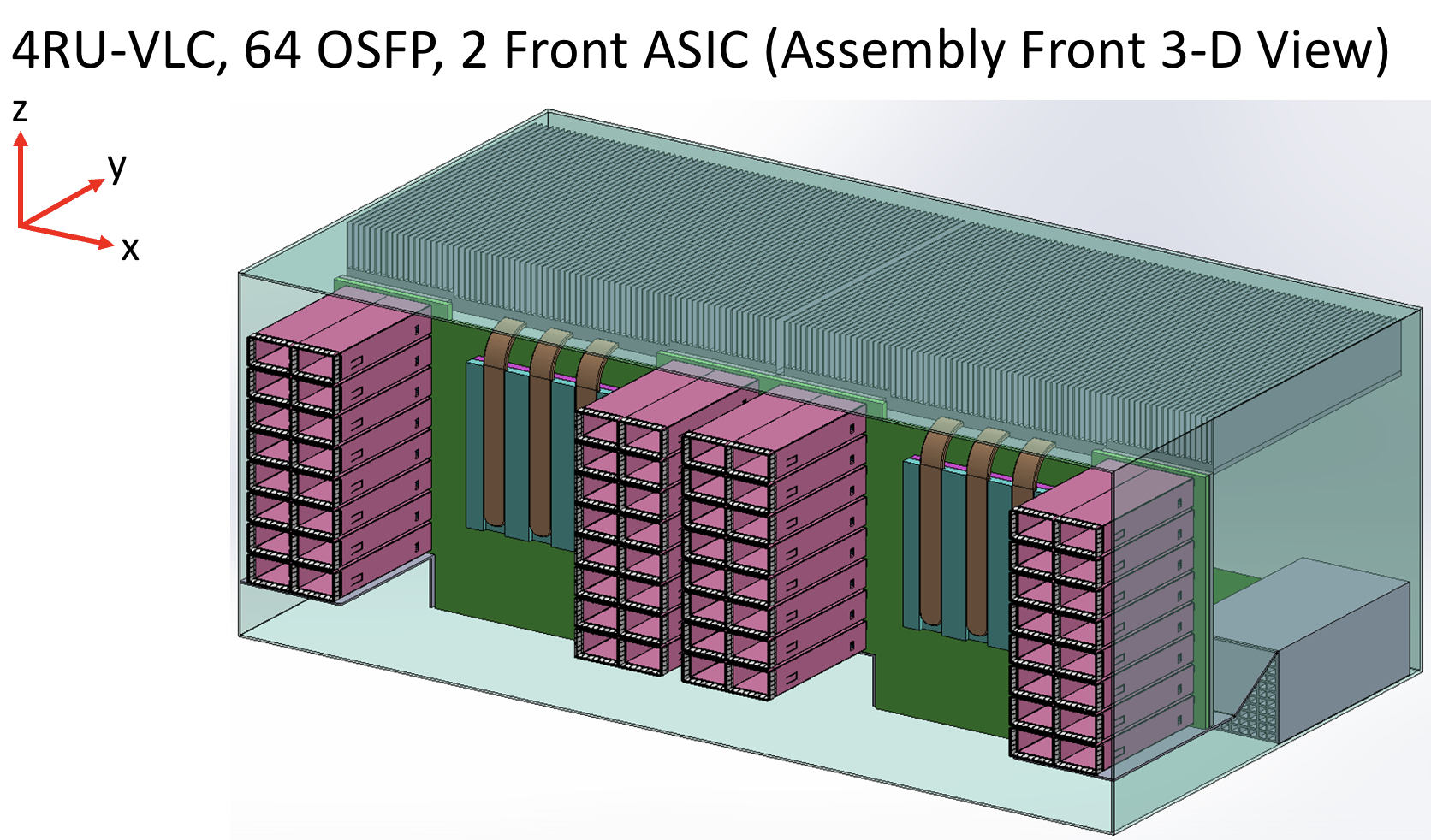
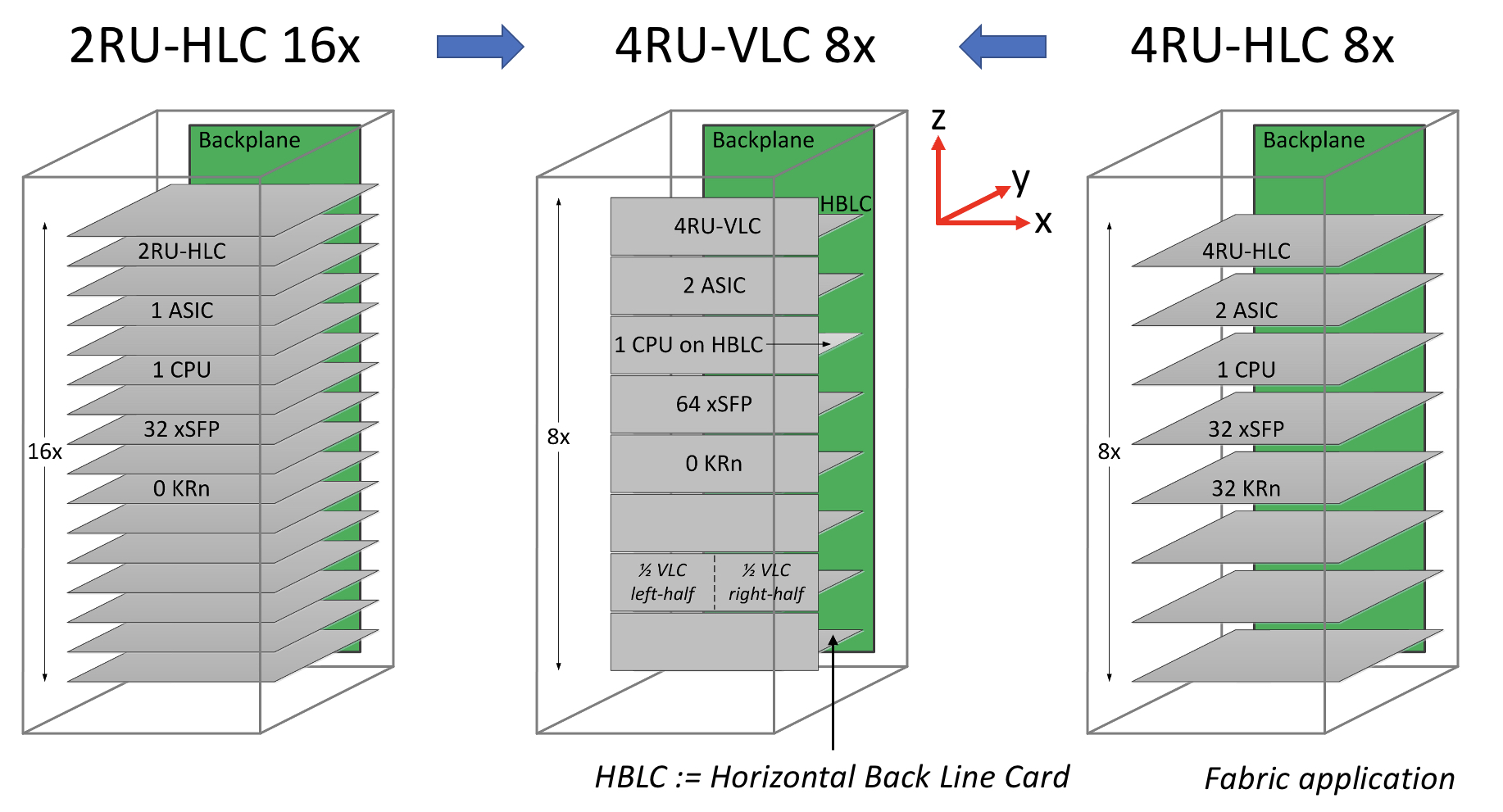
The vertical line card design is 4RU high. Each card supports two ASICs on one side and 64 cages for the OSFP modules on the other.
A 32RU chassis can thus support eight vertical cards or 16 ASICs, equivalent to the chassis with 16 horizontal 2RU line cards.
The airflow for the ASICs is improved, enabling more moderate air fans to be used compared to 1RU or 2RU horizontal card chassis designs. There is also airflow across the modules.
“The key change in the architecture is the change from a horizontal card to a vertical card while maintaining the pluggable orientation,” says Cole.
As stated, the maximum distance between an ASIC and the pluggables is reduced to three inches, but Cole says the modules can be arranged around the ASIC to minimise the length to 2.5 inches.
Alternatively, if the height of the vertical card is an issue, a 3RU card can be used instead, which results in a maximum trace length of 3.5 inches. “[In this case], we don’t have dedicated air intakes for the CPU,” notes Cole.
Cole also mentioned the option of a 3RU vertical card that houses one ASIC and 64 OSFP modules. This would be suitable for the Tomahawk 5. However, here the maximum trace length is five inches.
Vertical connectors
Yamaichi Electronics has developed the vertical connectors needed to enable the design.
Cole points out that, unlike a horizontal connector, a vertical one uses equal-length contacts. This is not the case for a flat connector, resulting in performance degradation since a set of contacts has to turn and hence has a longer length.
Cole showed the simulated performance of an OSFP vertical connector with an insertion loss of over 70GHz.
“The loss up to 70GHz demonstrates the vertical connector advantage because it is low and flat for all the leads,” says Cole. “So this [design] is 200-gigabit ready.”
He also showed a vertical connector for the OSFP-XD with a similar insertion loss performance.
Also shown was a comparison with results published for Twinax cables. Cole says this indicates that the loss of a three-inch PCB trace is less than the loss of the cable.
“We’ve dramatically reduced the RF maximum length, so we had solved the RF roadblock problem, and we maintain the cost-benefit of horizontal line cards,” says Cole.
The I/O densities may be unchanged, but it preserves the mature technology’s benefits. “And then we get a dramatic improvement in cooling because there are no obstructions to airflow,” says Cole.
Vladimir Kozlov, CEO of the market research firm, LightCounting, wondered in a research note whether the vertical design is a distraction for the industry gearing up for co-packaged optics.
“Possibly, but all approaches for reducing power consumption on next-generation switches deserve to be tested now,” said Kozlov, adding that adopting co-packaged optics for Ethernet switches will take the rest of the decade.
“There is still time to look at the problem from all angles, literally,” said Kozlov

ECOC '22 Reflections - Part 2

Gazettabyte is asking industry and academic figures for their thoughts after attending ECOC 2022, held in Basel, Switzerland. In particular, what developments and trends they noted, what they learned, and what, if anything, surprised them.
In Part 2, Broadcom‘s Rajiv Pancholy, optical communications advisor, Chris Cole, LightCouting’s Vladimir Kozlov, Ciena’s Helen Xenos, and Synopsys’ Twan Korthorst share their thoughts.
Rajiv Pancholy, Director of Hyperscale Strategy and Products Optical Systems Division, Broadcom*
The buzz at the show reminded me of 2017 when we were in Gothenburg pre-pandemic, and that felt nice.
Back then, COBO (Consortium for On-Board Optics) was in full swing, the CWDM8 multi-source agreement (MSA) was just announced, and 400-gigabit optical module developments were the priority.
This year, I was pleased to see the show focused on lower power and see co-packaged optics filter into all things ECOC.
Broadcom has been working on integrating a trans-impedance amplifier (TIA) into our CMOS digital signal processor (DSP), and the 400-gigabit module demonstration on the show floor confirmed the power savings integration can offer.
Integration impacts power and cost but it does not stop there. It’s also about what comes after 2nm [CMOS], what happens when you run out of beach-front area, and what happens when the maximum power in your rack is not enough to get all of its bandwidth out.
It is the idea of fewer things and more efficient things that draws everyone to co-packaged optics.
The OIF booth showcased some of the excitement behind this technology that is no longer a proof-of-concept.
Moving away from networking and quoting some of the ideas presented this year at the AI Hardware Summit by Alexis Bjorlin, our industry needs to understand how we will use AI, how we will develop AI, and how we will enable AI.
These were in the deeper levels of discussions at ECOC, where we as an industry need to continue to innovate, disagree, and collaborate.
Chris Cole, Optical Communications Advisor
I don’t have many substantive comments because my ECOC was filled with presentations and meetings, and I missed most of the technical talks and market focus presentations.
It was great to see a full ECOC conference. This is a good sign for OFC.
Here is an observation of what I didn’t see. There were no great new silicon photonics products, despite continued talk about how great it is and the many impressive research and development results.
Silicon photonics remains a technology of the future. Meanwhile, other material systems continue to dominate in their use in products.
Vladimir Kozlov, CEO of LightCounting
I am surprised by the progress made by thin-film lithium niobate technology. There are five suppliers of these devices now: AFR, Fujitsu, Hyperlight, Liobate, and Ori-chip.
Many vendors also showed transceivers with thin-film lithium niobate modulators inside.
Helen Xenos, senior director of portfolio marketing at Ciena
One key area to watch right now is what technology will win for the next Ethernet rates inside the data centre: intensity-modulation direct detection (IMDD) or coherent.
There is a lot of debate and discussion happening, and several sessions were devoted to this topic during the ECOC Market Focus.
Twan Korthorst, Group Director Photonic Solutions at Synopsys.
My main observations are from the exhibition floor; I didn’t attend the technical conference.
ECOC was well attended, better than previous shows in Dublin and Valencia and, of course, much better than Bordeaux (the first in-person ECOC in the Covid era).
I spent three days talking with partners, customers and potential customers, and I am pleased about that.
I didn’t see the same vibe around co-packaged optics as at OFC; not a lot of new things there.
There is a feeling of what will happen with the semiconductor/ datacom industry. Will we get a downturn? How will it look? In other words, I noticed some concerns.
On the other hand, foundries are excited about the prospects for photonic ICs and continue to invest and set ambitious goals.

Books read in 2021: Final Part

In the final favoured reads during 2021, the contributors are Daryl Inniss of OFS, Vladimir Kozlov of LightCounting Market Research, and Gazettabyte’s editor.
Daryl Inniss, Director, Business Development at OFS
Four thousand weeks is the average human lifetime.
A book by Oliver Burkeman: Four Thousand Weeks: Time Management For Mortals is a guide to using the finite duration of our lives.
Burkeman argues that by ignoring the reality of our limited lifetime, we fill our lives with busyness and distractions and fail to achieve the very fullness that we seek.
While sobering, Burkeman presents thought-provoking and amusing examples and stories while transitioning them into positive action.
An example is his argument that our lives are insignificant and that, regardless of our accomplishments, the universe continues unperturbed. Setting unrealistic goals is one consequence of our attempt to achieve greatness.
On the other hand, recognising our inability to transform the world should give us enormous freedom to focus on the things we can accomplish.
We can jettison that meaningless job, be fearless in the face of pandemics given that they come and go throughout history, and lower our stresses on financial concerns given they are transitory. What is then left is the freedom to spend time on things that do matter to us.
Defining what’s important is an individual thing. It need not be curing cancer or solving world peace – two of my favourites. It can be something as simple as making a most delicious cookie that your kids enjoy.
It is up to each of us to find those items that make us feel good and make a difference. Burkeman guides us to pursue a level of discomfort as we seek these goals.
I found this book profound and valuable as I enter the final stage of my life.
I continue to search for ways to fulfil my life. This book helps me to reflect and consider how to use my finite time.
Vladimir Kozlov, CEO and Founder of LightCounting Market Research
Intelligence is a fascinating topic. The artificial kind is making all the headlines but alien minds created by nature have yet to be explored.
One of the most bizarre among these is the distributed mind of the octopus. “Other Minds: The Octopus, the Sea and the Deep Origins of Consciousness, by Peter Godfery-Smith, is a perfect introduction to the subject.
The Overstory: A Novel, by Richard Powers takes the concept of alien minds to a new, more emotional level. It is a heavy read. The number of characters rivals that of War and Peace while the density matches the style of Dostoevsky. Yet, it is impossible not to finish the book, even if it takes several months.
It concerns the conflict of “alien minds”. The majority of the aliens are humans, cast from the distant fringes of our world. The trees emerge as a unifying force that keeps the book and the planet together. It is an unforgettable drama.
I have not cut a live tree since reading the book. I can not stop thinking about just how shallow our understanding of the world is.
The intelligence created by nature is more puzzling than dark matter yet it is shuffled into the ‘Does-not-matter’ drawer of our alien minds.
Roy Rubenstein, Gazettabyte’s editor
Ten per cent of my contacts changed jobs in 2021, according to LinkedIn.
Of these, how many quit their careers after 32 years at one firm? And deliberately downgraded their salaries?
That is what Kate Kellaway did. The celebrated Financial Times journalist quit her job to become a school teacher.
Kellaway is also a co-founder of Now Teach, a non-profit organisation that helps turn experienced workers in such professions as banking and the law into teachers.
In her book, Re-educated: How I Changed My Job, My Home and My Hair, Kellaway reflects on her career as a journalist and on her life. She notes how privileged she has been in the support she received that helped her correct for mistakes and fulfill her career; something that isn’t available to many of her students.
She also highlights the many challenges of teaching. In one chapter she describes a class and the exchanges with her students that captures this magnificently.

A book I reread after many years was Arthur Miller’s autobiography, Timebends: A Life.
In the mid-1980s on a trip to the UK to promote his book, Miller visited the Royal Exchange Theatre in Manchester. There, I got a signed copy of his book which I prize.
The book starts with his early years in New York, surrounded by eccentric Jewish relatives.
Miller also discusses the political atmosphere during the 1950s, resulting in his being summoned before the House Un-American Activities Committee. The first time I read this, that turbulent period seemed very much a part of history. This time, the reading felt less alien.
Miller is fascinating when explaining the origins of his plays. He also had an acute understanding of human nature, as you would expect of a playwright.
The book I most enjoyed in 2021 is The Power of Strangers: The Benefits of Connecting in a Suspicious World, by Joe Keohane.
The book explores talking to strangers and highlights a variety of people going about it in original ways.
Keohane describes his many interactions that include an immersive 3-day course on how to talk to strangers, held in London, and a train journey between Chicago and Los Angeles; the thinking being that, during a 42-hour trip, what else would you do but interact with strangers.
Keohane learns that, as he improves, there is something infectious about the skill: people start to strike up conversations with him.
The book conveys how interacting with strangers can be life-enriching and can dismantle long-seated fears and preconceptions.
He describes an organisation that gets Republican and Democrat supporters to talk. At the end of one event, an attendee says: “We’re all relieved that we can actually talk to each other. And we can actually convince the other side to look at something a different way on some subjects.”
If reading novels can be viewed as broadening one’s experiences through the stories of others, then talking to strangers is the non-fiction equivalent.
I loved the book.


Finisar demonstrates its first silicon photonics transceiver
- Finisar unveiled its first silicon photonics-based product, a 400-gigabit QSFP-DD DR4 module, at the recent ECOC event.
- The company also showed transceiver technology that simplifies the setting up of dense wavelength-division multiplexing (DWDM) links.
- Two 200-gigabit QSFP56 client-side modules and an extended reach 30km 400-gigabit eLR8 were also demonstrated by Finisar.
- A 64-gigabaud integrated tunable transmitter and receiver assembly (ITTRA) was used to send a 400-gigabit coherent wavelength.
Finisar is bringing to market its first silicon photonics-based optical module.
 Christian UrricarietThe 400GBASE-DR4 is an IEEE 500m-reach 400-gigabit parallel fibre standard based on four fibres, each carrying a 100-gigabit 4-level pulse amplitude modulation (PAM-4) signal. Finisar’s DR4 is integrated into a QSFP-DD module.
“The DR4 is the 400-gigabit interface that most of the hyperscale cloud players are interested in first,” says Christian Urricariet, senior director of global marketing at Finisar.
The company demonstrated the module at the recent European Conference on Optical Communication (ECOC), held in Rome.
Silicon photonics-based DR4
The DR4 is an integrated design, says Finisar, comprising modulators and photo-detectors as well as modulator drivers and the trans-impedance amplifiers (TIAs).
Finisar chose silicon photonics for the DR4 after undertaking an extensive technology study. Silicon photonics emerged as ‘a clear winner’ in terms of cost and performance for photonic designs made up of similar functions in parallel, such as the four-channel DR4. Silicon photonics manufacturing is also scalable, making it ideal for high-volume designs.
The DR4 is the 400-gigabit interface that most of the hyperscale cloud players are interested in first
The DR4 can also be used in a breakout mode to interface to four 100GBASE-DR modules. Also referred to as the DR1, the 100GBASE-DR fits within an SFP-DD or a QSFP28 module.
The DR4-DR1 combination can link four servers, each using a 100-gigabit link, to a 400-gigabit port on a top-of-rack or mid-row switch. The top-of-rack 400-gigabit DR4 can also connect to a leaf switch with multiple 100-gigabit ports. “The DR4 can be used ‘top-of-rack down’ [to servers] or ‘top-of-rack up’ [to leaf switches],” says Urricariet. “This is similar to what people are doing with the [100-gigabit parallel fibre] PSM4.”
400-gigabit eLR8
Finisar also showcased an extended reach version of the IEEE 400GBASE-LR8 standard.
Dubbed the eLR8, the QSFP-DD module is a technology demonstrator not a product that extends the reach of the LR8 from 10km to 30km.
Finisar already has an LR8 product in a CFP8 pluggable module and is moving the design to the smaller QSFP-DD. The LR8 is an eight-wavelength duplex interface where each wavelength carries a 50-gigabit PAM-4 signal.
“The 400GBASE-LR8 is a low-risk approach to achieving a 400-gigabit duplex single-mode link in the short term,” says Urricariet. “You don’t have to wait for 100-gigabit PAM-4 [ICs] to be manufactured in high volume.”
Urricariet says the IEEE is considering developing an extended LR8 standard with a 40km reach but such distances could also be addressed using inexpensive coherent technology.
Finisar’s design achieves the extended range using the same components as its LR8 module - directly modulated DFB lasers and PIN photodetectors. “There is plenty of margin with that [LR8 design],” says Urricariet. This suggests Finisar picked the best performing DFBs and PINs for the eLR8 design.
The QSFP-DD 10km LR8 design is sampling now, with general availability from the first half of 2019.
Flextune
Configuring DWDM links can be likened to two groups of people separated in a wood at night. Each individual has a flashlight and is tasked with finding a counterpart from the second group, a process repeated until everyone is paired.
Setting up DWDM links is comparable to telling each individual the exact path to take to find their counterpart. The Flextune technology that Finisar has developed can be viewed as giving each individual the confidence to stride out - sweeping their flashlights as they go - till they find a counterpart.
Currently, setting up a DWDM link requires coordination between a field engineer and network operations staff. Each tunable transceiver that is plugged into a port is told which wavelength to tune to. The system itself may tell the transceiver the wavelength to use or a field engineer programs each transceiver before it is plugged into the platform.
Equally, the transceiver output fibre must be connected to the right optical multiplexer and demultiplexer (mux-demux) port, as do the transceivers at the link’s other end.
The result is a time-consuming process that is prone to human error.
With Flextune, the tunable transceivers are plugged into the equipment’s ports and connected to the mux-demux’s ports. “It does not matter which port,” says Urricariet. “The transceivers search for each other and self-configure to the right wavelength.”
Each Flextune-enabled transceiver operates independently of the transceiver at the other end; there is no master-slave arrangement, says Urricariet, although a master-slave arrangement can be used if requested.
The mux-demux must also be a blocking architecture for Flextune to work. “If the mux-demux does not block the other wavelengths on each port, then you have a mess,” says Urricariet. With such a mux-demux, the channels scanned are blocked until the transceiver’s output is passed to the right channel. Once the link is established, the two transceivers set permanently to that wavelength.
“It [the process] happens at both ends simultaneously and on all the ports,” says Urricariet. “The basic technique can self-tune up to 96 [DWDM] channels in around five minutes.”
Being able to tune independently of the host equipment means that the Flextune-enabled transceivers can also be sold directly to operators and plugged into any of their equipment.
Urricariet says Flextune promises welcome operational savings given DWDM’s increasing adoption in the access network with developments such as 5G fronthaul.
The basic technique can self-tune up to 96 [DWDM] channels in around five minutes
Flextune will also be used for metro and data centre interconnect applications, as well as connecting Remote PHY nodes being deployed in cable networks. “The Remote PHY is also a big focus for this type of feature,” says Urricariet.
Finisar demonstrated Flextune with its 10-gigabit tunable SFP+ modules that are now sampling. Flextune will also be adopted for its 25-gigabit SFP+ that will sample ‘very soon’, followed by coherent modules.
“We do have a CFP2-ACO module in production and other coherent products on our roadmap,” says Urricariet. “We will be looking to implement Flextune technology in these products as well.”
Google has started deployments of 2x200GbE
200 Gigabit Ethernet: a growing interim solution
Finisar also demonstrated two 200-gigabit modules. The QSFP56 implements the 2km FR4 specification. The 200-gigabit FR4 uses four coarse WDM (CWDM) wavelengths, each carrying a 50-gigabit PAM-4 signal.
Finisar has previously said it will develop 200-gigabit modules for the large-scale data centres interested in the technology as an interim solution before 400-gigabit modules ramp. Such an intermediate market for “one hyperscaler and maybe two” is sufficient to justify making 200-gigabit modules, says Urricariet.
Market research firm LightCounting has increased its forecast for 200 Gigabit Ethernet (GbE) modules due to interest from Facebook.
A presentation by Facebook at ECOC suggested that 400 GbE is far from being ready, says Vladimir Kozlov, CEO of LightCounting. “It looks like 200GbE is being considered now, but Facebook may change its mind again,” says Kozlov. “In the meantime, Google has started deployments of 2x200GbE [in an OSFP module] as planned.”
As with the 400-gigabit eLR8, Finisar also demonstrated an extended reach version of the 200-gigabit FR4 to achieve a 10km reach. “This is not to be confused with the 10km 200-gigabit LR4 that is a LAN-WDM grid based design,” says Urricariet. “The extended FR4 uses a CWDM grid.”
ITTRA
At OFC 2018 in March, Finisar unveiled its 32-gigabaud (Gbaud) integrated tunable transmitter and receiver assembly (ITTRA) that combines the optics and electronics required for an analogue coherent optics interface.
The ITTRA comprises a tunable laser, an optical amplifier, modulators, modulator drivers, coherent mixers, a photo-detector array and the accompanying TIAs. All the components of the 32Gbaud ITTRA are integrated within a gold box that is 70 percent smaller than the size of a CFP2 module. The integrated assembly also has a power consumption below 7.5W.
At ECOC, the company demonstrated its second ITTRA design operating at 64Gbaud to transmit a 400-gigabit wavelength using 16-ary quadrature amplitude modulation (16-QAM). Finisar would not detail the power consumption of the 64Gbaud ITTRA.
“The doubling of the speed to 64Gbaud will enable 400-gigabit DCO modules as well as 400ZR,” says Urricariet. Digital coherent optics (DCO) refers to coherent modules that integrate the optics and the coherent digital signal processor (DSP).
Samples and production of the 64Gbaud ITTRA are due in 2019.
Infinera buying Coriant will bring welcome consolidation
Infinera is to purchase privately-held Coriant for $430 million. The deal will effectively double Infinera’s revenues, add 100 new customers and expand the systems vendor’s product portfolio.
 Infinera's CEO, Tom FallonBut industry analysts, while welcoming the consolidation among optical systems suppliers, highlight the challenges Infinera faces making the Coriant acquisition a success.
“The low price reflects that this isn't the best asset on the market,” says Sterling Perrin, principal analyst, optical networking and transport at Heavy Reading. “They are buying $1 of revenue for 50 cents; the price reflects the challenges.”
Benefits
According to Perrin, there are still too many vendors facing "brutal price pressures" despite the optical industry being mature. Removing one vendor that has been cutting prices to win business is good news for the rest.
For Infinera, the acquisition of Coriant promises three main benefits, as outlined by its CEO, Tom Fallon, during a briefing addressing the acquisition.
The first is expanding its vertically-integrated business model across a wider portfolio of products. Infinera develops its own optical technology: its indium-phosphide photonic integrated circuits (PICs) and accompanying coherent DSPs that power its platforms. Having its own technology differentiates the optical performance of its platforms and helps it achieve leading gross margins of over 40 percent, said Fallon.
Exploiting the vertical integration model will be a central part of the Coriant acquisition. Indeed, the company mentioned vertical integration 21 times in as many minutes during its briefing outlining the deal. Infinera expects to deliver industry-leading growth and operating margins once it exploits the benefits of vertical integration across an expanded portfolio of platforms, said Fallon.
Having a seat at the table with the largest global service providers to strategise about where their business is going will be invaluable
Buying Coriant also gives Infinera much-needed scale. Not only will Infinera double its revenues - Coriant’s revenues were about $750 million in 2017 while Infinera’s were $741 million for the same period - but it will expand its customer base including key tier-one service providers and webscale players. According to Fallon, the newly combined company will include nine of the top 10 global tier-one service providers and the six leading global internet content providers.
Infinera admits it has struggled to break into the tier-one operators and points out that trying to enter is an expensive and time-consuming process, estimated at between $10 million to $20 million each time. “[Now, with Coriant,] having a seat at the table with the largest global service providers to strategise about where their business is going will be invaluable,” said Fallon.
 Sterling Perrin of Heavy Reading The third benefit Infinera gains is an expanded product portfolio. Coriant has expertise in layer 3 networking, in the metro core with its mTera universal transport platform as well as SDN orchestration and white box technologies. Heavy Reading’s Perrin says Coriant has started development of a layer-3 router white box for edge applications.
Combining the two companies also results in a leading player in data centre interconnect.
“Coriant expands our portfolio, particularly in packet and automation where significant network investment is expected over the next decade,” said Fallon. The deal is happening at the right time, he said, as operators ramp spending as they undertake network transformation.
Infinera will pay $230 million in cash - $150 million up front and the rest in increments - and a further $200 million in shares for Coriant. The company expects to achieve cost savings of $250 million between 2019 and 2021 by combining the two firms, $100 million in 2019 alone. The deal is expected to close in the third quarter of 2018.
If a company is going to put that integrated product into their network, it’s a full-blown RFP process which Infinera may or may not win
Challenges
Industry analysts, while seeing positives for Infinera, have concerns regarding the deal.
A much-needed consolidation of weaker vendors is how George Notter, an analyst at the investment bank, Jefferies, describes the deal. For Infinera, however, continuing as before was not an option. Heavy Reading’s Perrin agrees: ”Infinera has been under a lot of pressure; their core business of long-haul has slowed.”
The deal brings benefits to Infinera: scale, complementary product sets, and the promise of being able to invest more in R&D to benefit its PIC technology, says Notter in a research note.
Gaining customers is also a key positive. “Infinera is really excited about getting the new set of customers and that is what they are paying for,” says Vladimir Kozlov, CEO of LightCounting Market Research. “However, these customers were gained by pricing products at steep discounts.”
What is vital for Infinera is that it delivers its upcoming 2.4-terabit Infinite Capacity Engine 5 (ICE5) optical engine on time. The ICE5 is expected to ship in early 2019. In parallel, Infinera is developing its ICE6 due two years later. Infinera is developing two generations of ICE designs in parallel after being late to market with its current 1.2-terabit optical engine.
Infinera is really excited about getting the new set of customers and that is what they are paying for
But even if the ICE5 is delivered on time, upgrading Coriant's platforms will be a major undertaking. “It sounds like they are going to fit their optical engines in all of Coriant’s gear; I don’t see how that is going to happen anytime quickly,” says Perrin.
Customers bought Coriant's equipment for a reason. Once upgraded with Infinera’s PICs, these will be new products that have to undergo extensive lab testing and full evaluations.
Perrin questions how moving customers off legacy platforms to the new will not result in the service providers triggering a new request-for-proposal (RFP). “If a company is going to put that integrated product into their network, it’s a full-blown RFP process which Infinera may or may not win,” says Perrin. “Infinera talked a lot about the benefits of vertical integration but they didn’t really address the challenges and the specific steps they would take to make that work.”
 LightCounting's Vladimir KozlovLightCounting’s Kozlov also questions how this will work.
“The story about vertical integration and scaling up PIC production is compelling, but how will they support Coriant products with the PIC?” he says. “Will they start making pluggable modules internally? Will Coriant’s customers be willing to move away from the pluggables and get locked into Infinera’s PICs? Do they know something that we don’t?”
While Infinera is a top five optical platform supplier globally it hasn’t dominated the market with its PIC technologies, says Perrin. “Even if they technically pull off the vertical integration with the Coriant products, how much is that going to win business for them?” he says. “It is one architecture in a mix that has largely gone to pluggables.”
Transmode
Infinera already has experience acquiring a systems vendor when it bought in 2015 metro-access player, Transmode. Strategically, this was a very solid acquisition, says Perrin, but the jury is still out as to its success.
“The integration, making it work, how Transmode has performed within Infinera hasn’t gone as well as they wanted,” says Perrin. “That said, there are some good opportunities going forward for the Transmode group.”
Infinera also had planned to integrate its PIC technology within Transmode’s products but it didn't make economic sense for the metro market. There may also have been pushback from customers that liked the Transmode products, says Perrin: “With Coriant it looks like they really are going to force the vertical integration.”
Infinera acknowledges the challenges ahead and the importance of overcoming them if it is to secure its future.
“Given the comparable sizes of each company’s revenues and workforce, we recognise that integration will be challenging and is vital for our ultimate success,” said Fallon.
Books in 2017
Andrew Schmitt, founder and lead analyst of Cignal AI
I didn’t have a good year with books. I bought more than these and either didn’t read them or I lost interest. Hopefully, 2018 will be better.
A Mind at Play: How Claude Shannon Invented the Information Age by Jimmy Soni and Rob Goodman was a big disappointment. It is a well-researched book and has tons of great history on Claude Shannon but there was something about the writing style that made it turgid. I struggled to finish it but learned a lot about Claude Shannon, including that his home in Boston wasn’t far from mine.
The Hard Thing about Hard Things: Building a Business When There are No Easy Answers by Ben Horowitz was the year’s winner. Ben Horowitz started the VC firm A16Z with Marc Andreessen, and both worked at Netscape and later founded Loudcloud. This is easily one of my favourite management books. Each chapter of the book covers an operational topic via a narrative of experiences from the author. Examples include how to build culture and how to scale a sales organisation. The book is highly readable and enjoyable, rare for a title about management advice. Horowitz talks about another book, High Output Management by Andy Grove, which I am reading now.
I reread Cryptonomicon by Neal Stephenson this year for fun. Entertaining book, particularly in light of all the crypto-currency mania. It was written 18 years ago and was way ahead of its time. As William Gibson said, the future is already here, it’s just not evenly distributed. Seveneves was good too (from 2015), but I sure hope that isn’t our future.
The King and Queen of Malibu: The True Story of the Battle for Paradise by David Randall is a history of the large parcel of land now known as Malibu in Southern California. One person owned it after the Spanish American war, and the book is the story of how a rapidly encroaching Los Angeles, spurred on by the automobile, led to its eventual taking by eminent domain. If you know the area and are interested in the history, it is a great book. Otherwise, it is probably of little interest.
I also read a few other sci-fi fiction books while on the road that came highly recommended (Ready Player One, Fortress at the End of Time, Blindsight) but I thought they were not that great.
Vladimir Kozlov, founder and CEO of LightCounting Market Research
I read two books in 2017 that I would highlight.
The first is War and Peace by Leo Tolstoy.
The second is Makers and Takers: The Rise of Finance and the Fall of American Business by Rana Foroohar. The book offers a sobering outlook on modern economic developments and questions the sustainability of growth.