
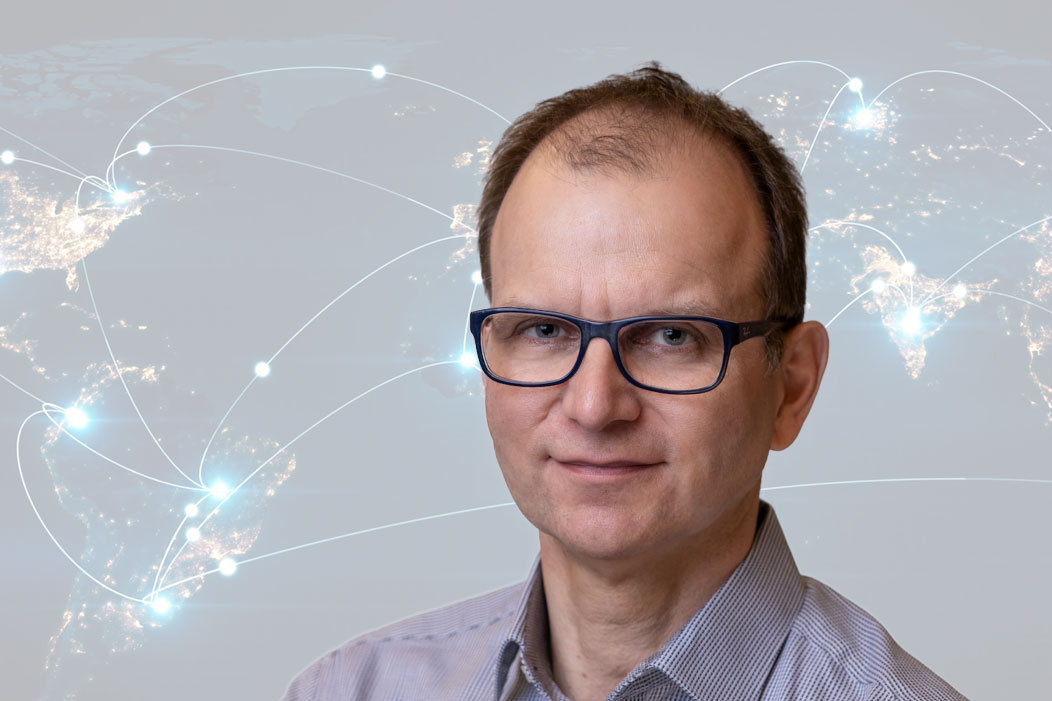
Paying homage to Harald Bock

Harald Bock, described by an optical networking executive as one of the great people of our industry, has died. Former colleagues describe the man and their sense of loss
Those who knew and worked with Harald Bock have been stunned by his sudden passing at 55. For them, Harald was a valued and much-admired friend, a deep thinker who made his views heard, quietly yet powerfully.
Last February, Harald changed jobs, becoming chief product officer at Ekinops after six years at Infinera. He was excited by the role and enjoyed his introductory period travelling to Ekinops’ sites, meeting colleagues and customers, and working on the company’s strategy.
Sylvain Quartier, Ekinops’ chief marketing & strategy officer, says it took the company a year to find the right candidate. Ekinops knew of Harald’s optical networking expertise but was impressed with his keenness to expand into what, for him, were new product areas such as routeing and cybersecurity.
“We needed someone expert in one domain and with good experience in product strategy,” says Quartier. “He was full of joy and happy to work.”
During Harald’s short spell at the company, he sharpened Ekinops’s product plans. “We’re executing his roadmap and strategy today,” says Quartier. “In six months, he had a great impact.”
Career
Harald earned his PhD in physics, specialising in polymer materials.
“Polymers may become an important material system for future high-speed [optical] modulators,” says Uwe Fischer, who was chief technology officer (CTO) at former optical networking firm, Coriant. “He was ahead of his time by doing something in his PhD thesis which is about to become important in business and technology.”
Harald’s career spanned some notable optical networking firms: Marconi, Nokia Siemens Networks, Coriant, and Infinera. He was part of Uwe Fischer’s team at Nokia Siemens Networks and Coriant. Harald’s strength was as a technologist, and had roles in several CTO offices.
Stefan Voll, then a lead product line manager and now senior director of business development at Adtran, worked with Harald at Nokia Siemens Networks in 2012.
The two were tasked with carving out the optical business of Nokia Siemens Networks in what was to become Coriant. “The carve-out was a big achievement,” says Voll. Harald represented the CTO office and Voll led the product line manager team and the two were tasked with making the product portfolio not only viable but profitable. This required aligning technical aspects with business needs, setting the foundation for Coriant’s operations.
At Coriant, Harald contributed to the development of Groove, one of the first compact modular platform for metro wavelength division multiplexing (WDM) and long-haul networks. Harald continued in the CTO office at Infinera after it acquired Coriant in 2019.
More recently, Harald served as editor of the Optical Internetworking Forum’s (OIF) 1600ZR project, taking over the role after an OIF member stepped down. The work involves standardising 1600-gigabit coherent optics for high-capacity networks. “He stepped in as smooth as possible,” says Karl Gass, optical vice chair of the OIF’s physical link layer (PLL) working group. “He knew how to manage personalities and get things done.”
Work ethic
Christian Uremovic, senior director of solution marketing at Nokia Optical Networks, worked with Harald at Coriant and Infinera. “He was a respected and valued technology guide for product line management and sales and for us in marketing,” says Uremovic. It wasn’t always an easy role; groups in the company would pull in different directions, and bringing it all together was a challenge. “Sometimes you had to make difficult decisions,” says Uremovic.
“He would like to understand basic technologies, and when, at executive meetings, he wanted to bring his opinion and convince others, he would talk quietly,” says Ekinop’s Quartier. “Everybody would be quiet because you wanted to hear him, and he made a strong impression.” With this quiet manner, Harald would progress the discussion and bring everybody in the right direction, says Quartier.
It is something Robert Richter, managing director and senior vice president, customer executive, product marketing office, at Nokia, highlights: “Harald would reiterate his view calmly, even if it annoyed some leaders, but it was always positive,” he says, adding that Harald was not the kind of guy who did what management told him. But he was always trying to change opinions constructively.
Voll reinforces this, saying Harald would not let shortcuts slide, ensuring all critical aspects were covered. “He was not afraid of conflict.” Harald would broaden discussions to bring in new angles to the point where it could be annoying. “But it was always valuable,” says Voll. “He was not fast, and that’s because he was a deep thinker. He reacted in meetings, but not immediately; he needed some time putting his thoughts together.”
Voll says Harald was focused on long-term technology trends, five to six years out, compared to product line managers’ shorter-term view. “He taught me to assess competitiveness through metrics like capacity per power consumption,” says Voll. Harald would say: “Convert it into capacity per volume or per power consumption.” Ten years ago, these were not usual metrics, but Harald used them to measure product plans. Harald would also also look product optimisations, such as whether a platform’s chips had features that were not used.
Maxim Kuschnerov, Director of R&D, at Huawei, worked with Harald at Coriant. He recalls a meeting he had with Deutsche Telekom presenting Huawei’s research topics. Afterwards, a Deutsche Telekom executive remarked that although it was framed as a research discussion, Kuschnerov kept steering the conversation toward commercial applications and customer value: “It reminds me of a guy at Coriant who talks about use cases a lot — Harald Bock”. Smiling, Kuschnerov replied: “Where do you think I was taught to think like that? I worked with Harald!”
Traits
Ekinops’ Quartier highlights Harald’s general cheerfulness: “He was always smiling, which was much appreciated.”
Richter, who worked with Harald for 18 years at Nokia Siemens Networks and Coriant, describes him as the most empathetic person he has met. “He was always listening to people and was very patient,” he says. Harald would bring cakes to the office from vacations and would never speak ill of others. He’d keep positive even during challenging times and in that sense, he was a role model, says Richter: “It was always a pleasure to talk to him over a coffee. He was open to a dialogue.”
Harald had an impressive fitness routine. “He’d bike 20km, swim for an hour, then come to the office relaxed,” says Voll. Until recently, Fischer and Harald would go biking on 40-kilometre rides. “Sometimes he was behind in my slipstream, then we change positions,” says Fischer. “We were proud of the competitive speed and times we could achieve together.” He was a keen water polo player in his youth.

Fluent in English, French, and his native German, Harald read books in all three languages. He adored France – his wife is French – with its pastries and Brittany with its Hydrangeas. He said how the Hydrangeas in his garden struggled, yet on seeing the flourishing bands of colour in Brittany (pictured), he was determined to try again.
Legacy
When colleagues talk about Harald, they recount his warmth and character.
Uremovic recollects sharing an office and hearing Harald’s diplomatic charm on calls. These experiences have shaped his ability to connect better with others. He will also miss their talks: “To me, he was like a big brother.”
Harald made a deep impression during his short time at Ekinops. “We miss him,” says Quartier. “We will always have his memory at Ekinops.”
Fischer highlights their shared interests in life – sport and a love of France.”There was a lot of mutual understanding which we didn’t need to put into words,” says Fischer. “Sometimes, when you feel close to somebody, you don’t even need to talk.”
Fischer, who has watched Harald’s career over the years, laments a life cut short. “He was at the peak of his career,” he says. ”He brought to Ekinops all his experience of the last 20 to 30 years so this period was maybe the most impactful time of his life.”
Richter’s grief over his lost colleague is evident in his sombre tone and demeanour, perhaps the deepest tribute one can pay to someone held so dear.


Coriant adds optical control to SDN framework
Coriant's CTO, Uwe Fischer, explains its Intelligent Optical Control and how the system will complement Transport SDN.

"You either master all that complexity at once, or you find the right entry point and provide value for each concrete challenge, and extend step-by-step from there"
Uwe Fischer, CTO of Coriant
Coriant has deployed a networking framework that it says will comply with Transport SDN, the software-defined networking (SDN) implementation for the wide area network (WAN).
The company's Intelligent Optical Control system is already deployed with one large North American operator while Coriant is working to install the system with other Tier 1 customers.
Work to extend SDN technology beyond the data centre to work across operators' transport networks has just begun. The Open Networking Foundation (ONF), for example, has established an Optical Transport Working Group to define the extensions needed to enable SDN control of the transport layer and not just packet.
"SDN and optical networking go together nicely; they are not decoupled but make up an end-to-end overall framework," says Uwe Fischer, CTO at Coriant.
The Intelligent Optical Control is designed to tackle immediate networking issues as Transport SDN is developed. Coriant says its system complies with the ONF's three networking layer SDN model. The top, application layer interfaces with the middle, control layer. And it is at the control layer where the SDN controller oversees the network elements found in the third, infrastructure layer.
Intelligent Optical Control adds two other components to the model. An extra intelligence component in the control layer that sits between the SDN controller and the infrastructure layer. This intelligence is designed to exploit the intricacies of the optical layer.
Coriant has also added an application at the topmost layer to automate operational procedures. "SDN at the application layer is centered around service creation," says Fischer. "We see a complete set of other applications which automate operational workflows."

Optical intelligence
One key benefit of SDN is the central view it has of the network and its resources. Such centralised control works well in the data centre and packet networking. Operators' networks are more complex, however, housing multiple vendors' equipment and multiple networking layers and protocols.
The ONF's Optical Transport Working Group is investigating two approaches - direct and abstract models - to enable the OpenFlow standard to extend its control across all the transport layers.
With the direct model, an SDN controller will talk to each network element, controlling its forwarding behaviour and port characteristics. The abstract model, in contrast, will enable the controller to talk to a network element or an intermediate controller or 'mediation'. This mediation performs a translator role, enacting requests from the SDN controller.
The direct model interests certain ONF members due to its potential of reduce the cost of networking equipment by moving much of the software from each element to the SDN controller. The abstract model, in contrast, has the benefit of limiting how much the controller needs to be exposed to the underlying network's details.
Coriant says it has yet to form a view as to the benefits of the direct and abstract ONF models. That said, Fischer does not see any mechanisms being discussed in the ONF that will fully exploit the potential of the photonic network. Accordingly, Coriant has added its own intelligence that sits between the SDN controller and the photonic layer.
“We fully comply with the approach of an SDN controller, however, we put another layer in between the control layer and the infrastructure layer,” says Fischer. “We consider it a part of the control layer, but adding the planning and routing intelligence to leverage the full performance of the infrastructure layer underneath."
Fischer says there is a role for abstraction at the photonic layer but perhaps only for metro networks. "We currently don't think this will really extend to the wide area photonic layer," he says.
"The added intelligence can leverage the full performance of the WDM network because it knows all the planning rules in detail," says Fischer. It does multi-layer optimisation across the transport layers. Coriant has added the intelligence because it does not think the transport-network-specific aspects can be centralised in a generic way.
Automated operations
Coriant's Intelligent Optical Controller also adds an application to automate operational procedures. Fischer cites how the application layer component benefits the workflow when a service is activated in the network.
With each service request, the Intelligent Optical Control details whether the new service can be squeezed onto existing infrastructure and details the service performance parameters to be expected, such as latency and the guaranteed bandwidth. "The operator can immediately judge the service level they would get," says Fischer.
Another planning mode supports the adding of equipment at the infrastructure layer. This enables a comparison to be made as to how the service level would improve with extra equipment in place.
If the operator can justify that business case for new hardware, the workflow is then automated. The tool creates the bill of materials, the electronic order, and the configuration and planning data needed to implement the hardware in the network.
Coriant says equipment and services can be time-tagged. If an engineer is known to be visiting a site once the hardware becomes available, the card can be pre-assigned and automatically used once it is plugged in. "There is a full consistency as to how the hardware is managed and optimised towards service creation," says Fischer.
Coriant is working with its major customers to create a testbed to demonstrate an SDN implementation of IP-over-DWDM. "It will involve interworking with third-party routers, and using SDN controllers to control the packet part of the network with Openflow and other mechanisms, and then connected to the Intelligent Optical Controller."
The goal is to demonstrate that Coriant's approach complies with this use case while better exploiting the optical network's capabilities.
Fischer says optical networking is moving to a new phase as transmission speeds move beyond 100 Gigabit.
"We are entering an interesting phase as capacity and reach hit the limits of practical networks," he says. "This means we are talking about flexible modulation formats and variously composed super-channels for 400 Gigabit and 1 Terabit."
In effect, a virtualisation of bandwidth is taking place at the photonic layer. "This fits nicely into the SDN principle as on the one hand it virtualises capacity, which very much fits in the model of virtualising infrastructure."
But it also brings challenges.
"There is currently not a good practical means to manage such flexible capacity at the photonic layer," says Fischer. This, says Coriant, it what its customers are saying. It also explains Coriant's decision to add the optical controller. "You either master all that complexity at once, or you find the right entry point and provide value for each concrete challenge, and extend step-by-step from there," says Fischer.
