

u2t Photonics pushes balanced detectors to 70GHz
- u2t's 70GHz balanced detector supports 64Gbaud for test and measurement and R&D
- The company's gallium arsenide modulator and next-generation receiver will enable 100 Gigabit long-haul in a CFP2

"The performance [of gallium arsenide] is very similar to the lithium niobate modulator"
Jens Fiedler, u2t Photonics
u2t Photonics has announced a balanced detector that operates at 70GHz. Such a bandwidth supports 64 Gigabaud (Gbaud), twice the symbol rate of existing 100 Gigabit coherent optical transmission systems.
The German company announced a coherent photo-detector capable of 64Gbaud in 2012 but that had an operating bandwidth of 40GHz. The latest product uses two 70GHz photo-detectors and different packaging to meet the higher bandwidth requirements.
"The achieved performance is a result of R&D work using our experience with 100GHz single photo-detectors and balanced detector technology at a lower speed,” says Jens Fiedler, executive vice president sales and marketing at u2t Photonics.
The monolithically-integrated balanced detector has been sampling since March. The markets for the device are test and measurement systems and research and development (R&D). "It will enable engineers to work on higher-speed interface rates for system development," says Fiedler.
The balanced detector could be used in next-generation transmission systems operating at 64 Gbaud, doubling the current 100 Gigabit-per-second (Gbps) data rate while using the same dual-polarisation, quadrature phase-shift keying (DP-QPSK) architecture.
A 64Gbaud DP-QPSK coherent system would halve the number of super-channels needed for 400Gbps and 1 Terabit transmissions. In turn, using 16-QAM instead of QPSK would further halve the channel count - a single dual-polarisation, 16-QAM at 64Gbaud would deliver 400Gbps, while three channels would deliver 1.2Tbps.
However, for such a system to be deployed commercially the remaining components - the modulator, device drivers and the DSP-ASIC - would need to be able to operate at twice the 32Gbaud rate; something that is still several years out. That said, Fiedler points out that the industry is also investigating baud rates in between 32 Gig and 64 Gig.
Gallium arsenide modulator
u2t acquired gallium arsenide modulator technology in June 2009, enabling the company to offer coherent transmitter as well as receiver components.
At OFC/NFOEC 2013, u2t Photonics published a paper on its high-speed gallium arsenide coherent modulator. The company's design is based on the Mach-Zehnder modulator specification of the Optical Internetworking Forum (OIF) for 100 Gigabit DP-QPSK applications.
The DP-QPSK optical modulation includes a rotator on one arm and a polarisation beam combiner at the output. u2t has decided to support an OIF compatible design with a passive polarisation rotator and combiner which could also be integrated on chip. The resulting coherent modulator is now being tested before being integrated with the free space optics to create a working design.
"The performance [of gallium arsenide] is very similar to the lithium niobate modulator," says Fiedler. "Major system vendors have considered the technology for their use and that is still ongoing."
The gallium arsenide modulator is considerably smaller than the equivalent lithium niobate design. Indeed u2t expects the technology's power and size requirements, along with the company's coherent receiver, to fit within the CFP2 optical module. Such a pluggable 100 Gigabit coherent module would meet long-haul requirements, says Fiedler.
The gallium arsenide modulator can also be used within the existing line-side 100 Gigabit 5x7-inch MSA coherent transponder. Fiedler points out that by meeting the OIF specification, there is no space saving benefit using gallium arsenide since both modulator technologies fit within the same dimensioned package. However, the more integrated gallium arsenide modulator may deliver a cost advantage, he says.
Another benefit of using a gallium arsenide modulator is its optical performance stability with temperature. "It requires some [temperature] control but it is stable," says Fiedler.
Coherent receiver
u2t's current 100Gbps coherent receiver product uses two chips, each comprising the 90-degree hybrid and a balanced detector. "That is our current design and it is selling in volume," says Fiedler. "We are now working on the next version, according to the OIF specification, which is size-reduced."
The resulting single-chip design will cost less and fit within a CFP2 pluggable module.
The receiver might be small enough to fit within the even smaller CFP4 module, concludes Fiedler.

u2t Photonics: Adapting to a changing marketplace
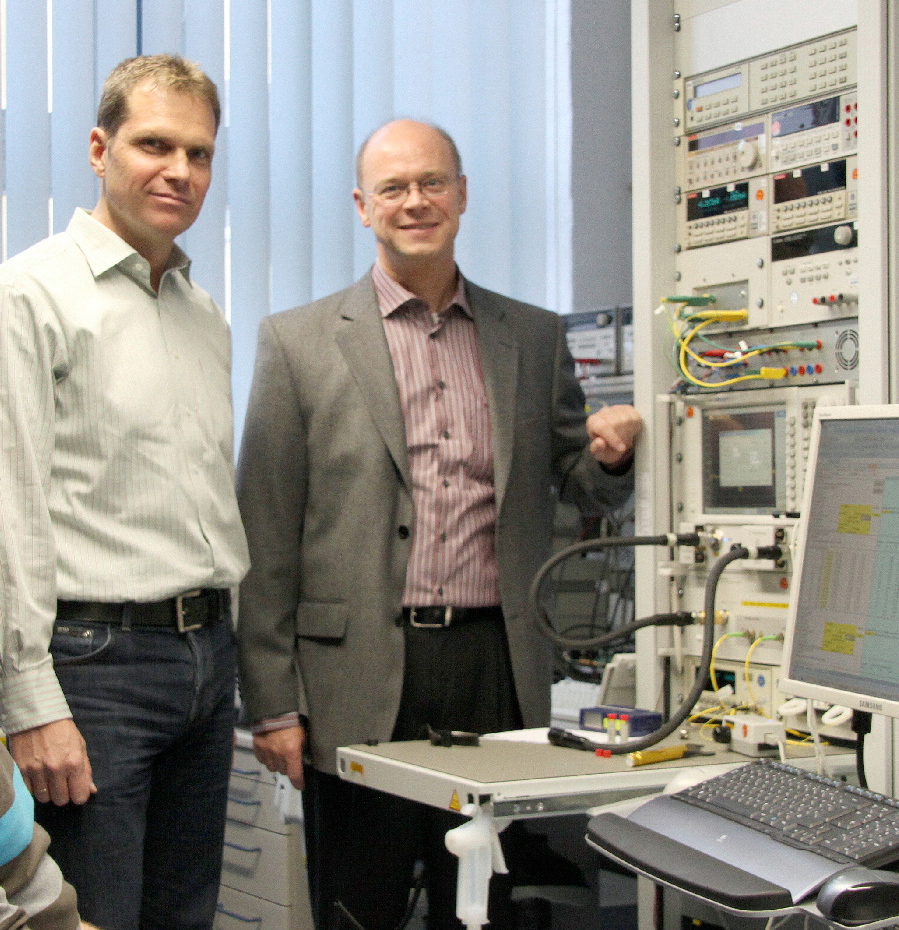 u2t Photonics' Jens Fiedler, vice president sales and marketing (left), and CEO Andreas Umbach.
u2t Photonics has begun sampling its second-generation coherent receiver module. The dual-polarisation, quadrature phase-shift keying (DP-QPSK) coherent transmission receiver adds polarisation diversity to the company’s first-generation design – an indium-phosphide 90O hybrid design that includes balanced photo-detectors – all within an integrated module. u2t Photonics has developed two such coherent receiver designs, to address the 40 Gigabit-per-second (Gbps) and the 100Gbps markets, adding to the company’s first-generation design now available in small volumes.
“We can explore [next-gen coherent] solutions before we need them and we learn a lot from these partnerships” Andreas Umbach
The latest coherent receiver design represents what CEO Andreas Umbach believes u2t Photonics does best: using its radio frequency (RF) and optical component expertise to design high-speed integrated optical receiver modules.
Differentiation at 100 Gigabit
u2t Photonics is a leading component supplier for the 40 Gigabit market with its photo-detectors and more recently differential phase-shift keying (DPSK) integrated receiver designs that combine a delay-line interferometer with a balanced receiver. Such receivers are used for optical transponder and line card designs. Now, with its latest integrated coherent receiver, the German company aims to exploit the emerging 100 Gigabit market.
“The 40 Gig market will be strong for awhile yet, but 100 Gig is coming and will start to squeeze 40 Gig,” says Umbach. “Right now we do not see 100 Gig cannibalising 40 Gig,” says Jens Fiedler, vice president sales and marketing at u2t Photonics. “For DP-QPSK, 100 Gig might cannibalise 40 Gig since the technology for 40 Gig does not offer a big cost benefit for the customer.”
The emergence of 100 Gigabit optical links and its use of more advanced modulation have changed component requirements. Whereas the DPSK modulation scheme for 40Gbps requires photo-detectors with bandwidths that match the data rate, 100Gbps coherent requires photo-detectors with bandwidths of 28GHz only.
“In principle, not having the requirement of a very high-speed photo-detector makes it [100Gbps] a little bit easier, yet having 40 Gig serial is not unique anymore; there are differences in performance but it is not a limiting factor,” says Umbach.
Instead what matters for optical component players is to understand the 100Gbps functional requirements and deliver a design that meets them as early as possible, says Umbach. The challenges after that are scaling volume production and driving down cost. “We are the first company with a second generation design, offering the highest integration based on the [100G OIF] standard,” says Fiedler. “No doubt our competition is tough, but so far we are doing pretty well.”
u2t Photonics dismisses the view that the advent of high-speed CMOS ASICs that execute digital signal processing algorithms at the DP-QPSK receiver is eroding the need for the company’s expertise by enabling less specialist optics to be used. The optical specification requirements the company faces are challenging enough because customers still want to get the best performance from the links, it says.
"u2t Photonics has grown its revenue tenfold in the last five years" Jens Fiedler
“The challenge for us now is not just a photo-detector with a higher bandwidth but a coherent receiver that can detect the polarisation, phase and amplitude of the optical signal,” says Umbach. “That puts a much higher challenge on the components – not just high speed and efficiency but linearity in all these parameters.”
EC Galactico and Mirthe projects
To keep on top of next-generation coherent optical transmission schemes, u2t Photonics is a member of two European Commission (EC) Framework 7 projects dubbed Galactico (Blending diverse photonics and electronics on silicon for integrated and fully functional coherent Tb Ethernet) and Mirthe (Monolithic InP-based dual polarization QPSK integrated receiver and transmitter for coherent 100-400Gb Ethernet).
The Galactico project, which includes Nokia Siemens Networks, will develop photonic integrated circuits (PICS) that will implement a 100Gbps DP-QPSK coherent transmitter and receiver, a 600Gbps dense wavelength division multiplexing (DWDM) DP-QPSK coherent transmitter and receiver and a 280Gbps DP-128 quadrature amplitude modulation (QAM) transmitter that will deliver 10bit/sec/Hz spectral efficiency. The second project, Mirthe, is tasked with developing multi-level coding schemes using QPSK and QAM.
“Both projects address next generation [high-speed optical transmission] and the next level of integration of coherent receivers and transmitters for complex coherent systems,” says Umbach.
u2t is working with the projects’ partners in defining the devices needed for next-generation networks. In particular it is helping define the specifications needed for the ICs to drive such optical devices as well as what the product should look like to aid integration and packaging. “We have partners in the Mirthe project such as the Heinrich Hertz Institute and [Alcatel Thales] III V Lab that are focusing on chip design according to our requirements and matching our packaging development efforts,” says Umbach. The Galactico project is similar but here u2t Photonics is also contributing its integrated modulator technology for more complex transmission formants compared to the current DP-QPSK.
The company says its involvement in these projects is less to do with the research funding made available. Rather, it is the chance to work with partners on the R&D side. “We can explore solutions before we need them and we learn a lot from these partnerships,” says Umbach.
Changing markets
The emergence of three or four dominant module makers as the optical market matures presents new challenges for u2t Photonics. These emerging leaders are increasingly vertically integrated, using their own in-house components within their modules.
“Vertical integration is something we have to face and are fully aware of,” says Fiedler. To remain a valid component supplier, what matters is delivering component performance, volume capability, and cost that meet customer targets and challenge their own developments. “That is what we need to – at least be the second source for these vertical integrated companies,” says Fiedler.
Umbach points out that many of the system vendors are developing their own 100Gbps systems on line cards, and this represents another market opportunity for u2t Photonics, independent of the module makers.
“u2t might not offer the best pricing and might have issues - technical challenges common when you have early, leading-edge components,” says Fiedler. “But finally u2t is chosen as the supplier. They know we deliver the products.” To prove his point, Fiedler claims u2t Photonics has grown its revenue tenfold in the last five years.
Europe’s optical vendors
The last few years has seen significant consolidation among European optical component firms. Whereas Europe has system vendors that include Alcatel-Lucent, Nokia Siemens Networks, Ericsson, ADVA Optical Networking and Transmode Systems, the number of component vendors has continued to shrink. Bookham became a US company before merging with Avanex to become Oclaro, MergeOptics folded and its assets were acquired by FCI, while CoreOptics was acquired by Cisco Systems in May 2010.
Oclaro may be a US-registered company but its main operations are in China and Europe, points out Umbach. And many companies’ operations in the US and elsewhere have large headcounts in the Far East such that they could be view as more Asian companies, he adds.
“I believe there are lot of systems and components expertise in Europe - in Italy, the UK and Germany,” says Umbach. “Maybe they are just teams out of global players, like the CoreOptics team which will stay in Nuremberg although it is now a US company.” u2t Photonics itself has opened a unit in the UK. “We don’t feel too lonely,” he adds. “There is a lot of know-how we can look at here in these areas, not only other companies but academia in all the photonics fields.”
In turn, the market is a global one, says the firm, with the Chinese market being particular important with its large 40Gbps DPSK deployments and the importance of Huawei as a leading system vendor. Fiedler says the Chinese market is rapidly moving and has the potential to be a huge market for high-speed optical transmission. Yet despite emerging Chinese optical component players, the likes of Huawei are no different to other system vendors in terms of the criteria used when choosing optical components: performance capabilities and cost.
u2t Photonics remains open to all developments. “We have the opportunity to grow and expand our own business, and face the challenge with our bigger competitors,” says Umbach. “And if there is a reasonable path into consolidation, there is nothing that keeps us from going this way.”
Further information:
A presentation on Galactico, click here
A presentation on Mirthe, click here