

ECOC 2015 Review - Part 1
- Several companies announced components for 400 gigabit optical transmission
- NEL announced a 200 gigabit coherent DSP-ASIC
- Lumentum ramps production of its ROADM blades while extending the operating temperature of its tunable SFP+
400 gigabit
Oclaro, Teraxion and NeoPhotonics detailed their latest optical components for 400 gigabit optical transmission using coherent detection.
Oclaro and Teraxion announced 400 gigabit modulators for line-side transmission; Oclaro’s based on lithium niobate and Teraxion’s an indium phosphide one.
NeoPhotonics outlined other components that will be required for higher-speed transmission: indium phosphide-based waveguide photo-detectors for coherent receivers, and ultra-narrow line-width lasers suited for higher order modulation schemes such as dual-polarisation 16-quadrature amplitude modulation (DP-16-QAM) and DP-64-QAM.
There are two common approaches to achieve higher line rates: higher-order modulation schemes such as 16-QAM and 64-QAM, and optics capable of operating at higher signalling rates.
Using 16-QAM doubles the data rate compared to quadrature phase-shift keying (QPSK) modulation that is used at 100 Gig, while 64-QAM doubles the data rate again to 400 gigabit.
Higher-order modulation can use 100 gigabit optics but requires additional signal processing to recover the received data that is inherently closer together. “What this translates to is shorter reaches,” says Ferris Lipscomb, vice president of marketing at NeoPhotonics.
These shorter distances can serve data centre interconnect and metro applications where distances range from sub-100 kilometers to several hundred kilometers. But such schemes do not work for long haul where sensitivity to noise is too great, says Lipscomb.
What we are seeing from our customers and from carriers looking at next-generation wavelength-division multiplexing systems for long haul is that they are starting to design their systems and are getting ready for 400 Gig
Lipscomb highlights the company’s dual integrable tunable laser assembly (iTLAs) with its 50kHz narrow line-width. “That becomes very important for higher-order modulation because the different states are closer together; any phase noise can really hurt the optical signal-to-noise ratio,” he says
The second approach to boost transmission speed is to increase the signalling rate. “Instead of each stream at 32 gigabaud, the next phase will be 42 or 64 gigabaud and we have receivers that can handle those speeds,” says Lipscomb. The use of 42 gigabaud can be seen as an intermediate step to a higher line rate - 300 gigabit – while being less demanding on the optics and electronics than a doubling to 64 gigabaud.
Oclaro’s lithium niobate modulator supports 64 gigabaud. “We have increased the bandwidth beyond 35 GHz with a good spectral response – we don’t have ripples – and we have increased the modulator’s extinction ratio which is important at 16-QAM,” says Robert Blum, Oclaro’s director of strategic marketing.
We have already demonstrated a 400 Gig single-wavelength transmission over 500km using DP-16-QAM and 56 gigabaud
Indium phosphide is now coming to market and will eventually replace lithium niobate because of the advantages of cost and size, says Blum, but lithium niobate continues to lead the way for highest speed, long-reach applications. Oclaro has been delivering its lithium niobate modulator since the third quarter of the year.
Teraxion offers an indium phosphide modulator suited to 400 gigabit. “One of the key differentiators of our modulator is that we have a very high bandwidth such that single-wavelength transmission at 400 Gig is possible,” says Martin Guy, CTO and strategic marketing at Teraxion. “We have already demonstrated a 400 Gig single-wavelength transmission over 500km using DP-16-QAM and 56 gigabaud.”
“What we are seeing from our customers and from carriers looking at next-generation wavelength-division multiplexing systems for long haul is that they are starting to design their systems and are getting ready for 400 Gig,” says Blum.
Teraxion says it is seeing a lot of activity regarding single-wavelength 400 Gig transmission. “We have sampled product to many customers,” says Guy.
NeoPhotonics says the move to higher baud rates is still some way off with regard systems shipments, but that is what people are pursuing for long haul and metro regional.
200 Gig DSP-ASIC
Another key component that will be needed for systems operating at higher transmission speeds is more powerful coherent digital signal processors (DSPs). NTT Electronics (NEL) announced at ECOC that it is now shipping samples of its 200 gigabit DSP-ASIC, implemented using a 20nm CMOS process.
Dubbed the NLD0660, the DSP features a new core that uses soft-decision forward error correction (SD-FEC) that achieves a 12dB net coding gain. Improving the coding gain allows greater spans before optical regeneration or longer overall reach, says NEL. The DSP-ASIC supports several modulation formats: DP-QPSK, DP-8-QAM and DP-16-QAM, for 100 Gig, 150 Gig and 200 Gig rates, respectively. Using two NLD0660s, 400 gigabit coherent transmission is achieved.
NEL announced its first 20nm DSP-ASIC, the lower-power 100 gigabit NLD0640 at OFC 2015 in March. At the same event, ClariPhy demonstrated its own merchant 200 gigabit DSP-ASIC.
Reconfigurable optical add/ drop multiplexers
Lumentum gave an update on its TrueFlex route & select architecture Super Transport Blade, saying it has now been qualified, with custom versions of the line card being manufactured for equipment makers. The Super Transport Blades will be used in next-generation ROADMs for 100 gigabit metro deployments. The Super Transport Blade supports flexible grid, colourless, directionless and contentionless ROADM designs.
“This is the release of the full ROADM degree for next-generation networks, all in a one-slot line card,” says Brandon Collings, CTO of Lumentum. “It is a pretty big milestone; we have been talking about it for years.”
Collings says that the cards are customised to meet an equipment maker’s particular requirements. “But they are generally similar in their core configuration; they all use twin wavelength-selective switches (WSSes), those sort of building blocks.”
This is the release of the full ROADM degree for next-generation networks, all in a one-slot line card. It is a pretty big milestone; we have been talking about it for years
Lumentum also announced 4x4 and 6x6 integrated isolator arrays. “If you look at those ROADMs, there is a huge number of connections inside,” says Collings. The WSSes can be 1x20 and two can be used - a large number of fibres - and at certain points isolators are required. “Using discrete isolators and needing a large number, it becomes quite cumbersome and costly, so we developed a way to connect four or six isolators in a single package,” he says.
A 6x6 isolator array is a six-lane device with six hardwired input/ output pairs, with each input/ output pair having an isolator between them. “It sounds trivial but when you get to that scale, it is truly enabling,” says Collings.
Isolators are needed to keep light from going in the wrong direction. “These things can start to accumulate and can be disruptive just because of the sheer volume of connections that are present,” says Collings.
Tunable transceivers
Lumentum offers a tunable SFP+ module that consumes less than 1.5W while operating over a temperature range of -5C to +70C. At ECOC, the company announced that in early 2016 it will release a tunable SFP+ with an extended temperature range of -5C to +85C.
Further information
Heading off the capacity crunch, click here
For the ECOC Review, Part 1, click here

Europe gets its first TWDM-PON field trial
Vodafone is conducting what is claimed to be the first European field trial of a multi-wavelength passive optical networking system using access equipment from Alcatel-Lucent.
 Source: Alcatel-Lucent
The time- and wavelength-division multiplexed passive optical network (TWDM-PON) technology being used is a next-generation access scheme that follows on from 10 gigabit GPON (XG-PON1) and 10 gigabit EPON.
“There appears to be much more 'real' interest in TWDM-PON than in 10G GPON,” says Julie Kunstler, principal analyst, components at Ovum.
The TWDM-PON standard is close to completion in the Full Service Access Network (FSAN) Group and ITU and supports up to eight wavelengths, each capable of 10 gigabit symmetrical or 10/ 2.5 gigabit asymmetrical speeds.
“You can start building hardware solutions that are fully [standard] compliant,” says Stefaan Vanhastel, director of fixed access marketing at Alcatel-Lucent.
TWDM-PON’s support for additional functionality such as dynamic wavelength management, whereby subscribers could be moved between wavelengths, is still being standardised.
The combination of time and wavelength division multiplexing, allows TWDM-PON to support multiple PONs, each sharing its capacity among 16, 32, 64 or even 128 end points depending on the operator’s chosen split ratio.
There appears to be much more 'real' interest in TWDM PON than in 10G GPON
Alcatel-Lucent first detailed its TWDM-PON technology last year. The system vendor introduced a four-wavelength TWDM-PON based on a 4-port line-card, each port supporting a 10 gigabit PON. The line card is used with Alcatel-Lucent’s 7360 Intelligent Services Access Manager FX platform, and supports fixed and tunable SFP optical modules.
“Several vendors also offer the possibility to use fixed wavelength - XG-PON1 or 10G EPON optics," says Vanhastel. "This reduces the initial cost of a TWDM-PON deployment while allowing you to add tunable optics later."
Operators can thus start with a 10 gigabit PON using fixed-wavelength optics and move to TWDM-PON and tunable modules as their capacity needs grow. “You won’t have to swap out legacy XG-PON1 hardware two years from now,” says Vanhastel.
Alcatel-Lucent has been involved in 16 customer TWDM-PON trials overall, half in Asia Pacific and the rest split between North America and EMEA. Besides Vodafone, Alcatel-Lucent has named two other TWDM-PON triallists: Telefonica and Energia, an energy utility in Japan.
You won’t have to swap out legacy XG-PON1 hardware two years from now
Vanhastel says the company has been surprised that operators are also eyeing the technology for residential access. The high capacity and relative expense of tunable optics made the vendor think that early demand would be for business services and mobile backhaul only.
 Source: Gazettabyte
There are several reasons for the operator interest in TWDM-PON, says Vanhastel. One is its ample bandwidth - 40 gigabit symmetrical in a four-wavelength implementation - and that wavelengths can be assigned to different aggregation tasks such as backhaul, business and residential. Operators can also pay for wavelengths as needed.
TWDM-PON also allows wavelengths to be shared between operators as part of wholesale agreements. Operators deploying TWDM-PON can lease a wavelength to each other in their respective regions.
Vodafone, for example, is building its own fibre network but is also expanding its overall fixed broadband coverage by developing wholesale agreements across Europe. Vodafone's European broadband network covers 62 million households: 26 million premises covered with its own network and 36 million through wholesale agreements.
First operator TWDM-PON pilot deployments will occur in 2016, says Alcatel-Lucent.
Further reading:
White Paper: TWDM PON is on the horizon: facilitating fast FTTx network monetization, click here
ECOC 2013 review - Part 2
- Oclaro's Raman and hybrid amplifier platform for new networks
- MxN wavelength-selective switch from JDSU
- 200 Gigabit multi-vendor coherent demonstration
- Tunable SFP+ designs proliferate
- Finisar extends 40 Gigabit QSFP+ to 40km
- Oclaro’s tackles wireless backhaul with 2km SFP+ module
 Finisar's 40km 40 Gig QSFP+ demo. Source: Finisar
Amplifier market heats up
Oclaro detailed its high performance Raman and hybrid Raman/ Erbium-doped fibre amplifier platform. "The need for this platform is the high-capacity, high channel rates being installed [by operators] and the desire to be scalable - to support 400 Gig and Terabit super-channels in future," says Per Hansen, vice president of product marketing, optical networks solutions at Oclaro.
"Amplifiers are 'hot' again," says Daryl Inniss, vice president and practice leader components at market research firm, Ovum. For the last decade, amplifier vendors have been tasked with reducing the cost of their amplifier designs. "Now there is a need for new solutions that are more expensive," says Inniss. "It is no longer just cost-cutting."
Amplifiers are used in the network backbone to boost the optical signal-to-noise ratio (OSNR). Raman amplification provides significant noise improvement but it is not power efficient so a Raman amplifier is nearly always matched with an Erbium one. "You can think of the Raman as often working as a pre-amp, and the Erbium-doped fibre as the booster stage of the hybrid amplifier," says Hansen. System houses have different amplifier approaches and how they connect them in the field, while others build them on one card, but Raman/ Erbium-doped fibre are almost always used in tandem, says Hansen.
Oclaro provides Raman units and hybrid units that combine Raman with Erbium-doped fibre. "We can deliver both as a super-module that vendors integrate on their line cards or we can build the whole line card for them" says Hansen.
The Raman amplifier market is way bigger than people have forecast
Since Raman launches a lot of pump power into the fibre, it is vital to have low-loss connections that avoid attenuating the gain. "Raman is a little more sensitive to the quality of the connections and the fibre," says Hansen. Oclaro offers scan diagnostic features that characterise the fibre and determine whether it is safe to turn up the amplification.
"It can analyse the fibre and depending on how much customers want us to do, we can take this to the point that it [the design] can tell you what fibre it is and optimise the pump situation for the fibre," says Hansen. In other cases, the system vendors adopt their own amplifier control.
Oclaro says it is in discussion with customers about implementations. "We are shipping the first products based on this platform," says Hansen.
"[The] Raman [amplifier market] is way bigger than people have forecast," says Inniss. This is due to operators building long distance networks that are scalable to higher data rates. "Coherent transmission is the focal point here, as coherent provides the mechanism to go long distance at high data rates," says Ovum analyst, Inniss.
Wavelength-selective switches
JDSU discussed its wavelength-selective switch (WSS) products at ECOC. The company has previously detailed its twin 1x20 port WSS, which has moved from development to volume production.
At ECOC, JDSU detailed its work on a twin MxN WSS design. "It is a WSS that instead of being a 1xN - 1x20 or a 1x9 - it is an MxN," says Brandon Collings, chief technology officer, communications and commercial optical products at JDSU. "So it has multiple input and output ports on both sides." Such a design is used for the add and drop multiplexer for colourless and directionless reconfigurable optical add/ drop multiplexers (ROADMs).
"People have been able to build colourless and directionless architectures using conventional 1xN WSSes," says Collings. The MxN serves the same functionality but in a single integrated unit, halving the volume and cost for colourless and directionless compared to the current approach.
JDSU says it is also completing the development of a twin multicast switch, the add and drop multiplexer suited to colourless, directionless and contentionless ROADM designs.
200 Gigabit coherent demonstration
ClariPhy Communications, working with NeoPhotonics, Fujitsu Optical Components, u2t Photonics and Inphi, showcased a reference-design demonstration of 200 Gig coherent optical transmission using 16 quadrature amplitude modulation (16-QAM).
For the demonstration, ClariPhy provided the coherent silicon: the digital-to-analogue converter for transmission and the receiver analogue-to digital and digital signal processing (DSP) used to counter channel transmission impairments. NeoPhotonics provided the lasers, for transmission and at the receiver, u2t Photonics supplied the integrated coherent receiver, Fujistu Optical Components the lithium niobate nested modulator while Inphi provided the quad-modulator driver IC.
ClariPhy is developing a 28nm CMOS Lightspeed chip suited for metro and long-haul coherent transmission. The chip will support 100 and 200 Gigabit-per-second (Gbps) data rates and have an adjustable power consumption tailored to the application. The chip will also be suited for use within a coherent CFP module.
"All the components that we are talking about for 100 Gig are either ready or will soon be ready for 200 and 400 Gig," says Ferris Lipscomb, vice president of marketing at NeoPhotonics. To achieve 400Gbps, two 16-QAM channels can be used.
The DWDM market for 10 Gig is now starting to plateau
Tunable SFPs
JDSU first released a 10Gbps SFP+ optical module tunable across the C-band in 2012, a design that dissipates up to 2W. The SFP+ MSA agreement, however, calls for no greater than a 1.5W power consumption. "Our customers had to deal with that higher power dissipation which, in a lot of cases, was doable," says JDSU Collings.
 Robert Blum, Oclaro
JDSU's latest tunable SFP+ design now meets the 1.5W power specification. "This gets into the MSA standard's power dissipation envelop and can now go into every SFP+ socket that is deployed," says Collings. To achieve the power target involved a redesign of the tunable laser. The tunable SFP+ is now sampling and will be generally available one or two quarters hence.
Oclaro and Finisar also unveiled tunable SFP+ modules at ECOC 2013. "The design is using the integrated tunable laser and Mach-Zehnder modulator, all on the same chip," says Robert Blum, director of product marketing for Oclaro's photonic components.
Neither Oclaro nor Finisar detailed their SFP+'s power consumption. "The 1.5W is the standard people are trying to achieve and we are quite close to that," says Blum.
Both Oclaro's and Finisar's tunable SFP+ designs are sampling now.
Reducing a 10Gbps tunable transceiver to a SFP+ in effect is the end destination on the module roadmap. "The DWDM market for 10 Gig is now starting to plateau," says Rafik Ward, vice president of marketing at Finisar. "From an industry perspective, you will see more and more effort on higher data rates in future."
40G QSFP+ with a 40km reach
Finisar demonstrated a 40Gbps QSFP+ with a reach of 40km. "The QSFP has embedded itself as the form-factor of choice at 40 Gig," says Ward.
Until now there has been the 850nm 40GBASE-SR4 with a 100m reach and the 1310nm 40GBASE-LR4 at 10km. To achieve a 40km QSFP+, Finisar is using four uncooled distributed feedback (DFB) lasers and an avalanche photo-detector (APD) operating using coarse WDM (CWDM) wavelengths spaced around 1310nm. The QSFP+ is being used on client side cards for enterprise and telecom equipment, says Finisar.
Module for wireless backhaul
Oclaro announced an SFP+ that supports the wireless Common Public Radio Interface (CPRI) and Open Base Station Architecture Initiative (OBSAI) standards used to link equipment in a wireless cell's tower and the base station controller.
Until now, optical modules for CPRI have been the 10km 10GBASE-LR4 modules. "You have a relatively expensive device for the last mile which is the most cost sensitive [part of the network]," says Oclaro's Hansen.
Oclaro's 1W SFP+ reduces module cost by using a simpler Fabry-Perot laser but at the expense of a 2km reach only. However, this is sufficient for a majority of requirements, says Hansen. The SFP supports 2.5G, 3Gbps, 6Gbps and 10Gbps rates. "CPRI has been used mostly at 3 Gig and 6 Gig but there is interest in 10 Gig due to growing mobile data traffic and the adoption of LTE," says Hansen.
The SFP+ module is sampling and will be in volume production by year end.
For Part 1, click here
JDSU's Brandon Collings on silicon photonics, optical transport & the tunable SFP+
JDSU's CTO for communications and commercial optical products, Brandon Collings, discusses reconfigurable optical add/drop multiplexers (ROADMs), 100 Gigabit, silicon photonics, and the status of JDSU's tunable SFP+.

"We have been continually monitoring to find ways to use the technology [silicon photonics] for telecom but we are not really seeing that happen”
Brandon Collings, JDSU
Brandon Collings highlights two developments that summarise the state of the optical transport industry.
The industry is now aligned on the next-generation ROADM architecture of choice, while experiencing a ’heavy component ramp’ in high-speed optical components to meet demand for 100 Gigabit optical transmission.
The industry has converged on the twin wavelength-selective switch (WSS) route-and-select ROADM architecture for optical transport. "This is in large networks and looking forward, even in smaller sized networks," says Collings.
In a route-and-select architecture, a pair of WSSes reside at each degree of the ROADM. The second WSS is used in place of splitters and improves the overall optical performance by better suppressing possible interference paths.
JDSU showcased its TrueFlex portfolio of components and subsystems for next-generation ROADMs at the recent European Conference on Optical Communications (ECOC) show. The company first discussed the TrueFlex products a year ago. "We are now in the final process of completing those developments," says Collings.
Meanwhile, the 100 Gigabit-per-second (Gbps) component market is progressing well, says Collings. The issues that interest him include next-generation designs such as a pluggable 100Gbps transmission form factor.
Direct detection and coherent
JDSU remains uncertain about the market opportunities for 100Gbps direct-detection solutions for point-to-point and metro applications. "That area remains murky," says Collings. "It is clearly an easy way into 100 Gig - you don't have to have a huge ASIC developed - but its long-term prospects are unclear."
The price point of 100Gbps direct-detection, while attractive, is competing against coherent transmission solutions which Collings describes as volatile. "As coherent becomes comparable [in cost], the situation will change for the 4x25 Gig [direct detection] quite quickly," he says. "Coherent seems to be the long-term, robust cost-effective way to go, capturing most of the market."
At present, coherent solutions are for long-haul that require a large, power-consuming ASIC. Equally the accompanying optical components - the lasers and modulators - are also relatively large. For the coherent metro market, the optics must become cheaper and smaller as must the coherent ASIC.
"If you are looking to put that [coherent ASIC and optics] into a CFP or CFP2, the problem is based on power; cost is important but power is the black-and-white issue," says Collings. Engineers are investigating what features can be removed from the long-haul solution to achieve the target 15-20W power consumption. "That is pretty challenging from an ASIC perspective and leaves little-to-no headroom in a pluggable," says Collings.
The same applies to the optics. "Is there a lesser set of photonics that can sit on a board that is much lower cost and perhaps has some weaker performance versus today's high-performance long-haul?" says Collings. These are the issues designers are grappling with.
Silicon photonics
Another area in flux is the silicon photonics marketplace. "It is a very fluid and active area," says Collings. "We are not highly active in the area but we are very active with outside organisations to keep track of its progress, its capabilities and its overall evolution in terms of what the technology is capable of."
The silicon photonics industry has shifted towards datacom and interconnect technology in the last year, says Collings. The performance levels silicon photonics achieves are better suited to datacom than telecom's more demanding requirements. "We have been continually monitoring to find ways to use the technology for telecom but we are not really seeing that happen,” says Collings.
Tunable SFP+
JDSU demonstrated its tunable laser in an SFP+ pluggable optical module at the ECOC exhibition.
The company was first to market with the tunable XFP, claiming it secured JDSU an almost two-year lead in the marketplace. "We are aiming to repeat that with the SFP+," says Collings.
The SFP+ doubles a line card's interface density compared to the XFP module. The SFP+ supports both 10Gbps client-side and wavelength-division multiplexing (WDM) interfaces. "Most of the cards have transitioned from supporting the XFP to the SFP+," says Collings. This [having a tunable SFP+] completes that portfolio of capability."
JDSU has provided samples of the tunable pluggable to customers. "We are working with a handful of leading customers and they typically have a preference on chirp or no-chirp [lasers], APD [avalanche photo-diode] or no APD, that sort of thing," says Collings.
JDSU has not said when it will start production of the tunable SFP+. "It won't be long," says Collings, who points out that JDSU has been demonstrating the pluggable for over six months.
The company plans a two-stage rollout. JDSU will launch a slightly higher power-dissipating tunable SFP+ "a handful of months" before the standard-complaint device. "The SFP+ standard calls for 1.5W but for some customers that want to hit the market earlier, we can discuss other options," says Collings.
Further reading
Reflections 2011, Predictions 2012 - Part 2
Gazettabyte asked industry analysts, CEOs, executives and commentators to reflect on the last year and comment on developments they most anticipate for 2012. Here are the views of Verizon's Glenn Wellbrock, Professor Rod Tucker, Ciena's Joe Berthold, Opnext's Jon Anderson, NeoPhotonics' Tim Jenks and Vladimir Kozlov of LightCounting.
Glenn Wellbrock, Verizon's director of optical transport network architecture & design
The most significant accomplishment from an optical transport perspective for me was the introduction of 100 Gigabit into Verizon's domestic - US - network.

"The key technology enabler in 2012 will be the flexible grid optical switching that can support data rates beyond 100 Gigabit"
That accomplishment has paved the way for us to hit the ground running in 2012 with a very aggressive 100 Gigabit deployment plan. I also believe this accomplishment gives others the confidence to start taking advantage of this leading-edge technology.
With coherent receiver technology and the associated high-speed electronics lowering the propagation latency by up to 15%, we see a much cleaner line system design that eliminates external dispersion compensation fibre while bringing down the cost, space and power per bit.
The value of the whole industry moving in this direction means higher volumes and, therefore, lower costs. This new infrastructure will allow operators to get ahead of customer demand, thus improving delivery intervals and introducing new, higher bandwidth services to those large key customers that require it.
In my opinion, the key technology enabler in 2012 will be the flexible grid optical switching that can support data rates beyond 100 Gigabit and provides the framework to support colourless, directionless and contentionless optical nodes.
Today, field technicians must plug a new transmitter/ receiver into the appropriate direction and filter port at both circuit ends. With this new technology, operations personnel can simply plug the new card into the next available port and it can then be provisioned, tested and even moved to a new colour or direction remotely without any on-site personnel involvement - even when there are multiple copies of the same colour on the same add/ drop structure coming from different fibres.
This new nodal architecture takes advantage of the inherent channel selection capability of the coherent receiver to eliminate fixed filters and opens up the door for a truly reconfigurable optical add/ drop multiplexer (ROADM) - creating new flexibility that can be used for optical restoration, network defragmentation, operational simplicity, and more.
Rod Tucker, Director of the Institute for a Broadband Enabled Society (IBES), Director of the Centre for Energy-Efficient Telecommunications (CEET), and professor of electrical and electronic engineering at the University of Melbourne.
Australia's National Broadband Network (NBN) hit the ground running in 2011.
The project is still many years from completion, but in 2011 the roll-out of fibre-to-the-premises infrastructure began in earnest. This is a very noteworthy project - a wholesale broadband access network delivering advanced broadband services to the entire population of the country, including fibre to 93% of all premises and a mixture of fixed wireless and satellite to the remainder. At an estimated cost of around AUS$36 billion, the price tag is not small.

"The environment created by [Australia's] National Broadband Network will greatly enhance opportunities for innovations in new services and new modes of broadband service delivery"
But the wholesale-only model maximises opportunities for competition at the service provider level, and reduces wasteful duplication of infrastructure in the last mile. A remarkable aspect of the NBN project is that a deal has been struck between the incumbent telco, Telstra, and the government-owned owner of the NBN.
Under this deal, Telstra will shut down its Hybrid-Fibre-Coax (HFC) network and decommission its legacy copper access network. Australia will become a truly fibre-connected country, with a future-proof broadband infrastructure.
My thoughts for 2012 also relate to Australia's National Broadband Network. The environment created by the NBN will greatly enhance opportunities for innovations in new services and new modes of broadband service delivery.
I anticipate that in 2012 and beyond, new services providers and aggregators in areas such as health care, education, entertainment and energy will emerge.
I am very excited about the opportunities.
Joe Berthold, vice president of network architecture at Ciena
One of the most memorable developments from a network architecture point of view was the clear emergence of the category of packet-optical switching products to serve as the transport layer of backbone IP networks.
For years two competing points of view have been put forth. First, in the 'IP-over-glass' position, long-haul optics is incorporated into core routers. This has never taken off, with some disappointing attempts in the early days of 40 Gigabit. The second approach involves a separate, very much simpler, packet optical transport platform being introduced to interconnect core routers. The packet transport could be based on Ethernet protocols, MPLS, MPLS-TE or MPLS-TP.

"It will be interesting to see if a large internet data centre operator decides to embrace the OpenFlow concept at this very early stage of its development"
What is quite significant in this development, traditional router vendors seem to be going in this direction too, with the vision of a much simpler packet switching platform to keep cost, space and power under control.
This is a clear response to the overwhelming need we see in the market, representing a separation of packet switching into two layers: one with global routing capability at strategic locations in the network, and the other with flexible transport functionality for network traffic engineering.
In 2012 it will be fascinating to see how the struggle for protocol dominance plays out within the data centre.
While the IETF has many competing proposals, worked in multiple groups, the IEEE is in final ballot now for Shortest Path Bridging (IEEE 802.1aq).
Shortest Path Bridging has broad applicability in networks, but we might see it first emerge as a solution within the data centre.
The other contender within the data centre is OpenFlow, which has developed quite a momentum too.
It will be interesting to see if a large internet data centre operator decides to embrace the OpenFlow concept at this very early stage of its development.
Jon Anderson, director of technology programme at Opnext
Our most significant 2011 events were the Japan great earthquake in March and the Thailand floods in October. Both events caused major disruptions and challenges in optical component supply-chain management and manufacturing.
JDS Uniphase's tunable SFP+ announcement was well ahead of the technology curve.

"Our most significant 2011 events were the Japan great earthquake in March and the Thailand floods in October."
In 2012 we expect initial production shipments and deployment of 100Gbps PM-QPSK/ coherent modules. Also a fast production ramp of 40 Gigabit Ethernet (GbE) QSFP+ modules for data centre applications.
Another development to watch is the next-generation 100 GbE interconnect technology and standards development for low-cost, high-density modules for data centre applications.
Lastly, there will be an increased focus on technologies and solutions for 100 Gigabit DWDM in metro and extended reach enterprise applications.
Tim Jenks, CEO of NeoPhotonics

NeoPhotonics made significant progress this year in developments of components and technologies for coherent transmission networks, including receivers, transmitters and advanced approaches toward switching.
We continue to see increasing adoption of coherent transmission systems, broad-scale deployment of access networks and a continuing emergence of large scale data centres as a prominent element of the communications network landscape.
Vladimir Kozlov, CEO of LightCounting
The industry was strong enough to get over an earthquake, tsunami and flood in 2011. Softer demand for optics in 2011 helped - is still helping - many vendors to ride the disruptions. Ironically, the industry was more stressed ramping up production in 2010 to meet demand than dealing with the disruptions of 2011. We are looking forward to a smoother ride in 2012, as demand/ supply reach equilibrium and nature cooperates.
 "Ironically, the industry was more stressed ramping up production in 2010 to meet demand than dealing with the disruptions of 2011"
Service provider revenue and capex were up significantly in 2011. Mobile data is driving the growth, but even wireline revenues are improving and FTTx is probably behind it. This should be a sustainable trend for 2012-2015, even as service providers curb expenses to improve profitability, a larger fraction of capex will be spend on equipment. New technology is critical to stay ahead of competition.
Data centre optics had another good year with 10GBASE-T falling further behind schedule and with 100 Gigabit generating much action. This will probably get even more interesting in 2012.
Our conservative forecast for active optical cable, criticised by some vendors, was not conservative enough in 2011. It will take a while for this segment to unfold.
For Part 1, click here
For Part 3, click here
Rational and innovative times: JDSU's CTO Q&A Part II

"What happens after 100 Gig is going to be very interesting"
Brandon Collings (right), JDSU
How has JDS Uniphase (JDSU) adapted its R&D following the changes in the optical component industry over the last decade?
JDSU has been a public company for both periods [the optical boom of 1999-2000 and now]. The challenge JDSU faced in those times, when there was a lot of venture capital (VC) money flowing into the system, was that the money was sort of free money for these companies. It created an imbalance in that the money was not tied to revenue which was a challenge for companies like JDSU that ties R&D spend to revenue. You also have much more flexibility [as a start-up] in setting different price points if you are operating on VC terms.
The situation now is very straightforward, rational and predictable.
There is not a huge army of R&D going on. That lack of R&D does not speed up the industry but what it does do is allow those companies doing R&D - and there is still a significant number - a lot of focus and clarity. It also requires a lot of partnership between us, our customers [equipment makers] and operators. The people above us can't just sit back and pick and choose what they like today from myriad start-ups doing all sorts of crazy things.
We very much appreciate this rational time. Visions can be more easily discussed, things are more predictable and everyone is playing from a similar set of rules.
Given the changes at the research labs of system vendor and operators, is there a risk that insufficient R&D is being done, impeding optical networking's progress?
It is hard to say absolutely not as less people doing things can slow things down. But the work those labs did, covered a wide space including outside of telecom.
There is still a sufficient critical mass of research at placed like Alcatel-Lucent Bell Labs, AT&T and BT; there is increasingly work going on in new regions like Asia Pacific, and a lot more in and across Europe. It is also much more focussed - the volume of workers may have decreased but the task still remains in hand.
"There are now design tradeoffs [at speeds higher than 100Gbps] whereas before we went faster for the same distance"
How does JDSU foster innovation and ensure it is focussing on the right areas?
I can't say that we have at JDSU a process that ensures innovation. Innovation is fleeting and mysterious.
We stay very connected to our key customers who are more on the cutting edge. We have very good personal and professional relationships with their key people. We have the same type of relationship with the operators.
I and my team very regularly canvass and have open discussions about what is coming. What does JDSU see? What do you see? What technologies are blossoming? We talk through those sort of things.
That isn't where innovation comes from. But what that can do is sow the seeds for the opportunity for innovation to happen.
We take that information and cycle it through all our technology teams. The guys in the trenches - the material scientists, the free-space optics design guys - we try to educate them with as much of an understanding of the higher-level problems that ultimately their products, or the products they design into, will address.
What we find is that these guys are pretty smart. If you arm them with a wider understanding, you get a much more succinct and powerful innovation than if you try to dictate to a material scientist here is what we need, come back when you are done.
It is a loose approach, there isn't a process, but we have found that the more we educate our keys [key guys] to the wider set of problems and the wider scope of their product segments, the more they understand and the more they can connect their sphere of influence from a technology point of view to a new capability. We grab that and run with it when it makes sense.
It is all about communicating with our customers and understanding the environment and the problem, then spreading that as wide as we can so that the opportunity for innovation is always there. We then nurse it back into our customers.
Turning to technology, you recently announced the integration of a tunable laser into an SFP+, a product you expect to ship in a year. What platforms will want a tunable laser in this smallest pluggable form factor?
The XFP has been on routers and OTN (Optical Transport Network) boxes - anything that has 10 Gig - and those interfaces have been migrated over to SFP+ for compactness and face plate space. There are already packet and OTN devices that use SFP+, and DWDM formats of the SFP+, to do backhaul and metro ring application. The expectation is that while there are more XFP ports today, the next round of equipment will move to SFP+.
Certainly the Ciscos, Junipers and the packet guys are using tunable XFPs in great volume for IP over DWDM and access networks, but the more telecom-centric players riding OTN links or maybe native Ethernet links over their metro rings are probably the larger volume.
What distance can the tunable SFP+ achieve?
The distances will be pretty much the same as the tunable XFP. We produce that in a number of flavours, whether it is metro and long-haul. The initial SFP+ will like be the metro reaches, 80km and things like that.
What is the upper limit of the tunable XFP?
We produce a negative chirp version which can do 80km of uncompensated dispersion, and then we produce a zero chirp which is more indicative of long-haul devices.
In that case the upper limit is more defined by the link engineering and the optical signal-to-noise ratio (OSNR), the extent of the dispersion compensation accuracy and the fibre type. It starts to look and smell like a long-haul lithium niobate transceiver where the distances are limited by link design as much as by the transceiver itself. As for the upper limit, you can push 1000km.
An XFP module can accommodate 3.5W while an SFP+ is about 1.5W. How have you reduced the power to fit the design into an SFP+?
It may be a generation before we get to that MSA level so we are working with our customers to see what level they can tolerate. We'll have to hit a lot less that 3.5W but it is not clear that we have to hit the SFP+ MSA specification. We are already closer now to 1.5W than 3.5W.
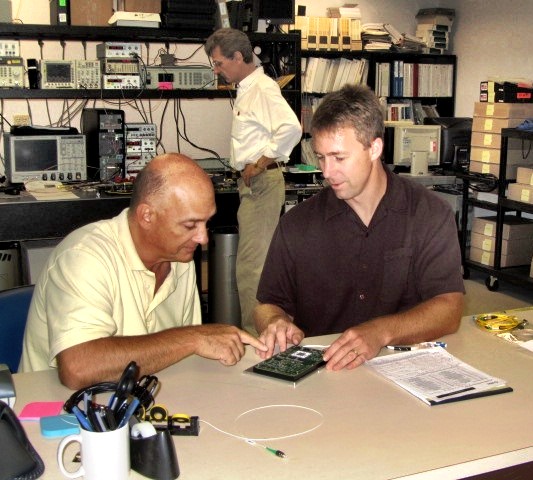
"I can't say that we have at JDSU a process that ensures innovation. Innovation is fleeting and mysterious."
Semiconductors now play a key role in high-speed optical transmission. Will semiconductors take over more roles and become a bigger part of what you do?
Coherent transmission [that uses an ASIC incorporating a digital signal processor (DSP)] is not going away. There is a lot of differentiation at the moment in what happens in that DSP, but I think overall it is going to be a tool the system houses use to get the job done.
If you look at 10 Gig, the big advancement there was FEC [forward error correction] and advanced FEC. In 2003 the situation was a lot like it is today: who has the best FEC was something that was touted.
If you look at coherent technology, it is certainly a different animal but it is a similar situation: that is, the big enabler for 40 and 100 Gig. Coherent is advanced technology, enhanced FEC was advanced technology back then, and over time it turned into a standardised, commoditised piece that is central and ubiquitously used for network links.
Coherent has more diversity in what it can do but you'll see some convergence and commoditisation of the technology. It is not going to replace or overtake the importance of photonics. In my mind they play together intimately; you can't replace the functions of photonics with electronics any time soon.
From a JDSU perspective, we have a lot of work to do because the bulk of the cost, the power and the size is still in the photonics components. The ASIC will come down in power, it will follow Moore's Law, but we will still need to work on all that photonics stuff because it is a significant portion of the power consumption and it is still the highest portion of the cost.
JDSU has made acquisitions in the area of parallel optics. Given there is now more industry activity here, why isn't JDSU more involved in this area?
We have been intermittently active in the parallel optics market.
The reality is that it is a fairly fragmented market: there are a lot of applications, each one with its own requirements and customer base. It is tough to spread one platform product around these applications. That said, parallel optics is now a mainstay for 40 and 100 Gig client [interfaces] and we are extremely active in that area: the 4x10, 4x25 and 12x10G [interfaces]. So that other parallel optics capability is finding its way into the telecom transceivers.
We do stay active in the interconnect space but we are more selective in what we get engaged in. Some of the rules there are very different: the critical characteristics for chip interconnect are very different to transceivers, for example. It may be much better to have on-chip optics versus off-chip optics. Obviously that drives completely different technologies so it is a much more cloudy, fragmented space at the moment.
We are very tied into it and are looking for those proper opportunities where we do have the technologies to fit into the application.
How does JDSU view the issues of 200, 400 Gigs and 1 Terabit optical transmission?
What happens after 100 Gig is going to be very interesting.
Several things have happened. We have used up the 50GHz [DWDM] channel, we can't go faster in the 50GHz channel - that is the first barrier we are bumping into.
Second, we're finding there is a challenge to do electronics well beyond 40 Gigabit. You start to get into electronics that have to operate at much higher rates - analogue-to-digital converters, modulator drivers - you get into a whole different class of devices.
Third, we have used all of our tools: we have used FEC, we are using soft-decision FEC and coherent detection. We are bumping into the OSNR problem and we don't have any more tools to run lines rates that have less power to noise yet somehow recover that with some magic technology like FEC at 10 Gig, and soft decision FEC and coherent at 40 and 100 Gig.
This is driving us into a new space where we have to do multi-carrier and bigger channels. It is opening up a lot of flexibility because, well, how wide is that channel? How many carriers do you use? What type of modulation format do you use?
What format you use may dictate the distance you go and inversely the width of the channel. We have all these new knobs to play with and they are all tradeoffs: distance versus spectral efficiency in the C-band. The number of carriers will drive potentially the cost because you have to build parallel devices. There are now design tradeoffs whereas before we went faster for the same distance.
We will be seeing a lot of devices and approaches from us and our customers that provide those tradeoffs flexibly so the carriers can do the best they can with what mother nature will allow at this point.
That means transponders that do four carriers: two of them do 200 Gig nicely packed together but they only achieve a few hundred kilometers, but a couple of other carriers right next door go a lot further but they are a little bit wider so that density versus reach tradeoff is in play. That is what is going to be necessary to get the best of what we can do with the technology.
That is the transmission side, the transport side - the ROADMS and amplifiers - they have to accommodate this quirky new formats and reach requirements.
We need to get amplifiers to get the noise down. So this is introducing new concepts like Raman and flex[ible] spectrum to get the best we can do with these really challenging requirements like trying to get the most reach with the greatest spectral efficiency.
How do you keep abreast of all these subject areas besides conversations with customers?
It is a challenge, there aren't many companies in this space that are broader than JDSU's optical comms portfolio.
We do have a team and the team has its area of focus, whether it is ROADMs, modulators, transmission gear or optical amplifiers. We segment it that way but it is a loose segmentation so we don't lose ideas crossing boundaries. We try to deal with the breadth that way.
Beyond that, it is about staying connected with the right people at the customer level, having personal relationships so that you can have open discussions.
And then it is knowing your own organisation, knowing who to pull into a nebulous situation that can engage the customer, think on their feet and whiteboard there and then rather than [bringing in] intelligent people that tend to require more of a recipe to do what they are doing.
It is all about how to get the most from each team member and creating those situations where the right things can happen.
For Part I of the Q&A, click here