

NeoPhotonics to expand its tunable laser portfolio
Part 1: Tunable lasers
NeoPhotonics will become the industry's main supplier of narrow line-width tunable lasers for high-speed coherent systems once its US $17.5 million acquisition of Emcore's tunable laser business is completed. Gazettabyte spoke with Ferris Lipscomb of NeoPhotonics about Emcore's external cavity laser and the laser performance attributes needed for metro and long haul.
 Key specifications and attributes of Emcore's external cavity laser and NeoPhotonics's DFB laser array. Source: NeoPhotonics.
Emcore and NeoPhotonics are leading suppliers of tunable lasers for the 100 Gigabit coherent market, according to market research firm Ovum. NeoPhotonics will gain Emcore's external cavity laser (ECL) on the completion of the deal, expected in January. The company will also gain Emcore's integrable tunable laser assembly (ITLA), micro ITLA, tunable XFP transceiver, tunable optical sub-assemblies, and 10, 40, 100 and 400 Gig integrated coherent transmitter products.
Emcore's ECL has a long history. Emcore acquired the laser when it bought Intel's optical platform division for $85 million in 2007, while Intel acquired the laser from New Focus in 2002 in a $50 million deal. Meanwhile, NeoPhotonics bought Santur's distributed feedback (DFB) tunable laser array in 2011 in a $39 million deal.
The two lasers satisfy different needs: Emcore's is suited for high-speed long distance transmission while NeoPhotonics's benefits metro and intermediate distances.
The Emcore laser uses mirrors and optics external to the gain medium to create the laser's relatively long cavity. This aids high-performance coherent systems as it results in a laser with a narrow line-width. Coherent detection uses a mixing technique borrowed from radio where an incoming signal is recovered by compared it with a local oscillator or tone. "The narrower the line-width, the more pure that tone is that you are comparing it to," says Lipscomb.
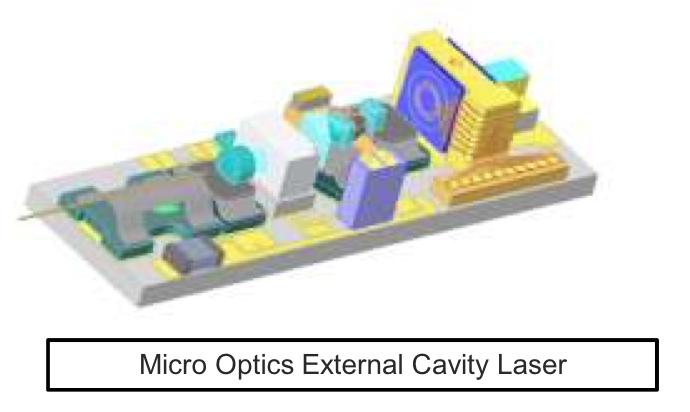 Source: NeoPhotonics
A narrower line-width also means less digital signal processing (DSP) is needed to resolve the ambiguity that results from that line-width, says Lipscomb: "And the more DSP power can be spent on either compensating fibre impairments or going further [distances], or compensating the higher-order modulation schemes which require more DSP power to disentangle."
The ECL has a narrow line-width that is specified at under 100kHz. "It is probably closer to 20kHz," says Lipscomb. One of the laser's drawbacks is that its uses a mechanical tuning mechanism that is relatively slow. It also has a lower output power of 16dBm compared to NeoPhotonics's DFB laser array that is up to 18dBm.
The metro market for 100 Gig coherent will emerge in volume towards the end of 2015 or early 2016
In contrast, NeoPhotonics' DFB laser array, suited to metro and intermediate reach applications, has a wider line-width specified at 300kHz, although 200kHz is typical. The DFB design comprises multiple lasers integrated compactly. The laser design also uses a MEMS that results in efficient coupling and the higher - 18dBm - output power. "Using the MEMS structure, you can integrate the laser with other indium phosphide or silicon photonics devices," says Lipscomb. "That is a little bit harder to do with the Emcore device."
 Source: NeoPhotonics
It is the compactness and higher power of the DFB laser array that makes it suited to metro networks. The higher output power means that one laser can be used for both transmission and the local oscillator used to recover the received coherent signal. "More power can be good if you can live with the broader line-width," says Lipscomb. "It reduces overall system cost and can support higher-order modulation schemes over shorter distances."
Market opportunities
NeoPhotonics' focus is on narrow line-width lasers for coherent systems operating at 100 Gigabit and greater speeds. Lipscomb says the metro market for 100 Gig coherent will emerge in volume towards the end of 2015 or early 2016. "The distance here is less and therefore less compensation is needed and a little bit more line-width is tolerable," he says. "Also cost is an issue and a more integrated product can have potentially a lower cost."
For long haul, and especially at transmission rates of 200 and 400 Gig, the demands placed on the DSP are considerable. This is where Emcore's laser, with is narrow line-width, is most suited.
System vendors are already investigating 400 Gig and above transmission speeds. "For the high-end, line-width is going to be a critical factor," says Lipscomb. "Whatever modulation schemes there are to do the higher speeds, they are going to be the most demanding of laser performance."
For Part 2: Is the tunable laser market set for an upturn? click here

ECOC 2012 summary - Part 1: Oclaro
Gazettabyte completes its summary of key optical announcements at the recent ECOC show held in Amsterdam. Oclaro's announcements detailed here are followed by those of Finisar and NeoPhotonics.
Part 1: Oclaro

"Networks are getting more complex and you need automation so that they are more foolproof and more efficient operationally"
Per Hansen, Oclaro
Oclaro made several announcements at ECOC included an 8-port flexible-grid optical channel monitor, a new small form factor pump laser MSA and its first CFP2 module. The company also gave an update regarding its 100 Gigabit coherent optical transmission module as well as the company's status following Oclaro's merger with Opnext (see below).
The 8-port flexible grid optical channel monitor (OCM) is to address emerging, more demanding requirements of optical networks. "Networks are getting more complex and you need automation so that they are more foolproof and more efficient operationally," says Per Hansen, vice president of product marketing, optical networks solutions at Oclaro.
The 8-port device can monitor up to eight fibres, for example the input and seven output ports of a wavelength-selective switch or an amplifier's outputs.
The programmable OCM can do more than simply go from fibre to fibre, measuring the spectrum. The OCM can dwell on particular ports, or monitor a wavelength on particular ports when the system is adjusting or turning up a wavelength, for example.
"There is processing power included such that you can do a lot of data processing which can then be exported to the line card in the format required," says Hansen. This is important as operators start to adopt flexible-grid network architectures. "[With flexible-grid spectrum] you don't know where channels stop and start such that an OCM that looks at fixed slots in no longer enough," says Hansen.
The OCM can monitor bands finer than 6.25GHz through to the spectrum across the complete C-band.
Oclaro also detailed that its OMT-100 coherent 100 Gigabit optical module is entering volume production. "We have shipped well over 100 [units] to various customers," says Hansen. "There are a lot of system houses looking at this type of module this year." The OMT-100 was developed by Opnext and replaces Oclaro's own MI 8000XM 100 Gigabit module
The company also announced its first 100 Gigabit CFP2 module and its second-generation CFP module 16W power consumption that support the IEEE 100GBASE-LR4 10km standard.
A new small form factor multi-source agreement (MSA) for pump laser diodes was also announced at the show, involving Oclaro and 3S Photonics.
The 10-pin butterfly package is designed to replace the existing 14-pin design. "It is 75% smaller in volume - about two-thirds in each dimension," says Robert Blum, director of product marketing for Oclaro's photonic components. The MSA supports a single cooled or uncooled pump laser, and its smaller volume enables more integrated amplifier designs.
Oclaro says other companies have expressed interest in the MSA and it expects additional players to join.
The New Oclaro
Source: Ovum
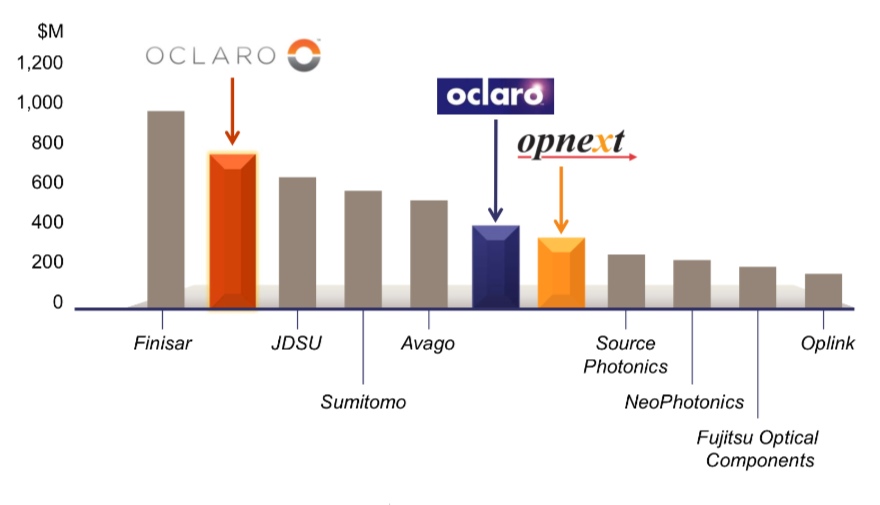
Oclaro also gave an update of the company's status following the merger with Opnext earlier this year. The now 3,000-strong company has estimated annual revenues of US $800m. This places the optical component company second only to Finisar.
The merger has broadened the company's product line, adding Opnext's strength in datacom pluggable transceivers to Oclaro's core networking products. The company is also more vertically integrated, using its optical components such as tunable laser and VCSEL technologies, modulators and receivers within its line-side transponders and pluggable optical transceivers.
"You can drive technologies in different directions and not just be out there buying components and throwing them together," says Hansen.
The company also has a range of laser diodes for industrial and consumer applications. "We [Oclaro] were already the largest merchant supplier of high-power laser diodes but now we have a complete portfolio that covers all the wavelengths from 400 up to 1500nm," says Blum.
The company has a broad range of technologies that include indium phosphide, gallium arsenide, lithium niobate, MEMS, liquid crystal and gallium nitride.
An extra business unit has also been created. To the existing optical networks solutions and the photonic components businesses there is now the modules and devices unit covering pluggable and high-speed client side transceivers, and which is based in Japan.