

Ciena's Tom Mock reflects on a career in telecom
Working for one technology company for so long may be uncommon, says Mock, but not at Ciena: the CTO has clocked 20 years while the CEO boasts 15 years.
 Tom Mock: “I’m about ready to go do something else.”
Mock studied electrical engineering and was at Scientific Atlanta running a product development group before joining Ciena where he crossed over from engineering to marketing. “I’ve been in telecom pretty much my entire career, 35 years worth of telecom,” says Mock. “I’m about ready to go do something else.”
A work colleague says that if there is one word that describes Mock, it is decency: “He has been a key role model of the ‘do the right thing’ culture at Ciena.”
Mock joined Ciena days before the company went public in 1997. He experienced the optical bubble of 1999-2000 and the bust that followed, and just when he thought the company had put that ‘nuclear winter’ behind it, Ciena endured the 2008 global financial crisis.
Now he leaves Ciena as senior vice president of corporate communications. A role, he says, that involves communicating the company's value proposition to the investment community and media, while helping Ciena’s sales staff communicate the company’s brand. The role also involves explaining the significance of the company’s technology: “It is great we can do 16-QAM [quadrature amplitude modulation] on optical, but why is it important?"
When Mock joined Ciena, optical technology in the form of dense wavelength-division multiplexing (DWDM) was starting to be deployed. “You could go to a service provider and say, look, I can increase the capacity of your network by a factor of 16 just by swapping out the bits at the end of your fibre route,” he says.
I remember sitting at my desk looking at stock prices and market capitalisations and realising that a start-up called Corvis ... had a market capitalisation larger than Ford Motor Company
The optical bubble quickly followed. The internet was beginning to change the world, and large enterprises were taking advantage of communication services in new ways. And with it came the inflated expectation that bandwidth demand would grow through the roof. As a result, optical communications became the hottest technology around.
"I remember sitting at my desk looking at stock prices and market capitalisations and realising that a start-up called Corvis, a competitor of ours started by one of the guys that founded Ciena, Dave Huber, had a market capitalisation larger than Ford Motor Company,” says Mock. Ford was the second largest auto manufacturer in the world at the time.
Yet despite all the expected demand for - and speculation in - bandwidth, conversations with Ciena’s customers revealed that their networks were lightly loaded. The inevitable shake-out, once it came, was brutal, particularly among equipment makers. In the end, all that capacity placed in the network was needed, but only from 2006 as the cloud began to emerge and enterprises started making greater use of computing.
“The one positive that came out of the bubble was that a lot of key technologies that enabled things that happened in the late 2000s were developed in that time,” says Mock.
Ciena made several acquisitions during the optical boom, and has done so since; some successful, others less so. Mock says that with most of the good ones, the technology and the market didn't overlap much with Ciena’s.
Speculation didn't work well for the industry in terms of building infrastructure, and it probably doesn't work well in terms of acquisitions.
One acquisition was Cyras Systems for $2.6 billion in 2000, a company developing 10 Gigabit multi-service provisioning platforms and add/ drop multiplexers. But so was Ciena. “That was one example that didn't work so well but if I look at the one that is going the best - Nortel MEN - that was a place where we didn't have as much technology and market overlap,” he says. That makes streamlining products easier and less disruptive for customers.
“The other thing that is important in a good acquisition is a very good understanding of what the end objective is,” he says. “Speculation didn't work well for the industry in terms of building infrastructure, and it probably doesn't work well in terms of acquisitions.”
Making sure the company cultures fit is also key. “In any of these technology acquisitions, it is not just about buying products and markets, it is about buying the capabilities of a workforce,” says Mock. It is important that the new workforce remains productive, and the way that of done is to make sure the staff feel an important part of the company, he says.
Mock highlights two periods that he found most satisfying at Ciena. One was 2006-2008 before the global economic crisis. Ciena was back of a sound financial footing and was making good money. “There was a similar feeling a year to 18 months after the Nortel acquisition” he says. “The integration had been successful, the people were all pointing in the same direction, and employee morale was pretty high.”
You hear about white boxes in the data centre, there are areas in the network where that is going to happen.
What Mock is most proud of in his time at Ciena is the company’s standing. “We do a perception study with our customers every year to 18 months and one of things that comes back is that people really trust the company,” he says. “Our customers feel like we have their best interest at heart, and that is something we have worked very hard to do; it is also the sort of thing you don't get easily.”
Now the industry is going through a period of change, says Mock. If the last 10-15 years can be viewed as a period of incremental change, people are now thinking about how networks are built and used in new ways. It is about shifting to a model that is more in tune with on-demand needs of users, he says: “That kind of shift typically creates a lot of opportunity.” Networks are becoming more important because people are accessing resources in different places and the networks need to be more responsive.
For Ciena it has meant investing in software as more things come under software control. The benefits include network automation and reduced costs for the operators, but it also brings risk. “There are parts of the infrastructure that are likely to become commoditised,” says Mock. “You hear about white boxes in the data centre, there are areas in the network where that is going to happen.”
We both came from small-town, working-class families. Over the years we have probably been more successful that we ever thought we would be, but a lot of that is due to people helping us along the way.
If this is a notable period, why exit now? “It’s a good time for me,” he says. “And there were some things that my wife and I wanted to start looking at.” Mock’s wife retired two years ago and both are keen to give something back.
“We both came from small-town, working-class families,” he says. “Over the years we have probably been more successful that we ever thought we would be, but a lot of that is due to people helping us along the way.”
Mock and his wife were their families’ first generation that got a good professional education. “One of the things that we have taken on board is helping others gain that same sort of opportunity,” he says.
“I’m excited for Tom but will miss having him around,” says his colleague. “Hopefully, in his next phase, he will make the rest of the world a little more decent as well.”

Ciena adds software to enhance network control
Engineers at Ciena have developed software to provide service providers with greater control over their networks. The operators' customers will also benefit from the software control, using a web portal to meet their own networking needs.
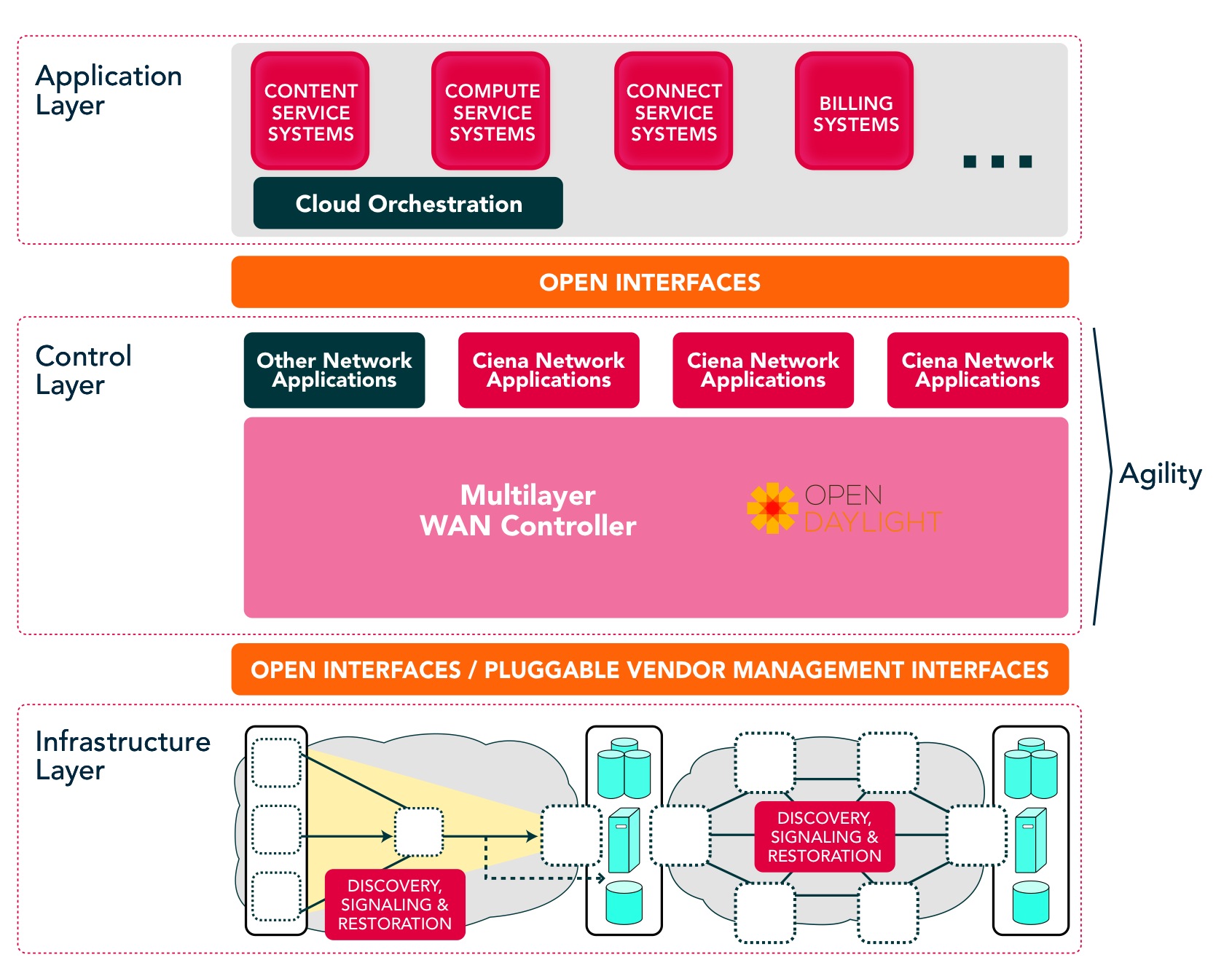 Source: Ciena
"Networks can become more dynamic," says Tom Mock, senior vice president, corporate communications at Ciena. "Operators can now offer more on-demand services." If much work has been done in recent years to make the network's lower layers dynamic, attention is turning to software to make the networks programmable, he says.
Ciena's announced Agility software portfolio, which resides in the network management centre running on standard computing hardware, includes:
- A multi-layer software-defined networking (SDN) controller
- Three networking applications: Navigate, Protect and Optimize. Navigate is used to determine the ideal route for a connection, Protect is a restoration path calculator used to protect against network failures, while Optimize frees up stranded bandwidth across the network's layers.
- Enhancements to Ciena's existing V-WAN network services module.
Ciena chose to implement the SDN controller using the OpenDaylight framework to ensure it will work with other vendors' equipment, while third-party developers writing software using the open source framework will benefit from Ciena's apps and platforms.
"We think the market is evolving so quickly that there isn't any one company that can deal with all the things end users will require," says Mock. "This idea of openness is not so much a nice thing as a requirement; it is going to require the cooperation of multiple vendors to build the kind of network that service providers are going to require."
At the top of the SDN architecture is the application layer, which resides above the control layer that, in turn, oversees the underlying infrastructure layer where the equipment resides. Agility's three network applications sit above the SDN controller while still being part of the control layer (see diagram).
This idea of openness is not so much a nice thing as a requirement; it is going to require the cooperation of multiple vendors to build the kind of network that service providers are going to require
End users can now control their network requirements using the V-WAN orchestrator. Ciena has added monitoring and control interfaces to enhance V-WAN. End users can now control their networking requirements using a web portal. The operator and the end user also have improved visibility about the network's health due to the performance monitoring. More plug-in adaptors have also been added to interface the platform to more equipment, while service providers can use V-WAN to set up VPNs for multiple users.
"[V-WAN] provides for an outside application to control the network directly," says Mock. "A service provider doesn't have to change the connectivity map, or establish or take down a connection."
V-WAN sits between the SDN's upper two layers, allowing applications in the applications layer to access the SDN controller. Ciena has already detailed work with Brocade that allows the vendor's data centre orchestrator - the Application Resource Broker (ARB) used to set up storage and compute resources - can request cloud resources in a remote data centre when demand can no longer be fulfilled in the existing one. Ciena has provided a plug-in adapter between Brocade's orchestrator and V-WAN to establish a connection between the data centres to allow workload transfers as required.
V-WAN will also be used by Equinix to allow end users to connect its data centres with other cloud computing providers. "If an Equinix end user today wants to run part of their applications on Amazon, they can do that, and if tomorrow they have a different set of applications that they want to run on Microsoft, they can do that as well, without changing a real lot of their physical infrastructure," says Mock.
The Agility software portfolio is Ciena's own work, developed prior to its strategic partnership with Ericsson that was announced earlier this year. However, the two companies are now working to add Ericsson's layer-3 capability to the OpenDaylight SDN controller. Mock says the enhanced SDN controller will be available in 2015.
Meanwhile, the V-WAN product is available now. The SDN controller and the three network applications are being trialled and will be available later this year.
Ciena post-MEN

“The 40G and 100G technology were key to the deal and we made sure that the core team was still there”
Tom Mock, Ciena
The company has announced the CN 5150 service aggregation switch, added Nortel’s 40 Gigabit-per-seconds (Gbps) coherent transmission technology to its flagship CN 4200 platform, and announced 140 job cuts, mostly in Europe. US operator AT&T has also selected the company as one of two suppliers of its optical and transport equipment.
Ciena provides optical transport, optical switching and Carrier Ethernet equipment. “We were finding it difficult to fund the required R&D in all three segments,” says Tom Mock, senior vice president of strategic planning at Ciena. “We saw this [the MEN acquisition] as an opportunity to bring good technology on board and give the company the scale needed to execute in these technology areas.”
According to Mock, Ciena was one of several firms interested in the Nortel unit but that Nokia Siemens Networks was the main counter-bidder in the auction process. Ciena won after agreeing to pay US $773.8 million, gaining MEN’s R&D group and associated sales and marketing.
In particular, it gained the R&D for optical transport – Nortel’s Optical Multiservice Edge (OME) 6500 product line for 40Gbps and 100Gbps, the Optical Metro 5200 metro and enterprise platform, Carrier Ethernet, and the R&D for software and network management. Most of these activities are based in Ottawa, Ontario.
“We had pretty good solutions in optical switching and carrier Ethernet but we were looking for a stronger transport offering, which is what Nortel brought to us,” says Mock. The acquisition, which effectively doubles the company’s size, means that Ciena now plays in a “$18 billion sandbox” comprising optical networking and Ethernet transport and services, according to market research firm Ovum.
Did Ciena secure Nortel’s MEN’s key staff, given the lengthy period – over a year – to complete the acquisition? “We agreed with Nortel that we would get 2000 staff out of a total of 2300 staff,” says Mock.
Yet Ciena had no visibility regarding staff since Nortel remained a competitor until the deal was completed. “We were very pleasantly surprised at the quality of the people who were in MEN,” says Mock. “When companies are in hard times the best people begin to leave, and because of the uncertainty I’m sure some people did leave.”
Ciena claims it secured MEN’s core 40 and 100Gbps team despite announcements such as Infinera's that it had recruited John McNicol, a senior engineer involved in the development of Nortel’s coherent technology. “The 40G and 100G technology were key to the deal and we made sure that the core team was still there,” says Mock.
He also dismisses the view that Nortel’s 100Gbps coherent technology market lead has been eroded due to the uncertainty. Mock claims it has a 12- to 18-month lead and points to Verizon Business’ deployment of Nortel’s 100Gbps system in late 2009 as proof that MEN continued to push the technology.
Strategy
Ciena’s primary focus is on what it calls carrier optical Ethernet, described by Mock as the marrying of the capacity scaling and reliability of optical transport with the ubiquity, flexibility and economics of Ethernet.
For Ciena this translates to three main product lines:
- Packet optical transport, primarily optical transport with some aggregation.
- Packet optical switching based on Ciena’s CoreDirector platform with its time-division multiplexing (TDM) and Ethernet switching, as well as control plane technology.
- Carrier Ethernet service delivery.
According to Ovum, Ciena is now the third “billion dollar club” optical networking vendor member with a 9% market share, behind Huawei and Alcatel-Lucent, with 24% and 19%, respectively. It also becomes the North American leader, with a 20% share while improving its standing in all other regional markets. In contrast, for Ethernet the combined company had only 3% share in 2009. “We are emerging as a leader in the Carrier Ethernet space,” claims Mock. “In 4Q 2009 we were leading in North America, according to Heavy Reading.”
Ciena sees optical transport and switching blurring but says that most of its customers still see these as separate products. “Both our packet optical switching and packet optical transport platforms can be used in these applications, for example the OME 6500 is looked at as a transport device but it has TDM and packet switching as well,” says Mock. But with time Ciena says optical switching and optical transport product families will increasingly consolidate.
What next?
Having completed the deal, one of the first things Ciena did was determine its product portfolio and tell its operator customers its plans.
Issues set to preoccupy Ciena for the next 12 to 18 months include the integration of Nortel’s 40Gbps and 100Gbps technology onto Ciena’s transport and switching platforms, getting the control plane of Ciena’s switching product integrated onto Nortel’s products, and bringing all the products under common network management.
At OFC/ NFOEC 2010 Ciena showcased Nortel’s OME 6500 transmitting over Ciena’s CN 4200 line system with both being overseen by Ciena’s OnCenter management software. “I wouldn’t point to the network management integration as a finished product but a step along the path,” says Mock.
According to Ovum, the demonstrations included 100Gbps over 1,500km of Corning ultra-low-loss fiber, 100Gbps over 800km in the presence of large and fast polarisation mode dispersion transients, and 40Gbps ultra-long haul transmission over 3,500km.
Ciena has said it expects its business to grow at least at the market rate: 10 to 12 percent yearly.
AT&T domain supplier
In April, AT&T announced that it had selected Ciena as a domain supplier. AT&T's domain supplier programme involves the operator splitting its networking requirements across several technologies, choosing two players for each domain. AT&T plans to work closely with each domain supplier ensuring that AT&T gains equipment tailored to its requirements while vendors such as Ciena can focus their R&D spending by seeing early the operator’s roadmap.
Did Ciena acquire Nortel to become a domain partner? “We would not make an acquisition to win the business of any one carrier,” says Mock. “But we realised that if we going to be a significant player in next-generation infrastructure we needed a certain critical mass, in portfolio and market coverage globally.
“Did we get selected because of Nortel, it’s hard to say – I’m sure it didn’t hurt - but we've been a supplier to AT&T for 10 years,” says Mock. He also highlights the operator’s own announcement to explain Ciena’s selection: “They talk about two technologies in particular – 100Gbps technology and Optical Transport Networking (OTN).”
Ovum argues in its “Telecoms in 2020: network infrastructure” report that the future prospects of specialist vendors will be as rosy as full-service ones. “We do view ourselves as specialists even though we’ve essentially doubled the size of the company, and there is absolutely a place for specialist companies as they are genuinely more agile,” says Mock.
Mock also expects further system vendor consolidation. “Optical transport remains fragmented so there are opportunities for further consolidation,” he says. Fragmented in what way? “If you look at the router space there are two dominant players, in optical transport there are 10 – no-one has a 40 to 50 percent market share.”