

Transmode adopts 100 Gigabit coherent CFPs
Transmode has detailed line cards that bring 100 Gigabit coherent CFP optical modules to its packet optical transport platforms.

We can be quicker to market when newer DSP-based CFPs appear
Jon Baldry
"We believe we are the first to market with line-side coherent CFPs, bringing pluggable line-side optics to a WDM portfolio," says Jon Baldry, technical marketing director at Transmode. Baldry says that other system vendors already support non-coherent CFP modules on their line cards and that further vendor announcements using coherent CFPs are to be expected.
The Swedish system vendor announced three line cards: a 100 Gig transponder, a 100 Gig muxponder and what it calls its Ethernet muxponder (EMXP) card. The first two cards support wavelength division multiplexing (WDM) Layer 1 transport: the 100 Gig transponder card supports two 100 Gig CFP modules while the 100 Gig muxponder supports 10x10 Gig ports and a CFP.
The third card, the EMXP220/IIe, has a capacity of 220 Gig: 12x10 Gigabit Ethernet ports and the CFP, with all 13 ports supporting optional Optical Transport Network (OTN) framing. "You can think of it as a Layer 2 switch on a card with 13 embedded transponders," says Baldry. The three cards each take up two line card slots.
Transmode's platforms are used for metro and metro regional networks. Metro has more demanding cost, space and power efficiency requirements than long distance core networks. "The move that the whole industry is taking to CFP or pluggable-based optics is a big step forward [in meeting metro's requirements]," says Baldry.
The line cards will be used with Transmode's metro edge TM-Series packet optical family that is suited for applications such as mobile backhaul and business services. "Within packet-optical networks, we can do customer premise Gigabit Ethernet all the way through to 100 Gig handover to the core on the same family of cards running the same Layer 2 software," says Baldry. Transmode believes this capability is unique in the industry.
The TM-3000 chassis is 11 rack units (RU) high and can hold eight double-slot cards, for a total of 800 Gig CFP line side capacity.
 Source: Transmode
100 Gig coherent modules
Transmode is talking to several 100 Gig coherent CFP module makers. The company will use multiple suppliers but says it is currently working with one manufacturer whose product is closer to market.
Acacia Communications announced the first CFP module late last year and other module makers are expected to follow at the upcoming OFC show in March 2014.
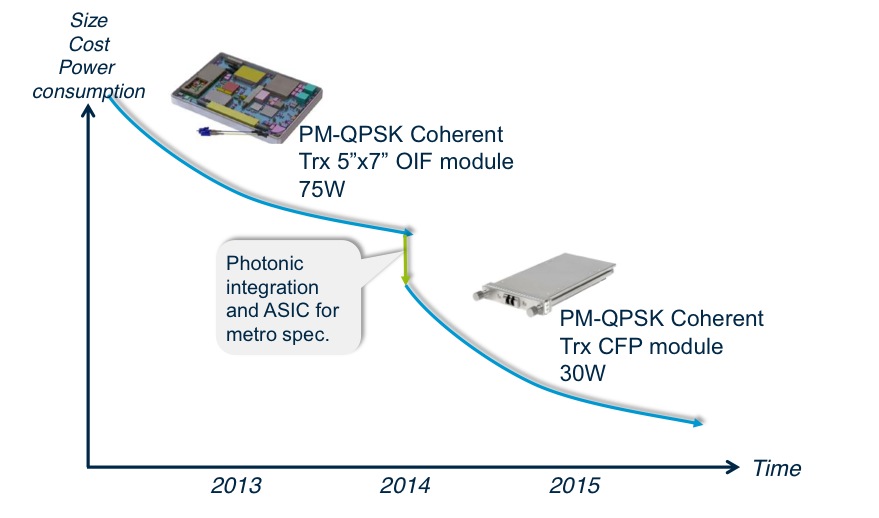
The roadmap of the CFP modules envisages the CFP to be followed by the smaller CFP2 and smaller still CFP4. For the CFP2 and CFP4, the coherent digital signal processor (DSP) ASIC is expected to be external to the module's optics, residing on the line card instead. The 100 Gig CFP, however, integrates the DSP-ASIC within the module and this approach is favoured by Transmode.
"We can be quicker to market when newer DSP-based CFPs appear; today we can do 800km and in the future that will go to a longer reach or lower power consumption," says Baldry. "Also, the same port can take a coherent CFP or a 100BASE-SR4 or -LR4 CFP without having the cost burden of a DSP on the card whether it is needed or not."
The company also points out that by using the integrated CFP it can choose from all the coherent designs available whereas modules that separate the optics and DSP-ASIC will inevitably offer a more limited choice.
There are also 100 Gigabit direct detection CFPs from the likes of Finisar and Oplink Communications and Transmode's cards would support such a CFP module. But for now the company says its main interest is in coherent.
"One key requirement for anything we deploy is that it works with the existing optical infrastructure," says Baldry. "One difference between 100 Gig metro and long haul is that a lot of the long distance 100 Gig is new build, whereas the metro will require 100 Gig over existing infrastructure and coherent works very nicely with the existing design rules and existing 10 Gig networks."
The 100 Gig transponder card consumes 75W, with the coherent CFP accounting for 30W of the total. The card can be used for signal regeneration, hosting two 100 Gig coherent CFPs rather than the more typical arrangement of a client-side and a line-side CFP. The card's power consumption exceeds 75W, however, when two coherent CFPs are used.
The 100 Gig transponder and Ethernet muxponder will be available in the second quarter of 2014, says Transmode, while the 100 Gig muxponder card will follow early in the third quarter of the year.

Transmode chooses coherent for 100 Gigabit metro
Transmode has detailed its 100 Gigabit metro strategy based on a stackable rack, a concept borrowed from the datacom world.
The Swedish system vendor has adopted coherent detection technology for 100 Gigabit-per-second (Gbps) optical transmission, unlike other recent metro announcements from ADVA Optical Networking and MultiPhy based on 100Gbps direct-detection.

"Metro is a little bit diverse. You see different requirements that you have to adapt to."
Sten Nordell, Transmode
"We are getting requests for this and we think 2012 is when people are going to put in a low number of [100Gbps] links into the metro," says Sten Nordell, CTO at Transmode.
The 100Gbps requirements Transmode is seeing include connecting data centres over various distances. The data centres can be close - tens of kilometers - or hundreds of kilometers apart.
"They [data centre operators] want to get more capacity over longer distances over the fibre they have rented," says Nordell. "That is why we are going down the standards path of coherent technology that gives you that boost in power and distance."
Nordell says that customers typically only want one or two 100Gbps light paths to expand fibre capacity or to connect IP routers over a link already carrying multiple 10Gbps light paths. "Metro is a little bit diverse," he says. "You see different requirements that you have to adapt to."
Rack system approach
Transmode has adopted a stackable approach to its 100Gbps TM-series of chassis. The TM-2000 is a 4U-high dual 100Gbps rack that implements transponder, muxponder or regeneration functions. "We have borrowed from Ethernet switches - you add as you grow," says Nordell.
Up to four TM-2000 are used with one TM-301 or TM-3000 master rack, with the architecture supporting up to 80, 100Gbps wavelengths overall.
"If you have too many ROADMs in the way it is going to hurt you. We have seen that with 40 Gig."
The system also uses daughter boards that support various client-side interfaces while keeping the 100Gbps line-side interface - the most expensive system component - intact. "You can install a muxponder of 10x10Gig modules,” says Nordell. "When an IP router upgrades to a 100 Gig interface, you take out the daughter board and put in a 100 Gig transponder."
Transmode will offer two line-side coherent options, with a reach of 750km or 1,500km. "We want to make sure that customers' metro and long-haul requirements will be covered," says Nordell.
 The reach of various 100Gbps technologies for the metro edge, core and regional networks. Source: Gazettabyte
The company chose coherent technology because it is an industry-backed standard. "We can benefit from coherent technology," he says. "If the industry aligns, the volumes of the components come down in price."
Coherent also simplifies the setting up and commissioning of agile photonic networks, especially as more ROADMs are introduced in the metro. "Coherent will help simplify this. All the others are more complex," he says. "Beforehand metro was more point-to-point, now we are seeing more flexibility."
Transmode recently announced it is supplying its systems to Virgin Mobile for mobile backhaul. "That is a metro network with all ROADMs in it," says Nordell. Such networks support multiple paths and that translates to a need for greater reach. "The power budget we need to have in the metro is going up a little bit."
Direct-detection technology was considered by Transmode but it chose coherent as it gives customers a better networking design capability.
Direct detection is also not as spectrally efficient as coherent: 200GHz or 100GHz-wide channels for a 100Gbps signal rather that coherent's 50GHz. "If you have too many ROADMs in the way it is going to hurt you, says Nordell.”We have seen that with 40 Gig."
The TM-2000 rack will begin testing in customers' networks at the start of 2012, with limited availability from mid-2012. The platform and daughter boards will be available in volume by year-end 2012.