

Mellanox Technologies to acquire EZchip for $811M
 Eyal Waldman
Mellanox makes InfiniBand and Ethernet interconnection platforms and products for the data centre while EZchip sells network and multi-core processors that are used in carrier edge routers and enterprise platforms.
EZchip’s customers include Huawei, ZTE, Ericsson, Oracle, Avaya and Cisco Systems.
“Mellanox needs to diversify its business; it is still heavily dependent on the high-performance computing market and InfiniBand,” says Bob Wheeler, principal analyst, networking at market research firm The Linley Group. “EZchip helps move Mellanox into markets and customers that it would not have access to with its existing products.”
CEO Eyal Waldman says Mellanox will continue to focus on the data centre and not the WAN, and that it plans to use EZchip’s products to add intelligence to its designs. Mellanox's Ethernet expertise may also find its way into EZchip’s ICs.
But analysts do expect Mellanox to benefit from telecom. “The big change has to do with Network Function Virtualisation (NFV) and the fact that service provider’s data centres are starting to look more and more like cloud data centres,” says Wheeler. “There is an opportunity for Mellanox to start selling to the large carriers and that is a whole new market for the company.”
Acquiring EZchip
Both companies will ensure continuity and use the same product lines to grow into each other’s markets, said Waldman on a conference call to announce the deal: “Later on will come more combined solutions and products.” First product collaborations are expected in 2016 with more integrated products appearing from 2017.
“Mellanox sees a need to add intelligence to its core products and it does not really have the expertise or the intellectual property,” says Wheeler. One future product of interest is the smart or intelligence network interface controller (NIC). “By working together they could product quite a compelling product,” says Wheeler.
In 2014 EZchip acquired Tilera for $50 million. The value of the deal could have risen to $130 million but was dependent on targets that Tilera did not meet, says Wheeler. Tilera's products include multi-core processors, NICs and white box security appliances. EZchip has also announced the Tile-Mx product family using Tilera’s technology, the most powerful family device will feature 100, 64-bit ARM cores.
The primary application of Tilera’s products is security applications: deep-packet inspection and layer 7 processing. Instead of replacing the general-purpose processor in a security appliance, an alternative approach is to use an intelligent NIC card with a Tilera processor connected via the PCI Express bus to an Intel Xeon-based server. “The card can do a lot of the packet processing offloaded from the Xeon,” says Wheeler.
Another area where EZchip’s NPS processor can be used is in more dedicated appliances or in an intelligent top-of-rack switch. The NPS would perform security as well as terminating overlay protocols used for network virtualisation in the data centre. “You can terminate all those [overlay] protocols in a top-of-rack switch and offload that processing from the server,” says Wheeler.
The key benefit of InfiniBand is its very low latency but the flip side is that the protocol is limited with regard routing to larger fabrics. Adding intelligence could benefit Mellanox’s core Infiniband fabric products, notes Wheeler.
EZchip’s founder and CEO Eli Fruchter said he expects the merger to open doors for EZchip among more hyper-scale data centre players: “With the merger we believe we can be a lot more successful in data centres than by continuing by ourselves.”
Mellanox has made several acquisitions in recent years. It acquired data centre switch fabric player Voltaire in 2011, and in 2013 it added silicon photonics start-up Kotura and chip company IPTronics in quick succession. Now with EZchip's acquisition it will add packet processing and multi-core processor IP to its in-house technology portfolio.
The EZchip acquisition is expected to close in the first quarter of 2016.
Further information:
Mellanox’s Waldman: We've discussed merging for years, click here

EZchip packs 100 ARM cores into one networking chip
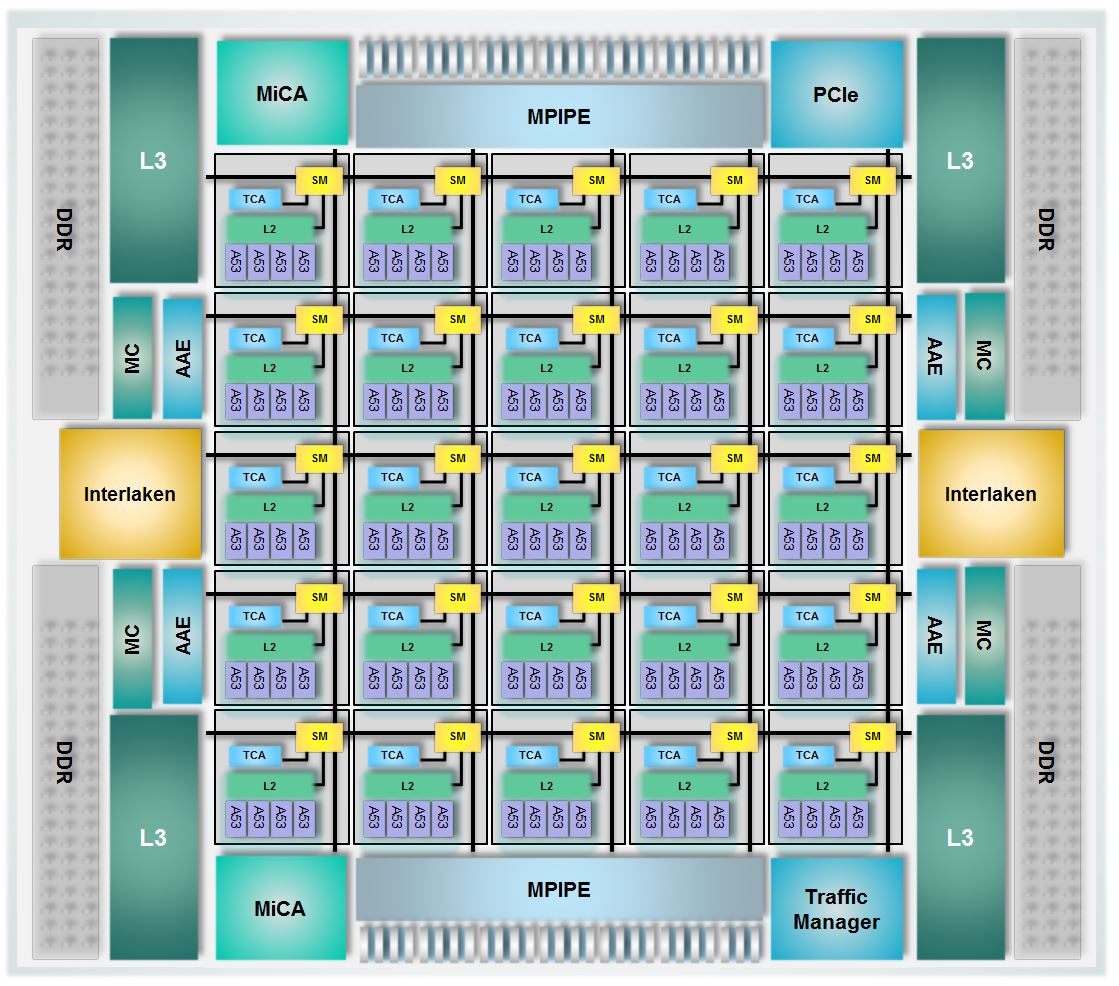 The Tile-Mx100. Source: EZchip
- The industry's first detailed chip featuring 100, 64-bit ARM cores
- The Tile-Mx devices will perform control plane processing and data plane processing
- The 100-core chip will have 100 Gigabit Ethernet ports and support 200 Gigabit duplex traffic
EZchip has detailed the industry's first 100-core processor. Dubbed the Tile-Mx100, the processor will be the most powerful of a family of devices aimed at such applications as software-defined networking (SDN), network function virtualisation (NFV), load-balancing and security. Other uses include video processing and application recognition, to identify applications riding over a carrier's network.
Known for its network processors, EZchip has branched out to also include general-purpose processors following its acquisition of multicore specialist, Tilera. It now competes with such companies as Broadcom, Cavium and Intel.
What's new about the EZchip Tile-Mx100 is that it is the first such processor with 100 cache-coherent programmable CPU cores and it is by far the largest 64-bit ARM processor yet announced
EZchip's NPS network processor is a custom IC designed to maximise packet-processing performance. The Tile-Mx also targets networking but using standard ARM cores. Engineers will benefit from open source software, third-party applications and ARM development tools. "We believe the market needs a standard, open architecture," says Amir Eyal, vice president of business development at EZchip.
"A multicore standard processor tailored for networking is nothing new; numerous such processors have been available for years from several vendors," says Tom Halfhill, senior analyst at The Linley Group. "What's new about the EZchip Tile-Mx100 is that it is the first such processor with 100 cache-coherent programmable CPU cores and it is by far the largest 64-bit ARM processor yet announced."
EZchip has detail three Tile-Mx devices, the most powerful being the Tile-Mx100 that uses 100, 64-bit ARM Cortex-A53 cores. The Cortex-A53 is newer and smaller than the Cortex-A57, and has a relatively low power consumption. Handset and tablet designs are also using the ARM Cortex-A53 core. Both the A53 and A57 cores use the ARMv8-A instruction set.
"We have taken the A53 in order to put more cores on the die," says Eyal. "The idea with networking applications is that the more packets you can process in parallel, the better." A chip hosting many, smaller cores helps meet this goal.
Tile-Mx architecture
The Tile-Mx100 device will process traffic at rates up to 200 Gigabit-per-second (Gbps) rates, or 200 Gbps duplex. In contrast, EZchip's NPS family of devices has a roadmap with a traffic processing performance of 400 Gbps to 800 Gbps duplex.
The Tile-Mx uses a two-level architecture. The 100 cores are partitioned into 25 processing clusters or tiles, each comprising four ARM cores that share network acceleration hardware and level-2 cache memory. Each tile also features router hardware, part of the chip's interconnect network that handles the tile's input/ output (I/O) requirements.
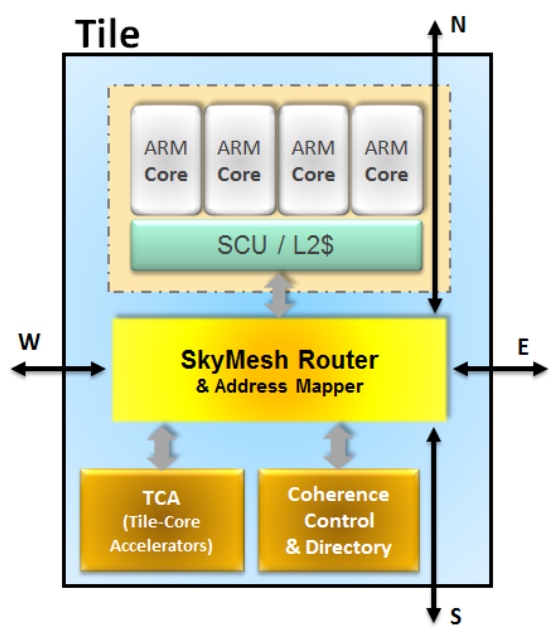 Source: EZchip
"The key technology for the Tile-Mx architecture is the interconnect that enables 100 CPUs to be connected in a coherent manner," says Jag Bolaria, principal analyst at The Linley Group.
"There are five different networks [part of the mesh] that interconnect the 100 cores in parallel, preventing bottlenecks and contention," says Eyal. The mesh also ensures that each core can talk to the chip's I/O and to the memory. The mesh is a fifth iteration, having been improved with each generation of chip design, says Eyal, and has a total bandwidth of 25 Terabits.
The mesh also implements cache coherency, an important aspect of multi-processor design that ensures that cache memory is updated when accessed by any of the cores without needing to introduce idle states first.
Other chip features include a traffic manager, essentially the one used for EZchip's NPUs, which prioritises traffic, allocates bandwidth and prevents packet loss. There are also hardware units (see MiCA blocks in main chip diagram), developed by Tilera, which do preliminary packet classification before presenting the packets to the cores.
The chip's I/O includes 1, 10, 25, 40, 50 and 100 Gigabit Ethernet interfaces, the Interlaken interface and PCI Express, used to connect the chip to a host processor such as an Intel x86 microprocessor.
The idea with networking applications is that the more packets you can process in parallel, the better
EZchip is not detailing the device's interface mix or such metrics as the chip's pin-count, clock speed or power consumption. However, EZchip says the chip's power consumption will be under 100W.
When a packet is presented to the chip, it is assigned to a core which processes it to completion before sending it typically to the I/O. For the programmer, the 100-core device appears as a single processor; it is the hardware on-chip that handles the details, sending an incoming packet to the next free core.
Ezchip shows examples of possible platforms that could use the Tile-Mx.
One is a 1-rack-unit-high pizza box in the data centre used to deliver virtual network functions. Such a NFV server would benefit from the Tile-Mx's hardware-accelerated table look-ups, packet classification and packet flow management in and out of the device. Another design example is using the device for an intelligent network interface card (NIC) in a standard Intel x86-based server.
The two other Tile-Mx family devices will use 36 and 64 Cortex-A53 cores. First Tile-Mx samples are expected in the second half of 2016.
Multicore trends
The Linley Group says that despite the unprecedented 100 ARM cores, EZchip's family of device faces competition. Moreover, the trend to increase core-count has its limits.
EZchip is already shipping a 72-core processor it acquired from Tilera although the device is not ARM-based. And Cavium's largest processor has 48 cores, says Halfhill. Broadcom's largest processor has only 20 cores, but those CPUs are quad-threaded, so the processor can handle up to 80 packet streams. "Not quite as many as the Tile-Mx100, but it is in the same ballpark," says Halfhill.
"Keep in mind that Tile-Mx100 production is about two years out; a lot can happen in two years," adds Halfhill.
According to Bolaria, multicore designs are good for applications that are highly parallelised such as packet processing and deep packet processing. But NPUs are better if all that is being done is packet processing.
"Many cores is not particularly good for applications that need good single-thread performance," says Bolaria. "This is where [an Intel] Xeon will shine — for applications such as high-performance computing, simulations and algorithms."
Coherent interconnects also limit CPU scaling, says Bolaria. Tile-Mx gets around the interconnect limitation by clustering four ARM cores into a tile, so that effectively 25 nodes only are connected. "With more nodes, it becomes difficult to maintain cache coherency and performance," says Bolaria.
Another limitation is partitioning applications into smaller chunks for execution on 100 cores. Some tasks are serial by nature and cannot benefit from parallel processing. "Amdahl’s law limits performance gains from adding more CPUs," says Bolaria.
EZchip targets multi-core processing with Tilera purchase
Network processor specialist, EZchip Semiconductor, is to acquire Tilera. The deal is valued at $130 million in cash: $50 million when the deal closes, and up to $80 million more depending on performance targets being met.
 Bob Wheeler, The Linley Group
Tilera's products include multi-core processors, intelligent network interface cards (NICs) and one rack-unit (1RU) network - 'whitebox' - appliances used for security applications.
Acquiring Tilera will broaden EZchip's market. Tilera's devices are used for network appliances, enterprise routers, cloud computing, video and voice encoders, security, deep-packet inspection, load-balancing, and emerging applications such as software-defined networking (SDN) and network functions virtualisation (NFV).
EZchip's first acquisition will also broaden the company's US presence and customers: Tilera has 100 customers including Brocade, Check Point Software Technologies, Cisco, Fujitsu, Harmonic, MikroTik and ZTE.
EZchip estimates that with the acquisition, its total addressable market will double to $2 billion by 2016.
EZchip's flagship NPS is a high-end network processor family while Tilera's multi-core general processors include the Tile-GX family with 9, 16, 36 and 72, 64-bit cores, programmed using the C-language and which supports the Linux operating system.
"The two companies are highly complementary," says Bob Wheeler, principal analyst for networking at the Linley Group. "Beyond the obvious addition of products, markets, and customers, I see Tilera’s software and systems expertise as important to the success of EZchip’s existing NPS programme."
Eli Fruchter, CEO of EZchip, says that the two companies have been discussing co-development of a next-generation multi-core family that will add specialist networking accelerator hardware from EZchip. The resulting family will have the highest core count at the lowest power, while achieving leading networking and packet-processing performance, says the CEO.
Tilera's designs are noted for their processing performance per watt. Wheeler also highlights the company's iMesh tiled architecture which enables efficient scaling as cores are added to a chip. "Tilera’s proprietary 64-bit VLIW [very long instruction word] CPU design is also important in delivering leading power efficiency," he says.
The next-generation device family will use a standard processing core and move away from Tilera's proprietary technology. EZchip's NPS uses the 32-bit ARC core which EZchip has redesigned. "Network security and monitoring are the primary targets [for the next-gen devices]," says Wheeler. "Tilera currently serves other applications, including videoconferencing, but these won’t benefit from EZchip’s accelerators."
Tilera's revenues were $35 million in 2013, suggesting single-digit percent market share using EZchip's $1 billion TAM estimate. It thus has some way to go to compete with Broadcom and Cavium. Near term, customers may be more willing to work with a profitable public company, notes Wheeler, but for EZchip to achieve major share gains will depend on delivering next-generation processors.
Tilera's revenues declined in the first half of 2014. EZchip would not detail why, except to suggest that the decline in orders is temporary and that growth will return in the second half of 2014. EZchip is confident Tilera's revenues will exceed $35 million in 2015.
EZchip will pay Tilera's shareholders up to $80 million if revenue targets are met: $50 million in cash if revenues reach $45 million between when the deal closes in Q3 2014 and June 2015, and a further $30 million if revenues of $31 million are achieved in the second half of 2015.