

Making best use of data at the network's edge

Moshe Shadmon has always been interested in data, the type that is spread out and requires scrutiny.
He read law at university but was also fascinated by maths and computers.
By the time Shadmon graduated with a law degree, he had set up a software company. He never practiced law.
“I think that part [not having an engineering degree] has always allowed me to look at things differently,” he says.
More recently, Shadmon’s interest in data has focussed on the network edge. Here, the data is typically across locations and too plentiful to fit within one machine.
“If the data needs to be managed across many machines, it is a problem,” says Shadmon. “Suddenly, solutions become complicated and expensive.”
Distributed edge data
Edge data refers to data generated by sensors or Internet of Things (IoT) devices located at several sites. Extracting insights from such edge data is challenging.
Shadmon refers to this as a ‘big data’ problem, ‘big’ being a relative term. Data keeps growing, proportional to the hardware used. Data generated two decades ago is now tiny compared to today’s data. The evolution of IoT devices, with billions now deployed, is a testament to such growth.
The real challenge with edge data lies in its management. There is currently no efficient technology to manage such distributed data – the data is raw and has no universal format. It is an issue many players in the industry can relate to.
Adding management software to the endpoints is also a challenge as edge hardware typically has limited resources. Alternatively, moving the data to the cloud where there are software tools and ample computing, is expensive: renting processing and storage and requiring networking to upload the data to the cloud.
“Companies move the data to the cloud or into centralized databases, not because it’s a great way to deal with the data, but because they don’t have a choice,” says Shadmon.
It is these edge data challenges that Shadmon’s start-up company, AnyLog, is addressing.
Shadmon founded AnyLog six years ago. AnyLog spent its first five years developing the edge data management platform. In the last year, AnyLog has been demonstrated its working product and is collaborating with large companies, such as IBM, that are building offerings using its technology.
AnyLog has also contributed an open-source version of its edge data technology to the Linux Foundation, a project known as EdgeLake.
The technology's workings
The hardware at the edge typically comprises one or more sensors, a programmable logic controller—an industrial computer interfaced to sensors—and an edge ‘node’ that extracts the data. The node may be a switch, a gateway, or a server next to the sensors and is typically connected to a network.
AnyLog has developed software that resides at the node. “You plug it on the node, and it’s a stack of services that manages the data in an automated way,” says Shadmon. “You could think of it as the equivalent of the data services you have in the cloud.”
The software does two clever things.
It adds a virtual layer that makes all the data in all the interest nodes appear centralised. This means that any node in the set of nodes of interest can be queried, and the software will identify the locations where the relevant data resides to satisfy the query first sent to one of the nodes. The outcome is identical to a setup where all the data is stored in the cloud except that here, the data remains at the edge.
Blockchain technology is used to locate and manage the distributed data. According to Shadmon, this is transparent to the end user, but it oversees the ‘metadata’- data about the data – and serves as a directory to identify where the needed data is located.
Shadmon cites a smart city example where the query is to quantify the electricity usage in San Francisco in the last hour. There may be thousands of nodes hosting the data. The technology identifies the nodes with the relevant data of electricity usage in San Francisco. These nodes are accessed and they return their data to the first node which then performs data aggregation.
Data may also be more substantial than time-stamped electricity usage numbers. For example, the data could be video streams from high-definition cameras across multiple locations.
The key benefit of AnyLog’s approach is that only the needed data is read wherever it is stored. This avoids moving and processing all the data from multiple locations into the cloud. Moreover, any of the nodes can be queried to satisfy a request.
“If you don’t get the performance you need, you can add more nodes and increase the data distribution,” says Shadmon. “Now you will have a higher degree of parallelism and less data on each node; it’s a very scalable model.”
AnyLog’s technology can also be used for machine learning at the edge, a market opportunity that excites Shadmon.
AI at the edge
Engineers must decide how they apply machine learning to data at the edge.
The necessary AI training and inferencing hardware can be deployed at the edge, but only if the application justifies such a solution. More commonly, the data is first moved to the cloud, especially when the edge data is spread across locations. Once the data is in the cloud, AI hardware and software can be applied.
“What companies want to do is to enable AI in real-time in a simple and cost-effective way,” says Shadmon. Cloud is used not because it’s a great solution but because the alternative – building and trying to deal with the data at the edge – is much more complicated, he says.
AnyLog’s proprietary solution — and the Linux Foundation open-source EdgeLake equivalent — enables the training of an AI model using federated learning without having to move the local data.
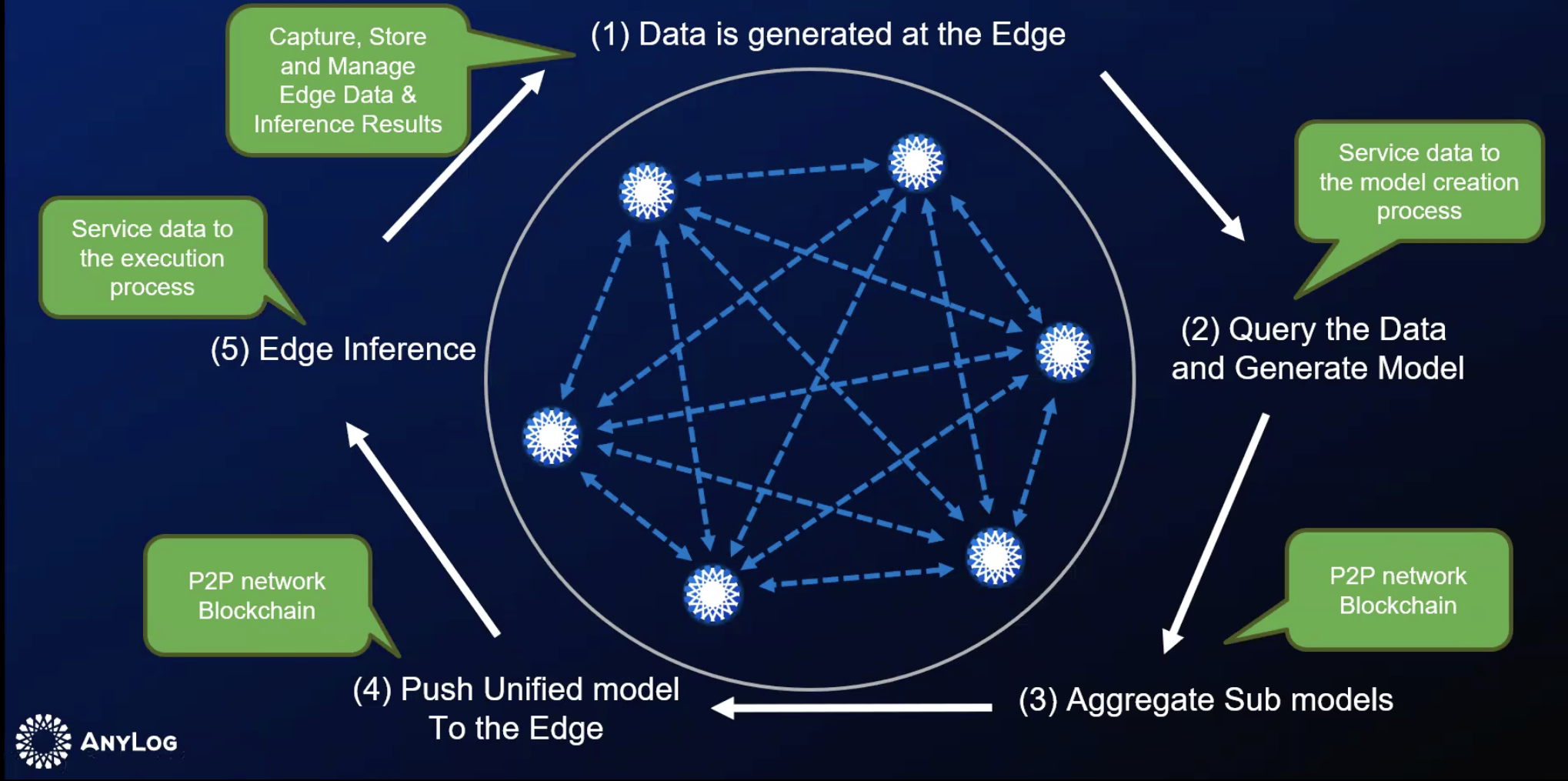
The data at each node is used for local training, creating a ‘sub’ model. The AnyLog software can locate and aggregate all the sub-models to form the complete training model, which is then pushed to each node for AI inferencing at the network edge. The AI learning cycle is repeated – see diagram – to incorporate new data as it is generated.
“All of this is automated,” says Shadmon.
Bypassing the cloud players
Today, the telcos are the leading connectivity providers uploading data from the edge to the cloud.
“But they are not just moving the data; the telcos are also moving the business from the edge to the cloud,” says Shadmon. It is the cloud computing players, not the telcos, that benefit from data hosting and data processing.
However, by virtualizing the data, a telco’s network also serves the end-user’s data requirements; the cloud players are bypassed. Here is an edge opportunity for the telcos. For once, they can take business away from the cloud providers, says Shadmon: “Every per cent of data that remains at the edge and doesn’t go to the cloud is a multi-billion-dollar opportunity for the telcos.”
AnyLog is in discussion with several telcos.


Will white boxes predominate in telecom networks?
Will future operator networks be built using software, servers and white boxes or will traditional systems vendors with years of network integration and differentiation expertise continue to be needed?
AT&T’s announcement that it will deploy 60,000 white boxes as part of its rollout of 5G in the U.S. is a clear move to break away from the operator pack.
The service provider has long championed network transformation, moving from proprietary hardware and software to a software-controlled network based on virtual network functions running on servers and software-defined networking (SDN) for the control switches and routers.
 Glenn WellbrockNow, AT&T is going a stage further by embracing open hardware platforms - white boxes - to replace traditional telecom hardware used for data-path tasks that are beyond the capabilities of software on servers.
For the 5G deployment, AT&T will, over several years, replace traditional routers at cell and tower sites with white boxes, built using open standards and merchant silicon.
“White box represents a radical realignment of the traditional service provider model,” says Andre Fuetsch, chief technology officer and president, AT&T Labs. “We’re no longer constrained by the capabilities of proprietary silicon and feature roadmaps of traditional vendors.”
But other operators have reservations about white boxes. “We are all for open source and open [platforms],” says Glenn Wellbrock, director, optical transport network - architecture, design and planning at Verizon. “But it can’t just be open, it has to be open and standardised.”
Wellbrock also highlights the challenge of managing networks built using white boxes from multiple vendors. Who will be responsible for their integration or if a fault occurs? These are concerns SK Telecom has expressed regarding the virtualisation of the radio access network (RAN), as reported by Light Reading.
“These are the things we need to resolve in order to make this valuable to the industry,” says Wellbrock. “And if we don’t, why are we spending so much time and effort on this?”
Gilles Garcia, communications business lead director at programmable device company, Xilinx, says the systems vendors and operators he talks to still seek functionalities that today’s white boxes cannot deliver. “That’s because there are no off-the-shelf chips doing it all,” says Garcia.
We’re no longer constrained by the capabilities of proprietary silicon and feature roadmaps of traditional vendors
White boxes
AT&T defines a white box as an open hardware platform that is not made by an original equipment manufacturer (OEM).
A white box is a sparse design, built using commercial off-the-shelf hardware and merchant silicon, typically a fast router or switch chip, on which runs an operating system. The platform usually takes the form of a pizza box which can be stacked for scaling, while application programming interfaces (APIs) are used for software to control and manage the platform.
As AT&T’s Fuetsch explains, white boxes deliver several advantages. By using open hardware specifications for white boxes, they can be made by a wider community of manufacturers, shortening hardware design cycles. And using open-source software to run on such platforms ensures rapid software upgrades.
Disaggregation can also be part of an open hardware design. Here, different elements are combined to build the system. The elements may come from a single vendor such that the platform allows the operator to mix and match the functions needed. But the full potential of disaggregation comes from an open system that can be built using elements from different vendors. This promises cost reductions but requires integration, and operators do not want the responsibility and cost of both integrating the elements to build an open system and integrating the many systems from various vendors.
Meanwhile, in AT&T’s case, it plans to orchestrate its white boxes using the Open Networking Automation Platform (ONAP) - the ‘operating system’ for its entire network made up of millions of lines of code.
ONAP is an open software initiative, managed by The Linux Foundation, that was created by merging a large portion of AT&T’s original ECOMP software developed to power its software-defined network and the OPEN-Orchestrator (OPEN-O) project, set up by several companies including China Mobile and China Telecom.
AT&T has also launched several initiatives to spur white-box adoption. One is an open operating system for white boxes, known as the dedicated network operator system (dNOS). This too will be passed to The Linux Foundation.
The operator is also a key driver of the open-based reconfigurable optical add/ drop multiplexer multi-source agreement, the OpenROADM MSA. Recently, the operator announced it will roll out OpenROADM hardware across its network. AT&T has also unveiled the Akraino open source project, again under the auspices of the Linux Foundation, to develop edge computing-based infrastructure.
At the recent OFC show, AT&T said it would limit its white box deployments in 2018 as issues are still to be resolved but that come 2019, white boxes will form its main platform deployments.
Xilinx highlights how certain data intensive tasks - in-line security, performed on a per-flow basis, routing exceptions, telemetry data, and deep packet inspection - are beyond the capabilities of white boxes. “White boxes will have their place in the network but there will be a requirement, somewhere else in the network for something else, to do what the white boxes are missing,” says Garcia.
Transport has been so bare-bones for so long, there isn’t room to get that kind of cost reduction
AT&T also said at OFC that it expects considerable capital expenditure cost savings - as much as a halving - using white boxes and talked about adopting in future reverse auctioning each quarter to buy its equipment.
Niall Robinson, vice president, global business development at ADVA Optical Networking, questions where such cost savings will come from: “Transport has been so bare-bones for so long, there isn’t room to get that kind of cost reduction. He also says that there are markets that already use reverse auctioning but typically it is for items such as components. “For a carrier the size of AT&T to be talking about that, that is a big shift,” says Robinson.
Layer optimisation
Verizon’s Wellbrock first aired reservations about open hardware at Lightwave’s Open Optical Conference last November.
In his talk, Wellbrock detailed the complexity of Verizon’s wide area network (WAN) that encompasses several network layers. At layer-0 are the optical line systems - terminal and transmission equipment - onto which the various layers are added: layer-1 Optical Transport Network (OTN), layer-2 Ethernet and layer-2.5 Multiprotocol Label Switching (MPLS). According to Verizon, the WAN takes years to design and a decade to fully exploit the fibre.
“You get a significant saving - total cost of ownership - from combining the layers,” says Wellbrock. “By collapsing those functions into one platform, there is a very real saving.” But there is a tradeoff: encapsulating the various layers’ functions into one box makes it more complex.
“The way to get round that complexity is going to a Cisco, a Ciena, or a Fujitsu and saying: ‘Please help us with this problem’,” says Wellbrock. “We will buy all these individual piece-parts from you but you have got to help us build this very complex, dynamic network and make it work for a decade.”
Next-generation metro
Verizon has over 4,000 nodes in its network, each one deploying at least one ROADM - a Coriant 7100 packet optical transport system or a Fujitsu Flashwave 9500. Certain nodes employ more than one ROADM; once one is filled, a second is added.
“Verizon was the first to take advantage of ROADMs and we have grown that network to a very large scale,” says Wellbrock.
The operator is now upgrading the nodes using more sophiticated ROADMs, as part of its next-generation metro. Now each node will need only one ROADM that can be scaled. In 2017, Verizon started to ramp and upgraded several hundred ROADM nodes and this year it says it will hit its stride before completing the upgrades in 2019.
“We need a lot of automation and software control to hide the complexity of what we have built,” says Wellbrock. This is part of Verizon’s own network transformation project. Instead of engineers and operational groups in charge of particular network layers and overseeing pockets of the network - each pocket being a ‘domain’, Verizon is moving to a system where all the networks layers, including ROADMs, are managed and orchestrated using a single system.
The resulting software-defined network comprises a ‘domain controller’ that handles the lower layers within a domain and an automation system that co-ordinates between domains.
“Going forward, all of the network will be dynamic and in order to take advantage of that, we have to have analytics and automation,” says Wellbrock.
In this new world, there are lots of right answers and you have to figure what the best one is
Open design is an important element here, he says, but the bigger return comes from analytics and automation of the layers and from the equipment.
This is why Wellbrock questions what white boxes will bring: “What are we getting that is brand new? What are we doing that we can’t do today?”
He points out that the building blocks for ROADMs - the wavelength-selective switches and multicast switches - originate from the same sub-system vendors, such that the cost points are the same whether a white box or a system vendor’s platform is used. And using white boxes does nothing to make the growing network complexity go away, he says.
“Mixing your suppliers may avoid vendor lock-in,” says Wellbrock. “But what we are saying is vendor lock-in is not as serious as managing the complexity of these intelligent networks.”
Wellbrock admits that network transformation with its use of analytics and orchestration poses new challenges. “I loved the old world - it was physics and therefore there was a wrong and a right answer; hardware, physics and fibre and you can work towards the right answer,” he says. “In this new world, there are lots of right answers and you have to figure what the best one is.”
Evolution
If white boxes can’t perform all the data-intensive tasks, then they will have to be performed elsewhere. This could take the form of accelerator cards for servers using devices such as Xilinx’s FPGAs.
Adding such functionality to the white box, however, is not straightforward. “This is the dichotomy the white box designers are struggling to address,” says Garcia. A white box is light and simple so adding extra functionality requires customisation of its operating system to run these application. And this runs counter to the white box concept, he says.
We will see more and more functionalities that were not planned for the white box that customers will realise are mandatory to have
But this is just what he is seeing from traditional systems vendors developing designs that are bringing differentiation to their platforms to counter the white-box trend.
One recent example that fits this description is Ciena’s two-rack-unit 8180 coherent network platform. The 8180 has a 6.4-terabit packet fabric, supports 100-gigabit and 400-gigabit client-side interfaces and can be used solely as a switch or, more typically, as a transport platform with client-side and coherent line-side interfaces.
The 8180 is not a white box but has a suite of open APIs and has a higher specification than the Voyager and Cassini white-box platforms developed by the Telecom Infra Project.
“We are going through a set of white-box evolutions,” says Garcia. “We will see more and more functionalities that were not planned for the white box that customers will realise are mandatory to have.”
Whether FPGAs will find their way into white boxes, Garcia will not say. What he will say is that Xilinx is engaged with some of these players to have a good view as to what is required and by when.
It appears inevitable that white boxes will become more capable, to handle more and more of the data-plane tasks, and as a response to the competition from traditional system vendors with their more sophisticated designs.
AT&T’s white-box vision is clear. What is less certain is whether the rest of the operator pack will move to close the gap.