

Telecoms' innovation problem and its wider cost
Imagine how useful 3D video calls would have been this last year.
The technologies needed – a light field display and digital compression techniques to send the vast data generated across a network – do exist but practical holographic systems for communication remain years off.
But this is just the sort of application that telcos should be pursuing to benefit their businesses.
A call for innovation
“Innovation in our industry has always been problematic,” says Don Clarke, formerly of BT and CableLabs and co-author of a recent position paper outlining why telecoms needs to be more innovative.
Entitled Accelerating Innovation in the Telecommunications Arena, the paper’s co-authors include representatives from communications service providers (CSPs), Telefonica and Deutsche Telekom.
In an era of accelerating and disruptive change, CSPs are proving to be an impediment, argues the paper.
The CSPs’ networking infrastructure has its own inertia; the networks are complex, vast in scale and costly. The operators also require a solid business case before undertaking expensive network upgrades.
Such inertia is costly, not only for the CSPs but for the many industries that depend on connectivity.
But if the telecom operators are to boost innovation, practices must change. This is what the position paper looks to tackle.
NFV White Paper
Clarke was one of the authors of the original Network Functions Virtualisation (NFV) White Paper, published by ETSI in 2012.
The paper set out a blueprint as to how the telecom industry could adopt IT practices and move away from specialist telecom platforms running custom software. Such proprietary platforms made the CSPs beholden to systems vendors when it came to service upgrades.

The NFV paper also highlighted a need to attract new innovative players to telecoms.
“I see that paper as a catalyst,” says Clarke. “The ripple effect it has had has been enormous; everywhere you look, you see its influence.”
Clarke cites how the Linux Foundation has re-engineered its open-source activities around networking while Amazon Web Services now offers a cloud-native 5G core. Certain application programming interfaces (APIs) cited by Amazon as part of its 5G core originated in the NFV paper, says Clarke.
Software-based networking would have happened without the ETSI NFV white paper, stresses Clarke, but its backing by leading CSPs spurred the industry.
However, building a software-based network is hard, as the subsequent experiences of the CSPs have shown.
“You need to be a master of cloud technology, and telcos are not,” says Clarke. “But guess what? Riding to the rescue are the cloud operators; they are going to do what the telcos set out to do.”
For example, as well as hosting a 5G core, AWS is active at the network edge including its Internet of Things (IoT) Greengrass service. Microsoft, having acquired telecom vendors Metaswitch and Affirmed Networks, has launched ‘Azure for Operators’ to offer 5G, cloud and edge services. Meanwhile, Google has signed agreements with several leading CSPs to advance 5G mobile edge computing services.
“They [the hyperscalers] are creating the infrastructure within a cloud environment that will be carrier-grade and cloud-native, and they are competitive,” says Clarke.
The new ecosystem
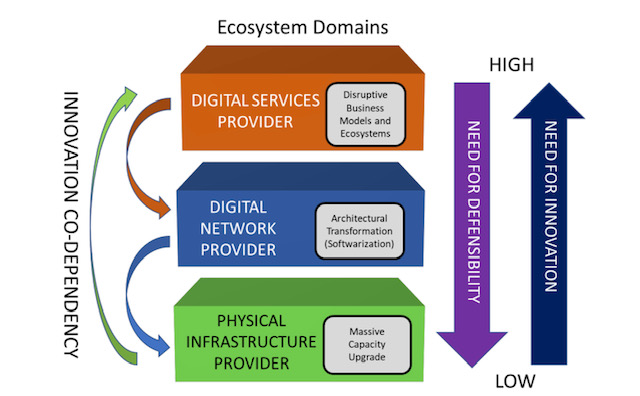
The position paper describes the telecommunications ecosystem in three layers (see diagram).
The CSPs are examples of the physical infrastructure providers (bottom layer) that have fixed and wireless infrastructure providing connectivity. The physical infrastructure layer is where the telcos have their value – their ‘centre of gravity’ – and this won’t change, says Clarke.
The infrastructure layer also includes the access network which is the CSPs’ crown jewels.
“The telcos will always defend and upgrade that asset,” says Clarke, adding that the CSPs have never cut access R&D budgets. Access is the part of the network that accounts for the bulk of their spending. “Innovation in access is happening all the time but it is never fast enough.”
The middle, digital network layer is where the nodes responsible for switching and routing reside, as do the NFV and software-defined networking (SDN) functions. It is here where innovation is needed most.
Clarke points out that the middle and upper layers are blurring; they are shown separately in the diagram for historical reasons since the CSPs own the big switching centres and the fibre that connect them.
But the hyperscalers – with their data centres, fibre backbones, and NFV and SDN expertise – play in the middle layer too even if they are predominantly known as digital service providers, the uppermost layer.
The position paper’s goal is to address how CSPs can better address the upper two network layers while also attracting smaller players and start-ups to fuel innovation across all three.
Paper proposal
The paper identifies several key issues that curtail innovation in telecoms.
One is the difficulty for start-ups and small companies to play a role in telecoms and build a business.
Just how difficult it can be is highlighted by the closure of SDN-controller specialist, Lumina Networks, which was already engaged with two leading CSPs.
In a Telecom TV panel discussion about innovation in telecoms, that accompanied the paper’s publication, Andrew Coward, the then CEO of Lumina Networks, pointed out how start-ups require not just financial backing but assistance from the CSPs due to their limited resources compared to the established systems vendors.
It is hard for a start-up to respond to an operator’s request-for-proposals that can be thousands of pages long. And when they do, will the CSPs’ procurement departments consider them due to their size?
Coward argues that a portion of the CSP’ capital expenditure should be committed to start-ups. That, in turn, would instill greater venture capital confidence in telecoms.
The CSPs also have ‘organisational inertia’ in contrast to the hyperscalers, says Clarke.
“Big companies tend towards monocultures and that works very well if you are not doing anything from one year to the next,” he says.
The hyperscalers’ edge is their intellectual capital and they work continually to produce new capabilities. “They consume innovative brains far faster and with more reward than telcos do, and have the inverse mindset of the telcos,” says Clarke.
The goals of the innovation initiative are to get CSPs and the hyperscalers – the key digital service providers – to work more closely.
“The digital service providers need to articulate the importance of telecoms to their future business model instead of working around it,” says Clarke.
Clarke hopes the digital service providers will step up and help the telecom industry be more dynamic given the future of their businesses depend on the infrastructure improving.
In turn, the CSPs need to stand up and articulate their value. This will attract investors and encourage start-ups to become engaged. It will also force the telcos to be more innovative and overcome some of the procurement barriers, he says.
Ultimately, new types of collaboration need to emerge that will address the issue of innovation.
Next steps
Work has advanced since the paper was published in June and additional players have joined the initiative, to be detailed soon.
“This is the beginning of what we hope will be a much more interesting dialogue, because of the diversity of players we have in the room,” says Clarke. “It is time to wake up, not only because of the need for innovation in our industry but because we are an innovation retardant everywhere else.”
Further information:
Telecom TV’s panel discussion: Part 2, click here
Tom Nolle’s response to the Accelerating Innovation in the Telecommunications Arena paper, click here


Telefonica tests XGS-PON
Part 1: XGS and TWDM passive optical networks
Telefonica is the latest operator to test XGS-PON, the 10-gigabit passive optical networking standard.
“Operators want to show they are taking the maximum from their fibre investment,” says Ana Pesovic, marketing manager for fibre at Nokia, the supplier of the XGS-PON equipment used for the operator’s lab tests. “Telefonica has been really aggressive in their fibre deployments in the last couple of years.”
 Ana Pesovic
XGS-PON
Approved by the ITU-T in 2016, XGS-PON supports two rates: 10-gigabit symmetrical and the asymmetrical rate of 10 gigabits downstream (to the user) and 2.5 gigabits upstream.
XGS-PON has largely superseded the earlier XG-PON standard which supports the 10-gigabit asymmetrical rate only. “It is fair to say there is no traction for XG-PON,” says Pesovic. “Even in China [an early adopter of XG-PON], we see the interest slowly moving to XGS-PON.”
Nokia says it has now been involved in 40 XGS-PON trials and nine customers have deployed the technology. “These have just started and they are not massive deployments,” says Pesovic.
Nokia’s XGS-PON customers include China Telecom and SK Broadband. SK Broadband has deployed XGS-PON alongside the more advanced TWDM-PON (time wavelength division multiplexing, passive optical network), the ITU-T NG-PON2 standard.
XGS-PON uses a fixed wavelength to deliver either the 10-gigabit symmetrical or asymmetrical service. The standard supports a distance of 20km and a split ratio of up to 1:128 - one XGS-PON optical line terminal (OLT) serving up to 128 optical network units (ONUs). In contrast, TWDM-PON supports four wavelengths enabling up to 40-gigabit symmetrical rates. And unlike XGS-PON, TWDM-PON supports flexible wavelengths using tuneable lasers.
The wavelengths used by XGS-PON and TWDM-PON have been specified such that the two standards can operate alongside GPON on the same fibre. Accordingly, with SK Broadband’s deployment, the two PON standards along with GPON support an aggregate capacity of 52.5 gigabits-per-second.
As well as testing XGS-PON's performance, Telefonica has tested that XGS-PON works without disturbing existing broadband services over its GPON networks, says Pesovic.
For the test, Telefonica used an 8-port line card where each port can be configured for XGS-PON or as a wavelength of a TWDM-PON. The line card fits within Nokia’s 7360 Intelligent Services Access Manager (ISAM) FX platform.
5G will require the deployment of many more small cells. With XGS-PON, multiple small cells can be served using a single PON
Applications
XGS-PON with its symmetrical 10-gigabit rate is suited to business services. "Operators can use one network to converge business and residential; today they are two overlay networks,” says Pesovic. Many businesses require 1-gigabit connectivity or less but by having a 10-gigabit link, multiple enterprises can be aggregated on one PON.
Nokia says that in countries such as South Korea as well as in Europe and North America there is also interest in a 10-gigabit PON for residential services. “People are taking the downstream bandwidth for granted and now the upstream is becoming a differentiator, making the quality of experience much better,” says Pesovic.
The bulk of traffic is still predominately downstream but increasingly users want to upload large files and video. Even if these uploads are of shorter duration, the network must deliver, says Pesovic.
Operators are also eyeing XGS-PON for the emerging 5G cellular standard. Nokia points out that 5G will require the deployment of many more small cells. With XGS-PON, multiple small cells can be served using a single PON.
Nokia expects XGS-PON will be deployed for years to come. Broadband is advancing by adding more wavelengths. To GPON, which uses one wavelength, can be added a second wavelength supporting 10-gigabit XGS-PON. Using TWDM-PON adds four and potentially eight more wavelengths - 40 gigabits and 80 gigabits of bandwidth, respectively. “It really doesn’t matter what the technology is called,” says Pesovic.
One North American operator is looking at TWDM-PON as a way to save power. During the night when there is less broadband usage, the operator wants to use wavelength mobility to migrate users onto a single wavelength.
TWDM-PON
Besides wavelength count, TWDM-PON differs from XGS-PON in its use of tuneable lasers.
Having tuneable wavelengths delivers several benefits to the operators. One is load balancing. If users on one wavelength start to exhaust its capacity, several users can be moved to a second wavelength that is less heavily loaded.
TWDM-PON also benefits network sharing and wavelength unbundling. A third-party operator can offer its fibre to interested operators. “Each operator could then operate on a single wavelength,” says Pesovic. If a user changes operator, they can simply be moved from one wavelength to another.
There are also operational benefits. If a fault develops on a board, users can be migrated to a second card without service interruption and the faulty board replaced.
One North American operator is looking at TWDM-PON as a way to save power, says Pesovic. During the night when there is less broadband usage, the operator wants to use wavelength mobility to migrate users onto a single wavelength. This would deliver sufficient bandwidth to those users that are active while allowing the remaining wavelengths to be powered down, saving power.
The issue impeding the uptake of TWDM-PON remains the high cost of tuneable lasers. Nokia expects it to be at least another year before the cost of tuneable lasers becomes more economical for PON. That said, service providers delivering businesses services may still be tempted to adopt TWDM-PON despite the higher cost of tuneable lasers given that the average revenue per user (ARPU) of business users is 5x that of residential users, says Pesovic.
See Part 2: FSAN unveils roadmap plans, click here

Telefónica tackles video growth with IP-MPLS network
- Telefónica’s video growth in one year has matched nine years of IP traffic growth
- Optical mesh network in Barcelona will use CDC-ROADMs and 200-gigabit coherent line cards
Telefónica has started testing an optical mesh network in Barcelona, adding to its existing optical mesh deployment across Madrid. Both mesh networks are based on 200-gigabit optical channels and high-degree reconfigurable add-drop multiplexers (ROADMs) that are part of the optical infrastructure that underpins the operator’s nationwide IP-MPLS network that is now under construction.
 Maria Antonia CrespoThe operator decided to become a video telco company in late 2014 to support video-on-demand and over-the-top streaming video services.
Telefónica realised its existing IP and aggregation networks would not be able to accommodate the video traffic growth and started developing its IP-MPLS network.
“What we are seeing is that the traffic is growing very quickly,” says Maria Antonia Crespo, IP and optical networking director at Telefónica. “In one year we are getting the same
figures as we got from internet traffic in the last nine years.”
The operator is rolling out the IP-MPLS network across Spain. Juniper Networks and Nokia are the suppliers of the IP router equipment, while Huawei and Nokia were chosen to supply the optical networking equipment.
IP-MPLS
Telefónica set about reducing the number of layers and number of hops when designing its IP-MPLS network. “At each hop, we have to invest money if we want to increase capacity,” says Crespo.
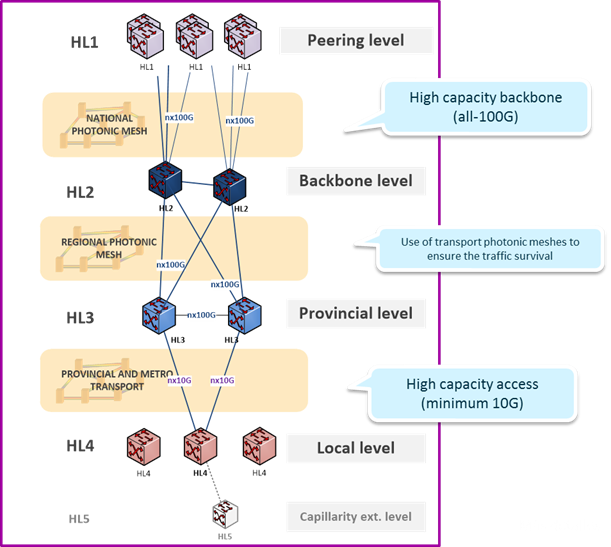
The result is an IP-MPLS network comprising four layers (see diagram). The uppermost Layer 1, dubbed HL1, connects the network to the internet world, while HL2 is a backbone transit layer. The HL3 layer is also a transit layer but at the provincial level. Spain is made up of 52 provinces. HL4 is where the services will reside, where Telefonica will deliver such services as Layer 2 and Layer 3 virtual private networks.
Between HL1 and HL2 is a national GMPLS-based photonic mesh, says Crespo, and between HL3 and HL4 there are the metro mesh networks. “Now we are deploying two GMPLS-based mesh networks, in Madrid and Barcelona,” she says. “Then, in the rest of the country, we are deploying [optical] rings.”
Systems requirements
Telefónica says it had several requirements when choosing the optical transport equipment, requirements common to both its backbone and regional networks.
One is the need to scale capacity at 10 gigabits and 100 gigabits, while network availability and robustness are also key. Telefónica says its network is designed to withstand two or more simultaneous fibre failures. “We have long experience with the GMPLS control plane to support different fibre impairments in the network,” says Alberto Colomer, optical technology manager at Telefónica.
The operator also wants its equipment to support high-speed interfaces and more granular rates to allow it to transition away from legacy traffic such as SDH and 1GbE. Operational improvements are another requirement: Telefónica wants to reduce the manual intervention its network needs. Optical time-domain reflectometers (OTDR) are being integrated into the network to monitor the fibre, as is the ability to automatically equalise the different optical channels.
 Alberto ColomerLastly, Telefónica is looking to reduce its capital expenditure and operational expense. It is deploying flexible rate 200-gigabit transponders in its Barcelona and Madrid networks and the same line cards will support 400-gigabit and even 1 terabit channels in future, as well as flexible grid to support the most efficient use of a fibre’s spectrum.
The 200-gigabit transponders use 16-quadrature amplitude modulation (16-QAM). Such transponders have enough reach to span each of the two cities but Colomer says Telefónica is still studying how many ROADM stages the 16-QAM transponders can cross.
It is like a pilot changing the engines while flying a plane
The ROADMs Telefónica is deploying in Madrid are directionless and are able to support up to 20 degrees. “You need some connectivity inside the mesh but also the mesh has to be connected to rings that cover all the counties around Madrid,” says Colomer.
Barcelona will be the first location where the ROADMs will also be colourless and contentionless (CDC-ROADMs). “We need to understand in a better way what are the advantages that come with that functionality,” says Colomer.
Telefónica has deployed Huawei’s Optix OSN 9800 platform in Madrid while in Barcelona Nokia’s 1830 Photonic Service Switch with the latest PSE-2 Coherent DSP-ASIC technology is being deployed.
Nokia’s PSS-1830 is designed to support the L-band as well as the C-band but Telefonica does not see the need for the L-band in the near future. “We are going in the direction of increasing capacity per channel: 400-gigabit channels and one terabit channels,” says Colomer. By deploying a photonic mesh and high-degree ROADMs, it will also be possible to increase capacity on a specific link by adding a fibre pair.
Status
The mesh in Madrid is already completed while Telefónica is deploying optical rings around Barcelona while it tests the contentionless ROADMs. These deployments are aligned with the IP-MPLS deployment, says Crespo, which is expected to be completed by 2018.
Crespo says the nationwide IP-MPLS rollout is a challenge. The deployment involves learning new technology that needs to be deployed alongside its existing network. "My boss likens it to a pilot changing the engines while flying a plane," says Crespo. "We are testing in the labs, duplicating it [the network], and migrating the traffic without impacting the customer."
Europe gets its first TWDM-PON field trial
Vodafone is conducting what is claimed to be the first European field trial of a multi-wavelength passive optical networking system using access equipment from Alcatel-Lucent.
 Source: Alcatel-Lucent
The time- and wavelength-division multiplexed passive optical network (TWDM-PON) technology being used is a next-generation access scheme that follows on from 10 gigabit GPON (XG-PON1) and 10 gigabit EPON.
“There appears to be much more 'real' interest in TWDM-PON than in 10G GPON,” says Julie Kunstler, principal analyst, components at Ovum.
The TWDM-PON standard is close to completion in the Full Service Access Network (FSAN) Group and ITU and supports up to eight wavelengths, each capable of 10 gigabit symmetrical or 10/ 2.5 gigabit asymmetrical speeds.
“You can start building hardware solutions that are fully [standard] compliant,” says Stefaan Vanhastel, director of fixed access marketing at Alcatel-Lucent.
TWDM-PON’s support for additional functionality such as dynamic wavelength management, whereby subscribers could be moved between wavelengths, is still being standardised.
The combination of time and wavelength division multiplexing, allows TWDM-PON to support multiple PONs, each sharing its capacity among 16, 32, 64 or even 128 end points depending on the operator’s chosen split ratio.
There appears to be much more 'real' interest in TWDM PON than in 10G GPON
Alcatel-Lucent first detailed its TWDM-PON technology last year. The system vendor introduced a four-wavelength TWDM-PON based on a 4-port line-card, each port supporting a 10 gigabit PON. The line card is used with Alcatel-Lucent’s 7360 Intelligent Services Access Manager FX platform, and supports fixed and tunable SFP optical modules.
“Several vendors also offer the possibility to use fixed wavelength - XG-PON1 or 10G EPON optics," says Vanhastel. "This reduces the initial cost of a TWDM-PON deployment while allowing you to add tunable optics later."
Operators can thus start with a 10 gigabit PON using fixed-wavelength optics and move to TWDM-PON and tunable modules as their capacity needs grow. “You won’t have to swap out legacy XG-PON1 hardware two years from now,” says Vanhastel.
Alcatel-Lucent has been involved in 16 customer TWDM-PON trials overall, half in Asia Pacific and the rest split between North America and EMEA. Besides Vodafone, Alcatel-Lucent has named two other TWDM-PON triallists: Telefonica and Energia, an energy utility in Japan.
You won’t have to swap out legacy XG-PON1 hardware two years from now
Vanhastel says the company has been surprised that operators are also eyeing the technology for residential access. The high capacity and relative expense of tunable optics made the vendor think that early demand would be for business services and mobile backhaul only.
 Source: Gazettabyte
There are several reasons for the operator interest in TWDM-PON, says Vanhastel. One is its ample bandwidth - 40 gigabit symmetrical in a four-wavelength implementation - and that wavelengths can be assigned to different aggregation tasks such as backhaul, business and residential. Operators can also pay for wavelengths as needed.
TWDM-PON also allows wavelengths to be shared between operators as part of wholesale agreements. Operators deploying TWDM-PON can lease a wavelength to each other in their respective regions.
Vodafone, for example, is building its own fibre network but is also expanding its overall fixed broadband coverage by developing wholesale agreements across Europe. Vodafone's European broadband network covers 62 million households: 26 million premises covered with its own network and 36 million through wholesale agreements.
First operator TWDM-PON pilot deployments will occur in 2016, says Alcatel-Lucent.
Further reading:
White Paper: TWDM PON is on the horizon: facilitating fast FTTx network monetization, click here
Packet optical transport: Hollowing the network core
The platform enables a fully-meshed metropolitan network Intune Networks' CEO, Tim Fritzley (right) and John Dunne, co-founder and CTO with software support for web-based services, claims the Irish start-up.
“What we have designed allows for the sharing of the same fibre switching assets across multiple services in the metro,” says Tim Fritzley, Intune’s CEO.
The company is in talks with several operators about its OPST system, which is being used for a nationwide network in Ireland. The system is also part of an EC seventh framework project that includes Spanish operator Telefónica.
OPST architecture
Intune’s OPST system, dubbed the Verisma iVX8000, uses dense wavelength division multiplexing (DWDM) technology but with a twist. Each wavelength is assigned to a particular destination port, over which the data is transmitted in bursts. The result is an architecture that uses both wavelength-division and time-division multiplexing.
To enable the approach, Intune has developed a control algorithm that can switch and lock a tunable laser’s wavelength “in nanoseconds”. Such rapid laser switching enables wavelength addressing - assigning a dedicated wavelength to each destination port.
As packets arrive at the iVX8000, they are ‘coloured’ and queued before being sent on the required wavelength to their destination. In effect packets are routed at the optical layer, in contrast to traditional systems where traffic is packed onto a lightpath that has a fixed predefined point-to-point optical path.
The packets are sent in bursts based on their class-of-service. Intune uses a proprietary framing scheme for transmission, with Ethernet frames restored at the destination. At the input port, all the packets are queued based on their wavelength and class-of-service. The scheduler, which composes the bursts, picks bits to transmit from the queues based on their class, with the bits sent without having to be aligned with a frame’s boundaries.
 “Instead of assigning an electrical address to a fixed wavelength, we are assigning electrical addresses to dynamic wavelengths”
Tim Fritzley, Intune Networks
Intune also uses dynamic bandwidth allocation: any bandwidth unused by the higher classes of service is assigned to lower priority traffic. This achieves over 80 percent utilisation of the Ethernet switching and the fibre, says Fritzley.
“You are responding to the dynamic loading of the traffic as it comes in, on a destination-by-destination, colour-by-colour basis,” says Fritzley “Instead of assigning an electrical address to a fixed wavelength [as with traditional systems], we are assigning electrical addresses to dynamic wavelengths.”
The result is a fully meshed architecture with any transponder able to talk to any other transponder on the network, says Fritzley.
System’s span
The network architecture is arranged as a ring with up to a 300km span. The ring connects up to 16 iVX8000 nodes each comprising four 10 Gigabit-per-second (Gbps) ports and switching hardware. Each port is assigned a particular wavelength, equating to a total switch capacity of 640Gbps.
Intune has an 80-wavelength design even though only 64 are used. Indeed it uses two optical rings in parallel. The two rings run in opposite directions, providing optical protection for each port and effectively doubling overall capacity.
For the client side interfaces, the iVX8000 uses four 10 Gigabit Ethernet ports. Since transmissions are in bursts, multiple ports can transmit data to the same destination port even though they share the same wavelength.
The system’s 300km span is an artificial value set by Intune to guarantee “plug-and-play” performance. If the individual chassis are less than 65km apart and the total ring is 300km or under, Intune guarantees no DWDM engineering is required. “We auto-discover all the optical paths and nodes in the network; we automatically adjust all the amplification and set up the dispersion compensation,” says Fritzley. “This saves thousands of engineer-hours and truck rolls.”
Intune points out that it has engineered a 700km network but claims that for distances beyond 1,000km, point-to-point links connecting regions make more sense.
John Dunne, co-founder and CTO of Intune, claims the metro architecture simplifies networking greatly when connecting the network edge to the IP core. “It is different to what is there today because there are no routeing decisions to be made,” says Dunne. “All of the routes pre-exist, and that is because the tunable lasers contain all the colours of all the ports on the ring.”
As a result, setting up a flow of packets between the edge and core involves using a single interface to the ring. “You don’t have to talk to all the [ring’s] elements, you just talk to the ring,” says Dunne. “The ring is pre-engineered so it knows it’s a ring; it also knows how to guarantee the latency, the bandwidth, the jitter of any flow.”
This is the system’s main merit, says Dunne, the pre-engineered ring hides all the difficulty of building a control layer on top of a dynamic optical and layer-two switching system.
Bringing the web into the network
Intune realised that traditional telecom software would struggle to make best use of its distributed optical packet switch architecture. The company has adopted the representational state transfer (REST) software approach for its architecture instead.
“REST is the heart of web services,” says Fritzley. “The reason we did this is that there are hundreds of thousands of programmers that understand how to program it, so you are not into the arcane telecom languages of SNMP and TL1.” Adopting a 'RESTful' approach, claims Intune, reduces code development by 70 percent.
Moreover, REST by its nature is distributed such that it lends itself to supporting distributed transactions across Intune’s switch. “We have put a mini-http server on every card; we do not centralise control inside a node,” says Fritzley. “Every card peers with all of its peer-functions on the ring.”
In terms of the switch's operation, high-level XML commands are used instead of sending low-level instructions to numerous elements. “For example you ask the ring - set up this flow of packets with this bandwidth, this jitter and this delay,” says Dunne. “The ring replies that it can set this up and it performs the low-level stuff internal to the ring."
Such a capability will ultimately enable a machine to provision bandwidth for services, and enable machine-to-machine communications, says Intune. It will also enable third-party application developers to use the switch for service provisioning. This isn’t possible today because there is a lack of control, says Dunne.
“We have a full suite of XML-based interface commands,” he says. “All [the interface commands] would go to the carrier, the carrier would expose a subset to the Googles, the Googles would expose a subset to their application writers, and the application writers would expose a subset to the consumer.” Were the consumer to send a command to request some bandwidth, the call would be passed through the various layers directly into the switch, all in a controlled manner.
Provisioning of bandwidth in such an automated fashion is possible because Intune’s underlying network is bounded and predictable, says Dunne, with the optical path pre-engineered to work with the data path.
Meanwhile until XML becomes more commonplace, Intune uses a code translator that converts the XML code to SNMP or TL1 to interface to existing systems.
 “The ring is pre-engineered so it knows it’s a ring; it also knows how to guarantee the latency, the bandwidth, the jitter of any flow”
John Dunne, Intune Networks
Applications
The iVX8000 is being targetted at applications such as cloud computing services and the moving of virtualised environments between data centres. But the real target is using the platform to support multiple services – 3G and 4G wireless backhaul, on-demand IP TV as well as cloud. “No-one can do traffic planning anymore around such services,” says Fritzley.
The platform addresses what one large European operator calls ‘hollowing the core’. The operator wants to simplify its metro network by moving such networking elements as broadband remote access servers (BRASs) to the network edge. These will be connected using a simpler layer-two network that lessens the use of large, expensive IP core routers.”All the IP processing is on the edge and you go edge-to-edge on a flat layer two,” says Fritzley.
Market developments
Intune is using its system to enable the Exemplar network in Ireland. Backed by the Irish Government, the company’s systems will be used to build a nationwide network. The first phase involves a lab for application development and testing. So far 40 multi-nationals have signed up to use the network. Starting next year, a ring network will be up and running around Dublin to be followed with a nationwide roll-out in 2013.
The Irish start-up is also part of an EC Seventh Framework research project called MAINS. The project, which started in January, involves Telefónica which is using the iVX8000 to move virtualised resources between data centres depending on user demand and latency requirements. The project uses XML commands to call for bandwidth from the networking layer.
Meanwhile, Intune says that it is “deeply engaged” with four to five of the largest operators in North America and Europe.