
Changing the radio access network for good

The industry initiative to open up the radio access network, known as open RAN, is changing how the mobile network is architected and is proving its detractors wrong.
So says a recent open RAN study by market research company, LightCounting.
“The virtual RAN and open RAN sceptics are wrong,” says Stéphane Téral, chief analyst at LightCounting.
Japan’s mobile operators, Rakuten Mobile and NTT Docomo, lead the world with large-scale open RAN deployments. Meanwhile, many leading communications service providers (CSPs) continue to trial the technology with substantial deployments planned around 2024-25.
Japan’s fourth and newest mobile network operator, Rakuten Mobile, deployed 40,000 open RAN sites with 200,000 radio units by the start of 2022.
Meanwhile, NTT Docomo, Japan’s largest mobile operator, deployed 10,000 sites in 2021 and will deploy another 10,000 this year.
NTT Docomo has shown that open RAN also benefits incumbent operators, not just new mobile entrants like Rakuten Mobile and Dish Networks in the US that can embrace the latest technologies as they roll out their networks.
Virtual RAN and open virtual RAN
Traditional RANs use a radio unit and a baseband unit from the same equipment supplier. Such RAN systems use proprietary interfaces between the units, with the vendor also providing a custom software stack, including management software.
The vendor may also offer a virtualised system that implements some or all of the baseband unit’s functions as software running on server CPUs.
A further step is disaggregating the baseband unit’s functions into a distributed unit (DU) and a centralised unit (CU). Placing the two units at different locations is then possible.
A disaggregated design may also be from a single vendor but the goal of open RAN is to enable CSPs to mix and match RAN components from different suppliers. Accordingly, the virtual RAN using open interfaces, as specified by the O-RAN Alliance, is an open virtual RAN system.
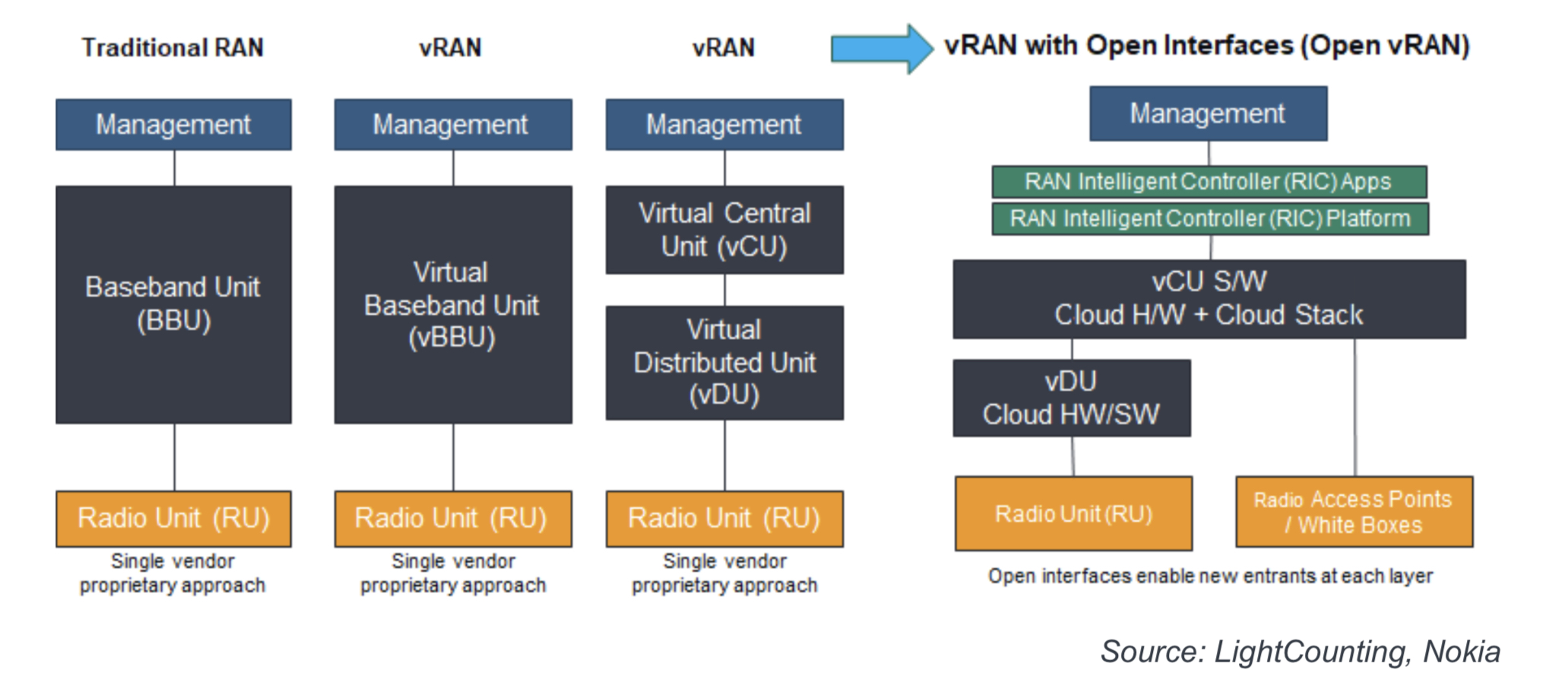
The diagram shows the different architectures leading to the disaggregated, virtualised RAN (vRAN) architecture.
Open virtual RAN comprises radio units, the DU and CU functions that can be implemented in the cloud, and the RAN Intelligent Controller (RIC), the brain of the RAN, which runs applications.
Several radio units may be connected to a virtual DU. The radio unit and virtual DU may be co-located or separate, linked using front-haul technology. Equally, the CU can host several virtual DUs depending on the networking requirements, connected with a mid-haul link.
Rakuten Mobile has deployed the world’s largest open virtual RAN architecture, while NTT Docomo has the world’s largest brownfield open RAN deployment.
NTT Docomo’s deployment is not virtualised and is not running RAN functions in software.
“NTT Docomo’s baseband unit is not disaggregated,” says Téral. “It’s a traditional RAN with a front-haul using the O-RAN Alliance specification for 5G.”
NTT Docomo is working to virtualise the baseband units and the work is likely to be completed in 2023.
Opening the RAN
NTT Docomo and the MGMN Alliance were working on interoperability between RAN vendors 15 years ago, says Téral. The Japanese mobile operator wanted to avoid vendor lock-in and increase its options.
“NTT Docomo was the only one doing it and, as such, could not enjoy economies of scale because there was no global implementation,” says Téral.
Wider industry backing arrived in 2016 with the formation of the Telecom Infra Project (TIP) backed by Meta (Facebook) and several CSPs to design network architectures that promoted interoperability using open equipment.
The O-RAN Alliance formed in 2018 was another critical development. With over 300 members, the O-RAN Alliance has ten working groups addressing such topics as defining the interfaces between RAN functions to standardise the open RAN architecture.
The O-RAN Alliance realised it needed to create more flexibility to enable boxes to be interchanged, says Téral, and started in the RAN to allow any radio unit to work with any virtual DU.
Geopolitics is the third element to kickstart open RAN. Removing Chinese equipment vendors Huawei and ZTE from key markets brought Open RAN to the forefront as a way to expand suppliers.
Indeed, Rakuten Mobile was about to select Huawei for its network, but it decided in 2018 to adopt open RAN instead because of geopolitics.
“Geopolitics added a new layer and, to some extent, accelerated the development of open RAN,” he says. “But it does not mean it has accelerated market uptake.”
That’s because the first wave of 5G deployments by the early adopter CSPs seeking a first-mover advantage is ending. Indeed, the uptake in 5G’s first three years has eclipsed the equivalent rollout of 4G, says LightCounting.
To date, over 200 of 800 mobile operators worldwide have deployed 5G.
Early 5G adopters have gone with traditional RAN suppliers like Ericsson, Nokia, Samsung, NEC and Fujitsu. And with open RAN only now hitting its stride, it has largely missed the initial 5G wave.
Open RAN’s next wave
For the next two years, then, the dominant open RAN deployments will continue to be those of Rakuten Mobile and NTT Docomo, to which can be added the network launches from Dish Networks in the US, and 1&1 Drillisch of Germany, which is outsourcing its buildout to Rakuten Symphony.
Rakuten Mobile’s vendor offshoot, Rakuten Symphony, set up to commercialise Rakuten’s open RAN experiences, is also working with Dish Networks on its deployment.
Rakuten Mobile hosts its own 5G network, including open RAN in its data centres. Dish is working with cloud player Amazon Web Services to host its 5G network. Dish’s network is still in its early stages, but the mobile operator can host its network in Amazon’s cloud because it uses a cloud-native implementation that includes Open RAN.
The next market wave for Open RAN will start in 2024-25 when the leading CSPs begin to turn off their 3G and start deploying Open RAN for 5G.
It will also be helped by the second wave of 5G rollouts those 600 operators with LTE networks. However, this second 5G cycle may not be as large as the first cycle, says Téral, and there will be a lag between the two cycles that will not be helped if there is a coming economic recession.
Specific leading CSPs that were early cheerleaders for open RAN has since dampened their deployment plans, says Téral. For example, Telefónica and Vodafone first spoke in 2019 of 1,000s of site deployments but have scaled back their deployment plans.
The leading CSPs explain their reluctance to deploy open RAN due to its many challenges. One is interoperability issues; despite the development of open interfaces, getting the different vendors’ components to work together is still a challenge.
Another issue is integration. Disaggregating the various RAN components means someone must stitch them together. Certain CSPs do this themselves, but there is a need for system integrators, and this is a challenge.
Téral believes that while these are valid concerns, Rakuten and NTT Docomo have already overcome such complications; open RAN is now deployed at scale.
These CSPs are also reluctant to end their relationships with established suppliers.
“The service providers’ teams have built relationships and are used to dealing with the same vendors for so long,” says Téral. “It’s very complicated for them to build new relationships with somebody else.”
More RAN player entrants
Rakuten Symphony has assembled a team with tremendous open RAN experience. AT&T is one prominant CSP that has selected Rakuten Symphony to help it with network planning and speed up deployments.
NTT Docomo working with four vendors, has got their radio units and baseband units to work with each other. In addition, NTT Docomo is also promoting its platform dubbed OREC (5G Open RAN Ecosystem) to other interested parties.
NEC and Fujitsu, selected by NTT Docomo, have also gained valuable open RAN experience. Fujitsu is a system integrator with Dish while NEC is involved in many open RAN networks in Europe, starting with Telefónica.
There is also a commercial advantage for these systems vendors since Rakuten Mobile and NTT Docomo are the leading operators, along with DISH and 1&1, deploying open RAN for the next two years.
That said, the radio unit business continues to look up. “There is no cycle [with radio units]; you still have to add radio units at some point in particular parts of the network,” says Téral.
But for open RAN, those vendors not used by NTT Docomo and Rakuten Mobile must wait for the next deployment wave. Vendor consolidation is thus inevitable; Parallel Wireless being the first shoe to drop with its recently announced wide-scale layoffs.
So while open RAN has expanded the number of vendor suppliers, further acquisitions should be expected, as well as companies folding that will not survive until the next deployment wave, says Téral.
And soon at the chip level too
There is also a supply issue with open RAN silicon.
With its CPUs and FlexRAN software, Intel dominates the open RAN market. However, the CSPs acknowledge there is no point in expanding RAN suppliers if there is a vendor lock-in at the chip level, one layer below.
Téral says several chip makers are working with system vendors to enter the market with alternative solutions. These include ARM-based architectures, AMD-Xilinx, Qualcomm, Marvell’s Octeon family and Nvidia’s BlueField-3 data processing unit.
The CSPs are also getting involved in promoting more chip choices. For example, Vodafone has set up a 50-strong research team at its new R&D centre in Malaga, Spain, to work with chip and software companies to develop the architecture of choice for Open RAN to expand the chip options.
Outlook
LightCounting forecasts that the open vRAN market will account for 13 per cent of the total global RAN sales in 2027, up from 4 per cent in 2022.
A key growth driver will be the global switch to open virtual RAN in 2024-25, driven by the large Tier 1 CSPs worldwide.
“Between 2025 and 2030, you will see a mix of open RAN, and where it makes sense in parts of the network, traditional RAN deployments too,” says Téral.


Marvell's 50G PAM-4 DSP for 5G optical fronthaul

- Marvell has announced the first 50-gigabit 4-level pulse-amplitude modulation (PAM-4) physical layer (PHY) for 5G fronthaul.
- The chip completes Marvell’s comprehensive portfolio for 5G radio access network (RAN) and x-haul (fronthaul, midhaul and backhaul).
Marvell has announced what it claims is an industry-first: a 50-gigabit PHY for the 5G fronthaul market.
Dubbed the AtlasOne, the PAM-4 PHY chip also integrates the laser driver. Marvell claims this is another first: implementing the directly modulated laser (DML) driver in CMOS.
“The common thinking in the industry has been that you couldn’t do a DML driver in CMOS due to the current requirements,” says Matt Bolig, director, product marketing, optical connectivity at Marvell. “What we have shown is that we can build that into CMOS.”
Marvell, through its Inphi acquisition, says it has shipped over 100 million ICs for the radio access network (RAN) and estimates that its silicon is in networks supporting 2 billion cellular users.
“We have been in this business for 15 years,” says Peter Carson, senior director, solutions marketing at Marvell. “We consider ourselves the number one merchant RAN silicon provider.”
Inphi started shipping its Polaris PHY for 5G midhaul and backhaul markets in 2019. “We have over a million ships into 5G,” says Bolig. Now Marvell is adding its AtlasOne PHY for 5G fronthaul.
Mobile traffic
Marvell says wireless data has been growing at a compound annual growth rate (CAGR) of over 60 per cent (2015-2021). Such relentless growth is forcing operators to upgrade their radio units and networks.
Stéphane Téral, chief analyst at market research firm, LightCounting, in its latest research note on Marvell’s RAN and x-haul silicon strategy, says that while 5G rollouts are “going gangbusters” around the world, they are traditional RAN implementations.
By that Téral means 5G radio units linked to a baseband unit that hosts both the distributed unit (DU) and centralised unit (CU).
But as 5G RAN architectures evolve, the baseband unit is being disaggregated, separating the distributed unit (DU) and centralised unit (CU). This is happening because the RAN is such an integral and costly part of the network and operators want to move away from vendor lock-in and expand their marketplace options.
For RAN, this means splitting the baseband functions and standardising interfaces that previously were hidden within custom equipment. Splitting the baseband unit also allows the functionality to be virtualised and be located separately, leading to the various x-haul options.
How the RAN is being disaggregated includes virtualised RAN and Open RAN. Marvell says Open RAN is still in its infancy but is a key part of the operators’ desire to virtualise and disaggregate their networks.
“Every Open RAN operator that is doing trials or early-stage deployments is also virtualising and disaggregating,” says Carson.
RAN disaggregation is also occuring in the vertical domain: the baseband functions and how they interface to the higher layers of the network. Such vertical disaggregation is being undertaken by the likes of the ONF and the Open RAN Alliance.
The disaggregated RAN – a mixture of the radio, DU and CU units – can still be located at a common site but more likely will be spread across locations.
Fronthaul is used to link the radio unit and DU when they are at separate locations. In turn, the DU and CU may also be at separate locations with the CU implemented in software running on servers deep within the network. Separating the DU and the CU is leading to the emergence of a new link: midhaul, says Téral.
Fronthaul speeds
Marvell says that the first 5G radio deployments use 8 transmitter/ 8 receiver (8T/8R) multiple-input multiple-output (MIMO) systems.
MIMO is a signal processing technique for beamforming, allowing operators to localise the capacity offered to users. An operator may use tens of megahertz of radio spectrum in such a configuration with the result that the radio unit traffic requires a 10Gbps front-haul link to the DU.
Leading operators are now deploying 100MHz of radio spectrum and massive MIMO – up to 32T/32R. Such a deployment requires 25Gbps fronthaul links.
“What we are seeing now is those leading operators, starting in the Asia Pacific, while the US operators have spectrum footprints at 3GHz and soon 5-6GHz, using 200MHz instantaneous bandwidth on the radio unit,” says Carson.
Here, an even higher-order 64T/64R massive MIMO will be used, driving the need for 50Gbps fronthaul links. Samsung has demonstrated the use of 64T/64R MIMO, enabling up to 16 spatial layers and boosting capacity by 7x.
“Not only do you have wider bandwidth, but you also have this capacity boost from spatial layering which carriers need in the ‘hot zones’ of their networks,” says Carson. “This is driving the need for 50-gigabit fronthaul.”
AtlasOne PHY
Marvell says its AtlasOne PAM-4 PHY chip for fronthaul supports an industrial temperature range and reduces power consumption by a quarter compared to its older PHYs. The power-saving is achieved by optimising the PHY’s digital signal processor and by integrating the DML driver.
Earlier this year Marvell announced its 50G PAM-4 Atlas quad-PHY design for the data centre. The AtlasOne uses the same architecture but differs in that it is integrated into a package for telecom and integrates the DML driver but not the trans-impedance amplifier (TIA).
“In a data centre module, you typically have the TIA and the photo-detector close to the PHY chip; in telecom, the photo-detector has to go into a ROSA (receiver optical sub-assembly),” says Bolig. “And since the photo-detector is in the ROSA, the TIA ends up having to be in the ROSA as well.”
The AtlasOne also supports 10-gigabit and 25-gigabit modes. Not all lines will need 50 gigabits but deploying the PHY future-proofs the link.
The device will start going into modules in early 2022 followed by field trials starting in the summer. Marvell expects the 50G fronthaul market to start in 2023.
RAN and x-haul IC portfolio
One of the challenges of virtualising the RAN is doing the layer one processing and this requires significant computation, more than can be handled in software running on a general-purpose processor.
Marvell supplies two chips for this purpose: the Octeon Fusion and the Octeon 10 data processing unit (DPU) that provides programmability and as well as specialised hardware accelerator blocks needed for 4G and 5G. “You just can’t deploy 4G or 5G on a software-only architecture,” says Carson.
As well as these two ICs and its PHY families for the various x-haul links, Marvell also has a coherent DSP family for backhaul (see diagram). Indeed, LightCounting’s Téral notes how Marvell has all the key components for an all-RAN 5G architecture.
Marvell also offers a 5G virtual RAN (VRAN) DU card that uses the OcteonFusion IC and says it already has five design wins with major cloud and OEM customers.