

Adtran broadens its OLS and access module offerings
Adtran has unveiled two products before the OFC show in San Francisco taking place at the end of the month.
One is a 50 gigabit-per second (Gbps) SFP56 optical transceiver that uses 4-level pulse-amplitude modulation (PAM-4) for 5G front-haul and enhanced broadband applications.
The second product is the FSP 3000 IP OLS, a compact open line system (OLS) designed for point-to-point links between sites 120km apart.
The OLS has been developed to simplify the setting up of dense wavelength division multiplexing (DWDM) optical links.
Enhancing broadband
Adtran has been developing a range of transceiver products to address specific requirements in the access-aggregation marketplace.
These include the MicroMux Edge Bidi, a QSFP+ pluggable module that supports 4×10 gigabit signals over 40km for mobile backhaul and enterprise wireless applications.
Adtran also offers the AccessWave25, a 25-gigabit tunable wavelength transceiver in an SFP28 form factor with a reach of 40km.
The pluggable module is used to link remote physical layer devices (RPDs) in cable operators’ networks. Cable operators are upgrading their infrastructure from 10 gigabits to 25 gigabits to support DOCSIS 4.0.
“You can argue if DOCSIS 4.0 is here or coming at the year-end,” says Saeid Aramideh, vice president of business development, optical engines business unit, at Adtran. “But there is no argument about the need for 25-gigabit uplinks for the cable MSO market.”
Now Adtran is announcing the AccessWave50, a 50-gigabit SFP56 optical module for fronthaul, part of the radio access network (RAN) and for other developments driving traffic such as smart homes, Internet of Things, and Smart Cities.
Aramideh refers to these applications as driving ‘enhanced’ broadband networks, requiring the upgrading of 25 gigabit links to 50- and even 100-gigabit ones.
Front-haul networks
For mobile, telco operators and RAN equipment makers are working with optical component makers to drive innovation in pluggables for emerging architectures such as enhanced 5G and 6G, says Aramideh.
In mobile networks, the front-haul network carries radio signals using the CPRI (common public radio interface) or enhanced CPRI protocols between the remote radio heads and the baseband units.
For 5G front-haul, the modules used are mainly at 10 gigabits-per-second (Gbps) with some 25-gigabit modules deployed. Adtran’s AccessWave50 addresses the next speed hike.
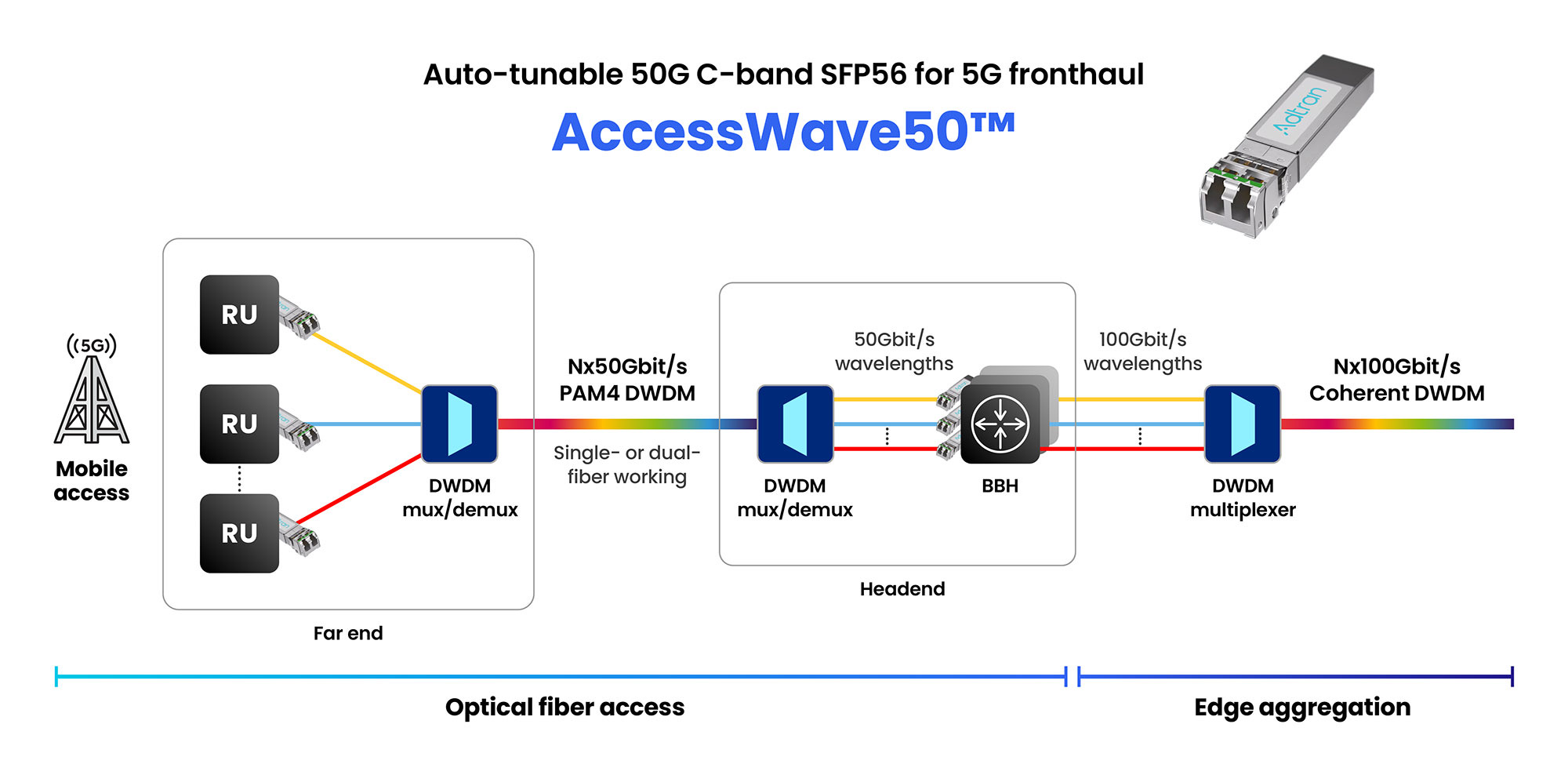
Adtran has designed the AccessWave50 using proprietary signal-shaping and distance optimisation techniques along with 4-level pulse amplitude modulation (PAM-4) to achieve the 50Gbps line rate.
“PAM-4 is proving itself to be a cost-performance-optimised technology and give you spectral efficiency as you go to higher data rates,” says Aramideh. “Of course, it’s not coherent optics, but you don’t need coherent for all applications.”
AccessWave50 uses a tunable laser and has a 15km, not 40km reach, but that is sufficient, says Aramideh, since front-haul networks are latency-constrained. The SFP56 module consumes 2.5W only.
Compact networking
Adtran has also unveiled its latest open line system (OLS) for C-band coherent transceivers.
The company has been providing bespoke OLS systems for hyperscalers. ADVA, the company Adtran acquired in 2022, provided Microsoft with the OLS that, working with the original ColorZ modules from Marvell, enabled 100 gigabit PAM-4 transmissions over 80km links.
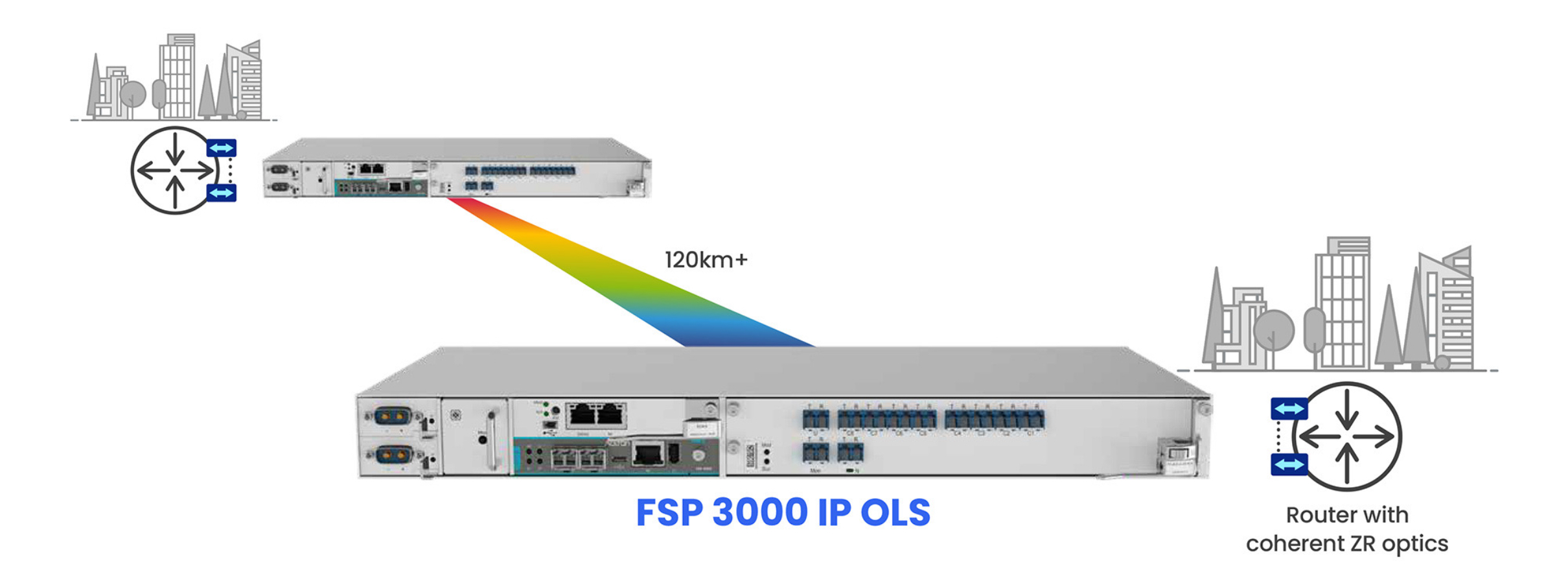
Adtran also provides an OLS for data centre interconnects using 400ZR coherent modules for reaches of 120km.
The latest FSP 3000 IP OLS platform is a compact one-rack (1RU) high box that supports eight wavelengths over 120km.
The platform also includes an OTDR (optical time domain reflectometer) for fibre diagnostics.
The OLS can be used with 400-gigabit, 800-gigabit, and ultimately 1.6 terabit coherent pluggable modules once available.
The OLS is also designed for telecom metro interconnect networks. “Telcos, in response to AI, are also looking for OLS technology tailored to coherent transceivers,” says Stephan Rettenberger, senior vice president of marketing and corporate communications at Adtran.
A chief design challenge has been to fit the OLS into a 1 RU form factor, requiring integration and packaging work. The OLS has also been designed to be set up and operated straightforwardly.
The platform is scalable: two racks stacked double the wavelength counts to 16.
The FSP 3000 IP OLS product is already in the hands of one telco customer, says Rettenberger.


ADTRAN-ADVA's metro-access play

ADTRAN and ADVA have agreed to merge after a long courtship.
The two CEOs have spoken regularly over the years but several developments spurred them to act.
The merger combines ADTRAN’s expertise in access technologies with ADVA’s metro wavelength-division multiplexing (WDM) know-how to create a ‘metro-core-to-door’ company with revenues of $1.2 billion.
ADTRAN and ADVA a better path forward together than separately
As such, the merger promises to double their size and networking skills. Yet the stock market appeared underwhelmed by the announcement, with ADTRAN’s shares down 16% for the rest of the week after the deal was announced.
Market research analysts, however, are more upbeat.
“ADTRAN and ADVA have a better path forward together than separately,” said John Lively, principal analyst at LightCounting Market Research, in a research note.
The deal is expected to close in the second or third quarter of 2022 but only after several hurdles are overcome in what is described as a complex deal.
Motivation
The two companies describe the merger as a logical outcome given recent developments in the marketplace.
“Our combination will make us one of the largest Western suppliers for the markets we serve,” said Tom Stanton, CEO and chairman of ADTRAN, on the call announcing the deal. The word “Western” is noteworthy, reflecting how geopolitics is one catalyst motivating the merger.
The deal will also reposition the two companies with their rivals. ADTRAN will distance itself from broadband competitors such as Calix while ADVA will diversify its business from its current larger competitors, Ciena and Infinera. The new company’s revenues will also approach those of the two players.
The product portfolios of ADTRAN and ADVA have almost no overlap. ADTRAN offers fibre access and connectivity solutions while ADVA addresses metro WDM, data centre interconnect, business Ethernet, network synchronisation and network functions virtualisation (NFV) expertise.
Once combined, each company will seek to expand its sales in the other’s main market.
The US accounts for 74 per cent of ADTRAN’s revenues, while Europe accounts for 21 per cent. Meanwhile, Europe accounts for 62 per cent of ADVA’s business while the US is 29 per cent. The remaining revenues come from the Asia Pacific: ADTRAN, 5 per cent, and ADVA, 9 per cent.
Also cited as a factor is the wave of investment in fibre, not just by communications service providers (CSPs) and public utilities but also government-backed stimulus plans in the US and Europe.
In the US, $66 billion in investment was mentioned spread across programmes such as the infrastructure bill, the second phase of the Rural Digital Opportunity Fund (RDOF), and state-level funding for high-speed broadband.
In Europe, the sum is similar: $35 billion in government funding for high-speed broadband in the European Union, and $30 billion in public and private funding for fibre builds in the UK alone.
“There is an ongoing global fibre investment opportunity that we believe will create sustained momentum for years to come,” said Stanton.
Moreover, having access and second-mile technologies, the new company can better win business. “There is not a customer that we sell to today that, when they are upgrading their access infrastructure, is not also upgrading their middle-mile,” said Stanton.
Becoming a larger player will help, he said: “We see our customers making a significant capital investment to transition their supply chain to trusted vendors.”

Another merger catalyst is the opportunity created by US and European service providers that no longer use Chinese vendors and in some cases are replacing equipment already deployed.
In the US, this is less of an issue due to the fewer deployments while in Europe the process started 18 months ago. Stanton expects Latin America to follow.
“The market opportunity is not just created by all the stimulus but it is also because of the displacement of Eastern vendors,” said Stanton.
There is a land grab going on, he says, and the company that gets there first wins.
“Once you get entrenched in a carrier, regardless of size – the larger ones tend to have two [vendors] and the smaller ones, one – once you are entrenched, it is very difficult to get pulled out,” said Stanton.
Analysis
LightCounting’s view of the merger is positive.
Lively says the merger will not reshape the optical networking industry but it will be attractive to Tier 2 and Tier 3 CSPs that want to buy access and aggregation equipment from a single supplier.
LightCounting notes that the deal values ADVA at $931 million, 1.3x its most recent four quarters of sales.
This is a relatively low valuation: the 2015 Infinera-Transmode merger was 2.6x while the Cisco-Acacia Communications deal, which closed earlier this year, was 7.7x. Of recent deals, only the 2020 Ribbon-ECI Telecom deal was lower, at 1.2x.
LightCounting says one reason for the lower valuation could be ADVA’s port shipments; the vendor is one of the smallest dense WDM suppliers.
The merger’s impact will mostly be felt by the competitors of the existing two companies, says Lively. The new ADTRAN’s sales will be 20 per cent greater than Infinera but still a third of the size of Fiberhome and Ciena.

The importance of size is something both companies stress.
“Our industry has been consolidating and there is an underlying notion that scale matters,” says Stephan Rettenberger, senior vice president, marketing and investor relations at ADVA.
Doubling in size, the new company will be in the same bracket as Infinera while Ciena will be about 3x its size, notes Rettenberger: “The companies that we used to worry about the most are not as distant as before.”
At first glance, the merger between a US and an European company raises questions about the integration challenge. But both firms have American CEOs and both have operations in the US and Germany.
ADTRAN acquired Nokia Siemens Networks’ fixed-line broadband access unit in 2011 while ADVA more recently acquired US firms, MRV Communications and Overture.

Brian Protiva, CEO of ADVA and a co-founder of the company in 1994, is the longest-serving CEO in the optical industry. As such he will have thought long and hard about the deal.
“This business combination is not only about growing the business,” says Protiva. “These two businesses fit perfectly together to address existing market and technology requirements, and we are well-positioned to lead the transition to access and edge convergence.”
Service providers do not need separate infrastructure for business services, residential broadband, and/ or 5G xHauling, he says.
Mechanics
The proposed deal is an all-stock one with ADTRAN and ADVA combining to form ADTRAN Holdings.
Each ADVA share will be swapped for 0.8244 shares of the new company while ADTRAN shares will be exchanged on a one-for-one basis. ADTRAN shareholders will own 54 per cent of the combined company while ADVA shareholders will own 46 per cent, assuming all of the ADVA shares are swapped.
But the new holding company must first be approved by German regulators, expected to occur by November. A three-month offer period then starts during which a minimum of 70 per cent of ADVA shares must be surrendered.
Stanton will continue as CEO and chairman at the new company while ADVA’s Protiva will join as executive vice chairman.
“I’m convinced that Tom is the right person to run the combined company,” says Protiva. “He executes to plan, is well-liked by customers, and thinks very similarly to our ADVA leadership around people first and the customer experience.” Stanton is also a long-serving CEO, heading ADTRAN since 2005.
Protiva will support Stanton during the integration period and then be involved in the corporate strategic direction of ADTRAN, as a board member, using his many long-term relationships in the combined markets.
After that, Protiva says he may return to Egora, a holding company out of which ADVA was born.
ADVA’s CTO, Christoph Glingener, will retain his role with the new company. ADTRAN and ADVA will have a combined annual R&D budget of $250 million.
”The stock exchange offer needs to pass all types of regulatory groups and needs to be accepted by the ADTRAN and ADVA shareholders,” stresses Rettenberger. “There is still a long path to closing.”