

The uphill battle to keep pace with bandwidth demand
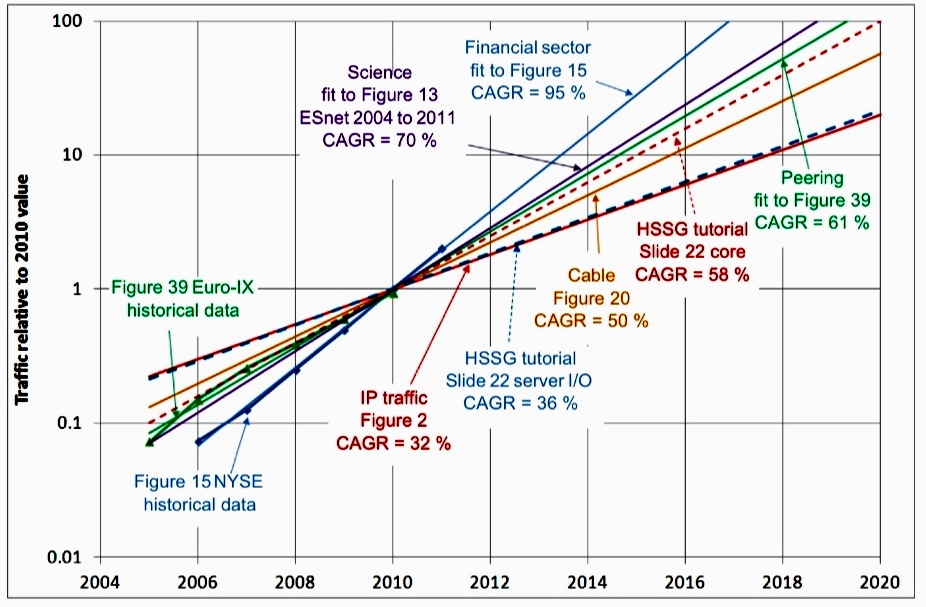 Relative traffic increase normalised to 2010 Source: IEEE
Optical component and system vendors will be increasingly challenged to meet the expected growth in bandwidth demand.
According to a recent comprehensive study by the IEEE (The IEEE 802.3 Industry Connections Ethernet Bandwidth Assessment report), bandwidth requirements are set to grow 10x by 2015 compared to demand in 2010, and a further 10x between 2015 and 2020. Meanwhile, the technical challenges are growing for the vendors developing optical transmission equipment and short-reach high-speed optical interfaces.
Fibre bandwidth is becoming a scarce commodity and various techniques will be required to scale capacity in metro and long-haul networks. The IEEE is expected to develop the next-higher speed Ethernet standard to follow 100 Gigabit Ethernet (GbE) in 2017 only. The IEEE is only talking about capacities and not interface speeds. Yet, at this early stage, 400 Gigabit Ethernet looks the most likely interface.
"The various end-user markets need technology that scales with their bandwidth demands and does so economically. The fact that vendors must work harder to keep scaling bandwidth is not what they want to hear"
A 400GbE interface will comprise multiple parallel lanes, requiring the use of optical integration. A 400GbE interface may also embrace modulation techniques, further adding to the size, complexity and cost of such an interface. And to achieve a Terabit, three such interfaces will be needed.
All these factors are conspiring against what the various end-user bandwidth sectors require: line-side and client-side interfaces that scale economically with bandwidth demand. Instead, optical components, optical module and systems suppliers will have to invest heavily to develop more complex solutions in the hope of matching the relentless bandwidth demand.
The IEEE 802.3 Bandwidth Assessment Ad Hoc group, which produced the report that highlights the hundredfold growth in bandwidth demand between 2010 and 2020, studied several sectors besides core networking and data centre equipment such as servers. These include Internet exchanges, high-performance computing, cable operators (MSOs) and the scientific community.
The difference growth rates in bandwidth demand it found for the various sectors are shown in the chart above.
Optical transport
A key challenge for optical transport is that fibre spectrum is becoming a precious commodity. Scaling capacity will require much more efficient use of spectrum.
To this aim, vendors are embracing advanced modulation schemes, signal processing and complex ASIC designs. The use of such technologies also raises new challenges such as moving away from a rigid spectrum grid, requiring the introduction of flexible-grid switching elements within the network.
And it does not stop there.
Already considerable development work is underway to use multi-carriers - super-channels - whose carrier count can be adapted on-the-fly depending on demand, and which can be crammed together to save spectrum. This requires advanced waveform shaping based on either coherent orthogonal frequency division multiplexing (OFDM) or Nyquist WDM, adding further complexity to the ASIC design.
At present, a single light path can be increased from 100 Gigabit-per-second (Gbps) to 200Gbps using the 16-QAM amplitude modulation scheme. Two such light paths give a 400Gbps data rate. But 400Gbps requires more spectrum than the standard 50GHz band used for 100Gbps transmission. And using QAM reduces the overall optical transmission reach achieved.
The shorter resulting reach using 16-QAM or 64-QAM may be sufficient for metro networks (~1000km) but to achieve long-haul and ultra-long-haul spans will require super-channels based on multiple dual-polarisation, quadrature phase-shift keying (DP-QPSK) modulated carriers, each occupying 50GHz. Building up a 400Gbps or 1 Terabit signal this way uses 4 or 10 such carriers, respectively - a lot of spectrum. Some 8Tbps to 8.8Tbps long-haul capacity result using this approach.
The main 100Gbps system vendors have demonstrated 400Gbps using 16-QAM and two carriers. This doubles system capacity to 16-17.6Tbps. A further 30% saving in bandwidth using spectral shaping at the transmitter crams the carriers closer together, raising the capacity to some 23Tbps. The eventual adoption of coherent OFDM or Nyquist WDM will further boost overall fibre capacity across the C-band. But the overall tradeoff of capacity versus reach still remains.
Optical transport thus has a set of techniques to improve the amount of traffic it can carry. But it is not at a pace that matches the relentless exponential growth in bandwidth demand.
After spectral shaping, even more complex solutions will be needed. These include extending transmission beyond the C-band, and developing exotic fibres. But these are developments for the next decade or two and will require considerable investment.
The various end-user markets need technology that scales with their bandwidth demands and does so economically. The fact that vendors must work harder to keep scaling bandwidth is not what they want to hear.
"No-one is talking about a potential bandwidth crunch but if it is to be avoided, greater investment in the key technologies will be needed. This will raise its own industry challenges. But nothing like those to be expected if the gap between bandwidth demand and available solutions grows"
Higher-speed Ethernet
The IEEE's Bandwidth Assessment study lays the groundwork for the development of the next higher-speed Ethernet standard.
Since the standard work has not yet started, the IEEE stresses that it is premature to discuss interface speeds. But based on the state of the industry, 400GbE already looks the most likely solution as the next speed hike after 100GbE. Adopting 400GbE, several approaches could be pursued:
- 16 lanes at 25Gbps: 100GbE is moving to a 4x25Gbps electrical interface and 400GbE could exploit such technology for a 16-lane solution, made up of four, 4x25Gbps interfaces. "If I was a betting man, I'd probably put better odds on that [25Gbps lanes] because it is in the realm of what everyone is developing," John D'Ambrosia, chair of the IEEE 802.3 Industry Connections Higher Speed Ethernet Consensus group and chair of the the IEEE 802.3 Bandwidth Assessment Ad Hoc group, told Gazettabyte.
- 10 lanes at 40Gbps: The Optical Internetworking Forum (OIF) has started work on an electrical interface operating between 39 and 56Gbps (Common Electrical Interface - 56G-Close Proximity Reach). This could lead to 40Gbps lanes and a 10x40Gbps implementation for a 400Gbps Ethernet design.
- Modulation: For the 100Gbps backplane initiative, the IEEE is working on pulse-amplitude modulation (PAM), says D'Ambrosia. Such modulation could be used for 400GbE. Modulation is also being considered by the IEEE to create a single-lane 100Gbps interface. Such a solution could lead to a 4-lane 400GbE solution. But adopting modulation comes at a cost: more sophisticated electronics, greater size and power consumption.
As with any emerging standard, first designs will be large, power-hungry and expensive. The industry will have to work hard to produce more integrated 16-lane or 10-lane designs. Size and cost will also be important given that three 400GbE modules will be needed to implement a Terabit interface.
The challenge for component and module vendors is to develop such multi-lane designs yet do so economically. This will require design ingenuity and optical integration expertise.
Timescales
Super-channels exist now - Infinera is shipping its 5x100Gbps photonic integrated circuit. Ciena and Alcatel-Lucent are introducing their latest generation DSP-ASICs that promise 400Gbps signals and spectral shaping while other vendors have demonstrated such capabilities in the lab.
The next Ethernet standard is set for completion in 2017. If it is indeed based on a 400GbE Ethernet interface, it will likely use 4x25Gbps components for the first design, benefiting from emerging 100GbE CFP2 and CFP4 modules and their more integrated designs. But given the standard will only be completed in five years' time, new developments should also be expected.
No-one is talking about a potential bandwidth crunch but if it is to be avoided, greater investment in the key technologies will be needed. This will raise its own industry challenges. But nothing like those to be expected if the gap between bandwidth demand and available solutions grows.

The post-100 Gigabit era
Feature: Beyond 100G - Part 4
The latest coherent ASICs from Ciena and Alcatel-Lucent coupled with announcements from Cisco and Huawei highlight where the industry is heading with regard high-speed optical transport. But the announcements also raise questions too.
 Source: Gazettabyte
Observations and queries
- Optical transport has had a clear roadmap: 10 to 40 to 100 Gigabit-per-second (Gbps). 100Gbps optical transport will be the last of the fixed line-side speeds.
- After 100Gbps will come flexible speed-reach deployments. Line-side optics will be able to implement 50Gbps, 100Gbps, 200Gbps or even faster speeds with super-channels, tailored to the particular link.
- Variable speed-reach designs will blur the lines between metro and ultra long-haul. Does a traditional metro platform become a trans-Pacific submarine system simply by adding a new line card with the latest coherent ASIC boasting transmit and receive digital signal processors (DSPs), flexible modulation and soft-decision forward error correction?
 Source: Gazettabyte
- The cleverness of optical transport has shifted towards electronics and digital signal processing and away from photonics. Optical system engineers are being taxed as never before as they try to extend the reach of 100, 200 and 400Gbps to match that of 10 and 40Gbps but what is key for platform differentiation is the DSP algorithms and ASIC design.
- Optical is the new radio. This is evident with the adding of a coherent transmit DSP that supports the various modulation schemes and allows spectral shaping, bunching carriers closer to make best use of the fibre's bandwidth.
- The radio analogy is fitting because fibre bandwidth is becoming a scarce resource. Usable fibre capacity has more than doubled with these latest ASIC announcements. Moving to 400Gbps doubles overall capacity to some 18 Terabits. Spectral shaping boosts that even further to over 23 Terabits. Last week 8.8 Terabits (88x100Gbps) was impressive.
- Maximising fibre capacity is why implementing single-carrier 100Gbps signals in 50GHz channels is now important.
- Super-channels, combining multiple carriers, have a lot of operational merits (see the super-channel section in the Cisco story). Infinera announced its 500Gbps super-channel over 250GHz last year. Now Ciena and Alcatel-Lucent highlight how a dual-carrier, dual-polarisation 16-QAM approach in 100GHz implements a 400Gbps signal.
- Despite all the talk of 16-QAM and 400Gbps wavelengths, 100Gbps is still in its infancy and will remain a key technology for years to come. Alcatel-Lucent, one of the early leaders in 100Gbps, has deployed 1,450 100 Gig line units since it launched its system in June 2010.
- Photonic integration for coherent will remain of key importance. Not so much in making yet more complex optical structures than at 100Gbps but shrinking what has already been done.
- Is there a next speed after 100Gbps? Is it 200Gbps until 400Gbps becomes established? Is it 500Gbps as Infinera argues? The answer is that it no longer matters. But then what exactly will operators use to assess the merits of the different vendors' platforms? Reach, power, platform density, spectral efficiency and line speeds are all key performance parameters but assessing each vendor's platform has clearly got harder.
- It is the system vendors not the merchant chip makers that are driving coherent ASIC innovation. The market for 100Gbps coherent merchant chips will remain an important opportunity given the early status of the market but how will coherent merchant chip vendors compete, several of them startups, with the system vendors' deeper pockets and sophisticated ASIC designs?
- Optical transponder vendors at least have more scope for differentiation but it is now also harder. Will one or two of the larger module makers even acquire a coherent ASSP maker?
- Infinera announced its 100G coherent system last year. Clearly it is already working on its next-generation ASIC. And while its DTN-X platform boasts a 500Gbps super-channel photonic chip, its overall system capacity is 8 Terabit (160x50Gbps, each in 25GHz channels). How will Infinera respond, not only with its next ASIC but also its next-generation PIC, to these latest announcements from Ciena and Alcatel-Lucent?
Ciena: Changing bandwidth on the fly
Ciena has announced its latest coherent chipset that will be the foundation for its future optical transmission offerings. The chipset, dubbed WaveLogic 3, will extend the performance of its 100 Gigabit links while introducing transmission flexibility that will trade capacity with reach.
Feature: Beyond 100 Gigabit - Part 1
 "We are going to be deployed, [with WaveLogic 3] running live traffic in many customers’ networks by the end of the year"
Michael Adams, Ciena
"This is changing bandwidth modulation on the fly," says Ron Kline, principal analyst, network infrastructure group at market research firm, Ovum. “The capability will allow users to dynamically optimise wavelengths to match application performance requirements.”
WaveLogic 3 is Ciena's third-generation coherent chipset that introduces several firsts for the company.
- The chipset supports single-carrier 100 Gigabit-per-second (Gbps) transmission in a 50GHz channel.
- The chipset includes a transmit digital signal processor (DSP) - which can adapt the modulation schemes as well as shape the pulses to increase spectral efficiency. The coherent transmitter DSP is the first announced in the industry.
- WaveLogic 3's second chip, the coherent receiver DSP, also includes soft-decision forward error correction (SD-FEC). SD-FEC is important for high-capacity metro and regional, not just long-haul and trans-Pacific routes, says Ciena.
The two-ASIC chipset is implemented using a 32nm CMOS process. According to Ciena, the receiver DSP chip, which compensates for channel impairments, measures 18 mm sq. and is capable of 75 Tera-operations a second.
Ciena says the chipset supports three modulation formats: dual-polarisation bipolar phase-shift keying (DP-BPSK), quadrature phase-shift keying (DP-QPSK) and 16-QAM (quadrature amplitude modulation). Using a single carrier, these equate to 50Gbps, 100Gbps and 200Gbps data rates. Going to 16-QAM may increase the data rate to 200Gbps but it comes at a cost: a loss in spectral efficiency and in reach.
"This software programmability is critical for today's dynamic, cloud-centric networks," says Michael Adams, Ciena’s vice president of product & technology marketing.
WaveLogic 3 has also been designed to scale to 400Gbps. "This is the first programmable coherent technology scalable to 400 Gig," says Adams. "For 400 Gig, we would be using a dual-carrier, dual-polarisation 16-QAM that would use multiple [WaveLogic 3] chipsets."
Performance
Ciena stresses that this is a technology not a product announcement. But it is willing to detail that in a terrestrial network, a single carrier 100Gbps link using WaveLogic 3 can achieve a reach of 2,500+ km. "These refer to a full-fill [wavelengths in the C-Band] and average fibre," says Adams. "This is not a hero test with one wavelength and special [low-loss] fibre.”
 Metro to trans-Pacific: The different reaches and distances over terrestrial and submarine using Ciena's WaveLogic 3. SC stands for single carrier. Source: Ciena/ Gazettabyte
When the modulation is changed to BPSK, the reach is effectively doubled. And Ciena expects a 9,000-10,000km reach on submarine links.
The same single-carrier 50GHz channel reverting to 16-QAM can transmit a 200Gbps signal over distances of 750-1,000km. "A modulation change [to 16-QAM] and adding a second 100 Gigabit Ethernet transceiver and immediately you get an economic improvement," says Adams.
For 400Gbps, two carriers, each 16-QAM, are needed and the distances achieved are 'metro regional', says Ciena.
The transmit DSP also can implement spectral shaping. According to Ciena, by shaping the signals sent, a 20-30% bandwidth improvement (capacity increase) can be achieved. However that feature will only be fully exploited once networks deploy flexible grid ROADMs.
At OFC/NFOEC. Ciena will be showing a prototype card that will demonstrate the modulation going from BPSK to QPSK to 16-QAM. "We are going to be deployed, running live traffic in many customers’ networks by the end of the year," says Adams.
Analysis
Sterling Perrin, senior analyst, Heavy Reading
Heavy Reading believes Ciena's WaveLogic 3 is an impressive development, compared to its current WaveLogic 2 and to other available coherent chipsets. But Perrin thinks the most significant WaveLogic 3 development is Ciena’s single-carrier 100Gbps debut.
Until now, Ciena has used two carriers within a 50GHz, each carrying 50Gbps of data.
"The dual carrier approach gave Ciena a first-to-market advantage at 100Gbps, but we have seen the vendor lose ground as Alcatel-Lucent rolled out its single carrier 100Gbps system," says Perrin in a Heavy Reading research note. "We believe that Alcatel-Lucent was the market leader in 100Gbps transport in 2011."
Other suppliers, including Cisco Systems and Huawei, have also announced single-carrier 100Gbps, and more single-wavelength 100Gbps announcements will come throughout 2012.
Heavy Reading believes the ability to scale to 400Gbps is important, as is the use of multiple carriers (or super-channels). But 400 Gigabit and 1 Terabit transport are still years away and 100Gbps transport will be the core networking technology for a long time yet.
"The vendors with the best 100G systems will be best-positioned to capture share over the next five years, we believe," says Perrin.
Ron Kline, principal analyst for Ovum’s network infrastructure group.
For Ron Kline, Ciena's announcement was less of a surprise. Ciena showcased WaveLogic 3's to analysts late last year. The challenge with such a technology announcement is understanding the capabilities and how it will be rolled out and used within a product, he says.
"Ciena's WaveLogic 3 is the basis for 400 Gig," says Kline. "They are not out there saying 'we have 400 Gig'." Instead, what the company is stressing is the degree of added capacity, intelligence and flexibility that WaveLogic 3 will deliver. That said, Ciena does have trials planned for 400 Gig this year, he says.
What is noteworthy, says Ovum, is that 400Gbps is within Ciena's grasp whereas there are still some vendors yet to record revenues for 100Gbps.
"Product differentiation has changed - it used to be about coherent," says Kline. "But now that nearly all vendors have coherent, differentiation is going to be determined by who has the best coherent technology."