

P-OTS 2.0: 60s interview with Heavy Reading's Sterling Perrin
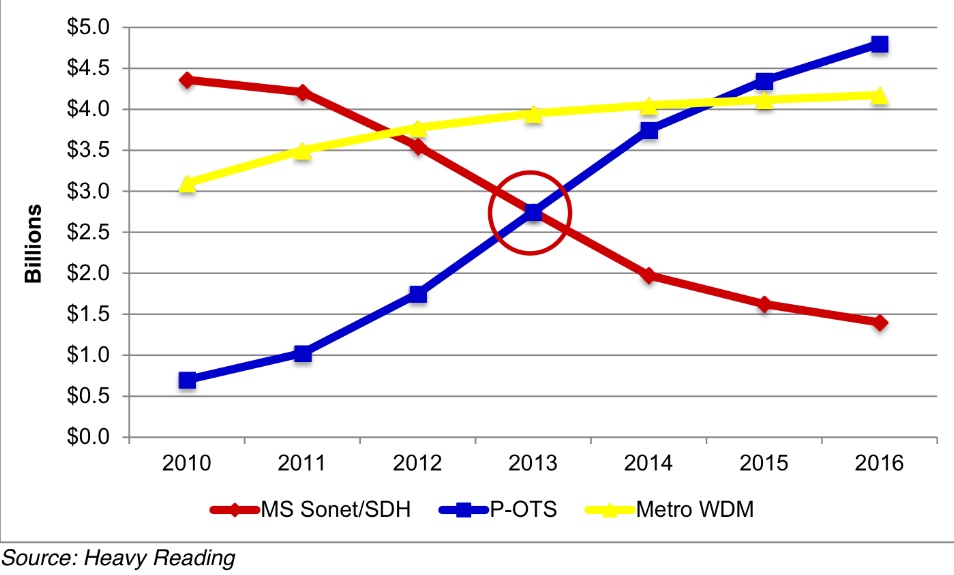
Q: Heavy Reading claims the metro packet optical transport system (P-OTS) market is entering a new phase. What are the characteristics of P-OTS 2.0 and what first-generation platform shortcomings does it address?
A: I would say four things characterise P-OTS 2.0 and separate 2.0 from the 1.0 implementations:
- The focus of packet-optical shifts from time-division multiplexing (TDM) functions to packet functions.
- Pure-packet implementations of P-OTS begin to ramp and, ultimately, dominate.
- Switched OTN (Optical Transport Network) enters the metro, removing the need for SONET/SDH fabrics in new elements.
- 100 Gigabit takes hold in the metro.
The last two points are new functions while the first two address shortcomings of the previous generation. P-OTS 1.0 suffered because its packet side was seen as sub-par relative to Ethernet "pure plays" and also because packet technology in general still had to mature and develop - such as standardising MPLS-TP (Multiprotocol Label Switching - Transport Profile).
Your survey's key findings: What struck Heavy Reading as noteworthy?
The biggest technology surprise was the tremendous interest in adding IP/MPLS functions to transport. There was a lot of debate about this 10 years ago. Then the industry settled on a de facto standard that transport includes layers 0-2 but no higher. Now, it appears that the transport definition must broaden to include up to layer 3.
A second key finding is how quickly SONET/SDH has gone out of favour. Going forward, it is all about packet innovation. We saw this shift in equipment revenues in 2012 as SONET/SDH spend globally dropped more than 20 percent. That is not a one-time hit - it's the new trend for SONET/SDH.
Heavy Reading argues that transport has broadened in terms of the networking embraced - from layers 0 (WDM) and 1 (SONET/SDH and OTN) to now include IP/MPLS. Is the industry converging on one approach for multi-layer transport optimisation? For example, IP over dense WDM? Or OTN, Carrier Ethernet 2.0 and MPLS-TP? Or something else?
We did not uncover a single winning architecture and it's most likely that operators will do different things. Some operators will like OTN and put it everywhere. Others will have nothing to do with OTN. Some will integrate optics on routers to save transponder capital expenditure, but others will keep hardware separate but tightly link IP and optical layers via the control plane. I think it will be very mixed.
You talk about a spike in 100 Gigabit metro starting in 2014. What is the cause? And is it all coherent or is a healthy share going to 100 Gigabit direct detection?
Interest in 100 Gigabit in the metro exceeds interest in OTN in the metro - which is different from the core, where those two technologies are more tightly linked.
Cloud and data centre interconnect are the biggest drivers for interest in metro 100 Gig but there are other uses as well. We did not ask about coherent versus direct in this survey, but based on general industry discussions, I'd say the momentum is clearly around coherent at this stage - even in the metro. It does not seem that direct detect 100 Gig has a strong enough cost proposition to justify a world with two very different flavours of 100 Gig.
What surprised you from the survey's findings?
It was really the interest-level in IP functionality on transport systems that was the most surprising find.
It opens up the packet-optical transport market to new players that are strongest on IP and also poses a threat to suppliers that were good at lower layers but have no IP expertise - they'll have to do something about that.
Heavy Reading surveyed 114 operators globally. All those surveyed were operators; no system vendors were included. The regional split was North America - 22 percent, Europe - 33 percent, Asia Pacific - 25 percent, and the rest of the world - Latin America mainly - 20 percent.

Optical transport to grow at a 10% CAGR through 2017
- Global optical transport market to reach US $13bn in 2017
- 100 Gigabit to grow at a 75% CAGR
 "I won't be surprised if it [100 Gig] grows even faster"
Jimmy Yu, Dell'Oro Group
The Dell'Oro Group forecasts that the global optical transport market will grow to US $13 billion in 2017, equating to a 10-percent compound annual growth rate (CAGR).
In 2012 SONET/SDH sales declined by over 20 percent, greater than Dell'Oro expected, while wavelength-division multiplexing (WDM) equipment sales held their own.
Regions
Dell'Oro expects optical transport growth across all the main regions, with no one region dominating. The market research company does foresee greater growth in Europe given the prolonged underspend of recent years.
European operators are planning broadband access investment such as fibre-to-the-cabinet/ VDSL vectoring as well as fibre-to-the-home. "That will drive demand for backhaul bandwidth and that is where WDM fits in well," says Jimmy Yu, vice president, microwave transmission, mobile backhaul and optical transport at Dell'Oro.
Technologies
Forty and 100 Gigabit optical transport will be the main WDM growth areas through 2017. Yu expects 40 Gigabit demand to grow over the forecast period even if the growth rate will taper off due to demand for 100 Gigabit.
The 100 Gigabit market continues to exceed Dell'Oro's forecasted growth. The market research company predicts 100-Gbps wavelength shipments to grow at a 75 percent CAGR over the next five years, accounting for 60 percent of the WDM capacity shipments by 2017. "I won't be surprised if it [100 Gig] grows even faster," says Yu.
"A lot of people wonder why have 40 Gig when there is 100 Gig? But that granularity does help service providers; having 40 Gig and 100 Gig rather than going straight from 10 Gig to 100 Gig," says Yu. The 100 Gig sales span metro and long-haul networks with the latter generating greater revenue due to the systems being pricier. "Forty Gigabit sales were predominantly long haul originally but we are seeing a good chunk of growth in metro as well," says Yu.
The current forecast does not include 400Gbps optical transport sales though Yu does expect sales to start in 2016.
Dell'Oro is seeing sales of 100 Gigabit direct detection but says it will remain a niche market. "We are talking tens of [shipped] units a quarter," says Yu.
There are applications where customers will need links of 80km or several hundred kilometers and will want the lowest cost solution, says Yu: "There is a market for direct detection; it will not be a significant driver for 100 Gig but it will be there."
60-second interview with .... Dell'Oro's Jimmy Yu
"For the year, it is going to be a fivefold growth rate [for 100 Gig transport]."
Jimmy Yu, Dell'Oro
Q: That fact that the market is down 5 percent on a year ago. Why is this?
A: There are a few factors. First, the macro-economy in Europe continues to get worse; that causes a slowdown.
A second factor is that in North America there was a decline in the second quarter, which is pretty unusual. Part of it, we think, might be that operators have caught up with a lot of the spending to increase broadband, after adding [to the network] for a couple of good years.
The third issue is that the China market has had a really slow start. And while there has been talk about the Chinese market softening, it seems that the CapEx [capital expenditure] is there for a strong second half.
What categories does Dell'Oro include when it talks about optical transport?
There are two main pieces: WDM [wavelength division multiplexing], both metro and long haul, and the multi-service multiplexer used for aggregation. The third piece, which is really small, is optical switching - optical cross-connect used in the core and lately more so in the metro.
According to Dell'Oro, wavelength division multiplexing was up 5 percent in the first half of 2012 compared to the same period a year ago, due to demand for 40 Gig and 100 Gig. What is happening in these two markets?
At 100 Gig we are at an inflection point where demand growth rates are really high. We've got a doubling in demand and shipments quarter-on-quarter [in the second quarter]. For the year, it is going to be a fivefold growth rate.
Also the 40 Gig is still growing. It has been around for a few years so its growth rate is not as strong [as 100 Gig transport] but it is still a significant part of the market.
Has the market settled on particular modulation scheme, especially at 40 Gig?
For 100 Gig the majority [deployed] is coherent. There is one company at least, ADVA Optical Networking, which is coming out with its direct-detection scheme for 100 Gig. This has now been shipping for one quarter. There is a market for the price point and the lower-span link of direct-detection.
For 40 Gig there is still a mix of modulations. Vendors coming out with 100 Gig coherent are also coming out with 40 Gig coherent options. So coherent at 40 Gig is now approaching half of the total market and is happening pretty quickly.
As for [40 Gig] DQPSK [differential quadrature phase-shift keying] modulation, it is probably a little bit more than DPSK [differential phase-shift keying].
You also report a rise in the adoption of optical packet products and that it contributed close to one-third of the optical market revenues in the first half 2012. Why is that?
The optical packet platform is a wider definition than just packet optical transport systems (P-OTS).
One reason why optical packet is growing is that with traditional P-OTS, you have cross-connect and switching capabilities in a WDM system so as you go to higher 40 and 100 Gig wavelengths you want some bandwidth management in that system.
Another thing is that people are trying to make the aggregation layer - the traditional SONET/SDH - more Ethernet friendly and MPLS-TP [multiprotocol label switching, transport profile] is gaining traction.
Combined, we are seeing this optical packet market has grown 12 percent year-on-year in the second quarter whereas the overall market has declined.
Dell'Oro said Huawei has 20 percent market share, which other vendors have double-digit market share?
Besides Huawei, the other vendors with double-digit percentage for the quarter - in order - are ZTE, Alcatel-Lucent and Ciena.
Did you see anything in this latest study that was surprising?
There was nothing in this quarter but I saw it last quarter. The legacy equipment – traditional SONET/SDH – is declining. Most of the market decline for optical is in legacy.
SONET/SDH sales in the second quarter of 2012 declined by 20 percent year-on-year. It is finally happening: the market is shifting away from SONET/SDH.
The OTN transport and switching market
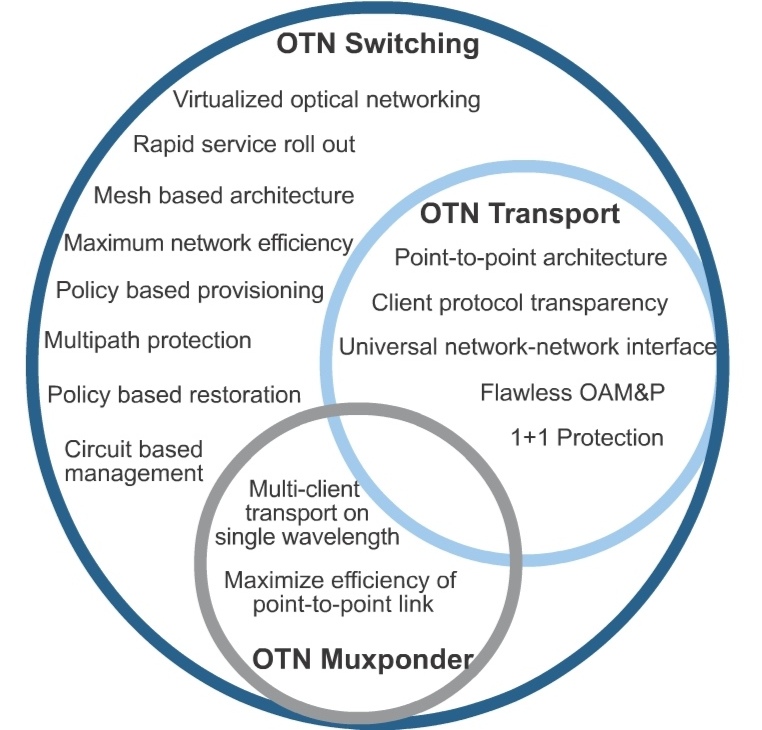 Source: Infonetics Research
The OTN transport and switching market is forecast to grow at a 17% compound annual growth rate (CAGR) from 2011 to 2016, outpacing the 5.5% CAGR of the optical equipment market (WDM, SONET/SDH). So claims a recent study on the OTN equipment marketplace by Infonetics Research.
A Q&A with report author, Andrew Schmitt, principal analyst for optical at Infonetics.
How should OTN (Optical Transport Network) be viewed? As an intermediate technology bridging the legacy SONET/SDH and the packet world? Or is OTN performing another, more fundamental networking role?
There is a deep misconception that once the voyage to an all-packet nirvana is complete, there is no need for SONET/SDH or an equivalent technology. This isn’t true. Networks that are 100% packet still need an OSI layer 1 mechanism, and to date this is mostly SDH and increasingly OTN.
OTN should be viewed as the carrier transport protocol for the foreseeable future. For many carriers, OTN will be used not just for carrying a single packet client, but for interleaving multiple clients onto the same wavelength. This is OTN switching, and it is a superset of OTN transport functionality.
Most people talk about the OTN market but they fail to distinguish between whether OTN is used as a point-to-point technology or as a switching technology that allows the creation of an electronic mesh network.
What is OTN doing within operators' networks that accounts for their strong investment in the technology?
OTN is the new physical layer protocol carrying out the OSI [Open Systems Interconnection] layer 1 functions. Carriers are investing in OTN as part of their continuing investments in WDM [wavelength division multiplexing] equipment, most of which supports OTN transport, a maturing market. The new market is that of OTN switching, which resembles the SONET/SDH multiplexing scheme, but with much better features and management.
OTN switching deployments are directly related to large scale deployments of 40G and 100G transport networks as part of what I like to call The Optical Reboot. As these new wavelength speeds are rolled out, often on unused fibre, other technologies are being introduced at the same time – things like OTN switching and new control plane methods.
"People are underestimating how hard it is to build this [OTN] hardware and combine it with control plane software"
Please explain the difference between the main platforms - OTN transport, OTN switching and P-OTS. And will they have the same relative importance by 2016?
OTN switching is a superset of OTN transport, and the differences are shown in a Venn diagram (chart above) from a recent whitepaper I wrote, Integrated OTN Switching Virtualizes Optical Networks. Somewhere between the two is the muxponder application, which is good for low-volume deployments but becomes expensive and tough to manage when used in quantity.
P-OTS (packet-optical transport systems) are boxes that combine both layer 1 (SONET/SDH and/or OTN switching) with layer 2 (Ethernet, MPLS-TP, other circuit-oriented Ethernet (COE) protocols) in the same hardware and management platform.
Cisco was one of the early leaders in this space with some creative brute-force upgrades to the venerable 15454 platform. Since then, many legacy SONET/SDH multi-service provisioning platforms (MSPPs) have seen upgrades to carry Ethernet. Some of the best examples of this platform type are the Fujitsu 9500, Tellabs' 7100, and Alcatel-Lucent's 1850.
You say a big vendor battle is brewing in the P-OTS space: Cisco, Tellabs, and Alcatel-Lucent are the top 3 vendors, but Fujitsu, Ciena, and Huawei are gaining. What factors will determine a vendor's P-OTS success here?
It really depends. In the metro-regional applications of bigger boxes, things like 100G optics and OTN switching will be more important, as the layer 2 functions are handed off to dedicated layer 2/3 machines. As you get closer to the edge, though, OTN switching will have no importance and everything will depend on the layer 2 and layer zero features.
For layer 2, this means supporting a lightweight circuit-oriented Ethernet protocol with awareness of all the various service types that might be in play. For layer zero, it is all about cheap tunable optics (tunable XFP and SFP+), but particularly ROADMs. I think BTI Photonics, Cyan, Transmode, and ADVA Optical Networking are some of the smaller players to watch here. Mobile backhaul, data centre interconnect, and enterprise data services are the big engines of growth here.
Were there any surprises as part of your research for the report?
There just are not that many vendors shipping OTN switching systems today. I think people are underestimating how hard it is to build this hardware and combine it with control plane software. In 2011, only Ciena, Huawei, and ZTE shipped OTN switching for revenue. This year we should see Alcatel-Lucent, Infinera, Nokia Siemens, and maybe a few more.
Is there one OTN trend currently unclear that you'd highlight as worth watching?
Yes: It isn’t clear to what degree carriers want integrated WDM optics in OTN switches. In the past, big SONET/SDH switches like Ciena’s CoreDirector were always shipped with short-reach optics that connected it to standalone WDM systems. I think going forward, OTN switching and the WDM transport functions must be built into the same hardware in order to get the benefits of OTN switching at the best price, and that’s why I wrote the Integrated OTN Switching white paper – to try to communicate why this is important. It is a shift in the way carriers use this equipment, though, and as you know, some carrier habits are hard to break.
Further reading
OTN Processors from the core to the network edge, click here
OTN processors from the core to the network edge
The latest silicon design announcements from PMC and AppliedMicro reflect the ongoing network evolution of the Optical Transport Network (OTN) protocol.

"There is a clear march from carriers, led in particular by China, to adopt OTN in the metro"
Scott Wakelin, PMC
The OTN standard, defined by the telecom standards body of the International Telecommunication Union (ITU-T), has existed for a decade but only recently has it emerged as a key networking technology.
OTN's growing importance is due to the enhanced features being added to the protocol coupled with developments in the network. In particular, OTN enhances capabilities that operators have long been used to with SONET/SDH, while also supporting packet-based traffic. Moreover chip vendors are unveiling OTN designs that now span the core to the network edge.
"OTN switching is a foundational technology in the network"
Michael Adams, Ciena
OTN supports 1 Gigabit Ethernet (GbE) with ODU0 framing alongside ODU1 (2.5G), ODU2 (10G), ODU3 (40G) and ODU4 (100G). The standard packs efficiently client signals such as SONET/SDH, Ethernet, video and Fibre Channel, at the various speed increments up to 100Gbps prior to transmission over lightpaths. Meanwhile, the Optical Internetworking Forum (OIF) has recently developed the OTN-over-Packet-Fabric standard that allows OTN to be switched using packet fabrics.
"OTN switching is a foundational technology in the network," says Michael Adams, Ciena’s vice president of product & technology marketing.
Operator benefits
Whereas 10Gbps services matched 10Gbps lightpaths only a few years ago, transport speeds have now surged ahead. Common services are at 1 and 10 GbE while transport is now at 40Gbps and 100Gbps speeds. OTN switching allows client signals to be combined efficiently to fill the higher capacity lightpaths and avoid stranded bandwidth in the network.
OTN also benefits network connectivity changes. With AT&T's Optical Mesh Service, for example, customers buy a total capacity and, using a web portal, can adapt connectivity between their sites as requirements change. "It [OTN] can manage GbE streams and switch them through the network in an efficient manner," says Adams.
The ability to adapt connectivity is also an important requirement for cloud computing, with OTN switching and a mesh control plane seen as a promising way to enable dynamic networking that provides guaranteed bandwidth when needed, says Ciena.
OTN also offers an alternative to IP-over-DWDM, argues Ciena. By adding a 100Gbps wavelength, service routers can exploit OTN to add 10G services as needed rather than keep adding a 10Gbps wavelength for each service using IP-over-DWDM. "To enable service creation quickly, why not put your router network on top of that network versus running it directly?" says Adams.
OTN hardware announcements
The latest OTN chip announcements from PMC and Applied Micro offer enhanced capacity when aggregating and switching client signals, while also supporting the interfacing to various switch fabrics.
PMC has announced two metro OTN processors, dubbed the HyPHY 20Gflex and 10Gflex. The devices are targeted at compact "pizza boxes" that aggregate residential, enterprise and mobile backhaul traffic, as well as packet-optical and optical transport platforms.
AppliedMicro's TPACK unit has unveiled two additions to its OTN designs: a 100Gbps chipset and the TPO134. The company also announced the general availability of its 100Gbps muxponder and transponder OTN design, now being deployed in the network.
 Source: AppliedMicro
"OTN has long had a home in the core of the network," says Scott Wakelin, product manager for HyPHY flex at PMC. "But there is a clear march from carriers, led in particular by China, to adopt OTN in the metro, whether layer-zero or layer-one switched."
Using various market research forecasts, PMC expects the global OTN chip market to reach US $600 million in 2015, the bulk being metro.
PMC and AppliedMicro offer application-specific standard product (ASSP) OTN ICs while AppliedMicro also offers FPGA-based OTN designs.
The benefits of using an FPGA, says AppliedMicro, include time-to-market, the ability to reprogramme the design to accommodate standards’ tweaks, and enabling system vendors to add custom logic elements to differentiate their designs. PMC develops ASSPs only, arguing that such chips offer superior integration, power efficiency and price points.
Both companies, when developing an ASSP, know that the resulting design will be adopted by end customers. When PMC announced its original HyPhy family of devices, seven of the top nine OEMs were developing board designs based on the chip family.
PMC's metro OTN processors
The HyPHY 20Gflex has 16 SFP (up to 5Gbps) and two 10Gbps XFP/SFP+ interfaces, whose streams it can groom using the device's 100Gbps cross-connect. The cross-connect can manipulate streams down to SONET/SDH STS-1/ STM-0 rates and ODU0 (1GbE) OTN channels.
Both ODU0 and ODUflex channels are supported. Before adding ODU0, a Gigabit Ethernet channel could only sit in a 2.5Gbps (ODU1) container, which wastes half the capacity. Similarly by supporting ODUflex, signals such as video can be mapped into frames made up of increments of 1.25Gbps. "For efficient use of resources from the metro into the core, you need to start at the access," said Wakelin.
 Source: PMC
The chip also supports the OTN-over-Packet-Fabric protocol. The devices can interface to OTN, SONET/SDH and packet switch fabrics.
The 20Gflex offers 40Gbps of OTN framing and a further 20Gbps of OTN mapping. The OTN mapping is used for those client signals to be fitted into ODU frames. With the additional 40Gbps interfaces that connect to the switch fabric, the total interface throughput is 100Gbps, matching the device's cross-connect capacity.
Other chip features include Fast Ethernet, Gigabit Ethernet and 10GbE MACs for carrier Ethernet transport, and support for timing over packet standards, including IEEE 1588v2 over OTN, used to carry mobile backhaul timing information.
The 10Gflex variant has similar functionality to the 20Gflex but with lower throughput.
PMC is now sampling the HyPHY Gflex devices to lead customers.
AppliedMicro's OTN designs
AppliedMicro's TPACK unit has unveiled two OTN designs: a TPO415/C415 OTN multiplexer chipset for use in 100Gbps packet optical transport line cards, and the TPO134 device used at the network edge.
The two devices combined - the TPO415 and TPOC415 - are implemented using FPGAs, what AppliedMicro dubs softsilicon. The two devices interface between the 100Gbps line side and the switch fabric. The TPO415 takes the OTU4 line side OTN signal and demultiplexes it to the various channel constituents. These can be ODU0, ODU1, ODU2, ODU3, ODU4 and ODUflex - capacity from 1Gbps to 100Gbps.

"The [100Gbps muxponder] design comes with an API that makes it look like one component"
Lars Pedersen, AppliedMicro
The TPOC415 has a 100Gbps, 80-channel segmentation and reassembly function (SAR) compliant with the OIF OTN-over-Packet-Fabric standard. The TPOC415 also has a 100Gbps, 80 channel packet mapper function for the transport of Ethernet and MPLS-TP over ODUk or ODUflex. The device's 100Gbps Interlaken interface is used to connect to the switch fabric for packet switching and ODU cross-connection. The devices can also be used in a standalone fashion for designs where the switch fabric does not use Interlaken, or when working with integrated switches and network processors.
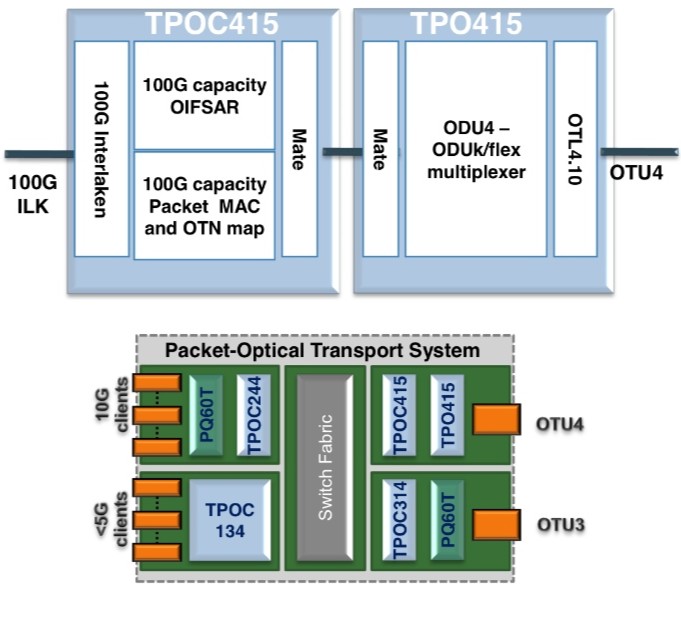 Source: AppliedMicro
"This is the first solution in the market for doing these hybrid functions at 100Gbps," says Lars Pedersen, CTO of AppliedMicro's TPACK.
The second design is the softsilicon TPO134, a 10Gbps add/drop multiplexer that can take in up to 16 clients signals and has two OTU2 interfaces. In between is the cross-connect that supports ODU0, ODU1 and ODUflex channels. Two devices can be combined to support 32 client channels and four OTU2 interfaces. Such a dual-design in a pizza-box system would be used to combine multiple client streams.
Being softsilicon, the TPO134 can also be used for packet optical transport systems. Here by downloading a different FPGA image, the design can also implement the segmentation and reassembly function required for the OIF's OTN-over-Packet-Fabric standard. "The interface to the switch fabric is Interlaken again," says Pedersen.
The TPO134 design doubles the capacity of AppliedMicro's previous add/drop multiplexer designs and is the first to support the OIF standard.
AppliedMicro has also announced the general availability of its 100G muxponder design. The muxponder design is a three-device chipset based on two PQ60 ASSPs and a TPO404 softsilicon design.
The PQ60T devices map 10 and 40Gbps clients into OTN and the TPO404 performs the multiplexing to OTU4 with forward error correction. The client signals supported include SONET/SDH, Ethernet and Fibre Channel. On the line side the design also supports various FEC schemes including an enhanced FEC. The TPO404 differ from the TPOT414/424 devices that link 100GbE and 100Gbps line side.
"The [100Gbps muxponder] design comes with an API [application programming interface] that makes it look [from a software perspective] like one component with some client and line ports, similar to the TPO134 device," says Pedersen.
Further reading:
Transport processors now at 100 Gigabit