

Books of 2024: Part 2
Gazettabyte asks industry figures to pick their reads of the year. In Part 2, Scott Wilkinson, Nigel Toon and Kailem Anderson select their best reads.
Scott Wilkinson, Lead Analyst, Networking Components, Cignal AI
I spent the year enjoying a poem a day from Brian Bilston’s Days Like These: An Alternative Guide to the Year in 366 Poems.
You may have seen his poems on social media, as he’s sometimes called The Poet Laureate of Twitter. It’s been a joy to end the day with one of his hilarious, occasionally poignant, and always topical poems.
I ended the year completing Andrew Roberts’ Napoleon: A Life. After the disappointing 2023 film, I wanted to know more about the person for whom an era of European history is named. At almost 1,000 pages, the author is remarkably thorough. Napoleon had a brilliant mind and his many achievements are lost in the legend of his military wins and losses. There’s no way I’ll remember all the details in the biography, but living in it for a few months was fascinating.
One book that I recommend to everyone is An Immense World: How Animal Senses Reveal the Hidden Realms Around Us by Ed Yong. In this amazing book, the author spends a chapter on the senses and looks at how animals experience the world around us. We have historically coloured the world based on our ability to perceive it, which is just a small fraction of the stimuli surrounding us. The author doesn’t just cover the five senses that humans rely on but investigates echolocation, the ability of seals to follow fish trails through water, magnetic navigation, and more.
I guarantee you won’t be able to read a chapter without relaying fascinating facts to anyone sitting nearby. The chapter on smell will change how you walk your dog. The chapter on sight will help you understand why we use RGB colour codes – and why they wouldn’t be the right choice for other animals. The chapters on senses humans don’t use will blow your mind and leave you wondering how much you’re missing on a casual walk through the park. It’s a book that any engineer, scientist, or curious mind will enjoy, and it is a great gift. And no, I don’t get residuals.
Every year at the holidays, I get a huge stack of books, a few of which I discovered through these articles. I didn’t get through my complete stack this year thanks to Mr. Bonaparte’s rich history, but that won’t stop me from picking up a few more again this holiday season. I look forward to seeing everyone else’s picks.
Nigel Toon, co-founder and CEO at Graphcore
My recommendation is Henry Kissinger on China. The book offers amazing insights into the relationship between the USA and China, which is as relevant today as when it was written in 2011.
Kailem Anderson, Vice President, Global Products & Delivery, Blue Planet
I love reading books on the history of technology. I’m currently reading Palo Alto: A History of Silicon Valley Capitalism and the World by Malcolm Harris. As an industry, it’s amazing how new technology can become old and then the old becomes new again. We forget the old and recycle many of the same issues from one technology transition to the next. I’m fascinated by learning from the past to see if solutions from our technology past can apply to the future.
I’m also reading Stephen Hawking’s Brief Answer to the Big Questions. This is a great book that stretches the mind on abstract concepts such as the universe, technology, predicting the future, and examining whether artificial intelligence will outsmart us. The book provides an insight into one of the most amazing minds, Stephen Hawking, and asks big-picture questions that we are afraid to ask ourselves.
Lastly, I would recommend Ali—A Life by Jonathan Eig. The book is an amazing read about Muhammad Ali’s life, how he took on the establishment, and how he broke down stereotypes and prejudices. Despite being rejected for his beliefs, Ali stood by his convictions to change people’s perceptions and become one of the greatest and most admired people of the 20th century.


Books in 2023
Gazettabyte asks industry figures to pick their reads of the year. William Koss, Dean Bubley and Scott Wilkinson kick off this year’s recommended reads.
William R Koss, CEO at Drut Technologies
My 2023 reading list is less than normal as the year has been full of technical reading and presentation materials for work. I enjoy history books as well as business history that tell the rise and fall of some company, industry or person.
In Progress
Target Tokyo: The Story of the Sorge Spy Ring by Gordon W. Prange: I picked this book out of Amazon’s recommendation list. Gordon Prange being the author of At Dawn We Slept and Tora, Tora, Tora. Currently plowing through this book that was unfinished at the time of his death.
The Crusades: The War for the Holy Land by Thomas Asbridge. My knowledge of the Crusades was thin and I was looking for a book that provided a grand overview. So far it has not disappointed, but I have had to familiarize myself with many new names.
Completed Reads
Band of Brothers: E Company, 506th Regiment, 101st Airborne, from Normandy to Hitler’s Eagle’s Nest by Stephen E. Ambrose. A second read for me as I watched the series on Netflix over the summer and the thought occurred to read the book and compare and contrast the series to the book. Ambrose is a wonderful writer.
Going Infinite: The Rise and Fall of a New Tycoon by Michael Lewis. I was raising venture capital during the crypto craze from the same firms SBF raised capital and I admit that reading this book is part schadenfreude.
Circle of Treason: CIA Traitor Aldrich Ames and the Men He Betrayed by Sandra Grimes and Jeanne Vertefeuille.A second read for me. Something triggered the thought of Aldrich Ames and I read the book in two days.
The Wager: A Tale of Shipwreck, Mutiny and Murder by David Grann. A very fun read and puts into perspective the speed of news and information that we enjoy today. People thought along the time scale of years in the 1700s
This Kind of War: The Classic Korean War History by T.R. Fehrenbach. My father was in the Korean War and I have read many a book on the subject. It was a new read for me.
Duel in the Sun: Alberto Salazar, Dick Beardsley, and America’s Greatest Marathon by John Brant. My hobby is road cycling, but I have a colleague who has run the Boston Marathon a few times. The Boston Marathon route is within walking distance of my house and my colleague recommended this book as the best book written on marathon racing. I finished it on a couple of airplane rides.
Unscripted: The Epic Battle for a Media Empire and the Redstone Family Legacy by James B. Stewart and Rachel Abrams. A complete disappointment. The book was recommended by a former colleague and I just did not find all the personal details that interesting. I think I was hoping for a better read along the lines of the series Succession which had just ended and that was the reason for my reading.
Castles of Steel: Britain, Germany, and the Winning of the Great War at Sea by Robert K. Massie. Robert Massie is a master historian. One of the greats of our time. I have read Dreadnaught and Castles of Steel a few times. This book is master level history telling. Magnificent in all regards. Sections of the book can be read as short books. The story of Von Spee’s journey from the Pacific to Atlantic could be a single book. I am about to start his book Nicholas and Alexandra about the fall of the Romanov Dynasty.
Dean Bubley, technology industry analyst & futurist at Disruptive Analysis
A recent stand-out for me is Material World: The Six Raw Materials That Shape Modern Civilization by Ed Conway.
I found the book fascinating. It helped me gain a new angle on a lot of the issues faced in the economy and society overall, as well as specific bits of the tech sector.
It tells the stories of the production, processing, transport and use of some of the core minerals we use throughout society and technology. The book covers:
- sand/silicon used for concrete and also semiconductors and optical fibre
- lithium for batteries
- copper for cables, generators and motors
- oil & gas and why they’re still necessary at least for creating products rather than combustion (such as carbon anodes in batteries)
- salt(s) for multiple purposes
- iron & steel
One of the things I often realise is that it is easy to get wrapped up in technology including telecoms. We talk about virtualisation, AI, cloud, orchestration and software all the time.
There’s also a lot of physics. I often talk about radio spectrum and wireless propagation, including 5G and WiFi indoors and through walls. But I don’t pay much attention to the chemistry and materials involved.
This book poses some hard questions, such as where we get enough lithium (and also cobalt and other metals) for decarbonisation, or enough copper for new generators and grid capacity.
My takeout is that the next 20-30 years involve a tightrope walk, buffeted by the winds of physical materials, economics, geopolitics and hidden dependencies. It’s all very well saying ‘just stop doing X’, but sometimes (at least some) of X is essential in order to continue making Y or doing Z.
We also must be careful not just about “supplier diversity” for complex systems like radio access network equipment, or even the components and chips, but all the way down to the raw materials, which may be mined or refined in only a few places around the world.
Worth a read or a listen. I’m an audiobook devotee & this is narrated well enough to listen at 3x speed.
Scott Wilkinson, lead analyst, networking components, Cignal AI
There have been several books this year that I recommended to friends and colleagues. The Cartel by Don Winslow provides unique insights (for fiction) into the crisis at the southern US border.
My son, a Biomechanical Engineering Master’s student at Virginia Tech, and I both read Andy Weir’s Project Hail Mary. It’s like candy to engineers and I enjoyed discussing it with him as he made his way through the chapters.
I recently finished Rod Chernow’s massive biography, Grant, which was fascinating on every page, especially to those who were erroneously taught that he was a mediocre general who won the Civil War due only to attrition and not due to his strategic genius.
But the one book that I recommend the most to my engineering colleagues and history fans is The Great Bridge: The Epic Story of the Building of the Brooklyn Bridge by David McCullough. I’ve read several of McCullough’s histories, but never got around to reading this, his first. The Great Bridge tells the story of the building of the Brooklyn Bridge. It was an engineering feat that is hard to comprehend today.
Anyone driving or taking a subway train across the East River nay have difficulty imagining a time when Brooklyn and Manhattan were separate cities. The only way to get from one to the other was by ferry, and the residents in Brooklyn were worried that any more permanent connection might bring NYC corruption across the river. Washington Roebling took over the project when his father unexpectedly died early in the planning stages. With only his mind and his pencil, he designed every aspect of the bridge from the caissons sunk deep into the river to the cables spanning the towers. Plagued by an unknown disease he contracted after repeatedly descending into the pressurized caissons (what we now know as the bends), Roebling – and his very underappreciated wife, Emily – nevertheless managed a feat that boggles the mind, especially for engineers who let computers do the heavy lifting today.
The book describes challenges ranging from river currents to corruption to political interference, and parallels to modern times are not hard to make. Yet, almost 100 years later, when the bridge was inspected, the only recommendation was to add a coat of paint. The engineering is breathtaking, but the ability of the Chief Engineer to accomplish it with the tools of his time and with all of the roadblocks thrown up is awe-inspiring.
On a recent visit to New York to visit my daughter during her internship at the AMNH, I tried to convince the family to all travel down to the Brooklyn Bridge, just to look at it again in person. I was overruled, but that’s ok. It’ll still be there the next time, and for a long time after.

The market opportunity for linear drive optics
A key theme at OFC earlier this year that surprised many was linear drive optics. Its attention at the optical communications and networking event was intriguing because linear drive – based on using remote silicon to drive photonics – is not new.
“I spoke to one company that had a [linear drive] demo on the show floor,” says Scott Wilkinson, lead analyst for networking components at Cignal AI. “They had been working on the technology for four years and were taken aback; they weren’t expecting people to come by and ask about it. “
The cause of the buzz? Andy Bechtolsheim, famed investor, co-founder and chief development officer of network switching firm Arista Networks and, before that, a co-founder of Sun Microsystems.
“Andy came out and said this is a big deal, and that got many people talking about it,” says Wilkinson, author of a recent linear drive market research report.
Linear Drive
A data centre’s switch chip links to the platform’s pluggable optics via an electrical link. The switch chip’s serialiser-deserialiser (serdes) circuitry drives the signal across the printed circuit board to the pluggable optical module. A digital signal processor (DSP) chip inside the pluggable module cleans and regenerates the received signal before sending it on optically.
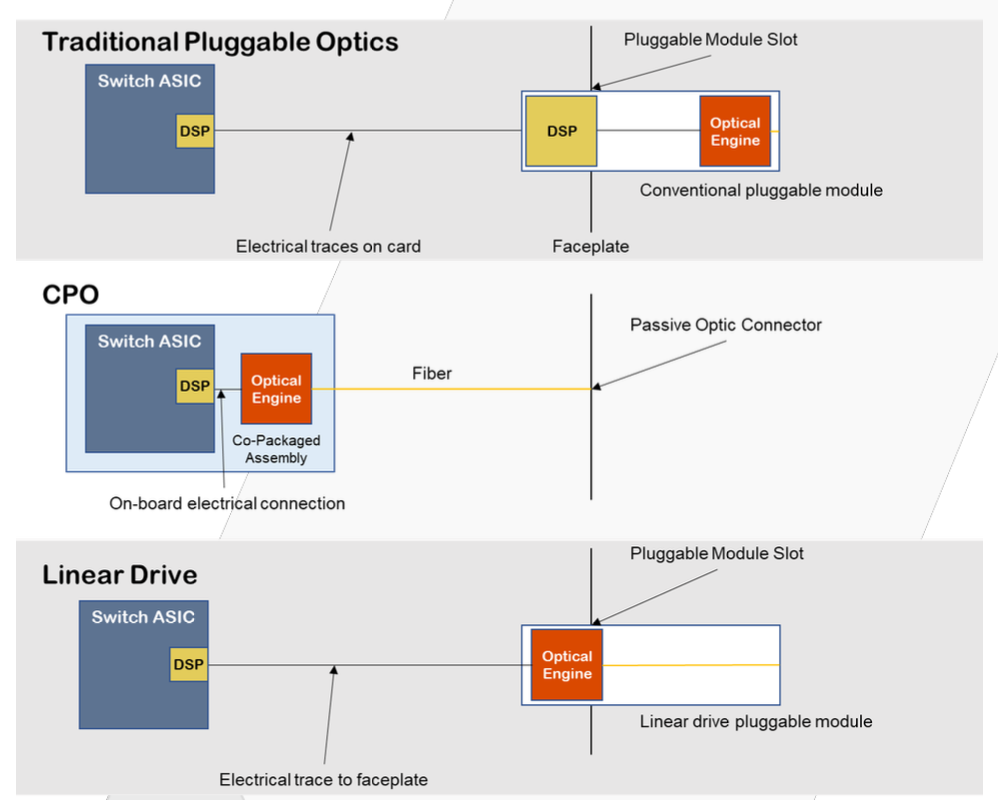
With linear drive optics, the switch ASIC’s serdes directly drives the module optics, removing the need for the module’s DSP chip. This cuts the module’s power consumption by half.
The diagram above contrasts linear drive optics compared with traditional pluggables and the emerging technology of co-packaged optics where the optics are adjacent to the switch chip and are packaged together. Linear drive optics can be viewed as a long-distance variant of co-packaged optics that comntinues to advance pluggable modules.
Proponents of linear drive claim that the power savings are a huge deal. “There will probably also be some cost savings, but it is not entirely clear how big they will be,” says Wilkinson. “But the only thing people want to discuss is the power savings.”
Misgivings
If linear drive’s main benefit is reducing power consumption, the technology’s sceptics counter with several technical and business issues.
One shortfall is that a module’s electrical and optical lanes must match in number and hence data rate. If there is a mismatch, the signal speeds must be translated between the electrical and optical lane rates, known as gearboxing. This task requires a DSP. Linear drive optics is thus confined to 800-gigabit optical modules: 800GBASE-DR8 and 800-gigabit 2xFR4. “There are people who think that at least 800 Gig – eight lanes in and eight lanes out – will continue to exist for a long time,” says Wilkinson.
Another question mark concerns the use of optics for artificial intelligence workloads. Adopters of AI will be early users of 200 gigabit-per-lane optics, requiring a gearbox-performing DSP.
Moreover, the advent of 200-gigabit electrical lanes will challenge serdes developers and, hence, linear drive designs. “It will be a technical challenge, the distances will be shorter, and some think it may never work,” says Wilkinson. “No matter how good the serdes is, it will not be easy.”
Co-packaged optics will also hit its stride once 200-gigabit serdes-based switch chips become available.
Another argument is that there are many ways to save power in the data centre; if linear drive introduces complications, why make it a priority?
Linear drive optics requires the switch chip vendors to develop high-quality serdes. Wilkinson says the leading switch vendors remain agnostic to linear drive, which is not a ringing endorsement. And while hyperscalers are investing time and resources into linear-drive technology, none have endorsed the technology such that they can withdraw at any stage without penalty.
“There is one story for linear drive and many stories against it,” admits Wilkinson. “When you compile them, it’s a pretty big story.”
Market opportunity
Cignal AI believes linear-drive optics will prove a niche market, with 800-gigabit linear-drive modules capturing 10 per cent of overall 800-gigabit pluggable shipments in 2027.
Wilkinson says the most promising example of the technology is active optical cables, where the modules and cables are a closed design. And while many companies are invested in the technology, and it will be successful, the opportunity will not be as significant as the proponents hope.