

ECOC '22 Reflections - Part 3
Gazettabyte is asking industry and academic figures for their thoughts after attending ECOC 2022, held in Basel, Switzerland. In particular, what developments and trends they noted, what they learned, and what, if anything, surprised them.
In Part 3, BT’s Professor Andrew Lord, Scintil Photonics’ Sylvie Menezo, Intel’s Scott Schube, and Quintessent’s Alan Liu share their thoughts.
Professor Andrew Lord, Senior Manager of Optical Networks Research, BT
There was strong attendance and a real buzz about this year’s show. It was great to meet face-to-face with fellow researchers and learn about the exciting innovations across the optical communications industry.
The clear standouts of the conference were photonic integrated circuits (PICs) and ZR+ optics.
PICs are an exciting piece of technology; they need a killer use case. There was a lot of progress and discussion on the topic, including an energetic Rump session hosted by Jose Pozo, CTO at Optica.
However, there is still an open question about what use cases will command volumes approaching 100,000 units, a critical milestone for mass adoption. PICs will be a key area to watch for me.
We’re also getting more clarity on the benefits of ZR+ for carriers, with transport through existing reconfigurable optical add-drop multiplexer (ROADM) infrastructures. Well done to the industry for getting to this point.
All in all, ECOC 2022 was a great success. As one of the Technical Programme Committee (TPC) Chairs for ECOC 2023 in Glasgow, we are already building on the great show in Basel. I look forward to seeing everyone again in Glasgow next year.
Sylvie Menezo, CEO of Scintil Photonics
What developments and trends did I note at ECOC? There is a lot of development work on emergent hybrid modulators.
Scott Schube, Senior Director of Strategic Marketing and Business Development, Silicon Photonics Products Division at Intel.
There were not a huge amount of disruptive announcements at the show. I expect the OFC 2023 event will have more, particularly around 200 gigabit-per-lane direct-detect optics.
Several optics vendors showed progress on 800 gigabit/ 2×400 gigabit optical transceiver development. There are now more vendors, more flavours and more components.
Generalising a bit, 800 gigabit seems to be one case where the optics are ready ahead of time, certainly ahead of the market volume ramp.
There may be common-sense lessons from this, such as the benefits of technology reuse, that the industry can take into discussions about the next generation of optics.
Alan Liu, CEO of Quintessent
Several talks focused on the need for high wavelength count dense wavelength division multiplexing (DWDM) optics in emerging use cases such as artificial intelligence/ machine learning interconnects.
Intel and Nvidia shared their vision for DWDM silicon photonics-based optical I/O. Chris Cole discussed the CW-WDM MSA on the show floor, looking past the current Ethernet roadmap at finer DWDM wavelength grids for such applications. Ayar Labs/Sivers had a DFB array DWDM light source demo, and we saw impressive research from Professor Keren Bergman’s group.
An ecosystem is coalescing around this area, with a healthy portfolio and pipeline of solutions being innovated on by multiple parties, including Quintessent.
The heterogeneous integration workshop was standing room only despite being the first session on a Sunday morning.
In particular, heterogeneously integrated silicon photonics at the foundry level was an emergent theme as we heard updates from Tower, Intel, imec, and X-Celeprint, among other great talks. DARPA has played – and plays – a key role in seeding the technology development and was also present to review such efforts.
Fibre-attach solutions are an area to watch, in particular for dense applications requiring a high number of fibres per chip. There is some interesting innovation in this area, such as from Teramount and Suss Micro-Optics among others.
Shortly after ECOC, Intel also showcased a pluggable fibre attach solution for co-packaged optics.
Reducing the fibre packaging challenge is another reason to employ higher wavelength count architectures and DWDM to reduce the number of fibres needed for a given aggregate bandwidth.

Scintil Photonics looks to add light to silicon
It’s the second day of Christmastide and Sylvie Menezo is working: “I enjoyed the last two days and now I’m back at work.”
But then it should not be surprising given how Menezo is both the CEO and CTO of Scintil Photonics, the French start-up that secured €4.4 million in first-round funding last year.
Origins
Scintil Photonics’ expertise is in the design of silicon photonics circuits and the addition of active III-V materials – for lasing, gain and modulation – to a silicon substrate.
The start-up is using its funding to move its technology from the lab to production, working with an unnamed commercial foundry. The firm is also growing its staff, from eight to a dozen by the year-end.
Menezo worked previously at CEA-Leti, a French technology research institute, where her roles included heading the silicon photonics lab and business development.
In her business role, there was interest from customers in Leti’s silicon photonics technology but, at the time, its III-V technology on silicon was not ready.
“There was an opportunity of putting III-V on silicon but quite a bit of investment was needed to make the technology more mature,” she says. “This is where you need quick money and a 100 per cent dedicated team.”
Menezo discussed the idea of a start-up with CEA-Leti and once the organisation was satisfied that the proposed venture could succeed, it enabled her to step down to focus solely on developing the technology.
In return, the organisation that oversees Leti, CEA Tech, took a share in the start-up before it sought funding. This is one of CEA Tech’s duties, says Menezo, to create jobs.
“Once the patent technology was strengthened, we went outside and looked for funding,” she says.
Technology
Scintil Photonics has both indium phosphide and silicon photonics expertise. The start-up’s plans to develop and sell fully photonic integrated circuits (PICs). The start-up’s optical component library includes lasers, modulators, waveguides, wavelength filters, and photodetectors.
“We have a fabrication process which is CMOS-friendly and which relies on existing silicon-photonics technology,” says Menezo. “We want to have silicon and III-V fabricated and we want to commercialise photonic ICs.”
Scintil’s work with a commercial foundry will take its technology to production using a standard silicon photonics process.
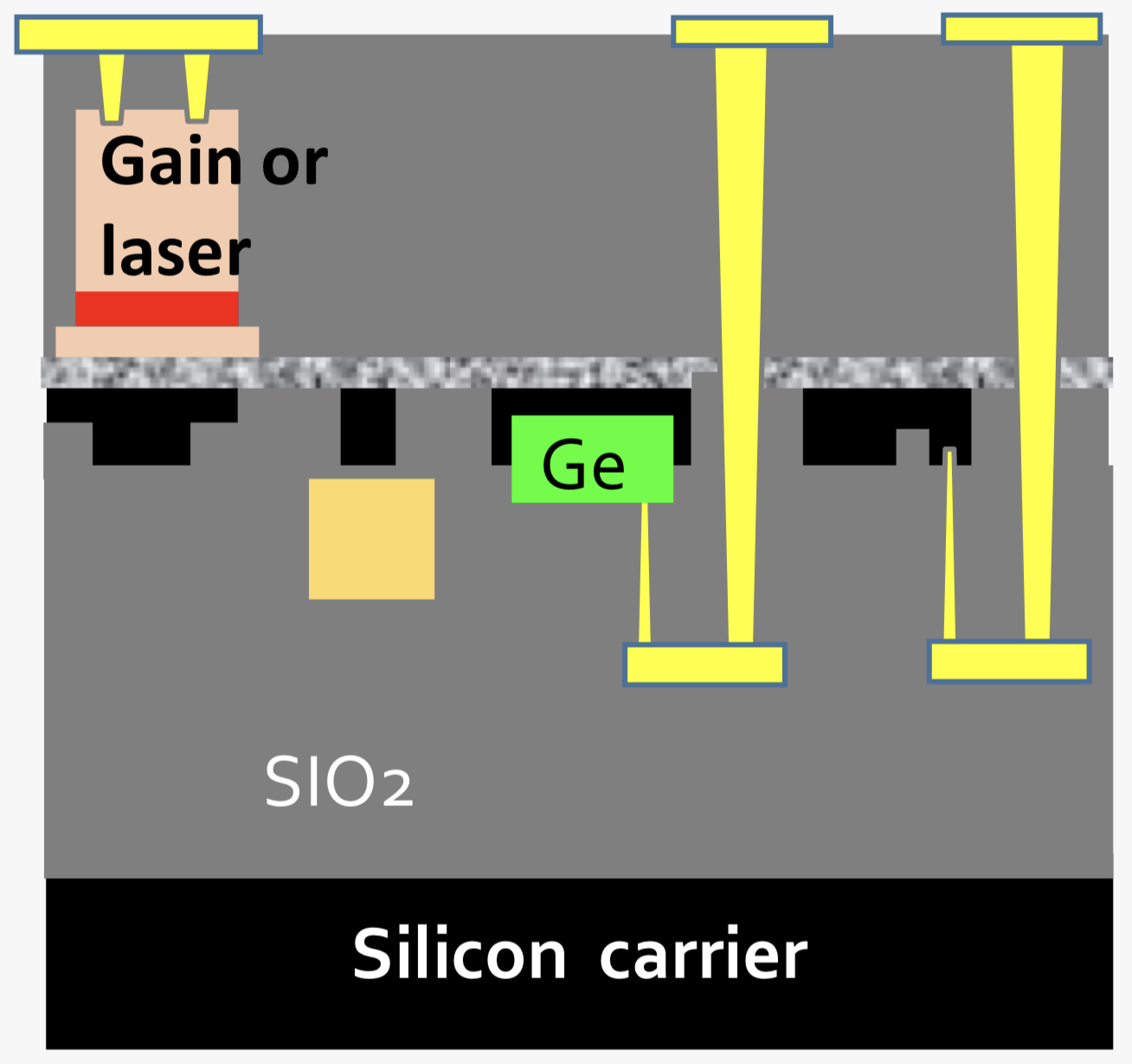
Once the silicon photonics chips are fabricated on a wafer, Scintil’s process bonds the wafer onto a silicon carrier, flips it and etches off the silicon-on-insulator (SOI) substrate.
Indium phosphide is bonded onto the exposed silicon layer before being processed to fabricate such active components as lasers, semiconductor optical amplifiers and hybrid modulators using CMOS fabrication techniques (see image).
Menezo describes the fabrication as CMOS-friendly: standard off-the-shelf processes are used while the processing of III-V is CMOS-compatible in terms of etching and electrical contacts.
Scintil’s process is also scalable, she says: new materials and functions will be added over time to the silicon photonics processes without impacting the integration of III-V materials onto the silicon.
“The more you design these devices and circuits, the more you see the design opportunities you have,” says Menezo. “This is the future if people manage to make it as a friendly as CMOS technology.”
Applications
Scintil Photonics is already working on circuit prototypes with the foundry.
The prototypes include coherent components for optical transmission and designs for 800-gigabit and 1.6-terabyte client-side interfaces. These are based on parallelising existing 400-gigabit DR4 and FR4 designs.
“For an 800-gigabit, the use of eight lanes [each lane being 100 gigabits] is indeed a good target because of [the need for] more integration,” says Menezo. “We can also scale to higher-speed lanes with our hybrid indium phosphide/ silicon photonics modulator.”
Eight-hundred gigabit modules are only needed from 2022 at the earliest.
Another application area for the technology is co-packaged optics, using optical interfaces to move data on- and off-chip.
Menezo says that the company is already thinking about the next round of funding but that it is at least two years away.

Books in 2019
Gazettabyte asks industry figures each year to cite the memorable books they have read. These include fiction, non-fiction and work-related titles.
Here are the choices of Cisco’s Bill Gartner, Sylvie Menezo of silicon photonics start-up, Scintil Photonics, and Andrew Schmitt, directing analyst at Cignal AI.
Bill Gartner, Senior Vice President and General Manager, Cisco Optical Systems and Optics.
At the top of my list is The Gene: An Intimate History, by Siddhartha Mukherjee. Mukherjee does an amazing job of telling the story of the gene, providing historical context dating back to pre-Darwin times through to modern advances in gene therapy. The material is complex but he is great at describing the evolution of thinking about genes and progress in the genome project in layman’s terms.
The book leaves me in awe of how much has been accomplished, especially in the past 20 years, and yet how much more we have to learn about this fascinating topic, how progress in this area might be applied to solve some of medicine’s most challenging problems, and the moral dilemma that we confront as we think about altering nature’s work.
The Billionaire Who Wasn’t: How Chuck Feeney Secretly Made and Gave Away a Fortune by Conor O’Clery is an amazing story of a man who went from rags to riches, built one of the most profitable private businesses in history (Duty-Free Shops), and earned billions. He then gave it all away and did so anonymously. He lived frugally and was adamant that his contributions be kept secret. It is an inspiring story of an American hero who touched the lives of millions who will never know.
Longitude: The True Story of a Lone Genius Who Solved the Greatest Scientific Problem of His Time by Dava Sobel includes a foreword by Neil Armstrong. I am fascinated by stories that highlight how one individual persists in a vision and has a major impact on the world. In the 18th century, it was common for entire fleets of ships to run aground or get lost as navigation techniques were primitive.
Latitude was relatively straightforward, based on the angle of the sun relative to the horizon (and the date), but determining longitudinal position was often guesswork. After several disasters, including one where over 200 sailors were killed, the British government established a prize for the solution.
This is a fantastic story of a relatively unknown watchmaker who single-handedly solved the problem and then persuaded the sceptics that his chronometer was superior to any available method.
Lastly, I read Franklin and Winston: An Intimate Portrait of an Epic Friendship by Jon Meacham. This is a fantastic story of the intimate and at times stormy relationship between FDR and Winston Churchill. The story, unlike many WWII narratives, is told from the perspective of their interactions. FDR and Churchill were magnificent leaders, each of whom took a principled stand against Nazism and Fascism. It is also frightening to contemplate the course history may have taken had lesser leaders been in place.
Sylvie Menezo, CEO and CTO of Scintil Photonics.
The book I recommend is a novel I read this summer, La Tresse (The Braid) by Laetitia Colombani. It is a tale of three women, each from a different continent and experiencing different living conditions, yet their lives happen to be connected by something at the end of the book. To me, all three are very beautiful and strong women figures, moved by a ‘different something’ deep inside them, and that is what makes them beautiful!
Andrew Schmitt, founder and directing analyst at Cignal AI
It was a good reading year for me. Starting with fiction, my overall pick of the year is the Three-Body Problem series by Cixin Liu, a science fiction story of epic scale that stretches from the Cultural Revolution in China into the distant future.
It was written in Chinese and as a result, the style, prose and cultural perspective are different in a refreshing way. This series is right up there with Dune, Asimov and all the sci-fi greats. It is a must-read if that is your thing.
Martha Wells turned out more short novels to conclude the Murderbot Diaries, a series that I reviewed in 2018. I also read Neal Stephenson’s FALL; or, Dodge in Hell: A Novel this year. He’s maintained a steady production of books but I don’t think his latest books are as good as his archive (Snow Crash, Cryptonomicon, others). FALL was very disappointing, particularly the second half – I don’t recommend it. Read the archive instead.
It was an intense non-fiction year, so I’ll hit the good stuff that I strongly recommend.
I picked up Nobody Wants to Read Your Sh*t: And Other Tough-Love Truths to Make You a Better Writer by Steven Pressfield on a twitter recommendation and it resonated with me. So much written market research lacks respect and appreciation of the client’s time and Pressfield shares simple, useful tips to make your reader care about what you are writing. Anyone who writes for others should read this, and it is quick.
This book leads me to one of Pressfield’s big hits, Gates of Fire: An Epic Novel of the Battle of Thermopylae, a narrative history of the Spartans and the battle. As an engineer, I never had the time – and frankly, the interest – to study Ancient Greece. Pressfield vividly brings Sparta and Greece to life and recounts the events leading up to the battle of the famous “300”. A fantastic book.
My son had to read Midnight in Chernobyl: The Untold Story of the World’s Greatest Nuclear Disaster by Adam Higginbotham over the summer for High School.
We read it together; a highly recommended thing to do with your teenagers. Better yet, after the book, we were treated with the excellent “Chernobyl” drama on HBO. If you liked the HBO series, definitely read the book as it tells the story in a comprehensive and detailed way without an artistic license. The size, scale, and sacrifices endured by the Soviets to contain the disaster are incredible. The organisational ineptitude before and right after the event are horrifying. The same top-down decision hierarchy that caused the problem was paradoxically the only way to get it cleaned up.
My last recommendation is Shoe Dog: A Memoir – by the Creator of Nike, by Phil Knight. It recounts the genesis of the company as a supplier of track shoes made in Japan following WWII as the country rapidly emerged as an export powerhouse. It is a book about post-war Japan, raw entrepreneurship, and building what at the time was a new sales and marketing model combining athletics and fashion. One of the better business books I’ve read.
Books in 2019 – Final part, click here