
BT’s first quantum key distribution network

The trial of a commercial quantum-secured metro network has started in London.
The BT network enables customers to send data securely between sites by first sending encryption keys over optical fibre using a technique known as quantum key distribution (QKD).
The attraction of QKD is that any attempt to eavesdrop and intercept the keys being sent is discernable at the receiver.
The network uses QKD equipment and key management software from Toshiba while the trial also involves EY, the professional services company.
EY is using BT’s network to connect two of its London sites and will showcase the merits of QKD to its customers.
London’s quantum network
BT has been trialling QKD for data security for several years. It had announced a QKD trial in Bristol in the U.K. that uses a point-to-point system linking two businesses.
BT and Toshiba announced last October that they were expanding their QKD work to create a metro network. This is the London network that is now being trialled with customers.
Building a quantum-secure network is a different proposition from creating point-to-point links.
“You can’t build a network with millions of separate point-to-point links,” says Professor Andrew Lord, BT’s head of optical network research. “At some point, you have to do some network efficiency otherwise you just can’t afford to build it.”
BT says quantum security may start with bespoke point-to-point links required by early customers but to scale a secure quantum network, a common pipe is needed to carry all of the traffic for customers using the service. BT’s commercial quantum network, which it claims is a world-first, does just that.
“We’ve got nodes in London, three of them, and we will have quantum services coming into them from different directions,” says Lord.
Not only do the physical resources need to be shared but there are management issues regarding the keys. “How does the key management share out those resources to where they’re needed; potentially even dynamically?” says Lord.
He describes the London metro network as QKD nodes with links between them.
One node connects Canary Wharf, London‘s financial district. Another node is in the centre of London for mainstream businesses while the third node is in Slough to serve the data centre community.
“We’re looking at everything really,” says Lord. “But we’d love to engage the data centre side, the financial side – those two are really interesting to us.”
Customers’ requirements will also differ; one might want a quantum-protected Ethernet service while another may only want the network to provide them with keys.
“We have a kind of heterogeneous network that we’re starting to build here, where each customer is likely to be slightly different,” says Lord.
QKD and post-quantum algorithms
QKD uses physics principles to secure data but cryptographic techniques also being developed are based on clever maths to make data secure, even against powerful future quantum computers.
Such quantum-resistant public-key cryptographic techniques are being evaluated and standardised by the US National Institute of Standards and Technology (NIST).
BT says it plans to also use such quantum-resistant techniques and are part of its security roadmap.
“We need to look at both the NIST algorithms and the key QKD ones,” says Lord. “Both need to be developed and to be understood in a commercial environment.“
Lord points out that the encryption products that will come out of the NIST work are not yet available. BT also has plenty of fibre, he says, which can be used not just for data transmission but also for security.
He also points out that the maths-based techniques will likely become available as freeware. “You could, if you have the skills, implement them yourself completely freely,” says Lord. “So the guys that make crypto kits using these maths techniques, how do they make money?”
Also, can a user be sure that those protocols are secure? “How do you know that there isn’t a backdoor into those algorithms?” says Lord. “There’s always this niggling doubt.”
BT says the post-quantum techniques are valuable and their use does not preclude using QKD.
Satellite QKD
Satellites can also be used for QKD.
Indeed, BT has an agreement with UK start-up Arqit which is developing satellite QKD technology whereby BT has exclusive rights to distribute and market quantum keys in the UK and to UK multinationals.
BT says satellite and fibre will both play a role, the question is how much of each will be used.
“They work well together but the fibre is not going to go across oceans, it’s going to be very difficult to do that,” says Lord. “And satellite does that very well.”
However, satellite QKD will struggle to provide dense coverage.
“If you think of a low earth orbit satellite coming overhead, it’s only gonna be able to lock onto to one ground station at a time, and then it’s gone somewhere else around the world,” says Lord. More satellites can be added but that is expensive.
He expects that a small number of satellite-based ground stations will be used to pick up keys at strategic points. Regional key distribution will then be used, based on fibre, with a reach of up to 100km.
“You can see a way in which satellite the fibre solutions come together,” says Lord, the exact balance being determined by economics.
Hollow-core fibre
BT says hollow-core fibre is also attractive for QKD since the hollowness of the optical fibre’s core avoids unwanted interaction between data transmissions and the QKD.
With hollow-core, light carrying regular data doesn’t interact with the quantum light operating at a different wavelength whereas it does for standard fibre that has a solid glass core.
“The glass itself is a mechanism that gets any photons talking to each other and that’s not good,” says Lord. “Particularly, it causes Raman scattering, a nonlinear process in glass, where light, if it’s got enough power, creates a lot of different wavelengths.”
In experiments using standard fibre carrying classical and quantum data, BT has had to turn down the power of the data signal to avoid the Raman effect and ensure the quantum path works.
Classical data generate noise photons that get into the quantum channel and that can’t be avoided. Moreover, filtering doesn’t work because the photons can’t be distinguished. It means the resulting noise stops the QKD system from working.
In contrast, with hollow-core fibre, there is no Raman effect and the classical data signal’s power can be ramped to normal transmission levels.
Another often-cited benefit of hollow-core fibre is its low latency performance. But for QKD that is not an issue: the keys are distributed first and the encryption may happen seconds or even minutes later.
But hollow-core fibre doesn’t just offer low latency, it offers tightly-controlled latency. With standard fibre the latency ‘wiggles around’ a lot due to the temperature of the fibre and pressure. But with a hollow core, such jitter is 20x less and this can be exploited when sending photons.
“As time goes on with the building of quantum networks, timing is going to become increasingly important because you want to know when your photons are due to arrive,” says Lord.
If a photon is expected, the detector can be opened just before its arrival. Detectors are sensitive and the longer they are open, the more likely they are to take in unwanted light.
“Once they’ve taken something in that’s rubbish, you have to reset them and start again,” he says. “And you have to tidy it all up before you can get ready for the next one. This is how these things work.“
The longer that detector can be kept closed, the better it performs when it is opened. It also means a higher key rate becomes possible.
“Ultimately, you’re going to need much better synchronisation and much better predictability in the fibre,” says Lord. “That’s another reason why I like hollow-core fibre for QKD.”
Quantum networks
“People focussed on just trying to build a QKD service, miss the point; that’s not going to be enough in itself,” says Lord. “This is a much longer journey towards building quantum networks.”
BT sees building quantum small-scale QKD networks as the first step towards something much bigger. And it is not just BT. There is the Innovate UK programme in the UK. There are also key European, US and China initiatives.
“All of these big nation-states and continents are heading towards a kind of Stage I, building a QKD link or a QKD network but that will take them to bigger things such as building a quantum network where you are now distributing quantum things.”
This will also include connecting quantum computers.
Lord says different types of quantum computers are emerging and no one yet knows which one is going to win. He believes all will be employed for different kinds of use cases.
“In the future, there will be a broad range of geographically scattered quantum computing resources, as well as classical compute resources,” says Lord. “That is a future internet.”
To connect such quantum computers, quantum information will need to be exchanged between them.
Lord says BT is working with quantum computing experts in the UK to determine what the capabilities of quantum computers are and what they are good at solving. It is classifying quantum computing capabilities into the different categories and matching them with problems BT has.
“In some cases, there’s a good match, in some cases, there isn’t,” says Lord. “So we try to extrapolate from that to say, well, what would our customers want to do with these and it’s a work in progress.”
Lord says it is still early days concerning quantum computing. But he expects quantum resources to sit alongside classical computing with quantum computers being used as required.
“Customers probably won’t use it for very long; maybe buying a few seconds on a quantum computer might be enough for them to run the algorithm that they need,” he says. In effect, quantum computing will eventually be another accelerator alongside classical computing.
”You already can buy time by the second on things like D-Wave Systems’ quantum computers, and you may think, well, how is that useful?” says Lord. “But you can do an awful lot in that time on a quantum computer.”
Lord already spends a third of his working week on quantum.
“It’s such a big growing subject, we need to invest time in it,” says Lord.

Making optical networking feel like cycling downhill
BT’s chief architect, Neil McRae, is a fervent believer in the internet, a technology built on the continual progress of optical networking. He discussed both topics during his invited talk at the recent OFC 2021 virtual conference and exhibition.
Neil McRae’s advocacy of the internet as an educational tool for individuals from disadvantaged backgrounds stems from his childhood experiences.
“When I was a kid, I lived in a deprived area and the only thing that I could do was go to the library,” says McRae, chief architect and managing director for architecture and technology strategy at BT.
His first thought on discovering the internet was just how much there was to read.
“If I’m honest, everything I’ve learnt in technology has been pretty much self-taught,” says McRae.
This is why he so values the internet. It has given him a career where he has travelled widely and worked with talented and creative people.
“Anyone who is out there in the world can do the same thing,” he says. “I strongly believe that the internet brings opportunities to people who are willing to spend the time to learn.”
Optical networking
McRae surveyed the last 20 years of optical networking in his OFC talk. He chose the period since it was only at the end of the last century that the internet started to have a global impact.
“The investment in networking [during this period] has been orders of magnitude bigger than prior years,” says McRae. “There has also been a lot of deregulation across the world, more telecoms companies, more vendors and ultimately more people getting connected.”
In 2000, networks used the SONET/SDH protocol and fixed wavelengths. “We have brought in many new technologies – coherent, coloured optics, programable lasers and silicon photonics – and they have been responsible for pretty significant changes.”
McRae likens optical network to gears on a bike. “It powers the rest of what we do in the network and without those advances, we wouldn’t be the digitally connected society we are today,” says McRae. “If I think about the pandemic of the last year, can you imagine what the pandemic would have been like if it had happened in the year 2000?”
McRae says he spends a fifth of his time on optical networking. This is more than previously due to the relentless growth in network bandwidth.
“Ultimately, if you get optical wrong, it feels like you are in the wrong gear cycling uphill,” says McRae. “If you get it right, you are in the right gear, you are going as fast as you can go and it feels like a downhill ride.”
And it’s not just bandwidth but also from a cost, capability and customer experience perspective. “We recognise the value that it brings to all the other layers right up to the application,” he says.
Research
BT Labs has an optical networking programme that is run by Professor Andrew Lord. The programme’s remit is to help BT address existing and future issues.
“There is a longer-term research aspect to what Andrew and his team do, but there are some here-and-now issues that they support me on like the hollow-core fibre work and some of the 400-gigabit [coherent] platforms we have been reviewing recently,” he says.
He cites as examples the work the programme did for BT’s next-generation optical platform that was designed for growth and which indeed has grown massively in the last decade. “We have launched optical services as a product because of the platform,” says McRae.
The programme has also helped Openreach, BT Group’s copper and fibre plant subsidiary, with its fibre-to-the-premise (FTTP) deployments that use such technologies as GPON and XGS-PON.
Reliable, dynamic, secure networks
McRae admits he is always nervous about predicting the future. But he is confident 400 gigabits will be a significant optical development over the next decade.
This includes inside the data centre, driven by servers, and in the network including long haul.
“The challenge will be around getting the volume and interoperability as quickly as we possibly can,” says McRae.
The other big opportunity is the increased integration of IP and optical using a control plane aligned to both.
“The biggest networking technology out there is IP,” says McRae. “And that will not change in the coming decade.”
The Layer-3 capabilities include working around issues but it is bad at managing bandwidth. Optical is the opposite: great at managing bandwidth but less dynamic for working around problems. Merging the two promises significant benefits.
This idea, advocated as IP-over-DWDM, has long been spoken of but has not been deployed widely. The advent of 400-gigabit coherent implemented using client-side modules means that the line-side interface density can equal that of the host. And other developments such as software-defined networking and artificial intelligence also help.
Software-defined networking will make a big difference because it will enable the move to automation and that will enable new technologies such as artificial networking (AI) and machine-learning to be introduced.
McRae talks of a control plane capable of deciding which interface to send packets down and also determine what paths to create across the optical infrastructure.
“We have seen some of that but we have not seen enough,” says McRae. AI and machine-learning technologies will provide networks with almost autonomous control over which paths to use and enable for the various traffic types the network sees.
McRae stresses that it is getting harder to get the maximum out of the network: “If we maintain human intervention, the network will never see its full potential because of complexity, demands and scale.”
He predicts that once the human component is taken out of the network, some of the silos between the different layers will be removed. Indeed, he believes networks built by AI and aided by automation will look very different to today’s networks.
Another technology McRae highlights is hollow-core fibre which BT Labs has been researching.
“Increasingly, we are starting to reach some limits although many folks have said that before, but hollow-core fibre gives us some interesting and exciting opportunities around latency and the total use of a fibre,” says McRae.
There are still challenges to be overcome such as manufacturing the fibre at scale but he sees a path in many parts of the network where hollow-core fibre could be valuable to BT.
Quantum key distribution (QKD) and the importance of network security is another area starting to gain momentum.
“We have gone from a world where people were scared to send an email rather than a fax to one where the network is controlling mission-critical use cases,” says McRae. “The more secure and reliable we make those networks, the more it will help us in our everyday lives.”
McRae believes this is the decade where the underlying optical network capability coupled with QKD security will take effect.
Making a difference
McRae has run several events involving children with autism although during the pandemic this has not happened. He uses gaming as a way to demonstrate how electronics works – switching things on and off – and then he introduces the concept of computer programming.
“I find that kids with autism get it really quickly” he says. BT runs such events two or three times a year.
McRae also works with children who are learning to program but find it difficult. “Again, it is something self-taught for me,” he says although he quips that the challenge he has is that he teaches them bad programming habits.
“I’m keen to find the next generation of fantastic engineers; covid has shown us that we need them more than ever,” he says.

A quantum leap in fear
The advent of quantum computing poses a threat which could break open the security systems protecting the world’s financial data and transactions.
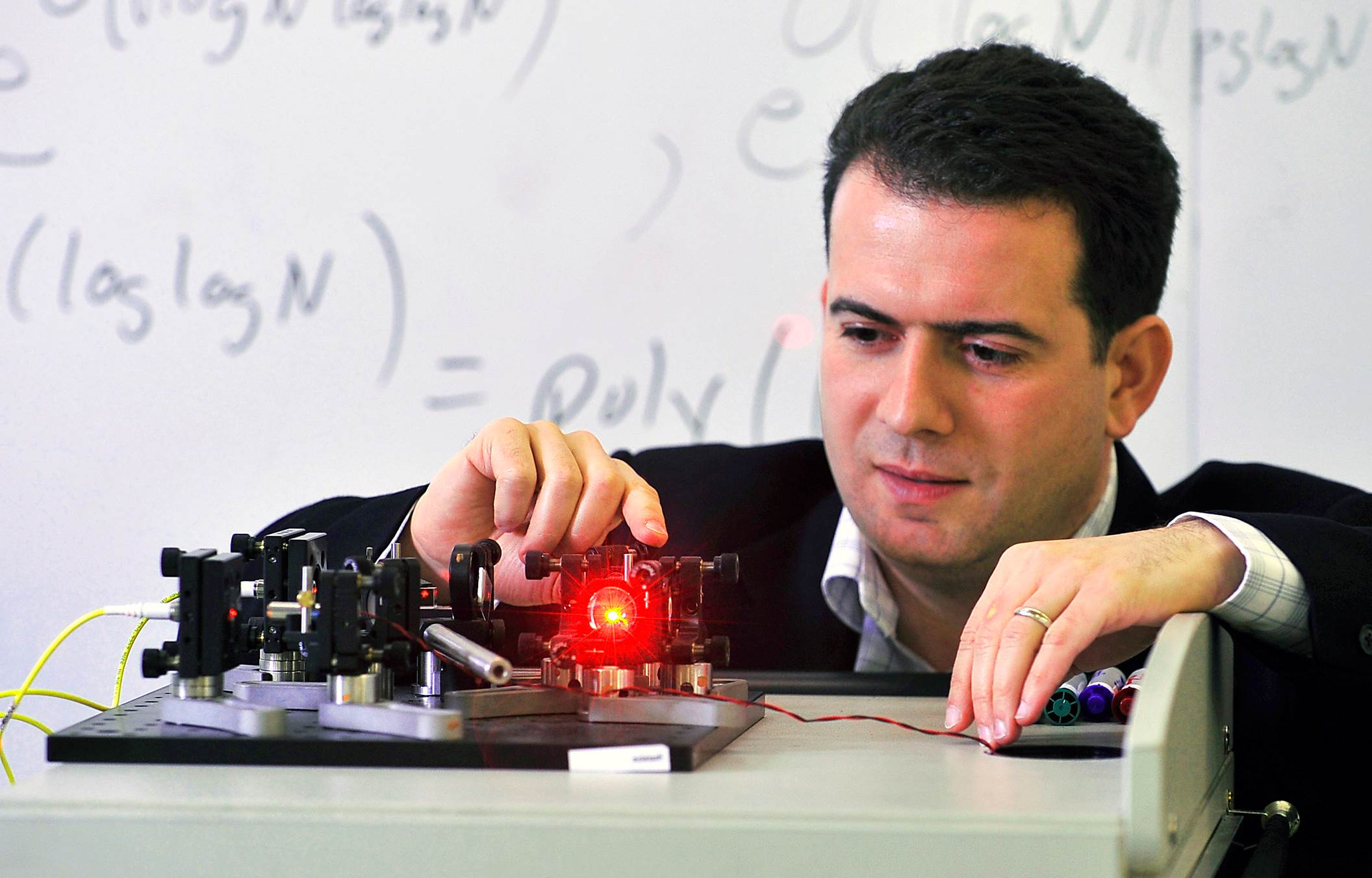 Professor Michele Mosca
Protecting financial data has always been a cat-and-mouse game. What is different now is that the cat could be de-clawed. Quantum computing, a new form of computer processing, promises to break open the security systems that safeguard much of the world’s financial data and transactions.
Quantum computing is expected to be much more powerful than anything currently available because it does not rely on the binary digits 1 or 0 to represent data but exploits the fact that subatomic particles can exist in more than one state at once.
Experts cannot say with certainty when a fully-fledged quantum computer will exist but, once it does, public key encryption schemes in use today will be breakable. Quantum computer algorithms that can crack such schemes have already been put through their paces.
The good news is that cryptographic techniques resilient to quantum computers exist. And while such “quantum-safe” technologies still need to be constructed, security experts agree that financial institutions must prepare now for a quantum-computer world.
Experts cannot say with certainty when a fully-fledged quantum computer will exist but, once it does, public key encryption schemes in use today will be breakable
Ticking clock
There is a 50 percent chance that a quantum computer will exist by 2031, according to Professor Michele Mosca, co-founder of the Institute for Quantum Computing at the University of Waterloo, Canada, and of security company evolutionQ.
A one-in-two chance of a fully working quantum computer by 2031 suggests financial institutions have time to prepare, but that is not the case. Since financial companies are required to keep data confidential for many years, quantum-safe protocols need to be in place for the same length of time that confidentiality is mandated prior to quantum computing. So, for example, if data must be kept confidential for seven years, quantum-safe techniques need to be in place by 2024 at the latest. Otherwise, cyber criminals need only intercept and store RSA-encrypted data after 2024 and wait until 2031 to have a 50-50 chance of access to sensitive information.
Unsurprisingly, replacing public key infrastructure with quantum-safe technology is itself a multi-year project. First, the new systems must be tested and verified to ensure they meet existing requirements – not just that their implementation is secure but that their execution times for various applications are satisfactory. Then, all the public key infrastructure needs to be revamped – a considerable undertaking. This means that, if upgrading infrastructure takes five years, companies should be preparing if quantum computers arrive by 2031.
Professor Renato Renner, the head of the quantum information theory research group at ETH Zurich, the Swiss science and technology university, sees the potential for even more immediate risk. “Having a full-blown quantum computer is not necessarily what you need to break cryptosystems,” he says. In his view, financial companies should be worried that there are already early examples of quantum computers that are stronger than current computers. “It could well be that in five years we have already sufficiently powerful devices that can break RSA cryptosystems,” says Renner.
Quantum-safe approaches
Quantum-safe technologies comprise two approaches, one based on maths and another that exploits the laws of physics.
The maths approach delivers new public key algorithms that are designed to be invulnerable to quantum computing, known as post-quantum or quantum-resistant techniques.
The US National Institute of Science and Technology is taking submissions for post-quantum algorithms with the goal of standardising a suite of protocols by the early to mid-2020s. These include lattice-based, coding-based, isogenies-based and hash-function-based schemes. The maths behind these schemes is complex but the key is that none of them is based on the multiplication of prime numbers and hence susceptible to factoring, which is what quantum computers excel at.
It could well be that in five years we have already sufficiently powerful devices that can break RSA cryptosystems
Nigel Smart, co-founder of Dyadic Security, a software-defined cryptography company, points out that companies are already experimenting with post-quantum lattice schemes. Earlier this year, Google used it in experimental versions of its Chrome browser when talking to its sites. “My betting is that lattice-based systems will win,” says Smart.
The other quantum-safe approach exploits the physics of the very small – quantum mechanics – to secure links so that an eavesdropper on the link cannot steal data. Here particles of light – photons – are used to send the key used to encrypt data (see Cryptosystems – two ways to secure data below) where each photon carries a digital bit of the key.
Financial and other companies that secure data should already be assessing the vulnerabilities of their security systems
Should an adversary eavesdrop with a photodetector and steal the photon, the photon will not arrive at the other end. Should the hacker be more sophisticated and try to measure the photon before sending it on, here they come up against the laws of physics where measuring a photon changes its parameters.
Given these physical properties of photons, the sender and receiver typically reserve at random a number of the key’s photons to detect a potential eavesdropper. If the receiver detects an altered photon, the change suggests the link is compromised.
But quantum key distribution only solves a particular class of problem – for example, protecting data sent across links such as a bank sending information to a data centre for back-up. Moreover, the distances a single photon can travel is a few tens of kilometres. If longer links are needed, intermediate trusted sites are required to regenerate the key, which is expensive and cumbersome.
The technique is also dependent on light and so is not as widely applicable as quantum-resistant techniques. “People are more interested in post-quantum cryptography,” claims Smart.
What now?
BT, working with Toshiba and ADVA Optical Networking, the optical transport equipment maker, has demonstrated a quantum-protected link operating at 100 gigabits-per-second.
What is missing still is a little bit more industrialisation,” says Andrew Lord, head of optical communications at BT. “Quantum physics is pretty sound but we still need to check that the way this is implemented, there are no ways of breaching it.”
 Kelly Richdale
ID Quantique, the Swiss quantum-safe crypto technology company, supplied one early-adopter bank with its quantum key distribution system as far back as 2007. The bank uses a symmetric key scheme coupled with a quantum key.
“You can think of it as adding an additional layer of quantum security on top of everything you already have,” says Kelly Richdale, ID Quantique’s vice-president of quantum-safe security.
“Quantum key distribution has provable security. You know it will be safe against a quantum computer if implemented correctly,” she says. “With post-quantum algorithms, it is a race against time, since in the future there may be new quantum attacks that could render them as vulnerable as RSA.”
Andersen Cheng, chief executive of start-up PQ Solutions, a security company with products including secure communication using post-quantum technology, argues that both quantum- resistant and quantum key distribution will be needed. “You can use both but quantum key distribution on its own is not enough and it is expensive,” he says.
Most organisations do not have a detailed map of where all their information assets are and which business functions rely on which crypto algorithms
What next?
Mosca says that leading financial services companies are aware of the threat posed by quantum computing but their strategies vary: some point to more pressing priorities while others want to know what they can buy now to solve the problem.
He disagrees with both extreme approaches. Financial companies should, in his view, already be assessing the vulnerabilities of their systems. “Most organisations do not have a detailed map of where all their information assets are and which business functions rely on which crypto algorithms,” he says.
Companies should also plan for their systems to change a lot over the next decade. That is why it is premature to settle on a solution now since it will probably need upgrading. And they must test quantum-resistant algorithms. “We don’t have a winner yet,” says Mosca.
Most importantly, financial institutions cannot afford to delay. “Do you really want to be in the catch-up game and hope someone else will solve the problem for you?” asks Mosca.
The article first appeared in the June-July issue of the Financial World, the journal of The London Institute of Banking & Finance, published six times per year in association with the Centre for The Study of Financial Innovation (CSFI).
Cryptosystems – two ways to secure data
To secure data, special digital “keys” are used to scramble the information. Two encryption schemes are used – based on asymmetric and symmetric keys.
Public key cryptography that uses a public and private key pair is an example of an asymmetric scheme. The public key, as implied by the name, is published with the user’s name. Any party wanting to send data securely to the user employs the published public key to scramble the data. Only the recipient, with the associated private key, can decode the sent data. The RSA algorithm is a widely used example. (RSA stands for the initials of the developers: Ron Rivest, Adi Shamir and Leonard Adleman.) A benefit of public key cryptography is that it can be used as a digital signature scheme as well as for protecting data. The downside is that it requires a lot of processing power and is slow even then.
Symmetric schemes, in contrast, are much less demanding to run and use the same key at both link ends to lock and unlock the data. A well-known symmetric key algorithm is the Advanced Encryption Standard, which uses keys up to 256-bits long (AES-256); the more bits, the more secure the encryption.
The issue with the symmetrical scheme is getting the secret key to the recipient without it being compromised. One way is to send a security guard handcuffed to a locked case. A more digital-age approach is to send the secret key over a secure link. Here, public key cryptography can be used; the asymmetric key scheme can be employed to protect the symmetric key transmission prior to secure symmetric communication.
Quantum computing is a potent threat because it undermines both schemes when existing public key cryptography is involved.

BT bolsters research in quantum technologies
BT is increasing its investment in quantum technologies. “We have a whole team of people doing quantum and it is growing really fast,” says Andrew Lord, head of optical communications at BT.
The UK incumbent is working with companies such as Huawei, ADVA Optical Networking and ID Quantique on quantum cryptography, used for secure point-to-point communications. And in February, BT joined the Telecom Infra Project (TIP), and will work with Facebook and other TIP members at BT Labs in Adastral Park and at London’s Tech City. Quantum computing is one early project.
 Andrew LordThe topics of quantum computing and data security are linked. The advent of quantum computers promises the break the encryption schemes securing data today, while developments in quantum cryptography coupled with advances in mathematics promise new schemes resilient to the quantum computer threat.
Securing data transmission
To create a secure link between locations, special digital keys are used to scramble data. Two common data encryption schemes are used, based on symmetric and asymmetric keys.
A common asymmetric key scheme is public key cryptography which uses a public and private key pair that are uniquely related. The public key is published along with its user’s name. Any party wanting to send data securely to the user looks up their public key and uses it to scramble the data. Only the user, which has the associated private key, can unscramble the data. A widely used public-key crypto-system is the RSA algorithm.
There are algorithms that can be run on quantum computers that can crack RSA. Public key crypto has a big question mark over it in the future and anything using public key crypto now also has a question mark over it.
In contrast, symmetric schemes use the same key at both link ends, to lock and unlock the data. A well-known symmetric key algorithm is the Advanced Encryption Standard which uses keys up to 256-bits long (AES-256); the more bits, the more secure the encryption.
The issue with a symmetrical key scheme, however, is getting the key to the recipient without it being compromised. One way is to deliver the secret key using a security guard handcuffed to a case. An approach more befitting the digital age is to send the secret key over a secure link, and here, public key cryptography can be used. In effect, an asymmetric key is used to encrypt the symmetric key for transmission to the destination prior to secure communication.
But what worries governments, enterprises and the financial community is the advent of quantum computing and the risk it poses to cracking public key algorithms which are the predominant way data is secured. Quantum computers are not yet available but government agencies and companies such as Intel, Microsoft and Google are investing in their development and are making progress.
Michele Mosca estimates that there is a 50 percent chance that a quantum computer will exist by 2030. Professor Mosca, co-founder of the Institute for Quantum Computing at the University of Waterloo, Canada and of the security firm, evolutionQ, has a background in cyber security and has researched quantum computing for 20 years.
This is a big deal, says BT’s Lord. “There are algorithms that can be run on quantum computers that can crack RSA,” he says. “Public key crypto has a big question mark over it in the future and anything using public key crypto now also has a question mark over it.”
A one-in-two chance by 2030 suggests companies have time to prepare but that is not the case. Companies need to keep data confidential for a number of years. This means that they need to protect data to the threat of quantum computers at least as many years in advance since cyber-criminals could intercept and cache the data and wait for the advent of quantum computers to crack the coded data.
Upping the game
The need to have secure systems in place years in advance of quantum computer systems is leading security experts and researchers to pursue two approaches to data security. One uses maths while the other is based on quantum physics.
Maths promises new algorithms that are not vulnerable to quantum computing. These are known as post-quantum or quantum-resistant techniques. Several approaches are being researched including lattice-based, coding-based and hash-function-based techniques. But these will take several years to develop. Moreover, such algorithms are deemed secure because they are based on sound maths that is resilient to algorithms run on quantum computers. But equally, they are secure because techniques to break them have not been widely investigated, by researchers and cyber criminals alike.
The second, physics approach uses quantum mechanics for key distribution across an optical link, which is inherently secure.
“Do you pin your hopes on a physics theory [quantum mechanics] that has been around for 100 years or do you base it on maths?” says BT’s Lord. “Or do you do both?”
In the world of the very small, things are linked, even though they are not next to each other
Quantum cryptography
One way to create a secure link is to send the information encoded on photons - particles of light. Here, each photon carries a single bit of the key.
If the adversary steals the photon, it is not received and, equally, they are taking information that is no use to them, says Lord. A more sophisticated technique is to measure the photon while it passes through but here they come up against the quantum mechanical effect where measuring a photon changes its parameters. The transmitter and receiver typically reserve at random a small number of the key’s photons to detect a potential eavesdropper. If the receiver detects photons that were not sent, the change alerts them that the link has been compromised.
The issue with such quantum key distribution techniques is that the distances a single photon can be sent are limited to a few tens of kilometres only. If longer links are needed, intermediate secure trusted sites are used to regenerate the key. These trusted sites need to be secure.
Entanglement, whereby two photons are created such that they are linked even if they are physically in separate locations, is one way researchers are looking to extend the distance keys can be distributed. With such entangled photons, any change or measurement of one instantly affects the twin photon. “In the world of the very small, things are linked, even though they are not next to each other,” says Lord.
Entanglement could be used by quantum repeaters to increase the length possible for key distribution not least for satellites, says Lord: “A lot of work is going on how to put quantum key distribution on orbiting satellites using entanglement.”
But quantum key distribution only solves a particular class of problem such as protecting data sent across links, backing up data between a bank and a data centre, for example. The technique is also dependent on light and thus is not as widely applicable as post-quantum algorithms. "There is a view emerging in the industry that you throw both of these techniques [post quantum algorithms and quantum key distribution] especially at data streams you want to keep secure."
Practicalities
BT working with Toshiba and optical transport equipment maker ADVA Optical Networking have already demonstrated a quantum protected link operating at 100 gigabits-per-second.
BT’s Lord says that while quantum cryptography has been a relatively dormant topic for the last decade, this is now changing. “There are lots of investment around the world and in the UK, with millions poured in by the government,” he says. BT is also encouraged that there are more companies entering the market including Huawei.
“What is missing is still a little bit more industrialisation,” says Lord. “Quantum physics is pretty sound but we still need to check that the way this is implemented, there are no ways of breaching it; to be honest we haven't really done that yet.”
BT says it has spent the last few months talking to financial institutions and claims there is much interest, especially with quantum computing getting much closer to commercialisation. “That is going to force people to make some decisions in the coming years,” says Lord.