

Transmode adopts 100 Gigabit coherent CFPs
Transmode has detailed line cards that bring 100 Gigabit coherent CFP optical modules to its packet optical transport platforms.

We can be quicker to market when newer DSP-based CFPs appear
Jon Baldry
"We believe we are the first to market with line-side coherent CFPs, bringing pluggable line-side optics to a WDM portfolio," says Jon Baldry, technical marketing director at Transmode. Baldry says that other system vendors already support non-coherent CFP modules on their line cards and that further vendor announcements using coherent CFPs are to be expected.
The Swedish system vendor announced three line cards: a 100 Gig transponder, a 100 Gig muxponder and what it calls its Ethernet muxponder (EMXP) card. The first two cards support wavelength division multiplexing (WDM) Layer 1 transport: the 100 Gig transponder card supports two 100 Gig CFP modules while the 100 Gig muxponder supports 10x10 Gig ports and a CFP.
The third card, the EMXP220/IIe, has a capacity of 220 Gig: 12x10 Gigabit Ethernet ports and the CFP, with all 13 ports supporting optional Optical Transport Network (OTN) framing. "You can think of it as a Layer 2 switch on a card with 13 embedded transponders," says Baldry. The three cards each take up two line card slots.
Transmode's platforms are used for metro and metro regional networks. Metro has more demanding cost, space and power efficiency requirements than long distance core networks. "The move that the whole industry is taking to CFP or pluggable-based optics is a big step forward [in meeting metro's requirements]," says Baldry.
The line cards will be used with Transmode's metro edge TM-Series packet optical family that is suited for applications such as mobile backhaul and business services. "Within packet-optical networks, we can do customer premise Gigabit Ethernet all the way through to 100 Gig handover to the core on the same family of cards running the same Layer 2 software," says Baldry. Transmode believes this capability is unique in the industry.
The TM-3000 chassis is 11 rack units (RU) high and can hold eight double-slot cards, for a total of 800 Gig CFP line side capacity.
 Source: Transmode
100 Gig coherent modules
Transmode is talking to several 100 Gig coherent CFP module makers. The company will use multiple suppliers but says it is currently working with one manufacturer whose product is closer to market.
Acacia Communications announced the first CFP module late last year and other module makers are expected to follow at the upcoming OFC show in March 2014.
The roadmap of the CFP modules envisages the CFP to be followed by the smaller CFP2 and smaller still CFP4. For the CFP2 and CFP4, the coherent digital signal processor (DSP) ASIC is expected to be external to the module's optics, residing on the line card instead. The 100 Gig CFP, however, integrates the DSP-ASIC within the module and this approach is favoured by Transmode.
"We can be quicker to market when newer DSP-based CFPs appear; today we can do 800km and in the future that will go to a longer reach or lower power consumption," says Baldry. "Also, the same port can take a coherent CFP or a 100BASE-SR4 or -LR4 CFP without having the cost burden of a DSP on the card whether it is needed or not."
The company also points out that by using the integrated CFP it can choose from all the coherent designs available whereas modules that separate the optics and DSP-ASIC will inevitably offer a more limited choice.
There are also 100 Gigabit direct detection CFPs from the likes of Finisar and Oplink Communications and Transmode's cards would support such a CFP module. But for now the company says its main interest is in coherent.
"One key requirement for anything we deploy is that it works with the existing optical infrastructure," says Baldry. "One difference between 100 Gig metro and long haul is that a lot of the long distance 100 Gig is new build, whereas the metro will require 100 Gig over existing infrastructure and coherent works very nicely with the existing design rules and existing 10 Gig networks."
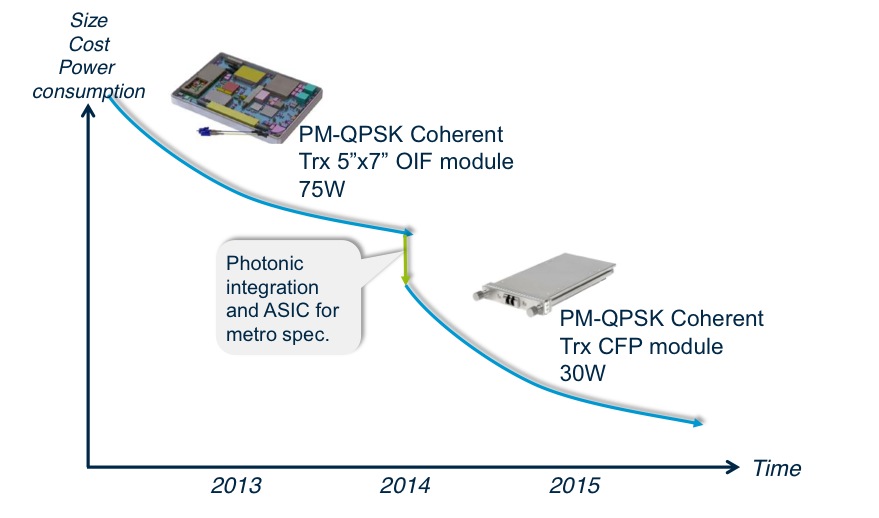
The 100 Gig transponder card consumes 75W, with the coherent CFP accounting for 30W of the total. The card can be used for signal regeneration, hosting two 100 Gig coherent CFPs rather than the more typical arrangement of a client-side and a line-side CFP. The card's power consumption exceeds 75W, however, when two coherent CFPs are used.
The 100 Gig transponder and Ethernet muxponder will be available in the second quarter of 2014, says Transmode, while the 100 Gig muxponder card will follow early in the third quarter of the year.

MultiPhy eyeing 400 Gig after completing funding round
MultiPhy is developing a next-generation chip design to support 100 and 400 Gigabit direct-detection optical transmission. The start-up raised a new round of funding in 2013 but has neither disclosed the amount raised nor the backers except to say it includes venture capitalists and a 'strategic investor'.
The start-up is already selling its 100 Gig multiplexer and receiver chips to system vendors and module makers. The devices are being used for up to 80km point-to-point links and dense WDM metro/ regional networks spanning hundreds of kilometers. "In every engagement we have, the solutions are being sold in both data centre and telecom environments," says Avi Shabtai, CEO of MultiPhy.
The industry has settled on coherent technology for long-distance 100 Gig optical transmission but coherent is not necessarily a best fit for certain markets if such factors as power consumption, cost and compatibility with existing 10 Gig links are considered, says Shabtai.
The requirement to connect geographically-dispersed data centres has created a market for 100 Gig direct-detection technology. The types of data centre players include content service providers, financial institution such as banks, and large enterprises that may operate their own networks.
In every engagement we have, the solutions are being sold in both data centre and telecom environments
MultiPhy's two chips are the MP1101Q, a 4x25 Gig multiplexer device, and the MP1100Q four-channel receiver IC that includes a digital signal processor implementing the MLSE algorithm.
The chipset enables 10 Gig opto-electronics to be used to implement the 25 Gig transmitter and receiver channels. This results in a cost advantage compared to other 4x25 Gig designs. A design using the chipset can achieve 100 Gig transmissions over a 200GHz-wide channel or a more spectrally efficient 100GHz one. The latter achieves a transmission capacity of 4 Terabits over a fibre.
ADVA Optical Networking is one system vendor offering 100 Gig direct-detection technology while Finisar and Oplink Communications are making 100 Gigabit direct-detection optical modules. Oplink announced that it is using MultiPhy's chipset in 2013.
Overall, at least four system vendors are in advanced stages of developing 100 Gig direct-detection, and not all will necessarily announce their designs, says Shabtai. Whereas all the main optical transmission vendors have 100 Gig coherent technology, those backing 100 Gig direct detection may remain silent so as not to tip off their competitors, he says.
We assume we can do more using those [25 Gig] optical components with our technology
Meanwhile, the company is using the latest round of funding to develop its next-generation design. MultiPhy is focussed on high-speed direct-detection despite having coherent technology in-house. "Coherent is on our roadmap but direct detection is a very good opportunity over the next two years," says Shabtai. "You will see us come with solutions that also support 400 Gig."
A 400 Gigabit direct-detection design using its next generation chipset will likely come to market only in 2016 at the earliest by which time 25 Gig components will be more mature and cheaper. Using existing 25 Gig technology, a 400 Gig design requires 16, 25 Gig channels. However, the company will likely extend the performance of 25 Gig components to achieve even faster channel speeds, just like it does now with 10 Gig components to achieve 25 Gig speeds. The result will be a 400 Gig design with fewer than 16 channels. "We assume we can do more using those [25 Gig] optical components with our technology," says Shabtai.
Hybrid integration specialist Kaiam acquires Gemfire
Kaiam Corp. has secured US $16M in C-round funding and completed the acquisition of Gemfire.

"We have a micro-machine technology that allows us to use standard pick-and-place electronic assembly tools, and with our micro-machine, we achieve sub-micron alignment tolerances suitable for single-mode applications"
Byron Trop, Kaiam
With the acquisition, Kaiam gains planar lightwave circuit (PLC) technology and Gemfire's 8-inch wafer fab in Scotland. This is important for the start-up given there are few remaining independent suppliers of PLC technology.
Working with Oplink Communications, Kaiam has also demonstrated recently a 100 Gigabit 10x10 MSA 40km CFP module.
Hybrid integration technology
Kaiam has developed hybrid integration technology that achieves sub-micron alignment yet only requires standard electronic assembly tools.
"With single-mode optics, it is very, very difficult to couple light between components," says Byron Trop, vice president of marketing and sales at Kaiam. "Most of the cost in our industry is associated with aligning components, testing them and making sure everything works."
The company has developed a micro-machine-operated lens that is used to couple optical components. The position of the lens is adjustable such that standard 'pick-and-place' manufacturing equipment with a placement accuracy of 20 microns can be used. "If you set everything [optical components] up in a transceiver with a 20-micron accuracy, nothing would work," says Trop.
Components are added to a silicon breadboard and the micro-machine enables the lens to be moved in three dimensions to achieve sub-micron alignment. "We have the ability to use coarse tools to manipulate the machine, and at the far end of that machine we have a lens that is positioned to sub-micron levels," says Trop. Photo-diodes on a PLC provide the feedback during the active alignment.
Another advantage of the technique is that any movement when soldering the micro-machine in position has little impact on the lens alignment. "Any movement that happens following soldering is dampened over the distance to the lens," says Trop. "Therefore, movement during the soldering process has negligible impact on the lens position."
Kaiam buys its lasers and photo-detector components, while a fab make its micro-machine. Hybrid integration is used to combine the components for its transmitter optical sub-assembly (TOSA) and receiver optical sub-assembly (ROSA) designs, and these are made by contract manufacturers. Kaiam has a strategic partnership with contract manufacturer, Sanmina-SCI.
The company believes that by simplifying alignment, module and systems companies have greater freedom in the channel count designs they can adopt. "Hybrid integration, this micro-alignment of optical components, is no longer a big deal," says Trop. "You can start thinking differently."
"We will also do more custom optical modules where somebody is trying to solve a particular problem; maybe they want 16 or 20 lanes of traffic"
For 100 Gigabit modules, companies have adopted 10x10 Gigabit-per-second (Gbps) and 4x28Gbps designs. The QSFP28 module, for example, has enabled vendors to revert back to four channels because of the difficulties in assembly.
"Our message is not more lanes is better," says Trop. "Rather, what is the application and don't consider yourself limited because the alignment of sub-components is a challenge."
With the Gemfire acquisition, Kaiam has its own PLC technology for multiplexing and de-multiplexing multiple 10Gbps and, in future, 25Gbps lanes. "Our belief is that PLC is the best way to go and allows you to expand into larger lane counts," says Trop.
Gemfire also owned intellectual property in the areas of polymer waveguides and semiconductor optical amplifiers.
Products and roadmap
Kaiam sells 40Gbps QSFP TOSAs and ROSAs for 2km, 10km and 40km reaches. The company is now selling its 40km 10x10 MSA TOSA and ROSA demonstrated at the recent OFC/NFOEC show. Trop says that the 40km 10x10 CFP MSA module is of great interest to Internet exchange operators that want low cost, point-to-point links.
"Low cost, highly efficient optical interconnect is going to be important and it is not all at 40km reaches," says Trop. "Much of it is much shorter distances and we believe we have a technology that will enable that."
The company is looking to apply its technology to next-generation optical modules such as the CFP2, CFP4 and QSFP28. "We will also do more custom optical modules where somebody is trying to solve a particular problem; maybe they want 16 or 20 lanes of traffic," says Trop.
